There are a number of Coast Guard related groups on Facebook. Bob Connelly who is active on the Coast Guard Aviation page https://www.facebook.com/groups/cgaviation/ and the Coast Guard retired page https://www.facebook.com/groups/97743292523/ sent me this listing of those including “USCGC”. https://www.facebook.com/search/results.php?q=uscgc&type=groups&init=quick&tas=0.6764054787345231
Category Archives: Uncategorized
Deployable Operations Group to be Disestablished.
Navy Times is reporting that the Deployable Operations Group is to be disestablished and control returned to the Area Commanders.
Presumably this reflects both the reduced opportunity for TACLETs to deploy with Navy ships and a desire to make better use of these units in support of area units.
Strategy for the Arctic Region
The Coast Guard has issued its “Arctic Strategy.” It is a 48 page pdf. I have added it to the reference section, and you can see it here:
Coast Guard Arctic Strategy, 2013
“The U.S. Coast Guard Arctic Strategy documents our intent to pursue three key objectives: Improving Awareness, Modernizing Governance, and Broadening Partnerships.”
This aligns with the National Strategy for the Arctic Region which specifically calls for
• Enhance Arctic Domain Awareness – We seek to improve our awareness of activities, conditions, and trends in the Arctic region that may affect our safety, security, environmental, or commercial interests. The United States will endeavor to appropriately enhance sea, air, and space capabilities as Arctic conditions change, and to promote maritime-related information sharing with international, public, and private sector partners, to support implementation of activities such as the search-and-rescue agreement signed by Arctic states.
• Preserve Arctic Region Freedom of the Seas – The United States has a national interest in preserving all of the rights, freedoms, and uses of the sea and airspace recognized under international law. We will enable prosperity and safe transit by developing and maintaining sea, under-sea, and air assets and necessary infrastructure. In addition, the United States will support the enhancement of national defense, law enforcement, navigation safety, marine environment response, and search-and-rescue capabilities. Existing international law provides a comprehensive set of rules governing the rights, freedoms, and uses of the world’s oceans and airspace, including the Arctic. The law recognizes these rights, freedoms, and uses for commercial and military vessels and aircraft. Within this framework, we shall further develop Arctic waterways management regimes, including traffic separation schemes, vessel tracking, and ship routing, in collaboration with partners. We will also encourage other nations to adhere to internationally accepted principles. This cooperation will facilitate strategic partnerships that promote innovative, low-cost solutions that enhance the Arctic marine transportation system and the safe, secure, efficient and free flow of trade.
The national strategy also repeatedly calls for various forms of partnerships and like the Coast Guard’s own strategy calls for the US to accede to the UNCLOS treaty.
If you have been paying attention to the Arctic Shield Exercises I don’t think you will find much unexpected in the stratgey. (More on Arctic Shield here.)
The Coast Guard does not expect to make major investments in infrastructure in the Arctic for at least ten years, and will undertake to serve the region with mobile assets–ships and seasonal assignment of aircraft.
The use of mobile assets and seasonal presence, supplemented by existing shore-based infrastructure, will be the preferred strategy for Coast Guard operations during periods of peak activity.
The strategy is light on specifics, we are reminded it is a strategy, not an implementation plan, but there are three specific items called for that will require additional funding:
- A new heavy icebreaker
- An Arctic Fusion Center to advance Maritime Domain Awareness, and
- An Arctic Center of Expertise at the Academy
The Projected environment:
This strategy assumes that recent decreases in Arctic ice mass will continue over the next 10 years. Even so, while previously unreachable areas will be increasingly open to vessel traffic, the remaining permanent ice cover, the continued winter ice cover, and hazards from ice floes and smaller ice remnants will continue to pose challenges to regional civilian, industrial, and military operations. Through efforts to discover and exploit offshore oil and gas reserves, the energy industry will deploy oil rigs, offshore supply vessels, barges, and tankers in Arctic waters. Cruise ship traffic will increase in areas that are unique and of commercial value to the recreational tourism industry, often in areas that are remote and challenging to render aid. The three strategic priorities of this Arctic strategy draw upon the Coast Guard’s strengths as a military, multi-mission, maritime service, leveraging authorities and partnerships, flexible operational capabilities, and relevant expertise within the international community to achieve an integrated, coherent approach to maritime operations and regional governance.
Improving Awareness:
The U.S. government requires effective understanding of maritime activity in the Arctic region in order to enforce maritime sovereignty and address threats as early as possible. Accurate awareness requires greater collection and sharing of maritime data, as well as increased cooperation in analyzing and disseminating near-real-time information. The Coast Guard will work with DHS, Department of Defense, other interagency partners, state, tribal, and local governments, the private sector, advocacy groups, academia, and the international community to improve maritime intelligence and information-sharing. Improvements require proper infrastructure for sensing, collecting, fusing, analyzing, and disseminating information. Improved awareness is critical for ensuring preparedness to respond to contingencies and is consistent with strategic priorities delineated in the National Strategy for Maritime Security and the National Plan to Achieve Maritime Domain Awareness. As long as there is maritime activity in the Arctic, the Coast Guard must maintain appropriate presence to monitor, regulate, and respond to threats and hazards. Effective presence on shore and at sea enables the awareness necessary to focus resources on highest risks and threats.
Modernizing Governance:
The safety, security, and economic well-being of the United States rely upon sound governance of the world’s oceans. To advance U.S. interests in the region, the Coast Guard must work with other Federal, state, tribal, and local government entities, international counterparts, relevant industries, and other stakeholders to promote maritime safety, security, and environmental responsibility in the Arctic region. Notable efforts include active participation in international organizations, such as the Arctic Council and the International Maritime Organization, and continued support of accession to the 1982 Convention on the Law of the Sea.
Broadening Partnerships:
Limited operational resources and expanding maritime risks underline the need for increasing collaboration in the region. The Coast Guard must foster domestic and international partnerships to specifically increase coordination, enhance efficiency, and reduce risk. Mutually beneficial relationships with and among our international, interagency, state, tribal, local, and other partners are essential for mission success. The Coast Guard must also collaborate with academia and non-governmental partners to incentivize Arctic research and expand the base of Arctic-related literature.
The Video: The Commandant introduced the new strategy at a meeting of the Center for Strategic and International Studies. You can watch the Video here.
If you have read the strategy there is nothing new in the prepared remarks but you might still want to watch the Q & A beginning at approx 25:30.
Commentary:
g Captain is reporting traffic on Russia’s Arctic Northern Sea route may experience a 30 fold increase in the next eight years. Much of that will pass close to US territory during the transit between the Arctic and Pacific Oceans. While the Coast Guard may not be ready to invest in new infrastructure it is not too early to start evaluating where it should be.
—Growing the Infrastructure:
The Coast Guard’s go slow approach (at least partly dictated by funding) is in contrast to the aggressive development by its Russian counterpart. Perhaps ironically the former socialist republic see this as a profit making opportunity, charging fees for transit of the route.
As the Commandant noted in the video the US has had reason to develop Arctic infrastructure before. Much work was done in support of the Distant Early Warning Network (DEW Line) when the US was concerned about Soviet bombers attacking the US via polar routes. Perhaps some of this infrastructure can be reactivated.
The Coast Guard might consider working with Navy SeaBees in the Arctic Shield exercises, to complete small dual use infrastructure projects that might serve both the Coast Guard and local economic development. Even a little work each year could result in substantial cumulative improvement considering the extremely limited facilities currently available. It could serve both as training for the Seabees in operating in the Arctic, and resource development for the Coast Guard at minimal cost.
I also wonder about the current state of the former Naval Air Station Adak.
—A Footnote:
Members of Congress from Alaska are interested in creation of a deepwater port in the Arctic.
The Alaska Native News in reporting on the prospects for the Coast Guard Reauthorization Act noted that it included a provision, “Requiring the Coast Guard to consult with other federal, state and local entities to determine what improvements are necessary to make the ice-free harbor at St. George, Alaska a fully functional harbor throughout the year.”
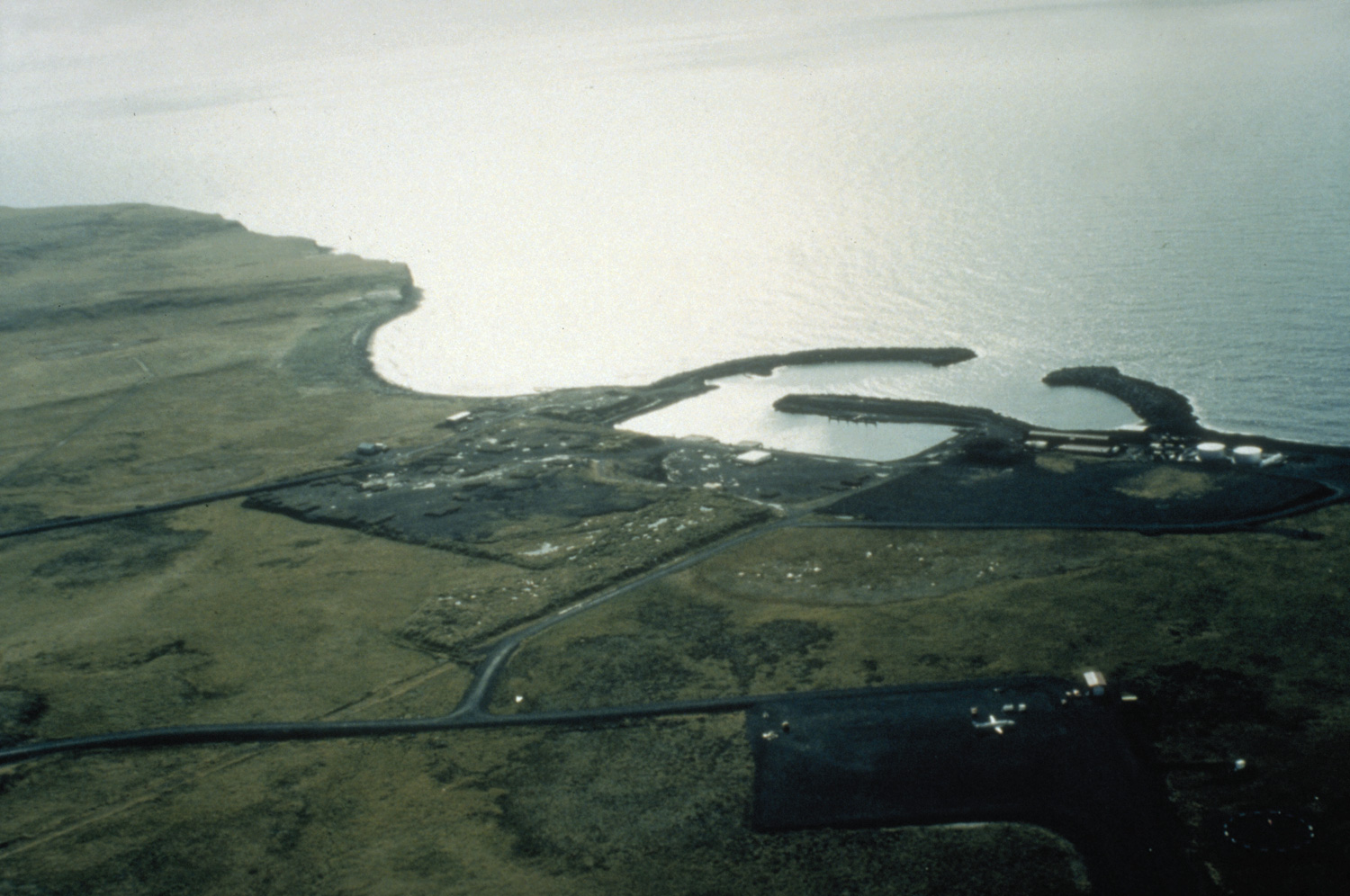
Photo: St. George Island Harbor, part of airport visible in the foreground. U.S. Army Corps of Engineers Digital Visual Library
The island is somewhat centrally located in the Bering sea, on the continental shelf, about 376 miles NE of Adak, about 194 miles NNW of Dutch, but still almost 550 miles south of the Bering Strait. It has a population of about 160 and is roughly a triangle with its long side running East West. The longest distance across the island running almost exactly East/West is less than 13 statute miles.The small harbor and 4,980 foot runway are on the South West side less than three statute miles from the village of St. George located on approximately at the center of the North side of the triangle.
Nearby St. Paul appears to have better facilities, and there was at one time a Coast Guard LORAN-C transmitter station on St. Paul.
You can get a pretty good feel for what the island is like here and here. Still If we were looking for a place to put a Fast Response Cutter in the Bering Sea, it might work.
Memorial Day, 2013

Photo: Photo No. 3743 (06-17-44 (02)
Photographer unknown.
USCG-20 (83401) and USCG-21 (83402) off the coast of Normandy.
Great little story about one man’s Coast Guard experience in WWII as CO of an 83 foot patrol boat assigned rescue duty for the Normandy invasion.
“Preserving D-Day Memories with a Tattered Flag,” LA Times
Unfortunately there are many stories of Naval battles during WWII when it seems we forgot to look for survivors after the battle. Fortunately President Roosevelt insisted that Coast Guard boats be sent to accompany the invasion fleet for the Normandy invasion. There were 60 of the wooden hulled gasoline powered boats sent England for the invasion.
Despite their apparent vulnerability, I have never heard of one being lost to enemy action. There were 15 Coast Guardsmen killed at Normandy on June 6, 1944. None were aboard the 83 footers. 11 were on the three Coast Guard manned LCI(L)s, Landing Craft Infantry (Large), that were lost that day: Coast Guardsmen killed in action on D-Day.

Photo: No date listed; probably June 1944.
No photo number.
Photographer unknown.
Apparently, with the target rich environment the Germans were presented, they concentrated on the vessels bringing troops ashore and the shore bombardment vessels that were shooting at them.
When we consider how our cutters might be used in future conflicts we might keep this experience in mind.
And lastly a bit of showmanship:
The Coast Guard and the Sinking of the Battleship Bismark
Seventy two years ago today, 24 May 1941, the crew of the Cutter Modoc on Greenland Patrol got a nasty shock. The tale is told by coasties who there on the Alaska/Bering Sea Patrol web site.
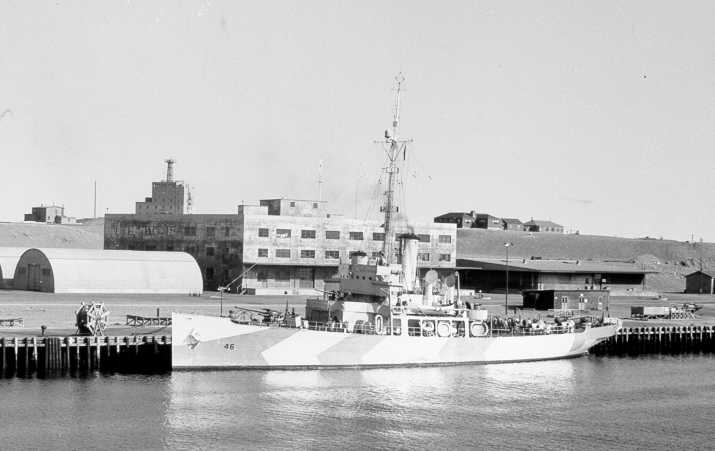
Photo: USCGC Modoc (WPB-46), USCG photo
There isn’t a direct link, so hopefully they will forgive me for quoting their story in its entirety.
“VE VAS DERE, CHARLIE!”, OR
SAGA OF THE CGC MODOC’SENCOUNTER WITH THE GERMAN BATTLESHIP BISMARCK
by VADM T. R Sargent (Ret), ’38, and CAPT B M. Chiswell (Ret)
There have been few references to the presence of a United States Coast Guard Cutter in the immediate vicinity of the German Battleship BISMARCK during that famous chase by the British Fleet in 1941. Most historians pass the incident as inconsequential since the United States was not at war at that time. A group of us, who were present on that occasion, however have a somewhat different view…
The CGC MODOC, out of Wilmington, North Carolina, had been assigned to the Greenland Patrol as COMGREPAT long before all the talent arrived some years later.
Shortly before this incident, the Danish government had turned Greenland over to the U.S. as a Protectorate. The basic mission involved the security of the mine at Ivigtut on the southwest coast.
Cutters NORTHLAND and GENERAL GREENE were also assigned, doing double duty as Greenland Patrol and International Ice Patrol. After departing from St. Johns, Newfoundland, about May 20, 1941, MODOC was ordered to proceed and search for survivors of a British convoy, which had lost many ships to the Nazi wolfpack in the Battle of the Atlantic.
LCDR Harold Belford was Commanding Officer; LCDR Robert H. Furey, XO; LT Emmet T. Calahan, Navigator; and LTJG George R. Boyce, LTJG Victor E. Bakanas, LTJG R. E Bacchus, ENS J. A. Cornish, ENS H. E. Sanders and ENS Benjamin M. Chiswell constituted the Deck Watch Officers.
The “Make Her Go” group consisted of LCDR Walter Anderson, Engineering Officer with LTJG Robert Wilcox and ENS Thomas R. Sargent as assistants. LT William Stimpson, USPHS, was the ship’s doctor.
As far as is known, one is still working, some are enjoying retirement, and some are no longer with us.
Whither we were and whither we were going only Spike Calahan knew — at least convinced us he knew-but at least the sun rose broad on the starboard bow so our course was generally northeasterly. The search proved fruitless as we were continually buffeted by heavy North Atlantic seas and snow squalls reducing visibility to zero and life expectancy on MODOC’s forecastle head to about the same.
Sunday, May 24th, 1941, dawned as a fairly good day considering that our position was slightly south but well east of Cape Farewell, Greenland. Visibility rose to about six miles and the seas, for a change, were relatively calm.
Observing Sunday routine, MODOC piped a matinee movie on the mess deck at about 1400. All hands not on watch settled down to at least the twentieth showing of Lana Turner, Betty Grable, et al. The late Bub Boyce and Dick Bacchus had the deck and Tommy Sargent was on watch in the engine room.
Toward the end of the watch a huge gray shape appeared in the evening dusk on the starboard horizon. In short order, it was properly classified as a battle wagon — of unknown nationality and intentions. Even Ben Chiswell, the Communications Officer, had no knowledge of BISMARCK’s escape from Norway and subsequent pursuit by the British fleet.
Our enterprising quartermaster of the watch (Art Gibbs), a QM1 reduced from QMC for false economy reasons, leapt to the flying bridge. cranked up the powerful carbon-arc signal light and commenced flashing “AAs”-the international signal meaning “What ship?” or “Identify yourself.” BISMARCK did not deign to reply. She just crossed our bow and passed down our port side two miles off.
We even tried to contact her by radio to determine if she had spotted any debris but upon reflection realized she was too smart to break radio silence and reveal her position.
When the huge ship had dropped astern about three or four miles, Dick Bacchus-fresh out of Norfolk, Virginia, where a Naval Air Station had been close by, was heard to exclaim “Hey, there’s an airplane”; then, as an afterthought, “Hey, that’s a land plane”; then, as a double take as he remembered our position relative to the nearest land, “My God, that is a land plane!”
That triggered the sounding of the General Alarm. Midst much grumbling about missing the rest of the movie, to general quarters we went to man the two five inch guns mounted fore and aft and the three inch fifty which was the quote anti-aircraft battery unquote.
We hastened to set our watertight integrity; (we closed both screen doors), secured U.S. flag horizontally and vertically to establish our neutrality, and settled down to watch developments. It didn’t take long. Suddenly seven British swordfisher torpedo planes were using us as a point of departure flying low over our masthead, wagling their wing tips, and heading for that distant gray shadow.
Well, a Fourth of July display like nothing ever before seen soon embellished evening twilight! Those of us not accustomed to warlike intentions were enjoying the show when a couple of brilliant flashes and tremendous explosions brought us back to reality.
As if to solidify the perception, a lookout suddenly cried “Sail ho — broad on the starboard bow, “then “Holly Jesu Cristo, lots of sails ho!” The entire Home Front appeared about equidistant from us as we were from the BISMARCK. We quickly learned we were being caught in the middle is all about.
Earlier, Tommy Sargent had anticipated that maneuvering would probably be demanded so the fireroom had been alerted for steam requirements and they were ready. (You can see why he made three stars.) In view of the fact that at time we were not mad at anybody except whoever it was that had neglected to tell us about a strange battleship-the Old Man decided he would not stand and fight.
He gave orders to make flank speed and no black smoke. For a vessel launched in 1921 requiring forced draft, that had to be a real accomplishment; and so it was. The engineers moved, the vessel moved and soon we were getting the hell out of there.
Tommy Sargent remembers her speed at 14.7 knots, even though the speed curve showed 14.5 kts maximum when Ben Chiswell’s Old Man had been her skipper in 1921. Anyway she squatted her stern down in the water and slithered out of the line of fire.
Soon the fire fight was over. Visibility dropped and BISMARCK limped away in the darkness. Though severely wounded she was to later lead the chase further and force more fighting before finally being done in.
Meanwhile, MODOC-headed in the opposite direction and moving faster than she ever had in her lifetime-soon raised Cape Farewell, rendezvoused with the CGC NORTHLAND, and again took up the search for survivors.
No doubt, MODOC played a vital role in the discovery of the BISMARCK as the German admiralty revealed in a news release shortly after the encounter. Due to the serious damage suffered in the engagement which we watched, BISMARCK was apprehended by the British fleet several days later. Her destruction was a severe blow to the German war effort. Certainly, history has not given full due to the saga of the USCGC MODOC.
PostscriptTwo days later (26 May 1941) the CGC GENERAL GREENE, having joined in the search for convoy survivors, also became a witness to this dramatic sea battle. This is reported in Willoughby’s “U.S. Coast Guard In World War II” as follows: On the same day, GENERAL GREENE’s officers saw four large battleships speeding northward; they heard heavy gunfire and observed thick smoke. The British ships had caught up with BISMARCK. Hit many times and barely holding her own, the latter had received the following message from Berlin: “All our thoughts are with our victorious comrades. Hitler.” From BISMARCK went the reply: “Ship unmaneuverable; we shall fight to the last shell. Lutjens.” It was at this time that the British battleship HOOD blew up with all hands as a result of a salvo from the invisible BISMARCK which touched off her magazines. On the 27th, BISMARCK was southwest of Ireland attempting desperately to make a French port. Her guns were silenced, her mast blown away, and smoke and flames poured skyward. She finally turned over and sank, with only 110 survivors out of a crew of 2,400.
We should probably thank the professionalism of the two German crews for not engaging the little cutter. For a better balanced but less personal view of the events you may want to check out the story here.
Damen’s New Patrol Boat
MarineLog is reporting that, “Damen Shipyards and Italian partner yard Cantiere Navale Vittoria S.p.a. are to build two Stan Patrol 5509 patrol boats for Italy’s Guardia di Finanza, a law enforcement agency that deals with financial crime, smuggling, illegal Immigration and narco traffic and that has a fleet of about 250 vessels.”
Damen also provided the design for the Coast Guard’s 87 foot WPBs and its 154 foot Webber Class Fast Response Cutters.
The two “5509” (55 meters long and 9 meter beam, 190 ft x 30 ft) patrol boats will be the largest built so far in their STAN Patrol Series.
The design features an “Axe” bow intended to minimize vertical acceleration in a seaway. Check the link above for illustrations and more info.
In Celebration of Icebreakers
gCaptain’s Maritime Monday this week is part one of a retrospective of ships operating in ice. Both interesting and amusing.
Maritime Monday for May 20th, 2013: Ice Ice Baby Part 1
Two FBI Agents Die in Maritime FAST Roping from Helicopter Training Exercise
The New York Times is reporting two veteran FBI agents, members of the Hostage Rescue Team, were killed in an exercise while attempting a FAST roping descent from a helicopter to the deck of a merchant ship.
A Collision at Sea Can Ruin Your Entire Day
If you haven’t seen and heard it yet, you may want to check out the Navy Times article about the collision between USS Porter (DDG-78) and a supertanker that occurred shortly before 1:00 AM, May 12. It includes four minutes and nine seconds of audio recorded on the bridge
“Hear the audio: Chaos on bridge before brutal ship collision”
This is one of those opportunities to learn from the mistakes of others, and a good illustration of why the “right hand rule” exists.
New Ballistic Protection Material
As you may remember the Offshore Patrol Cutter has a requirement for ballistic protection over limited areas of the ship. Some of our patrol boats are being equipped with ballistic protection in addition to body armor for boarding parties. This seems like a good idea, but significant ballistic protection used to mean armor. Now it might include something like Kevlar.
Businessinsider reports the development of a new Poly-Urethane ballistic protection material that can also be used for ports and windshields that is even lighter.