The U.S. military today began collecting the remnants of a Chinese high-altitude surveillance balloon shot down by an Air Force fighter over the weekend.
Air Force Gen. Glen D. VanHerck, commander of the North American Aerospace Defense Command and U.S. Northern Command, said the recovery effort began about 10 a.m. Rough seas thwarted safe, comprehensive debris collection yesterday, he said.
On Saturday, an F-22 Raptor fighter from the 1st Fighter Wing at Langley Air Force Base, Virginia, fired one AIM-9X Sidewinder missile at the balloon, which had floated southeastward across the United States.
It fell about six miles off the coast of South Carolina into about 50 feet of water. No one was hurt.
Precautions are being taken during the salvage operation in case explosives or toxic substances are present, VanHerck said.
Due to changing ocean currents, it’s possible that some debris could escape notice and wash ashore. VanHerck said members of the public can be assist by informing local law enforcement personnel if they spot remnants of the balloon; they should not collect it themselves.
The USS Carter Hall, an amphibious landing ship, is collecting debris in the vicinity of the splashdown, he said.
The USNS Pathfinder, a survey ship, is mapping the ocean floor using sonar for the debris search, VanHerck said.
Explosive ordnance members and at least one unmanned underwater vehicle are also participating, he said.
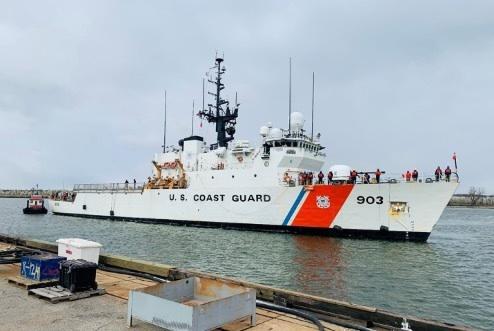
In addition, VanHerck said the Coast Guard cutters Venturous, Richard Snyder and Nathan B. Bruckenthal, along with Coast Guard aviation support, are keeping the area safe for military personnel and the general public.
The FBI and Naval Criminal Investigative Service agents are embedded with salvage operations personnel to assist in counterintelligence work, he added.
VanHerck mentioned that the Federal Aviation Administration was helpful in closing air space when the balloon was being shot down.
It’s truly been an interagency team effort, VanHerck noted.
Gen. Glen VanHerck, Commander, North American Aerospace Defense Command and United States Northern Command, Holds an Off-Camera, On-The-Record Briefing on the High-Altitude Surveillance Balloon Recovery Efforts
FEB. 6, 2023
STAFF: Well, good afternoon, everyone, and thank you for joining us. It’s my pleasure to introduce General Glen VanHerck, commander of North American Aerospace Defense Command and U.S. Northern Command, who will provide an update on the ongoing recovery operations following the takedown of the Chinese high-altitude balloon that violated U.S. airspace.
Today’s discussion is on the record. Please note that the focus of the discussion is on NORAD and NORTHCOM’s current operations as they relate to the recovery effort, so I appreciate you keeping your questions focused there. I’ll turn it over to General VanHerck for some brief opening comments, and then we’ll open it up to your questions.
General VanHerck, over to you, sir.
GENERAL GLEN VANHERCK: Hey, thanks a lot, Pat, and thanks a lot to the entire team here for the opportunity to get together and talk a little bit about the operations that ongoing right now to salvage as much as we can of the Chinese high-altitude balloon primarily for the safety and security of — of folks in the local area, but also to recover and exploit that in any way that we can.
So let me just walk through a few things that are — that are ongoing for you here. We continue to — to focus on safe execution of a recovery while effective recovery so that we can exploit that, and to provide as much information as we can to the media, the public, Congress — everybody that has an interest in what we’re actually finding.
So the USS Carter Hall, a U.S. Navy ship under the command and control of NORTHCOM through my Navy component, now the North, Navy North, led by Admiral Daryl Caudle, they’re on station in the vicinity of the splashdown, and they’ve been collecting debris, category — categorizing the debris since arrival. The U.S. Navy Ship Pathfinder is also on station. The Pathfinder is a ship that conducts survey operations using sonar and other means to map out the debris field. It’s capable of conducting oceanographic, hydrographic, bathymetric surveys of the bottom of the ocean to do that. And they’ll eventually produce us a map — they’re in the process of doing that, and I expect to have much more today — of the full debris field. But we expect the debris field to be of the rough order of magnitude of about 1,500 meters by 1,500 meters, and so, you know, more than 15 football fields by 15 football fields. But we’ll get a further assessment of that today.
Yesterday’s sea states did not allow us to conduct some of the operations that we would have liked to have conducted such as underwater surveillance. And so those forces that provide the explosive ordnance disposal to make sure the scene is safe, they’re out today, this morning, and they went out in what’s called a rigid hull inflatable boat this morning, Eastern time approximately 10:00 o’clock, to proceed to the — the area to utilize unmanned underwater vehicles using side scan sonar to further locate sunken debris. And so we expect them to get on there and to do some additional categorization of potential threats such as explosives that may be on, hazardous materials that could be in batteries, et cetera, so we’re working very hard.
I’d remind you, this is a effort that’s in the open ocean ongoing in approximately 50 feet of water, and so we have to be very cognizant of the sea states, currents, et cetera, so we continue to — to move forward.
Very proud to have a — a Coast Guard support. We have cutters, the U.S. Coast Guard Cutter Venturous, the Cutter Richard Snyder, the Cutter Nathan Rectanual, or — so excuse me — Bruckenthal — I — I got that one right finally. Those are out of the Coast Guard. We have air station support out of Elizabeth City and Savannah, Georgia, as well, and response boats from Georgetown, South Carolina, all providing security and safety to ensure not only the safety of the men and women of the military forces conducting operation, but the general public as well, so we keep it safe in the area.
As a quick note, I would remind you that due to ocean currents, it’s possible that there may be some debris that does float ashore. And so what we would ask of the public, and you can help me with this, is avoid contact. Contact local law enforcement immediately to take care of any of that debris.
The FBI and the Naval Criminal Investigative Service agents are working closely. They’re embedded with us, with authorities to make sure that we collect that debris, and the FBI is embedded with us on our salvage operations as we collect this under counterintelligence authorities.
I don’t know where the debris’ going to go for a final analysis, but I will tell you that certainly the intel community, along with the law enforcement community that works this under counter intelligence, will take a good look at it. So we look forward to moving forward there.
Okay, so I’m happy to talk about the ongoing operations or potentially some of the operations that we conducted on Saturday, and I look forward to your questions.
I’d also like to thank one more thing is — before we go forward. This was truly an inter-agency effort. The FAA was tremendous, and I know you’re all aware that we closed airports in the area, Charleston, Myrtle Beach, as well as some others. They were tremendous.
This was all for the public safety to ensure we could accomplish this operation safely and effectively, and that’s exactly what happened. The Federal Bureau of Investigation was able to reach out to the local law enforcement communities in near real time of making this happen to ensure that folks were aware and that we made as safe and effective as an operation as possible.
And so thanks for your time, and I look forward to your questions.
STAFF: Thank you very much, General VanHerck. We’ll go ahead and start with Associated Press, Tara Copp.
Q: Hi, thank you for doing this. My first question is as the balloon was still transiting across the U.S., what sort of protective measures did you take to make sure that it did not collect any U.S. intelligence such as — were you able to block the balloon from transmitting anything?
And then I have a follow-up. Thanks.
GEN. VANHERCK: Yes, so I’m not going to talk about any ongoing operations that occurred, such as attempts to use non-kinetic effects. Those are things that I need to go to Congress to talk about, I need to talk about with the department before we move forward.
What I will tell you is we took maximum precaution to prevent any intel collection. I was in close coordination with the Commander of the United States Strategic Command, and we provided counterintelligence messages out of our intelligence shop across the entire Department of Defense and the interagency so that we could take maximum protective measures while the balloon transited across the United States.
Again, this is on record previously. We did not assess that it presented a significant collection hazard beyond what already exists in actionable technical means from the Chinese.
And with that said, you always have to balance that with the intel gain opportunity. And so there was a potential opportunity for us to collect intel where we had gaps on prior balloons, and so I would defer to the intel community, but this gave us the opportunity to assess what they were actually doing, what kind of capabilities existed on the balloon, what kind of transmission capabilities existed, and I think you’ll see in the future that the — that time frame was well worth it’s value to collect,over.
Q: Thank you. And on the prior balloons, was NORTHCOM involved in tracking the balloon that was at the early stage of the Biden Administration and also the three that transited during the Trump Administration, and what can you tell us about those that were different?
Thank you.
GEN. VANHERCK: So those balloons, so every day as a NORAD commander it’s my responsible to — responsibility to detect threats to North America. I will tell you that we did not detect those threats. And that’s a domain awareness gap that we have to figure out. But I don’t want to go in further detail.
The intel community, after the fact, I believe has been briefed already, assess those threats to additional means of collection from additional means and made us aware of those balloons that were previously approaching North America or transited North America. I hope that answers your question.
STAFF: All right, thank you, sir. Let’s go to Jeff Schogol Task & Purpose.
Q: Thank you. Can you say the F-22 that shot down the balloon, will it get a balloon decal to signify the victory?
GEN. VANHERCK: Hey, Jeff, I’ll differ to the first fighter wing. I — I will say I’m really incredibly proud of everybody that took place in this. But the F-22 was remarkable. I’d remind everybody that the call sign of the first flight was Frank 01. The secondly flight of F-22s was Luke 01; a flight of two.
Frank, Luke; Medal of Honor winner, World War I for his activities that he conducted against observation balloons. So how fitting is it that Frank 01 took down this balloon in sovereign air space of the United States of America within our territorial waters.
STAFF: Thank you, sir. Let’s go to Natasha Laguerre from Myrtle Beach.
Q: Hello, I see that you guys still have ships out here. Is that should be a concern for people in this area? And you also mentioned that you guys yesterday could not use the sonar panels to collect the debris under the ocean. What was it that caused it to have a stop there compared to today?
GEN. VANHERCK: Yes, so those are under current — underwater currents and sea states, which were — that exceeded the safety parameters for the — the forces that come out of the EOD and the multiple unit two to provide that.
The area we have set up there is about a 10 mile — 10 by 10 mile area to — for safety purposes, from air traffic and a smaller area that we’re providing for security and safety on the surface. But the primary reason was absolutely for the safety of our military and our interagency partners supporting us. The sea states just didn’t allow that.
Q: And I have a follow-up question. Could you give us an estimate of how big the balloon was? We saw that it had solar panels and it could also potentially had a recording device on it.
GEN. VANHERCK: Yes, so the balloon assessment was up to 200 feet tall for the actual balloon. The payload itself, I would categorize that as a jet airliner type of size, maybe a regional jet such as a ERJ or something like that. Probably weighed in access of a couple thousand pounds. So I would — from a safety standpoint, picture yourself with large debris weighing hundreds if not thousands of pounds falling out of the sky. That’s really what we’re kind of talking about.
So glass off of solar panels potentially hazardous material, such as material that is required for batteries to operate in such an environment as this and even the potential for explosives to detonate and destroy the balloon that — that could have been present.
So I think that would give you an idea of the perspective of the balloon and the decision-making process along the way.
STAFF: Thank you, sir.
Q: Thank you.
STAFF: Let’s go to — let’s go to Jennifer Griffin, Fox.
Q: Thanks, General VanHerck. Can I just ask you, on the record again, because there’s been a lot made in recent days still about why this was not shot down after it crossed or neared the Aleutian Islands? Can you just explain what you were watching then, what you were thinking then? What the decision-making process was. And why it — you didn’t have enough time to do so, if that was the case?
GEN. VANHERCK: Thanks, Jennifer. It wasn’t time. It — the domain awareness was there as it approached Alaska. It was my assessment that this balloon did not present a physical military threat to North America, this is under my NORAD hat. And therefore, I could not take immediate action because it was not demonstrating hostile act or hostile intent. From there, certainly, provided information on the status of the whereabouts of the balloon. And moving forward, kept the department and the governor — the government of Canada in the loop as my NORAD, I have a boss in Canada as well. Over.
Q: And just to follow up, is it true you had U-2 spy planes around the balloon as it crossed the continental U.S. and that was another way that you could collect on the balloon?
GEN. VANHERCK: So, I’m not going to get into details of the operation, what planes. What I’d tell you, Jennifer, is that we utilized multiple capabilities to ensure we collected and utilized the opportunity to close intel gaps. I’ll defer to the department, I don’t want to get in front of my discussions with Congress or others about specific details for collection.
I would point out and I think it’s important to talk about is, day to day we do not have the authority to collect intelligence within the United States of America. In this case, specific authorities were granted to collect intelligence against the balloon specifically and we utilized specific capabilities to do that, Jennifer. And I’m sorry I can’t give you further detail.
Q: Thank you.
STAFF: Let’s go to David Martin, CBS.
Q: Two questions. Can you give us the names of some of the sensitive military sites that were in range of the balloon’s censors as it crossed the U.S.? And that debris field you’re describing is radically smaller than the predicted debris field that was 20 miles by 20 miles. What accounts for that? Was there — were your models off? Was there — did you figure out a different way to shoot it down? Was it — was there a warhead in that missile?
GEN. VANHERCK: Okay, thanks, David. I’m not going to get in front of the department on specific locations, flight path. I would just tell you we took every precaution to ensure any sites in the way were covered and that we minimized any collection. So, let’s — let us talk to Congress and provide those specific details.
As far as the actual site, the 20 by 20 was a — that’s a site — and area that we cleared out from the maritime — or the notice to mariners for safety. We wanted to clear that box out. I cleared another box out that was 150 miles by 150 miles for air traffic to ensure that there was no air traffic that was potentially involved, to minimize risks to all personnel and infrastructure.
The analysis — and oh, by the way, we were able to get significant analysis throughout this process, as a cross, that enabled us to make this a much more safe and effective operation. So, in partnership with NASA, who gave us an assessment that would potentially be up to six or seven miles of debris. That’s where — that’s where we decided to make the engagement six miles off the coast so that no debris would go back over the coast.
Now, with that said, David, I think it’s important to point out, there was debris that’s expanded out further, we have collected the majority of that debris that fell in the ocean and other places. Now, what we’re talking about, is really that superstructure below that fell down and limited itself to this 1,500 meter by 1,500-meter box that we’re talking about. Does that clarify?
Q: Yeah. And could you answer the question about whether there was a warhead in the missile?
GEN. VANHERCK: Yeah, absolutely. There was a warhead in the missile. You can see that explosion on TV as it goes through the lower part of the balloon and right there through the superstructure.
STAFF: All right, thank you, Gentlemen.
Let’s go to Alex Horton of Washington Post.
Q: Hey, thanks for doing this. I was curious if you can get a little bit more detail about those other balloons, and I think the four others. You know, you had mentioned that you weren’t aware of them. So how are you aware of them now? Was it through different agencies that are helping you in review since this incident? And can you also tell us something about their location and postures? We’ve heard some states like Florida and Texas, but those are pretty large, where they appeared interested in military bases. Were they interested in military installations like this one? Thank you.
GEN. VANHERCK: I don’t have that detail. I’d have to defer the intel community. They’ll have additional fidelity at this time.
STAFF: Thank you, sir. Let’s go to Phil, Reuters.
Q: Hi, there. Was there ever any thought or planning to try and potentially capture the balloon as opposed to using a — you know, a Sidewinder? And how was that munition chosen? And lastly, you know, at what point did you learn about these other balloons if you weren’t detecting them at the time? Was it all kind of retrospective upon the discovery of this one? Thank you.
GEN. VANHERCK: So, I’m not going to get into the technical details, I will just tell you there were multiple options considered and asked for at multiple levels. The decisions that were made were based on safety first, and then effectiveness and being able to take the balloon down within our sovereign airspace and territorial waters. Again, I’ll go back — I’m going to reserve that till I talk to Congress, till I talked to others who have interest in the specific details.
STAFF: Thank you very much. Let’s go to Jon Harper, Defense News.
Q: Right. Thank you. Can you give us some more details about this UUV you’re using, you know, what specific type of platform it is? You know, what capabilities it has to perform this underwater detection mission? And will the UUV itself be involved in lifting debris up from the undersea domain?
GEN. VANHERCK: Yeah, great question, and I’m not the expert. Maybe we can get that, and Pat, you can provide some additional details through my Navy component, through me I can get you that. What I can tell you is I’m sure — I can assure you that it has photographic capabilities. It’ll have capabilities to in place things such as inflatable devices, and mapping sonar, those types of things. But I can’t give you further details beyond that, because I physically don’t know.
Q: Okay. And are there multiple UUVs involved in this or is it just one single platform that you’re using?
GEN. VANHERCK: Yes, I don’t have that. I’m a — I’m going to make the assumption, but you can’t — I can’t guarantee this info, that they have multiple platforms and they likely can utilize multiple or single ones, depending on the scenario. But I’ll have to give you the facts on that from my Navy component.
Q: Thanks. And just to clarify, did you say that yesterday the C-states wouldn’t allow you to deploy these UUVs, but that activity just started today?
GEN. VANHERCK: That’s exactly what I said. There was safety concerns yesterday that prevented us from employing the EOD teams with their UUVs. And today they’re on scene as of 10 o’clock Eastern this morning.
Q: Great. Thank you.
STAFF: John. Let’s go to Annie, Canadian Television News.
Q: Hi, thank you very much for taking the question. As you mentioned, right after the balloon passed through Alaska it did enter Canadian airspace. I’m wondering if you can tell us who in Canada was notified when it crossed into the airspace. And what type of communication you’ve had with the Canadian officials?
GEN. VANHERCK: — Annie. So, I’m not going to give you specific details on who or speculate in Canada had information or what the Canadian decision-making process is. My boss is General Wayne Eyre, the Chief of Defense staff on the Canadian side. And I can assure you that General Eyre was kept in the loop.
Q: Thank you. And I’m wondering if you have any more information you can provide about how the balloon came into Canadian airspace. Whether you think that this was something done on purpose or it just sort of veered off course as it was going through the U.S.? And was this also the only balloon you’re aware of that entered Canadian airspace or were there others as well?
GEN. VANHERCK: In my domain awareness tells me that there was one balloon. I don’t have any indications that there was a second. There was some speculation about a second one. I launched NORAD fighters, Canadian CF-18s and we were not able to corroborate any additional balloon. I do think their path was purposely built. And they utilized the winds and it’s a maneuverable platform as well, but their utilize their maneuverability to strategically position themselves to utilize the winds to traverse portions of countries that they want to see for collection purposes.
STAFF: Thank you. Let’s go to Oren, CNN.
STAFF: A quick follow-up and another question. In response to Jennifer Griffin, you had said you didn’t as you watched the balloon that it was a posed a military or kinetic threat. Did you, at first, believe this was a weather balloon or did you believe all along it was a surveillance balloon?
And then I was just wondering what you can say about the condition of the — of the wreckage, of the debris? Is it in relatively good condition? Is there an estimate on how many pieces it’s in? And is there an estimate on weight or mass of what there is to collect from this?
GEN. VANHERCK: On your second question, I can’t give you that right now. I don’t know the numbers and until we get down there today, I expect later on today we’ll have additional fidelity on what debris looks like, size of pieces, weights of pieces, those kinds of things. On your first question, with regards to that, you know, my job as the Commander of NORAD’s to identify everything that approaches North America.
In this case, I would tell you, we had a good indication that it was a surveillance balloon from the beginning. I was able to corroborate that with my domain awareness capabilities and provided the — an assessment as such.
STAFF: Thank you.
Q: Thank you.
STAFF: Let’s go to Mike Glenn, Washington Times. —
Q: Thanks, sir. I was wondering, when are you planning to go (inaudible) —
STAFF: Hey, Mike, you’re breaking up really bad.
Q: I am?
STAFF: Can you repeat that? Yeah, you broke up really bad.
Q: Yeah. When are you going to Congress — God damn it.
Q: Yeah, when are you going before Congress to talk?
GEN. VANHERCK: All of that’s being worked, and I’m — I’m going to preserve their decision space, the department’s decision space, the president’s decision space. I — I — when I testified for confirmation, you know, conveyed to them that when asked, I will provide any testimony, and whenever they ask, I’ll be ready with the support of the department.
STAFF: Thank you. I’ve got time for just a couple more questions. Let’s go to Lara Seligman, Politico. Lara, are you there?
Q: Hey, Pat, it’s Lara. Did you call on me?
STAFF: I did. I did. Go ahead, Lara.
Q: Oh, okay, thank you. Sorry about that.
Hi, General, sir. Thanks — thanks so much for doing this. I just wanted to clarify. You said that the balloon potentially carried explosives to detonate and destroy the balloon. Can you just be — can you just clarify those comments? What — what exactly was the nature of those explosives? Were they to destroy itself? And then if it carried explosives, why — what was the assessment based on that it was not a threat?
GEN. VANHERCK: Yeah, so I can’t confirm whether it had explosives or not. Anytime you down something like this, we make an assumption that that potential exists. We did not associate the potential of having explosives with a threat to dropping weapons, those kinds of things, but out of a precaution, abundance of safety for not only our military people and the public, we have to make assumptions such as that. I hope that answers your questions.
Q: So — so just important clarification here: You didn’t have a reason to think there were explosives. You just — this was out of an abundance of caution, and you thought it might potentially have them, so you had to be careful. Is that correct, or did you have reason to believe there were explosives?
GEN. VANHERCK: I would say it was the prior. I did not have any corroboration or confirmation of explosives on this platform. That was an — an assessment that we wanted just to make sure for safety purposes.
STAFF: Thank you. And final question will go to Brian Everstine, Aviation Week.
Q: Hi. Thank you so much for doing this. I was hoping you could take a little bit more about the planning for the shot itself. We had talked about the modeling for the debris, but the planning, modeling for why you went with an AIM-9 versus an AIM-120. And can you talk a little — do you know if the AIM-9 has been fired at this altitude in test before?
GEN. VANHERCK: So on the last question there, I’d have to go talk to the Air Force and their Weapon System Evaluation Program. I don’t know that they’ve tested an AIM-9 at that altitude. I’m not aware of any engagements against a high-altitude bull… — high-altitude balloon such as this. We — we did not have the weapons data, so I — I can’t confirm that.
Can you remind me of your first question?
Q: I just was hoping you’d talk a little bit more about the planning, and why you went with an AIM-9 versus an AIM-120.
GEN. VANHERCK: Yeah, again, it goes back to safety considerations and effectiveness. You know, the AIM-120 has a significantly-larger range, a significantly-larger missile warhead, and the effectiveness of the AIM-9 here from a safety standpoint was going to be more safe, and we assessed from an effectiveness standpoint that it was going to be highly-effective, and that was proven on Saturday.
STAFF: All right, ladies and gentlemen, that is all the time we have available today. General VanHerck, thanks so much for taking a moment to update us. Everyone else, have a great day. Out here.





 Chuck Hill's CG Blog