The BlackKite-I sensor on an Insitu Blackjack unmanned aircraft system.LOGOS TECHNOLOGIES
The Navy League’s on line magazine Seapower brings us a report of a new type of sensor that sounds like it might be very useful in drug interdiction and for maritime domain awareness. It is seen here mounted on an MQ-21 Blackjack (max take off weight 135 pounds/61kg).
In fact, the Eastern Pacific Drug Transit Zone looks like the perfect place to test it against uncooperative targets.
Designated as T-ATS(X) by the Naval Sea Systems Command (NAVSEA), the new class of vessels will be based on existing commercial towing offshore vessel designs . Gulf Island Shipyards rendering.
Below is a press release from Bollinger. Clearly Bollinger is preparing for bigger things. They are competing for the next phase of the Offshore Patrol Cutter program as well as several Navy programs. The Coast Guard is certainly familiar with Bollinger, and vice versa. Bollinger has delivered 44 Fast Response Cutters, 73 Marine Protector class 87 foot patrol boats, and 49 Island class 110 foot patrol boats. But what about the other side of this acquisition, Gulf Island Fabrication, Inc. (“Gulf Island”)? What have they been doing?
Apparently they have been doing some significant work as well. They have been building five USNS Navajo (T-ATS-6) class Rescue and Salvage Vessels for the USN. These are 80 meter (263 foot) in length over all and of 5,110 tons full load displacement, perhaps not as complex as the Offshore Patrol Cutter or even the Webber class, but of greater displacement than the OPCs. In March 2020, the Navy awarded a $129.9M contract to build numbers four and five. These additional facilities certainly increase Bollinger’s credibility as a builder of ships larger than patrol boats.
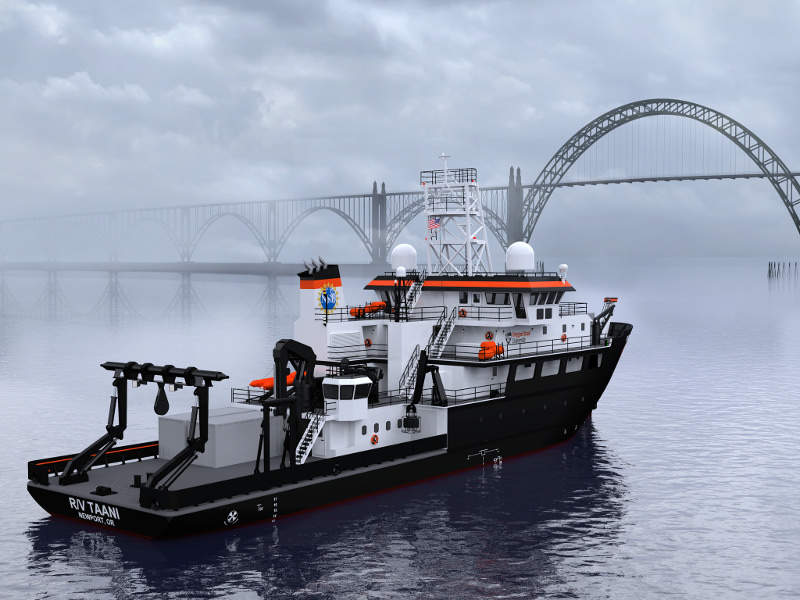
Gulf Island Shipyard has also been building three research vessels. (dimensions are 193’L x 41’B x 19’D with a design draft of 12′-6″, max speed 12.5 knots). Cost of the three ship program is $255.58M.
R/V Taani is a regional-class research vessel (RCRV) being built by Gulf Island Shipyards in Houma, Louisiana, for the National Science Foundation (NSF). Cost of the three ship program, $255.58M
PRESS RELEASE
Bollinger Shipyards Acquires Gulf Island Fabrication’s Shipyard Facilities
Cements Bollinger’s position as the largest American privately-owned and operated shipbuilder in the United States
Transaction includes 437-acre waterfront facility with 198,000 sq. ft. of existing operations, fabrication and warehouse space, and 4 floating drydocks
Acquisition expands new construction and repair capacity and capabilities to better serve key defense and commercial customers
(Lockport, LA) — Bollinger Shipyards (“Bollinger”), a privately-held leading designer and builder of steel military and commercial vessels for the past three quarters of a century, today announced that it has acquired Gulf Island Fabrication, Inc.’s (“Gulf Island”) (NASDAQ: GIFI) Shipyard facilities, expanding Bollinger’s new construction and repair capacity and capabilities to better serve its key defense and commercial customers. Financial terms of the transaction were not disclosed.
This acquisition creates expanded opportunities for Bollinger to better serve and deepen its relationships with key defense and commercial customers with an increased capacity for new projects and footprint, access to a larger workforce skilled in steel construction, improved efficiencies and enhanced economies of scale. Current customers for Bollinger include the U.S. Coast Guard, U.S. Navy, General Dynamics-Electric Boat, and non-defense and commercial customers servicing energy production to dredging. Gulf Island had been building the Towing, Salvage and Rescue Ships (T-ATS) for the U.S. Navy and Regional Class Research Vessels for the National Science Foundation and Oregon State University. These projects conveyed with the transaction.
“The addition of the new Houma shipyard further strengthens our position within the U.S. defense industrial base as a leading shipbuilder and vessel repair company,” said Ben Bordelon, CEO and President of Bollinger Shipyards. “For 75 years, we’ve developed a deep expertise in and proven track record of building reliable, high endurance steel vessels for the Coast Guard, Navy and our commercial customers. As the needs of these customers change and grow, we are constantly looking for ways to invest in and expand our capabilities and innovative solutions so that we can continue to provide them with the highest levels of quality, support and service in our industry.”
Bordelon continued, “For three quarters of a century, Bollinger’s greatest strength has and continues to be our people and their American ingenuity and quality craftsmanship. I am excited to welcome the Gulf Island Shipyard employees into the Bollinger family. Together, we will ensure that the ‘Bollinger Standard’ will be the high bar we measure ourselves against for superior quality and safety as we work to deliver the next generation of American made high-performance vessels for our government and commercial customers.”
The new Bollinger Houma facility encompasses 437 acres on the west bank of the Houma Navigation Canal, of which 283 acres is unimproved land that is available for expansion. The facility includes 18,000 square feet of administrative and operations facilities, 160,000 square feet of covered fabrication facilities and 20,000 square feet of warehouse facilities. It also has 6,750 linear feet of water frontage, including 2,350 feet of steel bulkheads. Located just 30 miles from the Gulf of Mexico, the strategic location provides short and unrestricted access to the newly acquired Houma facility from open waters.
The acquisition also includes a 15,000-short ton drydock, a 4,000-short ton drydock, a 3,000-short ton drydock and a 1,500-short ton drydock.
Bollinger’s acquisition increases the shipyard’s growing new construction and repair portfolio. In December of last year, Congress appropriated funds for Bollinger to build four additional Sentinel Class Fast Response Cutters (FRC) for the U.S. Coast Guard. In addition to construction of the FRC, Bollinger is under contract to construct an Ocean Transport Barge and Floating Dry Dock for General Dynamics Electric Boat Division. In addition, Bollinger is participating in industry studies for five Government programs, including the U.S. Coast Guard’s Offshore Patrol Cutter (OPC) program, the U.S. Navy’s Common Hull Auxiliary Multi-Mission Platform (CHAMP) program, the U.S. Navy’s Auxiliary General Ocean Surveillance (T-AGOS(X)) program, the U.S. Navy’s Large Unmanned Surface Vehicle (LUSV) program and the U.S. Navy’s Light Amphibious Warship (LAW) program.
About Bollinger Shipyards LLC
Bollinger Shipyards LLC (www.bollingershipyards.com) has a 75-year legacy as a leading designer and builder of high performance military patrol boats and salvage vessels, research vessels, ocean-going double hull barges, offshore oil field support vessels, tugboats, rigs, lift boats, inland waterways push boats, barges, and other steel and aluminum products from its new construction shipyards as part of the U. S. industrial base. Bollinger has 11 shipyards, all strategically located throughout Louisiana with direct access to the Gulf of Mexico, Mississippi River and the Intracoastal Waterway. Bollinger is the largest vessel repair company in the Gulf of Mexico region.
NavalNews brings us a news release from MTU about a sale, but I think the real news here is, “The Taiwanese Coast Guard is currently carrying out a modernization program under which a total of 141 ships of various sizes are to be built by 2027.”
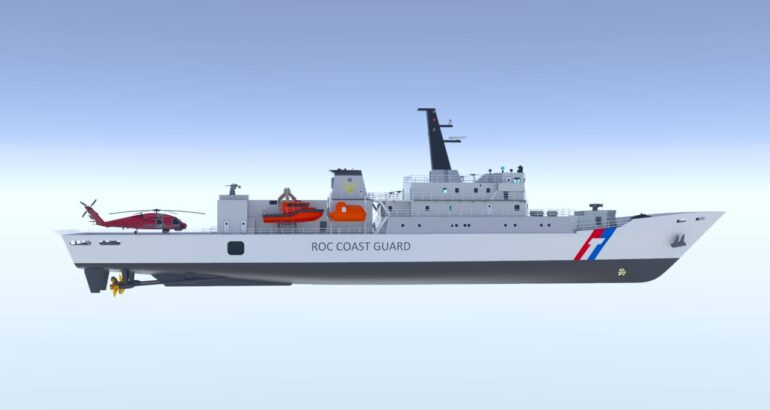
There is not a lot of information here about this class of six new vessels, except that the two engines will provide 7,280 KW each (for a total of 19,525HP, about the same as the Offshore Patrol Cutters) for a speed of 24 knots. The vessel pictured is nominally 1000 tons, but Taiwan, like most Asian nations, tends to understate the size of their vessels by using light displacement and then perhaps rounding down. Full Load displacement may be close to 2,000 tons. It certainly looks at least as large as the 270s. The illustration shows what appears to be an H-60 on the flight deck. Looks like there may be a hangar as well.
BOLLINGER SHIPYARDS DELIVERS 44th FAST RESPONSE CUTTER STRENGTHENING DEFENSE CAPABILITIES IN THE ARABIAN GULF
LOCKPORT, La., — April 22, 2021 – Bollinger Shipyards LLC (“Bollinger”) has delivered the USCGC GLEN HARRIS to the U.S. Coast Guard in Key West, Florida. This is the 167th vessel Bollinger has delivered to the U.S. Coast Guard over a 35-year period and the 44th Fast Response Cutter (“FRC”) delivered under the current program.
The USCGC GLEN HARRIS is the third of six FRCs to be home-ported in Manama, Bahrain, which will replace the aging 110’ Island Class Patrol Boats, built by Bollinger Shipyards 30 years ago, supporting the Patrol Forces Southwest Asia (PATFORSWA), the U.S. Coast Guard’s largest overseas presence outside the United States.
“Bollinger is proud to continue enhancing and supporting the U.S. Coast Guard’s operational presence and ensuring it remains the preferred partner around the world,” said Bollinger President & C.E.O. Ben Bordelon. “It is our top priority to ensure that the brave men and women of the Coast Guard stationed in PATFORSWA have the most state-of-the-art, advanced vessels as they work to build and maintain the necessary regional alliances to ensure maritime security in the region. Building ships for the Coast Guard provides critical assets to bolster our national security and advance America’s interests, both at home and abroad.”
Earlier this year at the commissioning ceremony of the USCGC CHARLES MOULTHROPE, U.S. Coast Guard Commandant Admiral Karl Schultz lauded the “enhanced seakeeping” capabilities of the PATFORSWA-bound FRCs, saying “these ships are truly going to be game changing in their new theater of operations” and “offer increased opportunities for integrated joint operations with our Navy and Marine Corps colleagues” as the Coast Guard seeks to be part of the whole-of-government solution set in the region.
PATFORSWA is composed of six cutters, shoreside support personnel, and the Maritime Engagement Team. The unit’s mission is to train, organize, equip, support and deploy combat-ready Coast Guard Forces in support of U.S. Central Command and national security objectives. PATFORSWA works with Naval Forces Central Command in furthering their goals to conduct persistent maritime operations to forward U.S. interests, deter and counter disruptive countries, defeat violent extremism and strengthen partner nations’ maritime capabilities in order to promote a secure maritime environment.
Earlier this week, Bollinger announced the acquisition of Gulf Island Fabrication, Inc.’s Terrebonne Parish shipyard facilities, expanding the company’s new construction and repair capacity and capabilities to better serve its key defense and commercial customers. The acquisition increases the shipyard’s growing new construction and repair portfolio. Gulf Island had been building the Towing, Salvage and Rescue Ships (T-ATS) for the U.S. Navy and Regional Class Research Vessels for the National Science Foundation and Oregon State University. These projects conveyed with the transaction.
Each FRC is named for an enlisted Coast Guard hero who distinguished themselves in the line of duty. Surfman Glen Harris piloted the first wave of landing craft on Tulagi Island in the Pacific Theater during World War II, and also made a landing against a Japanese force on Guadalcanal Island. Harris was awarded a Silver Star medal by Admiral Chester Nimitz for his heroic combat actions.
About the Fast Response Cutter Platform
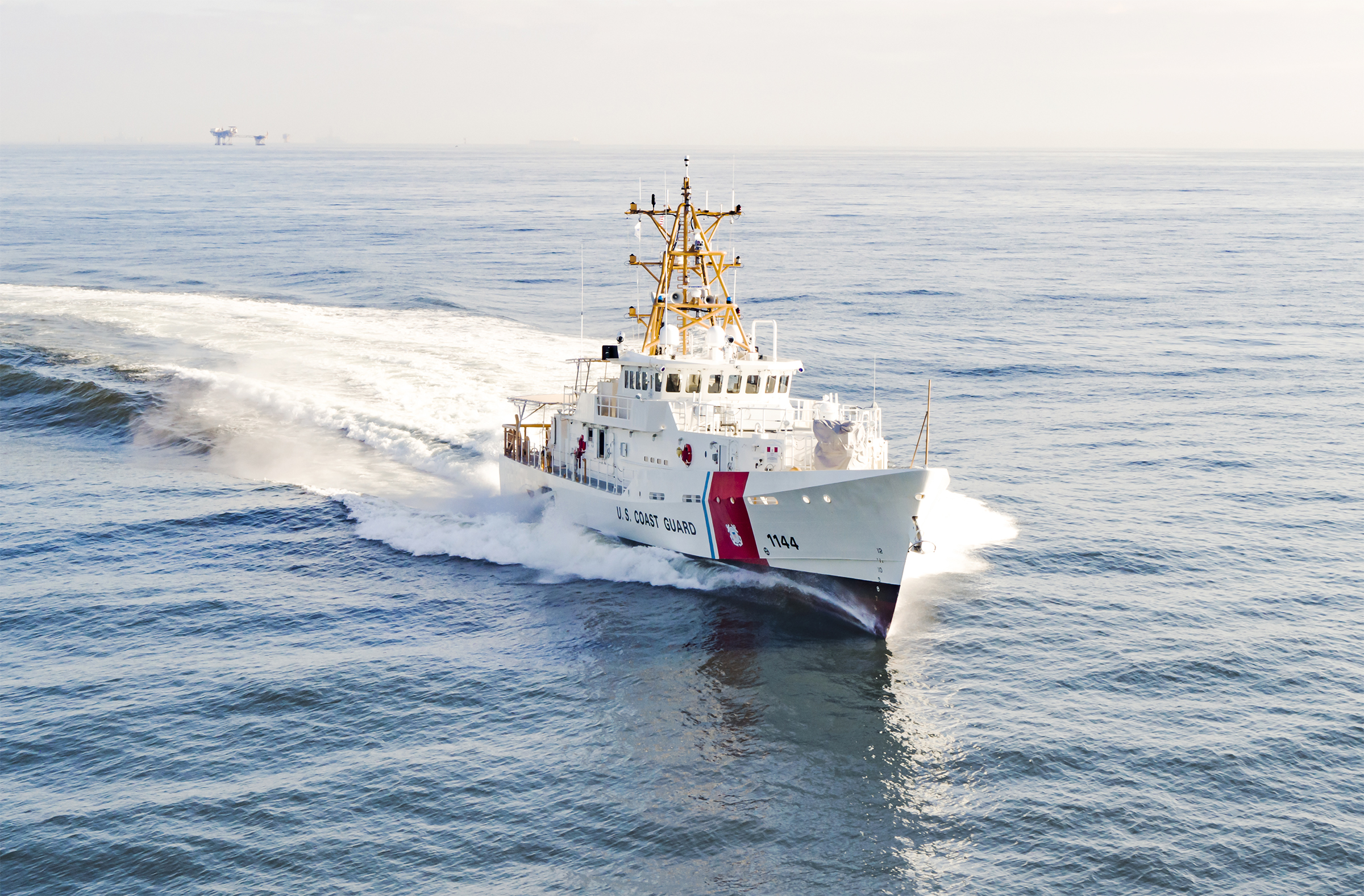
The FRC is an operational “game changer,” according to senior Coast Guard officials. FRCs are consistently being deployed in support of the full range of missions within the United States Coast Guard and other branches of our armed services. This is due to its exceptional performance, expanded operational reach and capabilities, and ability to transform and adapt to the mission. FRCs have conducted operations as far as the Marshall Islands—a 4,400 nautical mile trip from their homeport. Measuring in at 154-feet, FRCs have a flank speed of 28 knots, state of the art C4ISR suite (Command, Control, Communications, Computers, Intelligence, Surveillance, and Reconnaissance), and stern launch and recovery ramp for a 26-foot, over-the-horizon interceptor cutter boat.
About Bollinger Shipyards LLC
Bollinger Shipyards LLC (www.bollingershipyards.com) has a 75-year legacy as a leading designer and builder of high performance military patrol boats and salvage vessels, research vessels, ocean-going double hull barges, offshore oil field support vessels, tugboats, rigs, lift boats, inland waterways push boats, barges, and other steel and aluminum products from its new construction shipyards as part of the U. S. industrial base. Bollinger has 11 shipyards, all strategically located throughout Louisiana with direct access to the Gulf of Mexico, Mississippi River and the Intracoastal Waterway. Bollinger is the largest vessel repair company in the Gulf of Mexico region.
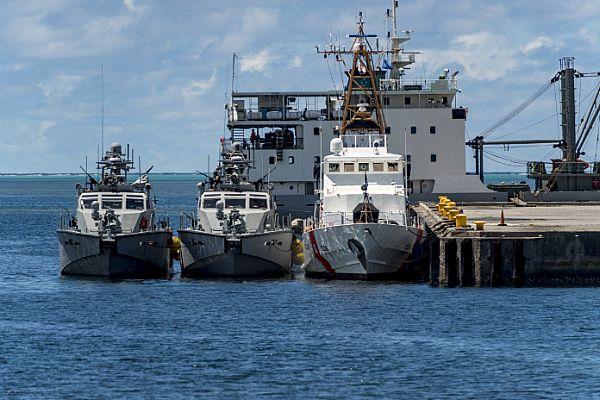
COLONIA, Yap (July 4, 2019) The U.S. Coast Guard Island-class patrol boat USCGC Kiska and Mark VI patrol boats assigned to Coastal Riverine Squadron (CRS) 2, Coastal Riverine Group 1, Detachment Guam, moored in the Micronesia port of Yap. CRG 1, Det. Guam’s visit to Yap, and engagement with the People of Federated States of Micronesia underscores the U.S. Navy’s commitment to partners in the region. The Mark VI patrol boat is an integral part of the expeditionary forces support to 7th Fleet, capability of supporting myriad of missions throughout the Indo-Pacific. (U.S. Navy photo by Mass Communication Specialist 2nd Class Jasen Moreno-Garcia/Released)
Craig Hooper suggests that the Navy could benefit from a cooperative effort with the Coast Guard in this Forbes article.
“Even as the Navy embraces robotic craft, early at-sea experience counts. Independence matters. To help maintain a small population of early career officers with experience in early command at sea, the Navy may be wise to procure a set of “navalized” patrol boats based upon the Fast Response Cutter platform, and use them to advance unmanned technology while working with the Coast Guard on certain tasks.
“Adding marine-ized sensors from the F-35, anti-drone technology, a bare-bones combat system and unmanned command-and-control capabilities onto a proven Fast Response Cutter hull offers the Navy a useful asset that the Navy and early-career naval officers can employ alongside Coast Guard units. By leveraging the Coast Guard’s existing small boat doctrine, operational concepts and logistical support network, the integration and leadership challenges facing the Navy’s struggling small craft commands can be reduced.
“By building capabilities to work together, both Services can advance their priorities while offering early-career officers relevant opportunities to command at a sea.
The US is critically short of trained Merchant Mariners. Below is a story from MyCG about how Coast Guardsmen can help fill the need and find a second career after the Coast Guard.
New courses developed by the Military to Mariner Program and approved by the National Maritime Center ease pathway to earning credentials
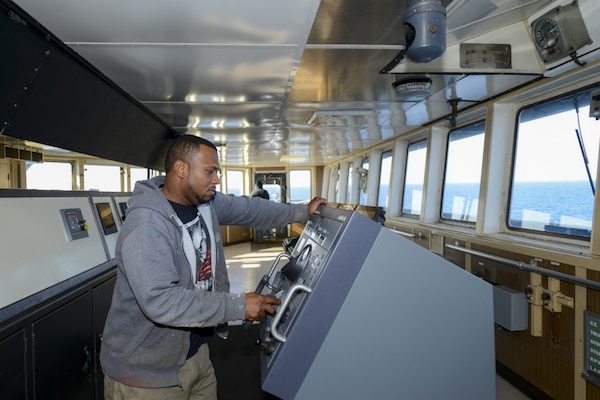
PACIFIC OCEAN (Sept. 30, 2016) A merchant mariner aboard the fast sealift ship SS Capella (T-AKR 293) mans the helm as the ship is underway to conduct a 120-hour turbo activation. The U.S. Transportation Command (TRANSCOM) conducts turbo activation to measure personnel and material readiness of the selected Ready Reserve Force. Capella, more than 40-years-old, is still among the fastest cargo ships in the world and capable of transporting nearly all equipment needed to outfit a full mechanized brigade of the U.S. Army. (U.S. Navy photo by Petty Officer 2nd Class Billy Ho/Released)0PRINT | E-MAILApril 21, 2021 —
The Military to Mariner (M2M) program, along with the National Maritime Center (NMC), is facilitating obtaining merchant mariner credentials through four new courses.
These courses allow students to complete training requirements in lieu of an examination at a regional exam center, thus streamlining obtainment of a national credential.
The M2M program is a subset of the Force Readiness Command’s (FORCECOM) Voluntary Credentialing Program. Through several efforts, the M2M program supports enhanced professionalization of the workforce while in service and improved post-service employment opportunities in the maritime industry upon separation.
The NMC is the merchant mariner credentialing authority for the United States Coast Guard under the auspices of the Department of Homeland Security. The mission of the NMC is to issue credentials to fully-qualified mariners in the most effective and efficient manner possible in order to ensure a safe, secure, and environmentally sound marine transportation system.
The four courses are collections of Coast Guard training and qualifications that meet credentialing requirements. Each maritime course has a pathway to a merchant mariner credential. Together, the M2M program and the NMC are working to approve additional courses.
Credential-seeking members who want to take advantage of these courses will have to complete all course requirements and a final examination prior to receiving a certificate of completion.
The four approved deck courses for service members are:
Lifeboatman Limited
Able Seaman
Operator of Uninspected Passenger Vessels
Master or Mate of vessels less than 200 tons
To design its courses, the M2M program analysis teams cross-walked all relevant training, qualifications, and experience for both deck and engineering to national credentials. The crosswalk data identified gaps between Coast Guard content and professional mariner training and skills. With the Office of Cutter Forces, the M2M program successfully closed deck gaps and mapped pathways to produce deck courses. The M2M program continues to work with the Office of Cutter Forces to close engineering gaps.
Participation in the M2M program courses is strictly voluntary and is only one of many options available to members seeking merchant mariner credentials. Members can elect to take training courses through other vendors. In fact, many units coordinate these training opportunities. It is also important to note, members do not have to take training if seeking a merchant mariner credential under 200 gross tons.
Members can request to take examinations towards a desired credential with their regional exam center.
For members who are seeking to complete the requirements for a merchant mariner credential, the M2M program is here to further their efforts.
The M2M program supports members seeking merchant mariner credentials through counseling on credential options and opportunities, advocating for policies, and analyzing training and qualifications that align with merchant mariner credentials. The M2M program aims to reach members early in their career so they can grow their credential from entry level to higher tonnages by the time they transition out of service.
“This is a great step in streamlining the process for the members,” said Stephen R. Keck, chief of FORCECOM Career Investment. “Upon completion of one of these courses, the M2M program will issue a course completion certificate that members can submit to NMC for credit as part of their merchant mariner credential application. This removes the hurdle for members to take examinations at a regional exam center and to seek outside training courses in order to earn a merchant mariner credential.”
To reach out to the program to ask questions or provide feedback about your application experience, contact M2M program by email.
More information on how to participate and complete requirements can be found at the portal.
For more detailed information on the Navy COOL program, see the comprehensive Blueprint to Mariner document.
Reference:
Coast Guard Merchant Mariner Credential Pathway by Military to Mariner (M2M) Program ALCOAST 153/21
Below is a story from the Acquisitions Directorate (CG-9). The first eight NSCs now all have ScanEagle unmanned air systems (UAS). USCGC Stone will get hers next year. So far they have gotten 3,300 hours during 20 patrols. That averages to 165 hours per patrol. Assuming 60 day patrols, that equates to about 2.75 flight hours per day or about 16 long flights per patrol. Sounds like both great progress and potential for a lot more flight time.
Coast Guard completes UAS installations on two national security cutters
April 16, 2021 —
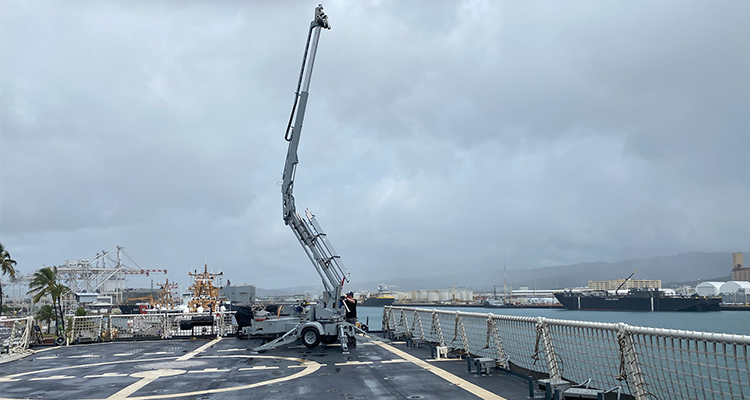
Shoreside testing of launch and recovery equipment for unmanned aircraft system capability was conducted on Coast Guard Cutter Midgett’s flight deck while tied up at Base Honolulu. U.S. Coast Guard photo.
The Coast Guard small unmanned aircraft system for the national security cutter (NSC) program in March completed system operation verification testing for the unmanned aircraft system (UAS) installations on Coast Guard cutters Hamilton and Midgett. This milestone completes the effort to outfit the first eight NSCs with UAS capabilities. Coast Guard Cutter Stone, which was commissioned March 19, 2021, will undergo installation of UAS capability in 2022 and, after testing, will have full UAS-functionality in 2023.
Since the first installation, the UAS capability has completed more than 3,300 flight hours on 20 NSC patrols. UAS platforms have supported 78 interdictions, assisted in the seizure of 72 tons of illicit narcotics worth over $1.7 billion and helped facilitate the capture of 161 narco-terrorists.
The UAS capability on the NSCs has also been used to:
Provide real-time damage assessments of the Bahamas in the aftermath of Hurricane Dorian in September 2019. This event was the first time the Coast Guard used UAS overland for humanitarian relief efforts; the added surveillance capability allowed the service to focus recovery assets on emergent search and rescue and critical infrastructure needs.
Aid a medical evacuation off a container ship in the Bering Sea, saving one life.
Aid in a person-in-the-water search and rescue case off Hawaii in September. Work groups are underway to determine how to use UAS for search and rescue in the future.
Identify more than 35 Chinese vessels illegally fishing off the coast of the Galapagos Islands by sorting through Automatic Identification System data from 150+ vessels actively operating in the area.
The deployment of an UAS-enabled NSC and its comprehensive sensor suite packages can support day and night operations. UAS capability can conduct surveillance, detection, classification and identification of a wide range of targets and is capable of up to 18+ hours of continuous flight time per day.
The Coast Guard is deploying a contractor-owned, contractor-operated solution to provide UAS capability onboard the NSCs; the current contract includes options that could extend service through June 2026. The Coast Guard is also conducting preliminary efforts to explore the potential benefits of deploying UAS across several surface, and potentially land-based, platforms.
WASHINGTON – Vice Adm. Linda L. Fagan has been nominated by the White House to be the next Vice Commandant of the U.S. Coast Guard.
She currently serves as the commander of the Coast Guard Pacific Area, overseeing all Coast Guard missions from the Rocky Mountains to the waters off the East Coast of Africa. Fagan concurrently serves as commander, Defense Force West and provides Coast Guard mission support to the Department of Defense and Combatant Commanders. Fagan is a 1985 graduate of the Coast Guard Academy and is the Coast Guard’s first-ever Gold Ancient Trident, the officer with the longest service record in the Marine Safety field.
“Vice Adm. Fagan is an outstanding leader with 36 years of Coast Guard operations, policy-making, joint service, and interagency experience,” said Adm. Karl L. Schultz, Commandant of the U.S. Coast Guard. “Throughout her distinguished career, she has been a top performer and a trailblazer. As the Coast Guard’s first female four-star admiral, and President Biden’s nominee to serve as the Coast Guard’s 32nd Vice Commandant, Adm. Fagan will be instrumental in moving the Service forward at a critical juncture in our history.”
Pending confirmation, Fagan is expected to relieve current Vice Commandant of the Coast Guard Adm. Charles W. Ray on June 18.
Vice Admiral Fagan assumed command of the Coast Guard Pacific Area in June 2018 where she serves as the operational commander for all U.S. Coast Guard missions from the Rocky Mountains to the waters off the East Coast of Africa. She concurrently serves as Commander, Defense Force West and provides Coast Guard mission support to the Department of Defense and Combatant Commanders.
Vice Admiral Fagan is the Coast Guard’s first-ever Gold Ancient Trident, as the officer with the longest service record in the Marine Safety Field. As such, she advocates for and advises the Prevention workforce.
Vice Admiral Fagan reports to the Pacific Area from her tour as the Deputy Commandant for Operations, Policy, & Capabilities, responsible for establishing operational strategy, policy, capability, and resources to meet national priorities. Prior flag officer assignments were Commander, First Coast Guard District where she oversaw multi-mission operations across New England, and Deputy Director of Operations for Headquarters, United States Northern Command, advising the Commander on mission operations.
Admiral Fagan has served on all seven continents, from the snows of Ross Island, Antarctica to the heart of Africa, from Tokyo to Geneva, and in many ports along the way. She commanded Sector New York, with responsibility for all Coast Guard missions in the greater New York metropolitan area and as far north as Albany. Additional operational assignments include sea duty on board the USCGC Polar Star, and more than 15 years as a Marine Inspector. Vice Admiral Fagan’s staff tours include Executive Assistant to the Commandant and Vice Commandant, and Division Chief of the Foreign and Offshore Compliance Office.
Vice Admiral Fagan has extensive interagency as well as intergovernmental experience. She has worked with both the International Maritime Organization and International Labor Organization on flag state and port state issues, including the development of the International Ship and Port Security Code (ISPS), and the Consolidated Maritime Labor Convention.
Vice Admiral Fagan has a Bachelor’s Degree in Marine Science from the U.S. Coast Guard Academy, a Master’s Degree in Marine Affairs from the University of Washington, and a Master’s Degree in National Resource Strategy from the Industrial College of the Armed Forces. She has earned numerous personal and team awards during her 38 years of Coast Guard service.
Illegal Fentanyl pills are manufactured and often appear very “unclean and unevenly colored with unprofessional lettering appearances” unlike pharmaceutical opioids where the pills’ colors, letters, and numbers are even and clearly defined. Note the uneven blue color and the barely legible markings on these illegal Fentanyl pills. (Photo: Fentanyl Pro)
Drug interdiction has not gotten any easier as the dollar value per cubic volume of product has increased as smugglers moved from Marijuana to Cocaine and now to easily hidden fentanyl. Guest author Peter Ong, gets some answers about the Coast Guard current interdiction efforts. I did not find the answers encouraging–Chuck
—
In April 2021, a United States Coast Guard (USCG) spokesperson in Media Relations at the USCG Headquarters, Washington D.C., responded to my questions via email about America’s “War on Drugs,” particularly against opioids and the ever-popular and dangerous illegal opioid, Fentanyl, that appears to arrive smuggled in commercial shipping containers and aboard International aircraft.
In perspective, the USCG’s “War on Drugs” covers vast oceanic geography using the Coast Guard’s white-painted Cutters and aircraft to patrol and pursue from the Gulf of Mexico to the coasts of Central and South America to the INDO-PACOM region.
I asked the U.S. Coast Guard what actions are being taken to curb the smuggling of Fentanyl from Canada, Mexico, Central and South America, and China, and if the Coast Guard has any statistics on Fentanyl seizures. The Coast Guard Headquarters spokesperson replied, “The Coast Guard is the only federal maritime law enforcement agency with both the authority and capability to enforce national and international law, including drug interdiction, on the high seas. The Coast Guard shares the lead for interdiction and enforcement responsibilities with Customs and Border Protection (CBP) in U.S. territorial waters.
“While the Coast Guard has conducted little to no maritime enforcement activity involving synthetic opioids (to include Fentanyl), we continue to leverage international and interagency partnerships to maintain a forward-leaning interdiction posture to counter all illicit maritime drug trafficking.
“The Coast Guard removed over 2.2 million pounds of cocaine and apprehended nearly 3,000 suspected smugglers for U.S. and foreign prosecution over the last five years. The massive profits from cocaine trafficking allow transnational criminal organizations (TCOs) to diversify and fund other nefarious activities, including manufacture and trafficking of illicit opioids, synthetics, and methamphetamines.
“Additionally, Coast Guard, working with the U.S. State Department, has been supporting the Mexican Navy’s (SEMAR) maritime authority skill-development process. These efforts will assist SEMAR in their mission to monitor and inspect all cargo, increase the security/safety, and reduce illegal trafficking through Mexican ports.
“The Coast Guard has one case on record involving Fentanyl. In August 2020, Coast Guard Sector San Diego assisted a Customs and Border Protection boat in seizing 9.8 kilograms (21 pounds) of Fentanyl from a smuggling vessel in the waters off southern California.”
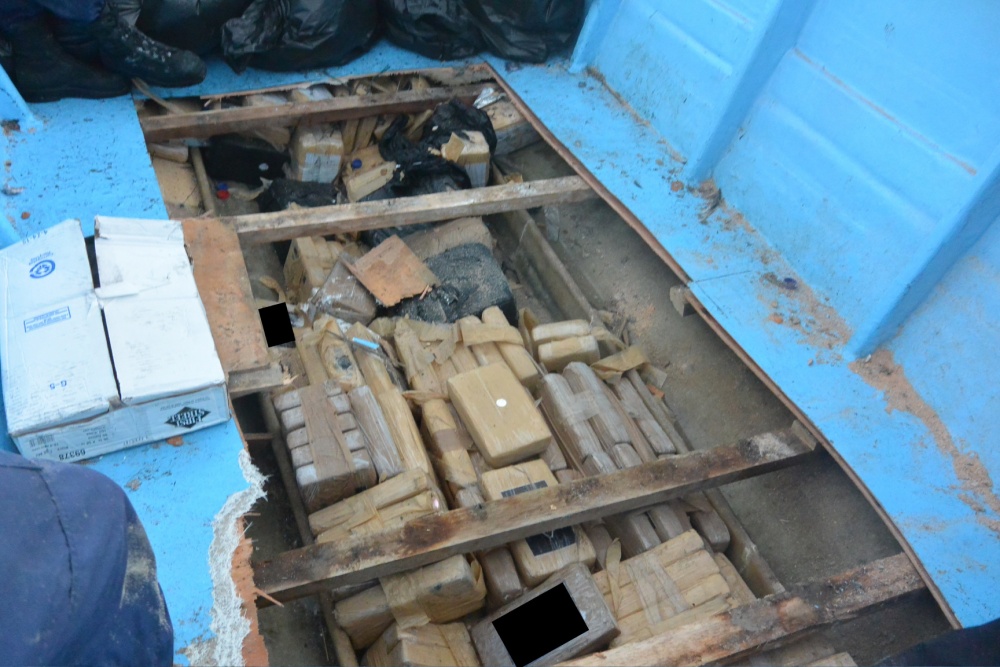
Bales of cocaine lie stacked under the deck of a suspected smuggling vessel in October interdicted by the crew of the Coast Guard Cutter Alert in international waters of the Eastern Pacific Ocean. Approximately 2,000 pounds of cocaine were seized and three suspected smugglers were detained. (U.S. Coast Guard photo, United States, 10.02.2019, Photo by Petty Officer 3rd Class Alexander Gray)
U.S. Coast Guard, Washington D.C. Headquarters spokesperson also replied to questions on if inspecting for Fentanyl is more difficult to conduct in the open seas because Fentanyl comes in smaller shipments (compared to huge bales of marijuana and cocaine), and if the USCG Cutters have any trained drug-sniffing dogs aboard for detecting Fentanyl. “TCOs [transnational criminal organizations] employ ever-changing tactics, using a variety of vessels and methods to smuggle illicit drugs in the maritime environment. These include go-fast vessels, fishing vessels, low-profile vessels, self-propelled semi-submersibles, and commercial cargo ships. Smugglers often conceal illicit drugs in elaborate hidden compartments, challenging law enforcement search efforts in often difficult sea conditions. Upon detection by law enforcement personnel, maritime smugglers often jettison illicit drugs along with other evidence in an attempt to evade enforcement action. Illicit drugs smuggled via commercial maritime means (e.g.: commercial cargo ships) are often well-concealed among legitimate cargo, severely challenging detection by law enforcement agencies.
“Drugs other than cocaine and marijuana comprise less than one percent of Coast Guard annual drug removals. These “other drugs” are primarily methamphetamine, amphetamine, and heroin.
“The Coast Guard does not routinely employ drug-sniffing dogs aboard its cutters, but employs a variety [of] actions and devices to detect the presence of contraband.”
Who also assists the U.S. Coast Guard in helping stem the tide of illegal drugs from overseas?
“The Coast Guard leverages our vast network of international and interagency partners to reduce the availability of illicit drugs in the United States. We conduct counter narcotics efforts at sea with partners, to include the DEA [Drug Enforcement Administration] and FBI [Federal Bureau of Investigation].”
“The Coast Guard defers to our partners in the Drug Enforcement Administration regarding Fentanyl smuggling via aircraft.
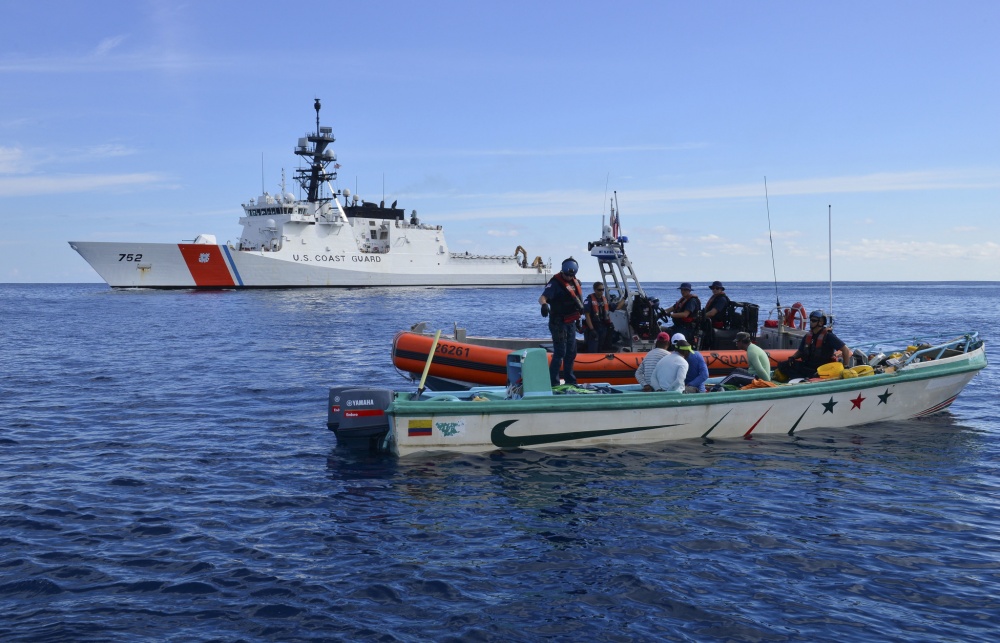
A boarding team aboard the Coast Guard Cutter Stratton apprehends four suspected drug smugglers in international waters in the drug transit zone of the Eastern Pacific Ocean, February 23, 2017. After gaining control of the suspect’s go-fast vessel, the boarding team discovered and seized 700 kilograms of cocaine. (U.S. Coast Guard photo by Petty Officer 1st Class Mark Barney)
I asked about the protection that USCG’s Visit, Board, Search and Seizure (VBSS) boat teams, or Cutter personnel use when searching for drugs, and if any USCG personnel have been injured from Fentanyl exposure. The USCG spokesperson replied, “The Coast Guard employs appropriate safety precautions and procedures against potential exposure to Fentanyl and other illicit drugs. Coast Guard personnel don personal protective equipment when handling or potentially encountering all illicit drugs. This includes gloves, masks, and appropriate coverings of the arms and legs. Additionally, the appropriate Coast Guard assets are equipped with naloxone [naloxone, also known by the name brands Narcan® and Evizo®, can treat a narcotic opioid overdose from, for example, Fentanyl, morphine, and heroin, in an emergency situation], and personnel are trained on its administration following a potential exposure to Fentanyl or other opioids.
“No Coast Guard personnel have been injured due to Fentanyl exposure.”



 News Release U.S. Coast Guard Headquarters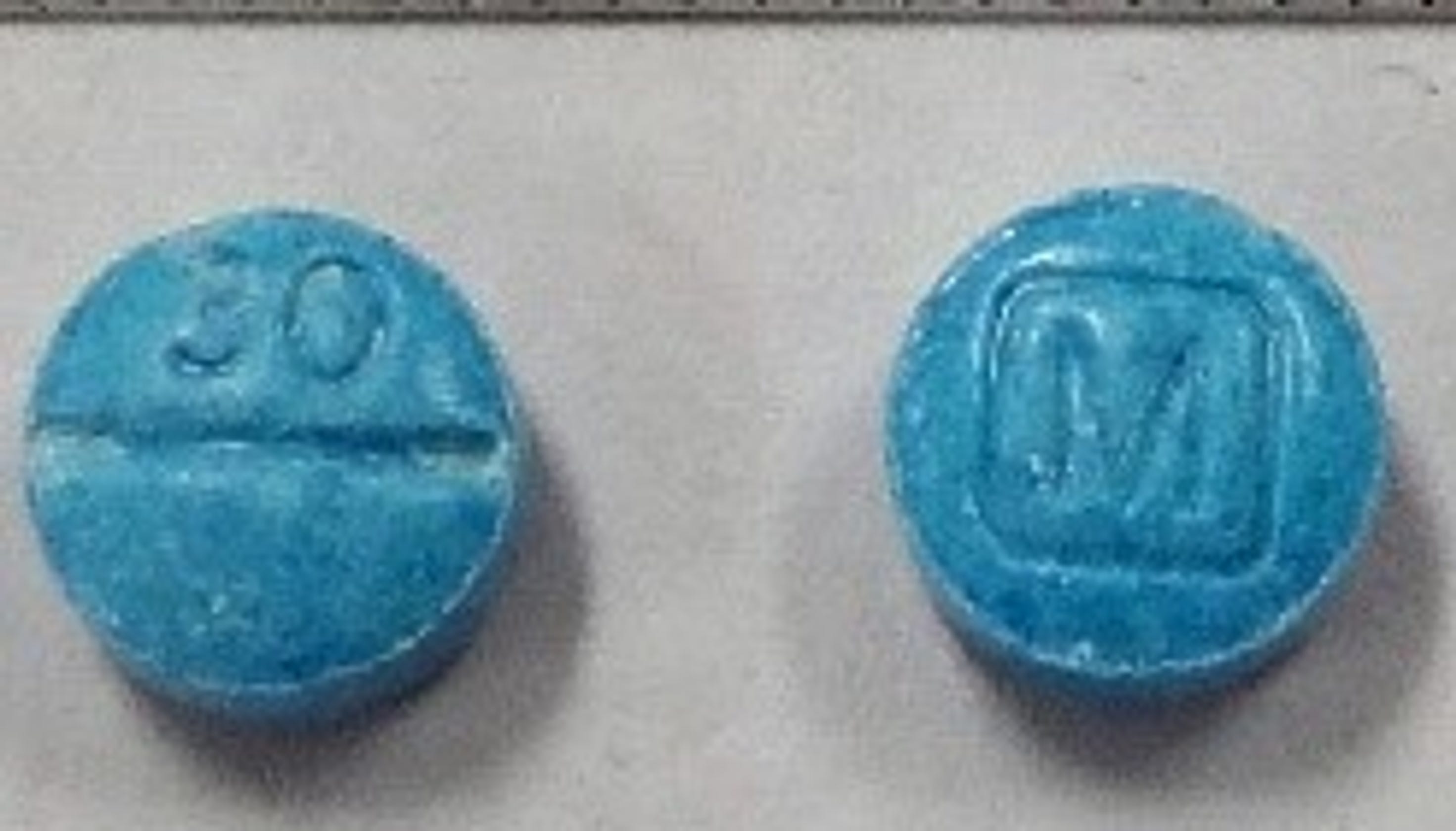
 Chuck Hill's CG Blog