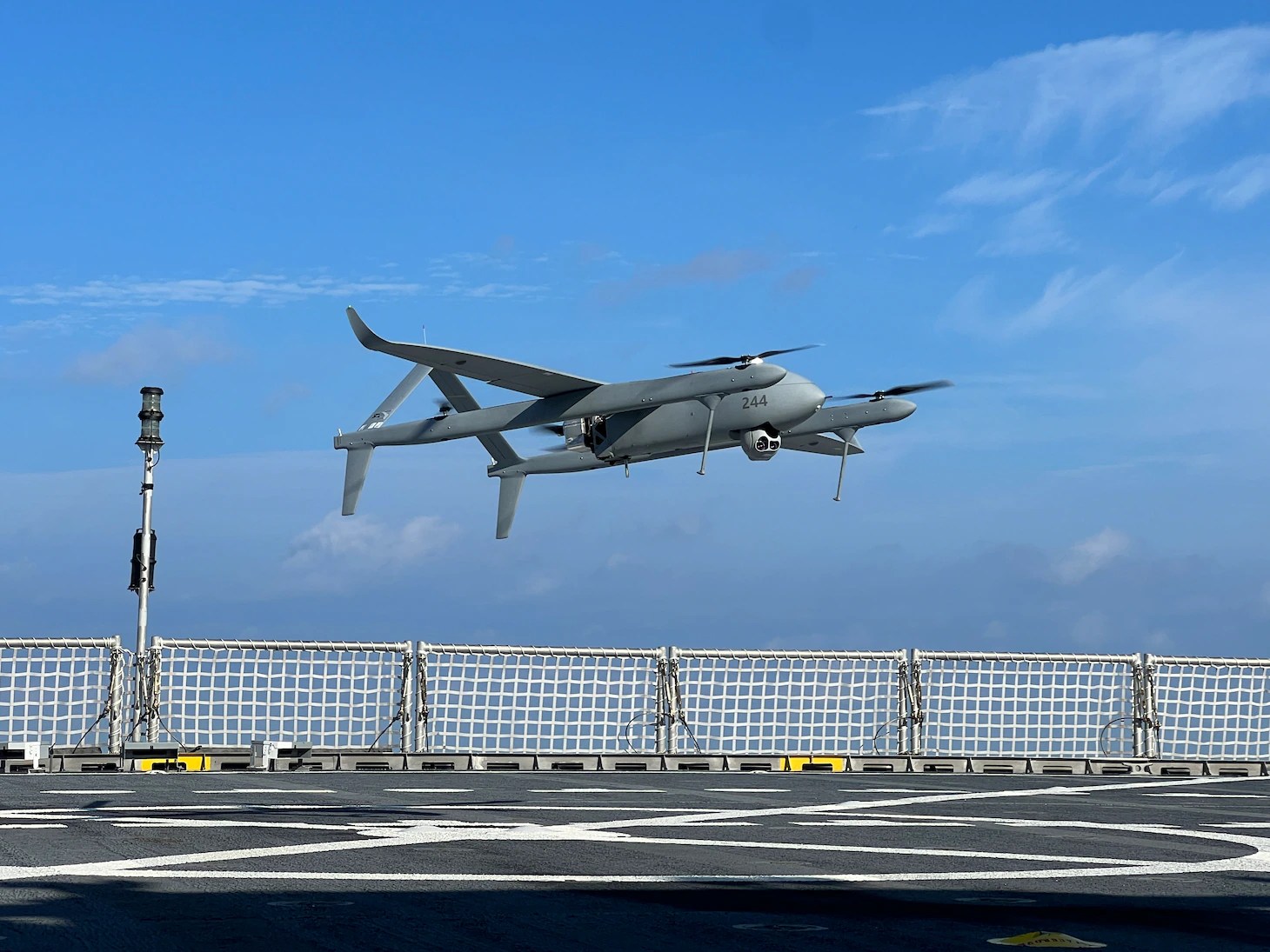
“Hybrid Fleet Campaign Event Evaluates Technology For Future Operations” –4th Fleet

U.S. Naval Forces Southern Command/U.S. 4th Fleet demonstrated unmanned air and surface capabilities from expeditionary fast transport USNS Burlington (T-EPF 10) during the command’s Hybrid Fleet Campaign Event (HFCE) in Key West Oct. 4-13, 2023.

Below is a news release from 4th Fleet. Notably, 4th Fleet is approaching the problem of operationalizing unmanned systems in a different way from that of 5th Fleet.

“A key detail in SECNAV and CNO’s vision was that 4th Fleet would not stand up a separate task force like U.S. 5th Fleet did in Bahrain in 2021, but would develop the hybrid fleet from inside the staff already in place.”


 Oct. 20, 2023

Hybrid Fleet Campaign Event Evaluates Technology For Future Operations

By USNAVSOUTH/4TH FLEET PUBLIC AFFAIRS

U.S. Naval Forces Southern Command/U.S. 4th Fleet demonstrated unmanned air and surface capabilities from expeditionary fast transport USNS Burlington (T-EPF 10) during the command’s Hybrid Fleet Campaign Event (HFCE) in Key West Oct. 4-13, 2023.

This is the most recent event in U.S. 4th Fleet’s campaign to operationalize cutting edge technologies. After successful rollout of the Campaign at UNITAS in July 2023 and the beginning of operation WINDWARD STACK in September, the Science and Technology event in Key West this past week focused on the evaluation of unmanned systems in advanced kill chains, contested littoral operations, survivability, and sustainment at sea.  It served as both a proving ground for emerging technologies and an opportunity for senior leaders to see for themselves the capabilities of systems that could support the hybrid fleet.

“One of the best ways to change our force is to rapidly operationalize new technologies, new systems, and new tactics, techniques, and procedures,” said Adm. Lisa Franchetti, Vice Chief of Naval Operations. “Whether you’re talking about artificial intelligence, cyber, unmanned platforms, directed energy, or hypersonic missiles, we are on the cusp of technological breakthroughs that are going to define future conflict.”

“This week’s technology evaluation event will push boundaries and risk failure in order to allow us to evaluate unmanned technology and then move to operationalize that technology to inform the hybrid fleet,” Rear Adm. Jim Aiken, Commander U.S. Naval Forces Southern Command (USNAVSOUTH) & U.S. 4th Fleet, said in advance of the event. “We have many events scheduled and in some of those events we will win, and in some of them we will learn. In both cases, the Hybrid Fleet will be informed, and the Navy will continue to push forward at the speed of technology.”

The campaign to inform the hybrid fleet calls for the combination of manned and unmanned systems to allow U.S. 4th Fleet to execute its larger missions of defending the southern approaches to the United States, countering malign activity in the region with our partners, and supporting the detection and monitoring of illicit trafficking in the region.

“Broad partnership across DoD and industry partners has allowed 4th Fleet to mature operational capabilities rapidly fostering innovation and providing informed recommendations to the parties involved in creating the Disruptive Capabilities Office,” said Dr. Chris Heagney, the Naval Air Systems Command Fleet/Force Advisor to USNAVSOUTH/4th Fleet.

In April 2023 at the Navy League of the United States’ annual Sea Air Space Symposium, Secretary of the Navy (SECNAV) Honorable Carlos Del Toro and then Chief of Naval Operations Adm. Michael Gilday announced that USNAVSOUTH/4th Fleet would operationalize hybrid fleet operations. A key detail in SECNAV and CNO’s vision was that 4th Fleet would not stand up a separate task force like U.S. 5th Fleet did in Bahrain in 2021, but would develop the hybrid fleet from inside the staff already in place.

“This technology evaluation event is a continuation of the campaign we began in April,” said Cmdr. David Edwards, USNAVSOUTH/4th Fleet’s technology and innovation director. “We evaluate these technologies in focused events like this, then operationalized the technology quickly to fulfill operational requirements in the U.S. Southern Command Area of Responsibility (AOR). While we operate these systems to fulfil the 4th Fleet mission, the evaluation continues over months and years, not just hours and days. Those operational evaluations inform future acquisitions to ensure the Navy is ready to fight and win with these technologies.

HFCE was 4th Fleet’s largest technology event yet with 305 participants including VCNO and Master Chief Petty Officer of the Navy James Honea and 26 other U.S. government distinguished visitors, 10 foreign partners, 18 industry partners, and 47 Department of Defense Commands participating.

U.S. Naval Forces Southern Command/U.S. 4th Fleet supports U.S. Southern Command’s joint and combined military operations by employing maritime forces in cooperative maritime security operations to maintain access, enhance interoperability, and build enduring partnerships in order to enhance regional security and promote peace, stability, and prosperity in the Caribbean, Central and South American region.
“US Navy ‘operationalizes’ drones in 4th Fleet’s UNITAS event” –Defense News

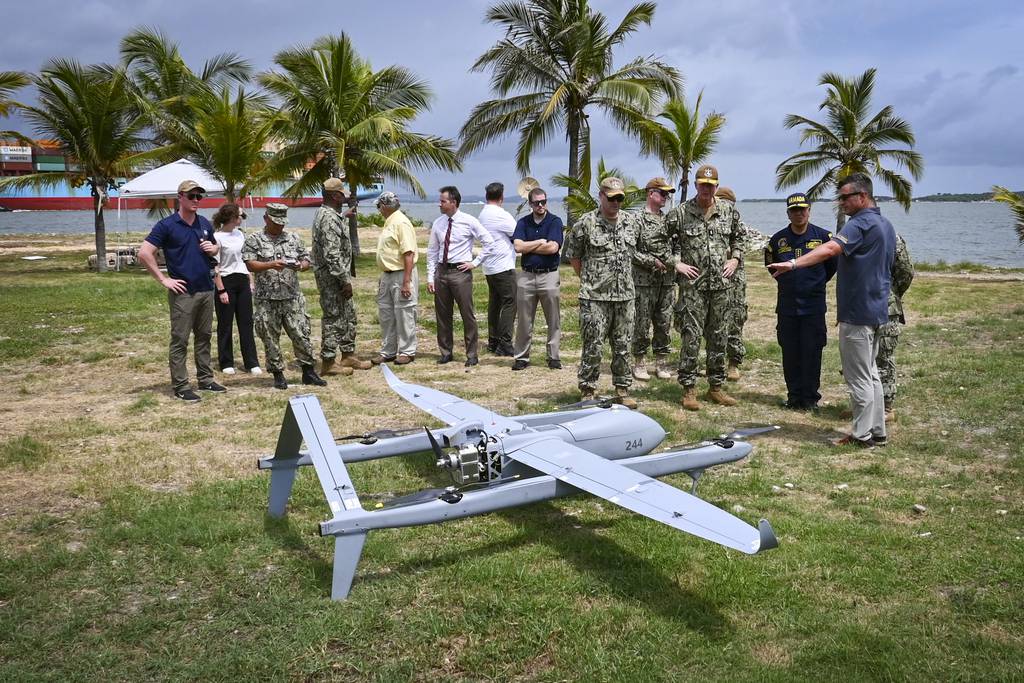
Personnel from the U.S. and Colombian navies attend a demonstration of Aerosonde MK4.7 Hybrid Quad drone during UNITAS on July 16, 2023. (MC1 Hunter Harwell/U.S. Navy)

Defense News reports,

“The U.S. Navy leveraged air and surface drones throughout its two-week UNITAS 2023 naval exercise near Latin America, the first major event since service leadership announced the region would host the sea service’s second unmanned operations hub.”

The Coast Guard certainly has an interest in 4th Fleet’s use of unmanned systems since their area of responsibility (AOR) includes the Eastern Pacific drug transit zones and the Caribbean.

Apparently, not all the systems are in place yet.

“Some of the same systems will return this fall for operations and exercises in the Caribbean and Eastern Pacific Ocean, he added.”

Importantly 4 Fleet is developing a “mesh network that compiles a detailed common operating picture of the region — then AI tools could help flag areas where potentially problematic activities are happening.”

Hopefully we will see video of the SINKEX as recorded by the UAS.

“UNITAS LXIV to begin in Colombia” –USNAVSOUTH/4TH FLEET PUBLIC AFFAIRS

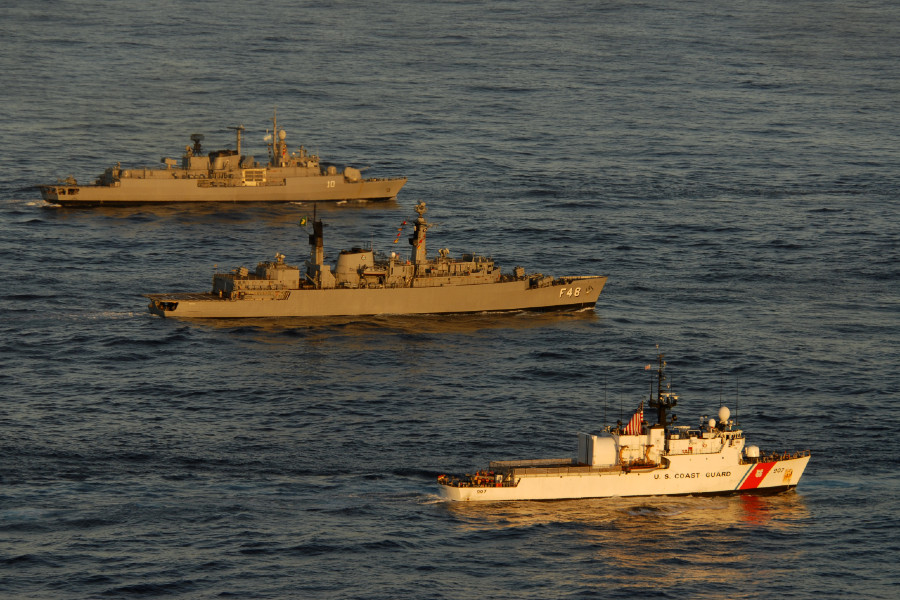
The US Coast Guard cutter USCGC Escanaba (WMEC 907), Brazlian Navy ship BNS Bosisio (F 48) and Argentinian navy ship ARA Almirante Brown (D-10) move into formation for a photo exercise during the Atlantic phase of UNITAS 52 on May 4, 2011. The formation included a total of ten ships from the US, Brazil, Mexico and Argentina. (Photo: US Navy/Mass Communication Specialist 1st Class Steve Smith)

Below is a news release announcing the start of exercise UNITAS LXIV (64 if you are not up on your Roman numerals). There is no mention of Coast Guard participation, but maybe they “simply forgot us.” Think we can bet there are some Coasties involved.

Britain’s Royal Navy also sent one of their highly regarded destroyers, HMS Dauntless.

With 26 surface vessels and three submarines participating, I think this is larger than most of the recent UNITAS exercises. In 2022 it was 19 ships, one submarine, 21 aircraft, accounting for approximately 5,500 total military personnel.

This year will see an attempt at large scale integration of unmanned systems into the exercise by 4th Fleet.


July 11, 2023

UNITAS LXIV to begin in Colombia

By USNAVSOUTH/4TH FLEET PUBLIC AFFAIRS

– U.S. Navy and Marine forces are set to arrive in Cartagena in support of UNITAS LXIV, the world’s longest-running multinational maritime exercise in the world, scheduled to start July 11, 2023.

The Colombian navy will host this year’s UNITAS, which will feature 26 warships/vessels, three submarines, 25 aircraft (fixed wing/helicopter), and approximately 7,000 people from 20 partner nations. Forces will conduct training operations off the coast of Cartagena, Colombia, and ashore in Covenas and Barranquilla, Colombia, through July 21. This year marks the 64th iteration of the exercise. Additionally, this year Colombia will celebrate the bicentennial of its navy, a historical milestone commemorating 200 years of the country’s maritime forces.

“UNITAS is so much more than a two week exercise. All participating nations have given much time, energy and effort into the months of planning leading up to what will be one of the most complex UNITAS to date,” said Rear Admiral Jim Aiken, commander U.S. Naval Forces Southern Command/U.S. 4th Fleet. “Utilizing air, surface, sub-surface, and unmanned assets, and land units, UNITAS will provide the multinational force a challenging environment in which to conduct training across the full spectrum of maritime operations. UNITAS strengthens maritime partnerships, enhances proficiency and improves interoperability of the participating forces, which is why so many partner nations are taking part this year.”

As part of the U.S. Navy’s future hybrid fleet, the Chief of Naval Operations has tasked U.S. 4th Fleet to scale unmanned platforms to the fleet level. An addition to this year’s UNITAS will include the integrated operations of unmanned air, surface, and subsurface systems into the exercise. UNITAS’ challenging training address key aspects of multinational and combined operations such as technology standardization and common operating procedures.

“This is our first opportunity to integrate unmanned systems into our operations at sea,” said Rear Adm. Aiken. “UNITAS has often served as a test bed for technology, so it is appropriate that we begin our unmanned integration campaign to operationalize the hybrid fleet here in UNITAS.”

In addition to the United States, UNITAS LXIV will bring together 19 nations from all over the world to train forces in joint maritime operations that enhance tactical proficiency and increase interoperability. Participating nations include Belize, Brazil, Canada, Chile, Colombia, Dominican Republic, Ecuador, France, Germany, Honduras, Jamaica, Mexico, Panama, Peru, Paraguay, Spain, South Korea, United Kingdom, United States, and Uruguay.

Following the UNITAS LXIV Opening Ceremony on July 12, the in port phase of the exercise will feature subject matter expert exchanges, professional symposia, ship rider exchanges, and operations meetings. During this time, Marines and Sailors will conduct expeditionary training events in Covenas to include riverine operations and diving and salvage operations.

During the UNITAS LXIV Underway Phase, forces will participate in events testing all warfare operations, to include live-fire exercises such as a SINKEX and an amphibious ship-to-shore landing and force retraction.

“Marines and Sailors from across the United States will travel to Colombia to not only train alongside our partner nations’ militaries, but to hone the skills required to operate as part of a larger maritime force focused on sea control and sea denial,” said Lt. Gen. David G. Bellon, commander, U.S. Marine Corps Forces, South, and U.S. Marine Corps Forces, Reserve. “We will be exercising command and control from a forward position as Marines set up and employ Expeditionary Advanced Base Operations to enhance naval capabilities as part of UNITAS.”

U.S. forces participating in UNITAS LXIV include USS New York (LPD 21), USS Cole (DDG 67), USS Little Rock (LCS 9), USS Pasadena (SSN 752), and USNS Burlington (T-EPF 10). Other U.S. participants include Patrol Squadron Five (VP 5), Mobile Diving and Salvage Unit (MDSU) 2, Explosive Ordnance Disposal Mobile Unit (EOD) 612, Mine Countermeasures Group 3, (MCMGRU 3), Expeditionary Mine Countermeasures EOD Company 61 (EODMU 61), East-coast based Naval Special Warfare units, Helicopter Sea Combat Squadron 22 (HSC 22), Helicopter Maritime Strike Squadron 70 Detachment 2 (HSM 70 Det 2), Joint Communications Support Element (JCSE), Fleet Surgical Team (FST) Eight, and the Meteorological Environmental Team (MET). U.S. Marine forces include 3rd Battalion, 23rd Marine Regiment (3/23), 4th Amphibious Assault Battalion (4th AABn), 8th Combat Logistic Battalion (CLB 8), 4th Combat Engineer Battalion (4th CEB), Marine Medium Tiltrotor Squadron 774 (VMM 774), Marine Light Helicopter Attack Squadron 775 (HMLA 775), Marine Aerial Refueler Transport Squadron 234 (VMGR-234), Marine Aircraft Control Group – 48 (MACG-48), and Marine Fighter Attack Squadron 112 (VMFA-112). Finally, Commander, Destroyer Squadron 40, (COMDESRON 40), Commander, Amphibious Squadron Four (COMPHIBRON FOUR), U.S Marine Corps Forces South (MARFORSOUTH), Special Operations Command South (SOCSOUTH), USNAVSOUTH/FOURTHFLT, and U.S. Southern Command (USSOUTHCOM) are participating in UNITAS LXIV.

UNITAS, which is Latin for unity, united, or oneness, was conceived in 1959 during a previous era of strategic competition when representatives at the first Inter-American Naval Conference in Panama agreed to conduct an annual maritime exercise with one another. Prior to UNITAS I in 1960, U.S. Chief of Naval Operations Adm. Arleigh Burke reviewed preparations for the multinational exercise. He commended planners for their progress, especially in building compatible communication systems among navies, and predicted that UNITAS would build strong relationships among Sailors of the Western Hemisphere.

U.S. Naval Forces Southern Command/U.S. 4th Fleet supports U.S. Southern Command’s joint and combined military operations by employing maritime forces in cooperative maritime security operations to maintain access, enhance interoperability, and build enduring partnerships in order to enhance regional security and promote peace, stability and prosperity in the Caribbean, Central and South American region.

U.S. Marine Corps Forces, South is the Marine Corps component to U.S. Southern Command, is responsible for planning exercises, operations, and overall Marine Corps support for the SOUTHCOM assigned area of responsibility.

CG in July 6 USNI Fleet and Marine Tracker, No Mention of UNITAS

The US Naval Institute News “Fleet and Marine Tracker” is continuing to plot the approximate locations of a few Coast Guard units. I first noticed this change in the May 22, 2023 edition.

The July 6 post reported.

U.S. Coast Guard Cutter Stratton (WMSL-752) is underway in the Western Pacific.

and

Coast Guard Cutter Eagle departed Funchal Madeira (Portugal) and is en route to Hamilton, Bermuda.

The post again acknowledged the existence of PATFORSWA. I guess this is going to be boiler plate for all future Fleet and Marine Tracker posts.

U.S. Coast Guard Sentinel-class Fast Response Cutters (FRCs) are forward-deployed to the region under Patrol Forces Southwest Asia (PATFORSWA). (Note this is a broken link–Chuck) PATFORSWA deploys Coast Guard personnel and ships alongside U.S. and regional naval forces throughout the Middle East. Initially deployed in 2003 to support Operation Iraqi Freedom, PATFORSWA is now a permanent presence based out of the Kingdom of Bahrain

What originally caught my eye, when I first saw this post, was the plotted position of USCGC Richard Snyder (WPC-1127), which placed her in the high Arctic, about 2000 miles North of where she was actually reported to be.

The U.S. Coast Guard Cutter Richard Snyder, a Sentinel Class cutter homeported at Atlantic Beach, N.C., teamed with Bermudian authorities this past week in patrols that included a focus on deterring maritime drug smugglers, according to local reports.

The report also reflects the start of the UNITAS 2023 Exercise (have not been able to find the official dates) with six Navy ships in 4th Fleet compared to a typical number of two. One or more Coast Guard cutters are probably involved in the exercise. The only participant I was able to identify was USS New York (LPD-21). Reportedly the exercise will include significant use of unmanned systems.

Coast Guard SAR units, particularly aviation units, get frequent recognition. I appreciate that they are giving Coast Guard surface units some recognition in these posts, but the few mentions don’t reflect the bulk of the work being done by Coast Guard ships.  Perhaps a simple statement of number of large cutters and number underway would be nice.

“U.S. Maritime Forces Arrive for UNITAS LXIII hosted by Brazil” –Seapower

LOOKING BACK: The US Coast Guard cutter USCGC Escanaba (WMEC 907), Brazlian Navy ship BNS Bosisio (F 48) and Argentinian navy ship ARA Almirante Brown (D-10) move into formation for a photo exercise during the Atlantic phase of UNITAS 52 on May 4, 2011. The formation included a total of ten ships from the US, Brazil, Mexico and Argentina. (Photo: US Navy/Mass Communication Specialist 1st Class Steve Smith)

The Navy League’s on line magazine, Seapower, reports on the upcoming 63rd UNITAS exercise,

RIO DE JANEIRO, Brazil — Navy and Marine forces are set to arrive in Rio de Janeiro in support of UNITAS LXIII, the world’s longest-running multinational maritime exercise scheduled to take place Sept. 8-22, the U.S. Naval Forces Southern Command / U.S. 4th Fleet said in a Sept. 1 release.

This year’s exercise is hosted by the Brazilian navy and will included 20 participating nations, 19 ships, one submarine, 21 aircraft, accounting for approximately 5,500 total military personnel that will conduct operations principally off the coast of Rio de Janeiro.

USCG Pacific Area Tactical Law Enforcement Team (PAC AREA TACLET) will be there, but apparently no other Coast Guard units.

Notably, Argentina is not participating.

USCGC Legare Participates in UNITAS LXI

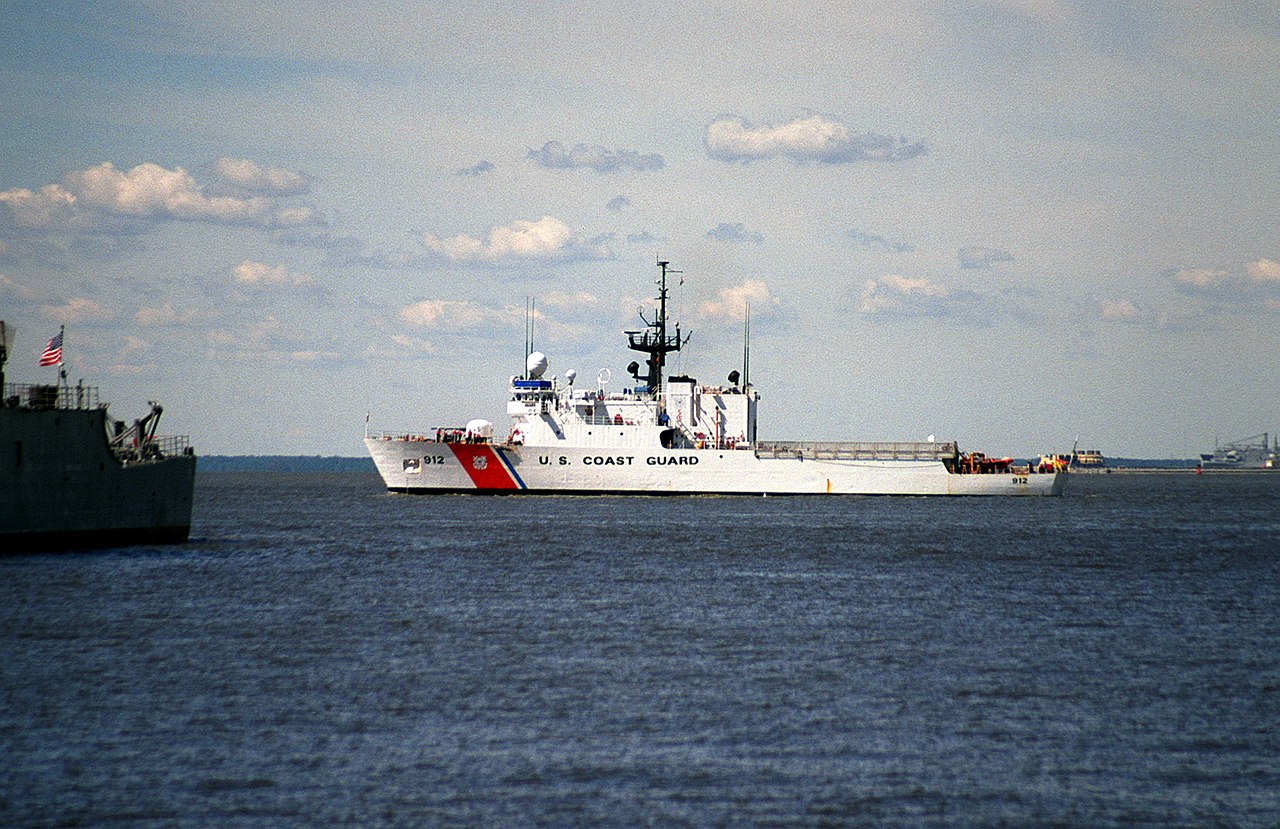
USCG LEGARE (WMEC 912) passing by pier No. 9 at the Norfolk Naval Base. Returning to port after the passage of Hurricane Floyd up the east coast. Location: HAMPTON ROADSTEAD, VA, Photo credit: Don S. Montgomery, USN (RET)

UPI is reporting that, beginning this week, USCGC Legare (WMEC-912) will be participating in this year’s UNITAS exercise along with USS Gabrielle Giffords (LCS-10), USNS Burlington (T-EPF-10), Helicopter Sea Combat Squadron 23 Detachment 9 (which flies MH-60S and MQ-8B drones), Patrol Squadron 9, Patrol Squadron 26 (both VP-9 and VP-26 fly the P-8 Poseidon Maritime Patrol Aircraft) and the U.S. Army Vessel Chickahominy (LCU-2011).

Other participants include representatives form Argentina, Brazil, Chile, Colombia, Dominican Republic, Ecuador, Peru and Uruguay for a total of 13 ships.