“Shield AI Collaborates with Sentient Vision Systems to Offer AI-Enabled Wide Area Motion Imagery Capability” –News Release

The unmanned aircraft sensor payload capability is varied based on the Coast Guard’s desired mission and search conditions: MWIR 3.5 is a mid-wave infrared for thermal imaging capability, for use at night or periods of low visibility; EO-900 is a high-definition telescopic electro-optical (EO) imager to zoom in on targets at greater distance; and ViDAR is a visual detection and ranging wide-area optical search system that is a comprehensive autonomous detection solutions for EO video. Courtesy Photo.

I am passing along this vender’s news release. It references two systems we have discussed in the past, Vidar and the V-Bat UAS. The Coast Guard has a history with these systems.

 Shield AI Collaborates with Sentient Vision Systems to Offer AI-Enabled Wide Area Motion Imagery Capability

SAN DIEGO (Aug. 10, 2023) – Shield AI, an American defense technology company building the world’s best AI pilot, and Sentient Vision Systems (Sentient), an Australia-based leader in AI-enabled passive wide area search, are pleased to announce a strategic collaboration aimed at delivering a wide area motion imagery (WAMI) solution for Department of Defense (DoD), Australian Defense Forces (ADF) and other international customers.

The companies will jointly develop and integrate a ViDAR-enabled, wide-area-search capability onto Shield AI’s V-BAT unmanned aircraft, which will enable Shield AI’s V-BAT to intelligently classify, track, and read-and-react to targets in dynamic missions. Shield AI plans to fly the capability on V-BAT next year.

“This work with our Australian partner, Sentient, is a unique opportunity to fuse the innovation prowess of two companies from allied countries on opposite sides of the world. Together, we are shaping the future of defense technology,” said Brandon Tseng, Shield AI’s President, Co-founder, and former U.S. Navy SEAL.

ViDAR is Sentient’s AI system, which uses an Electro-Optic or Infrared (EO/IR) sensor to detect and classify targets in the imagery stream that would be invisible to a human operator or to a conventional radar. With these enhanced capabilities, V-BAT will be even more proficient in executing the most challenging missions, offering a level of capability that significantly bolsters threat deterrence, thereby reinforcing international peace and security.

“Sentient is excited and proud to be working with Shield AI on this truly breakthrough solution,” said Mark Palmer, Sentient’s Chief Technology Officer. “We look forward to combining the AI expertise and operational understanding of our two great teams to deliver superior ISR capabilities for today’s rapidly changing defense and security environment.”

About Shield AI 
Founded in 2015, Shield AI is a venture-backed defense technology company whose mission is to protect service members and civilians with intelligent systems. In pursuit of this mission, Shield AI is building the world’s best AI pilot. Its AI pilot, Hivemind, has flown a fighter jet (F-16), a vertical takeoff and landing drone (V-BAT), and a quadcopter (Nova). The company has offices in San Diego, Dallas, Washington DC and abroad. Shield AI’s products and people are currently in the field actively supporting operations with the U.S. Department of Defense and U.S. allies. For more information, visit www.shield.ai. Follow Shield AI on LinkedIn, Twitter, and Instagram.

Media contact: media@shield.ai

About Sentient Vision Systems                                                                                      Sentient Vision Systems specializes in passive, modular optical sensors for persistent, wide area motion imagery. Sentient’s artificial Intelligence (AI)-enabled edge solutions better detect and identify small objects in real time, on land and at sea. With more than 20 years of development in moving target indication, AI computer vision and machine learning, Sentient has deployed thousands of systems worldwide in the field of Intelligence, Surveillance, Search and Rescue, enhancing situational awareness, accelerating informed decisions, and saved numerous lives. For more information, visit www.sentientvision.com. Follow Sentient on LinkedIn, Twitter and YouTube.

Media contact: media@sentientvision.com

Editorial enquiries :

Shield AIMedia contact: media@shield.ai

Sentient Vision Systems Media contact: media@sentientvision.com
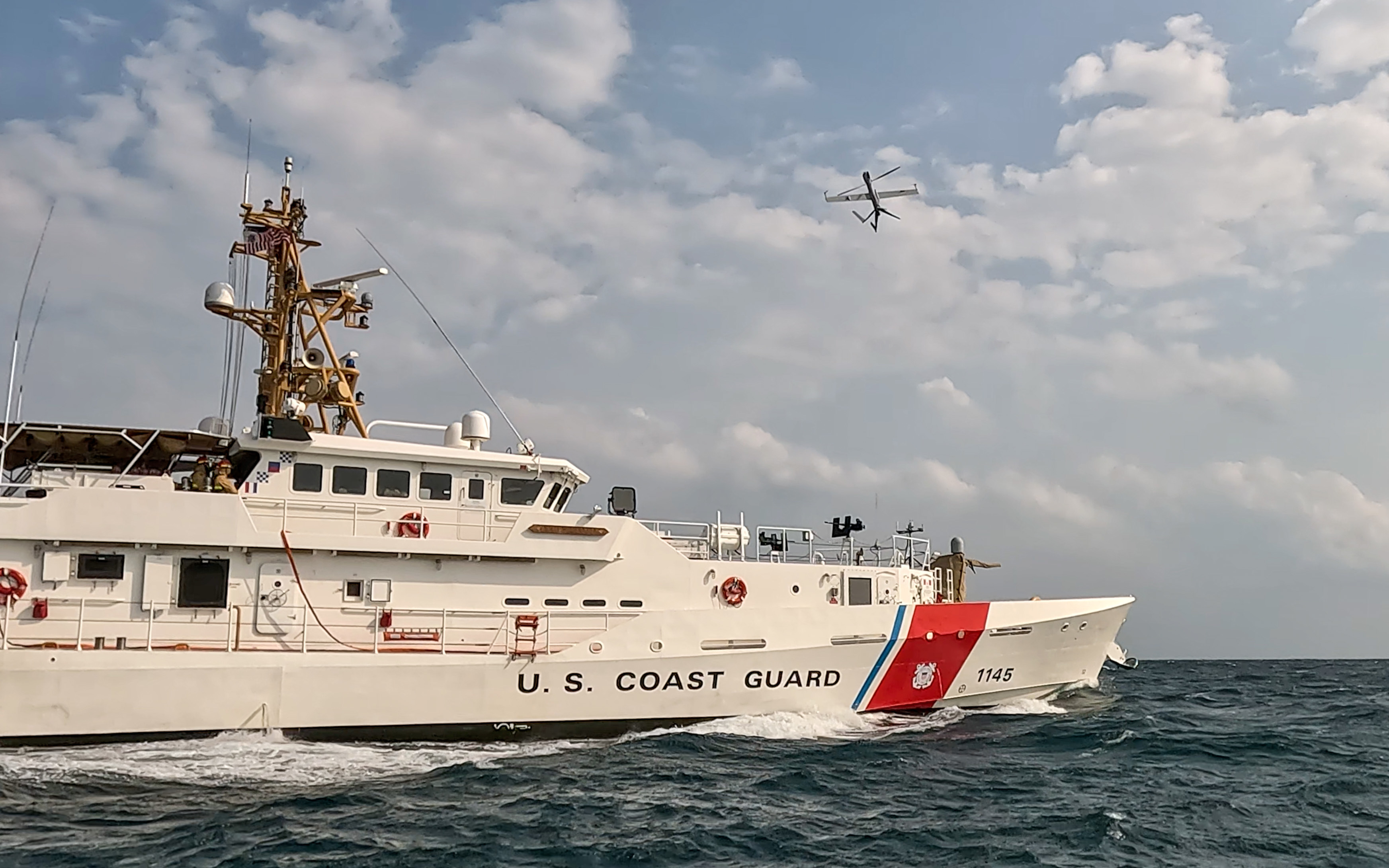
“Task Force 59 Launches Aerial Drone from Coast Guard Ship in Middle East” –NAVCENT

221207-N-NO146-1001 ARABIAN GULF (Dec. 7, 2022) An Aerovel Flexrotor unmanned aerial vehicle (UAV) takes off from U.S. Coast Guard fast response cutter USCGC Emlen Tunnell (WPC 1145) transiting the Arabian Gulf, Dec. 7. U.S. 5th Fleet’s Task Force 59 launched the UAV during Digital Horizon, a three-week event focused on integrating new unmanned and artificial intelligence platforms, including 10 that are in the region for the first time. (U.S. Navy photo)

Below is a December 07, 2022, news release by U.S. Naval Forces Central Command / U.S. 5th Fleet Public Affairs.

To me this is really exciting news. The Webber class has been doing some great work at surprising long distances, performing most of the functions of a medium endurance cutter. Their primary weakness as a patrol ship has been the lack of an organic search aircraft. I assume this UAS is operating from the area on the O-1 deck forward of the bridge that had been designated for vertical replenishment.

This from Aerovel, maker of the Flexrotor (follow the link for dimensions and performance),

Boasting a flight endurance of more than 30 hours and a 120-kilometer communications range, this all-weather aircraft has operated in some of the harshest conditions on earth. Flexrotor is excellent for expeditionary missions. Needing only a 20’ by 20’ area for launch and recovery, it takes off and lands vertically and easily transitions into horizontal wing-borne flight. The STUAS flies completely automatically after takeoff, with no pilot intervention needed. Flexrotor quickly assembles for flight and can be boxed and stowed in minutes by a single person.

The Flexrotor is, in most respects, in the same class as the Scan Eagles that are currently being deployed on National Security Cutters. It is not as fast as Scan Eagle but apparently comparable or greater endurance and requires no launch or recovery equipment. These systems may actually constitute an improvement, compared to searches by manned helicopters, because of their much greater endurance and sensors like the VIDAR used on Coast Guard Scan Eagle UAS..


Task Force 59 Launches Aerial Drone from Coast Guard Ship in Middle East

By By U.S. Naval Forces Central Command / U.S. 5th Fleet Public Affairs | December 07, 2022

MANAMA, Bahrain —

A U.S. Navy unmanned task force in the Middle East launched an aerial drone from a U.S. Coast Guard vessel operating the Arabian Gulf, Dec. 7.

U.S. 5th Fleet’s Task Force 59 launched an unmanned aerial vehicle (UAV) from USCGC Emlen Tunnell (WPC 1145), marking a first for the task force with a U.S. Coast Guard vessel since the task force’s establishment in September 2021.

The launch also demonstrated close collaboration between the U.S. Coast Guard and Task Force 59 as U.S. 5th Fleet rapidly integrates unmanned systems and artificial intelligence to enhance monitoring of regional waters.

Task Force 59 is conducting Digital Horizon, a three-week event focused on integrating new unmanned and artificial intelligence platforms, including 10 that are in the region for the first time.

“Each day during Digital Horizon we have pushed to discover new capabilities, fast,” said Capt. Michael Brasseur, commodore of Task Force 59. “I am so proud of the team for their steadfast commitment to not only imagine new possibilities, but to deliver them.”

An Aerovel Flexrotor successfully took off and landed vertically aboard Emlen Tunnell, showcasing close collaboration between Navy, Coast Guard and industry partners to advance technology integration.

“We are so excited to be part of Digital Horizon and play a critical role by helping integrate new technologies into the fleet,” said Lt. Patrick Kelly, Emlen Tunnell’s commanding officer. “I am so proud of the crew for their dedication, commitment and professionalism, which made today’s success possible.”

The Flexrotor can support intelligence, surveillance and reconnaissance (ISR) missions day and night using a daylight or infrared camera to provide a real-time video feed.

In addition to providing ISR capability, UAVs like the Flexrotor enable Task Force 59 to enhance a resilient communications network used by unmanned systems to relay video footage, pictures and other data to command centers ashore and at sea.

U.S. 5th Fleet established Task Force 59 more than 14 months ago. Since its launch, the task force has deployed a suite of new unmanned systems while integrating artificial intelligence at operational hubs in Jordan and Bahrain.

Emlen Tunnell is one of the Coast Guard’s newest Sentinel-class fast response cutters forward-deployed to Bahrain where U.S. 5th Fleet is headquartered. The ship helps ensure maritime security and stability across the Middle East.

Australian OPV and VTOL UAS

The video above is part of Naval News‘ continuing coverage of the “Pacific 2019” Defense Industry show taking place in Sydney, Australia. The topics of the video are listed below. At least two may be of interest, (1) the new Australian Offshore Patrol Vessel (OPV) being built to a Luerssen design which we discussed  here earlier, and (2) the SAAB UMS Skeldar V200 VTOL Unmanned Air System. This is one of a growing number of vertical takeoff “drones.” This one is the first I have seen with ViDAR included in its list of possible payloads. VIDAR was tested by the Coast Guard in 2016.

Video content:

  • Hunter-class Frigate (SEA5000) with BAE Systems
  • Safran Optronic masts for Attack-class submarine (SEA1000)
  • Luerssen Arafura-class offshore patrol vessel (SEA1180) (time 4:30 to 6:00)
  • Saab UMS Skeldar V200 VTOL UAV (SEA129 Phase 5) (time 6:00 to 7:35)
  • Australian Naval Infrastructure / Osborne Naval Shipyard

There is reference to the fact that the German Navy has also purchased the SAAB UMS Skeldar. Apparently they ordered two, but are not yet decided if it will become a their standard.