41107-A-BD526-1148 DORAL, Florida (Nov. 7, 2024) Navy Adm. Alvin Holsey, incoming commander of U.S. Southern Command, takes the command guidon from Secretary of Defense Lloyd J. Austin III during the SOUTHCOM change-of-command ceremony in Doral, Florida, Nov. 7, 2024. Holsey assumed command from Army Gen. Laura Richardson, who is retiring after 38 years of service. (Photo by Erica Bechard)
These reports all seem to suggest that the resignation is due to disagreement with the administration about the lethal attacks on suspected drug smugglers. On the other hand neither Admiral Holsey nor DOD has made no public statement on his reasons for stepping down.
The statement above impacts the Coast Guard’s reputation and potentially its budget. Youtube indicates that this was recorded on October 15.
I would be the first to acknowledge that the Coast Guard has not been 100% effective in cutting off the supply of drugs flowing from Latin America, but if it is ineffective, so is every other US law enforcement agency.
The Coast Guard seizes more illegal drugs than any other US law enforcement agency. Perhaps more than all others combined.
SAN YSIDRO, CALIFORNIA, UNITED STATES, Port of Entry Photos by Mani Albrecht, U.S. Customs and Border Protection
The President is claiming that each boat destroyed saves the lives of 25,000 Americans. If that were true, there should be no deaths due to overdose this year the rate of deaths due to overdose was a bit over 100,000 per year during the Covid pandemic but has been reduced to about 80,000 by the end of 2024. That is still a lot, but the recent success suggests there may be other things we can do to cut deaths due to overdose that may be more effective than relying on kinetic interdiction.
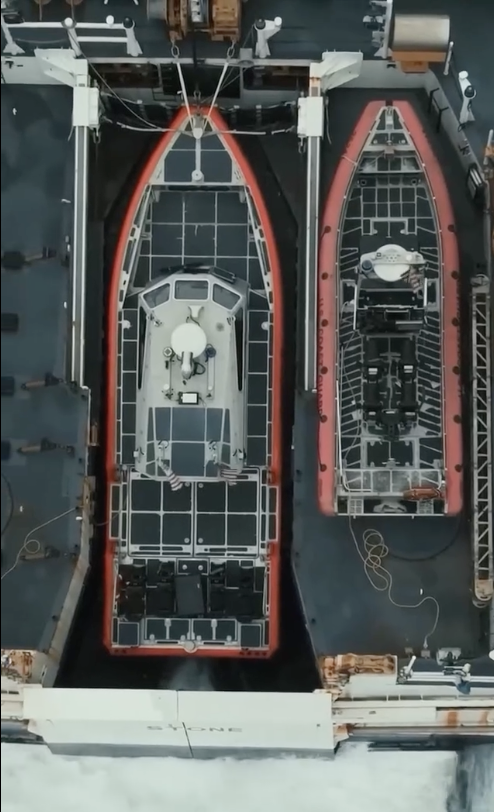
USCGC Stone (WMSL-758) delivers $517.5 million in illicit drugs interdicted in Eastern Pacific Ocean. Along side are displayed cowlings of outboard motor disabled by the Airborne Use of Force crew from the Coast Guard’s Helicopter Interdiction Tactical Squadron (HITRON) based in Jacksonville, FL.
Suggestions that the smugglers are consistently able to outrun the Coast Guard are completely false. The cutters carry smaller high speed craft that can generally out run the smugglers and where they cannot, the Coast Guard has snipers in helicopters with specially trained crews who can disable the smugglers engines. The smugglers can’t outrun a missile but they also cannot out run Coast Guard helicopters. This special squadron just celebrated their 1000th interdiction.
Lately, I have been hearing the word accountability being thrown around a lot, and it is a good word. Who is responsible for the epidemic of drug use and the resulting deaths due overdose? Gangs in Mexico, Colombia, and Venezuela may have helped, but demand by American users created this problem. Most of the distributors and pushers were American citizens. Americans own this problem. Blaming it on foreigners is more comfortable, but not really helpful because, as long as the demand exists, there will be a source.
No indication how this works with Joint Interagency Task Force South, headed by a Coast Guard Rear Admiral (one or two stars), despite the obvious overlap.
Can’t help suspecting this has something to do with the lethal attacks on boats out of Venezuela. Commanded by Marine Corps Lieutenant General (three star), I don’t see him answering to a CG two star; in fact here is an explicit statement, “The JTF will report directly to SOUTHCOM.”
My reading is that this is transitioning from law enforcement to something akin to combat, that is what the President says this is, but we are keeping the trappings of law enforcement. Notice no difference in the Eastern Pacific or further North in the Caribbean. Perhaps we will see a geographic split between the two commands.
Oct. 10, 2025
New Joint Task Force Established to Lead SOUTHCOM Counter-Narcotics Operations
FOR IMMEDIATE RELEASE
MIAMI, Fla. – U.S. Southern Command (SOUTHCOM) announced the establishment of a new Joint Task Force (JTF) under II Marine Expeditionary Force (II MEF) today to synchronize and augment counter-narcotics efforts across the Western Hemisphere.
The JTF will integrate the expeditionary capabilities of II MEF with Joint Force and U.S. interagency partners, represented by the Homeland Security Task Force.
“Transnational criminal organizations threaten the security, prosperity, and health of our hemisphere,” said Adm. Alvin Holsey, Commander, SOUTHCOM. “By forming a JTF around II MEF headquarters, we enhance our ability to detect, disrupt, and dismantle illicit trafficking networks faster and at greater depth – together with our U.S. and partner-nation counterparts.”
Key objectives of the new JTF include:
Identifying narcotics trafficking patterns to interdict illegal shipments of narcotics before they reach the U.S. and partner-nation territories using intelligence, surveillance, and reconnaissance aircraft.
Expanding real-time intelligence fusion among U.S. military, federal law enforcement, and partner-nation agencies.
Conducting joint training to improve interoperability among U.S. military services and increase rapid-response posture.
Enhancing partner-nation counter narcotics operations capacity through advisory teams and combined operations.
“Our team is trained, equipped, and ready to lead this Joint Task Force,” said Lt. Gen. Calvert Worth, Commanding General, II MEF and designated JTF Commander. “This is principally a maritime effort, and our team will leverage maritime patrols, aerial surveillance, precision interdictions, and intelligence sharing to counter illicit traffic, uphold the rule of law, and ultimately better protect vulnerable communities here at home.”
The JTF will report directly to SOUTHCOM. Its creation underscores SOUTHCOM’s commitment to a whole-of-government, multinational approach to defeat and dismantle criminal networks that exploit our shared borders and maritime domains.
Updates will be released as they become available.
U.S. Coast Guard MH-60 Jayhawk helicopter aircrews conduct overflights of Kipnuk, Alaska, after coastal flooding impacted several western Alaska communities, Oct. 12, 2025. The Coast Guard continues to support the state of Alaska’s response efforts in impacted communities. (U.S. Coast Guard photo courtesy of Air Station Kodiak)
I don’t usually talk about ongoing SAR cases, we have so many, but this is something different and you are not likely to hear about on local or national news.
The nearest Coast Guard air station is on Kodiak Island, roughly 350 miles away.
U.S. Coast Guard MH-60 Jayhawk helicopter aircrews conduct overflights of Kipnuk, Alaska, after coastal flooding impacted several western Alaska communities, Oct. 12, 2025. The Coast Guard continues to support the state of Alaska’s response efforts in impacted communities. (U.S. Coast Guard photo courtesy of Air Station Kodiak)
Oct. 13, 2025
ANCHORAGE, Alaska — The Coast Guard is conducting search and rescue operations Monday in Kipnuk and Kwigillingok, Alaska, where communities have been impacted by severe flooding.
In support of the state of Alaska’s response, Coast Guard crews from Air Station Kodiak successfully rescued 18 people in Kwigillingok and 16 people in Kipnuk. All were transferred to safety in stable condition.
Search efforts are ongoing for three residents of Kwigillingok who remain unaccounted for. A Coast Guard MH-60 Jayhawk helicopter aircrew searched 76 square miles for the missing individuals Sunday and resumed first light searches this morning. Search efforts are currently underway.
The crew of Coast Guard Cutter Kimball (WMSL 756) aided in search and rescue efforts using unmanned aerial surveillance, providing logistics support for aviation assets participating in rescue operations. Relief crews and supplies are being staged in Bethel to support a multi-day response.
The Coast Guard is working closely with partner agencies, including the Alaska State Troopers, the Alaska Rescue Coordination Center, the Alaska Division of Homeland Security and Emergency Management, and the Alaska Air and Army National Guard to coordinate ongoing rescue operations in impacted communities.
“Preservation of life is our top priority,” said Capt. Christopher Culpepper, commander of U.S. Coast Guard Sector Western Alaska and U.S. Arctic. “The Coast Guard remains closely connected to the State Emergency Operations Center in full support of combined rescue and response operations alongside State Troopers, National Guard, and various additional agencies.”
The situation is ongoing, and more information will be released as it becomes available.
Anyone in need of rescue should contact the Alaska Rescue Coordination Center at 907-551-7230.
136 Haitian refugees on the flight deck of the US Coast Guard cutter Harriet Lane
The US Naval Institute has a post that proposes a relatively radical solution to the problems the Coast Guard has had in providing maintenance for our ships.
“The first step to combat rising maintenance costs would involve decommissioning several ships, including the 210-foot Reliance– and 270-foot Famous-class WMECs, the 282-foot USCGC Alex Haley (WMEC-39), 175-foot Keeper-class buoy tenders, and 87-foot Marine Protector-class patrol boats. They should be replaced with significantly more capable ships, such as WMSLs, WPCs, and 225-foot seagoing buoy tenders.”
I don’t think that is going to happen any time soon, for a number of reasons, but in making his case he does a great job in identifying the problem.
“The Coast Guard’s budget for FY24 was $13.4 billion, a figure that severely limits the service’s operational capabilities. Consider that the Coast Guard’s budget in 2014, adjusted for inflation, was $18.5 billion—in real-dollar terms, the budget has fallen by $5.1 billion in a decade.”
If that is the case, there is no way you can maintain a fleet the same size as we had in 2014 whether the ships are new or old. Plus it is going to get worse because with the newer larger ships they will need access to dry docks that are larger and consequently more expensive and fewer in number. Increasingly we will be in competition with the Navy rather than with fishermen.
The author also points to the Coast Guard’s short planning horizon. While the Navy has a 30 year shipbuilding plan, the Coast Guard produces only a 5 year capital investment plan. The author suggests the Coast Guard return to producing a 20 year plan as was prepared for a short period. I have been recommending a 30 year plan for almost as long as I have produced the blog.
While we can’t do it in the short term, the Coast Guard needs a culture change that says we will not operate ships more than 30 years old. As they reach 30 years old, they should be declared excess property and passed to our allies who cannot afford new construction but where labor for repairs is much cheaper than here.
To make this work we have to start the process for planning for replacements when the units are 20 years old because realistically, it is 10 years from “Gee we are going to need a new WXX” to commissioning.
USCGC Bertholf was commissioned in 2008. In three years planning for her replacement should begin. That will require a real change of organizational culture.
I have seen a RFI that indicates planning has begun for the icebreaking 140 and 65 foot tug replacements.
We are probably already behind in planning replacements for the WLBs, WLMs, and WPBs.
Fleet the new generation of ships was supposed to replace included 12 WHECs, 32 WMECs, and 49 WPB 110s or 93 ships including 44 large patrol ships.
The “Program of Record” was to give us 8 NSCs, 25 OPC, and 58 FRCs, a total of 91 ships but only 33 large patrol ships.
The shortfall in large patrol ship was to be made up by the magic of the “CREW ROTATION CONCEPT,” having four crews for every three ships so we could keep the ships underway 33% more and 33 ships could do the work of 44.
The “CREW ROTATION CONCEPT” was killed in the FY2019 budget cycle
Two addition NSCc and many FRCs have been added, but the current plan is now only 35 large cutters leaving us with far fewer large cutter days. Currently I think we are down to 32 large cutters.
OPCs are more expensive and require a larger crew than originally projected. They were originally expected to have a crew of about 90 and to cost about half as much as the NSCs.
Crew size for NSCs has also grown and of course crew size for FRCs are considerably greater than that of the 110 and 87 foot WPCs they are replacing.
Since 2012 I have been advocating for a mid-sized patrol cutter between the 4500 ton OPCs and the 353 ton Webber class that I have called Cutter X. The Philippine Navy is acquiring a new class of six Offshore Patrol Vessels built by South Korean ship builder Hyundai Heavy Industries. These 2400 ton ships are an example of what can be achieved on that kind of intermediate displacement.
These are what I would call prototypical modern OPVs, good examples of the type. They are little more than half the size of NSCs or OPCs, but they are significant improvements over the 210 and 270s. They are large enough to perform typical large patrol cutter peacetime missions, but do it more economically the than an OPC both in terms of initial procurement and operating cost.
One feature I like that sets them apart from most OPVs is the mission bay below the flight deck. This could be used for disaster response equipment, as a holding area for migrants, or for a towed array during war time.
I am very late on referencing this, but perhaps it might still be of interest. The Coast Guard has published a brief budget fact sheet.
The “Appropriation Summary” compares FY2023 enacted with FY2025 request. The FY2025 request is lower than the FY2023 enacted. Historically the Coast Guard’s enacted budget is larger than the President’s request as bipartisan Congressional supporters tend to add things. It is impossible to compare to FY2024 enacted because no budget was enacted, just continuing resolutions. The Coast Guard also benefitted from the “Big Beautiful Bill” which addressed some costs that had been expected to be addressed in FY2025.
This makes it hard to meaningfully compare the two budgets, but as a retiree I have to ask how the retired pay appropriation could go from $2,044,414 to $1,210,840, a more than 40% drop?
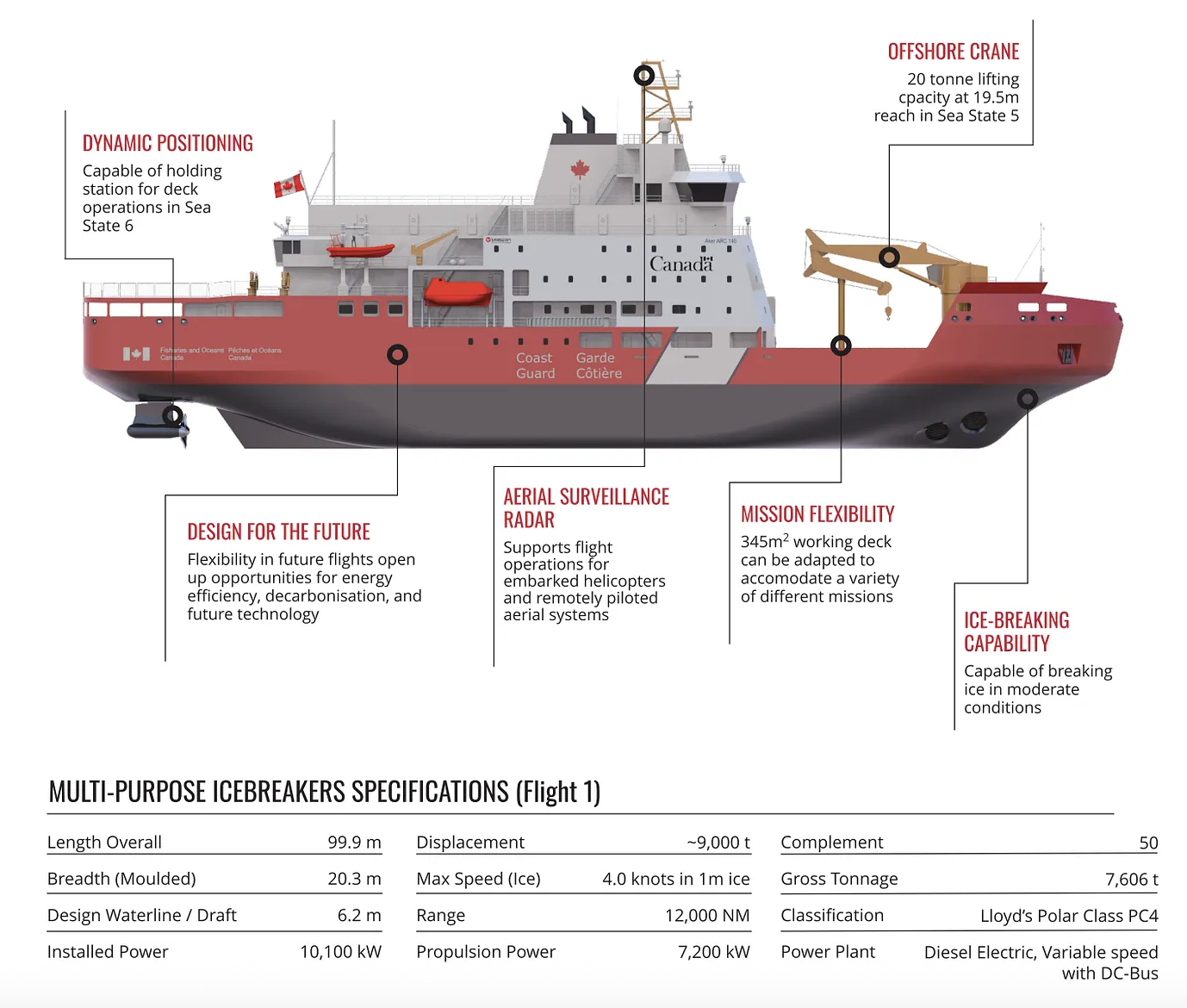
Canadian Coast Guard Multi-Purpose Icebreaker (MPI). Source: Seaspan. This is the ship to be built by the Bollinger/Seaspan/Rauma Marine Constructions (Rauma)/Aker Arctic Team. Two will be built in Finland while four are be built in the US. Note: The MPI image does not show the right propulsors; it will use Steerprop’s contra-rotating propulsors (CRP). Additionally according to Seaspan, the design could easily be upgraded to PC3. Confirmation from Seaspan and Aker Arctic.
An agreement between President Trump and Finnish President Alexander Stubb seems to have determined the plan for procurement of Coast Guard’s Arctic Security Cutter fleet.
It looks good, but it is not in the budget yet, it includes more ships than studies have shown the Coast Guard needs, and neither design has the propulsion power to be classed as “Medium” icebreaker under the terms the Arctic Security Cutter was previously defined, e.g.. 20,000 to 45,000 shaft HP. Even so I don’t expect any significant push back.
The agreement is relatively complex with many parties producing two classes of ships in two countries in four different shipyards. Perhaps the best explanation actually appeared before the official announcement in Peter Rybski’ Sixty Degrees North, “USA-Finland Icebreaker Deal Announcement Expected Today.” There is another very clear report here from Marine Link.
I used information from Sixty Degrees North in the captions of the two illustrations I used.
Last August the US was very active in exercising in the High North. The U.S.S Gerald R. Ford carrier strike group was in the Norwegian Sea. Two of Ford’s escorts broke off and joined two Norwegian frigates in patrolling the Northern Norwegian coast.
Indo-Pacific Command Northern Edge 2025 which included the USS Abraham Lincoln carrier strike group was in the Northern Pacific using the Joint Pacific Alaska Range Complex.
Most importantly for the Coast Guard, NORTHCOM conducted Arctic Edge 2025 primarily in Alaska and the surrounding seas. In the early days of any conflict involving Alaska (other than just flying over it) Coast Guard ships and aircraft will be a significant part of those forces NORTHCOM can call upon. Coast Guard ships and aircraft can transport personnel, equipment, and supplies including landing small combat units.
A U.S. Coast Guard C-130 participates in forward arming and refueling point (FARP) operations during Arctic Expeditionary Capabilities Exercise (AECE) in Adak, Alaska on Sept. 18, 2019. US Marine Corps Photo
When I saw reports of last year’s Operation Noble Defender Exercise run by NORTHCOM in Alaska, I was very disappointed to see no mention of the Coast Guard. So this year I was very pleased to see this.
A joint Marine Corps/Coast Guard team performed a simulated raid on Port MacKenzie, seizing it and reestablishing force flow through the port. The Army’s 3rd Transportation Brigade (Expeditionary) opened the unimproved port and led transit operations there.
(I do think they made it too easy on themselves by doing it so close to Anchorage but sometimes it’s necessary. Of course they also made it easy on themselves by having the exercise in August.)
There was no specific mention of Coast Guard units participating in the exercise but the exercise extended the entire month of August. The Canadian frigate HMCS Regina was sighted as participating and we know USCGC Waesche operated with HMCS Regina the last week of August including live fire exercises.
“During the exercise, the squadron collaborated closely with the Air Force, Coast Guard and Naval Aviation Warfighting Development Center personnel recovery experts to coordinate SAR coverage throughout the Aleutian Islands. This ensured smooth integration across commands and enabled HSC-14 to streamline logistics and adapt to Alaska’s unique operational challenges, including extreme weather and limited infrastructure…During the exercise, the squadron collaborated closely with the Air Force, Coast Guard and Naval Aviation Warfighting Development Center personnel recovery experts to coordinate SAR coverage throughout the Aleutian Islands. This ensured smooth integration across commands and enabled HSC-14 to streamline logistics and adapt to Alaska’s unique operational challenges, including extreme weather and limited infrastructure.”
It still looks like the surface Navy may never have gotten North of the Aleutians. That may be because of the way the Combatant Commander boundaries are drawn. NORTHCOM has most but not all of the Bering Sea.
Combatant Command AORs, Bering Sea
It should not be this way. That USEUCOM is responsible for Siberia is insane. Siberia, the Aleutians and the Bering Sea should be under INDOPACOM.
As you probably know, I believe the Coast Guard should build a more war-like cutter that could be built jointly with the Navy to fill a destroyer escort like role.