“Coast Guard to Triple Western-Pacific Deployments, Policy Chief Says” –Defense One

Defense One has an interview with Rear Adm. Michael Ryan, the Coast Guard’s deputy commandant for operations policy and capabilities.

The reference to tripling Western-Pacific Deployments seems to reflect the planned deployment of three National Security Cutters to the Western Pacific in 2023, but that is not explicitly stated and there is also reference to homeporting a WMEC in the Western Pacific, topics we discussed here.

Most of the interview is really about connectivity, data collection, and analysis. Hopefully we will see some data used for a new Fleet Mix Study, that will determine our needs and be able to justify them to Congress.

It was interesting to me that the interview was a result of Admiral Ryan’s attendance at the National Defense Industrial Association’s Expeditionary Warfare conference in Arlington, Va.

After Prototype SLEP USCGC Seneca still has her 76mm

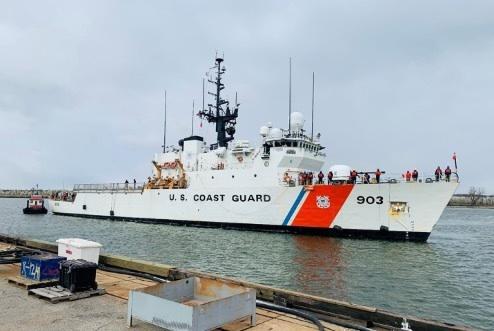
USCGC Seneca’s (WMEC 906) crew pulls into home port in Portsmouth, Virginia, Feb. 17, 2023, following a 24-day patrol in the Caribbean Sea. Seneca’s crew worked with Joint Interagency Task Force South and the U.S. Air Force to disrupt nearly 1,350 kilograms of narcotics from two law enforcement cases in the Caribbean Sea. (U.S. Coast Guard photo by Petty Officer 3rd Class Kate Kilroy)

Not a big thing, but since we have been told USCGC Seneca was the prototype for the WMEC 270 SLEP,

“Coast Guard Cutter SENECA arrived in the summer of 2021 for the prototype Service Life Extension. Both SSDG and Emergency Generators replaced which included electrical upgrades to SSDG and emergency switchboards. SENECA was utilized as the prototype vessel for ISVS to the 270’ fleet that begins in 2022 with CGC HARRIET LANE.

and we have heard that the 76mm Mk75 gun and presumably the Mk92 Fire Control System are being removed during the SLEP, I wondered if the gun and firecorntrol had been removed?

A recent photo (above) accompanying a Navy League Seapower Magazine report of the return to homeport of USCGC Seneca after 24 day Caribbean Patrol clearly shows both the Mk75 and the Mk92 in place.

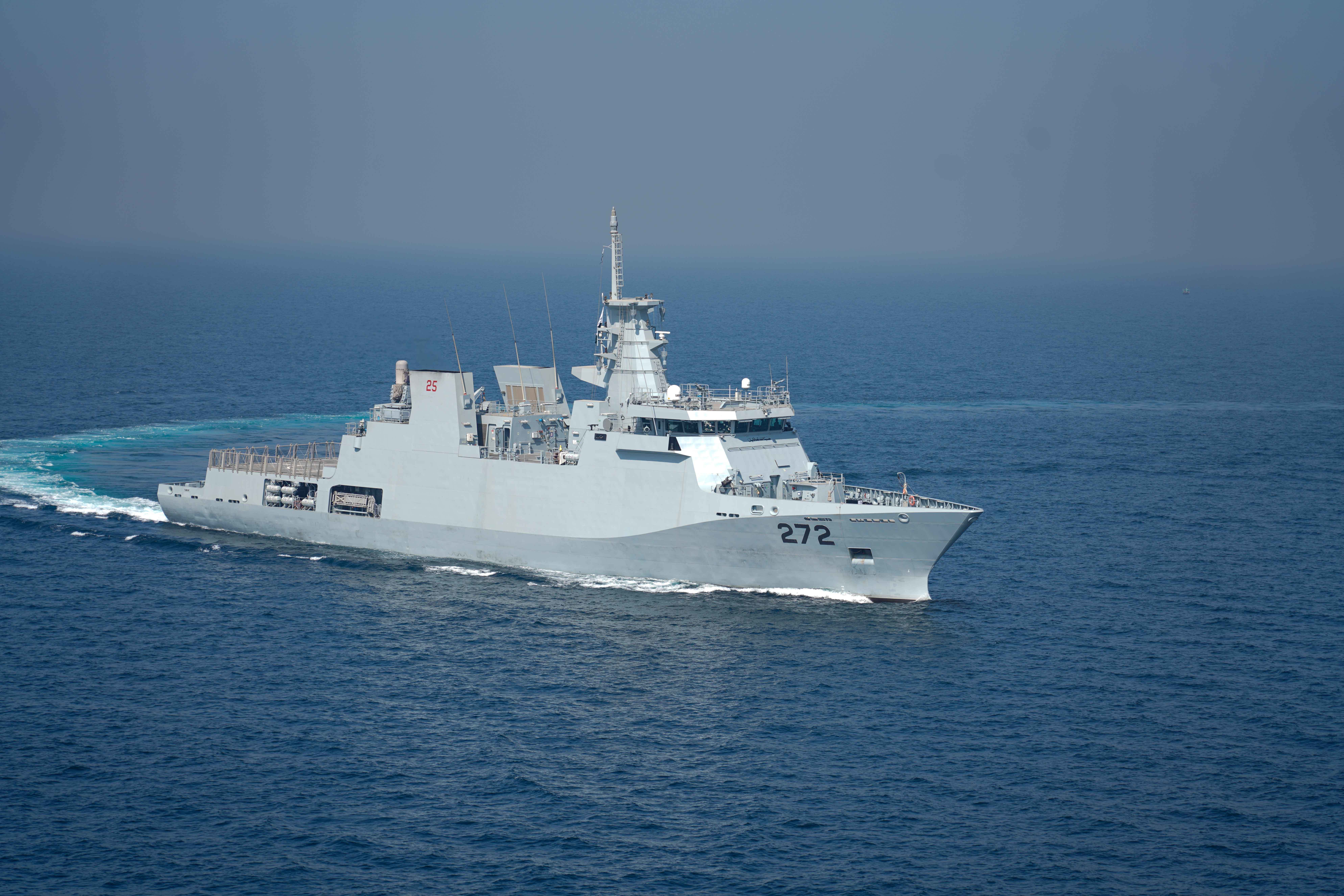
“Pakistan’s New OPV – PNS Yarmook – Is At NAVDEX 2023” –Naval News

Sister ship: GULF OF OMAN (Nov. 11, 2021) Pakistani corvette PNS Tabuk sails alongside amphibious dock landing ship USS Pearl Harbor (LSD 52) during a passing exercise in the Gulf of Oman, Nov. 11, 2021. (U.S. Navy photo by Mass Communication Specialist 3rd Class Sang Kim)

Naval News reports on a tour of a recently completed Damen designed Offshore Patrol Vessel. The vessel itself, PNS Yarmook (271), is a very typical modern OPV. What is not typical is the way it is being armed.

A medium caliber gun (57-76mm) and a pair of auto-cannon (20-30mm) seems to be the norm. Instead, it is to be a 30 mm Aselsan SMASH remote weapon station, two Aselsan STAMP remote weapon systems, (presumably with .50 cal. machine guns) and a Phalanx Block 1B close-in weapon system, and eight Harbah sub-sonic, anti-ship cruise missiles (ASCM) with land attack capability. This missile, at 1350 kg, is about twice as large as Harpoon (1523 lbs / 691 kg) and 50 kg or 110 pounds heavier than the Tomahawk. It is more than three times larger than Naval Strike Missile.

Pakistan is building another, slightly larger class of OPVs. Presumably, they will also be armed with ASCM. These, like the Yarmook class, are being built by the Damen yard in Galati, Romania.

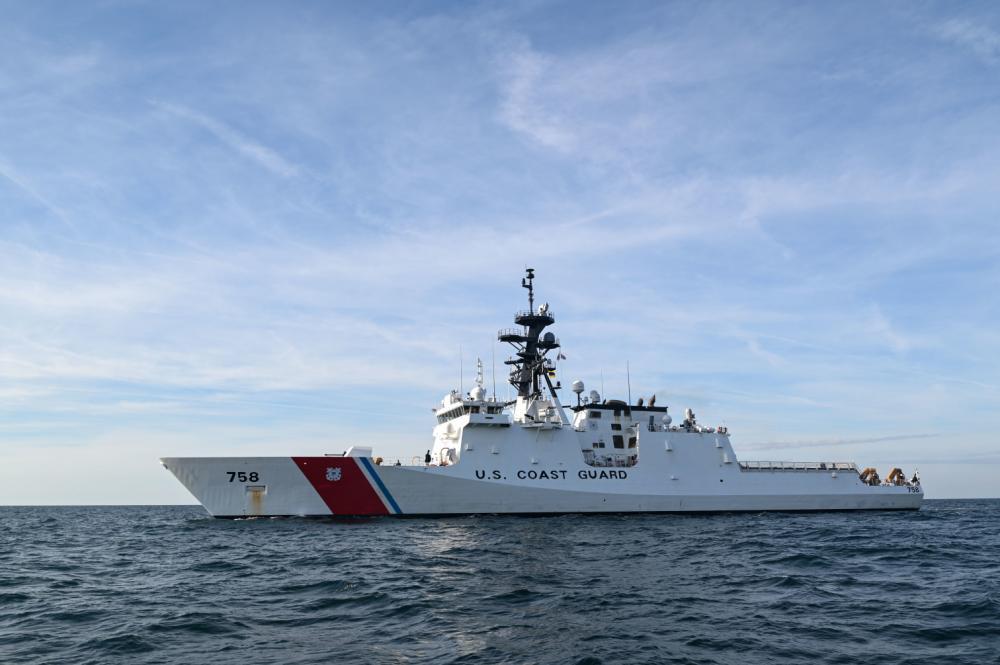
USCGC Stone arrives in Montevideo, Uruguay for scheduled visit” –LANTAREA

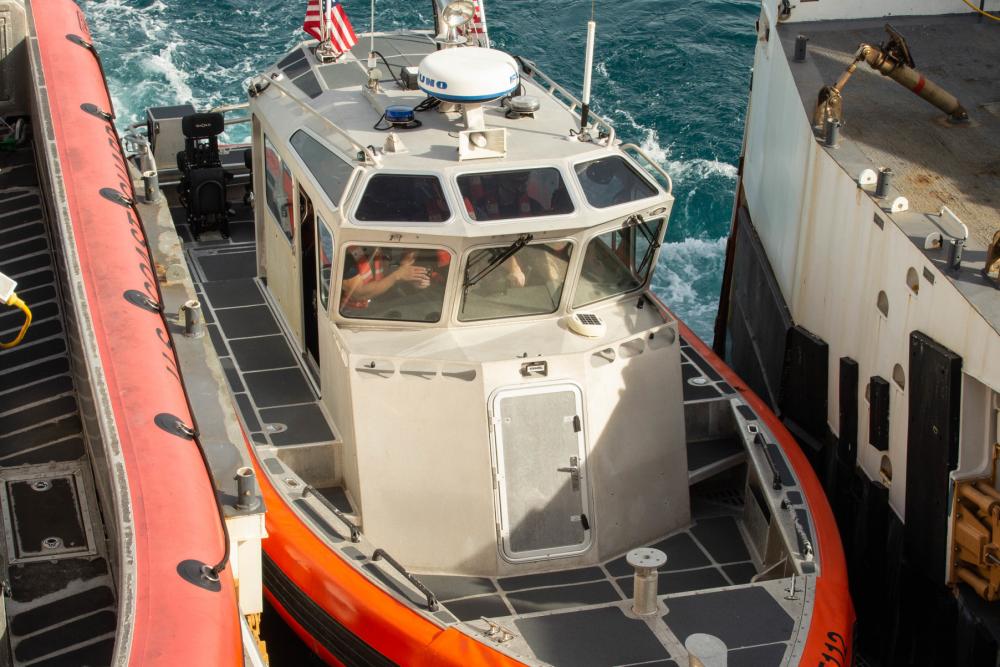
USCGC Stone’s (WMSL 758) 35-foot long range interceptor small boat crew conducts vessel on vessel use of force training in the Atlantic Ocean, Jan. 18, 2023. Stone is the ninth Legend-class national security cutter in the Coast Guard fleet and currently homeports in Charleston, South Carolina. (U.S. Marine Corps photo by Cpl. Ethan Craw)

Below is a press release from Atlantic Area. Seems cutters are going everywhere lately. We had a report of a previous port call on this deployment. “Expanding partnerships: U.S. Coast Guard Cutter Stone arrives in Port of Suape, Brazil” –LANTAREA, Jan. 31, 2023

This is Stone’s second deployment to the Atlantic coast of South America. The first was done before she was even commissioned. The weather should be nice, Summer in Montevideo.

Other reports of her previous deployment to South America.


Feb. 19, 2023

USCGC Stone arrives in Montevideo, Uruguay for scheduled visit

USCGC Stone (WMSL 758)  USCGC Stone small boat launch

Editor’s Note: To view more or download high-resolution imagery, click on the photos above.

MONTEVIDEO, Uruguay — The USCGC Stone (WMSL 758) arrived in the Port of Montevideo, Uruguay for a scheduled visit Sunday.

Stone is conducting a multi-mission deployment in the South Atlantic Ocean, exercising the U.S. Coast Guard’s partnership with the host nation to counter illicit maritime activity and promote maritime law enforcement throughout the region. Stone’s deployment focuses on developing partnerships and increasing U.S. interoperability with South American nations to counter illegal, unreported, and unregulated (IUU) fishing.

“Illegal, unreported, and unregulated fishing has replaced piracy as the leading global maritime security threat,” said U.S. Coast Guard Capt. Clinton Carlson, Stone’s commanding officer. “The United States stands with Uruguay in our shared commitment to countering this threat and we are working hand-in-hand to uphold our mutual security interests in the region.”

Uruguay and the United States are party to the Port State Measures Agreement, the first binding international agreement that targets IUU fishing. The agreement brings together best practices to strengthen enforcement measures for signatories to apply when foreign fishing and fishing support vessels seek entry into their ports to prevent IUU-caught fish and fish products from being landed or transshipped, eliminating the economic incentives that drive IUU fishing.

Both nations also participate in the International Commission for the Conservation of Atlantic Tunas (ICCAT), which coordinates the conservation and management of highly migratory fish species throughout the Atlantic Ocean, including through shared science and joint monitoring. Stone’s visit is intended to build a mutual understanding and rapport among the nations’ maritime forces to advance our shared efforts to strengthen the Commission’s tools against IUU fishing.

“U.S. maritime law enforcement presence in South American waters is not unusual,” said Carlson. “Many of the illicit actors operating in this region come from all over the world to fish in other nations’ exclusive economic zones. Partnering with these nations’ maritime forces allows us to identify those who are violating our partners’ maritime sovereignty, fishing migratory species to near extinction, and impacting the economic livelihoods of coastal communities that rely on sustainable fish stocks.”

Stone last visited Uruguay in January of 2021 on a similar mission to address port security and threats posed by IUU fishing, and to help facilitate safe and lawful maritime commerce and travel.

Stone’s second visit to Montevideo in as many years comes at an opportune time, as the United States and Uruguay mark the 70th anniversary of the 1953 Mutual Defense Assistance Agreement between the nations. The accord served as the foundation of the long history of cooperation between the two democracies in defense equipment, training, and peacekeeping operations around the world that continues to thrive today.

Stone is the ninth Legend-class national security cutter in the Coast Guard fleet and currently homeports in Charleston, South Carolina. The national security cutters can execute the most challenging national security missions, including support to U.S. combatant commanders.

Stone is under the command of U.S. Coast Guard Atlantic Area. Based in Portsmouth, Virginia, U.S. Coast Guard Atlantic Area oversees all Coast Guard operations east of the Rocky Mountains to the Arabian Gulf. In addition to surge operations, they also allocate ships to work with partner commands and deploy to the Caribbean and Eastern Pacific to combat transnational organized crime and illicit maritime activity.

Information about the U.S. Coast Guard’s efforts to combat IUU-F, including the Coast Guard’s IUU-F Strategic Outlook, the National 5-Year Strategy for Combatting IUU-F, and other resources, can be found here.

For information on how to join the U.S. Coast Guard, visit GoCoastGuard.com to learn about active duty, reserve, officer, and enlisted opportunities. Information on how to apply to the U.S. Coast Guard Academy can be found here.

Why we, and the US Navy, need the 30mm

I found the video above through a post from Defense News “Rafael unveils video of counter-drone capability on Typhoon weapon.” The vessel in the video is, I believe, the Israeli built, Shaldag V class, Philippine Navy patrol boat BRP Lolinato To-Ong (PG-902). Presumably the video was taken during the vessel’s trials.

While the story is about the latest 30mm version of the Typhoon Remote Weapon Station, the lesson for the Coast Guard (and the Navy) seems to be that the new 30mm air burst ammunition fired from the Mk44 Bushmaster II gun, which is also part of the M38 Mod4 system, provides a Counter UAS capability that is not possible with our current 25mm guns.

If that were not enough, we have known for a long time that the 30mm is much more effective than the 25mm against even small surface craft.

The air burst is not the only type of round that is available for the 30mm but not the 25mm. There is the swimmer round that makes it more likely the gun can punch a hole in the hull below the water line. It is also likely to be more effective against ships’ propulsion machinery.

Major Patrol Cutter in the Western Pacific 365?

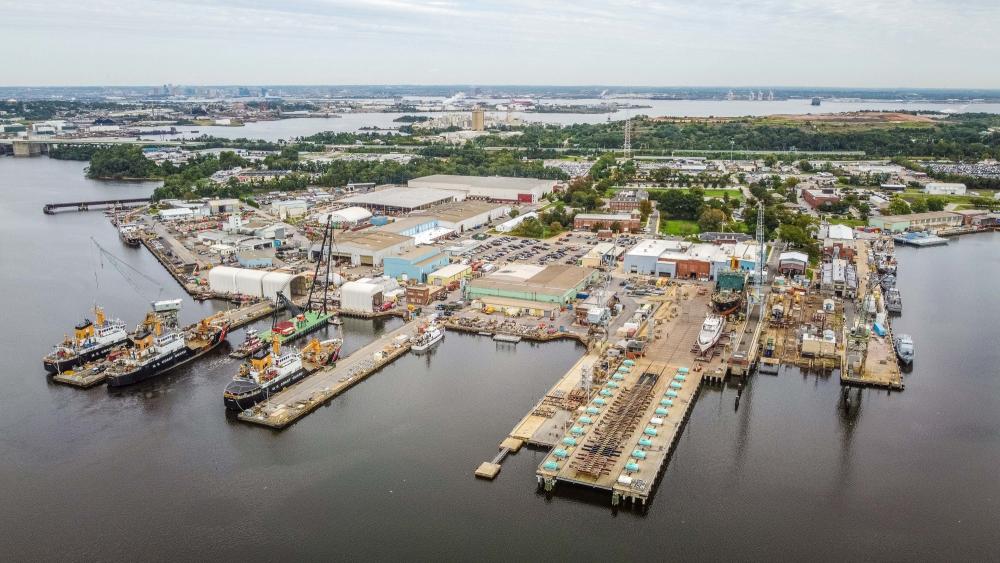
The U.S. Coast Guard Cutter Harriet Lane arrives at the Coast Guard Yard for a service life extension in Baltimore, March 28, 2022. The cutter will remain in Baltimore without the crew for approximately nine months during the overhaul project.

The US Naval Institute News service reported on remarks by Pacific Area Commander Vice Adm. Andrew Tiongson Wednesday, February 15, during an address to the WEST conference, hosted by the U.S. Naval Institute and the Armed Forces Communications and Electronics Association.

What he said:

Sometime in 2024, one of the WMEC 270s currently based in Portsmouth, VA that has (or will) undergo a Service Life Extension Program (SLEP) will be moved to a new homeport, somewhere in the Western Pacific. Admiral Tiongson specifically said, “…it can be anywhere from Sasebo [Japan] to Honolulu,” I don’t think he was ruling out ports west of Sasebo, and

“… this year, the Coast Guard is sending three national security cutters to the Indo-Pacific. Hawaii-based cutter USCGC Kimball (WMSL-756) is currently deployed and operating in U.S. 7th Fleet “with the Japan coast guard,” he said. Two more national security cutters are scheduled to deploy to the region this year.”

(All I know about the status of the WMEC270 SLEP program is here.)

Speculation:

The Mission: 

This is explicitly a commitment to countering Illegal, Unregulated, Unreported (IUU) fishing done primarily, but not exclusively by the Chinese, and to stand up for our friends against Chinese bullying, particularly in regard to their expansive unrecognized claims in the South China Sea.

If, as the Admiral says, the MEC will provide 185 days away from homeport, and if we continue to deploy three National Security Cutters to the area annually for about two months each, we have the potential to have a large patrol cutter on task, either underway or making a diplomatic port visit all year round.

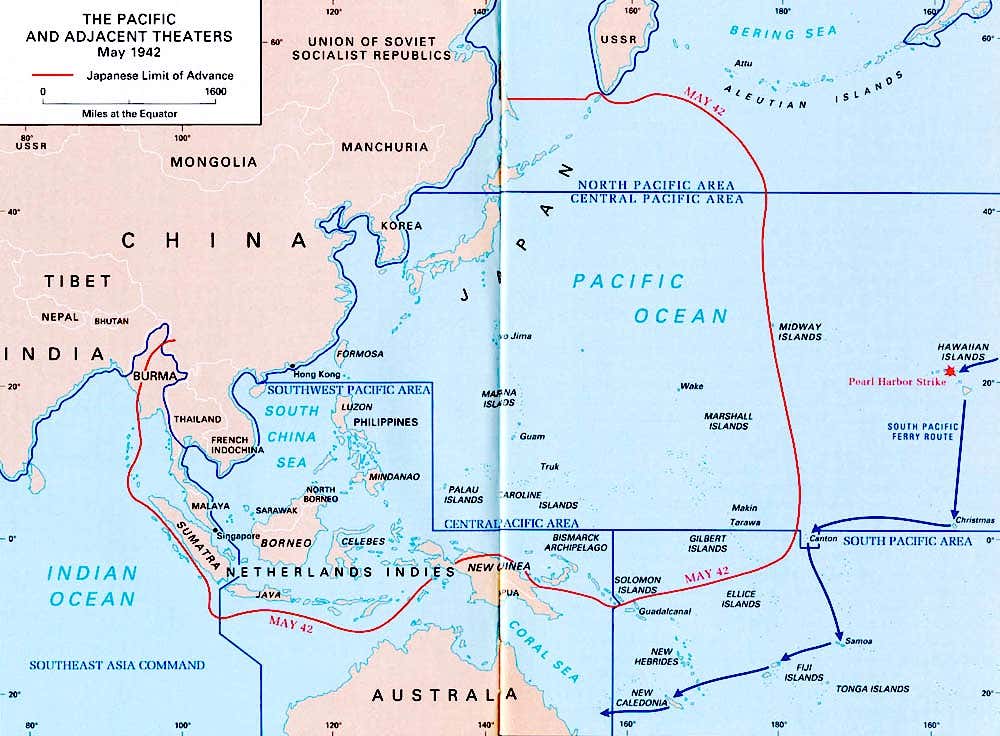
The map above, which shows the maximum extent of Japanese advance across the Pacific during WWII, was the best I could find to show potential homeports. Geography hasn’t changed and I think it may be evocative. 

Homeport?: There are certainly several possibilities, but my interpretation is that this is largely about the South China Sea, so geography should play heavily in the choice of the homeport for the transferred cutter.

Honolulu is an easy answer, since we already have a major base supporting large cutters there, but it is far from where I think this ship is expected to work. It is the only port in the Western Pacific where a Coast Guard Airstation could provide a helicopter to deploy with the cutter (Kodiak is about as far West, but not really a player). Beside requirig long transits, being homeported in Honolulu would not help our outreach efforts while the ship is in port, as it might if the ship were based in a partner nation.

Guam is also a possibility. It is 6,126 kilometers or 3,308 nautical miles West of Honolulu. We have a buoy tender and three Webber class FRCs there. There are also a pair of Navy submarine tenders there that should be able to provide a degree of support. There is a Navy helicopter squadron there that might be able to provide a helicopter to deploy with the ship, but like Honolulu in port time there will not help a partner nation.

Singapore is at a critical strategic strait and has been used by the US Navy as home away from home for Littoral Combat Ships. Singapore is a wealthy and sophisticated nation. They don’t seem to need any help from us. We will want to visit and maintain good relations, but I don’t think we want to homeport there.

Sasebo, Japan, already has a major US Navy base, so support is not a problem. Like Guam the US Navy in Japan probably has helicopters that could deploy with the cutter. Japan Coast Guard is both very experienced and extremely large, with more large cutters than the US Coast Guard. Again, we will want to visit and maintain good relations, but I don’t think we have a lot to offer them.

Embed with the Philippine Coast Guard, perhaps sharing a homeport with the Philippines’ new 97 meter Japanese built cutters BRP Teresa Magbanua and BRP Melchora Aquino. This is where I think the WMEC should be. It is close to the center of action. The Philippines has seen the benefits of allowing US military access and a cutter might be the most welcome form of US military presence. Joint patrols are planned. A cutter based in the Philippines would foster greater interoperability. Shipboard helicopter operation is in its infancy in the Philippine Coast Guard. Frequent ready access to a flight deck equipped US Coast Guard cutter and crew could help them mature this capability.

Embarked Aircraft?:

It seems likely the transferred cutter may frequently operate without an embarked USCG helicopter. A UAS seems to be a good idea, at least the same ScanEagle system currently on the NSCs.

Hosting a partner nation’s helo on board might be beneficial to both services and would improve interoperability.

The End Game: 

Ultimately, I think the US is hoping to open a chapter of Combined Maritime Forces, a 34 member country law enforcement alliance, or to form something similar, in the Western Pacific. This could be the beginning.

“U.S. Coast Guard cutter departs Japan following joint training with Japan Coast Guard” –PACAREA

Below is a Pacific Area news release.

One thing the Japan Coast Guard would have seen in any tour of a National Security Cutter (NSC) is the close relationship between the USCG and the US Navy. I can’t say that the NSCs are highly capable warships, but they are much more capable than any Japan Coast Guard cutter.

I think it is fair to say that the US Coast Guard benefits from the relationship with the US Navy in terms of secure communications, intelligence gathering, weapons support, and training. The country in turn has a significant naval auxiliary it can call on in time of war.

The Japan Coast Guard’s relationship with the Japanese Maritime Defense Force is much more distant. I think that needs to change.

If there is any doubt that cutters in the Western Pacific have become a regular thing, note,

“Recent U.S. Coast Guard cutter deployments to the Western Pacific include the Coast Guard Cutters Bertholf (WMSL 750) in 2019, Stratton (WMSL 752) in 2019, Waesche (751) in 2020, Munro (WMSL 755) in 2021 and the Midgett (WMSL 757) in 2022.”


Feb. 16, 2023

U.S. Coast Guard cutter departs Japan following joint training with Japan Coast Guard

KAGOSHIMA, Japan – The U.S. Coast Guard Cutter Kimball (WMSL 756) departed Kagoshima Thursday following a multi-day visit where the crew conducted a joint training exercise and professional exchanges with Japan Coast Guard members.

Crewmembers from the Kimball and the Japan Coast Guard conducted combined operations and search-and-rescue exercises in Kagoshima Bay Tuesday with multiple sea and air assets. The crews performed collaborative mission planning, boat handling and helicopter operations, and demonstrated techniques for locating, recovering and hoisting a simulated distressed swimmer.  These activities enhance the partnership and interoperability between the services in cooperative safety and security missions, including search-and-rescue operations.

While in port, Kimball’s command visited the Japan Coast Guard’s 10th Regional Headquarters and provided tours of the cutter to multiple groups of Japan Coast Guard servicemembers and community members.

The professional engagements expanded on a recently signed memorandum of cooperation between the two sea services.

The U.S. Coast Guard and the Japan Coast Guard signed an expanded memorandum of cooperation in May 2022, which added annexes to include standard operating procedures for combined operations, training and capacity building, and information sharing. The two services established a new perpetual operation to strengthen relationships, increase bilateral engagements, and focus on maintaining a free and open Indo-Pacific.

The new operation’s name, SAPPHIRE, is an acronym for Solid Alliance for Peace and Prosperity with Humanity and Integrity on the Rule of law-based Engagement. It honors the gem regarded as an emblem of integrity and affection found throughout the Indo-Pacific.

Since signing the SAPPHIRE memorandum of cooperation, the two services have conducted multiple joint training exercises and operations across the Pacific Ocean.

“The U.S. Coast Guard endeavors to continue strengthening our relationships with the Japan Coast Guard through engagements like ours in Kagoshima that build on the foundation laid out in SAPPHIRE,” said Capt. Thomas D’Arcy, Kimball’s commanding officer. “Our oceans are global maritime superhighways facilitating commerce, food security, and transportation. Collaborative engagement with the Japan Coast Guard, who also value strong maritime governance, enables greater connection and a more open and secure Indo-Pacific.”

By partnering with like-minded nations, the U.S. Coast Guard seeks to strengthen global maritime governance to preserve sovereignty, share information to facilitate force-multiplying partnerships, and demonstrate professional standards of behavior to reinforce the rule of law at sea through the global deployment of cutters and personnel.

Recent U.S. Coast Guard cutter deployments to the Western Pacific include the Coast Guard Cutters Bertholf (WMSL 750) in 2019, Stratton (WMSL 752) in 2019, Waesche (751) in 2020, Munro (WMSL 755) in 2021 and the Midgett (WMSL 757) in 2022.

“Expanded U.S. Coast Guard presence in the Western Pacific facilitates professional coast guard exchanges like our crews conducted in Kagoshima with the Japan Coast Guard,” said D’Arcy. “Presence and human-to-human interactions like we experienced this past week builds the connective tissue that embodies durable networks, strengthens the safety and security of all countries and fosters a committed network of partners with shared principles and norms in the maritime domain.”

Commissioned in 2019, Kimball is one of nine Legend-class national security cutters in service and one of two homeported in Honolulu. National security cutters are 418-feet long, 54-feet wide, and have a 4,600 long-ton displacement. They have a top speed of more than 28 knots, a range of 12,000 nautical miles, endurance of up to 90 days, and can hold a crew of up to 170. These cutters are the centerpiece of the U.S. Coast Guard’s fleet, capable of executing the most challenging operations, including supporting maritime homeland security and defense missions at home and abroad.

“Coast Guard partners with Space Force to strengthen presence in space domain” –CG-9

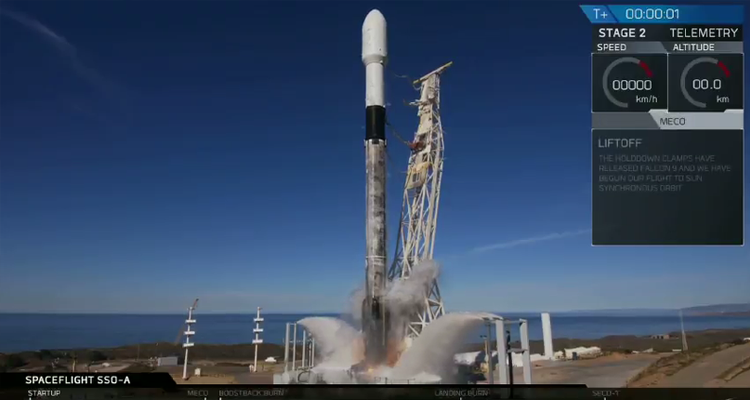
The Coast Guard Research, Development, Test, and Evaluation Program, in partnership with the Department of Homeland Security Science and Technology Directorate, launched two 6U CubeSats from Vandenberg Air Force Base, California, as part of the Polar Scout project. Photo courtesy of SpaceX.

Below is from the Acquistions Directorate (CG-9). CG R&D seems to be reaching out quite a bit lately. The CG R&D budget is quite small, smaller than it should be, but they seem to be making the best of it.


Coast Guard partners with Space Force to strengthen presence in space domain

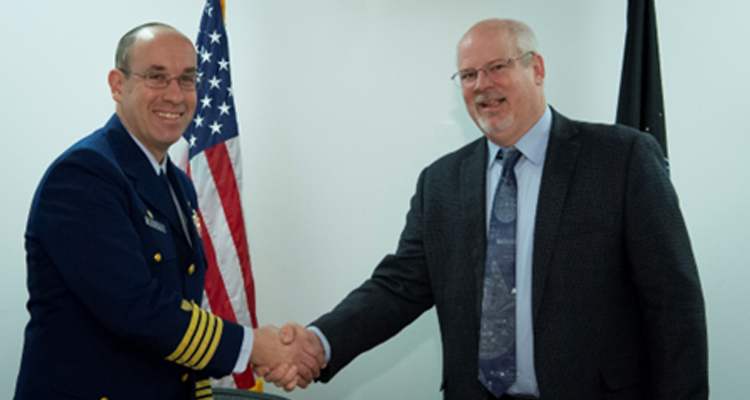
Capt. Dan Keane, commanding officer of the Coast Guard Research and Development Center (left), and Dr. Joel Mozer, director of science, technology and research for the U.S. Space Force, share a handshake following the Jan. 19, 2023, signing of a memorandum of understanding (MOU) to enhance space-related capabilities for the joint warfighter. This MOU aims to develop a partnership that focuses on coordination, collaboration and transparency to enhance capabilities and technologies. U.S. Air Force photo by Staff Sgt. Stuart Bright.


The Coast Guard Research and Development Center (RDC) and the U.S. Space Force (USSF) Science, Technology and Research Directorate solidified their commitment to collaborate and enhance space capabilities for the joint warfighter through a new memorandum of understanding (MOU) signed Jan. 19.

This significant occasion marks the first time the two organizations have worked together and the beginning of a partnership focused on coordination, sharing and exchange of information as well as identifying opportunities for applied research and advanced technology development.

Capt. Daniel Keane, RDC commanding officer, and Dr. Joel Mozer, USSF science, technology and research director, signed the MOU.

Mozer underscored the importance of the partnership. “The Coast Guard is more than 230 years old and the Space Force just three,” he said. “The nation’s newest service has a lot to learn from one of its oldest on how to provide national power and security in a burgeoning new domain full of new economic and geostrategic opportunity, but also representing unknown threats.”

The missions of the Coast Guard and Space Force are intertwined and have many goals that could be achieved more effectively and yield greater impact with coordinated planning. This MOU will enable and improve the Space Force’s access to unique RDC facilities, infrastructure and personnel to support their mission to protect the space interests of the U.S. and its allies by optimizing the development and transition of future space capabilities to the joint force.

“We are excited for the opportunity to partner with Space Force in potential future research, as well as share researchers and best practices,” Keane said. “We quickly realized the value that this relationship presented for both agencies soon after the Space Force participated in a Coast Guard strategic study that examined the Coast Guard’s future role in space governance, use of spaced-based technology and research areas.”

Due to the high dynamics of space and its rapidly evolving domain, the demand for space-based capabilities is significantly increasing, and the U.S. national security community is pursuing collaborative approaches to maintain its technological edge and strong foothold in space.

The Coast Guard has research activities adept at identifying, developing and operating emerging technologies to benefit national space-related capabilities, including space missions and operations. Through this MOU the organizations aim to develop a partnership that focuses on collaboration and transparency to enhance capabilities and technologies and to share best practices.

“The Coast Guard is a forward-leaning organization with an eye to the future,” Mozer said. “The Space Force wants to take advantage of their methods of strategic foresight and apply them to our own space problems; where technology developments overlap between the two services, we want to partner.”

For more information: Research, Development, Test & Evaluation and Innovation Program page and Research and Development Center page

“How a new Vietnam-Indonesia deal will affect South China Sea disputes” –Defense News

Defense News reports that Vietnam and Indonesia have agreed on demarcation of their respective EEZs where they had previously been in dispute.

Peaceful settlement of conflicting SE Asian nation claims would go a long way toward presenting a united front against China’s expansive 9 Dash Line claims and clarify IUU fisheries enforcement.

“Practically, the successful Indonesia-Vietnam EEZ [exclusive economic zone] demarcation will help both countries to resolve illegal, unreported, and unregulated (IUU) fishing, which has been a serious bilateral irritant and a broader issue involving third-party countries, including China and Thailand,” according to Bich Tran, a visiting fellow writing in the Fulcrum, a publication of the ISEAS—Yusof Ishak Institute in Singapore.