“Report to Congress on Coast Guard Cutter Procurement” –CRS, Updated 8 June, 2021

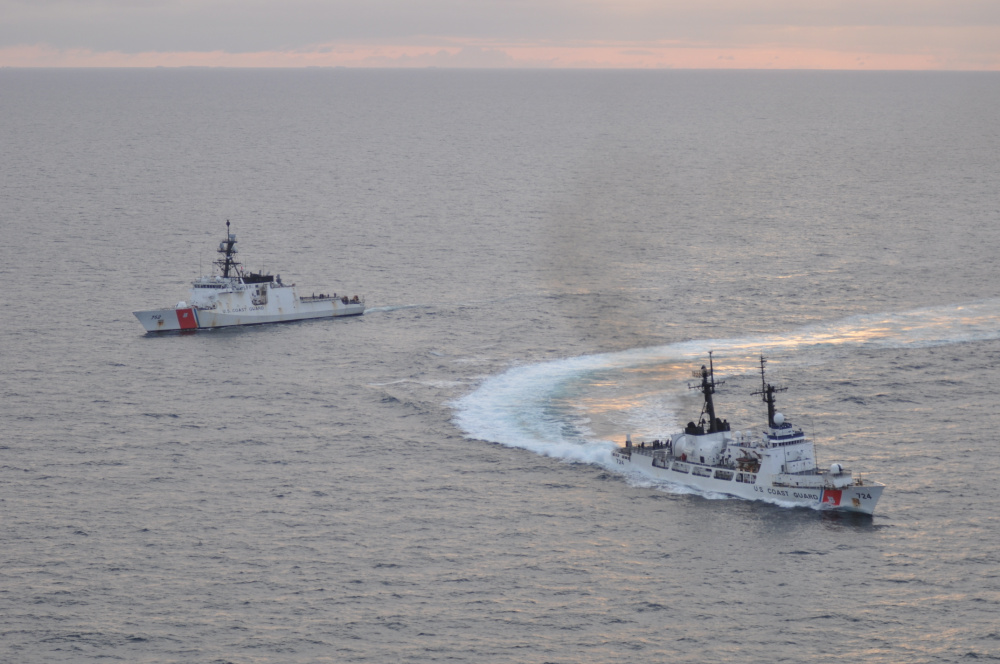
The Coast Guard Cutter Stratton’s (WMSL 752) crew relieves the crew of the Coast Guard Cutter Douglas Munro (WHEC 724) in the Bering Sea, March 12, 2021. The Douglas Munro was the Coast Guard’s last 378-foot high endurance cutter and was relieved by Stratton concluding their final patrol prior to being decommissioned April 24, 2021. U.S. Coast Guard photo.

The Congressional Research Service has again updated their report on Coast Guard cutter procurement. (The link will always take you to the most recent edition of the report.) I have reproduced the summary in full below. But first some comments. 

Offshore Patrol Cutter:

From page 12–this could be a problem.

On January 29, 2021, the Coast Guard released the RFP for the Stage 2 competition, with responses due by May 28, 2021. The Coast Guard plans to award the Stage 2 contract in the second quarter of FY2022. The contract is to be a Fixed Price Incentive Firm (FPIF) contract for detail design and construction of up to 11 OPCs, including Long Lead Time Materials (LLTM), as well as logistics, training, and life-cycle engineering. One observer stated on March 29, 2021, that,

“‘In the current 11-ship [Stage 2] proposal, the Coast Guard is giving interested shipyards an enormous amount of leeway to redesign the cutter’s innards, a tactic that, according to stakeholders, facilitates increased competition. Newly proposed ships must look generally the same [as ESG’s OPC design] from the outside, but almost everything “under the hood”—outside of a few major components—can be changed, shifted or modified.‘”

Whether 2004 Program of Record Should Be Updated:

There is a considerable discussion of the need for a reexamination of the program of record, including a new “Fleet Mix Study” on pages 12-19.

It also appears we have failed to complete a report “…required by Section 8261 of the Elijah E. Cummings Coast Guard Authorization Act of 2020 (Division G of P.L. 116-283), which is due to Congress no later than 90 days after the date of enactment.” (p.19)

Budget Request History:

There are a couple of interesting tables of budget requests for PC&I funding. Table 1 looks at requests for funding ships. Table B-1 includes the full PC&I request. (Approved budgets were generally different.)

  • Table 1. Requested Funding in FY2013-FY2022 Budget Submissions (p.15)
  • Table B-1. Requested Funding in PC&I Account in FY2013-FY2022 Budgets (p.34)

Unwavering Support for Our Coast Guard Act (S. 1845):

The Senate has introduced a bill that would require a new Fleet Mix Study. (p.25/26)

The phase “Fleet Mix Analysis” is used no less than 22 times in this CRS report; the term “Fleet Mix” no less than 48 times. I think Congress wants us to do this. Hopefully DHS will not prevent publication.

Summary: (Below is the one page summary contained in the report–Chuck)

The Coast Guard’s program of record (POR), which dates to 2004, calls for procuring 8 National Security Cutters (NSCs), 25 Offshore Patrol Cutters (OPCs), and 58 Fast Response Cutters (FRCs) as replacements for 90 aging Coast Guard high-endurance cutters, medium-endurance cutters, and patrol craft. The Coast Guard’s proposed FY2022 budget requests a total of $695.0 million in procurement funding for the NSC, OPC, and FRC programs, including $597 million for the OPC program.

NSCs are the Coast Guard’s largest and most capable general-purpose cutters; they are replacing the Coast Guard’s 12 Hamilton-class high-endurance cutters. NSCs have an estimated average procurement cost of about $670 million per ship. Although the Coast Guard’s POR calls for procuring 8 NSCs to replace the 12 Hamilton-class cutters, Congress through FY2021 has fully funded 11 NSCs, including the 10th and 11th in FY2018. In FY2020, Congress provided $100.5 million for procurement of long lead time materials (LLTM) for a 12th NSC, so as to preserve the option of procuring a 12th NSC while the Coast Guard evaluates its future needs. The Coast Guard’s proposed FY2022 budget requests $78.0million in procurement funding for activities within the NSC program; this request does not include further funding for a 12th NSC. The Coast Guard’s proposed FY2022 budget also proposes rescinding $65.0 million of the $100.5 million in FY2020 funding for LLTM for a 12th NSC, “allowing the Coast Guard to focus investments on building, homeporting, and crewing Polar Security Cutters and Offshore Patrol Cutters.” The
remaining $35.5 million appropriated in FY2020 for LLTM would be used to pay NSC program costs other than procuring LLTM for a 12th NSC. Nine NSCs have entered service; the ninth was commissioned into service on March 19, 2021.

OPCs are to be less expensive and in some respects less capable than NSCs; they are intended to replace the Coast Guard’s 29 aged medium-endurance cutters. Coast Guard officials describe the OPC and PSC programs as the service’s highest acquisition priorities. OPCs have an estimated average procurement cost of about $411 million per ship. The first OPC was funded in FY2018. The Coast Guard’s proposed FY2022 budget requests $597.0 million in procurement funding for the fourth OPC, LLTM for the fifth, and other program costs. On October 11, 2019, the Department of Homeland Security (DHS), of which the Coast Guard is a part, announced that DHS had granted extraordinary contractual relief to Eastern Shipbuilding Group (ESG) of Panama City, FL, the builder of the first four OPCs, under P.L. 85-804 as amended (50 U.S.C. 1431-1435), a law that authorizes certain federal agencies to provide certain types of extraordinary relief to contractors who are encountering difficulties in the performance of federal contracts or subcontracts relating to national defense. The Coast Guard is holding a full and open competition for a new contract to build OPCs 5 through 15. On January 29, 2021, the Coast Guard released a Request for Proposals (RFP) for this Stage 2 contract, as it is called. Responses to the RFP were due by May 28, 2021. The Coast Guard plans to award the Stage 2 contract in the second quarter of FY2022.

FRCs are considerably smaller and less expensive than OPCs; they are intended to replace the Coast Guard’s 49 aging Island-class patrol boats. FRCs have an estimated average procurement cost of about $65 million per boat. A total of 64 have been funded through FY2021, including four in FY2021. Six of the 64 are to be used by the Coast Guard in the Persian Gulf and are not counted against the 58-ship POR quantity for the program, which relates to domestic operations. Forty of the 64 have been commissioned into service, and others have been accepted by the Coast Guard and are awaiting commissioning. The Coast Guard’s proposed FY2022 budget requests $20.0 million in procurement funding for the FRC program; this request does not include funding for any additional FRCs

“Small drone biz Vanilla Unmanned has big plans for the US Navy” –Defense News

A very impressive, relatively cheap, long range, high endurance, unmanned air system. Its already a record breaker, having flown over five days and 7000 miles before landing with substantial fuel still on board.

This looks like it might be a candidate for the Coast Guard’s land based Maritime Domain Awareness (MDA) Unmanned Air System (UAS).

Defense News reports on the participation of the system in the Navy’s recent exercise focusing on unmanned systems.

“The drone is marketed as being capable of 10 days of flight with 30 pounds of internally stored payloads, or several days of flight with up to 150 pounds of internal and external payloads (three times the max take off weight of ScanEagle–Chuck) in a multimission heavy-lift mode. Those specifications well exceed both the endurance and the payload capacity of its peers in Group 3…” (DOD’s drone classifications here–Chuck.)

Price is quoted as $2M per system, not including the payload. Vanilla Unmanned is owned and operated by Platform Aerospace.

“Coast Guard cutters join Navy destroyers in exercises” –UPI

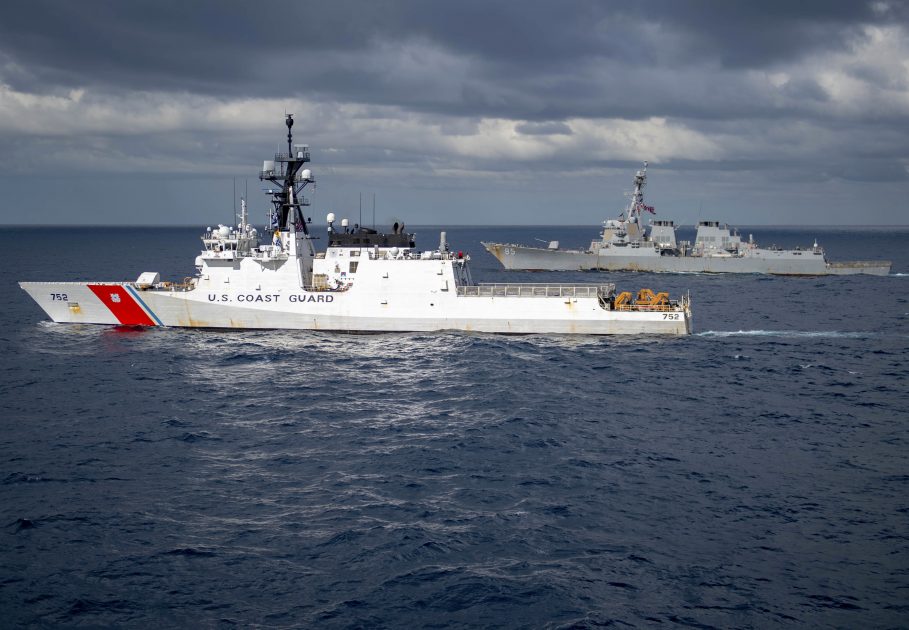
USCGC Stratton (WMSL-752), left, and the U.S. Navy Arleigh Burke-class guided-missile destroyer USS McCampbell (DDG-85) maneuver in formation during Talisman Sabre 2019 on July 11, 2019. US Navy Photo

This is one of those things where I ask myself, what does this really mean? UPI reports five US Navy destroyers, USS O’Kane (DDG-77), USS Howard (DDG-83), USS Chafee (DDG-90), USS Kidd (DDG-100) and USS Michael Murphy (DDG-112) exercised with USCGC Midgett (WMSL-757) and USCGC Oliver Berry (WPC-1124).

The only clue seems to be a quote from USS Michael Murphy’s CO:

“Working with our Coast Guard counterparts has allowed us to expand interoperability between our AEGIS weapons system and their unmanned systems. The Coast Guard is an indispensable partner in an integrated, all-domain naval force,” Maloney said.

The Destroyers are homeported in San Diego, Everett, and Pearl Harbor. Both Midgett and Oliver Berry are homeported in Honolulu. So I presume this happened in the operating areas near Hawaii. None of these destroyers is mentioned as underway in the June 14 US Naval Institute Fleet and Marine Tracker.

The Defense Visual Information Distribution Service quotes Midgett’s captain, Alan McCabe, “Combined operations like this one provide the Coast Guard an opportunity to bolster our interoperability with the Navy and ensure readiness that facilitates a free and open Indo-Pacific consistent with international rules and norms.”

It is likely the Coast Guard is helping with boarding techniques, but the mention of Coast Guard unmanned systems, suggests they are also learning to tap into the information from Midgett’s Scan Eagle.

USS Cod vs USCGC Morro Bay

I got a couple of emails about this, so there is apparently interest. A couple of views of the allision of museum ship, the former USS Cod, with the140 foot icebreaking tug, USCGC Morro Bay in Cleveland. Minor but with a little forethought this would not have happened.

In this video you can see the newly installed boat and davit that were added as part of the in service vessel sustainment program.

USCGC Eagle arrives in Iceland, hosts U.S.-Iceland meeting

Below is a LANTAREA news release. Eagle is in Iceland, but looks like more than a simple portcall.

The vessel seen in the third photo, background, right, is, I believe, the Icelandic Coast Guard cutter ICGV Þór (Thor).

Maybe while there, someone could take a look at this innovative hull form for motor surf boats and RHIBs.

united states coast guard
News Release
U.S. Coast Guard Atlantic Area

USCGC Eagle arrives in Iceland, hosts U.S.-Iceland meeting

USCGC Eagle arriving Iceland
USCGC Eagle wreath-laying for USCGC Hamilton
USCGC Eagle arriving Iceland
VADM Poulin meets with Dept. of State, Iceland leaders
Vice Adm. Steven Poulin, commander U.S. Coast Guard Atlantic Area, shakes hands with Chargé d'Affaires Harry Kamian
Eagle hosts Iceland leaders, CO gives tour

Editors’ Note: To view more or download high-resolution imagery, click on the photos above.

REYKJAVIK, Iceland — USCGC Eagle (WIX 327), “America’s Tall Ship,” arrived in Reykjavik Wednesday and proceeded to host tours and senior officials through the weekend.


Aboard Eagle moored in the harbor, Vice Adm. Steven Poulin, commander U.S. Coast Guard Atlantic Area, joined by Jonathan Moore, principal deputy assistant secretary, Bureau of Oceans and International Environmental and Scientific Affairs, met with Commadore Asgrimur Asgrimsson of the Icelandic coast guard, Chargé d’Affaires Harry Kamian, and Byrndis Kjartansdottir, director of security and defense directorate in the Icelandic Ministry of Foreign Affairs.

“I congratulate Iceland on a successful Arctic Council and Arctic Coast Guard Forum chairmanship, and I thank them for their persistent and reliable partnership in the Arctic Council and Arctic Coast Guard Forum. Maintaining a strong, rules-based order in the Arctic remains a top priority, both for my command and the U.S. Coast Guard. Steadfast partners like Iceland enable and enforce this,” said Vice Adm. Steven Poulin. “It was a great pleasure to discuss the challenges we share with such dedicated colleagues learning more about our partner agencies and their operations.” 

The United States was the first country to recognize Iceland’s independence in 1944. In addition to being founding members of NATO, the United States and Iceland signed a bilateral defense agreement in 1951. Cooperation and mutual support are the foundation of the U.S.-Icelandic relationship. Visits such as Eagle’s allow opportunities to further effective partnerships, collaboration, and interoperability for various issues that can occur in the Arctic.   

For more than a century, the U.S. Coast Guard has been the visible U.S. surface presence in the Arctic, ensuring adherence to the rules-based order. We work with High North nations to safeguard and enable the uninterrupted flow of maritime commerce throughout the entire Marine Transportation System, including the burgeoning Arctic and ensure responsible stewardship of its resources. Allies and partners like Iceland are integral to protecting the United States’ enduring interests, preserving our mutual interests, and upholding the rules-based international order supporting good maritime governance.  

On approach to Iceland, Eagle’s crew conducted a wreath-laying in memory of the Treasury-class USCGC Hamilton (WPG 34), torpedoed by German submarine U-132 on January 30, 1942, patrolling the Icelandic coast near Reykjavík. Hamilton capsized and sank 28 miles (45 km) from the Icelandic coast on January 30, at the cost of 26 of the ship’s 221-person crew. In 2009, divers discovered the wreck in over 300 feet of water, and in 2013, a memorial plaque was placed in honor of those lost.  

Eagle is currently conducting summer U.S. Coast Guard Academy cadet training in at-sea leadership and professional development. Their first port call was Portugal in late May. Eagle has served as a classroom at sea to future Coast Guard officers since 1946, offering an at-sea leadership and professional development experience as part of the Coast Guard Academy curriculum.  


Eagle is a three-masted barque with more than 6,797 square meters (22,300 square feet) of sail and 9.7 kilometers (6 miles) of rigging. At 90 meters (295 feet) in length, Eagle is the largest tall ship flying the stars and stripes and the only active square-rigger in United States government service. For information about Eagle, including port cities, tour schedules, current events, as well as cadet and active duty crewmember photographs, follow the “United States Coast Guard Barque EAGLE” Facebook page or on Instagram @barqueeagle. All U.S. Coast Guard imagery is in the public domain and is encouraged to be shared widely.  

“Passenger Vessel Grounding Shows Risks of Arctic Travel” –Maritime Executive

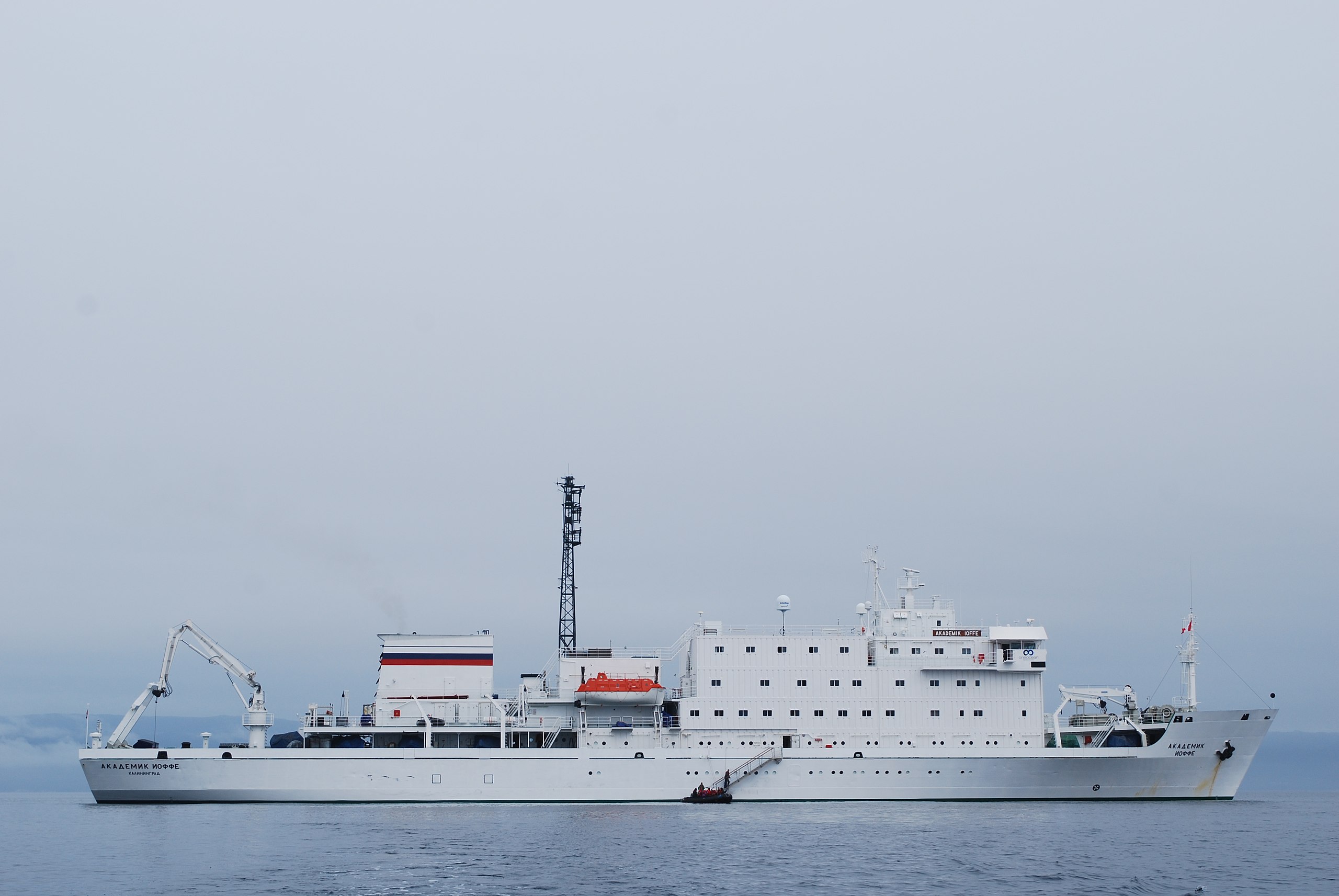
Profile view of the starboard side of the Russian research vessel Akademik Ioffe. The gangway is lowered with a Zodiac at its base. Photo: Ryan Sharpe, via Wikipedia

Maritime Executive reports on the results of an investigation into the 24 August 2018 grounding of a small Russian flag, research vessel turned passenger ship, AKADEMIK IOFFE in the Canadian Arctic.

The area is still not surveyed to the extent we have come to expect in the rest of the world. Not to mention it is a long way between SAR facilities. This could have been a lot worse.

“Bollinger Submits Proposal for U.S. Coast Guard Heritage-class Offshore Patrol Cutter” –News Release

To no one’s surprise, Bollinger is competing for the Phase II Offshore Patrol Cutter Contract. Below is a press release I received today from the Company.

The country is really going need more shipyards capable of building warships. It would not be a bad thing for these Coast Guard contracts provide “trainer wheels” to prepare first Eastern and now a perhaps a second shipyard for even more complex projects. The newly expanded Bollinger might be able to replace now defunct Avondale shipyard.

Bollinger Submits Proposal for U.S. Coast Guard Heritage-class Offshore Patrol Cutter

  • Bollinger Shipyards has the necessary management and production experience, engineering expertise, and facilities
  • Proven record of success executing USCG Detail Design and Construction contracts
  • Project would help sustain Bollinger’s seasoned workforce through 2031

LOCKPORT, La., — (June 11, 2021) – Bollinger Shipyards (“Bollinger”), a privately-held and leading designer and builder of steel military and commercial vessels, today submitted its proposal to the United States Coast Guard to build Stage 2 of the Heritage-class Offshore Patrol Cutter (OPC) program. If chosen, Bollinger would construct and deliver a total of 11 vessels to the U.S. Coast Guard over the next decade, helping to sustain the Bollinger workforce through 2031.

“Bollinger is the right shipyard at the right time to build the Offshore Patrol Cutter program for the U.S. Coast Guard.” said Ben Bordelon, Bollinger President and CEO. “Our long history building for the Coast Guard is unparalleled and has shown time and time again that Bollinger can successfully deliver the highest quality vessels on an aggressive production schedule.”

Bollinger has been actively involved in every step of the U.S. Coast Guard’s OPC acquisition process, including execution of the Stage 1 Preliminary and Contract Design, where the Company was included in the final three shipyards, as well as execution of the OPC Stage 2 Industry Study. This unique experience ensures Bollinger’s understanding of every detail and aspect of the program.

Bordelon continued, “Bollinger has the existing capability and capacity using our proven serial production build strategy and an experienced management team and workforce. Our production approach is based on our established and mature processes and tools, which integrate design development, production, and lifecycle considerations. Our unique experience results in a reliable production schedule and cost so that we can deliver high-quality vessels on time and on budget.”

Notably, in its current program for the U.S. Coast Guard, Bollinger has delivered Sentinel Class Fast Response Cutter hulls 1139 through 1144 a total of 127 days ahead of the contract schedule, despite the incredible challenges of the COVID-19 global pandemic and a historic hurricane season in the Gulf of Mexico impacting Louisiana’s coast.

Bollinger has a long history building for the U.S. Coast Guard, delivering 170 vessels in the last three decades alone. This includes the Island Class (49 delivered), the Marine Protector Class (77 delivered), and now the Sentinel Class (44 of 64 delivered to-date).

About the Offshore Patrol Cutter Program

Offshore Patrol Cutters (OPCs) will provide the majority of offshore presence for the Coast Guard’s cutter fleet, bridging the capabilities of the 418-foot national security cutters, which patrol the open ocean, and the Bollinger-built 154-foot fast response cutters, which serve closer to shore. The OPCs will conduct missions including law enforcement, drug and migrant interdiction, search and rescue, and other homeland security and defense operations. Each OPC will be capable of deploying independently or as part of task groups and serving as a mobile command and control platform for surge operations such as hurricane response, mass migration incidents and other events. The cutters will also support Arctic objectives by helping regulate and protect emerging commerce and energy exploration in Alaska.

About Bollinger Shipyards LLC

Bollinger Shipyards LLC (www.bollingershipyards.com) has a 75-year legacy as a leading designer and builder of high performance military patrol boats and salvage vessels, research vessels, ocean-going double hull barges, offshore oil field support vessels, tugboats, rigs, lift boats, inland waterways push boats, barges, and other steel and aluminum products from its new construction shipyards as part of the U. S. industrial base. Bollinger has 11 shipyards, all strategically located throughout Louisiana with direct access to the Gulf of Mexico, Mississippi River and the Intracoastal Waterway. Bollinger is the largest vessel repair company in the Gulf of Mexico region.

“Enterprise Revisited: Titanium is the USCG Vessel Procurement Magic Bullet” –Marine Link

“Coast Guard Cutter Forward and Coast Guard Cutter Bear, homeported in Portsmouth, Virginia, finish an at-sea transfer while underway on a two-month patrol. Coast Guard Cutter Forward returned to homeport on April 10, 2021.” (U.S. Coast Guard photo)

We all know, the Coast Guard will continue to use cutters long after there nominal life. Maybe we should act on that, by looking at using more durable material. Marine Link talks about how making hulls of titanium could provide significant savings in the long run.

The proposed rationale for maintaining the option of up-arming cutters is also interesting.

I will just quote their conclusion, but take a look at the whole rationale.

“The bigger the Navy (and USCG combination), the cooler it gets. It especially argues for building lots of USCG cutter hulls, but leaving them mostly unoutfitted for naval combat. One can build 20 titanium USCG cutters for the life cycle cost of 10 steel hulls, and make them ready for sea, but only install one ship with the best weapons package. The world will know that you can build something that can dominate the battle space, but there is no need to fit all 20 with the latest and the greatest (which saves enough money to build a couple of additional hulls) if there is no immediate threat of war. Meanwhile the “enemy” will know that when they start to rattle their sabers you will not have 10 (if built in steel) obsolescent hulls, but instead will have access to more than 19 hulls that can be fitted with the hottest weapons much more quickly. This is a much better result than having 10 old “fancy steel” units and actually will defer cost until it is needed. This thinking already works with steel hulls, but if the hulls do not waste away it becomes even more cost effective and further strengthens Dr. Daidola’s argument.

“So here we have three clever engineers who have developed two independent USCG procurement approaches, which each save incredible amounts of money, and, when combined, save even more money.”

“Northrop Grumman to Develop C5ISR and Control Systems for US Coast Guard Offshore Patrol Cutters”

Below is a Northrop Grumman press release.

CHARLOTTESVILLE, Va. – June 8, 2020 – Northrop Grumman Corporation (NYSE: NOC) has been awarded a newly expanded role as systems integrator for C5ISR and control systems on the U.S. Coast Guard Offshore Patrol Cutter (OPC), by Eastern Shipbuilding Group (ESG), the prime contractor for the OPC program.Northrop Grumman to Develop C5ISR and Control Systems for US Coast Guard Offshore Patrol CuttersArtist’s rendition of USCGC ARGUS, the first vessel of the Heritage Class Fleet of Offshore Patrol Cutters. (Image courtesy Eastern Shipbuilding Group)

In a newly expanded role as C5ISR systems integrator, Northrop Grumman is responsible for integrating all cyber hardened C5ISR systems, including command and control, communications, navigation and the shipboard computer networking systems.

“With C5ISR and control system test and integration underway, the ESG-Northrop Grumman team hasn’t missed a beat,” said Todd Leavitt, vice president, maritime systems and integration, Northrop Grumman. “The effort and resiliency shown by our teammates at Eastern Shipbuilding Group has been outstanding.”

Northrop Grumman’s responsibilities for the OPC platform include the integrated bridge, navigation, command and control, computing network, data distribution, machinery control, and propulsion control systems, cyber/information assurance, testing and integration work.

Northrop Grumman solves the toughest problems in space, aeronautics, defense and cyberspace to meet the ever evolving needs of our customers worldwide. Our 90,000 employees define possible every day using science, technology and engineering to create and deliver advanced systems, products and services.