
Military.Com reports on the President’s Coast Guard Academy commencement address.

Military.Com reports on the President’s Coast Guard Academy commencement address.

A short announcement from Baird Maritime, that the Japanese intend to build a new icebreaking research vessel, and that it will be dual fuel capable, e.g. LNG or diesel.
This is becoming more common as users strive to minimize pollution both in port and in the Polar regions.

This article was in the print edition of the Navy League’s magazine, “Seapower.” Unfortunately it is not available on the on-line version of “Seapower.”
Interestingly the only photo with the article was of a light vehicle mounting sensors that appear to be identical to those we saw on a photo of USCGC Charles Moulthrope (WPC-1141) en route to become part of PATFORSWA, based in Bahrain. That sensor is the RPS-42, part of the Marine Air Defense Integrated System (L-MARDIS). This is the system that was credited with downing an Iranian drone that approached USS Boxer.

According to the Seapower article, the Coast Guard began its counter unmanned air system (C-UAS) effort in October 2019, in response to the Preventing Emerging Threats Act of 2018. “…the Coast Guard instituted a pilot program and outfitted two units with and one cutter with C-UAS capability…”
The first line of defense is certainly electronic countermeasures, but apparently we are also considering hard-kill options.
“Also working with the DHS and DOD is Northrop Grumman, which has designed a “hunter-killer” concept for C-UAS missions. In October 2020, the company demonstrated its Mobile Acquisition Cueing and Effector (M-ACE) a vehicle mounted system capable of detecting, identifying, and tracking threats before cueing soft or hard kill effectors, including the company’s own M230 30-by-113-millimeter gun, which fires proximity fuse ammunition.”
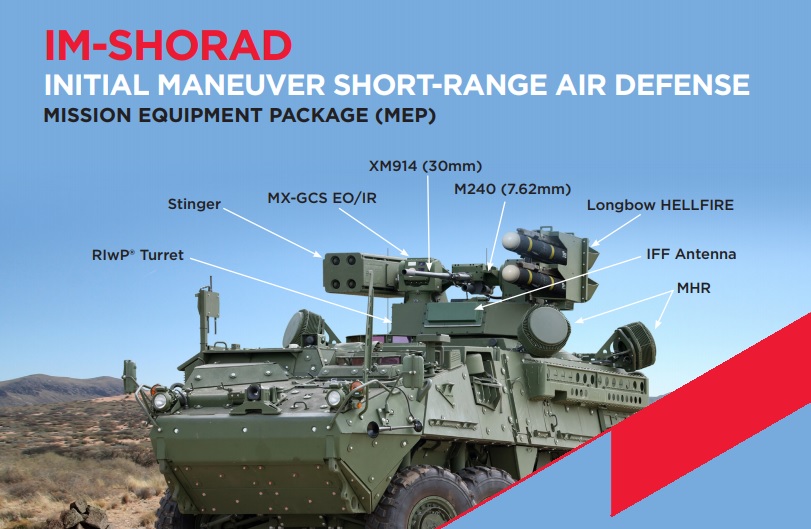
The M230 is actually as lighter weapon than the M242 25mm used in the Coast Guard’s Mk38 mounts, at 130 pounds vs 262 pounds for the M242. It also has a lower muzzle velocity and shorter range. It is, however, the gun used in the Army’s Interim Maneuver Short Range Air Defense System (IM-SHORAD)
.A similar turret could provide cutters with a great deal of flexibility in responding to a broad spectrum of threats. (Note what appear to be RPS-42 radars, labeled MHR, Multi-Mission Hemispheric Radar, mounted on the vehicle below.) The Navy might be interested in a similar turret for their light amphibious warship (LAW).
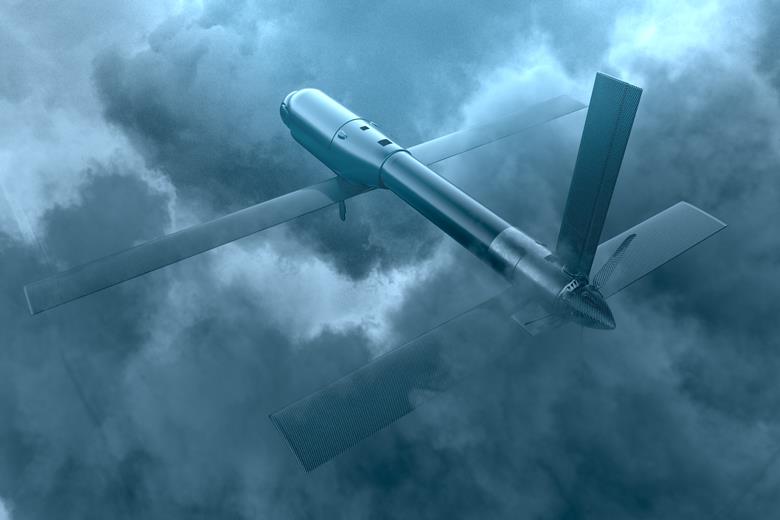
This post was prompted by a recent post, Northrop Grumman Reveals Sky Viper Chain Gun And New Suicide Drone For Future Helicopters (thedrive.com)
We have talked about loitering munitions before, and I think they represent both a threat we need to be prepared to counter and a possible solution to countering small, fast, highly maneuverable surface threats be they manned or unmanned. Switchblade “Loitering Munition”/Puma–Switchblade Sensor to Shooter Capability | Chuck Hill’s CG Blog
Their effectiveness has been proven conclusively in the recent conflict between Azerbaijan and Armenia. What the United States Military Can Learn from the Nagorno-Karabakh War | Small Wars Journal
The US military is looking seriously at these. Top Priority: Marines Want New Loitering Drones « Breaking Defense – Defense industry news, analysis and commentary
US Special Ops is experimenting with integrating them onto some of their small boats. US Special Ops buys AeroVironment’s anti-armour Switchblade 600 loitering munition | News | Flight Global
I’m not going to comment further, but I am going to provide additional links. There has been a lot of discussion about these recently.
The Army Is Testing Arming Its Light Tactical Vehicles With Drones (Updated) (thedrive.com)
The Navy Plans To Launch Swarms Of Aerial Drones From Unmanned Submarines And Ships (thedrive.com)

Naval News reports the availability of a type of sensor I was not even aware of, at least for the maritime environment.
“As far as Thales UK are aware, it is the first acoustic shot detection system that has successfully undertaken a live firing trial on a maritime vessel. Acusonic detects and combines two key sounds associated with incoming hostile fire: the supersonic shockwave of the bullet and the muzzle blast. Unique algorithms in Acusonic’s software then use this data to derive range, bearing and caliber of incoming fire,” said Adrian Rondel of Thales UK.
Certainly in some circumstance, when a vessel takes in coming fire, it may not be clear where the shoots are coming from. Making that determination quickly and accurately could be critical.
Apparently the device can be used even on small craft as seen on an RHIB in the photo above. It is, “…100% protected against solid objects such as dust and sand, and can withstand being submerged for at least 30 minutes in 15 centimeters to 1 meter of water.”

Below is a LANTAREA news release. Additional photos here.
“The New Zealand Defence Force has issued a request for information on design and build solutions for an eventual ice-strengthened offshore patrol vessel that the Royal New Zealand Navy would operate in the Southern Ocean and Antarctic’s Ross Sea for at least four months per year.”
“The RFI anticipates the ship will be 295-377 feet in length (90 to 115 meters-Chuck), with accommodations for 100 people, including 60 crew members, 30 scientific staff and a military helicopter flight crew of 10. The RFI cautions that the ship will traverse “one of the roughest seas in the world.” Waves in the region regularly exceed 33 feet and some are more than 66 feet high.”
The video above, used in this 2014 post, New Zealand’s “OPC” (OPV) in Action, gives a taste of their anticipated operations.
Really sounds like they may be looking at something like Canada’s Arctic Offshore Patrol Ship, but it would require additional accommodations and greater range.
Where will it be built? Not a clue really. New Zealand does not have the shipyard. The latest New Zealand Navy ship, HMNZS Aotearoa, was built in Korea. Their two frigates and two OPVs were built in Australia. Their two frigates recently went through an extensive renovation in Canada. If, as the linked article suggests, either Damen or Fincantieri get the contract, it could be built in Europe, possibly with the basic construction done in Eastern Europe and fitting out completed in Western Europe.


A couple of amazing LEGO projects done by Jason Camlic
Naval News reports the delivery of two Cape Class patrol boats to the Trinidad and Tobago Coast Guard.
“The two 58 metre patrol boats, TTS Port of Spain (CG41) and TTS Scarborough (CG42), were accepted by Lieutenant Commander Francise Paulette Cazoe of the TTCG, at a delivery ceremony held at Austal Australia’s Henderson shipyard today, attended by Western Australia Minister for Minister for Police: Road Safety; Defence Industry; and Veterans Issues, The Hon Paul Papalia CSC MLA.”
The Cape class is also used by the Australian Navy and Border Force. This is the first export of the class.
My August 2019 post, reporting the order for these vessels, provides specifications and compares them with the Webber class WPCs.
A quick video look from the Acquisitions Directorate (CG-9) at the “Top Six Coast Guard Innovations of 2020,” including, where can I take a leak?
A production focused around the winners of the U.S. Coast Guard 2020 Capt. Niels P. Thomsen Innovation Award at Coast Guard Headquarters, Washington DC, April 30. 2021. Six individuals or teams win the award annually for innovations that pushes the Coast Guard forward. (U.S. Coast Guard video by Petty Officer 2nd Class Ronald Hodges)

 Chuck Hill's CG Blog