This Day in Coast Guard History, June 1

Based on the Coast Guard Historian’s timeline, https://www.history.uscg.mil/research/chronology/
With inspiration from Mike Kelso

June 1

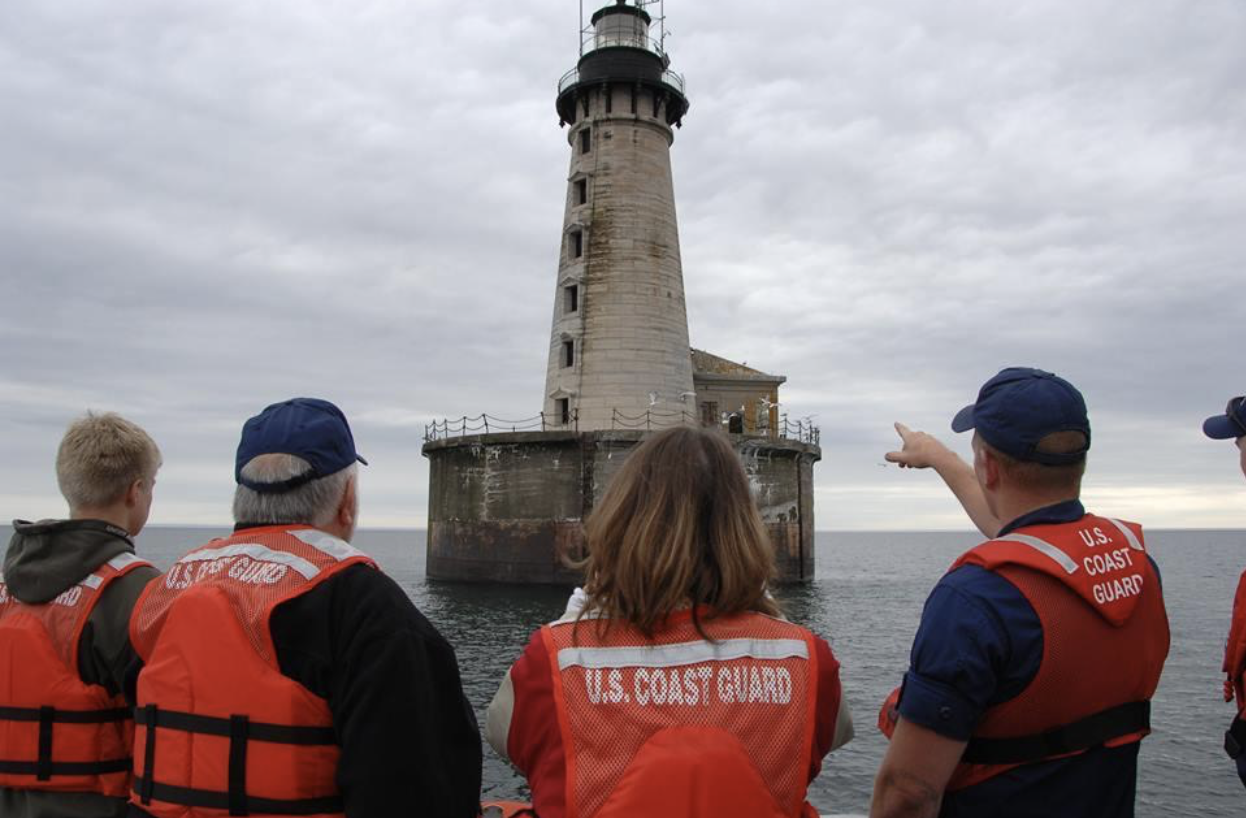
Spectacle Reef Lighthouse

1874  The light was first lit at Spectacle Reef Lighthouse, located on a limestone reef at the northern end of Lake Huron, near the Straits of Mackinac, ten miles from land.  The structure of this lighthouse was similar to that of Minots Ledge, and its construction was “a notable engineering work.”

USCGC Manitou (WYT-60) Operating in the Arctic Ice, during World War II. Note her ice-breaking bow. Photo was taken in Greenland. Catalog #: 26-G-3497

The wooden fishing trawler Belmont was acquired for service for a fee of $2,122 to serve under charter by the Navy “for Coast Guard use as a vessel of the Greenland Patrol.” After conversion, including the addition of two small depth charge tracks and minimal anti-aircraft armament, she was commissioned as a vessel of the Coast Guard on 19 June 1942 and renamed Natsek.

1941  The Navy organized the South Greenland Patrol.  It consisted of three cutters and a Navy vessel.

Callao (IX-205) as the armed German Naval Auxiliary vessel Externsteine off Greenland after being captured by the Coast Guard in October 1944. US Coast photo

1946  The Coast Guard returned to operation under the Treasury Department after the end of World War II.

Memorial Duty 2025. In honor of Memorial Day, #TCCM recruits and permanent party held a wreath laying ceremony at the #USCG Enlisted Memorial. Today especially, we reflect on the service and sacrifice of all American military personnel who died in the performance of their military duties, and to pay tribute to these heroes and to honor the family members they left behind.

1948  The Coast Guard Training Center at Cape May, New Jersey, was established as a receiving center for the initial classification, outfitting, and indoctrination of recruits.  The primary reason for this move from the training station at Mayport, Florida, which was then be decommissioned, was to locate more centrally the Service’s facilities for handling recruits.

Adm. Linda Fagan relieves Adm. Karl Schultz as the 27th commandant of the Coast Guard during a change of command ceremony at Coast Guard headquarters June 1, 2022. Fagan is the first woman service chief of any U.S. military service. U.S. COAST GUARD / Petty Officer 1st Class Travis Magee

2022  ADM Linda L. Fagan is sworn in by POTUS, as the 27th Commandant of the United States, first woman leader of the Coast Guard, and first female uniformed lead of a US Military Service.

This Day in Coast Guard History, May 31

Based on the Coast Guard Historian’s timeline, https://www.history.uscg.mil/research/chronology/
With inspiration from Mike Kelso

May 31

1947  Authority of the U.S. Coast Guard for the establishment and disestablishment of prohibited, restricted, and anchorage areas, conferred by the Espionage Act (50 U.S.C. 191) and Proclamation No. 2412 of June 27, 1940 was terminated by Proclamation No. 2732, signed by the President on this date.

1948  The Coast Guard assumed command of the former Navy base at Cape May, New Jersey, and formally established its east coast recruit training center there the next day.

1963  The Commandant authorized the disestablishment of Light Station Alcatraz, California.

Jack Dempsey (center) wearing a U.S. Coast Guard Commander uniform, watches two seamen loading twin 40mm anti-aircraft guns, circa 1942 to 1944. USCG Photo

1983  Former world heavyweight boxing champion Jack Dempsey passed away at the age of 87.  He served in the Coast Guard during World War II and achieved the rank of commander.

1988  The first search and rescue agreement with the Soviet Union was signed at a summit in Moscow.  The agreement set a general line, or boundary, separating SAR regions and provided for exchange visits to SAR coordination centers in both countries, joint SAR exercises, and regular communication checks. (Not the same thing but interesting.)

USCGC Fir (WLM 212), ex-USCGC Fir (WAGL 212), Commissioned USCGC Fir (WAGL 212) 1 October 1940 at Seattle, WA.

1988  CGC Fir became the oldest cutter in commission after CGC Ingham was decommissioned this day in 1988.

The Coast Guard cutter Boutwell,’ foreground, is seen escorting the Liberian-flagged vessel ‘Command’ Tuesday, Oct. 6, 1998, in international waters. AP Photo by US Coast Guard

2009  USCGC Boutwell arrived in the port of Tubruq, Libya, during its around-the-world cruise, becoming the first U.S. military ship to visit Libya in more than 40 years.

2013  Coast Guard Group Humboldt Bay, the Coast Guard command responsible for operations from the California-Oregon border south to the Mendocino-Sonoma county line, was renamed Coast Guard Sector Humboldt Bay during a formal ceremony.

Response Boat Medium (RB-M)–Video

Stumbled across the video above. It is extremely well done. It is very insightful including some good graphics.

Obviously the crew members were loving what they were doing. Looked like they were having fun and were proud of what they were doing.

The video would make a good intro for any future RB-M crew members. It could also be a recruiting video.

We could do worse than have this guy create a series of 30 minute TV programs just going around from station to station talking about the equipment and to the crew members about what they do. It would have the same kind of appeal as the very successful low budget program “Dirty Jobs.”

The amazing maneuverability also made me want to see jet drives on our bigger vessels.


This Day in Coast Guard History, May 29 / 30

Based on the Coast Guard Historian’s timeline, https://www.history.uscg.mil/research/chronology/
With inspiration from Mike Kelso

May 29

USCGC Dallas

1995  A request from the Commander in Chief of Naval Forces Europe led to the deployment of CGC Dallas, under the command of Captain Joseph Jones, USCG, to the Mediterranean.  Dallas departed Governors Island on May 29, 1995 and visited ports throughout the Mediterranean and Black Sea, including Istanbul and Samsun in Turkey; Durres, Albania; Varna, Bulgaria; Constanta, Romania; Koper, Slovenia; Taranto, Italy; and Bizerte, Tunisia.  The crew trained with naval and coast guard forces in each country.  She deployed for a few days with the Sixth Fleet and served as a plane guard for the USS Theodore Roosevelt.  The crew was also able to coordinate schedules with six NATO and non-NATO nations to conduct boardings.  She returned to the U.S. in August and arrived at Governors Island on August 28, 1995.

May 30

Morris Island (vicinity), South Carolina. Ruins of Charleston lighthouse
cropped Shows an observation tower built on the lighthouse ruins cropped. Haas & Peale, photographer.

1767  The Charleston Lighthouse was built on Morris Island, South Carolina.  The first stone of the tower was laid on this date.

1996  The 8th and 2nd Coast Guard Districts were combined to form the new 8th Coast Guard District.

Cutter Yocona towing environmental bouy (EB-16) off of San Diego underway for deployment. May 19,1975.

1996  CGC Yocona was decommissioned in Kodiak, Alaska.  Yocona had been in Coast Guard service since 1946.

First U.S. Coast Guard-Sponsored Medical Student Graduates from Uniformed Services University

USU graduated its first U.S. Coast Guard-sponsored medical student, Elise Bobczynski. (Photo credit: Tom Balfour, USU)

Uniformed Services University News reports,

In a historic milestone, USU graduated its first U.S. Coast Guard-sponsored medical student. Ensign Elise Bobczynski was commissioned as a physician into the Coast Guard by Rear Adm. Paul Jung, the Coast Guard’s Chief Medical Officer. Her graduation marked a significant step in the Service’s effort to expand its organic medical capabilities and address the growing need for uniformed physicians.

This is great, that the Coast Guard should have its own commissioned full time Coast Guard doctors rather than relying on Public Health Service, doctors on loan from other services, or contracted civilians.

I have a personal interest in this in that my daughter also graduated from the Uniformed Services University, became a Navy flight surgeon, served two tours in Iraq with a Marine helicopter squadron doing casualty evacuation. Uniformed Services University is a great opportunity.

I have to thank “librarydoc” for bringing this to my attention. He (or she) referenced the link in a comment on an earlier post, but it was stuck in the moderation queue and I did not recognize it until today, sorry it took so long.

This Day in Coast Guard History, May 28

Based on the Coast Guard Historian’s timeline, https://www.history.uscg.mil/research/chronology/
With inspiration from Mike Kelso

May 28

A painting by Peter Rindlisbacher of the Cutter James Madison capturing the British merchantman Shamrock. Credit: Coast Guard Collection

1813  Revenue Cutterman John Bearbere died of pneumonia while being held as a Prisoner of War by the British after his cutter, James Madison, was captured by the Royal Navy frigate HMS Barbadoes near Savannah, Georgia on November 24, 1812 during the War of 1812.  He was one of five crewmen captured aboard the cutter who died in captivity.  James Madison had only recently captured and seized the 300-ton, six-gun British brig Shamrock in July 1812.

USCGC Icarus (WPC-110) arriving at Charleston Navy Yard with prisoners of war from the U-boat U-352, 10 May 1942, US Navy photo

1938  CGC Icarus, patrol boats CG-176 and CG-135 as well as motor lifeboats from stations Rockaway Point and Sandy Hook responded to a distress call after the collision of two vessels, the SS Acadia and SS Mandalay, in New York Harbor.  The Coast Guard vessels safely transported to New York City all 325 passengers and crew from the Mandalay which sank soon after the collision.

1947  The Coast Guard announced the disestablishment of all U.S. Coast Guard Merchant Marine Details in foreign ports.  During World War II, a total of 36 foreign Merchant Marine Details had been activated for the purpose of performing “on-the-spot” services in connection with the preventive aspects of safety of life and property of the US Merchant Marine.  These functions reverted to the continental U.S. ports in which there were located U.S. Marine Inspection Offices.  The Merchant Marine Details disestablished were located in the following ports: Antwerp, Belgium; Bremerhaven, Germany; London, England; Cardiff, Wales; Le Havre, France; Marseille, France; Naples, Italy; Piraeus, Greece; Shanghai, China; Manila, Philippine Islands; and Trieste, Venezia Giulia.

1984  The first Marine Safety Information System (MSIS) module was deployed Coast Guard-wide.  The Port Safety Module replaced the Interim MSIS system, first established when the Port and Tanker Safety Act of 1978 was passed, to provide field units with vessel histories.  The replacement module was vital in the day-to-day execution of Port Safety and Marine Violation functions.

“Philippines Inks Deal with OCEA for 40 Coast Guard Patrol Boats” –Naval News

A 3D rendering of the Philippine Coast Guard’s future FPB 110 MKII. OCEA photo

Naval News reports,

“French shipbuilder OCEA signed a contract for the construction and basing support of 40 fast patrol boats for the Philippine Coast Guard on Thursday, marking the largest investment by Paris into Manila’s maritime security efforts to date.

“These fast patrol craft will be based on OCEA’s FPB 110 MKII design, which comes in at 35 meters long and weighs 110 tons. The vessels are more capable than the existing four OCEA FPB 72s in service, which are used for littoral patrol and rarely operate into the South China Sea. According to company infographics, the FPB can reach speeds up to 28-35 knots. The vessels can also operate out to 700 nautical miles at 12 knots. OCEA claims that the vessels can conduct missions relating to territorial and deep sea surveillance operations, control of vessels at sea, and “sovereignty.” It should be noted that while there is a space for a deck gun, this is not depicted in 3D graphics of the vessels.”

These will be a bit larger than the Island class WPBs at about 115 feet and will have an Aluminum hull providing greater fuel economy.

That they would have no permanently installed gun mount should not be a surprise since no Philippine Coast Guard vessels have any weapon larger than a .50 caliber machine gun.

The illustration above suggests that the Philippine OCEA’s FPB 110 will have a single arm davit for a launching their RHIB on the port side.

This contract was not unexpected, but the boats are large than originally expected “Philippine Coast Guard to Receive 40 Patrol Boats from France in $438 Million ODA Project” –USNI

OCEA is an experienced patrol boat builder. Some previous projects:

This Day in Coast Guard History, May 27

Based on the Coast Guard Historian’s timeline, https://www.history.uscg.mil/research/chronology/
With inspiration from Mike Kelso

May 27

Quarantine Flag at the time

1796  Congress passed “An Act relative to Quarantine” and assigned “officers. . .[of the] revenue cutters, to aid in the execution of quarantine, and also in the execution of the health laws of the states.” This Act was repealed with the 1799 Act (1 Stat. L., 619).

Elmer Stone, Coast Guard Aviator #1

1919  The U.S. Navy’s flying boat NC-4, piloted by First Lieutenant Elmer F. Stone, USCG, landed in the Tagus River estuary near Lisbon, Portugal on May 27, 1919, thereby completing the first successful trans-Atlantic flight.  Stone was decorated that same day by the Portuguese government with the Order of the Tower and Sword.

Sculptured relief on the facade of the United States Department of Commerce Building in Washington, D.C.

1936  Public Law 622 reorganized and changed the name of the Bureau of Navigation and Steamboat Inspection Service to Bureau of Marine Inspection and Navigation (49 Stat. L., 1380).  The Bureau remained under Commerce Department control.

1943  Douglas Munro’s posthumous Medal of Honor was given to Douglas Munro’s parents, Mr. and Mrs. James Munro of South Cle Elum, Washington, by President Franklin D. Roosevelt in a ceremony at the White House on Thursday, May 27, 1943.  The citation read: “Awarded posthumously to DOUGLAS ALBERT MUNRO, SIGNALMAN FIRST CLASS, U.S. COAST GUARD ‘For extraordinary heroism and conspicuous gallantry in action above and beyond the call of duty as Office-in-Charge of a group of Higgins boats, engaged in the evacuation of a Battalion of Marines trapped by enemy Japanese forces at Point Cruz, Guadalcanal, on September 27, 1942.  After making preliminary plans for the evacuation of nearly 500 beleaguered Marines, Munro, under constant risk of his life, daringly led five of his small craft toward the shore.   As he closed the beach, he [signaled] the others to land, and then in order to draw the enemy’s fire and protect the heavily loaded boats, he valiantly placed his craft with its two small guns as a shield between the beachhead and the Japanese.   When the perilous task of evacuation was nearly completed, Munro was killed by enemy fire, but his crew, two of whom were wounded, carried on until the last boat had loaded and cleared the beach.  By his outstanding leadership, expert planning, and dauntless devotion to duty, he and his courageous comrades undoubtedly saved the lives of many who otherwise would have perished.  He gallantly gave up his life in defense of his country.'”

USS Bennington (CV-20) A memorial to the victims of the 1954 explosion was erected at Fort Adams in 2004.[1]

1954  The aircraft carrier USS Bennington (CV-20), with about 2,000 persons aboard, suffered an explosion and fire 35 miles south of Brenton Reef Lightship, injuring some 100 persons.  U.S. Coast Guard aircraft from Salem Air Station and Quonset Point proceeded to the scene, assisted in transporting medical personnel to Bennington and provided air cover for all helicopter operations.  One of the Coast Guard’s helicopters made seven landings aboard the aircraft carrier and transported 18 injured to the hospital; another transported 14 injured.

The 82-foot patrol boats of Squadron One (RONONE) deploying from Subic Bay in the Philippines to the theater of operations in Vietnam. (U.S. Coast Guard)

1965  Coast Guard Squadron One was commissioned for service with Operation Market Time in Vietnam.

1996  While on leave, Coast Guardsman Kevin S. DeGroot rescued 12 people who had been thrown into the water when their boat capsized.  For his “extreme and heroic daring” that day, he was awarded the Gold Life-Saving Medal.

Date of Award: January 24, 1997

For extreme and heroic daring on 27 May 1996, when a 17-foot pleasure boat capsized, throwing 12 people into the violently surging waters of Pensacola Bay, Florida.  Petty Officer DeGroot was on leave, sightseeing in downtown Pensacola, when he was alerted to the overturned vessel with people in the water, directly off the seawall.  He immediately ran to the scene and joined others in pulling the victims out of the choppy water.  Alerted to the possibility of three children trapped under the boat, Petty Officer DeGroot jumped into the 6-foot swells, swam to the overturned vessel, and repeatedly dove under the boat as it pounded against the seawall, searching for the missing children.  On his fourth dive Petty Officer DeGroot located a 5-year-old girl, unconscious and tangled in the boat’s lines.  He fought to free her enough to bring her from under the capsized vessel.  Once again treading the rough water at the surface, he struggled to keep her head above the swells while he disentangled her from the lines around her legs.  Petty Officer DeGroot swam with the unconscious girl to rescuers waiting to assist on the seawall.  Climbing hand-over-hand up a lowered set of automotive jumper cables, Petty Officer DeGroot raised the young girl to the point where a hopeful rescue team could pull her to the top of the wall.  A waiting paramedic was able to successfully resuscitate the young victim after she had been underwater for at least 15 minutes.  Although suffering from extreme exhaustion, Petty Officer DeGroot remained in the water to attach a towline to the drifting boat and retrieved a life preserver for another victim struggling to stay afloat until rescued.  Petty Officer DeGroot’s determined efforts, outstanding initiative and fortitude during this rescue resulted in the saving of one life.  His unselfish actions and valiant service, despite imminent personal danger, reflect great credit upon himself and are in keeping with the highest traditions of humanitarian service.

080827-N-4044H-152 BATUMI, Georgia (Aug. 27, 2008) A pallet of humanitarian assistance supplies is offloaded from the U.S. Coast Guard Cutter Dallas (WHEC 716). Dallas arrived with more than 76,000 pounds of humanitarian supplies to be given to the people of Georgia. The supplies are in response to the request of the government of the Republic of Georgia. Dallas is part of Combined Task Force 367, the maritime element of the U.S. humanitarian assistance mission to Georgia. (U.S. Navy photo by Mass Communication Specialist 3rd Class Eddie Harrison/Released)

2008  CGC Dallas departed Charleston, South Carolina for a planned 4-1/2 month deployment to conduct maritime safety and security exchanges with countries along the central and west coasts of Africa, the Mediterranean, and the Black Sea.  It was an historic voyage that included delivering relief supplies to Georgia after that country was attacked by Russia in “Operation Assured Delivery (she was the second U.S. military ship to deliver relief supplies to Georgia) and a port visit to Sevastopol, Ukraine.

USCGC Stratton in the Philippines

The Legend-class USCGC Stratton (WMSL 752) sails with Philippine Navy’s Gregorio del Pilar-class patrol ship BRP Ramon Alcaraz (PS-16) (former USCGC Dallas) and Philippine Coast Guard Vessel BRP Melchora Aquino (MRRV-9702) as part of a division tactics exercise in the Sulu Sea, May 20, 2025. Stratton is deployed and assigned to Destroyer Squadron (DESRON) 15, the Navy’s largest DESRON and the U.S. 7th Fleet’s principal surface force. The U.S. Coast Guard has operated in the Indo-Pacific for more than 150 years, and the service is increasing efforts through targeted bilateral patrols with our national security cutters, fast response cutters, and other activities conducted in support of maritime missions to enhance our regional partnerships. (U.S. Coast Guard photo by Petty Officer 3rd class William Kirk)

Below the line is a report of Alameda based USCGC Stratton’s visit to the Philippines at the start of a Western Pacific deployment. The report mentions exercising “with the Armed Forces of the Philippines and the PCG.”

“Following their departure, Stratton’s crew conducted a bilateral Maritime Cooperative Activity (MCA) …The MCA included exercises in maritime domain awareness, division tactics, maneuvering, and visit, board, search and seizure procedures.”

Following the link above we learn,

Participating units included the Legend-class cutter USCGC Stratton (WMSL-752) and a P-8A Poseidon maritime patrol and reconnaissance aircraft from the U.S. Navy, as well as the Philippine Navy’s Gregorio del Pilar-class patrol ship BRP Ramon Alcaraz (PS16); Acero-class patrol gunboats BRP Gener Tinangag (PG903) and BRP Domingo Deluana (PG905); an AW109 naval helicopter; the Philippine Air Force’s Super Tucano and Sokol helicopters; and the Philippine Coast Guard’s Teresa Magbanua-class patrol vessel BRP Melchora Aquino (MRRV 9702).

That is a pretty substantial exercise, US Navy, Philippine Navy, and Philippine Air Force in addition to US and Philippine Coast Guards.

While the Philippine Coast Guard has many of the trappings of a military service, they are not nearly as well armed as their Chinese, US, and Japanese counterparts. Their most powerful weapon seems to be .50 caliber machine guns. If they get into an armed confrontation with the Chinese, they cannot go it alone. Notably this was not a SAR exercise. Perhaps the idea was to practice coordination of support for the Philippine Coast Guard in their interactions with the Chinese, making sure the Philippine CG can communicate with the Philippine Navy and Air Force and with US assets in the area.

Army Recognition’s Naval News also has a report on the exercise which mentioned that Japanese built Philipine WPC BRP Malapascua (MRRV 4403) also participated in the exercise. “Philippine and US Naval Forces Conduct First Joint Maritime Exercise to Strengthen Indo-Pacific Maritime Security


May 24, 2025

U.S. Coast Guard Cutter Stratton departs Philippines, commences months-long Indo-Pacific patrol

PUERTO PRINCESA, Philippines — The U.S. Coast Guard Cutter Stratton (WMSL 752) and its crew departed Puerto Princesa, Philippines, Monday, after in-port engagements and visits with the Philippine Coast Guard (PCG), the U.S. Ambassador to the Republic of the Philippines MaryKay Carlson, U.S. embassy staff, and PCG District Palawan senior leadership.

Stratton’s visit to Puerto Princesa marked the first international port call of their months-long deployment to the Indo-Pacific region.

Following their departure, Stratton’s crew conducted a bilateral Maritime Cooperative Activity (MCA) with the Armed Forces of the Philippines and the PCG within the Philippines’ exclusive economic zone. The MCA included exercises in maritime domain awareness, division tactics, maneuvering, and visit, board, search and seizure procedures.

These engagements demonstrate the U.S. commitment to maritime governance that supports security, freedom and prosperity in the region.

The U.S. Coast Guard serves as a unique instrument of national power, bridging defense, diplomacy and law enforcement to further national objectives and mutual interests with allies and partners like the Philippine Coast Guard.

During the visit, Stratton’s commanding officer, Capt. Brian Krautler, welcomed Amb. Carlson, PCG Commandant Adm. Ronnie Gil Gavan, and senior PCG leaders aboard Stratton, highlighting U.S. Coast Guard interoperability with allies.

“Our alliance with the Philippine Coast Guard has cultivated a close, collaborative maritime partnership—this is Stratton’s second deployment to the Philippines during my two years aboard as commanding officer,” Krautler said. “Our enduring partnership enables combined effects and cooperation across a broad spectrum of engagements and operations. Stratton’s deployment to the Indo-Pacific will further strengthen our relationships with allied coast guards and services throughout the region.”

The U.S. Coast Guard works closely with regional allies to deliver a broad range of capabilities in support of a prosperous and secure Indo-Pacific. Multilateral operations like the at-sea MCA and in-port engagements enhance cooperation, improve interoperability and strengthen readiness.

While moored, Krautler and Stratton’s leaders also met with the WESTCOM Commander PCG District Palawan for a pre-sail planning meeting to discuss bilateral search and rescue exercises (SAREX) to enhance cooperation. At-sea operations and exercises with the Philippine Coast Guard will strengthen the ability to execute coordinated maritime operations and enhance overall mission readiness.|

The U.S. Coast Guard’s commitment to a prosperous and secure Indo-Pacific requires working closely with regional allies, allowing the service to improve its logistics flexibility to better deliver a broad range of capabilities.

During the patrol, Stratton is scheduled to engage with regional partners and participate in joint operations aimed at enhancing maritime safety and security. Throughout its Indo-Pacific deployment, Stratton is assigned to Destroyer Squadron (DESRON) 15, the Navy’s largest DESRON and the U.S. 7th Fleet’s principal surface force. DESRON 15 regularly assumes tactical control of surface units operating in the area.

Stratton’s port call to the Philippines marks the cutter’s third visit following stops in 2019 and 2023. Consistent U.S. Coast Guard national security cutter deployments to the region demonstrate the U.S. commitment to strong maritime governance that supports security, freedom and prosperity in the Western Pacific.

Commissioned in 2012, Stratton is one of ten Legend-class national security cutters and one of four homeported in Alameda, California. National security cutters are 418 feet long, 54 feet wide and have a 4,600 long-ton displacement with a top speed of 28 knots, a range of 12,000 nautical miles and can hold a crew of up to 170. National security cutters routinely conduct operations throughout the Pacific, where their combination of range, speed and ability to operate in extreme weather provides mission flexibility.

The namesake of U.S. Coast Guard Cutter Stratton is Capt. Dorothy Stratton, who led the service’s all-female reserve force during World War II. Dorothy Stratton was the first female commissioned officer in the Coast Guard and commanded more than 10,000 personnel. The ship’s motto is “We can’t afford not to.”

This Day in Coast Guard History, May 26

Based on the Coast Guard Historian’s timeline, https://www.history.uscg.mil/research/chronology/
With inspiration from Mike Kelso

May 26

1906  Congress passed an act to regulate enlistments and punishments in Revenue Cutter Service was passed.

1924  Congress passed the “Immigration Act of 1924,” (Pub. L. 68-139; 43 Stat. 153) that limited the number of immigrants annually who could be admitted to the U.S. to two percent of the number of people from that country who were already living in the U.S. in 1890.  This was a one percent reduction from the three percent limit established by Congress in 1921.

Admiral Paul A. Yost Jr. US Coast Guard photo.

1988  Admiral Paul Yost, Commandant, explained the new “Zero Tolerance” initiative to Congress’s Subcommittee on the Coast Guard and Navigation.  Yost noted: “The Coast Guard Zero Tolerance policy is that, subject to statutory and jurisdictional limitations, individuals possessing measurable quantities of controlled substances aboard vessels will be subject to the full extent of available criminal and civil sanctions…Zero Tolerance means that the Coast Guard, in the course of its regular patrols, boardings and inspections, will now, within the limits of the law, seize vessels and arrest individuals when ‘personal use’ quantities of illegal drugs are discovered.”

1995  The Secretary of Transportation authorized the involuntary recall of 300 reservists to assist in the relief efforts in the Midwest after the Missouri and Mississippi rivers flooded.  However, only 143 were called to duty.  (See the May 2, 1995 entry.)