Surface Navy in the Arctic

The Coast Guard has been at this for quite a while, but for the first time in about 27 years, the Surface Navy has ventured north of the Arctic Circle in force. Its been a learning experience for the fleet and for the people of Reykjavik, Iceland

They are participating in Exercise Trident Juncture, taking place in and around Nordic Europe Oct. 25 to Nov. 23, including the Baltic Sea, Iceland, and the airspace of Finland and Sweden. There are expected to be “More than 50,000 participants – including 14,000 U.S. service members – … utilizing approximately 150 aircraft, 65 ships and more than 10,000 vehicles in support of the exercise.”

US Navy units include the Harry S. Truman Carrier Strike Group (HSTCSG) with the carrier, a cruiser, and four destroyers and the Iwo Jima Amphibious Ready Group (ARG), USS Iwo Jima (LHD-7), USS New York (LPD-21) and USS Gunston Hall (LSD-44).

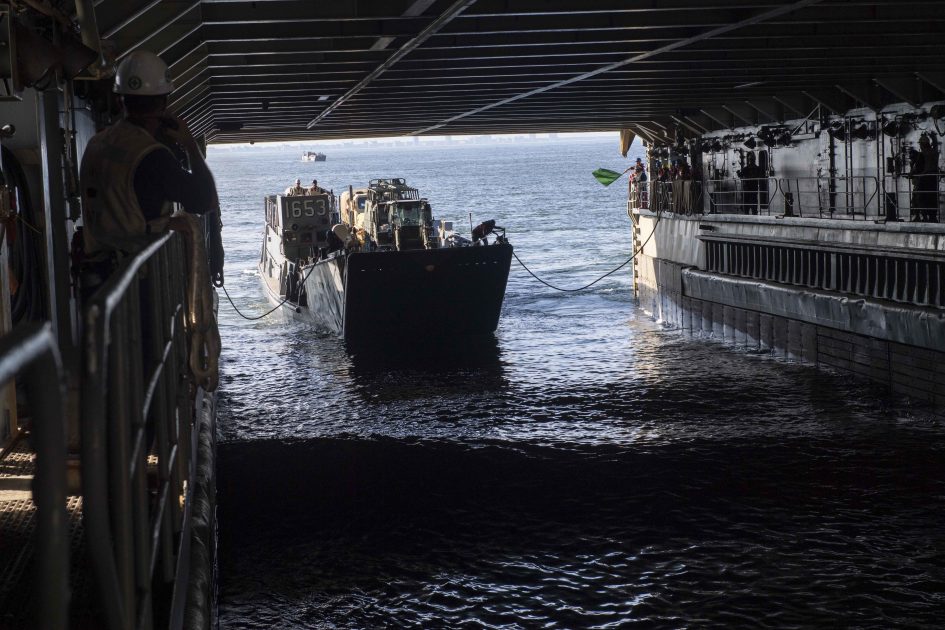
A landing craft utilities (LCU) enters the well deck of the Whidbey Island-class dock landing ship USS Gunston Hall (LSD 44) on Oct, 3, 2018, to embark on the ship for Trident Juncture 2018. US Navy photo.

Apparently Gunston Hall experienced some minor injuries and damage.

According to a Navy news release, “the amphibious dock landing ship USS Gunston Hall (LSD-44) experienced heavy seas during the evening of Monday, October 22, 2018. As a result, the ship’s Landing Craft Utilities (LCU) and well deck experienced damage. The Gunston Hall is in port Reykjavik, Iceland for further assessment….Amphibious transport dock USS New York (LPD-21) also returned to port as a precautionary measure…”

But now we hear from the poor victims in Iceland. 7000 sailors and marines invaded the town of Reykjavik (population about 125,000) and drank all their beer.

Will We Start Seeing LCS in SOUTHCOM?

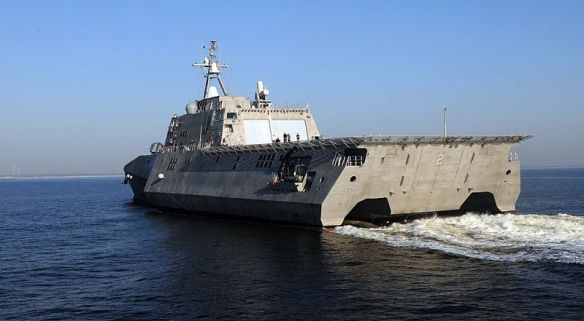
USS Independence (LCS-2)

Are we going to see any Littoral Combat Ships (LCS) joining the Coast Guard in interdicting drugs? They seem to be saying yes, but the level of effort, and when it will start, is still not clear. In April DefenseNews reported, “The Pentagon is poised to send the LCS to thwart narcos.,” but then the first line said they were “poised to decide,” which is not really the same thing.

The report indicated that four ships would deploy in 2019 (“The Navy has been piecing together a strategy to get at least four ships back down to SOUTHCOM to perform counter-drug ops.), and that 24 LCS deployments are planned between 2019 and 2024.

August 22 we had another DefenseNews report, “Newly reorganized littoral combat ship program faces its first big test in 2019,” that reported , “Four littoral combat ships are on track to be available to deploy in 2019,” but it is still unknown when that will be, for how long, and even what kind of deployment.

SOUTHCOM and others are pushing for additional assets from the Navy, but it is unclear what, if any, additional support he will be given.

Both articles had the same quote from Secretary of Defense Mattis,

“Is it primarily law enforcement? Do they need to have people with badges, which would mean Coast Guard cutters were going to have to shift and go to the Department of Homeland Security? Or is it LCSs, because of the nature of an evolving threat?” Mattis said. “We don’t have the answer yet, sir, but we’re working it.”
I find that statement a bit troubling. It looks like SecDef does not know how the ships are used. There certainly seems to be no urgency. So when will we see them? Given the current lack of commitment, probably not until mid to late 2019 at best, and even then we are unlikely to see all four committed to SOUTHCOM. The Navy will probably want to send at least one to IndoPacific Command (INDOPACOM) and one to Central Command (CENTCOM).
Ships expected to be deployed in 2019 are two of the trimaran Independence class,
USS Montgomery (LCS-8) and USS Gabrielle Giffords (LCS-10), both based in San Diego, and two mono-hull Freedom-class, USS Detroit (LCS-7) and USS Little Rock (LCS-9), both based in Mayport. One of these, USS Detroit is now expected to deploy with Naval Strike Missile installed. I can’t believe they have accelerated integration of this anti-ship cruise missile so that they could go chase drug runner. Detroit is likely to go to INDOPACOM, although it might pass through SOTHCOM AOR in transit.
There are potentially a couple of interesting things to watch if they do deploy.
  • How long can they deploy given their apparent strong dependence on contractor support and the short cruising range of particularly the mono-hull Freedom class? Hopefully deployment will be more than a photo-op.
  • If they bring an MQ-8 Fire Scout, particularly the larger “C” model which the Coast Guard has not had a chance to try, it will be interesting to see how useful it is for a Coast Guard mission.

MQ-8C Fire Scout Ground Turns and Telemetry Testing onboard USS Montgomery (LCS 8)

Photo: MQ-8C seen in the hangar of USS Montgomery (LCS-8)


“YOU MIGHT BE A COASTIE, IF…”

Misappropriated this from Fred’s Place Tribute Group on Facebook. Feel free to add more in the comments. 

Image may contain: text

1. You know instantly that “work smarter, not harder” means billet cuts.
2. People ask you what you’re doing beyond the three mile limit.
3. You get married to move out of the barracks.
4. You precede every public speech with, “I was going to tell a sea story, but seeing the lack of Cutterman’s pins out there, you all just wouldn’t understand.”
5. An Alaskan cruise is not an option for your honeymoon.
6. You are still trying to figure out what TQM was all about.
7. You’ve ever laughed when watching the CG commercial at 0300 and wondered why all they show is helo’s and small boats.
8. You’ve successfully avoided at least one inspection, Change of Command, or urinalysis.
9. After boot camp, you’ve never fired a rifle.
10. You hear a HH-65 and DON’T look up.
11. Your port calls have more bars in them than people.
12. You consider the door falling off your aircraft natural air conditioning.
13. While underway, a life raft comes loose, hits you on the head and you’re counseled for “loss of situational awareness.”
14. Members of other branches of the service visit your workspace and they shout “Wow, I haven’t seen one of these in 20 years.”
15. Your idea of aroma therapy is Simple Green and JP5.
16. Any time you set out on a trip you expect to hear, “make
preparations for getting underway.”
17. When you come home with armloads of groceries you shout, “All hands lay to the driveway for stores.”
18. You catch yourself speaking to your children in the same tone of voice you use with your non-rates …. or is it the other way around?
19. It seems every time you watch a movie it says on the bottom of the screen “Property of the US Navy.”
20. If you had people say to you “The Coast Guard is military?”
21. If getting to sleep after the mid-watch was ever difficult due to the ever-present sun above throwing your system off.
22. If your ship is handed a list of businesses, your crew is not welcome at during their port call.
23. You’ve left a port with more than one sign from the naval base.
24. You’ve woken up in the “red zone” in Panama.
25. WMEC mean ‘We Must Eat Chicken’ to you.
26. If your 40 year old cutter is getting underway on Monday for a 6-week patrol, you still make plans for the weekend because you know there will be CASREP within 2-3 days.
27. You know you’re a Coastie when your ship sends an emergency CASREP for the broken coffee maker.
27. You might be a Coastie if the Marines get upset when they see you use real bullets in your weapon.
28. If your child refers to the boat or station as “where Daddy lives”
29. You claim to have a woman in every port, yet you are on your fourth tour at a shore station.
30. Your wife and/or girlfriend are active duty Coast Guard women.
31 You run from the kitchen, trip over the dog, fall and hit your head on the coffee table just to see a 15 second blip on TV when you hear the words “Coast Guard”.
32. You PANIC when you have to wear nice civilian clothes because you can’t color coordinate, for you know no other color than blue.
33. Your wife looks at you strange and spouts out, “You’re not my Chief, and I sure as hell ain’t one of your deck-apes.”
34. You tell your children that Fridays are “field days”.
35. You can get in an alcohol incident and get a rate advance in the same week.

ALCOAST 366/18 – OCT 2018 U.S. NAVAL INSTITUTE’S GENERAL PRIZE ESSAY CONTEST

Just passing this along. the ALCOAST is repeated below. Note the contest is open to anyone. 

R 181223 OCT 18
FM COMDT COGARD WASHINGTON DC//CG-09//
TO ALCOAST
UNCLAS//N05700//
ALCOAST 366/18
COMDTNOTE 5700
SUBJ: U.S. NAVAL INSTITUTE’S GENERAL PRIZE ESSAY CONTEST
A. Coast Guard External Affairs Manual, COMDTINST M5700.13 (series)
1. This ALCOAST announces the U.S. Naval Institute’s annual General Prize Essay Contest.
2. Overview. Located at the U.S. Naval Academy in Annapolis, MD, the U.S. Naval Institute (USNI), a private, non-profit, non-partisan organization, has provided an open forum for honest debate, informed discussion, and professional development for members of the Naval Services since 1873. The vision and mission of USNI is to give a voice to those who seek the finest Navy, Marine Corps, and Coast Guard by providing an independent forum for those who dare to read, think, speak, and write to advance the professional, literary, and scientific understanding of sea power and other issues critical to global security. USNI is noted for its flagship magazine Proceedings, and a variety of historical and professional books.
3. General Prize Contest. This year’s annual General Prize Essay Contest challenges authors to dare to write to advance the professional, literary, and scientific understanding of sea power and other issues critical to national defense. Authors are encouraged to discuss the most compelling issues, ideas, and solutions. There is no restriction on topic. Those authors who choose to write about the Coast Guard are encouraged to advance new thinking about the Coast Guard’s critical role in the 21st century, including constructively analyzing and challenging conventional wisdom and current practices. In fact, USNI encourages authors to push the “dare” factor, and Coast Guard senior leaders encourage diversity of thought and respectful deliberation of difficult issues facing our Service.
a. Eligibility: Open to all contributors – active duty military, reservists, veterans,
and civilians – who are eligible for USNI membership. The essay must be original and not
published or under consideration for publication elsewhere.
b. Length: 3,000 words maximum, excluding footnotes, endnotes and sources.
c. Prizes: First prize – $6,000. Second prize – $3,000. Third prize – $2,000. Some
entrants will be awarded a one year USNI membership. All winning essays will be announced and published in the May 2019 issue of Proceedings. Essays not earning prizes will be considered for publication in future issues of Proceedings.
d. Submission Deadline: 31 December 2018. Note: Essays are submitted directly to USNI and the Coast Guard plays no role in selecting the winning essays. Applicants shall ensure entries conform to Chapter 6, sections (A) through (C) of REF (A).
e. Additional details: https://www.usni.org/essay-contest/general-prize-essay-contest/.

4. Other Essay Contests and Writing Opportunities.
a. Essay Contests. In addition to its flagship General Prize Essay Contest, the Naval
Institute sponsors other essay contests throughout the year including the Coast Guard, Cyber, Emerging and Disruptive Technology, Enlisted, Leadership, Marine Corps, Naval History, Naval Intelligence, Naval Mine Warfare, and Midshipman and Cadet essay contests. For details see: https://www.usni.org/essay-contests/.
b. Other Writing Opportunities. Authors can also submit articles year round for
publication in Proceedings or Naval History magazines, Proceedings Today (online), and the Naval Institute Blog (online). For details see: https://www.usni.org/magazines/submissions.
5. POCs.
a. For additional information on USNI, contact RDML Jack Vogt (Anthony.J.Vogt@uscg.mil), the Coast Guard’s representative to the U.S. Naval Institute.
b. For additional information on professional writing for USNI, including essay contests, contact CAPT Greg Stump (Gregory.G.Stump@uscg.mil), CAPT Holly Harrison
(Holly.Harrison@uscg.mil), CDR Brian Smicklas (Brian.A.Smicklas@uscg.mil) or CDR Grant Thomas (Joseph.G.Thomas@uscg.mil) who currently serve or have served as elected members of the Naval Institute’s editorial board.
6. ADM Charles W. Ray, Vice Commandant, sends.
7. Internet release is authorized.

Coast Guard Seeks Information to Support Waterways Commerce Cutter Program

USCGC Smilax (WLIC-315)The Coast Guard has issued a Request for Information “seeking information regarding various ship mounted, marine cranes for the Waterways Commerce Cutter (WCC) program.”

The interesting thing here is that it gives us a good idea of what is expected of these ships which hope to combine both buoy tending and construction in a single ship.

  • A. River Buoy Tending
  • B. Pile Driving and Extraction
  • C. Tower Construction
  • D. Large Buoy Operations

The RFI calls out specifics of weight, number, height, etc.

I’m hoping we will not try to use WCC as a ships designation. Even then it would probably have to be WWCC. Considering what WC means, we probably don’t want to go there. WLI at least has precedence, but in the standardized typing conventions “L” refers to “Landing” or amphibious warfare and “I” stands for intelligence. If we wanted to more closely follow the standard typing convention we might go with WNR,” W” the prefix for Coast Guard, “N” as primary type designation for Navigation since “N” is not currently used as a primary designation but only as a modifier for Nuclear power where it always comes at the end of the designation, and “R” for River.

You Can’t Get There From Here

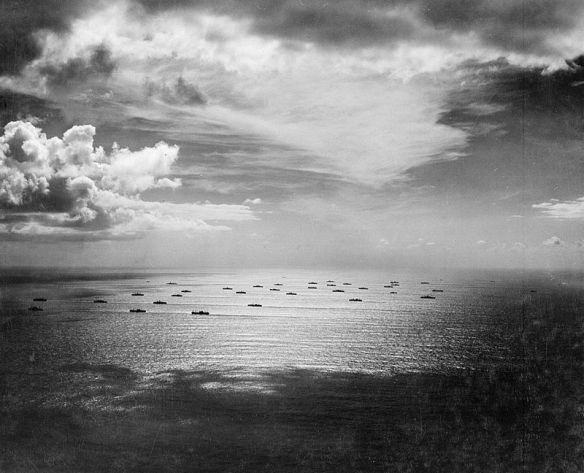
An Allied convoy heads eastward across the Atlantic, bound for Casablanca, in November 1942. U.S. Navy (photo 80-G-474788), Post-Work: User:W.wolny – This media is available in the holdings of the National Archives and Records Administration, cataloged under the National Archives Identifier (NAID) 520948.

In planning for the possibility of a major war in Europe or Asia, the US is finding it has a number of problems with Logistics. 90% of the weight of supplies and equipment have to go by sea, but,
  • We have too few ships
  • The ships we have are old
  • These old ships are in many cases steam powered
  • These ships may not have been maintained as well as they should have been
  • We have too few mariners to man the ships
  • Too few of the mariners we do have know how to run steam ships
  • Most of our mariners have no concept of how to contend with a wartime environment
  • and, oh by the way the Navy does not have ships to protect the few ships we have as they make their way through contested waters.

After outlining the problem, I’ll talk about how the Coast Guard might mitigate the problem.

Recent Reports:

DefenseNews in a post, “The US Army is preparing to fight in Europe, but can it even get there?” reports,

The U.S. sealift capacity — the ships that would ultimately be used to transport Army equipment from the states to Europe or Asia — is orders of magnitude smaller than it was during World War II. Combine that with the fact that the commercial shipbuilding industry in the U.S. is all but gone, and the U.S. can’t launch the kind of massive buildup of logistics ships it undertook during wartime decades ago.

Among the ships the country has for sealift and logistics forces, the Government Accountability Office has found a steady increase in mission-limiting equipment failures, which raises questions about how many might actually be available if the balloon goes up.

The ships the U.S. counts among its ready stock available for a large-scale contingency are 46 ships in the Ready Reserve Force, 15 ships in the Military Sealift Command surge force, and roughly 60 U.S.-flagged commercial ships in the Maritime Security Program available to the military in a crisis,

The 46 Ready Reserve Force ships, overseen by the Maritime Administration, are old and rapidly approaching the end of their hull life, as are many of the senior engineers who are still qualified and able to work on the aging steam propulsion plants.

DefenseNews commentary, “The US armed forces have a mobility problem,” reports,

“Our Merchant Marine fleet’s wartime role is to move weapons, ammunition, troops, equipment, fuel and supplies. Our current fleet — simply put — does not have the capacity to meet today’s requirements.

“We don’t have enough ships, and even if we did we don’t currently have the crews to sail them. We’re short at least 1,800 merchant mariners.

“The human capital shortage may be worse than the shortage in ships. A report by the Maritime Administration to Congress highlighted the problem. The report “estimates that 11,768 qualified mariners … are available to crew the Ready Reserve Force … the estimated demand for mariners [in an emergency] is 13,607.” ”

There is a Navy Times report, “Pentagon investigators slam military’s oversight of supply ships,” based on an IG report that looked at 20 ships we have in the MSC’s Prepositioning Program. It seems to indicate that some of these ships, already loaded with critical equipment, may not be ready to sail.

Perhaps most troubling of all, “‘You’re on your own,’ US sealift can’t count on US navy escorts in the next big war,” that reports

“The Navy has been candid enough with Military Sealift Command and me that they will probably not have enough ships to escort us. It’s: ‘You’re on your own; go fast, stay quiet,’” Buzby told Defense News in an interview earlier this year.

The head of U.S. Naval Forces Europe, Adm. James Foggo, tried to put a positive spin of the personnel shortage, “The tradition of the Merchant Marine is we go to sea no matter what, damn the torpedoes. Most of us believe that our people will not be dissuaded. But until they walk up the gangway, you never know.”

It does seem that the fleet obsolescence may be addressed, but the lack of personnel and escort ships remain.

A Modern Convoy:

I have real problems with the idea of independent sailing in the age of satellite reconnaissance, not only because the ships become easy pickings, but also because there would be no one to rescue the crews. This would certainly make mariners think twice before signing on. The answer is as old as naval warfare, convoy. Certainly we are not likely to ever see the likes of WWII convoys, with ships steaming only a few hundred yards apart. Ranges of both sensors and weapons have increased by an order of magnitude or more. We don’t want one sub to be able to simultaneously target several ships. A modern convoy would be spread over a much greater area, perhaps a moving grid 100 miles on a side. It might include escorting ships, but it would certainly include at least one escorting aircraft.

WHAT THE COAST GUARD CAN DO?:

“Convoy WS-12: A Vought SB2U Vindicator scout bomber from USS Ranger (CV-4) flies anti-submarine patrol over the convoy, while it was en route to Cape Town, South Africa, 27 November 1941. The convoy appears to be making a formation turn from column to line abreast. Two-stack transports in the first row are USS West Point (AP-23) — left –; USS Mount Vernon (AP-22) and (Coast Guard manned) USS Wakefield (AP-21). Heavy cruisers, on the right side of the first row and middle of the second, are USS Vincennes (CA-44) and USS Quincy (CA-39). Single-stack transports in the second row are (Coast Guard manned) USS Leonard Wood (AP-25) and (Coast Guard manned) USS Joseph T. Dickman (AP-26).”

A little Coast Guard History:

It might be worthwhile to look at what was done in the past. Before the start of WWII both the US Navy and Army had transports. The Navy transports were manned by regular Navy personnel. The Army transports were manned by civilians. During a large scale exercise before the war started, the civilian mariners refused to operate with darkened ships, considering it unsafe. This lead to the Coast Guard being assigned to crew these transports. Personnel were available because ten cutters had been lend leased to the British and their crews were available. These were the first of 351 Navy ships and craft manned by Coast Guard crews. While these included over 100 surface combatants, most of them convoy escorts, the rest were mostly transports and landing ships and craft. In addition the Coast Guard manned 288 Army vessels, mostly small inter-island freighters.

So what can we do now?

Encourage Coast Guard members to become credentialed mariners:

The first thing the Coast Guard might do is to encourage and facilitate the credentialing of personnel by the time they leave the service. The Coast Guard Cuttermen’s Association has provided guidance as to how coastguardsmen can become credentialed mariners, “”A Coasties Companion Guide to the Mariner Licensing Process” (PDF document).

A Navy program, Credentialing Opportunities On-line (COOL), in partnership with Military Sealift Command (MSC), provides training in a military to mariner program. that may be open, or if not already, could be opened, to the Coast Guard.

Money is the sincerest expression of appreciation, and if this is a national security issue, perhaps there should be a monetary incentive to obtain and maintain mariner’s credentials after a member separates from the service (Navy or Coast Guard). Apparently there is still on the books (46 U.S. Code 51701) provision for the Secretary of Transportation to set up a United States Maritime Service that could:

  1. Determine the number of individuals to be enrolled for training and reserve purposes in the Service:
  2. Fix the rates of pay and allowances of the individuals…
  3. Prescribe the course of study and the periods of training for the Service; and 
  4. Prescribe the uniform of the Service and the rules on providing and wearing the uniform. 

Add Reserve Units capable of manning US ships: 

The Coast Guard Reserve could be expanded to include crewmembers for these ships, either as augmentees or as complete crews. Some of the MSC ships currently have mixed crews of military and civilians. Presumably if the ship had an all military crew, it would be a commissioned ship, rather than an MSC ship.

Provide Rescue Ships: 

If we had a modern convoy, watched over by Maritime Patrol Aircraft, a Coast Guard cutter equipped with helicopter could act as rescue vessel. It would probably be positioned near the center of the convoy perhaps toward the rear. Its helicopter could remove the crew of a sinking ship and the cutter could provide damage control assistance.

Provide Administrative Escort:

The same ship that provides rescue and assistance might also serve as an administrative escort. The idea is to use the superior communications ability of the larger cutters including the Sensitive Compartmented Information Facility (SCIF) on the National Security Cutters (and perhaps the Offshore Patrol Cutters) to route the convoy away from danger.

Bring Back the Coast Guard ASW program:

Perhaps it is time to revive the Coast Guard’s ASW capability. When the Soviet Union fell apart, the Coast Guard dismantled its ASW capability as no longer relevant, but things have changed. China appears increasingly aggressive and is building a modern fleet at an alarming rate. Russia is also resurgent with their submarines now patrolling at levels similar to those seen during the cold war, while our own Navy has been drastically reduced. It appears, in ten to twenty years we will face a naval challenge greater than pre-WWII Japan. I don’t really think the 20 planned FFGs are going to be enough. Providing suitable weapons and sensors for the eleven NSCs and 25 OPCs, augmented by Navy Reserve ASW helicopters, could make a huge difference in our ability to move supplies and equipment safely across the Oceans.



Homeland Security Today (HSToday) Seeks Input for Critical Infrastructure Protection Month!

I received the following from Homeland Security Today and have received permission to pass along the request.

Dear HSToday Readers,

I’ve been an advocate and supporter of critical infrastructure protection since well before serving as Assistant Secretary for Infrastructure Protection at the U.S. Department of Homeland Security.  For all of us, securing and enhancing the resilience of our nation’s critical infrastructure assets is job one.
Since joining HSToday as a Visiting Editor, I have focused on issues related to resilience and critical infrastructure. I am thrilled to chair HSToday’s National Critical Infrastructure Protection & Resilience Month (NCISRM) coverage.  NCISRM began in earnest while I was at the Department with the simple objective of building awareness and appreciation of the importance of critical infrastructure and reaffirming the nationwide commitment to keep our critical infrastructure secure and resilient.
I know that for many of you – a “month” isn’t really necessary. You are on the front-lines protecting our critical infrastructure every day, 24/7.  You also know that awareness, vigilance, evolution and innovation in our security posture and resiliency practices is needed now more than ever.
That is why I’m reaching out to you today.
I invite you to share your advice and expertise here at HSToday for our focus on critical infrastructure in November.  

I hope you have noticed that since Government Technology & Services Coalition acquired HSToday, its editorial content has been enhanced by contributions from experts in our field.  Former government officials, practitioners, subject matter experts with the experience and understanding of the complexities faced by the professionals protecting our homeland in the various disciplines across the vast enterprise – are engaged with us.

I encourage you to reach out if you’d like to contribute a piece. We are looking for you  to share your thoughts about the evolving threat landscape and/or a security solution that helped a company or agency save money, better secure assets or improve its resilience posture. We are looking for “lessons learned” from your experience – OR just your opinion about something going right, or wrong. We do not accept marketing pieces, but if you have an idea we are interested in hearing it. If you would preferred to be interviewed, we can make that happen as well.
Thank you for your service and your commitment to advancing the security and resilience of our nation’s critical infrastructure – AND thank you for being a loyal reader of HSToday. Please do not hesitate to reach out to us with ideas or suggestions.
Respectfully,
Caitlin Durkovich
Chair, HSToday National Critical Infrastructure Security & Resilience Month
Director, Toffler Associates
Former Assistant Secretary for Infrastructure Protection, U.S. Department of Homeland Security

“Hit by Hurricane Michael, Eastern Shipbuilding starts recovery efforts”–MarineLog

WeatherNation showed this image of storm damaged trawler that had been nearing completion at Eastern

Marine Log reports:

Both of Panama City, FL, headquartered Eastern Shipbuilding Group’s shipyards have been damaged by Category 4 Hurricane Michael.

Just one indication of the severity of the storm: The 261-foot Alaska factory trawler North Star, which had been nearing completion at Eastern, was pictured resting on its starboard side in the waters of Saint Andrews Bay, FL, October 12, after being swept from its moorings.

Eastern was of course awarded a contract for detail design and construction of the first of the Offshore Patrol Cutters with options for eight more. No idea how this will affect the project.

NAIS for Command and Control/”The USCG RDC & Electronic Aids To Navigation”–Marine Link

Marine Link has an excellent overview of the increasingly useful Nationwide Automated Identification System (NAIS) and the R&D Center’s role in its development.

As for the Coast Guard’s own use of the system, we have this press release from FLIR.

WILSONVILLE, Ore., October 16, 2018 – FLIR Systems, Inc. (NASDAQ: FLIR) announced today that it has been awarded a contract from the United States (U.S.) Department of Homeland Security (DHS) in support of the U.S. Coast Guard’s (USCG) Second Generation Automatic Identification System (AIS-2) program. The indefinite delivery indefinite quantity (IDIQ) contract has a ceiling value of $9.9 million to provide second generation Automatic Identification System (AIS) transponders, associated peripherals, and spare parts for nearly 1,774 boats and 282 cutters in the USCG’s active fleet.

The government anticipates the purchase of vessel class-specific kits and spare parts to equip all USCG vessels with AIS-2 over the next five years.

“We are pleased to provide AIS hardware and software technology to support the US Coast Guard’s mission,” said Jim Cannon, President and CEO at FLIR.  “Our technology will provide enhanced levels of secure communication and coordination between Coast Guard boats, cutters, and shore stations (emphasis applied–Chuck). This award further extends our technology partnership with the Coast Guard, providing next-generation communication capabilities to complement their Raymarine SINS-2 navigation systems.”

I was a little surprised to see reference to secure communications in conjunction with AIS because I don’t associate those two things, but it is apparent we are finding new uses for the system, including as a blue force locator.

It looks like we will be putting these systems on even our smallest boats. Ran across a study that may provide an indication (Note this is apparently a Russian URL) of where we are going with this.

Narco Vessel Update/Houthi Navy–Covert Shores

Covert Shores has a pair of recent posts that may be of interest.

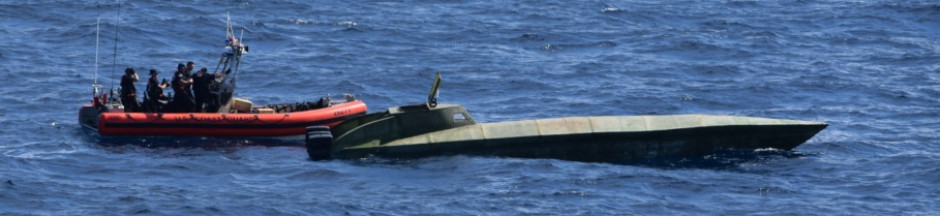
LPV (Low Profile vessel) intercepted by Stratton (WMSL-752) in Eastern Pacific, Aug. 27, 2018. It had three outboard motors. Ref dvidshub.net

First there is a series of recent pictures of narcotics smuggling vessels seized by El Salvador and cutters Seneca and Stratton.

Attack on the Saudi Frigate Al Madinah (702), 30th Jan 2017

Also there is a brief review of the naval activity and capabilities of the Houthi Insurgency in Yemen.

Observations on the Smuggling Vessels:

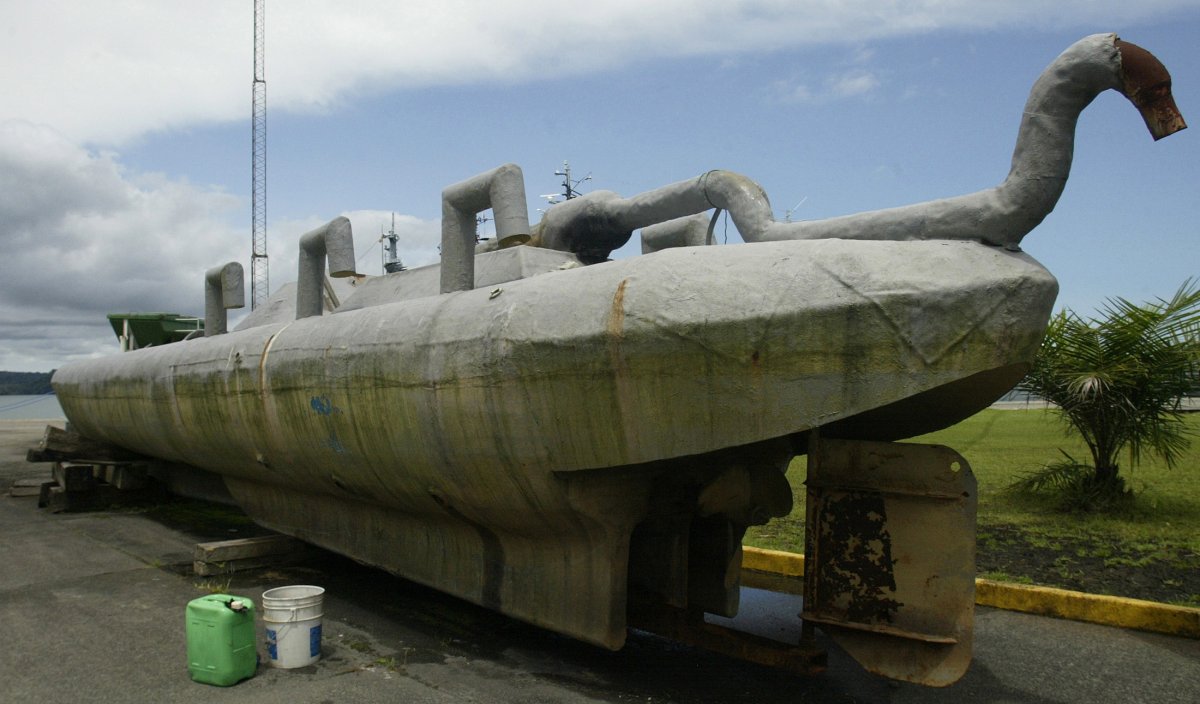
What is striking about the photos of the smuggling vessels is how similar they are, and how different from many of the preceding craft. They are not identical, so they are not being made on an industrial scale, but they are all of a common concept. The post calls them narcosubs, but they don’t have the extensive effort to minimize observability that earlier narcosubs had, and they don’t run decks awash. They have made some attempt at stealth, but the attempts to cool their exhaust to minimize Infrared signature are gone, along with the inboard diesel engines replaced by multiple outboards. They have more freeboard, and are probably a great deal faster. Looks like they have combined features from go-fasts, Very Slender Vessels, Low Profile Vessels, and semi-submersibles.

An early narcosub. REUTERS/Jaime Saldarriaga