Story here: http://charleston.thedigitel.com/features/decommissioned-coast-guard-cutter-dallas-being-tra-39329-0518
The old girl was effective right up to the end. Hope she is as successful in Philippine service.

Story here: http://charleston.thedigitel.com/features/decommissioned-coast-guard-cutter-dallas-being-tra-39329-0518
The old girl was effective right up to the end. Hope she is as successful in Philippine service.
On an earlier post, a conversation developed over how we refer to the various Coast Guard vessel classes. I had called the 154 foot WPC, Fast Response Cutters (FRC), of the Sentinel Class, the Webber Class. It went like this:
—————————————————————————————————————————
Jimmy, “If you’re shooting for an A+ in accuracy, it’s the Sentinel class, not the Webber class.”
Chuck Hill, “Let’s just say I like Webber better, and it fits the international norms of usage.”
While the Coast Guard will perhaps soon be commissioning four 353 ton Webber Class Fast Response Cutters a year, and has been averaging one large cutter every two years, it looks like the Chinese Maritime Surveillance Administration (CMS) will have commissioned 36 new cutters from 2010 to 2012 including seven 1500 ton class, fifteen 1000 ton class and fourteen 600 ton class “to better protect China’s maritime interests.” This is a huge, rapid expansion of their assets. (Also the tonnage ratings the Chinese provide tend to be light displacement, so they understate their size.)
This is only one of several Chinese agencies that do Coast Guard type task. Other agencies are also building ships. These agencies use relatively few air assets, and these ships are less sophisticated. But as Stalin was reported to say, quantity has a quality all its own.
To put this in perspective, China’s recognized EEZ is 877,019 km2 . They claim approximately 3,000,000 km2 additional, disputed by other nations, or about 3,877,019 km2 in total. The US EEZ is 11,351,000 km2 so even considering all their claimed EEZ, it is only a slightly more than a third the size of our own.
There has been a recent AP report that USCGC Stratton, the newest National Security Cutter has had a problem with holes developing in the hull.
I’m told this may have been the result of improperly grounded electric welding equipment. Hopefully she will get this behind her quickly.
Two related items, on an emerging technology–solar powered ships.
First a solar powered vessel completes an around the world journey. It did take them quite a while.
And of more immediate interest, the Marine Log is reporting a builder is offering a solar power augmented alternative to the Fast Response Cutter (FRC).
It takes so little power to move a ship at modest cruise speeds, there might be a place for this in our future. I still wonder about walking around on the solar cells on the proposed FRC alternative.
(Thanks Lee)
Had an interesting discussion about why the National Security Cutter retained the Phalanx Close In Weapon System (CIWS) while the very similar weapons suite on the Freedom class Littoral Combat Ship used the Rolling Airframe Missile (RAM) system instead.

Mk 49 Rolling Airframe Missile Launching System Photo credit: Darkone 13 Aug, 2006, via Wikipedia
My friend contended that, while the Phalanx is very maintenance intensive, the launcher for the RAM is virtually maintenance free, which would benefit the relatively small crew. He also noted that the current models have an excellent anti-surface capability and longer range than the Phalanx.
This got me to thinking. I won’t make a recommendation, but will discuss alternatives that might be considered. I’ll talk about who is using the RAM and how, and discuss how the Coast Guard might use it, and its advantages and disadvantages as a possible replacement for the Phalanx and possibly even the 57 mm. But before we get to that, as we are always told, you have to start with the mission.
 When the draft technical package for the Offshore Patrol Cutter was released, I provided what information I could glean from the attachments, but the basic specs were not available. Fortunately CG-9 were kind enough to agree to answer my questions about the basic requirements for the design. I would like to thank Ms. Maureen Schumann and Mr. Brian R. Olexy for their assistance.
The following are my questions and Mr. Olexy’s response:
Q1) What are the threshold and desired capabilities for maximum speed? Range? at what speed? Personnel accommodations? Anticipated crew size?
A1) The objective top speed is 25 knots (22 knots minimum acceptable top speed). The objective range of the OPC is 9500 nm (8500 nm minimum acceptable range) at 14 knots sustained speed.
The objective underway crew size is 90, with a threshold of 104. The objective for total number of accommodations is 126 (accommodations for 120 total personnel is the minimum acceptable capability).
Q2) Still a requirement for two enginerooms? with power equally split? Any specific requirements for the power plant other than diesels?
A2) The OPC Specification requires the propulsion plant to be arranged in at least two separate main machinery spaces so that a level of propulsion capability is retained in the event of a complete loss of one main machinery space. (Note this is a change, providing more flexibility in the design–Chuck)
Q3) Is there space and weight set aside for additional weapons in war time?
A3) The OPC will be capable of accommodating equipment and configurations needed for operations in higher threat environments.
Q4) Are there provisions for loading mission modules or containers for specific missions?
A4) The OPC will not use mission modules and is not required to carry ISO containers.
Q5) What size helicopter will be able to land on deck? What size helicopter can be hangered? UAV(s)?
A5) The OPC will be able to land H-1, H-3, H-6, H-60 and H-65 helicopter variants. The objective requirement for hangaring capability is USCG H-65 and USCG/USN H-60 variants (minimum acceptable hangaring capability: USCG H-65).
Space, weight and power allocations for future UAS operations are also included in the requirements.
Q6) Provision for only two boats? Both 7meter? No 11 meter? Capacity for 11 meter later?
A6) The OPC boat provision threshold is to deploy with and support two boats capable of over-the-horizon operations; the objective is to deploy with two OTH boats and one additional boat, for a total of three. The specification defines “over-the-horizon” as “any of a family of nominal 7+ meter aluminum hulled boats…”
Q7) Underway replenishment capability for both full and stores?
A7) The OPC will be capable of receiving fuel (DFM and JP-5) and water from a replenishment ship and solid cargo via VERTREP.
Q8) Still have the requirement for taking on 500 migrants and keeping them on deck?
A8) Yes. The specific requirement is the capability to embark, process and sustain up to 500 migrants for up to 48 hours.
Q9) Still a 10,000 ton towing capacity?
A9) Yes. The OPC shall have the capacity to tow astern up to OPC-equivalent displacement through SS5 and to up to 10,000 long tons through SS2.
Q10) Does the design specification still preclude a stern ramp?
A10) Yes, Ships Work Breakdown Structure (SWBS) section 070 of the spec precludes a stern ramp.
Q11) Does the fact that the NSC program has been cut from eight to six mean the OPC program will go from 25 to 27?
A11) The program of record for the NSC prescribes eight cutters. The program of record for the OPC prescribes 25 cutters.
Q12) Is the multi-mode radar referred to, the radar component of the gun firecontrol system? An AN/SPQ-9? Or is the fire control system electro-optic only?
A12) Yes, the multi-mode radar is envisioned to be part of the gun fire control system, but it has not been defined yet.
———————————————————-
The earlier post has information on the selection process and the projected government furnished equipment.
Wonder why we cannot afford NSCs 7 and 8, and why we will be building only one OPC a year? Why the Coast Guard cannot get the approximately $2-2.5B/year it needs for modernization and is making do with $1.4B? There are lots of explanations, but take a look at this chart.
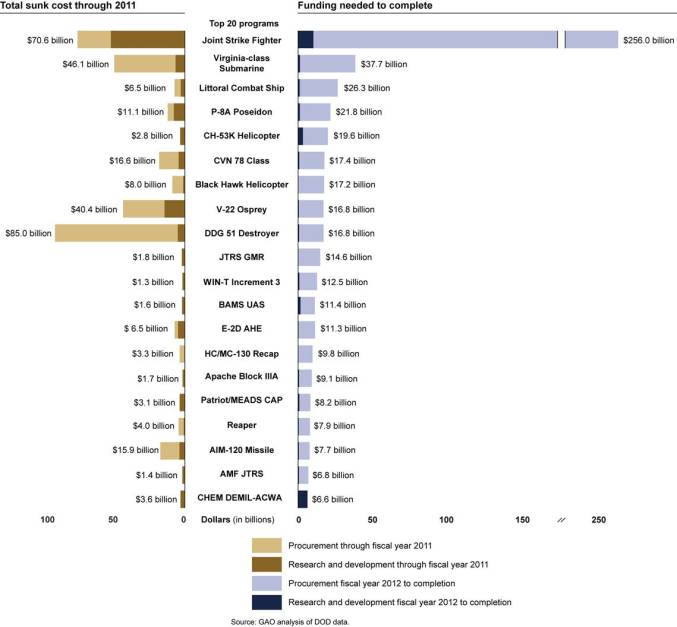
“Among the 96 programs in DOD’s 2011 portfolio, the Joint Strike Fighter is the costliest, the poorest performer in terms of cost growth, and the program with the largest remaining funding needs. The Joint Strike Fighter accounts for 21 percent, or nearly $327 billion, of the planned total acquisition cost of the portfolio.–“The Joint Strike Fighter program alone is expected to account for 38 percent—or almost $246 billion—of the future procurement funding needed. This amount is enough to fund the remaining procurement costs of the next 15 largest programs.
The US Naval Institute has begun an new service, hosting a Wikipedia like source. It includes Coast Guard as well as Navy and Marine topics. A list is here.
 The CNO has issued a “navigation plan” for for Fiscal Years 2013-2017 that can be accessed here. (It’s only four pages.)
“The Nav Plan provides details on how we will execute this guidance, highlighting our investments through the lens of my three tenets: Warfighting First, Operate Forward, and Be Ready.”
Most of it is, of course, not Coast Guard related, but there are some that might ultimately impact the Coast Guard.
Under “Warfighting First”:
“Improve near-term capability to counter fast attack craft by fielding enhanced gun and surface-to-surface missile systems for Patrol Coastal (PC) ships and Littoral Combat Ship (LCS) and laser-guided rockets for helicopters and Unmanned Aerial Vehicles (UAV).”
Some of this might ultimately be applicable to CG platforms.
Under “Operate Forward”:
“Sustain the “places” our forward operating forces depend on to rest, repair, refuel, and resupply in Spain, Italy, Greece, Djibouti, Diego Garcia, Bahrain, Japan, Singapore, and Republic of Korea – as well as our forward base on Guam”
“Field improved Firescout UAVs…”
“Forward station additional ships – LCS at Singapore and PCs at Bahrain – to improve our ability to cooperate with regional partners in maritime security operations.”
“Improve our ability to remain forward by studying options for rotational crewing of other classes of ships.”
We already have Patrol Boats at Bahrain. We may see an additional push to put more assets, including perhaps more than one FRC, in Guam, (maybe not a bad thing for SAR and Fisheries enforcement). The increased Navy presence in Guam may also provide opportunities to exploit their units for SAR and LE as well.
Hopefully the CG will benefit from improvements in Firescout, but the Navy is talking about increasing the size of the airframe substantially which may be problematic for CG ships.
Certainly there will the opportunity to share experience in rotational crewing, and perhaps make it work.
Under “Be Ready”:
“Improve the “wholeness” of the Aegis Weapons System through data link and software upgrades while adding the Shipboard Self Defense System to more non-Aegis ships, such as amphibious assault ships.”
“Improve operational energy efficiency by investing in new technologies such as hybrid-electric drive.”
The weapon systems on the NSCs, and presumably the OPCs, are derived from the Aegis system and, I believe, closely related to the Shipboard Self Defense System for non-Aegis ships mentioned above. As the system evolves, ultimately we might see the Rolling Airframe Missile system replace the Phalanx on the NSCs. It is essentially the same weight and is used by the very similar system on the Freedom Class Littoral Combat Ship.
The Navy is already using hybrid-electric drive on the USS Makin Island (LPD-8) and a fully integrated system on the USNS Louis and Clark class T-AKEs. There may be opportunities to ride the coat tales of their experience. Fuel economy is probably even more important to the Coast Guard than to the Navy.
What was not there:
I notice there was no mention of either African Partnership station or Drug Enforcement.
 Chuck Hill's CG Blog