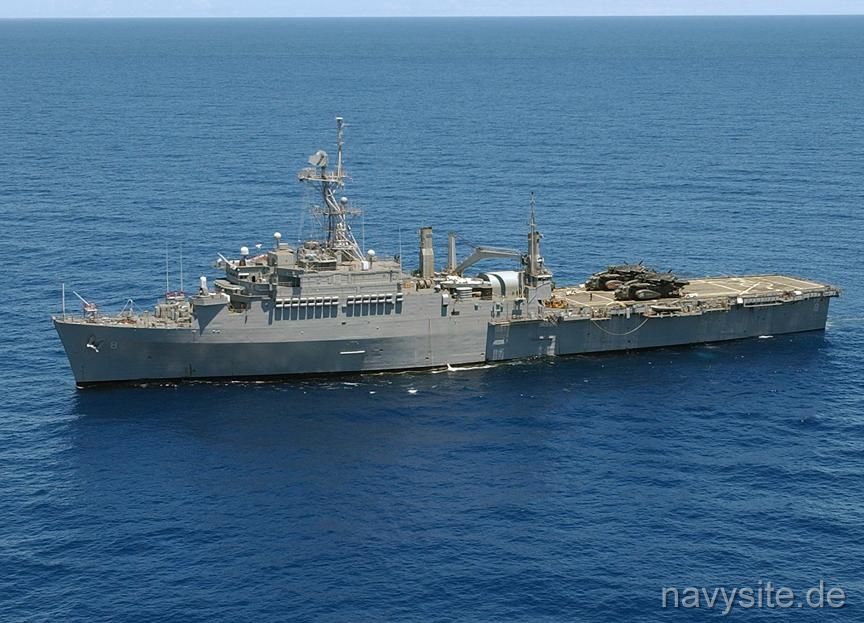
Changes to the Fleet / “MMEA to get ex-US Coast Guard cutter next year” –The Star

USCGC Steadfast (WMEC 623)

The Star, a Malaysian publication, reports,

“The Malaysian Maritime Enforcement Agency (MMEA) is set to receive the former United States Coast Guard Cutter (USCGC) Steadfast once its preparation in Baltimore, in the US, is completed and the vessel is transported back to Malaysia in the first quarter of 2025.”

Of the 16 original WMEC210s, two, Courageous and Durable were decommissioned in 2001 and later transferred to Sri Lanka and Colombia respectively. That left us with 14.

USCGC Decisive was decommissioned 2 March 2023, followed by USCGC Steadfast decommissioned Feb. 1, 2024. That left us with 12.

Most recently, this year, three more WMEC210s were effectively decommissioned, being placed in “In Commission, Special” status: Dependable, 9 April; Confidence 2 May; and Dauntless 21 June. This status suggests they might reenter active service sometime in the future, but it probably means they are being held as parts donors.

This leaves the Coast Guard with nine active WMEC210s, 13 WMEC270, Alex Haley, and ten National Security Cutters, a total of 33 large patrol cutters, fewer than the currently planned 36 (11 NSCs and 25 OPCs).

This is the smallest number of large patrol cutters the Coast Guard has had since 1941.

As much as I am impressed with the capabilities of the Webber class Fast Response Cutters, they are not a substitute for cutters that have an endurance of 21 days or more.

We can’t really expect the remaining WMECs to remain in service until replaced on a one for one basis. There is a good chance we will see the number drop further. We need to start completing more than two cutters a year. We have not been completing even one a year (10 NSCs in 16 years).

The Coast Guard has contract or options for 15 OPCs. Eleven have been named, one has been launched. I don’t think contracts have been awarded nor work done on any more than five. GAO anticipates there will be additional delays and costs will rise.

If planning started in the near future, instead of building the last ten OPCs, the Coast Guard could build about 20 true WMEC replacements of 2,000 to 2,500 tons for the about the same price and have at least ten of them completed by 2038 when the last OPCs is supposed to be completed. If we tried hard enough, we might have all 20 completed by then, providing 46 cutters by then instead of 36. It is not impossible. In only nine years, 1964 to 1972 the Coast Guard commissioned 28 ships, 16 WMEC210s and 12 WHEC378s.

Thanks to Peter for bringing the report of Steadfast’s transfer to my attention.

Coast Guard Day, 2024

240229-G-NJ244-1001 Crews from Coast Guard cutters Hamilton (WMSL 753) and Munro (WMSL 755) conduct at-sea training in the Pacific Ocean, March 12, 2024. Hamilton and Munro exchanged cutter boats and sailed in formation during this evolution. (U.S. Coast Guard photo by Ensign Ray Corniel)

Crews from Coast Guard cutters Hamilton (WMSL 753) and Munro (WMSL 755) conduct at-sea training in the Pacific Ocean, March 12, 2024. Hamilton and Munro exchanged cutter boats and sailed in formation during this evolution. (U.S. Coast Guard photo by Ensign Ray Corniel)

Happy Coast Guard Day, wherever you are.
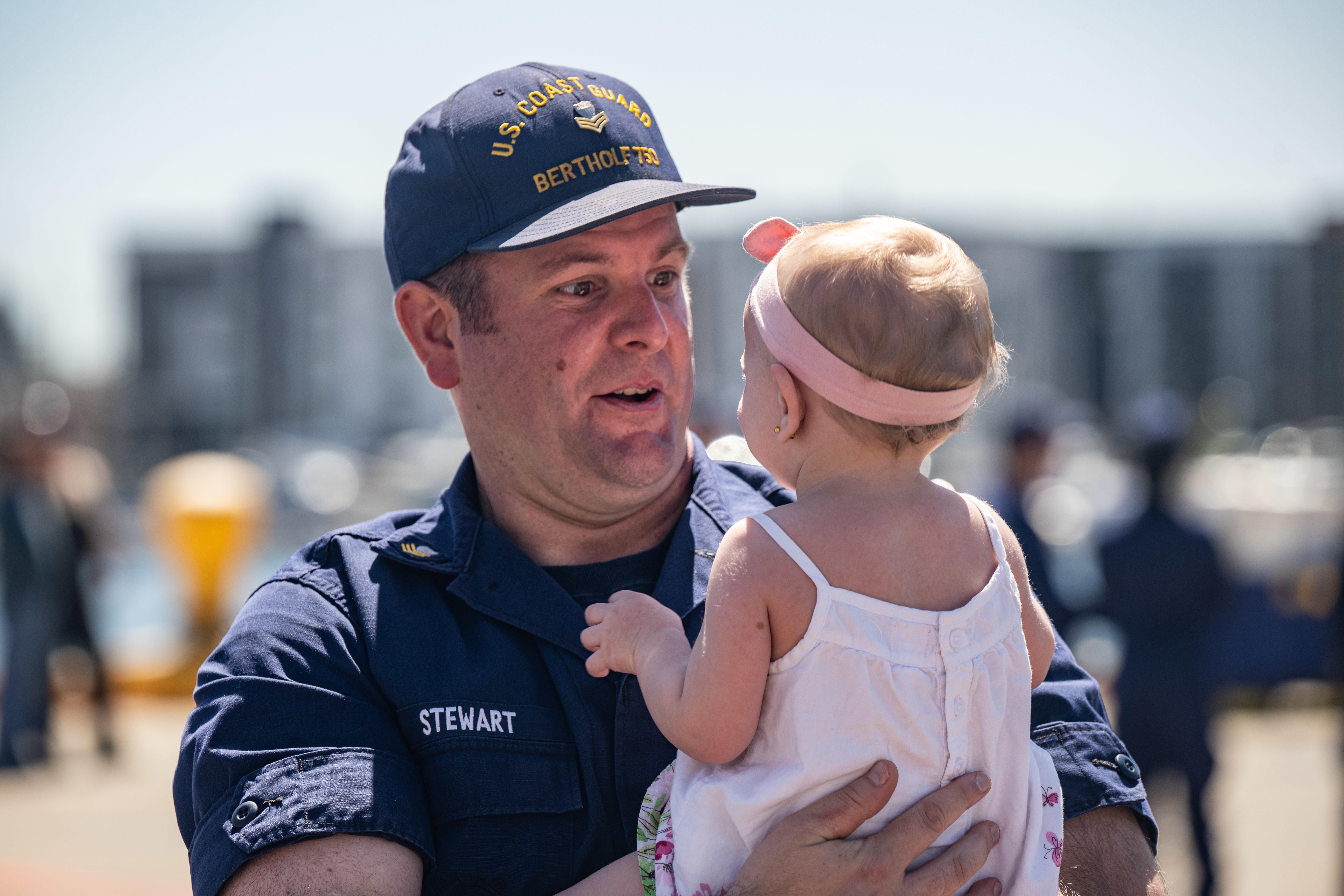
U.S. Coast Guard Petty Officer 1st Class Chase Stewart, an Electrician’s Mate assigned to the Coast Guard Cutter Bertholf (WMSL 750) greets his family at the cutter’s return to home port on Coast Guard Base Alameda, Calif., following a 98-day patrol in the Indo-Pacific region, April 8, 2024. The Cutter Bertholf deployed to the Indo-Pacific to advance relationships with ally and partner nations to build a more stable, free, open and resilient region with unrestricted, lawful access to the maritime commons.​ (U.S. Coast Guard Photo by Petty Officer 3rd Class Hunter Schnabel)

Coast Guard C130J
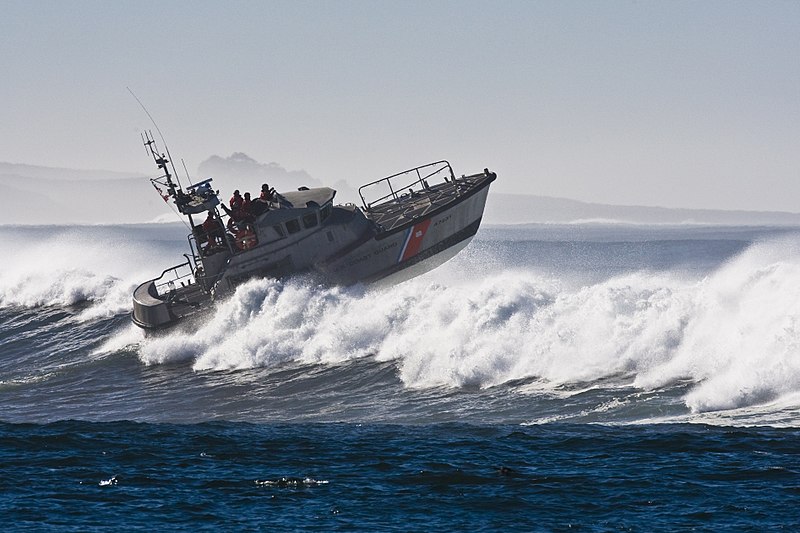
47-Foot Motor Life Boat (MLB) 47231 from Station Morrow Bay, 4 Dec 2007. Photo by Mike Baird

Following efforts with Kiribati partners, the USCGC Oliver Henry (WPC 1140) crew transit in the Republic of Marshall Islands Exclusive Economic Zone during the next leg of their expeditionary patrol on Feb. 24, 2024. Underway in support of Operation Blue Pacific, the cutter crew showcased the effectiveness of the U.S. and RMI maritime bilateral agreement, conducting a shared patrol with shipriders emphasizing collaborative efforts in maritime safety, security, and stewardship in terms of resource protection. (U.S. Coast Guard photo)

ANTARCTICA 02.03.2024 Photo by Petty Officer 2nd Class Ryan Graves
U.S. Coast Guard Pacific Area
U.S. Coast Guard Lt. Cmdr. Don Rudnickas, the Coast Guard Cutter Polar Star (WAGB 10) operations officer, salutes Cmdr. Jayna McCarron, Polar Star’s executive officer, prior to a medal ceremony for Polar Star’s crew on the Ross Ice Shelf, Antarctica, Feb. 3, 2024. The U.S. military’s support of U.S. Antarctic research began in 1955. U.S. Indo-Pacific Command continues to lead the Joint Task Force-Support Forces Antarctica team in providing logistic support for the United States Antarctic Program. (U.S. Coast Guard photo by Petty Officer 2nd Class Ryan Graves)
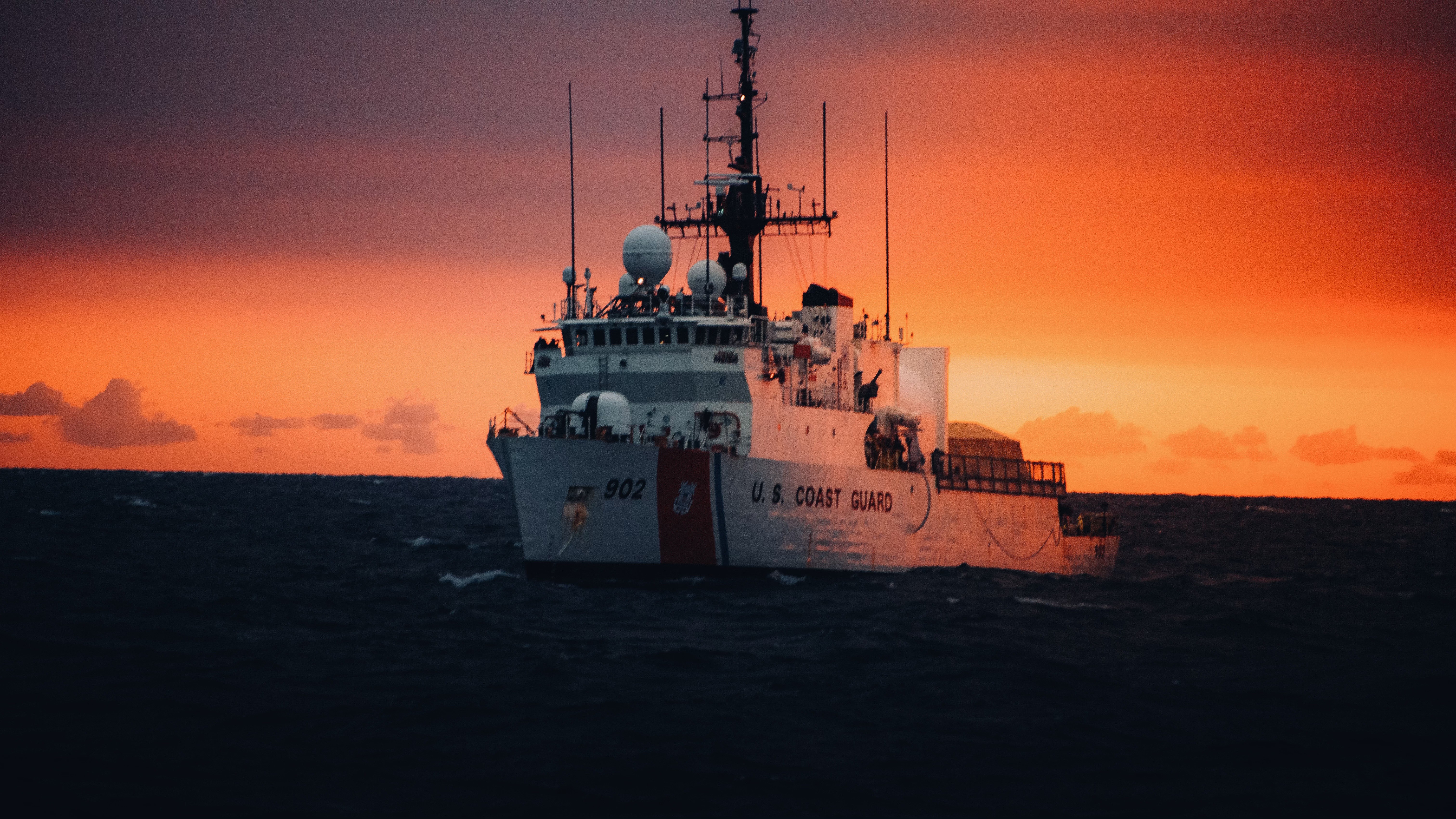
The U.S. Coast Guard Cutter Tampa (WMEC 902) transits the Florida Straits on Feb. 4, 2024, supporting Operation Vigilant Sentry. Tampa is homeported in Portsmouth, Virginia. (U.S. Coast Guard photo by Senior Chief Petty Officer Brodie MacDonald)
Feb 15, 2024
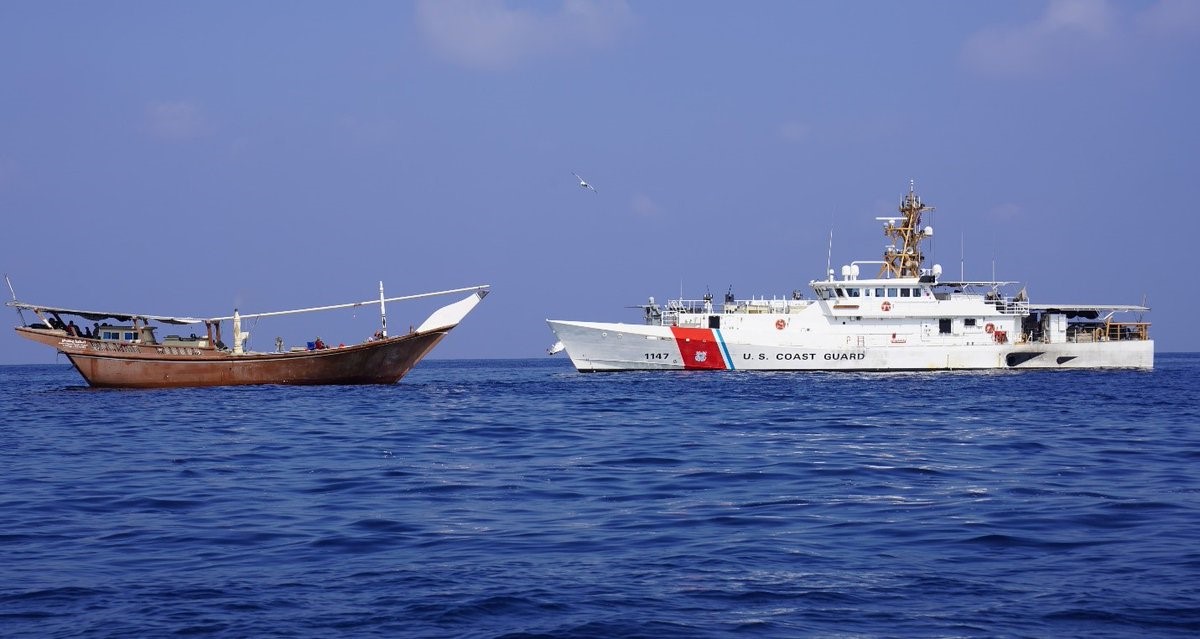
U.S. 5TH FLEET – The U.S. Coast Guard Sentinel-class fast-response cutter USCGC Clarence Sutphin Jr. (WPC 1147) seizes a vessel carrying military-grade weapons and other lethal supplies in the Arabian Sea, Jan. 28. Clarence Sutphin Jr. operates in the U.S. 5th Fleet area of operations to help ensure maritime security and stability in the Middle East region.

Petty Officer 3rd Class Vincent Wassylenko, Coast Guard Cutter Willow buoy deck supervisor (wearing yellow safety hardhat in photo), prepares to set a relief hull in Mayaguez Bay, Puerto Rico Oct. 9, 2022. During Willow’s eight-day visit to Puerto Rico, crewmembers serviced 23 aids to navigation and performed eight buoy hull reliefs around island ports and navigable waters in Arecibo, Culebra, Guanica, Guayanilla, Ponce, San Juan, Tallaboa, and Vieques. (U.S. Coast Guard photo)

Rear Admiral F. J. Lowry on deck of the USCGC Duane. Photos by Dale Rooks, a Coast Guard Photographer’s Mate First Class.

Members of the Coast Guard Cutter Waesche (WMSL-751) law enforcement boarding team inspect a self-propelled semi-submersible (SPSS) in international waters of the Eastern Pacific Ocean, Nov. 20, 2023. The interdiction of the SPSS yielded more than 5,500 pounds of cocaine. In November 2023, Waesche crewmembers seized approximately 18,219 pounds of cocaine, with an estimated street value of over $239 million, during four separate suspected drug smuggling vessel interdictions or events off the coasts of Mexico and Central and South America. (U.S. Coast Guard photo)
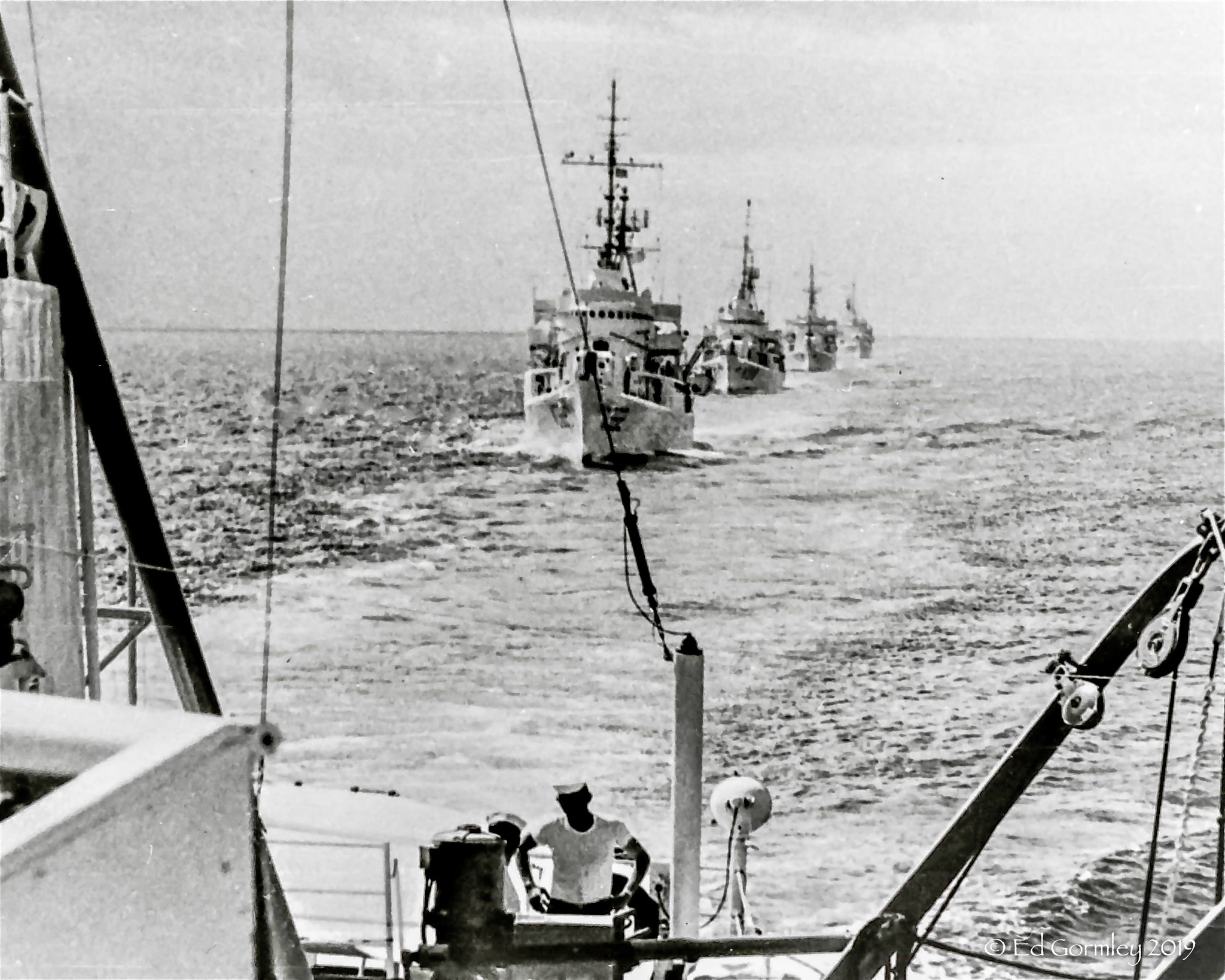
CG Squadron 3 enroute Subic Bay, 1967, Vietnam War
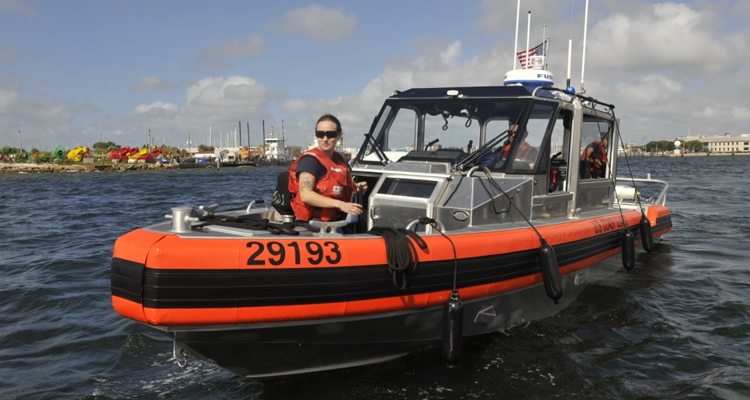
A boat crew from Coast Guard Station St. Petersburg, Florida, conducts training near the station on a new 29-foot response boat-small II Aug. 25, 2014. The Coast Guard placed a delivery order for 20 additional boats Jan. 12, 2018. U.S. Coast Guard photo by Seaman Meredith Manning.

GULF OF OMAN (Nov. 14, 2023) Illegal narcotics seized from a stateless vessel are stacked on the deck of the U.S. Coast Guard Sentinel-class fast response cutter USCGC Emlen Tunnell (WPC 1145) in the Gulf of Oman, Nov. 14. Emlen Tunnell was operating under Combined Task Force 150, one of five task forces under Combined Maritime Forces, the largest multinational naval partnership in the world. CTF 150 focuses on maritime security operations in the Gulf of Oman, Arabian Sea and Indian Ocean. (Photo by U.S. Coast Guard courtesy photo)

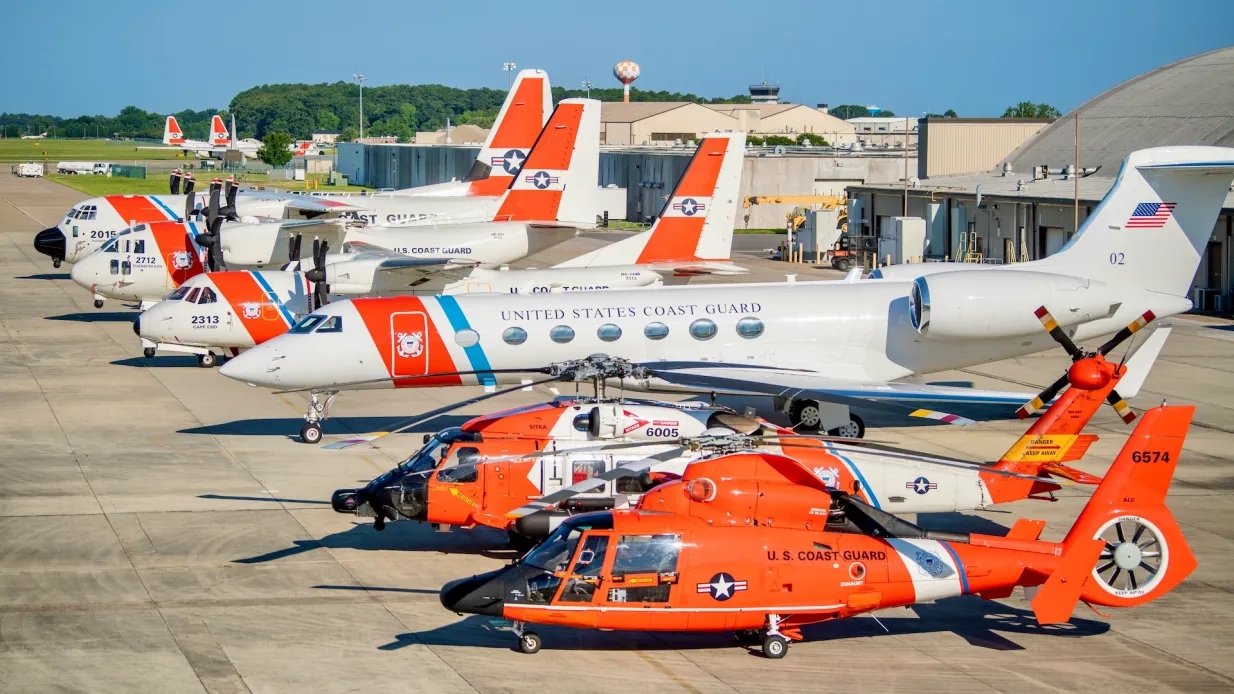
Every Coast Guard Aircraft Type Pictured Together In Rare ‘Family Photo’. Pictured: HC-130J, C-27J, HC-144, C-37B, MH-60T, MH-65E.

US Coast Guard cutter Munro transits the Taiwan Strait with US Navy destroyer USS Kidd in August. US Navy
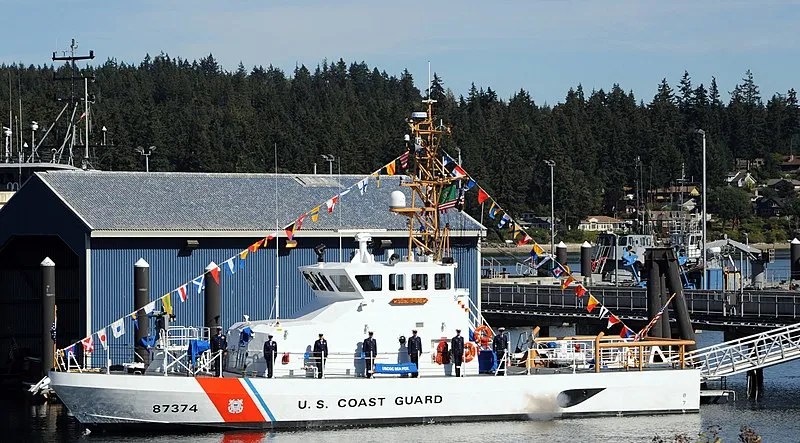
KEYPORT, Wash. (Aug. 18, 2009) U. S. Coast Guardsmen man the rails as the U.S. Coast Guard Cutter Sea Fox (WPB 87374) is brought to life at Naval Base Kitsap. (U.S. Navy photo Ray Narimatsu/Released)
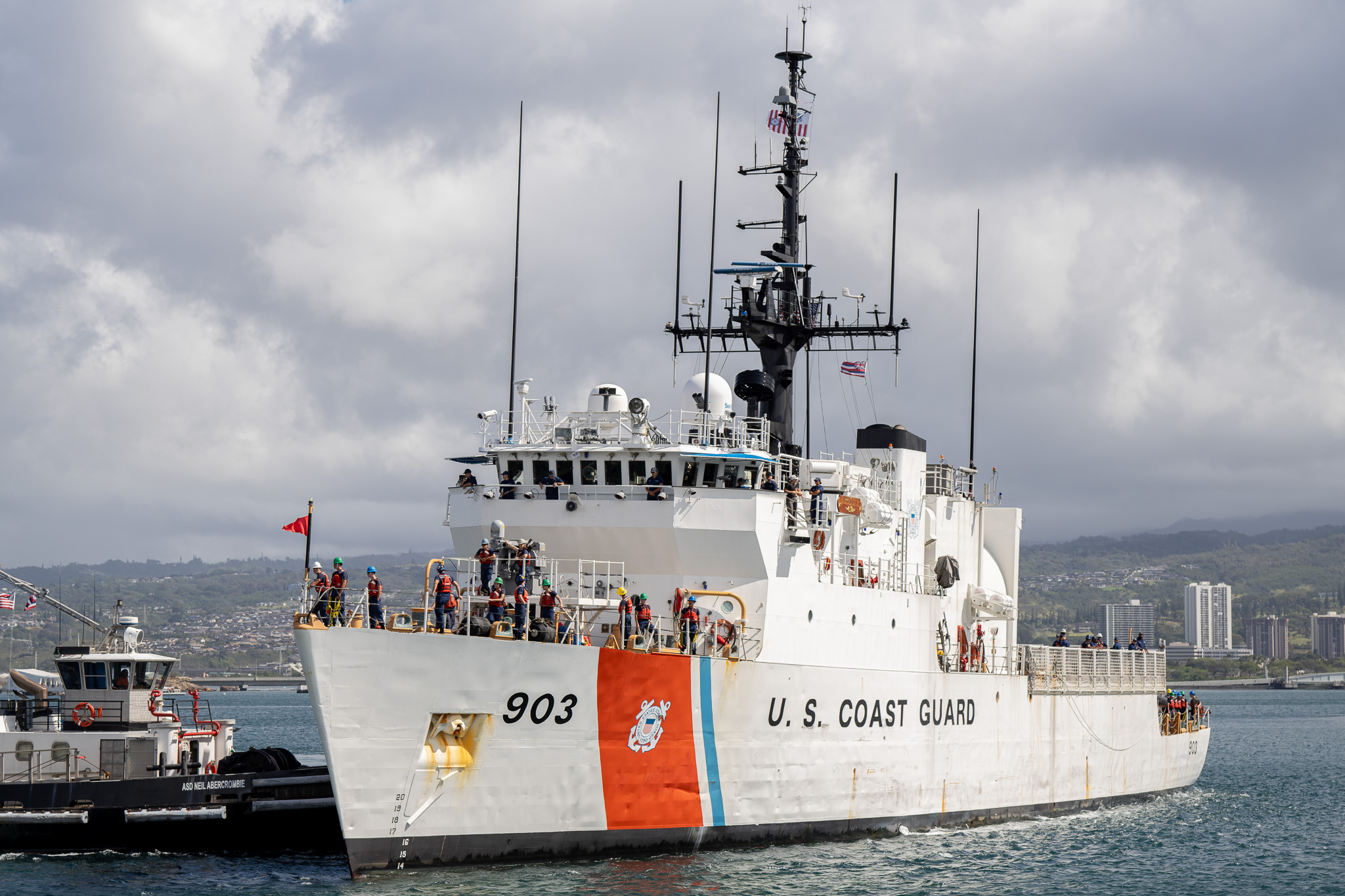
U.S. Coast Guard Cutter Harriet Lane returns to home port after 79-day patrol, April 9, 2024. (U.S. Coast Guard photo by Senior Chief Petty Officer Charly Tautfest)

A U.S Coast Guard 87-foot patrol boat fleet stages in Freeport, Bahamas for storm avoidance, Sept. 27, 2022. The Coast Guard from South Carolina to the Florida Keys and Caribbean are urging mariners to secure their vessels and paddlecraft, stay informed and follow local evacuation orders, and use VHF Ch. 16 or 911 for emergency assistance. (U.S. Coast Guard video by Senior Chief Petty Officer Brodie MacDonald)

The Coast Guard Cutter Alert (WMEC 630) conducts an engagement coincidental to operations with members of the Guatemalan Navy August 23, 2022, five miles south of Puerto Quetzal, Guatemala. The engagement to strengthen law enforcement and search and rescue capabilities with our partners in Guatemala included joint pursuit training with two Guatemalan small boats, and a search-and-rescue exercise with the Guatemalan vessels Kukulkan and the Kaibil Balam. U.S. Coast Guard courtesy photo.

An Air Station Barbers Point HC-130 Hercules aircrew flies over the Coast Guard Cutters Midgett (WMSL 757) and Kimball (WMSL 756) off Oahu, Hawaii, Aug. 16, 2019. The Midgett joined the Kimball as the second national security cutter homeported in Hawaii. (U.S. Coast Guard photo by Petty Officer 3rd Class Matthew West/Released)

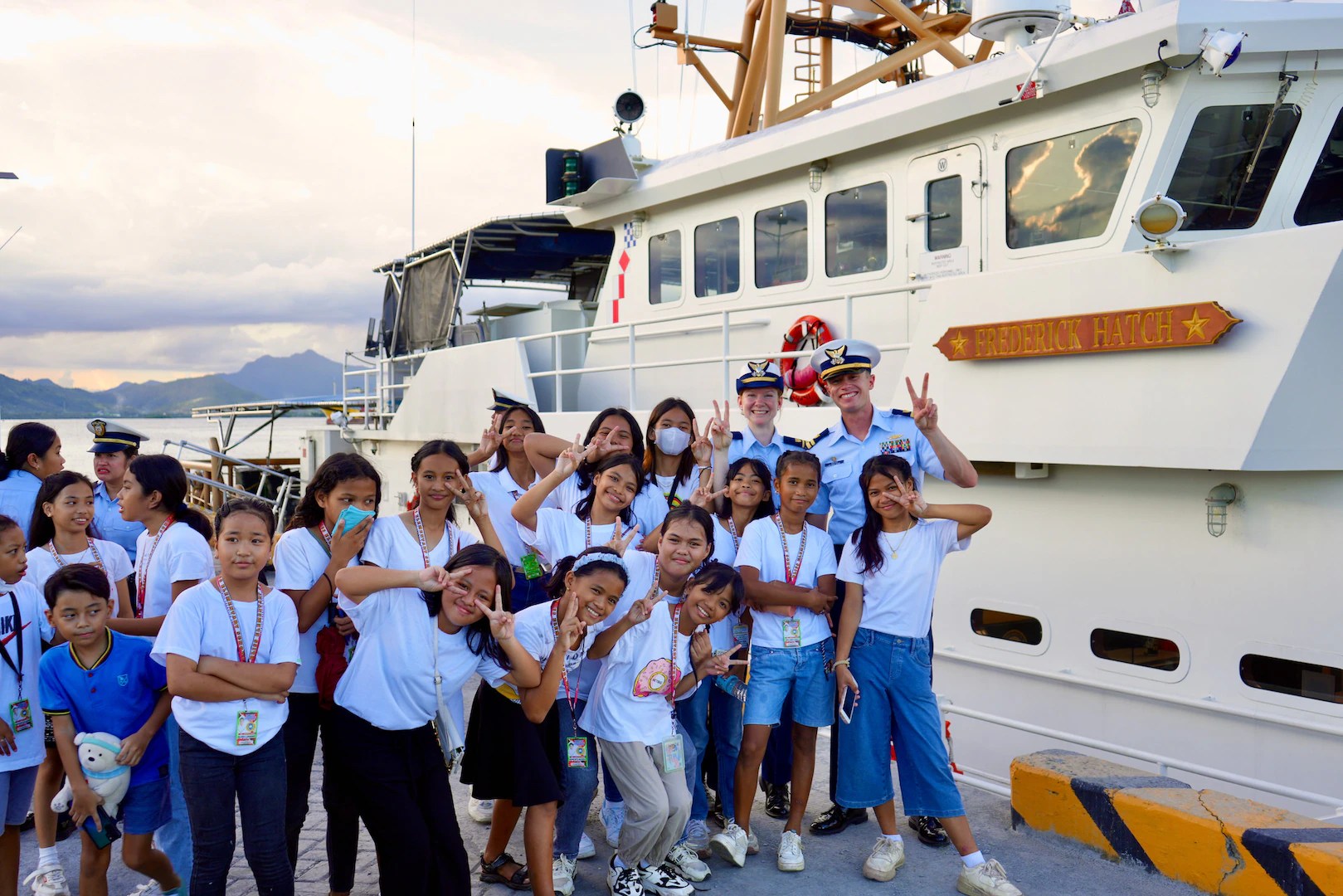
Lt. j.g. Mary Sims, executive officer of USCGC Frederick Hatch (WPC 1143), takes a photo with students touring the ship at the pier in Tacloban, Philippines, on Oct. 21, 2023. In a historic first, the USCGC Frederick Hatch (WPC 1143) visited Tacloban, Philippines, from Oct. 19 to 23, 2023, and the crew conducted engagements marking a significant milestone in the enduring relationship between the United States and the Philippines. (U.S. Coast Guard photo by Lt. j.g. Mary Sims)

Should There Be a Coast Guard Barbie?

A female U.S. Navy aviator Barbie doll of the character Natasha “Phoenix” Trace, from the movie ‘Top Gun: Maverick,’ is posed in Teterboro, New Jersey, on Monday, Nov. 22, 2021. Barbie has represented every long-standing U.S. military branch except the Coast Guard. (Ted Shaffrey/AP Photo)

There is a Barbie doll representing every US military service except the Coast Guard (and maybe Space Force). Should there be a Coast Guard Barbie? You can get the story and vote here.

Perhaps a rescue swimmer.

I think it would sell well at Coast Guard Exchanges.

What a Former WHEC is Doing Now

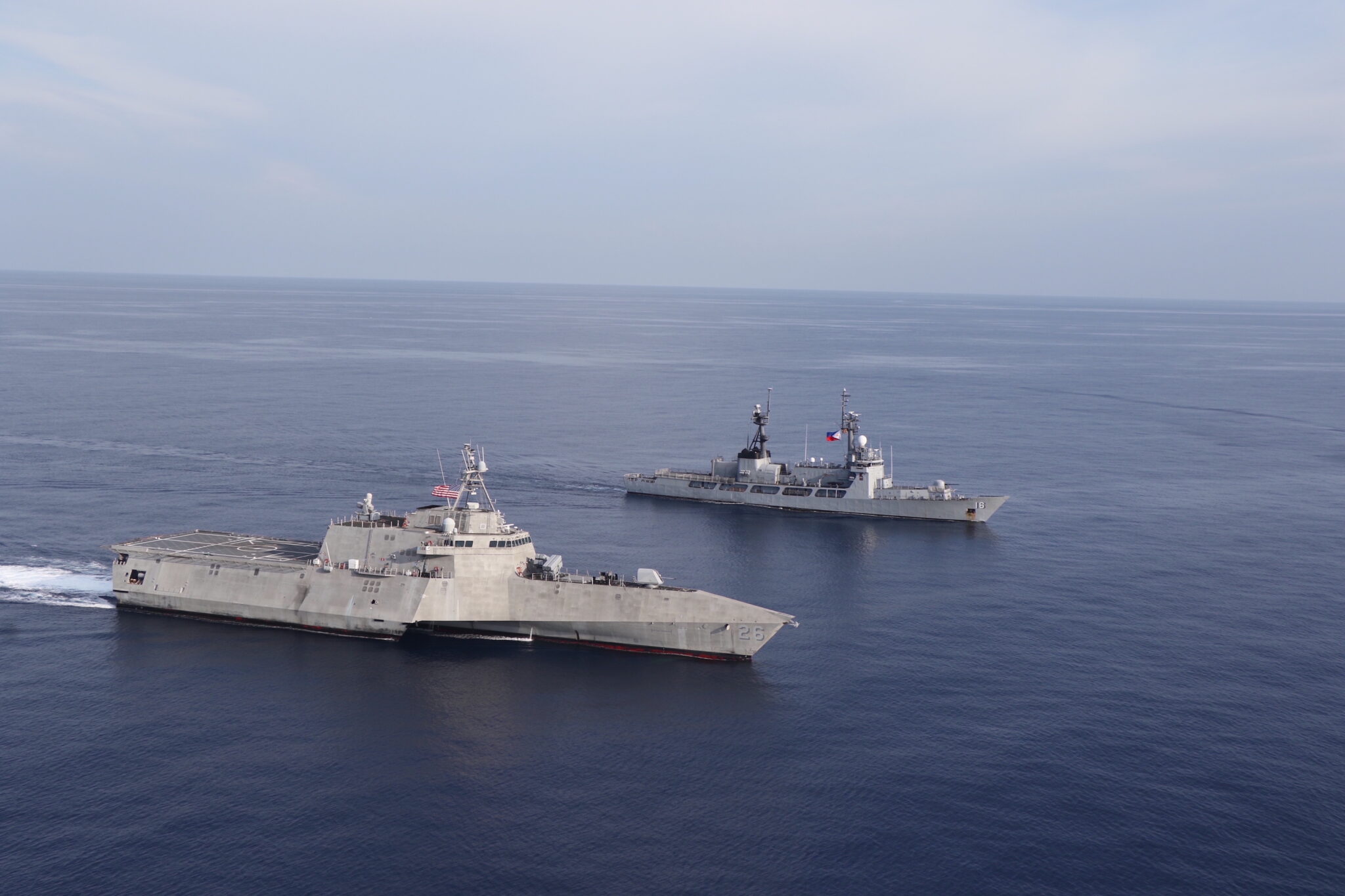
SOUTH CHINA SEA (July 31, 2024) – Independence-class littoral combat ship USS Mobile (LCS 26) conducts a Maritime Cooperative Activity with Philippine Navy’s Gregorio del Pilar-class patrol ship, BRP Ramon Alcaraz (PS 16), (former USCGC Dallas), in the South China Sea, July 31, 2024. Mobile, part of Destroyer Squadron 7, is on a rotational deployment operating in the U.S. 7th Fleet area of operations to enhance interoperability with allies and partners and serve as a ready-response force in support of a free and open Indo-Pacific region. (U.S. Navy photo by Naval Aircrewman Tactical Helicopter 2nd Class Diego Chavez)

US Naval Institute News reports,

U.S. and Philippine warships rendezvoused near a disputed South China Sea feature to conduct a joint maritime patrol on Wednesday.

USS Mobile (LCS-26) and BRP Ramon Alcaraz (PS-16) met off Leslie Bank, a maritime feature within Manila’s exclusive economic zone and Beijing’s 10-dash line claim. The littoral combat ship and ex-Coast Guard Hamilton-class cutter drilled in bilateral surface operations and communication, with a video released by the Armed Forces of the Philippines claiming that the two vessels took up a patrol formation.

Nice to see the LCS is apparently armed with Naval Strike Missiles.

Gun vs Missiles: Pakistan’s Damen Built 2600 Ton OPV

Naval News reports,

The Pakistan Navy has commissioned its first Offshore Patrol Vessel (OPV) 2600, named PNS HUNAIN, at Constanta Port in Romania.

This is a rare beast, a heavily armed Offshore Patrol Vessel. It is a medium sized OPV, little more than half the size of a National Security Cutter or Offshore Patrol Cutter:

  • Length: 98.0 m (321′)
  • Beam: 14.6 m (48′)
  • Draught: 4.0 m (13′)
  • Displacement: 2600 tons
  • Speed: 24 knots

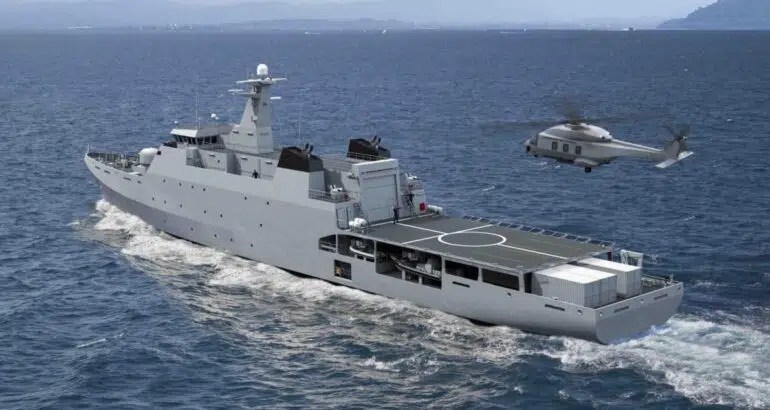
The basic design, the DAMEN OPV 2600, may have been the Bollinger proposal for the Offshore Patrol Cutter competition. At that time DAMEN’s generic OPV 2600 looked like this.

OPV 2600 multi-mission patrol vessel rendering (Source: Damen)

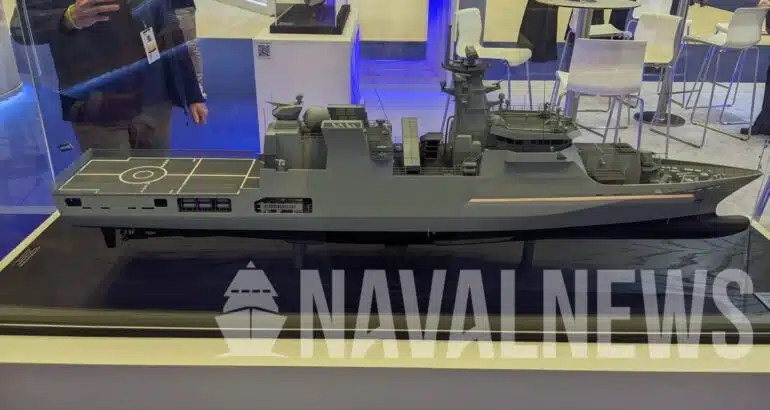
The ship has not been fitted out yet. If the model seen in the report is actually the way the ship is equipped, the Pakistani OPV will have

Pakistan seems to have decided it was better to go with a small 40mm gun rather than a 76mm to make room for the air defense missiles. I think that was a good decision and may save money in the long run.

My own feeling is that the only thing guns can do that missiles cannot do as well or better is fire shots across the bow. To be able to fire a shot across the bow is a requirement for a law enforcement vessel, but while it is commonly done in the CG by a .50 caliber, if you want to do it at a greater range, say four km or about two nautical miles, the 40mm is a good choice. The need for a larger gun for that purpose is highly unlikely.

Upfront costs to buy a medium caliber gun, its fire control systems, and its initial ammunition allowance are high, as are long term personnel support costs.

A capability to launch missiles that have a higher probability of hit and greater hitting power beyond the effective range of 57 or 76mm guns may actually be relatively inexpensive. Plus, VLS missile launchers may actually look less intimidating than heavy guns.

Graphic from Leonardo


Are We Going to do the Same Thing to the Crew of Healy that was done to the Crew of Polar Star?

The spouse of a Coast Guard Cutter Healy (WAGB 20) crewmember waves goodbye as the cutter departs Base Seattle for a multi-month deployment to the Arctic, June 12, 2024. (U.S. Coast Guard photo by Petty Officer 3rd Class Annika Hirschler)

Having recently reread the Acquisition Directorate’s In-Service Vessel Sustainment web page, I found this.

Service life extension program for Coast Guard Cutter Healy will occur in a five-year phased production between 2026 and 2030. Healy is a 420-foot cutter, the service’s only active medium polar icebreaker, which was commissioned in 1999. When completed, the SLEP effort will recapitalize a number of major systems and extend the service life of the cutter until the polar security cutters are operational.

This sounds an awful lot like what was done to Polar Star over a five year period. Healy, like Polar Star, is based in Seattle, but Polar Star’s five year rolling Service Life Extension Program was not done in Seattle, it was done in Vallejo, CA. Vallejo is 776 miles from Seattle. These five phased Yard periods were extremely long, so the ship spent about half its down time far from home. I know they tried to mitigate the effect on the crew, but it had to be bad for crewmembers whose families were in Seattle.

I can’t help but think it would have been a good idea to change Polar Star’s homeport to Vallejo or Alameda (water depth at the Support Center permitting). Vallejo is a lower priced area than Seattle and there is property there from the old Navy shipyard that the city is still trying to develop. Pretty sure the city would be happy to have Healy homeported there.

If Vallejo was not possible, it is 31 miles from Vallejo to Alameda. That is not a particularly long commute in the Bay area, for the relatively short time the ship would be in Alameda, and there are relatively affordable places to live in between.

Is it going to be different for Healy?

I also notice this, that the SLEP is intended to “extend the service life of the cutter until the polar security cutters are operational.” Since Healy is nominally a medium icebreaker, I would have thought the Coast Guard would keep her in service until replaced by an Artic Security Cutter (medium icebreaker). Healy was commissioned in 1999, so I would have thought she would remain in service 40 years, until 2039. A SLEP ending in 2030/31 also suggests another ten years of life. Are we going to have to wait until 2039 for the Polar Security Cutters to be completed?

WMEC 270 SLEP / USCGC Legare Begins Service Life Extension Program at Coast Guard Yard

The Coast Guard Cutter Legare (WMEC 912) weighs anchor near the Statue of Liberty in New York City, New York, March 17, 2024. (U.S. Coast Guard photo courtesy of Legare)

The Acquisitions Directorate (CG-9) website includes a photo of USCGC Legare (WMEC-912) and the caption “270- foot medium endurance cutter Legare begins service life extension program at Coast Guard Yard.” Normally clicking on the caption would lead to a post expanding on the title, but in this case, it takes you to the In-Service Vessel Sustainment Program page. That page gives us this information about the 270 SLEP.

“Service life extension program for the 270-foot medium endurance cutters involves targeted system replacement to address system reliability, supportability, obsolescence and in­teroperability. This work will include upgrades or replacements to the electrical power generation and distribution system as well as the main propulsion engines. The mission is to facilitate continued operations during transition to the offshore patrol cutter by extending the service life of 270-foot cutters for up to 10 years. Work began on one prototype vessel at the Coast Guard Yard in July 2021 and on the second cutter in April 2022. Full production is scheduled to begin in 2023.”

The intention is not to SELP all 13 WMEC270s, rather they did two limited prototype SLEPS (Seneca, WMEC-906, and Harriet Lane, WMEC-903), and plan to do six full production SLEPs. These 270s should be the last WMECs in commission as they are replaced by Argus class Offshore Patrol Cutters. Harriet Lane’s most visible change was removal of her 76mm Mk75 gun and Mk92 fire control system. A 25mm Mk38 remote weapon station was mounted on the bow on an elevated position. This change is to be applied to all subsequent 270 SLEPs.

Spencer, (WMEC-905) was the first full production 270 SLEP. Spencer was the first 270 to receive new engines. Spencer’s old engines were to be remanufactured and reinstalled on a subsequent WMEC270 SLEP, presumably the newly arrived Legare.

This is a long process. Work on Harriet Lane lasted 15 months, so I expect we will have at least one 270 in the Yard being SLEPed for the next five years.

“Coast Guard Cutter James honored by White House at United States Interdiction Coordinator Awards Ceremony” –CG News

Coast Guard Cutter James (WMSL 754) personnel pose for a photo with other law enforcement agency officials, July 19, at the White House in Washington, D.C. for the annual United States Interdiction Coordinator Awards. James’ crew was recognized with the top maritime interdiction during the awards ceremony. (Photo courtesy of the White House)

Below is a release from Coast Guard News.

Wanted to highlight this, because it all goes back to one very junior person who took her job seriously and a command that believed in her.


July 26, 2024

Coast Guard Cutter James honored by White House at United States Interdiction Coordinator Awards Ceremony

To view the full event, click here. 

WASHINGTON — The crew of the Coast Guard Cutter James (WMSL 754) was honored at the White House during the United States Interdiction Coordinator Awards Ceremony on July 19.

The annual event, held by the Office of National Drug Control Policy (ONDCP), recognized the exceptional contributions and achievements of various law enforcement entities in drug interdiction efforts. James’ crew was recognized for top maritime interdiction.

Amidst heavy seas on the afternoon of Sept. 11, 2023, a junior watchstander noticed what appeared to be the wake of a go-fast vessel approximately 10 nautical miles off James’ bow. The cutter set its go-fast response bill, spurring the entirety of James’ crew in motion to prepare for a counter-drug pursuit. James used an operational procedure agreed upon with Ecuador that allowed law enforcement teams to embark the foreign-flagged vessel, where they found 73 bales of cocaine. Following the successful seizure of 3,863 pounds of cocaine and the detention of three suspected narcotraffickers, James coordinated an at-sea transfer of the detainees and contraband with Ecuador to enable home country prosecution and strengthen a key partnership.

To successfully spot a target of interest on the high seas without positive identification from aerial assets or radar is known as a cold hit. Within the realm of maritime interdiction, cold hits are the equivalent of finding the proverbial needle in a haystack, a complex difficult task made more challenging by the heavy seas and gray skies that limited visibility on that day. In this case, the cold hit detection of the go-fast vessel was made by the lookout, one of James’ most junior crewmembers, who had been in the Coast Guard for only six months. Her initial cold hit spurred the rest of the crew and teams into action.

During the ceremony, ONDCP Director Dr. Rahul Gupta, commended the crew of James for their outstanding service and unwavering commitment to protecting the nation’s borders and safeguarding the lives of countless Americans. The cutter’s achievements are a testament to the Coast Guard’s enduring legacy of excellence in maritime law enforcement and drug interdiction.

“It was an honor to receive this award on behalf of the entire James crew,” said Capt. Donald Terkanian, commanding officer of James. “Our crew’s exceptional efforts disrupted illicit drug trafficking, deprived transnational criminal organizations of millions of dollars in revenue, apprehended suspected traffickers, strengthened a key partnership, and helped save lives by preventing drugs from reaching the streets.”

James is a 418-foot, Legend-class national security cutter, homeported in North Charleston, South Carolina. The cutter’s primary missions are counter-drug operations and defense readiness. Stone falls under the command of the Coast Guard Atlantic Area in Portsmouth, Virginia. Atlantic Area oversees all Coast Guard operations east of the Rocky Mountains to the Arabian Gulf. In addition to surge operations, Atlantic Area also allocates ships to deploy to the Caribbean Sea, Eastern Pacific Ocean, and South Atlantic Ocean to combat transnational organized crime and illicit maritime activity.

For information on how to join the U.S. Coast Guard, visit GoCoastGuard.com to learn about active duty, reserve, officer, and enlisted opportunities. Information on how to apply to the U.S. Coast Guard Academy can be found here.

“B-2 Stealth Bomber Demoes QUICKSINK Low Cost Maritime Strike Capability During RIMPAC 2024” –The Aviationist

We are starting to hear some stories about what was done during RIMPAC 2024. The Aviationist reports,

The U.S. Air Force B-2 Spirit carried out a QUICKSINK demonstration during the second SINKEX (Sinking Exercise) of RIMPAC 2024. This marks the very first time a B-2 Spirit has been publicly reported to test this anti-ship capability… During the drills, two long-planned live-fire sinking exercises (SINKEXs) led to the sinking of two decommissioned ships: USS Dubuque (LPD 8), sunk on July 11, 2024; and the USS Tarawa (LHA 1), sunk on July 19.

The video above is from 2022. Unlike the recent RIMPAC sinking, the weapon was delivered by an F-15 and the target was only a small ship.

We talked about QuickSink earlier and why preparing Coast Guard aircraft to use it on the first day of a war might be a good idea.

Perhaps the threat of an invasion of Taiwan may have influenced the choice of targets for the SINEXes.

USS Dubuque (LPD-8)

Yuzhao (Type 071) Class Amphibious Ship With two Houbei (Type 022) fast attack craft behind. CSR Report RL33153 China Naval Modernization: Implications for U.S. Navy Capabilities—Background and Issues for Congress by Ronald O’Rourke dated February 28, 2014.

020628-N-3228G-001.Pearl Harbor, HI (Jun. 28, 2002) — Amphibious warfare ship USS Tarawa (LHA 1) leaves Pearl Harbor to participate in exercise “Rim of the Pacific” (RIMPAC) 2002.  U.S. Navy photo by Photographer’s Mate 1st Class William R. Goodwin. (RELEASED)

I look forward to seeing the Videos. Would really like to know how many weapons of each type were used. These big ships can be very hard to sink.

QuickSink, a modified 2,000-pound GBU-31 JDAM that blows up under the keel, is the only non-nuclear weapon that may be more deadly to ships than a torpedo, and the B-2 can carry 16 of them. Employing the Rapid Dragon system, C-17s and C-130s could bring many more.

Below is video of the USS Denver SINKEX in 2022. She was a sister ship of USS Debuque.