“Q&A: Vice Admiral Andrew J. Tiongson, Commander, Pacific Area and Commander, Defense Force West, U.S. Coast Guard” –Seapower

Tiongson speaks at a press conference before the crew of the Coast Guard Cutter Waesche offloads 18,219 pounds of cocaine, worth more than $239 million, on Dec. 6, 2023. U.S. Coast Guard

The Navy League’s on-line magazine, Seapower, has an interview with the Pacific Area Commander. There is a lot of good information here.

HC-130Js (and C-27Js):

CGAS Sacramento will “transition” to HC-130Js. Pacific Area certainly needs the long range aircraft because, while 84% of the US EEZ is in Pacific Area they have only three fixed wing air stations (Kodiak, Barbers Point, and Sacramento) while Atlantic Area has five fixed wing air stations to cover only 16% of the US EEZ.

What will happen to the C-27Js? No mention was made of these. They might go to Guam. That would be helpful in providing fixed wing search aircraft in the Western Pacific. Recently there was a SAR case in the Western Pacific. A C-130 was dispatched from Barbers Point, but the flight was so long the crew needed a day’s rest before the aircraft could be used in the search. On the other hand, Guam might not be an optimal location since it is so far West. There are other options.

Fast Response Cutters:

As I read the statement, the intention is to have a total of six FRCs in Guam and add a fourth in Hawaii.

His discussion about these little ships clearly indicates that their nominal five-day endurance (same as the preceding 110 foot WPBs) is being exceeded regularly.

“The FRCs, first off, are game changers for the Coast Guard in general. Back in the day, we had patrol boats that were limited in terms of the sea states they could handle, the food that they could carry, the number of crew members and certainly their duration at sea. The FRCs have changed that.”

Six WPCs in the same port is not unusual. District 7 has three different ports, each homeport to six or seven Webber class, but this may be a move toward replicating a PATFORSWA type organization to support 7th Fleet in the Western Pacific.

Large Patrol Cutters:

There was a brief discussion of the Offshore Patrol Cutters, but no indication of when they are expected to arrive in PACAREA.

A second “Harriet Lane or Indo-Pacific support cutter” is on PACAREA’s unfunded priority list. For some reason, I think this may happen.

Commercial Icebreaker Procurement:

Plans for the commercial icebreaker (Aiviq) were discussed. It will be homeported in Juneau, as reported here in March, but still has not been purchased and it will take two years to complete changes to make it fully operational.

The admiral was asked, “Is the commercial icebreaker going to be crewed by Coast Guardsmen or by a contract crew?” and there was no definitive answer. Should the Coast Guard adopt a hybrid crew, as has been done by some Navy vessels it would be a major change in Coast Guard policy.

The Eastern Pacific Drug Transit Zone: 

Atlantic Area cutters are not assisting in Eastern Pacific drug transit zone interdiction efforts, as they normally would, because they are heavily engaged in migrant interdiction operations.

Trusted Partner:

The Area Commander talked a lot about what being a trusted partner meant, about partnerships with Asian coast guards, and the outsized effect of having a few good people in liaison positions.
“Coast Guard Cancels Icebreaker Healy’s Arctic Mission” –USNI

US Naval Institute News Service reports,

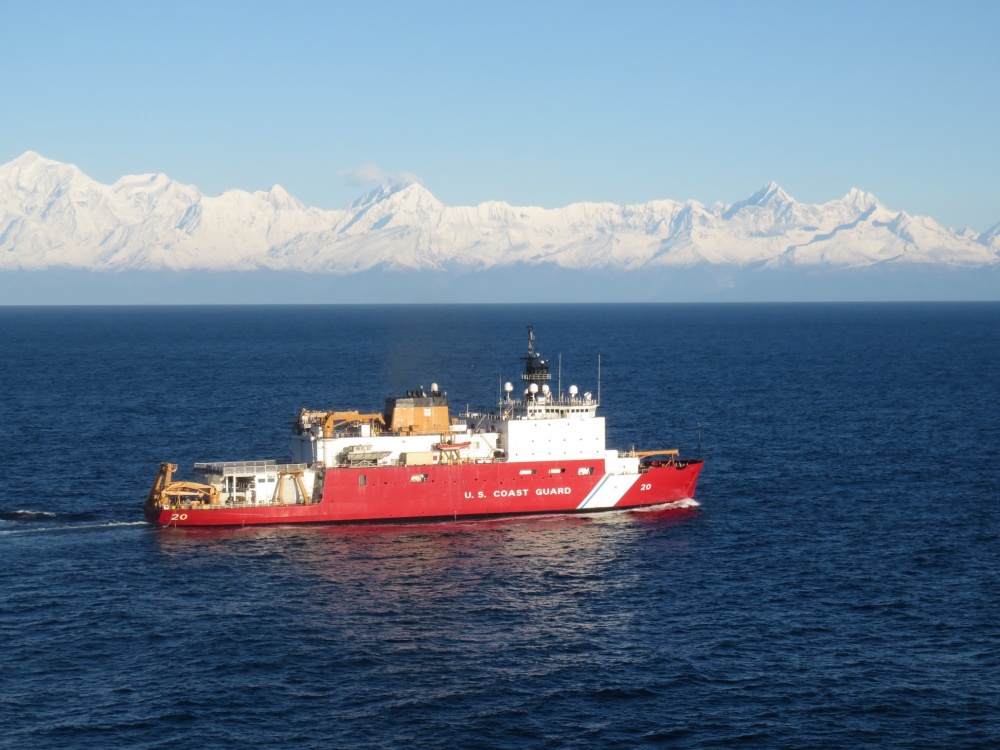
“An electrical fire in a transformer forced USCGC Healy (WAGB-20), one of two American icebreakers, to cancel its Arctic mission, USNI News has learned.”

The fire and Healy’s return to port have been mentioned in comments here at least a couple of time, but this clearly puts an end to any possibility the ship might be quickly repaired and return to the Arctic this year. “This is the second time in four years that a fire cut Healy’s summer mission short.”

The post talks a bit about “…controlled parts exchange with other ships at the pier. That’s a fancy term for cannibalization.” That helps keep Polar Star and the medium endurance cutters operational, but Healy is one of a kind so that is not even a possibility for some systems.

Keeping ships reliable and underway as they approach and pass 30 years of age gets increasingly difficult and possibly uneconomical. In this case, where we have no “bench strength,” it could be disastrous.

Cutter Size Ships Building in Latin America

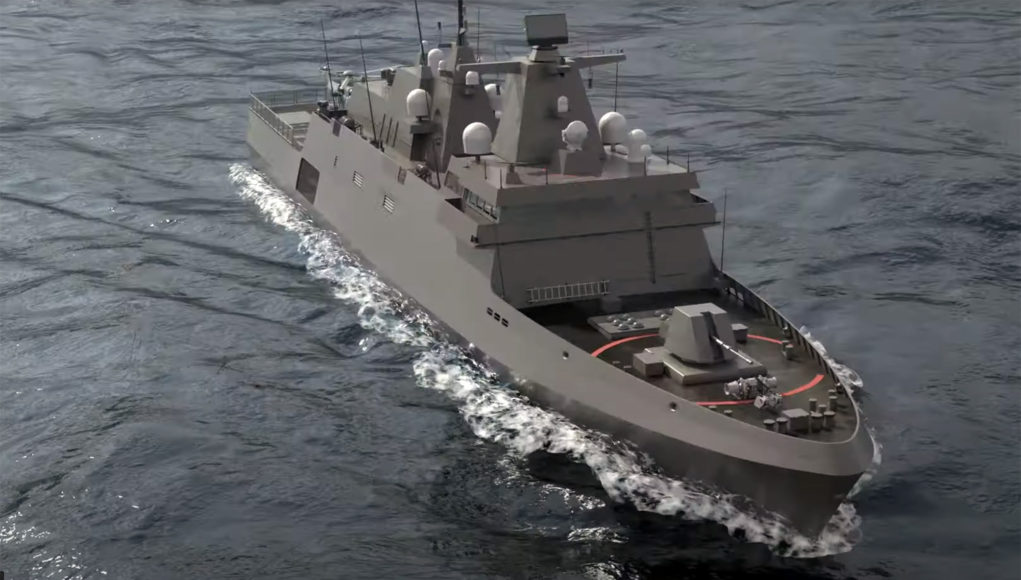
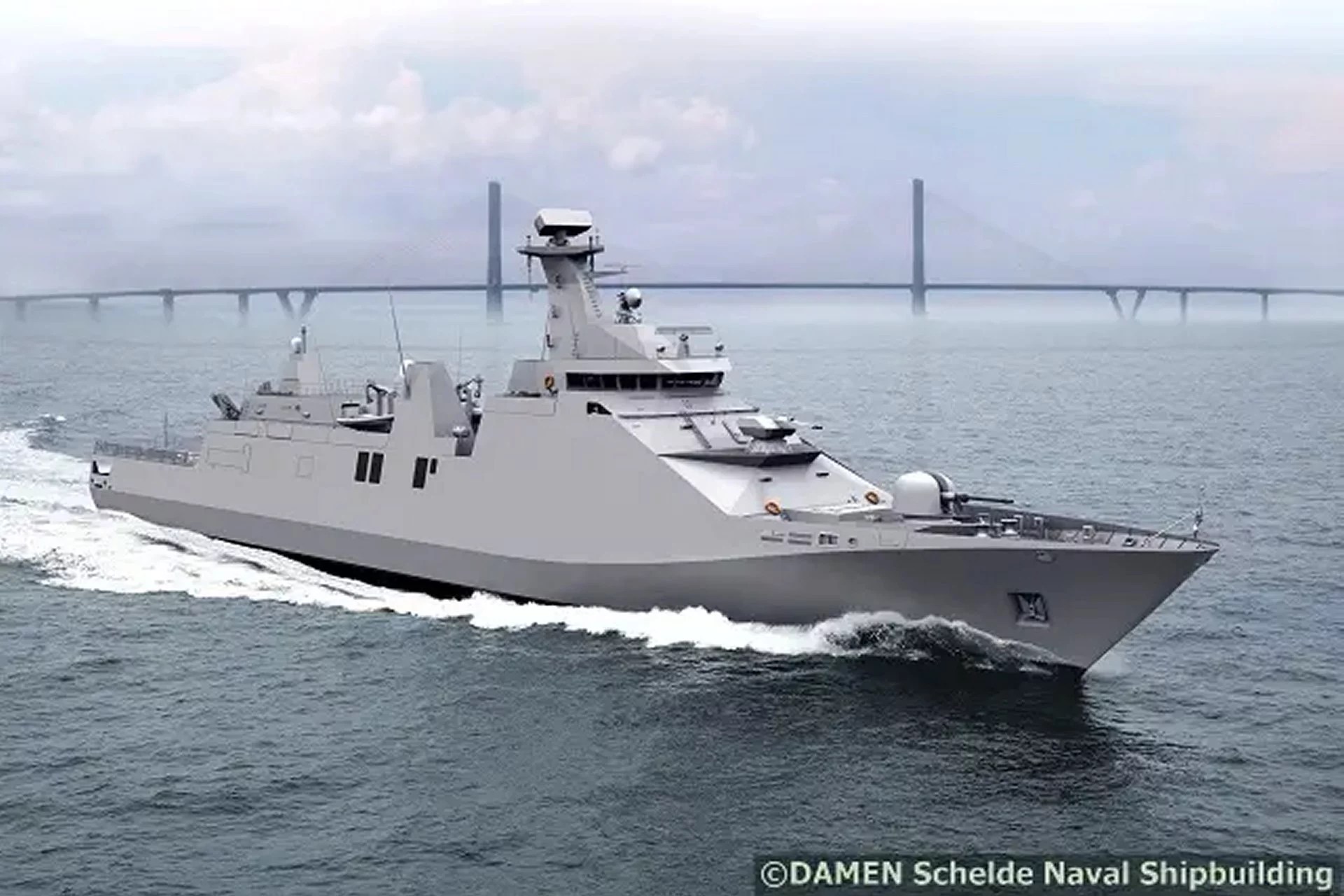
Damen SIGMA 10714 for Colombia

Always interesting to see what other countries are doing in terms of ships that will perform coast guard style missions. In some countries, these are their largest warships.

Two recent reports from Latin America.

In both cases they have chosen to build ships with the assistance of experienced European shipbuilders. Both are smaller than either the National Security Cutter or the Offshore Patrol Cutter.

Brazil has launched the first of a planned eight Tamandaré-Class Frigates, pictured above, designed by ThyssenKrupp Marine Systems of Germany. It is evolved from earlier MEKO designs that include the German K130 Braunschweig class corvettes and the Israeli Sa’ar 6.

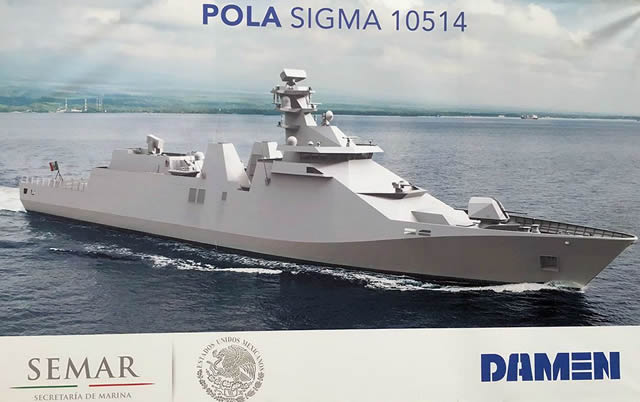
Colombia has contracted with Damen, designers of the USCG Fast Response Cutters, to help locally build the first of five planned light frigates that will replace four somewhat smaller sized Admirante Padilla class ships commissioned 1983/4. The design is a Damen SIGMA 10714 design, meaning it is 107 meters (353′) in length with a beam of 14 meters (46′). The design is closely related to ships built in Mexico (pictured below) and in Indonesia.

Mexico’s Damen SIGMA 10514, ARM Benito Juárez (POLA-101)

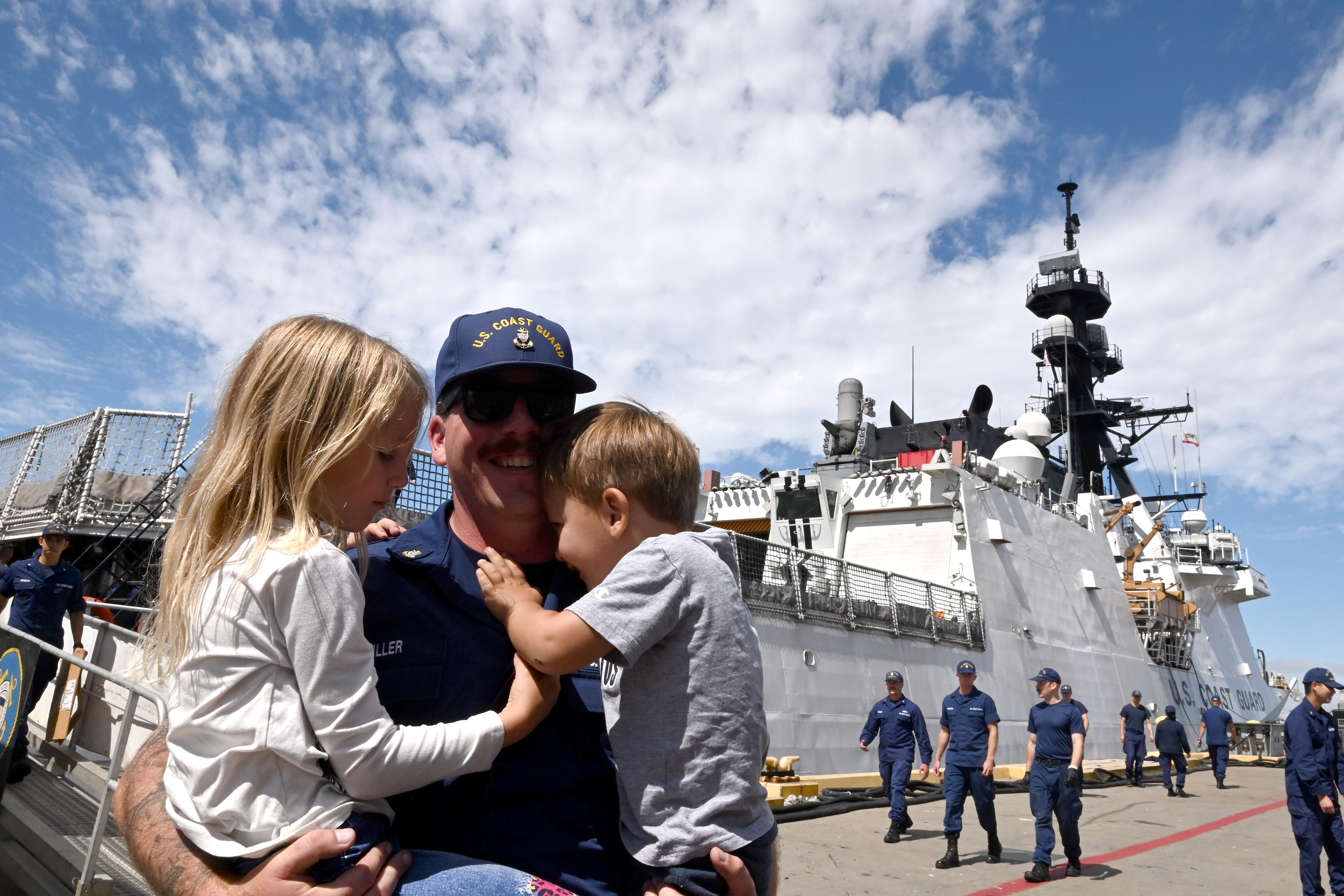
U.S. Coast Guard Cutter Waesche returns home following a 120-day Indo-Pacific patrol

The U.S. Coast Guard Cutter Waesche (WSML 751) crew members reunite with family, friends and loved ones after returning to their Base Alameda, California, home port, Aug. 11, 2024, following a 120-day Indo-Pacific patrol. The Waesche participated in various engagements, exercises, and events throughout their deployment. U.S. Coast Guard photo by Chief Petty Officer Matthew Masaschi.

Below is a news release from Coast Guard News (more photos and a video there). Looks like the Coast Guard is aiming to keep at least one cutter in the Western Pacific at all times.

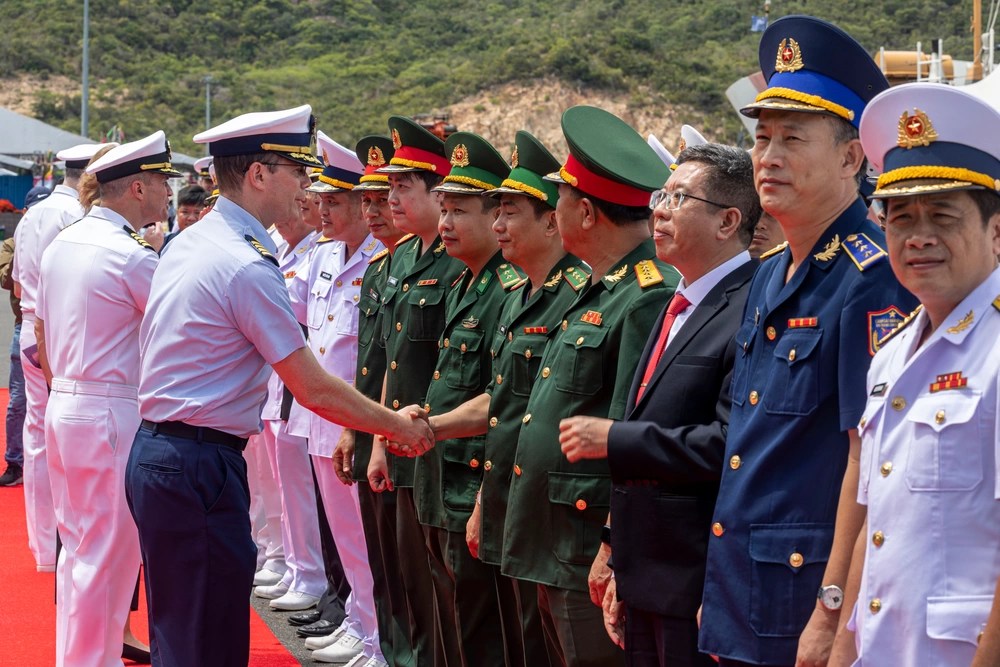
Those of my generation can’t help but see the irony of the friendly relations with the Socialist Republic of Vietnam as Waesche accompanied the 7th Fleet Flagship to Cam Ranh Bay.

U.S. Coast Guard Capt. Tyson Scofield, commanding officer of the U.S. Coast Guard Cutter Waesche (WMSL 751), shakes hands with leadership from the Vietnamese People’s Army during a reception at the Cam Ranh International Port in Vietnam, July 8, 2024. Leadership from the Vietnam Coast Guard and Vietnam Peoples Navy welcomed U.S. Sailors and Coast Guardsmen upon their arrival. Waesche is deployed to the Indo-Pacific to advance relationships with ally and partner nations to build a more stable, free, open and resilient region with unrestricted, lawful access to the maritime commons. (U.S. Marine Corps photo by Cpl. Elijah Murphy)

Aug. 12, 2024

U.S. Coast Guard Cutter Waesche returns home following a 120-day Indo-Pacific patrol

ALAMEDA, Calif. — The U.S. Coast Guard Cutter Waesche (WSML 751) and crew returned to their Base Alameda home port Sunday, following a 120-day patrol throughout the Indo-Pacific.

Waesche participated in various engagements, exercises, and events throughout their deployment.

The cutter’s leadership and crew met with officials and military personnel during port calls in Japan, Republic of Korea, Singapore, and Vietnam.

Following Waesche’s visit to Maizuru, Japan, Waesche joined crews from the Japan Coast Guard vessel Wakasa (PL 93) and the Republic of Korea Coast Guard patrol vessel Taepyongyang (KCG 3016) for a joint search-and-rescue exercise at sea.

Waesche’s crew also conducted a bilateral U.S.-Philippine search-and-rescue exercise with the Philippine Coast Guard in the South China Sea.

“We are thankful to have traveled safely home to our loved ones and to have completed a successful and meaningful patrol,” said Capt. Tyson Scofield, Waesche’s command officer. “Waesche’s patrol strengthened U.S. relationships with our partner nations to foster a free and open Indo-Pacific. The opportunity to work alongside our allies and partners in the Indo-Pacific through impactful engagements was an honor and a rewarding experience that the crew will remember for the rest of their lives.”

Tyson assumed command of the Waesche during a change of command ceremony held in Honolulu as the cutter transited to the Indo-Pacific.

Waesche deployed with a San Francisco-based MH-65E Dolphin helicopter and an aircrew from Air Station Barbers Point, Hawaii.

Waesche was assigned to Destroyer Squadron (DESRON) 15, the Navy’s largest DESRON and the U.S. 7th Fleet’s principal surface force. DESRON 15 regularly assumes tactical control of surface units operating in the area.

Commissioned in 2010, Waesche is one of four Legend-class national security cutters homeported in Alameda. National security cutters are 418-feet long, 54-feet wide, has a top speed of over 28 knots, a range of 12,000 nautical miles, endurance of up to 90 days, and can hold a crew of up to 170. The advanced technologies of the national security cutter class ships are designed to support the operations and missions in the Indo-Pacific region.

Maybe One Small Step Closer to a Polar Security Cutter

Photo of a model of Halter Marine’s Polar Security Cutter seen at Navy League’s Sea-Air-Space Exhibition have surfaced. Photo credit Chris Cavas.

Saw this new Navy contract on a list of DOD Contracts for Aug. 12, 2024.

Bollinger Mississippi Shipbuilding, Pascagoula, Mississippi, is awarded a $37,990,331 firm-fixed-price modification to previously awarded contract (N00024-19-C-2210) to exercise an option for provisioned item orders to procure a diesel generator. Work will be performed in Rostock, Germany (90%); Mankato, Minnesota (5%); and Lafayette, Indiana (5%), and is expected to be completed by December 2025. Fiscal 2021 procurement, construction, and improvement (Coast Guard) funds in the amount of $37,990,331 will be obligated at time of award and will not expire at the end of the current fiscal year. Naval Sea Systems Command, Washington, D.C., is the contracting activity.

That is a mighty expensive emergency generator. It was not clear where this generator was going. Googling the contract number, I found this reference to the contract, connecting it to the Polar Security Cutter.

Contracts For April 23, 2019

NAVY

VT Halter Marine Inc., Pascagoula, Mississippi, is awarded a $745,940,860 fixed-price incentive-firm contract for the detail design and construction of the U.S. Coast Guard (USCG) Polar Security Cutter (PSC) (formerly the Heavy Polar Ice Breaker). The PSC program is a multiple year Department of Homeland Security Level 1 investment and a USCG major system acquisition to acquire up to three multi-mission PSCs to recapitalize the USCG fleet of heavy icebreakers which have exhausted their design service life. The PSC’s mission will be to ensure continued access to both polar regions and support the country’s economic, commercial, maritime, and national security needs. This contract includes options which, if exercised, would bring the cumulative value of this contract to $1,942,812,266. Work will be performed in Pascagoula, Mississippi (61 percent); Metairie, Louisiana (12 percent); New Orleans, Louisiana (12 percent); San Diego, California (4 percent); Mossville, Illinois (4 percent); Mobile, Alabama (2 percent); Boca Raton, Florida (2 percent); and various other locations (3 percent), and is expected to be completed by June 2024. If all options are exercised, work will continue through November 2027. Fiscal 2019 procurement, construction, and improvement (Coast Guard); and fiscal 2018 and 2017 shipbuilding and conversion (Navy) in the amount of $839,224,287 will be obligated at time of award and will not expire at the end of the current fiscal year. This contract was competitively procured via the Federal Business Opportunities website, with three offers received. The Naval Sea Systems Command, Washington, District of Columbia, is the contracting activity (N00024-19-C-2210).

I presume this is for the first of class since construction has not yet begun, but there was also this,

Contracts For Dec. 29, 2021

NAVY

VT Halter Marine Inc., Pascagoula, Mississippi, is awarded a $552,654,757 fixed-price incentive modification to previously awarded contract N00024-16-C-2210 to exercise an option for the detail design and construction of the second Coast Guard Polar Security Cutter. Work will be performed in Pascagoula, Mississippi (61%); Metairie, Louisiana (12%); New Orleans, Louisiana (12%); San Diego, California (4%); Mossville, Illinois (4%); Mobile, Alabama (2%); Boca Raton, Florida (2%); and other locations (3%), and is expected to be completed by September 2026. Fiscal 2021 procurement, construction, and improvement (Coast Guard) funds in the amount of 485,129,919 (80%); fiscal 2020 procurement, construction, and improvement (Coast Guard) funds in the amount of $100,000,000 (17%); and fiscal 2019 procurement, construction, and improvement (Coast Guard) funds in the amount of $20,000,000 (3%) will be obligated at time of award and will not expire at the end of the current fiscal year. The Naval Sea Systems Command, Washington, D.C., is the contracting activity.

“Russia’s war on Ukraine stalls PRC’s Arctic momentum” –The Watch

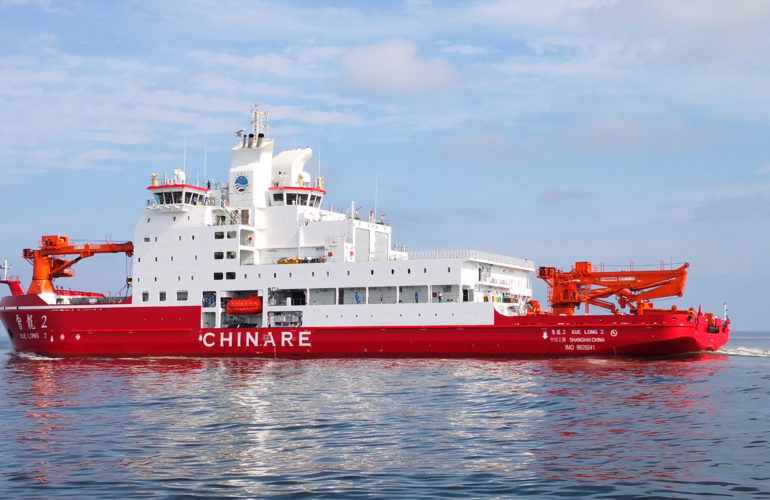
Xue Long 2 on sea trials. Photo by PRIC.

This is about a year old, but somehow, I apparently missed commenting on it when it first came out.

The Watch Reports,

As the largest non-Arctic country, and one which has often referred to itself as a near-Arctic state, the People’s Republic of China (PRC) finds itself in a more precarious position in the region as compared to five years ago when it launched its ambitious white paper, which proclaimed Chinese interests in being a key stakeholder in the far north. Beijing’s plans for the Arctic assumed that the region would be open and amenable to the development of three main pillars of Chinese Arctic policy, namely scientific diplomacy, economic partnerships and participation in regional governance initiatives. All three of these pillars are now under pressure, which has underscored the PRC’s limitations in the Arctic and will inevitably force a rethinking and likely a retrenchment of the country’s far-northern interests.

The report notes,

Despite hopes in Beijing that the PRC’s Polar Silk Road initiative would emerge as an integral part of the overall Belt and Road framework, many centerpiece projects of the infrastructure initiative have either failed or are in doubt because of financial constraints, political opposition or some combination thereof.

The “no limits” partnership between China and Russia has always been one of opportunism. There is a natural antipathy between the two countries. China has never forgotten the unequal treaties imposed on them by European powers including Russia, that stripped away Chinese territory, including important parts of what is now Russia’s Asian holdings.

Facing frustration in the Arctic. Do not be surprised to see China double down on its efforts in Antarctica.

USCGC Alex Haley Encounters Russian AGI

The Navy League’s on-line magazine, Seapower, reports,

While patrolling the Aleutian Islands, the crew of U.S. Coast Guard Cutter Alex Haley (WMEC 39) detected the vessel 30 nautical miles southeast of Amukta Pass, Alaska.

The Russian vessel was transiting in international waters but inside the U.S. Exclusive Economic Zone, which extends 200 nautical miles from the U.S. shoreline. The Alex Haley did not communicate with the Russian vessel. The Alex Haley confirmed it to be a Russian Federation Vishnya-class naval vessel and followed the vessel as it transited east. An HC-130 air crew from Coast Guard Air Station Kodiak also observed the vessel.

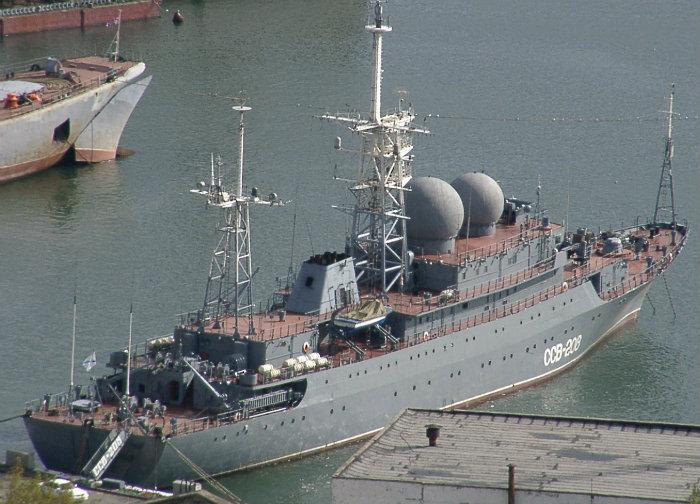
The Vishnya class are intelligence gathering ships completed in the late 1980s, like the one pictured above.

The detection was made 30 miles SE of Amukta Pass (52°27′31″N 172°00′55″W). This is well East of Eareckson Air Force Base (52°42′44″N 174°06′49″E) on Shemya and the former US Naval Air Facility, Adak (51°52′41″N 176°38′46″W).

Distances from Dutch Harbor (53°54′10.5″N 166°31′06.2″W):

  • Shemya 802 miles
  • Adak 446 miles
  • Amukta Pass 242 miles

The report seems to say that Haley simply stumbled across this Russian vessel. This suggests that it had been inside the US EEZ for at least two days before it was detected. That probably is not something to get excited about, but there may, of course, be more to this than we are aware.

USCGC Alex Haley moored in Nome, AK.

“Coast Guard Cutter Eagle and USS Constitution get underway in Boston with a 21-gun salute” –CG News

The U.S. Coast Guard Cutter Eagle (WIX 327) passes USS Constitution in Boston Harbor during the ship’s July Fourth turnaround cruise as part of Boston Navy Week. Boston Navy Week is one of 15 signature events planned across America in 2012. The eight-day event commemorates the bicentennial of the War of 1812, hosting service members from the U.S. Navy, Marine Corps and Coast Guard and coalition ships from around the world. (U.S. Navy photo by Sonar Technician (Submarine) 2nd Class Thomas Rooney/Released)

Below is an Atlantic Area news release on Coast Guard News. Wish I could see this.

Coast Guard Academy Cadets climb the rigging of Coast Guard Cutter Eagle (WIX 327) while underway July, 30, 2024. The Eagle serves as a classroom at sea for Academy Cadets and future leaders in the Coast Guard. (U.S. Coast Guard photo by Petty Officer 3rd Class Matt Thieme)

Aug. 7, 2024

BOSTON — U.S. Coast Guard Cutter Eagle (WIX 327) is scheduled to rendezvous with USS Constitution at approximately 11:30 a.m. Friday, in the vicinity of Castle Island, in Boston, Massachusetts, where the Constitution will fire a 21-gun salute.

Constitution will also fire a 17-gun salute as it passes U.S. Coast Guard Base Boston, the historic site of Edmund Hartt’s Shipyard where Constitution was built and launched on October 21, 1797.

Media members interested in riding in with Eagle for this transit can coordinate through Petty Officer Kate Kilroy at katlin.j.kilroy@uscg.mil. Those interested should RSVP by 3 p.m. Thursday and plan to be at Coast Guard Base Boston no later than 7:45 a.m. Friday.

Eagle will moor at Coast Guard Base Boston following the transit. On Saturday and Sunday, Eagle will be available for free tours for the following dates and times:

  • Saturday (10 a.m. to 7 p.m.)
  • Sunday (10 a.m. to 7 p.m.)

Military members and first responders with valid ID can attend tours one hour prior to posted tour times.

Media is invited to tour Eagle and conduct interviews from 10:00 a.m. to 11:00 a.m. on Saturday. Those interested should RSVP at katlin.j.kilroy@uscg.mil by 5 p.m. Friday.

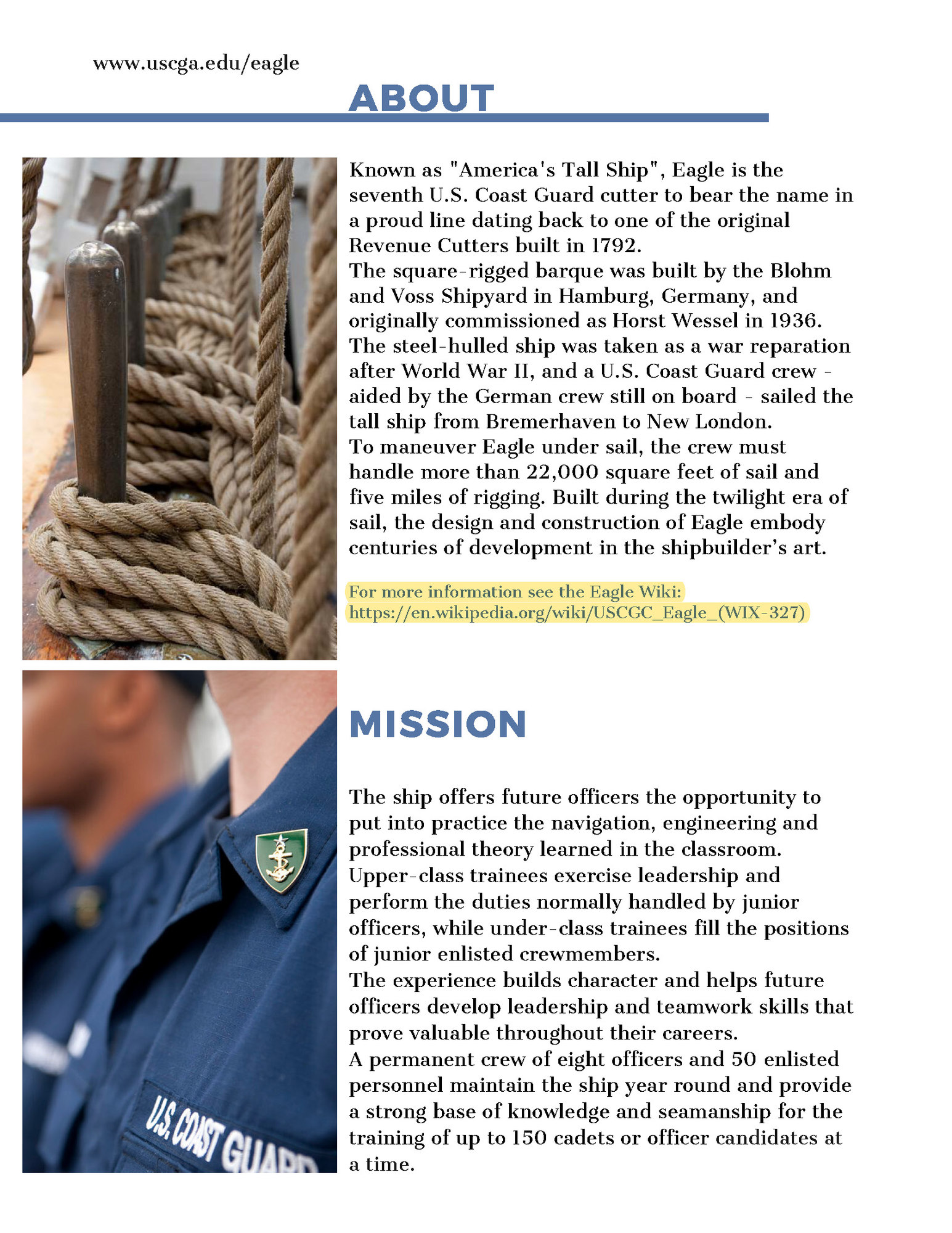
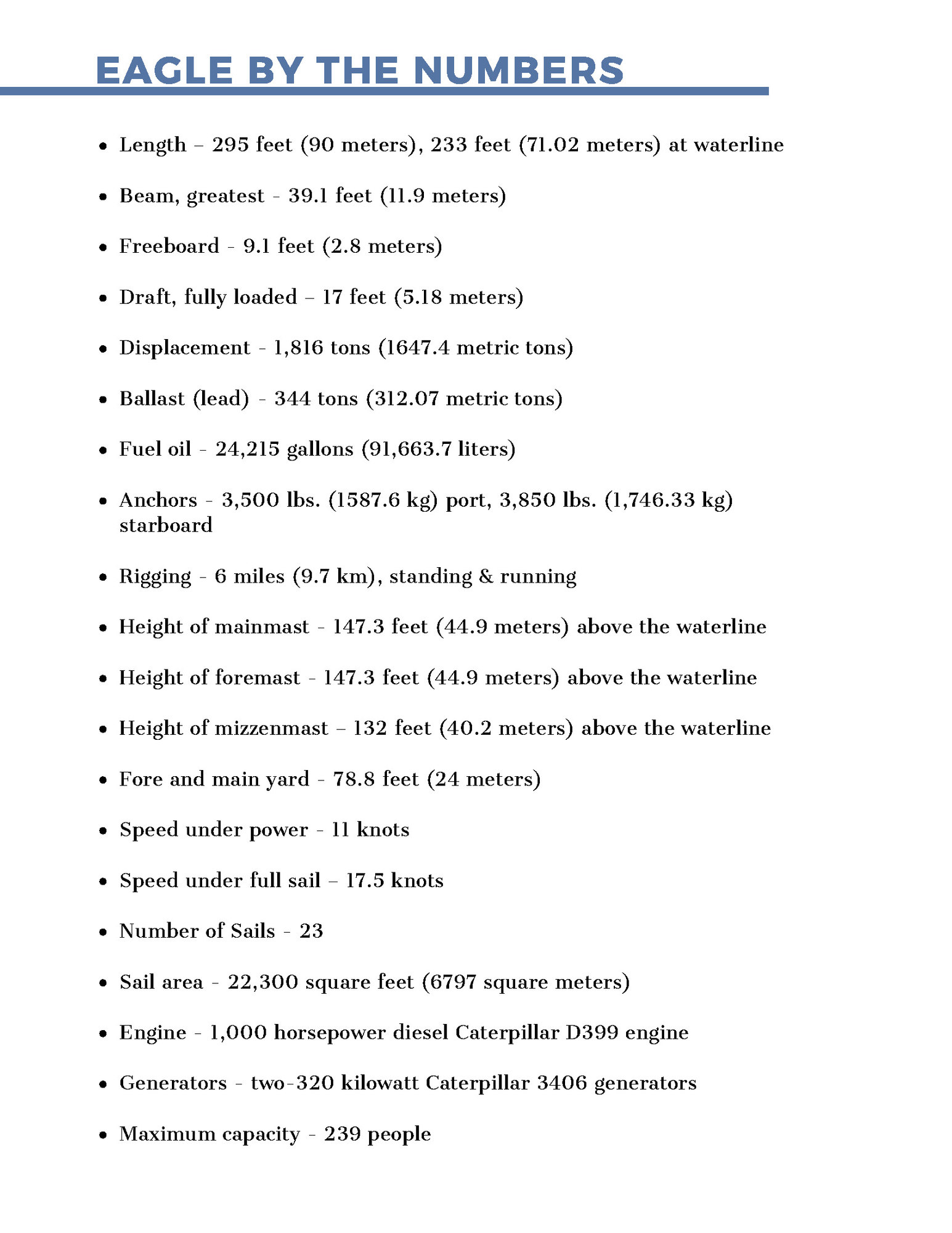
At 295 feet in length, Eagle is the largest tall ship flying the stars and stripes and the only active square-rigger in United States government service. Eagle has served as a classroom at sea to future Coast Guard officers since 1946, offering an at-sea leadership and professional development experience as part of the U.S. Coast Guard Academy curriculum.

Eagle is a three-masted barque with more than 22,300 square feet of sail and six miles of rigging. The cutter was constructed in 1936 by the Blohm and Voss Shipyard in Hamburg, Germany. Originally commissioned as the Horst Wessel by the German navy, Eagle was a war reparation for the United States following World War II.

Additional information about the Eagle can be found here. The Eagle’s design dimensions can be found here.

For more information about Eagle, including port cities, tour schedules, and current events, follow the “United States Coast Guard Barque EAGLE” Facebook page or on Instagram @barqueeagle. All U.S. Coast Guard imagery is in the public domain and is encouraged to be shared widely.

Thanks to Paul for bringing this to my attention.

“Coast Guard participates in multinational exercise near Galapagos Islands” –Coast Guard News

The U.S. Coast Guard joined coast guards and navies from 13 nations, between June 24 and July 9, in an exercise hosted by Ecuador to align international mission priorities seeking to ensure the defense, security, multinational cooperation and governance of the maritime domain of the Eastern Pacific Ocean. (U.S. Coast Guard photo)

Below is a release from Coast Guard News. More photos and a video there. 

This is another outstanding performance by a Webber class WPC. District Eleven has sent Fast Response Cutters (FRC) down to the Eastern Pacific Drug transit zones before, but this is further and unlike previous deployments, the little ship was not accompanied by an accompanying larger vessel. 

No reason this size vessel should not be able to do it, but it requires a lot of planning. Fortunately, there is a new Expeditionary Logistics Element to provide support.

I would note that, despite the fact that the Atlantic Area has far more FRCs and at least 20 of them are closer to the Eastern Pacific than the four FRCs based in San Pedro, no Atlantic Area FRCs have made it into the Eastern Pacific. Perhaps this is a prototype operation, a proof of concept. Pac Area has proven its possible.


U.S. Coast Guard District 11, Aug. 6, 2024

ALAMEDA, Calif. – The U.S. Coast Guard joined coast guards and navies from 13 nations, between June 24 and July 9, in an exercise hosted by Ecuador to align international mission priorities seeking to ensure the defense, security, multinational cooperation and governance of the maritime domain of the Eastern Pacific Ocean.

The Eleventh Coast Guard District employed the Coast Guard Cutter Benjamin Bottoms, a 154-foot Fast Response Cutter, and subject matter experts to engage in professional exchanges with international partners completing a variety of exercises centered around countering illegal, unreported, and unregulated (IUU) fishing operations.

“Fostering strong diplomatic and operational relationships between the U.S. and partner nations is essential in having improved maritime security and governance,” said Capt. Jason Hagen, Eleventh District chief of Enforcement Division. “By participating in exercises like Galapex, the U.S. Coast Guard can assess and understand operational capabilities of other nations in the IUU domain, which strengthens future joint multi-agency and multi-national maritime operations.”

During the exercise, participants simulated real-world scenarios to refine response strategies for IUU fishing activities. The exercise helped participating nations to develop and refine procedures in enforcing maritime law.

“As the sole U.S surface asset to participate in the exercise, the cutter executed our first unsupported expeditionary patrol to the Southern Hemisphere in the Eastern Pacific area of operations,” said Lt. Cmdr. Allice Gholston, commanding officer of the USCGC Benjamin Bottoms (WPC-1132). “The crew engaged with 14 partner nations both on land and at sea and did so in impeccable fashion. We encourage the continued partnership with the Ecuador Navy in future iterations of Galapex.”

Transiting 3,500 miles from homeport to Ecuador and Galapagos Islands, the crew pushed the boundaries of mission sets and downrange operations. The ability to conduct expeditionary operations in support of our Central and South American partners could only be possible with the support of the Coast Guard’s Expeditionary Logisitics Element (LOG-X), providing foreign port contracting services and advanced medical staffing through the deployable independent duty health services technician billet.

Working with the CG Attache in the U.S. Embassy Quito, the cutter enacted the ship rider program under the maritime bilateral agreement with Ecuador, hosting an Ecuadorian Coast Guard officer while underway.

The scenarios were run out of Ecuador’s Maritime Operations Center in Salinas, Ecuador. Drills included nine ships including the cutter Benjamin Bottoms operating as a task force and implementing standard procedures and considerations for illegal, unreported, and unregulated (IUU) fishing operations within the South Pacific Regional Fisheries Management Organization (SPRFMO) high seas boarding inspections.

“AC-130J Ghostrider Hammers Amphibious Warship During Rare Appearance At Sinking Exercise” –The War Zone

The War Zone provides a video of one minute and 36 seconds of a RIMPAC2024 SINKEX.

The firing platform is an Air Force AC-130J and the weapons used were a 105mm (4.1″) howitzer and a 30mm chain gun.

As noted previously, to respond to a terrorist threat, the Coast Guard needs to be able to forcibly stop any ship, regardless of size. I don’t think the weapons the Coast Guard has can do that. So, I wanted you to see the effects of the weapons used in the video.

We already know that 30mm rounds, weighing about twice as much as the 25mm rounds, are much more effective. In a US Navy test against boats (65 feet long or smaller), the 30mm did nine times the damage to the hull and five times the damage inside the hull. The 25mm rounds, exploding on impact, failed to even penetrate the 1/4 inch aluminum hull of the Mk3 target boat.

Against larger targets, is even the 30mm gun used in the new Mk38 Mod4 effective? It appears the rounds may be exploding on impact. You would not want to be out on deck when this happening, but it appears the rounds may be exploding on contact and not penetrating.

The 57mm round is about 7 times larger than the 30mm, but still relatively small for a naval gun.

You see a hit from the 105mm at 30 seconds. The 105mm fires a 33 pound projectile, about 5 and a half times larger than the 57mm. It would have probably killed anyone in the bridge, but even it did relatively little damage to the structural integrity of the ship. It did not seem that any of the damage effected the engineering plant or the watertight integrity of the ship.

Getting a mobility kill on a ship with gun fire is extremely difficult. What the Coast Guard has is not what it needs.

More here, here, and here.