Program Updates from a GAO Report

September 26, Fiercehomelandsecurity posted a story (“GAO: Not eliminating two National Security Cutters will cause ‘difficult choices'”) on a recent GAO report, “COAST GUARD, Portfolio Management Approach Needed to Improve Major Acquisition Outcomes” (download the report, GAO-12-918 (.pdf)).

I’m going to look at other aspects of the report later, but there were a number of items addressed in the report that readers may not be aware of. This is not an exhaustive list, the report contains even more, but I thought these most interesting. We may have touched on some of  these changes already, but here goes.

General:

“DHS stated that future breaches in Coast Guard programs would almost be inevitable as funding resources diminish.” (p.17)

Maritime Domain Awareness/C4ISR:

Nationwide Automatic Identification System–Indefinitely deferring plan for continuous nationwide coverage. (p14)

Common Operating picture:

“The Coast Guard planned to buy an integrated C4ISR system for each asset to enable greater awareness. As we reported in July 2011, the Coast Guard has spent over $600 million purchasing a C4ISR system that is difficult to maintain and does not yet achieve the system-of systems capability and the Coast Guard’s helicopters are no longer going to be a part of this system” (p.26)

–Neither the OPC or the FRC are expected to be able to exchange near real time “battle data” (tactical data link?) with DOD assets. (p.25)

–Why don’t we use LINK 16 Multifunctional Information Distribution System-Low Volume Terminals on all these platforms?

Fast Response Cutter:

“…the Coast Guard has attributed the more than $1 billion rise in the Fast Response Cutter’s cost to a reflection of actual contract cost from the September 2008 contract award and costs for shore facilities and initial spare parts not included in the original baseline.”

Aviation:

Coast Guard’s Aviation Logistics Center told us they recently identified that the end of service life for the HH-60s and HH-65s could be reached as early as the 2022 time frame—not the 2027 time frame as originally planned. Officials added that this will require the Coast Guard to either buy new HH-60s and HH-65s or conduct a service life extension—previous service life extensions have been funded with acquisition dollars.(p16)

H-65 program: dropping both a helicopter handling, traversing, and securing system and a surface search radar. (p.13)

H-60 Program: deferring indefinitely upgrades to include a surface search radar and C4ISR due to budget constraints. (p.13)

A revise baseline program for C-130s has been forwarded DHS that recommends 11 H models and 11 J models (p.40) (I think this is an increase in the expected number of “J” models.)

Sanity Prevails:

The Coast Guard has dropped its plans to deliver boarding parties on potentially hostile ships by helicopter (p.27)

A Small Bit of Surprisingly Good News:

The National Security Cutter can do 32 knots (“speed is based on the results of an operational assessment” p. 32), making it almost certainly the fastest major cutter ever.

DHS Cutter Fleet Study

FierceHomlandSecuroty brought to my attention a Study by DHS (.pdf) they obtained under the Freedom of information act.

A cursory scan of the study suggest that (at 392 pages), it is a rich source of data and probably of continuing interest, so I have added it to the blog’s references page. I’ll try to give a more in depth review later. I have also added an earlier report–GAO briefing slides for Congressional Committees, April 20, 2012, “Observations on the Coast Guard’s and the Department of Homeland Security’s Fleet Studies”[PDF]

The study helps explain the apparent cancellation of NSCs #7 and 8, in that the DHS study finds very little difference in mission performance between NSCs and OPC, to justify the NSCs apparently much higher price, but it also leaves room for a revision of this decision because, they expect not building NSCs would reduce the fleet’s capabilities at least into the 2030s. The study recognized there remain many unknowns and at least to some extent recognizes the urgency of replacing the cutter fleet, so, at least to my reading, it identifies no definitive single best course of action.

Related:

Offshore Patrol Cutter Update, June 2012

Several documents have emerged recently that provide more information on the proposed Offshore Patrol Cutter (OPC), also known as the Maritime Security (Cutter), Medium (WMSM). This builds on information previously published (here, herehere, here and here).

The Request for Proposal included a projected build schedule for the first 11 ships.

  • FY 2016 Detail Design
  • FY 2017 OPC#1 Construction begins
  • FY 2018 OPC#2
  • FY 2019 OPC#3
  • FY 2020 OPC#4 and #5
  • FY 2021 OPC #6 and #7
  • FY 2022 OPC #8 and #9
  • FY 2023 OPC #10 and #11

There is a notation that the average cost of units 4-9 shall be $276M in FY2016 dollars. (Looks like there might be potential for a multi-year contract here.)

One of the big surprises to me (found in the Fleet Mix Study) was that the OPCs are expected to essentially take over all Alaska Patrols.

The draft Request for Proposal (RFP) also includes a requirement to equip all of them “to operate in areas of broken plate, pancake, and sea ice ranging from 10 to 30 inches thick.” Along with this, came a requirement to be able to operate an ice capable small boat as well. OPCs are also to have automated topside de-icers.

These characteristics combined with the Commandant’s affirmation that the ships should be capable of boat and helicopter operations in state five seas mean these ships will be very much more capable than the WMECs they are nominally replacing, and at least to some degree, that they are taking over duties previously assigned to 378s.

Towing ability to 10,000 tons is required, same as the 378s.

The ships are expected to be able to do Fueling at Sea (FAS), Replenishment at Sea (RAS), Vertical (Helicopter) Replenishment or VERTREP, and to refuel smaller vessels (apparently reflecting an expectation of sustained operations with WPCs or WPBs at locations remote from their bases).

Minimum ranges was specified as 7,500 nautical miles. (This is a reduction from 8,500 miles). Typical operations as outlined in the Concept of Operations (CONOPS) were 14 days between refueling, 21 days between replenishment, and 45-60 day patrols. It also stated there would typically be a four to six week inport “Charlie” (stand-down/maintenance) period after each patrol; a six to seven week dockside availability every two to three years; and a seven to eight week drydocking every four to five years. “In addition, the cutter will undergo 3-4 weeks of training and evaluation every 10-24 months.”

An expectation that the ships might operate with Expeditionary Strike Groups (ESG) was apparently a recent addition. This helps establish a floor for the ships’ maximum speed, since all the units typically operating in an Expeditionary Strike Group (LHAs, LHDs, LPD, LSDs) have speeds of 20 to 24 knots. When the current generation of LSDs is replaced in the not too distant future, all will do 22+ knots. Of the three ships that typically make up an ESG, the largest (LHAs or LHDs) all do at least 24 knots and frequently act as small aircraft carriers. If the OPCs are to be fast enough to stay with these ships and hopefully maneuver around them, then 25 knots appears to be a minimum rather than a nice to have.

The crew is not to exceed 100, but additional birthing must also be available for a 5 person AvDet and a 5-11 person “Signals Intelligence Support Element,” “and possibly others.”

There was reference to ballistic protection, that I had not seen before.

“The WMSM will provide increased protection for (sic.) small caliber weapons and shrapnel fragmentation around the bridge, CIC, and magazine spaces.”

The ships are to be built the American Bureau of Shipping Naval Ship Rules, but will not have explosive or underwater shock hardening.

Again we do not have access to the draft specifications, but we can deduce some details of the proposed equipment from the Allowance Equipage List included in the Draft RFP. All the systems below are referenced. (In a few cases there may be duplicate listing if different nomenclature is used for the same system.) The outfit, in most respects, repeats or even improves on that of the National Security Cutter:

Communications:

  • Military SAT com
  • Tactical Data Link System
  • IFF
  • SBU (presumably “Sensitive but Unclassified”) Network
  • SIPRNET (Classified Network)
  • NIPRNET (Unclassified Network)
  • Entertainment System

Sensors:

  • TSR-3D RARAD System, a multimode surface and air surveillance and target acquisition radar
  • Electro-Optic/Infrared Sensor system
  • RADIAC

Armament:

  • Mk 48 mod 1 Gun Weapon System (pdf), which includes the Mk 110 57mm gun, AN/SPQ-9B  Surface search and Fire Control Radar, Electro-Optical sensor system Mk 20 mod 0, the Mk 160 GCS Mod 12, and Mk 12 Gun Computer System
  • Mk 15 mod 21-25 CIWS (Phalanx)
  • Mk 38 mod 2 25 mm
  • Gun Weapon System (.50 cal.) SSAM
  • Four crew served .50 mounts including Mk 16 and Mk 93 mod 0 or mod 4 mounts
  • Mk 46 optical sight

Electronic Warfare:

  • Mk 53 Decoy launcher
  • AN/SLQ-32 (v)2

Navigation:

  • Encrypted GPS
  • Electronic Chart Display and Information System

Intelligence:

  • Ships Signals Exploitation Space (A change from SCIF (Sensitive Compartmented Information Facility))
  • Special Purpose Intel System

Aviation:

  • Hangar for helicopter up to and including Navy and Coast Guard H-60s
  • Facilities for the support of unmanned Aerial Systems (UAS)
  • TACAN
  • Visual Landing Aids

GAO Responds to Fleet Mix Studies, Part 1, The Report

In my post, Irresponsibly Rebuilding the Fleet-a Look at the Future, I talked about why it was essential that the Coast Guard build at least two Offshore Patrol Cutters (OPC) a year, when it finally starts building them in 2016. My concern is that there is still no wide spread support for funding the Coast Guard’s “Program of Record” which includes 25 OPCs in addition to eight National Security Cutters and 58 Fast Response Cutters.

Conceptual Rendering of the OPC

The Coast Guard has recently gone public with similar concerns.

Studies are playing an important part in the effort to build consensus on what the Coast Guard’s fleet of Cutters should look like in the future and how to get there. May 28 of this year, we looked at the Executive Summary of the Offshore and Aviation Fleet Mix Study completed in 2009, but only recently made public. The Coast Guard completed a second phase of its Fleet Mix Study which looked at the effects of two funding levels on the procurement process in May 2011 and the Department of Homeland Security completed a “Cutter Study” in August 2011.

May 31, 2012 GAO released a report to Congressional Committees titled “Observations on the Coast Guard’s and the Department of Homeland Security’s Fleet Studies” [PDF] along with briefing slides provided on April 20, 2012. I’m going to quote GAO’s report and slides extensively.

GAO saw there objectives as to:

  • “(1) What are the key results of the Coast Guard’s Fleet Mix Studies and DHS’s Cutter Study with respect to recapitalization and operations?
  • “(2) How useful are these studies to DHS, the Office of Management and Budget (OMB), and the Coast Guard for informing recapitalization decisions?” Continue reading

Offshore and Aviation Fleet Mix Study Published

The Coast Guard has made public the Executive Summary of its Offshore and Aviation Fleet Mix Study. “FierceHomelandSecurity” has published a short summary of the content.

They also provided a direct link to the “Executive Summary” (a 24 page pdf). It is heavy with acronyms, and there is no list of acronyms attached to the Executive Summary, although there is probably one in the full study. I’ve attached a list of those I found, at the end of the post for those who might want a little help going through the summary.

“This initial phase of the FMA (Fleet Mix Analysis-ed.) is intended to address offshore surface and aviation capabilities. Follow-on FMA phases will assess capabilities needed for coastal and inland missions as well as emerging missions, such as Arctic operations and those of the Deployable Operations Group (DOG).

“ES.5.1  SCOPE:

“The FMA explored the projected Fleet mix requirements to meet the CG’s 11 statutory missions in FY2025. Mission requirements were based on nine Mission Performance Plans (MPPs) and an assessment of critical activities, such as training and support, which consume asset mission availability.

“The FMA included all CG aviation (fixed- and rotary-wing), all white-hull cutters (FRC up to NSC), and all applicable C4ISR systems.

“The FMA focused on activities in the offshore and aviation operating environment. Offshore and aviation are defined in the FMA as being generally 50+ nautical miles offshore and/or requiring extended presence. The FMA also considered missions within 50 nautical miles that consume air asset availability.

“The FMA used the 2007 CG Fleet, as defined in the 2007 Modeled CONOPS (Concept of Operations-ed.) and the “Deepwater” POR (Program of Record-ed.) as Baselines for comparative performance and cost analysis.

“ES.5.2  ASSUMPTIONS

“Preliminary Operational Requirements Document (P-ORD) thresholds were used for the OPC (Offshore Patrol Cutter-Chuck).

“The OPC and NSC will operate 230 days away from homeport (DAFHP). No specific crewing method is assumed (i.e., crew rotation concept [CRC]).

“The HC-144A will operate at 800 programmed flight hours (PFH) per year. (This is a reduction from previous assumption–Chuck)

“U.S. Navy out-of-hemisphere (OOH) (2.0 OPC/NSC) and Joint Interagency Task Force South (JIATF-S) (7.0 OPC/NSC) support was consistent with the FY2010 demand.

“Additional acquisition/next generation platforms have the same capabilities and cost as the FMA Baseline Fleet mix cutters and aircraft (e.g., the next-generation short range recovery (SRR) helicopter is an MH-65C).

“ES.5.3  CONSTRAINTS:

“The High Latitude regions of the ice shelf and Deployable Operations Group (DOG) mission requirements were not considered.

“No specific MDA performance measures have been established to model.

“87-ft coastal patrol boat (CPB), 225-ft seagoing buoy tender (WLB), Department of Defense (DoD)/Department of Homeland Security (DHS), and foreign asset contributions were considered, but force level requirements for 87-ft CPB, 225-ft WLB, DoD/DHS and foreign assets were not assessed.

“Additional shore facilities (e.g., schools, berthing, simulators/training aids, etc.) beyond those directly associated with platforms (e.g., piers, hangars, etc.) are not included in costs.

“”The need for non-operational/shore billet increases commensurate with the projected increases in operational manning was not assessed and is not included in costs.

“All cost estimates are rough order of magnitude (ROM) and are not budget quality.

“Additional specific assumptions utilized for modeling, simulation, and costing are included in their respective chapters of the final report.

“ES.3  Methodology:

“The Fleet Capacity Analysis (FCA) combined information developed in the mission validation phase, the capability definition phase, and a Warfare Analysis Laboratory Exercise (WALEX) to produce an objective Fleet mix and incremental Fleet mix alternatives. To develop the objective Fleet mix, the FMA used three independent teams with unique force projection tools or methodologies – the Database Enhanced Center for Naval Analysis (CNA) IDS Asset Assessment Tool (CIAAT) Model (DECMv2), the Mission Effectiveness Asset Needs Model (MEAN), and a qualitative analysis by a panel of CG SMEs – to develop a force structure that was aligned with MPP capability and capacity targets. Each team applied their methodology using a common set of asset characteristics and mission demands to develop a zero-based force mix (capable of meeting all mission requirements) projection. The results from these independent projections were considered as three “lines of position” (LOPs) and were consolidated to form a conceptual “fix.””

Seven Alternative Fleets:

The Study looks at seven levels of effort: Continue reading

Where Is the Money Going?

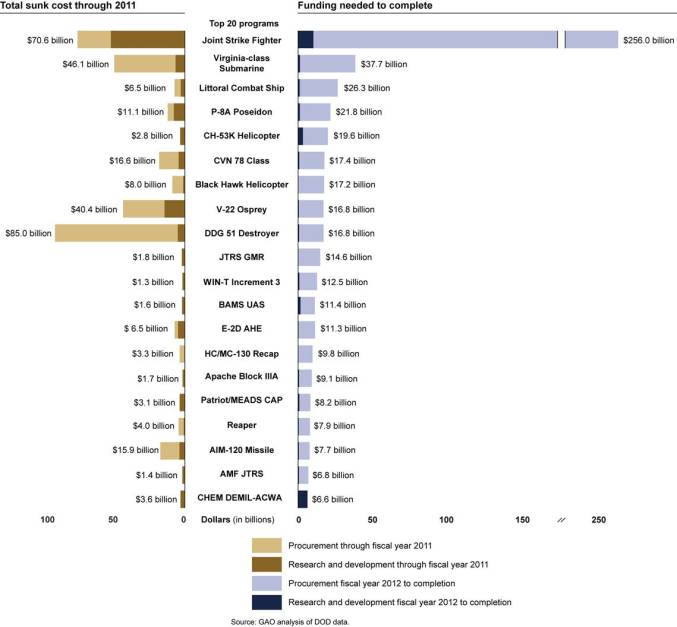
Wonder why we cannot afford NSCs 7 and 8, and why we will be building only one OPC a year? Why the Coast Guard cannot get the approximately $2-2.5B/year it needs for modernization and is making do with $1.4B? There are lots of explanations, but take a look at this chart.

Informationdissemination.net has a great discussion of this. I always knew the F-35 was a big program, but I never realized how big. The thing I find most frightening in this is that one contractor is so monopolizing the Defense Budget that it may kill off its competitors not just in the US but all over the world.
“Among the 96 programs in DOD’s 2011 portfolio, the Joint Strike Fighter is the costliest, the poorest performer in terms of cost growth, and the program with the largest remaining funding needs. The Joint Strike Fighter accounts for 21 percent, or nearly $327 billion, of the planned total acquisition cost of the portfolio.
“The Joint Strike Fighter program alone is expected to account for 38 percent—or almost $246 billion—of the future procurement funding needed. This amount is enough to fund the remaining procurement costs of the next 15 largest programs.
Let’s see, $70.6B in and $256B to go, without considering probable future growth, that is $326.6B, enough to buy about 467 National Security Cutters.

FY2013 AC&I Budget Request

Thanks to fiercehomelandsecurity.com, we have a summary of the FY2013 budget request for the Coast Guard. They also provide a link to the full budget justification.

I would like to focus on the AC&I portion and compare and contrast it with the FY 2012 appropriation which we talked about here.

Total AC&I funds go down from $1,463,968,000 to $1,192,309,000, a drop of almost 18%.

In the out years (FY 2014, 2015 and 2016) the AC&I budget is projected to rise above the FY2012 level.

A number of programs are zeroed out in FY 2013, either because they are cancelled, are on hold, or because they are complete. These include “In-service Vessel Sustainment,” Response Boat-Medium, HH-60 conversion projects, Long Range Surveillance Aircraft (C-130H/J), Rescue 21, Inter-agency Operations Centers (IOCs).

AC&I for vessels went up from $642M to $879.5M, but last year did not fund an NSC as this one does. As has been reported the seven and eighth NSC have been removed from the out-year budgets.

The breakdown for “vessels” (cutters, small boats and related equipment) looks like this:

………………………………………………….FY2012………..FY2013

Total for Vessels ……………………………….$642M……….$879.5M

  • Survey and Design – Vessels & Boats ….$6M ………….$2.5M (175 ft WLM begins)
  • In Service Vessel Sustainment (ISVS) ….$14M…………..(Restarts FY2014)
  • Response Boat – Medium (RB-M) ……$110M…………. (Complete)
  • National Security Cutter (NSC) …………$77M………….$683M
  • Offshore Patrol Cutter (OPC) …..………$25M……………$30M
  • Fast Response Cutter (FRC) …….……$358M………….$139M
  • Cutter Boats ………………………………$5M…………….$4M
  • MEC Sustainment ……………………….$47M…………..$13M
  • Heavy Icebreaker …………………………………………….$8M

Icebreakers:

There is a total of $770M identified for a new icebreaker in FY 2014, 2015, and 2017. Total acquisition cost “TBD.”

“The survey and design phase (for the new icebreaker) would last from the second quarter of fiscal 2013 through the fourth quarter of fiscal 2016, according to the justification.”

Offshore Patrol Vessels:

The $30M is to fund competitive design efforts by up to three short-listed competing ship building organizations.  This is expected to be a two step, three year design process beginning after the end of FY 2012, followed by a presumably three to four year construction process to hopefully deliver the first OPC before the end of calender year 2019. Surprisingly the out-years appear to provide for OPC construction at the rate of only one ship per year. Only $360M per year in FY2015 (first ship), 2016, and 2017. If we continue to build OPCs at only one per year it will take until 2043 to build the 25 projected by which time the newest 270 will be 53 years old. 2045 if we build two extra to replace the cancelled NSCs. (That would be truly ridiculous.) Stretching out the production run will inevitably lead to higher unit costs in contrast to the multi-year production contracts the Navy used for the Littoral Combat Ships (two five year contracts with options for up to 10 ships each).

Fast Response Cutters

The cutters are being built at a rate of four per year. Last years budget included funds for six. FY 2013 request funds number 19 and 20, and will keep the line going. FY 2014, 2015, and 2016 go back up to a $360M/year level.

AC&I for aircraft dropped from $354.4M to $74.5M.

Out years are all higher than FY 2012, as purchases of HC-144s are projected to go back up from $43M in FY 2013 to $220M/year for the succeeding three years and a total of $470M is projected for C-130s 2014-2016. Some notes of interest below:

“The LRS program continues efforts to extend the operating life and enhance the capability of the HC-130H fleet by replacing key component Center Wing Boxes (CWBs) and adding new capability (avionics-A1U), permanently defers the second avionics upgrade (A2U), and reduces the scope of the mission systems upgrade in favor of C-130J production. Consolidation of the C-130H and C-130J PPAs into one new LRS Project enables greater flexibility toward achieving an 11H/11J fleet configuration, which is expected to result in increased mission effectiveness and minimizes lifecycle cost. The eventual goal is to transition to an all C-130J fleet by the mid-2020s, when it will no longer be practical or affordable to keep the C-130H in service.”

“The Coast Guard intends to leverage FY 2012 funding initially intended for the H-60 Radar Sensor System for sustainment segments now underway, including life-limiting component recapitalization and replacement of obsolete components. These revised plans will focus resources on sustaining existing capacity and capability.”

Finally:

AC&I for “Shore, Military Housing and Aids to Navigation dropped from approximately $200.7M to 69.4M.

If we could get the Air Force’s nearly new C-27Js in lieu of HC-144s as has been discussed, it might allow us to build a second OPC each year.

(Note most of the cost breakdown information is found on page CG-AC&I-12)

New Budget Cancels Plan for Last Two NSCs

File:USCGC Waesche by Yerba Buena Island.jpg

U.S. Coast Guard photo ID: 100228-G-2129M-004, by Petty Officer 3rd Class Kevin Metcalf

Defensedaily.com is reporting that while the FY 2013 budget request would fund the sixth National Security Cutter, additional purchases would be delayed while the Department reevaluates its needs.

Homeland Security Secretary Janet Napolitano said yesterday that the reason for proposing a pause in the NSC program is due to budget constraints as well as examining how it fits with the Navy’s plans.

“We will look at [NSC’s] seven and eight in light of what the Navy is doing,” Napolitano told the House Appropriations Homeland Security Subcommittee during a hearing to examine her department’s budget request. “So we need to look at what the DoD is doing with respect to their own force lay down to see what we need to be putting in the acquisition pipeline.”

Presumably this ties in with the Navy’s review of their own programs.

It has been recognized for a long time that current plans would require a substantial increase in AC&I funding. The GAO has called the program of record “unachievable.”

While I certainly applaud coordination with DOD, this could mean a lot of different things.

Will the Navy try to move the Littoral Combat Ship program to the CG as replacement for the OPC?

Will the Navy try to avoid cutting their building programs further by suggesting that the CG does not need large ships for drug enforcement because they will supply platforms for CG boarding teams? or

This might not be so bad. When Under Secretary of the Navy Robert O. Work  discusses American Sea Power, he almost never fails to mention the contribution of the Coast Guard. Perhaps some additional thought will go into how possible military roles should be reflected in the requirements for Offshore Patrol Cutters (OPC), Icebreakers, and other assets.

An OPC that  reflects military requirements would almost certainly be larger and more capable than one designed only to meet peacetime requirements that might otherwise have been forced on the CG in an austere budget climate. Those greater capabilities probably would also make it a more capable CG asset in peacetime.

The differences might include a larger hull, more speed, better aviation facilities, and better communications and sensors, possibly including a towed array that would be useful for detecting drug subs (both true subs and self propelled semi-submersibles).

Its not clear yet, if this is a disaster or an opportunity. Perhaps a new way of justifying CG assets will come out of this, and the government will see that putting money in the CG is a sound investment.

Offshore Patrol Cutters–Are They Affordable?

Earlier the GAO advised that the “Deepwater” program was unachievable, now we have this from the Coast Guard leadership. Nationaldefensemagazine.org reports:

“The Coast Guard does not have a firm date for when it will release a request for proposals for the final piece of its ship modernization program, the Offshore Patrol Cutter. But it does know that building an affordable ship is of great importance….”

“‘We are dedicated to meeting those minimum requirements. We think we can get within an affordable range using commercial practices’ rather than methods used to build combatant ships, Korn (RAdm. John Korn, Chief of Acquisitions) said. Among the initial industry proposals submitted were ideas to reduce costs, he added.”

(I hope that statement does not mean we are totally abandoning the intention to generally comply with American Bureau of Shipping, Naval Vessel Rules–the ABS NVR.)

There are two things this report seem to suggest.

  • There will be further delays in the delivery of these ships, and
  • The Offshore Patrol Cutters are likely to be less capable and robust than previously envisioned.

Conceptual Rendering of the OPCDisclaimer: The conceptual renderings posted on this website are for artistic display purposes only and do not convey any particular design, Coast Guard design preferences, or other requirements for the OPC.

The procurement is already well behind previously published milestones, which would have seen the first ship funded in 2015 and delivered in 2019. These milestones included releasing a draft “Request for Proposal” in April-June 2011 and a “Pre-Solicitation Conference” thirty days later. In reality this does not necessarily mean substantial delays. The timeline for planning is still relatively generous.

Some limits on the design are already planned to keep the price of these ships down. Quoting further:

“The Coast Guard has already made some decisions as far as what the ship will not feature. Gas turbine engines and a system to launch small boats from the stern are two ideas that have already been scrapped, he said. Other Coast Guard ships may have these capabilities, but they would be too costly for the OPC, Korn said.”

I’m not sure if there is a need to further reduce the cost of the OPC or if they are just selling the idea that it already incorporates reduced cost, but it does sound like they need to go further. Earlier I commented on the draft specification. The two engineroom requirement with a 50/50 split in power available seemed particularly arbitrary and unnecessary, although some form of redundancy would seem wise. A diesel electric or hybrid system would appear to offer the possibility of long range, better fuel economy (particularly at low speed), low noise, reduced manning and training requirement, and lower maintenance costs, as well as improved survivability.

An Integrated propulsion and ship service electrical system similar to the one on the Lewis and Clark class T-AKEs (and most cruise ships) could permit a design with only four diesel engines (one forward, one aft, and two in the main machinery space). With azipods providing propulsion, including a drop-down unit in the bow, and the ability to use generators forward and aft, as well as those in the main engineering space for propulsion, the ship would have three compartment redundancy for both propulsion and ship service power while minimizing manning and watch standing requirements. Looking to the future, integrated power makes large amounts of power available throughout the life of the ship. This power can be reallocated to sensors or to accommodate future combat systems.

The Coast Guard has had a long history of using diesel-electric propulsion including the 180 WLBs and has already used azipods in the Mackinaw.

In seeking to make these ships affordable, there are some things that should not be compromised.

  • Boats–We need at least two and they should include at least one 11 meter. This not only makes the ship a more capable law enforcement vessel. 11 meters seems to be the emerging size for unmanned and optionally manned surface vessels that are likely to fill a variety of roles in the future including surveillance, force protection and security, mine countermeasures and ASW.
  • Aviation–We need the ability to support an MH-65 and two UAVs, and the same facilities should also be able to hanger a Navy MH-60s for contingencies. Space that can serve other purposes in peacetime should be identified to support embarked Navy helo including magazine space.
  • Speed–To be credible both for law enforcement and as a potential warship, we need a speed advantage over the average merchant ship and we need to be able to maneuver with underway replenishment ships and amphibious warfare ships. To me this means a minimum of 24 knots.
  • I don’t think this is in the current plan, but these ships should have provision for accepting mission modules, like those being developed for the LCS. In addition to Navy systems, this will give the Coast Guard the flexibility to develop their own modules–e.g., class rooms, holding cells, research facilities, command posts, disaster recovery, or hospital rooms.
  • The ship needs volume to meet the heavy weather operational requirements, but it also means there will be room to accommodate changing mission requirements. In the long run, this will save us money. Reading between the lines, it appears that the seakeeping, which also drives the size, is one thing the Coast Guard will not compromise on.

The program is at a crossroad, and to some extent, so is the service. Is the Coast Guard a military force or not? If we don’t consider armed conflict in our planning, we might as well be civilians. We can dumb down these ships to little more than 270s, maybe less in some respects, or we can make a pitch a better, more capable ship that can contribute to the national defense, at the same time they better fulfill genuine needs in peacetime.

At a time when the Navy is likely to be cut, while naval challenges are growing; spending a tiny fraction of what additional Navy ships would cost, to make sure these are credible low end combatants,  makes an awful lot of sense, particularly when, mostly, all we are only really talking about is providing a little extra space, that also enhances their peacetime utility. The nexus of a desire to strengthen naval forces while cutting costs is a perfect rationale for funding units that can do double duty.

Related:


Deepwater program “Unachievable”–GAO, Part Two

As I noted in part one, GAO has found the Coast Guard’s Deepwater program “unachievable.” Basically, they see a mismatch between the historic funding levels and the anticipated funding requirements. This in turn has impacted the delivery schedule, which in turn further adversely effects cost. Additionally significant questions still remain regarding the C4ISR (Command, Control, Communications, Computers, Intelligence, Surveillance, and Reconnaissance) system that was intended to tie the “system of systems” together. There also remains a significant unknown in the form of the Offshore Patrol Cutter (OPC) which, as the most costly single system in the program, constituted a third of the total “Deepwater” Program’s estimated cost in the 2007 Baseline.

I’m not sure I would call that “unachievable,” rather it is simply more expensive and more difficult than the Coast Guard was lead to believe, and four years later the plan is already well out of date. The Cost overruns are significant, but no more so than a lot of procurements and pale in comparison to the F-35 and Littoral Combat Ship cost overruns.

Costs

This is the cost growth GAO has seen. From Table 2 (page 12), “Increased Total Acquisition Cost Estimates for Deepwater Assets with approved baselines as of May 2011 (Then year dollars in millions)”:

Asset                                                    2007 Baseline                Revised Baseline                 % Change

NSC                                                             3,450                                 4,749                                  38
FRC                                                             3,206                                 4,243                                  32
OPC                                                             8,098                         Not yet revised                         —
Cutter Small Boats                                       110                          Not yet revised                         — (see b. below)
MEC Sustainment                                        317                                       321                                    1
Patrol Boat Sustainment                             117                                       194                                 66
MPA                                                             1,706                                  2,400                                  41
C-130J                                                               11                                       176                             1,500 (see c. below)
C-130H                                                            610                                      745                                  22
HH-65                                                             741                                    1,242                                  68 (see d. below)
HH-60                                                             451                                       487                                    8
UAS (unmanned air system)                     503                           Not yet revised                         —
C4ISR                                                            1,353                                   2,522                                  86
Other Deepwater                                        3,557                           No revision expected              — (see e. below)
—————————————————————————————————————————————————–
Total                                                           24,230                                   29,347                                21

There were some notes with this, including some that explained some of the increased costs:

If the revised baselines present both threshold costs (the maximum costs allowable before a
breach occurs) and objective costs (the minimum cost expected), threshold costs are used. An
acquisition program baseline breach of cost, schedule, or performance is an inability to meet the
threshold value of the specific parameter.

a. When a revised baseline is not available, the 2007 baseline cost is carried forward for calculating
the total revised baseline cost.

b. The cutter small boat program includes two different versions of small boats. Only one had an
approved revised baseline as of May 2011.

c. The acquisition costs are related to the mission system. The original HC-130J baseline only included
costs associated with the fleet introduction of missionized aircraft and did not include the cost of
acquiring the mission system and logistics support of the first six aircraft, and the revised baseline
corrected this omission.

d. The 2007 approved baseline did not include airborne use of force, National Capital Region Air
Defense, and the surface search radar for the HH-65. The addition of these capabilities constitutes
about $420 million of the revised costs.

e. Includes other Deepwater costs, such as program management, that the Coast Guard states do not
require a new baseline.

Additional note from page 13, “The original 2007 estimate for one OPC was approximately $320 million. However, the Coast Guard’s fiscal years 2012-2016 capital investment plan cites a planned $640 million in fiscal year 2015 for the lead cutter. Coast Guard resource and acquisition directorate officials stated that this $640 million is a point estimate for the lead cutter, some design work, and project management”

If we look at only the programs that have had revised baseline (these make up 64% of the 2007 baseline), the cost growth has actually been 33% and even that cost is not really reliable since, in some cases, prices have increased since the revised baseline. The true cost of the eight NSCs for which good cost information is now available is expected to be approximately $5.6B, a 62% increase over the 2007 baseline. There is also still considerable uncertainty about the final cost of the unmanned air systems and the C4ISR systems.

Scheduling

The second dimension that GAO regards as unachievable is projected delivery schedule. Figure 3 on page 16 shows scheduled deliveries of the final item in each of the several projects, as originally scheduled in the Baseline document approved in 2007, as approved in subsequent baseline revisions, and as projected in the FY2012-2016 Capital Investment Plan (CIP) and the projected delay, comparing the 2007 baseline and the 2012-2016 CIP. Because the projected costs exceed likely funding, they believe that even the FY2012-2016 Capital Investment Plan schedule is “unachievable.”

Asset                                                    2007 Baseline    Revised Baseline      2012-2016 CIP     Projected Delay (years)
—————————————————————————————————————————————————–
NSC                                                              2014                        2016                       2018                            4
FRC                                                              2016                        2021                       2022                            6
MEC Sustainment                                    2016                        2017                       2014                     (2 years early)
Patrol Boat Sustainment                         2013                        2014                           —                               ?
MPA                                                            2016                        2020                      2025                             9
C-130J                                                        2009                        2011                       2011                              2
C-130H                                                       2017                         2017                       2022                             5
HH-65                                                        2013                        2020                      2020                             7
HH-60                                                       2019                        2020                      2020                              1
C4ISR                                                        2014                        2027                       2025                             11
OPC                                                            2021                          —                          2031                              10
—————————————————————————————————————————————————–

You might note that the Cutter boats and Unmanned Air Systems are not included in this table.

Capabilities

Beginning on page 30 the study notes, “Key Decisions Remain for Assets in Design to Ensure Promised Capabilities Are Achieved.”

The primary technical risk appears to be the C4ISR system which was to tie the “system of systems” together and allow the service to perform the missions with few (but more capable) assets. The CG has apparently already backed away from the concept of providing all units a common operational picture. The all singing, all dancing NTDS with pictures now appears both unnecessary and too expensive. The additional overhead in maintaining classified material may also a consideration. What the Coast Guard will ultimately choose was undecided when the study was written.

By far the largest chunk of  “Deepwater” AC&I money is expected to go for the twenty-five Offshore Patrol Cutters (OPC). “DHS approved the OPC’s requirements document in October 2010 despite unresolved concerns about three key performance parameters—seakeeping, speed, and range—that shape a substantial portion of the cutter’s design. For example, DHS questioned the need for the cutter to conduct full operations during difficult sea conditions, which impact the weight of the cutter and ultimately its cost. The Coast Guard has stated that limiting the ability to conduct operations during difficult sea conditions would preclude operations in key mission areas. While it approved the OPC requirements document, DHS at the same time commissioned a study to further examine these three key performance parameters. According to Coast Guard officials, the study conducted by the Center for Naval Analysis found that the three key performance parameters were reasonable, accurate, and adequately documented.”–That is the good news–The GAO again took the CG to task because it has not completed a Fleet Mix Study that can be used for determining trade-offs (page 45/46), but noted that DHS is doing one that includes an updated 270 and the Littoral Combat Ship as alternatives.

The report talks about a number of remaining issues, some of which have already been corrected, some of which sound like typical teething problems for new systems. One that does bother me is that the helo haul down and traversing system referred to as “ASSIST,” has been found unsatisfactory. The CG, having already bought four systems and equipping one helicopter, is now looking at the system the Navy uses (p. 40). I’m a bit surprised we didn’t go to the Navy system first for the sake of commonality.

Conclusion

The Deepwater systems are not “unachievable” in the literal sense. The question remains, will it be pursued? and will it be pursued in a reasonably expeditious fashion?

The decision to “outsource” to ICGS (Integrated Coast guard Systems) was a mistake, but it was what the government was encouraging at the time. The 2007 baseline was the best the CG could do at the time, but it was inevitably flawed having been tainted by the “puffing” of contractors who were at best overly optimistic.  Actual costs have exceeded estimates but they are not out of line compared to similar DOD programs. As I understand it, the Coast Guard engineering staffs had been gutted in previous economy moves so it is not surprising they did not get it 100% correct first try. To hold the CG to the 2007 baseline is simply unrealistic. The Question remains, does the nation want the CG to have a presence in the offshore regions? The Navy is shrinking and will not fill that void.  Dragging out the procurement will only result in higher prices in the end.

Related: