“Crisis in the Cutter Fleet”–Protecting America’s Ocean

Good to be seeing some public discussion of the Coast Guard’s need for new cutters.

This article appearing in the San Francisco Examiner was written by James Jay Carafano of the Heritage Foundation. (I think I saw virtually the same article appeared in other newspapers as well.)

The Naval Institute has published a good article explaining the need for recapitalization of the Cutter Fleet. It is available on line here. The article was writen by Captain Fears. Here is his bio from the article:

“Captain Fears is the U.S. Coast Guard’s chief of law enforcement. He has more than a decade of sea service in seven ships around the world, and he served as commanding officer in two of them. He is also the chairman of the U.S. Naval Institute Editorial Board.”

He does an excellent job of emphasizing the expansiveness of the areas to be patrolled.

Escanaba Change of Command

Some kind words for the Coast Guard from Raymond Pritchett (Galrahn) over at informationdissemination.net on the relief of Commander Edward A. Westfall as CO of Escanaba. Escanaba has been very active in sharing her story. She maintained an active blog that has since migrated to Facebook. We have included reference to her several times here.

Cdr Westfall is going on to the National War College. The crew and the ship are separated now, as the ship is going through a “Mission Effectiveness Project” (MEP) overhaul. The crew is being kept together and will deploy aboard Spencer and Seneca, relieving their regular crews. This should give the Coast Guard some additional experience with multiple crewing before it is attempted on the National Security Cutters.

Fleet Mix–Where are the Trade-Offs?

A recent GAO report offers some insight into how the AC&I budget will work for the next few years. The report is accessible here: Coast Guard: Observations on Acquisition Management and Efforts to Reassess the Deepwater Program
GAO-11-535T, Apr 13, 2011
Quick View Quick view toggle Summary (HTML)   Highlights Page (PDF)   Full Report (PDF, 18 pages)   Accessible Text

The thrust of the report seems to be that while the coast Guard has made some progress in managing its own programs since terminating Deepwater there are still a lot of problems and many of them stem from being unrealistic about budget expectations. There also seems to be an underlying frustration because the Coast Guard is not offering real alternatives to the fleet mix proposed by the discredited “Deepwater” program.

“We reported in 2009 that the administration’s budget projections indicated that the DHS annual budget was expected to remain constant or decrease over the next decade. When the Coast Guard submitted its fiscal year 2012 budget request, it also released its fiscal years 2012-2016 acquisition capital investment plan. In reviewing this plan, we found that the Coast Guard’s projected funding levels for fiscal years 2013 through 2016 are significantly higher than budgets previously appropriated or requested and therefore may be unrealistic. This unrealistic acquisition budget planning exacerbates the challenges Coast Guard acquisition programs face. As seen in figure 2, the average annual budget plan from fiscal year 2012-through fiscal year 2016 is about $520 million, or approximately 37 percent, higher than the average Coast Guard acquisition budgets previously appropriated or requested during the past 6 years.”

Continue reading

Russian and US Coast Guard meet–a Russian WMSL

Bertholf-and-Vorovskyhttp://cgvi.uscg.mil/media/main.php?g2_view=core.DownloadItem&g2_itemId=1211594

110421-G-6458F-007-Bertholf and Vorovsky

KODIAK, Alaska – The crews of the ships Bertholf and Vorovsky sail west to the Bering Sea on a joint exchange April 21, 2011. The Vorovsky is a Krivak-class frigate commissioned in 1990 for the Russian Federal Security Service and the Bertholf is the first of the Coast Guard’s National Security Cutters, Legend-class, commissioned in 2008. U.S. Coast Guard photo by Petty Officer 1st Class Sara Francis

This photo was taken during an exchange visit by the Russian Federal Security Service ship Vorovsky to Kodiak. This is the latest in a regular series of bi-annual port visits between the Coast Guard and the Russian Security Service, alternating visits between Alaskan and Siberian ports. The Seventeenth District Commander and the Chief of the Northeast Border Directorate of the Federal Security Service of Russia and some of their staff members used the opportunity to meet.

As the Russian equivalent of our National Security Cutter or Maritime Security, Large (WMSL), I find it interesting to compare the Russian vessel with the Bertholf. The Vorovsky, almost 20 years older, is the newest of seven “Krivak III” (NATO designation) class frigate, derived from the Soviet Navy’s “Krivak” class, but with modifications for “coast guard” tasks, primarily the addition a helicopter deck and hanger. Continue reading

The Commandant Answers–the National Security Cutters: Multiple Crewing, Build Rates, OPC Compared

The Commandant has been good enough to answer three more of our questions, and we expect to hear more in the near future. Today we hear more about the National Security Cutter (NSC).

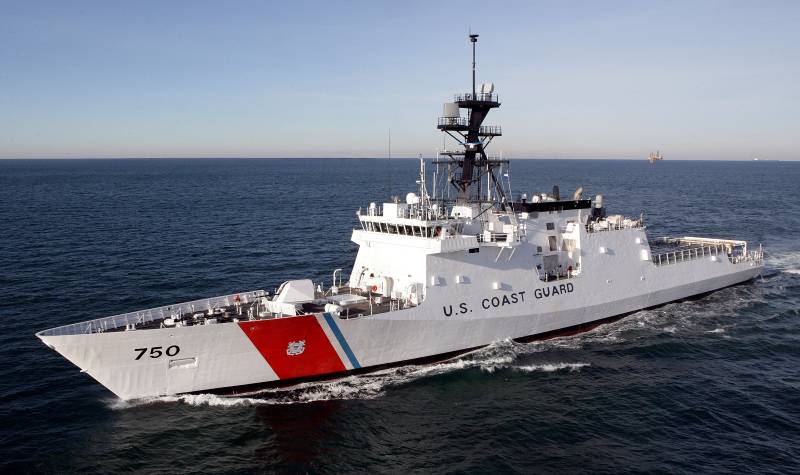
File:USCG National Security Cutter BERTHOLF (WMSL-750).jpeg
USCG National Security Cutter BERTHOLF (WMSL-750)

Will the Coast Guard implement the National Security Cutter multi-crewing plan referred to as the Crew Rotation Concept?  Has the concept been adequately tested?  If the plan is workable, would it be implemented on smaller vessels? Continue reading

Shipbuilding, Dealing with Reality

The Coast Guard’s fleet of large cutters  is facing a budgetary “perfect storm,” and if it is to survive without a major reduction in numbers, a change in procurement strategy is required.

The NSCs cost as much as an entire year’s AC&I budget for vessels. An analysis of the Coast Guard’s FY 2012 budget request for vessels and the funding history of the National Security Cutters (NSC), funding only about one half the cost of an NSC each year, and with three more NSCs still to be funded, suggest it is unlikely the Coast Guard will see the first Offshore Patrol Cutter in 2019 as has been planned. In fact there is reason to believe the Coast Guard will not be allowed to proceed with the OPC program as currently envisioned.

There are rumblings that some parties want to kill the Offshore Patrol Cutter (OPC) program all together, and many of those who understand the need to replace old ships question why all of our replacements are notably larger than the ships they replace.

  • 378s, 3,050 tons, full load (fl) to be replaced by NSCs, 4,375 tons
  • 210s, 1050 tons (fl) to be replaced by OPCs, 2,500 to 3,000 tons
  • 110s, 165 tons (fl) to be replaced by RFCs, 353 tons

We haven’t generated the “Fleet Mix Study” that might justify these larger and more capable ships. Saying we need larger ships to provide better living conditions for the crew won’t cut it and frankly it does a disservice to our crews who have shown a willingness to accept spartan condition on shipboard, particularly since now most, if not all, will have a place to live ashore as well.

If we want to actually arrest and reverse the aging of the large cutter fleet and have a more capable fleet in the long run, we have to do something different, and we have to do it soon.

Additionally it appears that we may have funded enough NSCs and the Coast Guard needs a different kind of cutter to address the emerging new ways drugs are being smuggled.

Conceptual Rendering of the OPC

Disclaimer by Acquisition Directorate (CG-9): (This) conceptual rendering (is) for artistic display purposes only and do not convey any particular design, Coast Guard design preferences, or other requirements for the OPC.

This is an alternative plan.

  • Stop NSC production at five or at most six ships and put them all in the Pacific.
  • Forget the Crew Rotation Concept (CRC), at least for now.
  • Kick start the OPC program by building the first six or seven as lower cost, smaller replacements for the remaining 378s and give them the sensors needed to find drug running semi-submersibles and true submersibles.
  • To provide “value added,” work with the Navy to make sure they have credible wartime mission capabilities.

NSCs go north, OPCs go south. NSCs will specialize in ALPAT while OPCs will specialize in drug interdiction, with at least some of them being made capable of interdicting true submersibles.

Normally it takes three ships to keep one on station, suggesting six NSCs to keep two on ALPAT at all times, but mixing in an occasional OPC during the summer months, 5 should be enough.

The OPC, at 2,500 tons or more, is a hard sell as a replacement for 1,000 ton 210s, but as a replacement for the 3,000 ton 378s, at what should be close to half the price of an NSC, the Coast Guard is clearly being a team player. This gets the program started and, in quantity, the price should start coming down substantially. After the first six or seven are built as 378s replacements, and they prove their worth, they may not be as hard to sell as MEC replacements as the economy improves.

Earlier posts (here and here) addressed multiple crewing of National Security Cutters and, following the numbers, demonstrated why, even if it works as planned, the current plan could only provide the equivalent of 10 conventionally manned cutters, not 12, and the total operating costs are likely to be higher compared to conventionally manned ships providing the same number of ship-days.

The only example I know of, where multiple crewing of complex ships works is the Fleet Ballistic Missile submarine program and there, the incentives to make it work are huge. Total numbers of submarines are limited by treaty so there is a desire to get maximum use out of an artificially limited supply and the capital cost per crew member is probably an order of magnitude greater than it is for Coast Guard Cutters. The Navy with all their experience does not attempt to multi-crew it’s attack submarines even though this is a closely allied program, again with a far higher ratio of capital cost to crew cost. If we want to try this concept, try it on the Fast Response Cutters first, where it is more likely to work, but kill it as a planning consideration for large ship procurement. Consider it just another hoax perpetrated on the Coast Guard by Integrated Deepwater Systems.

Since we started planning the new fleet of large cutter, our needs have changed. Drug smugglers have begun to change their tactics, using semi-submersibles and even true submersibles (here, here, here, and here). A ship equipped with a towed array and an embarked Navy MH-60R ASW helicopter detachment would substantial improve our chances of intercepting these.

Having a credible wartime capability can also help convince members of congress these ships are a worthwhile investment. Once we have given the ship a towed array and the ability to operate Navy ASW helos, at almost no costs we can add the ability to operate them in a war time role by insuring we have spaces appropriate for storing their weapons and other equipment, spaces that can be used for other purposes until required.  It also should not be difficult, working with the Navy, to insure they can accept at least some of the LCS Mission Modules.

A 2,500 ton OPC, as currently planned, is in many respects an excellent replacement for a 378 and it will have lower operating costs. More importantly, if the OPC program survives and goes on to replace the 210s and 270s, we will have a far more capable fleet overall.

We need to start this change with the FY2013 budget.


Budget Realities Setting In?

The Marine Log is reporting “House Coast Guard and Maritime Transportation Subcommittee Chairman Frank LoBiondo (R-N.J.) set a no-nonsense tone when he opened up a hearing yesterday to review the Administration’s budget requests for the U.S. Coast Guard…’Congress must make extremely difficult decisions in the coming months to bring our spending under control and cut the deficit’…Chairman LoBiondo commended the service for uncovering some savings through efficiencies in operations and the consolidation of services, but wanted to know ‘if more operational savings can be found that will not adversely impact safety, security, and mission success.'”

He called the Coast Guard’s  five year Capital Improvement Plan “fantastic,” (not in a good way, as in, it is a fantasy) referring to a planned 66 percent increase in funding over the next three fiscal years. (Assuming we are talking about a 66% increase in AC&I over the FY2012 request ($1.4B) that is a $924M increase annually, approximately a 9% increase in the total budget.)

He also took the service to task for its failure to complete a “fleet mix analysis” that the Subcommittee requested over 13 months ago.  “I urge the Service, in the strongest possible terms, to satisfy our request for this document in short order…Second, the Service continues to lack the polar missions plan long sought by Congress. To add insult to injury, the Service intends to spend millions of unbudgeted dollars to refurbish the POLAR SEA’s engine and then decommission the icebreaker.  This is a classic example of throwing good money after bad.”

The Coast Guard is still projecting procurement planned under the discredited “Deepwater” program, almost ten years ago, that included replacing 12 WHECs with 8 multi-crewed National Security Cutters (NSC) and replacing 29 WMECs with 25 Offshore Patrol Cutters (OPC), a reduction of 20% in the number of hulls. Meanwhile, there is little evidence to prove multiple crewing of NSCs will work; UAVs, which don’t seem to be working out for reasons beyond Coast Guard control, were supposed to do a lot of the air surveillance work; drug runners are turning to semi-submersibles and true submarines that are increasingly hard to detect; and new responsibilities are coming with the opening of the Arctic to commerce. It is also possible to make a case that the South Pacific EEZ was never adequately policed. Things have changed and they justify more, not fewer assets. Continue reading

Acquisitions Directorate Newletter, Feb 2011

The new Acquisitions Directorate Newsletter for February 2011 is available here. The topics are

  • Coast Guard Awards Contracts for National Security Cutters 4 & 5
  • The Ocean Sentry: The Coast Guard’s Multi-Mission Aircraft

Plus Command Master Chief Ayer answers the question, “I see you have a project to replace the current Response Boat-Small with a new RB-S. What about other vessels and boats that are a lot older, are you planning to replace them?  How do you decide which assets get replaced?”

The FY2012 AC&I Budget Request for Vessels

The FY 2012 budget for “vessels” is a year without major funding for the National Security Cutter (NSC) project. It only includes $77M to finish funding the fifth ship. Consequently, even though vessel funding dropped from $851.7M in the FY2011 request to only $642M, we see the start of a program to update 140-foot WTGBs, 225-foot WLBs and 175- foot WLMs, beginning with the oldest WTGB and funding of five Mission Effectiveness Projects (MEP) for 270 foot WMECs. We also see an acceleration of the Response Boat-Medium and Fast Response Cutter Programs.

But of course the plan has been to complete the NSC program before starting the OPC program and having the first OPC delivered in 2019. I don’t see how this can happen without a major bump in AC&I funding or at least a major diversion from other areas. The funding for the first five NSCs was spread over eleven years. In the last ten budgets, from FY 2003-2012, NSC funding has averaged $312M. Only in FY 2011 did funding for the program approach the full cost of an NSC ($615M requested compared to a projected cost of $697M for NSC#5), that year, there was no funding for the Fast Response Cutter Program. The Coast Guard is unlikely to get $1.2B it needs in FY 2013/14/15 to complete the “In Service Vessel Sustainment” and WMEC Mission Effectiveness Projects and each year build:

  • one NSC (approx. $700M)
  • six FRC (approx. $350M)
  • 40 Response Boat-Medium (approx $100M)

Short of canceling one or more of the NSCs (my preferred alternative), the only way to deliver an OPC by 2019 is to build the NSCs and OPCs in parallel.

Continue reading

How much do the National Security Cutters Cost?

Earlier I asked this question regarding NSC #5 (WMSL 754 James), because what I had seen recently seemed out of line with the prices I had seen reported for #4 (WMSL 753 Hamilton). Someone from Headquarters was good enough to point me to a helpful 3,311 page document, the DHS 2012 budget justification (this is a large pdf), and even told me where to look (see page 1622 of the pdf). Turns out the total costs are pretty close. Continue reading