Draft Technical Package for the Offshore Patrol Cutter Released

The Acquisitions Directorate (CG-9) has issued the draft technical package for the Offshore Patrol Cutter. It was announced on the Federal Business Opportunity website, March 12, 2012.

“The red-lined draft System Specification contains all of the changes that the Coast Guard incorporated as a result of industry comment. This document will be automatically distributed to those companies and individuals that received the draft OPC specification released in May 2011. The other draft documents will be available on the USCG OPC website at: http://www.uscg.mil/acquisition/OPC/default.asp

A two step Acquisition process is expected. First, three contractors will be selected to develop their preliminary designs into fully detailed contract proposals. They will compete for the final award which will include the first OPC and all documentation. It may (and probably will) also include options for follow-on ships. So far, the Coast Guard is saying they will maintain their flexibility regarding who will build follow-on ships.

On the Acquisitions directorate website, you can down load hundreds of pages of technical requirements for the contractors, but don’t expect to find updated information on the specification of the ships. As noted above, revised draft specifications were sent to companies and individuals that received the draft OPC System Specification released in May 2011. Hopefully the Acquisition Directorate will release at least some basic information in the near future.

Still going through the documents yields some useful information of more general interest. The list of Government furnished Equipment (GFE) and Government Furnished information (GFI) tells us about much of the equipment the vessels are expected to carry. (I will not list all the normal items included on every cutter.)

Armament:

  • Mk 48 mod 1 Gun weapon system
  • Mk 110, 57mm gun system
  • Electro Optical Site Sensor (EOSS), MK 20 MOD 0
  • 25mm, MK 38 MOD 2
  • Two SSAM gun systems, (remotely operated .50 Caliber)

Sensors:

  • IFF, AN/UPX-29A
  • AN/SLQ-32B(V)2 (and Mk 53 NULKA decoy system)
  • Multi-Mode Radar (air as well as surface? AN/SPQ-9?)
  • Encrypted GPS
  • CBRN monitoring

Boats: 2 x 7m OTH IV (apparently no 11m boat)

Aviation:

  • TACAN
  • Visual Landing Aids (VLA)
  • Glide Slope Indicator (GLI)
  • Wave Off Light Assembly (WOLS)

The Mk48 Mod 0 (www.dtic.mil/ndia/2011gunmissile/Thursday11660_Aswegan.pdf) is apparently the system on the National Security Cutter. Perhaps, the Mk48 mod 1 is simply an improvement, but unlike some of the other components of the system, the AN/SPQ-9 radar is not called out specifically, so this system may not have a radar. It may be that the “multi-mode radar” refers to the AN/SPQ-9. Hopefully that is the case.

A quick scan through the other documents shows that the Coast Guard has not ruled out the possibility of hybrid or integrated diesel-electric propulsion.

“One Line Diagram. During Contract Design the Contractor shall provide the Electric-Drive Propulsion System One Line Diagram (if an Electric Propulsion System or IDE is provided). [235-01-2219]”

Other included systems are:

  • Two encrypted computer networks including one for classified material.
  • Television systems for both monitoring security and entertainment and training.
  • UHF MIL SAT COM Equipment
  • A crane for loading stores
  • A bow thruster
  • An unmanned air system (UAS)

It appears there may also be a SCIF (Sensitive Compartmented Information Facility).

Generally it appears, a much more sophisticated ship that the WMECs they are replacing.

(illustration: French shipbuilder DCNS concept)

Intercept That Drug Runner–Sorry, Not Enough Ships

https://i0.wp.com/upload.wikimedia.org/wikipedia/commons/3/36/USCGC_Hamilton_%28WHEC-715%29.jpg

File:USCGC Reliance WMEC 615.jpghttps://i0.wp.com/upload.wikimedia.org/wikipedia/en/e/ea/Thetis_cutter_WMEC-910.jpg

There have been several articles recently as a result of a breakfast meeting with reporters hosted by Air Force Gen. Douglas Fraser, chief of the U.S. Southern Command, reporting that SouthCom is intercepting only one in three drug shipments that they know about. He sited diversion of assets for combat operations in Afghanistan and Iraq, and operations off Libya, Somalia, and Iran.

One thing I found very curious, as noted in the AOL defense report, “Fraser focused on Navy vessels and did not specifically address the Coast Guard, which does contribute some ships to Southern Command operations.” Why the hell not?

The General reported a decline in our ability to intercept drug shipments.

At sea, Fraser explained, the U.S. Navy is retiring the smaller ships that have traditionally been the mainstay of drug interdiction patrols, the aging and increasingly expensive to operate Perry-class frigates, while their much-delayed replacement, the Littoral Combat Ships, is just beginning to enter service. “We ‘ll see a gap in the numbers of those types of ships,” Fraser said. “So we’re working with the Navy to see what other types of vessels and capability that’s coming back from Iraq might be available,” particularly small craft that have been used for river patrol and offshore patrol in the Gulf. Such boats could boost the U.S. fleet’s own interception capability but also, and perhaps more importantly, some could be transferred to friendly countries that are currently short on assets to intercept drug boats moving through their own territorial waters.

Nationaldefensemagazine.org also reported he made reference to the possibility of terrorists entering the US by using the drug smuggling routes.

There was much made of the lack of assets available to partner nations.

Here is a proposal, The Coast Guard still has 10 WHECs and 29 WMECs that are due for replacement. If we can get them replaced, we can turn them over to partner nations. That should essentially totally eliminate any shortage of vessels in SouthCom. The sooner we replace them the more useful they will be.

Why couldn’t the General have put in a good word for the Coast Guard?

New Budget Cancels Plan for Last Two NSCs

File:USCGC Waesche by Yerba Buena Island.jpg

U.S. Coast Guard photo ID: 100228-G-2129M-004, by Petty Officer 3rd Class Kevin Metcalf

Defensedaily.com is reporting that while the FY 2013 budget request would fund the sixth National Security Cutter, additional purchases would be delayed while the Department reevaluates its needs.

Homeland Security Secretary Janet Napolitano said yesterday that the reason for proposing a pause in the NSC program is due to budget constraints as well as examining how it fits with the Navy’s plans.

“We will look at [NSC’s] seven and eight in light of what the Navy is doing,” Napolitano told the House Appropriations Homeland Security Subcommittee during a hearing to examine her department’s budget request. “So we need to look at what the DoD is doing with respect to their own force lay down to see what we need to be putting in the acquisition pipeline.”

Presumably this ties in with the Navy’s review of their own programs.

It has been recognized for a long time that current plans would require a substantial increase in AC&I funding. The GAO has called the program of record “unachievable.”

While I certainly applaud coordination with DOD, this could mean a lot of different things.

Will the Navy try to move the Littoral Combat Ship program to the CG as replacement for the OPC?

Will the Navy try to avoid cutting their building programs further by suggesting that the CG does not need large ships for drug enforcement because they will supply platforms for CG boarding teams? or

This might not be so bad. When Under Secretary of the Navy Robert O. Work  discusses American Sea Power, he almost never fails to mention the contribution of the Coast Guard. Perhaps some additional thought will go into how possible military roles should be reflected in the requirements for Offshore Patrol Cutters (OPC), Icebreakers, and other assets.

An OPC that  reflects military requirements would almost certainly be larger and more capable than one designed only to meet peacetime requirements that might otherwise have been forced on the CG in an austere budget climate. Those greater capabilities probably would also make it a more capable CG asset in peacetime.

The differences might include a larger hull, more speed, better aviation facilities, and better communications and sensors, possibly including a towed array that would be useful for detecting drug subs (both true subs and self propelled semi-submersibles).

Its not clear yet, if this is a disaster or an opportunity. Perhaps a new way of justifying CG assets will come out of this, and the government will see that putting money in the CG is a sound investment.

The Case for Big(ger) OPCs

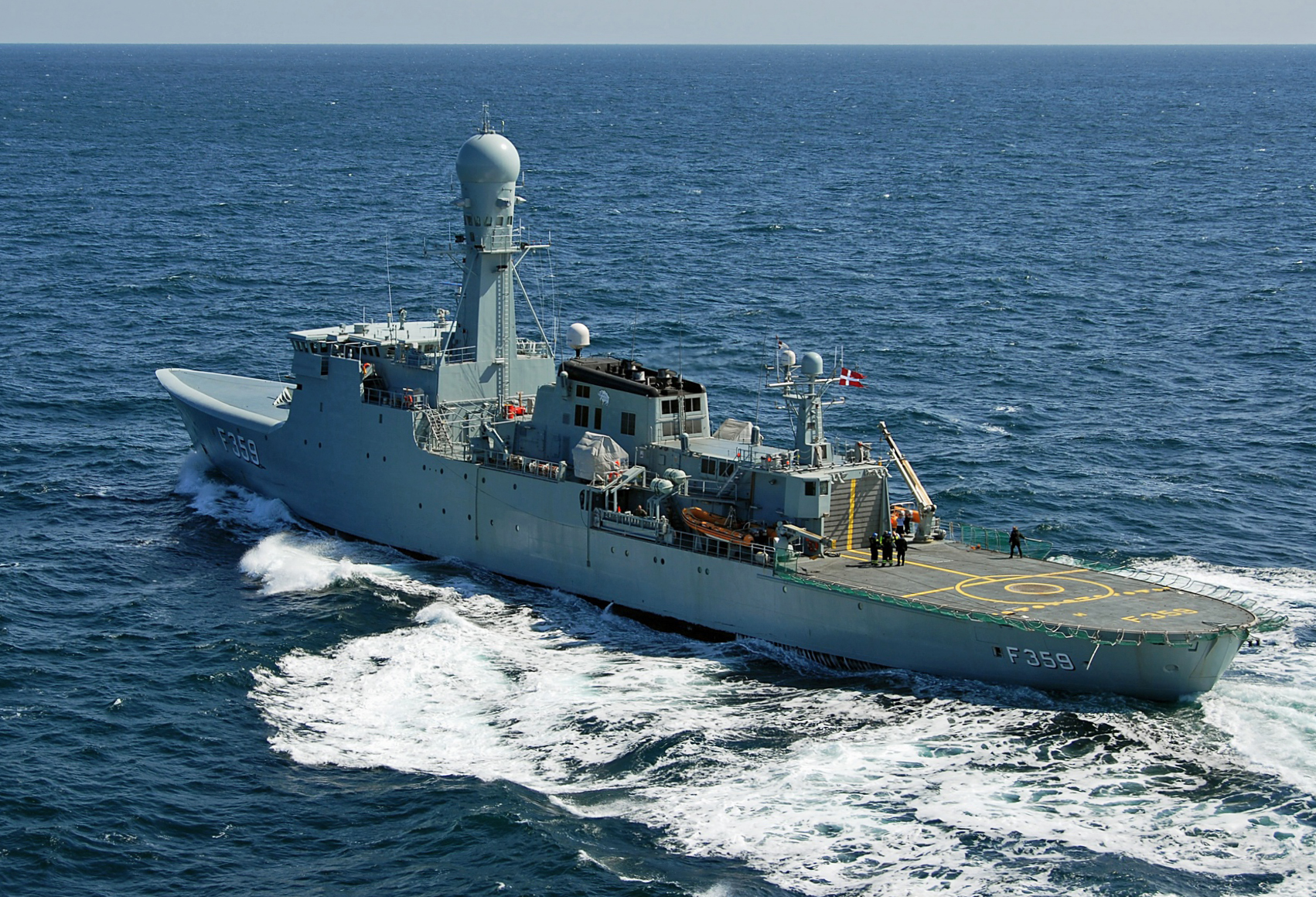
File:HDMS Vaedderen (F359).jpgUSCG Photo: HMDS Vaedderen, at 3,500 tons, a relatively large but simple, ice strengthened Offshore Patrol Vessel of the Thetis Class, with StanFlex modular payload capability

Considering the new Navy destroyer program, GAO identified problems that come from trying to put too much, into too small a hull. They call this problem design density. While perhaps less of a problem for the Coast Guard, this also applies to cutters like the proposed Offshore Patrol Cutter (OPC).

It may be counter-intuitive, but size alone is not necessarily a significant determinant of cost. As we noted earlier, the new largest ships in the world do not really cost that much. In fact, they cost less than the National Security Cutter (NSC), and probably less than the OPC. The GAO report indicates for a given capability, a smaller hull may actually cost more, because the density of systems may make design, construction, and maintenance more difficult. Additionally GAO notes it may lead to shorter hull life as it seems to have in some Navy ships. Certainly it is easier to provide good range and sea keeping if we use a larger hull. Both the crew and the machinery are likely subject to less motion. Larger hulls also mean more underway maintenance may be possible, because it is easier to get to the machinery.

This also goes a long way to explain why the NSC is larger than the 378s, the Fast Response Cutters are larger than the 110s, and why hopefully the the OPCs will be larger than the 210s and 270s. There is also the long term advantage of the vessels being able to take on new and unforeseen future roles, as we saw with the 327s.

Commandant asks Surface Navy Association for Help

Thursday, Jan. 12, Admiral Papp addressed the Surface Navy Association and asked for their help in educating the Congress and the Administration regarding the need to complete the current ship acquisition plans.

Two things come to mind, first, good to see the Commandant on the stump trying to sell the program, and second, the Navy has not been helpful so far.

Why hasn’t the Navy helped in this regard?

  • Is it negligence?
  • Are they afraid money will be diverted from the Navy to the CG?
  • Do they feel the Coast Guard’s large ships are no longer naval assets, so why bother?

Ship Design Efficiencies

GCaptain has published a nice two part presentation by Wartsila discussing ways to make ship propulsion more efficient. The target audience is merchant ships, but much of it is applicable to Cutters.

Makes me more convinced than ever that, considering life-cycle costs, an integrated propulsion and ship service electrical system, like that already being used successfully on the Lewis and Clark class T-AKEs (and planned for the DDG-1000), combined with Azipod propulsion should be seriously considered for the Offshore Patrol Cutter.

New Finnish and Norwegian OPVs powered by LNG

Finnish Border Guards are procuring an new class of Offshore Patrol Vessel (OPV). It is fairly large at 96 meters long and 17 meters beam (315’x56′) and ice strengthened, but the most unique aspect of the design is that it is designed to use both conventional diesel and Liquified Natural Gas (LNG) as fuel. Picture and more here.

The Norwegians are also planning duel fueled OPVs, three ships of the slightly smaller Barentshav Class.

Descriptions seem to indicate that while the Norwegian ships have separate engines for diesel and LNG, the engines on the Finnish ship apparently will be able to burn either diesel or LNG.

Not only is LNG more environmentally friendly, the US is well endowed with natural gas.

25 New Russian 650 ton Patrol Vessels

Photo: Alex (Florstein) Fedorov

The Russian Federal Security (FSB) Coast Guard (successor organization to the Maritime Boarder Troops of the KGB), has begun a program of 25 ships that they rate as “second rank patrol ships” (WMEC?). They are reportedly designed “for protection of Russian sea border in the Black Sea and would maintain security of Winter Olympics 2014 in Sochi.”  They will replace ships built in the Soviet era.

Ships of the class are pictured here (broken link–Chuck) in the second, third, and forth photo. Below that are photos of an ice strengthened patrol vessel that appears to be based on an oil industry supply vessel.

Lead ship of the project, Rubin (501), laid down Sept 3, 2007, launched June 26, 2009, which was handed over to Black Sea/Azov Frontier Service Dept in Sept 2010 “has completely satisfied all expectations.”

“…in Oct 2011 unmanned helicopter system Horizon Air S-100 (this may be the Schiebel (Austria) S-100) that is also deployed on the French OPV L’Adroit–Chuck) designed for search, detection, and identification of small-size fast-speed sea targets at the distance of 150 km from the platform was effectively tested on board Rubin. Besides, ships of this project are equipped with automated control system, advanced navigation and comm equipment. Crew living conditions are unusually comfortable; there are sauna and swimming pool on board.

Full displacement of the Project 22460 patrol ship is about 650 tons, length is 62.5 meters (205′), beam is 11 meters (36′), draft is 3.8 meters (12.5′), full speed in quiet water is up to 30 knots, operating range is 3,500 miles, endurance is up to 30 days. Armament includes one 30-mm six-barreled gun mount AK-630 and two 12.7-mm machine guns. The crew is 20 men. The ship is equipped with stern inclined slip for rigid inflatable boat, a heliport for light helicopter like Ka-226(a helo a bit smaller than the H-65–Chuck) or UAV, and a quick-mounted folding hangar.

The second ship, Brilliant, and was laid down May 12, 2010, and the third, Zhemchug, is currently under construction. Construction on the remaining ships is expected to continue through 2020.

While these ships are reported to be only 650 tons full load, the dimensions are close to or exceed those of a 210 (210.5’x34’x10.5′) so I find it hard to believe they are not close to 1,000 tons full load.

The AK-630 gun is a real beast, a six barrel 30 mm similar to the GAU-8 Avenger, the gun on the A-10 tank killer aircraft, which is also used as part of the Dutch developed “Goalkeeper” CIWS. Close in, it could be very effective in an anti-surface role as well.

Photo added Jan. 2022 More info on this class here.

OPV (OPC) for the Philippines

NavSea has issued an RFI for something that looks a lot like an Offshore Patrol Cutter (OPC), to be procured under the Foreign Military Sales (FMS) program.

“This Request for Information (RFI) N00024-11-R-2217 is being issued in anticipation of a potential future procurement program for the Republic of the Philippines. The Naval Sea Systems Command is conducting market research to determine the existence of a general purpose Offshore Patrol Vessel (OPV) …”

This is a bit old, having been issued on May 6, 2011 (only four days after the issuance of the draft OPC specifications) with a June 3, 1011 response deadline, but I only just stumbled across it here. The Philippines would like to have the ship assembled in country, but that is a question to be addressed by the contractors. If the program follows the pattern I have seen in other countries, the lead ship would be built here and the follow-ons in the Philippines. A multi-ship buy is expected, but the number is not specified and subject to change.

Considering that there is the possibility of extensive similarities to the Offshore Patrol Cutter program, you might assume this was discussed with the Coast Guard, but I have my doubts. After all, the Philippines might want to participate in the OPC program since a large order quantity is likely to drive down cost.

The specifications require “The vessel must be new construction, but derived from a proven hull design previously built by the contractor.” (That sounds like the ship yard would not be allowed to use a design previously built by a different contractor.) (revision: this was changed to: “The vessel must be new construction, but derived from a proven hull design.”)

The specifications are also remarkably specific, not only in performance, but also in dimensions.

  • a. Overall Length: At least 80 meters (NTE 10%)
  • b. Beam: At least 10.5 meters (NTE 10%)
  • c. Displacement (full load): At least 1,000 tons (NTE 10%)

If, as I suspect, the “(NTE 10%)” means “Not To Exceed” then it is also setting maximums, so:

  • length: 80 to 88 meters (262.4 to 288.64′)
  • beam: 10.5 to 11.55 (34.45 to 37.9′)
  • full load displacement: 1,000 to 1,100 tons

I have done an extensive literature search, and I cannot find an OPV 80 meters or longer, with a full load displacement <= 1,100 tons. The closest I got in terms of tonnage was the Israeli SA’AR 5 corvettes, not really an OPV, but the hull might be used:

  • 85.64 meters long
  • 11.88 meter beam (10.3 at the waterline)
  • 1,227 tons full load

By way of comparison the dimensions for the 270 and 210 are:

  • WMEC 270
  • 82.3 m long
  • 11.58 m beam
  • 1,780 tons

and

  • WMEC 210
  • 60.96 m
  • 10.36 m
  • 1,000 tons

Specifications include:

  • helo deck for a seven ton helicopter (but a hanger was not specified).
  • speed => 20 knots
  • Endurance of 3,500 miles at a cruise speed of at least 14 knots and storage for 30 days supplies.
  • Mixed crew accommodations for 75 including a flag officer, 14 other officers and three civilians.
  • “The ship will be equipped with two 11 meter Rigid Hull Inflatable Boats (RIBs) capable of being quickly launched from a stern ramp.” This sounds a lot like L’Adroit  (87 m x 11 m, 1,450 tons), and seems to be driven by a desire to use the ships for small scale amphibious operations–landing perhaps a platoon.
  • “Propulsion System shall be two main diesel engines with fixed pitch propellers.” This degree of specificity is hard to understand, considering the many alternatives available, particularly the advantages of variable pitch props.

The Combat Systems requirement are quite extensive for an OPV of this size including:

  • 76 mm gun
  • 25 mm gun.
  • “Surveillance and acquisition radar capable of 3D surveillance and acquisition radar that meet OPV requirements for combat surface and air defense search
  • “IFF ability to differentiate and friendly units from unknowns
  • “Radar fire control system to provide data to 76mm gun and 25mm gun systems trained at the same target
  • “Electro Optical Fire Control System for the 76mm and 25mm gun systems
  • “Electronic Support measures for the passive listening capability for selected radar laser and infrared warning devices and communications signals from land, air and sea with the OPV battle space
  • “Ship should have space available for the future growth for SAM (Surface to Air Missile), SSM (Surface to Surface Missile) and ECM (Electronic Counter Measures) as well as towed array sonar equipment”

The list of  “Interested Vendors”  includes:

Sure looks like they have something very specific in mind, particularly since they gave less than a month to make a response.

Offshore Patrol Vessel Power Point

There is an interesting power point presentation, “The Changing Face of OPV Design and Cost Drivers,” available here (pdf). Apparently it was presented at the OPV Asia Conference in Singapore, April 5-7, 2011, by the President of STX Canada Marine Inc./STX US Marine Inc. These are divisions of STX Offshore and Shipbuilding headquartered in South Korea with 18 shipyards in eight different countries.

There is a series of charts discussing the effects of increased size, increased speed, and increasing levels of combat and surveillance capabilities have on cost.

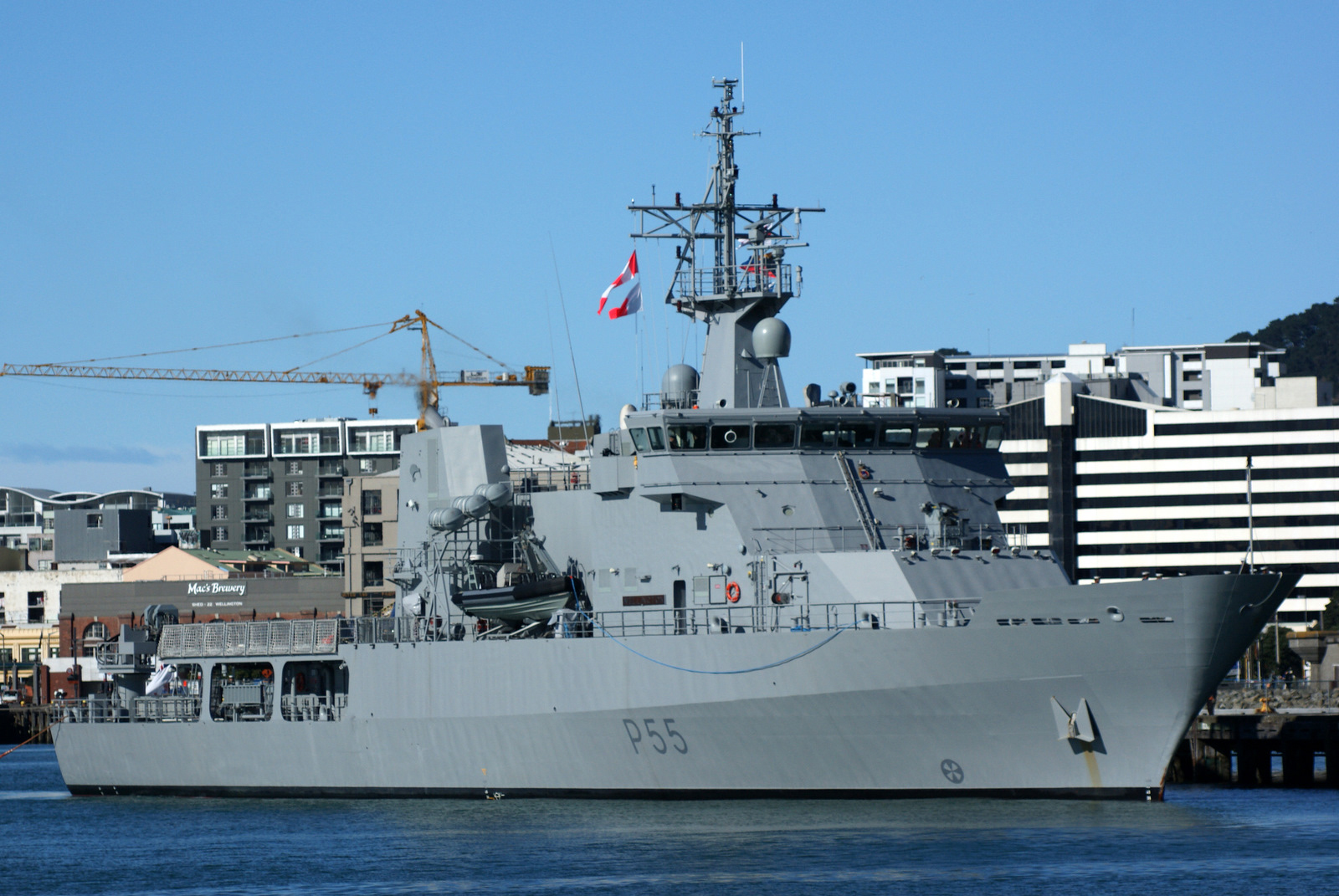
STX is the maker of the Royal New Zealand Navy’s ice strengthened OPVs “Otago“ and “Wellington.”

File:HMNZS Wellington.JPG