Weapons Testing

As we have noted earlier, I believe there is a need to validate the Coast Guard’s ability to forcibly stop a medium to large vessel being used as a terrorist weapon. To do that the .50 cal., Phalanx 20mm, 25 mm, 57 mm, and 76 mm ought to be tested to confirm their ability to penetrate the side of a substantial ship, and go on to penetrate the cylinders of a truly large diesel engine (they can go to over 30 liters per cylinder).

File:US Navy 101027-N-8913A-252 Rounds from a Mk-15 Phalanx Close-in Weapon System (CIWS) from the guided-missile destroyer USS Mitscher (DDG 57) impact.jpg

(U.S. Navy photo by Mass Communication Specialist Seaman Leonard Adams/Released)

The Navy is restarting its SINKEX program. Perhaps they could be persuaded to allow some controlled testing, with the objective of developing doctrine with regard to effective ranges and choice of ammunition.

Alternate Weapons for New Large Cutters?

Had an interesting discussion about why the National Security Cutter retained the Phalanx Close In Weapon System (CIWS) while the very similar weapons suite on the Freedom class Littoral Combat Ship used the Rolling Airframe Missile (RAM) system instead.

https://i0.wp.com/upload.wikimedia.org/wikipedia/commons/2/2c/RIM-116_Rolling_Airframe_Missile_Launcher_3.jpg

Mk 49 Rolling Airframe Missile Launching System Photo credit: Darkone 13 Aug, 2006, via Wikipedia

My friend contended that, while the Phalanx is very maintenance intensive, the launcher for the RAM is virtually maintenance free, which would benefit the relatively small crew. He also noted that the current models have an excellent anti-surface capability and longer range than the Phalanx.

This got me to thinking. I won’t make a recommendation, but will discuss alternatives that might be considered. I’ll talk about who is using the RAM and how, and discuss how the Coast Guard might use it, and its advantages and disadvantages as a possible replacement for the Phalanx and possibly even the 57 mm. But before we get to that, as we are always told, you have to start with the mission.

Continue reading

Reflections on the CNO’s Navigation Plan

https://i0.wp.com/upload.wikimedia.org/wikipedia/commons/thumb/8/86/Admiral_Jonathan_W._Greenert_%28CNO%29.jpg/819px-Admiral_Jonathan_W._Greenert_%28CNO%29.jpgThe CNO has issued a “navigation plan” for for Fiscal Years 2013-2017 that can be accessed here. (It’s only four pages.)

“The Nav Plan provides details on how we will execute this guidance, highlighting our investments through the lens of my three tenets: Warfighting First, Operate Forward, and Be Ready.”

Most of it is, of course, not Coast Guard related, but there are some that might ultimately impact the Coast Guard.

Under “Warfighting First”:

“Improve near-term capability to counter fast attack craft by fielding enhanced gun and surface-to-surface missile systems for Patrol Coastal (PC) ships and Littoral Combat Ship (LCS) and laser-guided rockets for helicopters and Unmanned Aerial Vehicles (UAV).”

Some of this might ultimately be applicable to CG platforms.

Under “Operate Forward”:

“Sustain the “places” our forward operating forces depend on to rest, repair, refuel, and resupply in Spain, Italy, Greece, Djibouti, Diego Garcia, Bahrain, Japan, Singapore, and Republic of Korea – as well as our forward base on Guam”

“Field improved Firescout UAVs…”

“Forward station additional ships – LCS at Singapore and PCs at Bahrain – to improve our ability to cooperate with regional partners in maritime security operations.”

“Improve our ability to remain forward by studying options for rotational crewing of other classes of ships.”

We already have Patrol Boats at Bahrain. We may see an additional push to put more assets, including perhaps more than one FRC, in Guam, (maybe not a bad thing for SAR and Fisheries enforcement). The increased Navy presence in Guam may also provide opportunities to exploit their units for SAR and LE as well.

Hopefully the CG will benefit from improvements in Firescout, but the Navy is talking about increasing the size of the airframe substantially which may be problematic for CG ships.

Certainly there will the opportunity to share experience in rotational crewing, and perhaps make it work.

Under “Be Ready”:

“Improve the “wholeness” of the Aegis Weapons System through data link and software upgrades while adding the Shipboard Self Defense System to more non-Aegis ships, such as amphibious assault ships.”

“Improve operational energy efficiency by investing in new technologies such as hybrid-electric drive.”

The weapon systems on the NSCs, and presumably the OPCs, are derived from the Aegis system and, I believe, closely related to the Shipboard Self Defense System for non-Aegis ships mentioned above. As the system evolves, ultimately we might see the Rolling Airframe Missile system replace the Phalanx on the NSCs. It is essentially the same weight and is used by the very similar system on the Freedom Class Littoral Combat Ship.

The Navy is already using hybrid-electric drive on the USS Makin Island (LPD-8) and a fully integrated system on the USNS Louis and Clark class T-AKEs. There may be opportunities to ride the coat tales of their experience. Fuel economy is probably even more important to the Coast Guard than to the Navy.

What was not there:

I notice there was no mention of either African Partnership station or Drug Enforcement.

What Does It Take to Sink a Ship, Illustrated

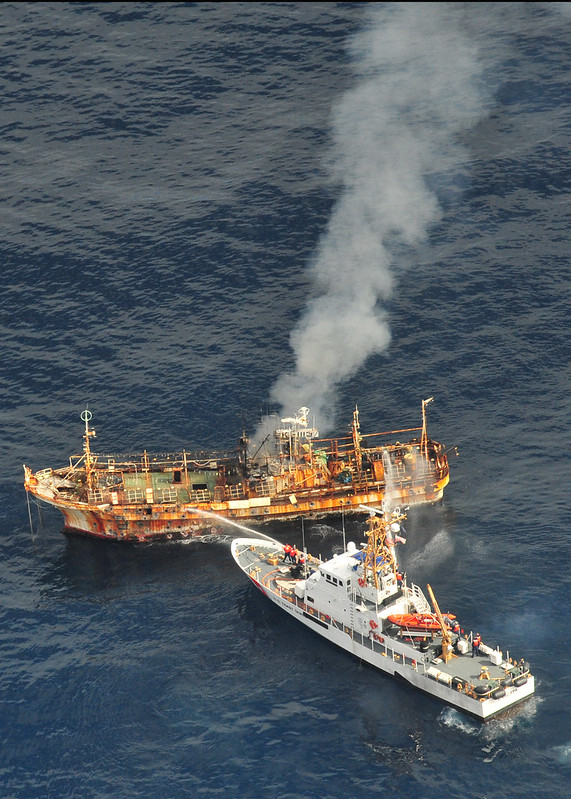
A little over a year ago, I published a post entitled “What Does It Take to Sink a Ship.” It has proven perhaps my most widely read post. The recent sinking of the Japanese fishing vessel Ryou-Un Maru beautifully illustrates the point that ships can be very hard to sink by gun fire.

120405-G-ZZ999-The sinking of the Japanese fishing vessel Ryou-un Maru

  • Title: GULF OF ALASKA – The Japanese fishing vessel, Ryou-Un Maru
  • Summary: GULF OF ALASKA – The Japanese fishing vessel, Ryou-Un Maru, shows significant signs of damage after the Coast Guard Cutter Anancapa fired explosive ammunition into it 180 miles west of the Southeast Alaskan coast April 5, 2012.

Reportedly the USCGC Anacapa began the operation at 13:00 and the Ryou-Un Maru sank at 18:15. It appears that the F/V may have been hit 100 times by explosive 25mm projectiles. With no crew aboard to do damage control and probably with no real measures taken to ensure water tight doors were closed, it stayed afloat for over five hours and ultimately the Anacapa resorted to pumping water into the vessel to sink it.

120405-G-RS249-005-USCG responds to Japanese vessel in Gulf of Alaska

  • Title: 120405-G-RS249-005-USCG responds to Japanese vessel in Gulf of Alaska
  • Summary: GULF OF ALASKA – The Coast Guard Cutter Anacapa crew douses the adrift Japanese vessel with water after a gunnery exercise 180 miles west of the Southeast Alaskan coast April 5, 2012. The crew was successful and sank the vessel at 6:15 p.m. in 6,000 feet

This was a very small ship, probably less than 500 tons, the implications for our ability to stop a medium to large vessel with a determined crew on board, bent on using the vessel for a terrorist act in an American port should be obvious. With even crude and unsophisticated measures to protect vital machinery and control functions, a ship can resist a great deal of gunfire and continue to its objective.

Late Addition–Video of the sinking added 25 Dec. 2012

What Might Coast Guard Cutters do in Wartime? Part 2, Coast Guard Roles

https://i0.wp.com/upload.wikimedia.org/wikipedia/commons/8/83/USCGC_Spencer_WPG-36.jpg

This is the second of two parts. The first part focusing on what I believe are the current shortfalls in the US Navy force structure is here.

Since part one, additional cuts to the Navy’s plans have been announce. Attack submarines which have an important ASW role are now expected to decline from a current 55 to 40 in 2030 and all SSGNs will be removed from service. Additionally the Navy will prematurely retire seven cruisers and two amphibious warfare ships. The planned five year building program is going from 57 ships to 41.

Now we will look more closely at what Coast Guard Cutters may be called upon to do in future conflicts, what changes to our existing force might be prudent, and desirable characteristics for future cutters. Continue reading

EURONAVAL 2010 Exhibition

A couple of blogs allow us to see new equipment and concepts (mostly in model form) being shown at the EURONAVAL 2010 Exhibition. One of my regular reads, http://combatfleetoftheworld.blogspot.com/, has a four part series of photos. Clicking on the image gives you a better view and the blogger, Mike Columbaro (he’s French, but the blog is in English), was good enough to label the photos.

There are four pages of additional pictures and discussion here as well (http://www.militaryphotos.net/forums/showthread.php?188289-Euronaval-news). Unfortunately the pictures are not as well labeled.

If you are interested, I would suggest you start by going directly to the Combat Fleet blog first and then moving on to the militaryphotos site. Because over time the combatfleetoftheworld posts will get buried by newer posts, I’ll provide links for each of them separately, here, here, here, and here.

More News From the North–An Armed Canadian Coast Guard?

Related Posts:

Ryan Erickson’s blog pointed out an article in the Vancouver Sun reporting that the Canadians are considering arming their icebreakers as a way to “bolster Arctic sovereignty.”

This was in response to “recommendations in a report from the Senate fisheries committee about strengthening Canada’s presence in the North.”

“The government also has indicated that it will review new shipping regulations in the Northwest Passage and other Arctic waters with an eye to extending mandatory registration of foreign vessels, which currently applies only to large freighters and other heavy ships, to all foreign-ship traffic in the region, regardless of size.”

Ryan links the report to the 1985 transit of the North West Passage by the Polar Sea, in which the USCG icebreaker transited what the Canadians consider their internal waters and what the US considers an international strait, after the US gave notification of our intention, rather than asking permission.

Since then, basically the US and the Canadians have agreed to disagree. Currently the US and Canada have an agreement that allows access to US military ships. They have given us blanket permission and we have said we will give notification.

For the US Navy this is a matter of avoiding a precedence that could close off access elsewhere.

For the Coast Guard, our interests are a little different, perhaps closer to that of the Canadians. We want Maritime Domain Awareness. We want ships to give notice of their intentions, and ultimately that has to mean we need some options to deny access, but the international norms are still being set.

The talk of arming Canadian icebreakers leads to the question, will the Canadian Coast Guard be transformed by it’s new mission to more closely parallel the military organization of the USCG. There has already been a question about whether the Canadian Navy or their Coast Guard would man the proposed Arctic Patrol Ship since they would be armed, unlike current Canadian cutters.

Offshore Patrol Cutters–Why the Navy Should Support the Program

A number of things have happened that makes the Offshore Patrol Cutters potentially important to the national defense, and suggest that the Navy should support their design and construction, including helping with project administration if we need that and testifying before Congress to justify the additional cost of naval features.

  • The number of ships in the Navy has decreased dramatically. From almost 600 ships 20 years ago, the number has fallen to about 280, in spite of constant statements to the effect that 313 is the minimum number required. Many expect that the number of Navy ships will fall to as low as 230. Much of the decrease has been in ships at the low end of the high/low mix and the planned replacement is behind schedule, and in the eyes of many, a failure. Our allies’ fleets have also been shrinking, in many cases, more rapidly than our own, while new challenges to American naval supremacy are developing, so the importance of any Coast Guard contribution is proportionately greater.
  • Despite having entered service between 1979 and 1989, the FFGs, which are the “maid of all works” within the Navy, are being rapidly decommissioned and will soon be all gone because of maintenance problems. These are the ships that do most of the Navy’s partnerships station and drug enforcement work. (29 of 51 built currently in service)
  • The Cyclone Class Patrol Craft, that entered service between 1993 and 2000, have been found to have deteriorated much faster than expected and have been sidelined. Never quite what the Navy hoped for, too small for some roles and too large for others, they became busiest vessels in the US Navy with proportionately more underway time than any other type. (Of 14 built, 10 in service with the USN, 3 with USCG, one transferred to Philippine Navy)
  • The Littoral Combat ships (LCS) were supposed to fix some of these problems. This was a program to build 55 ships that would replace the Navy’s 14 Mine Warfare ships, the remaining FFGs, and the Cyclone Class PCs. They were to be cheap to build, minimally manned, and use removable mission modules that would allow them to become alternately mine countermeasures, anti-submarine, or anti-surface warfare ships. The LCS program is in trouble. Ship construction is behind schedule, and module development is even farther behind. The ships are much more expensive than expected. The manning concepts appears flawed and berthing limitations mean more people cannot simply be added to the crew. If the program is killed the Navy is going to need a replacement.

If the LCS project is killed, a class based on the OPC’s hull might be able to take its place. If the LCS program is terminated at less than the planned number, Navy ships based on the OPC can supplement the LCS and do many, perhaps all of it’s missions, at a lower cost. Even if all 55 LCSs are built, Coast Guard OPCs can still make a significant contribution to the Nation’s defense; particularly, if they can use systems designed for the LCS.

Navy vessels based on the OPC could cost less than half the price of an LCS. Even without mission modules, the Navy could use the class as the basis for a common hull that could be fill the partnership, patrol, presence, counter-piracy, and drug enforcement roles of the FFGs at a much lower cost and also perform many of the PCs missions with greater endurance and better sea keeping. They are potentially affordable, relatively low tech platforms, that can be exported under the Foreign Military Assistance Program to help our friends. If their aviation facilities are made adequate for MH-60R and MH-60S helicopters (not much different from our own H-60s), with LCS modules they could fill the LCS roles. (This might require them to operate in pairs to carry all the equipment planned for a LCS)

To fulfill its potential in these roles, the OPC need not be much different from current planning. The ship’s description over at the Acquisitions Directorate web site has gotten progressively fuzzier over time, but I will be specific about what I think it needs.

  • Speed: 25 knots
  • Aviation Facilities including a hanger for at least: one USCG MH-65 and one MQ-8 Firescout UAV/one USCG HH-60J or MH-60T/one USN MH-60R or 60S with magazines and storage space for independent operation with these aircraft, not just the ability to land and refuel.
  • Air Search Radar that can track our helos at least 100 miles
  • Launch/recover facilities for at least two boats, 11 meters or larger, including at least one “Long Range Interceptor.”
  • Medium caliber gun and associated radar/optical firecontrol system–presumably 57 mm Mk 110, but Mk 75 would work too and might save money
  • At least one/preferably two Mk38 mod2 auto-cannon positioned as required to cover any bearings not covered by the medium caliber gun
  • Four mounts for .50 cal. positioned to provide coverage by at least two mounts any bearing
  • Two OPC operated together, should have the sufficient space/weight reservation and necessary supporting connections/utilities/etc to take on at least one full suite of LCS MCM or ASW mission modules.
  • Fitted for but not with: CIWS, ESM/decoy systems, and anti-surface missile chosen for the LCS, ie NLOS or system chosen to replace it

Mission Modules, a Possible CG System?

For those who might be interested, here is a “pdf” with a bit of information on how the Navy is implementing their mission module concept on the Littoral Combat Ship (LCS). Unfortunately the information only covers the 30 mm gun and 60 round missile system. They are also developing mission modules for ASW and Mine Warfare.

I like the concept for the Coast Guard, in that it provides a way for Cutters to be designed to be armed for wartime missions without the service bearing the cost of maintenance, training, and personnel in peacetime. It might be applicable to the Offshore Patrol Cutter (OPC) and possibly other cutters, such as future icebreakers and arctic patrol cutters.

There have been some difficulties with the surface to surface missile (SSM) system being developed for the LCS, the non-line-of-sight launch system (NLOS-LS), which began as an Army project, but which has now been taken over by the Navy. There is a relative recent summary of the status of the project here. It does seem the Navy is going to develop something to fill this perceived need, as well as the existing hole in the decks of the LCSs. There is some additional pictures and information here. If the Navy does get NLOS-LS working, it may also be useful on much smaller vessels. Looks like a 15 round launcher might fit on the FRC.

Mk38 mod2, 25 mm, more than just a gun

Yes, it is a gun but it is also a day/night electro-optic sensor system that can help with SAR, law enforcement, navigation, man-overboard. When the Webber Class Cutters are delivered they will have a new gun system, but it is really much more.

The new system includes the familiar 25 mm chain gun that currently arms 378s, 210s, and 110s but it is mounted on a stabilized system with an on board electro-optic system that appears to have many uses beyond directing the gun.

The Mod2 is a product of BAE Systems Minneapolis, MN, but it is designed by Rafael, Haifa, Israel and it incorporates Rafael’s Toplite electro-optic system that includes 4-axis gimbal stabilization, forward looking infra-red radar with three fields-of-view, a low contrast, low light level color television camera and an eye-safe laser range finder.

Navigating at night, you can pick out a point that would be invisible to the naked eye and get a bearing and range. Looking for a man in the water, the IR will help you find him. See what is happening on suspected smuggler as you approach at night, or document illegal fishing activities. The electro-optic sensors can be slewed separately from the weapon, so we don’t have to point the weapon to use the sensors.

Israel calls the mount the Typhoon and uses the mount on boats as small as the Super Dvora and Shaldag class patrol boats which are slightly smaller than our own 87 ft WPBs. The Israelis also mount small missiles like the Spike-ER on the Typhoon in addition to the gun which extends the range of the system from 2,000 meters for the gun out to 8,000 for the missile. Here is a video of the system in operation: http://www.youtube.com/watch?v=T2kLdFW8EMc ( You’ll have to copy and paste, I could not get it to link properly.)