A Cooperative Strategy for 21st Century Seapower: Forward, Engaged, Ready


Center for Strategic & International Studies hosted an event to introduce the updated strategy

Friday, March 13, the Coast Guard, Navy and Marines issued a new strategy document endorsed by all three services. It is a substantial update and revision of the existing tri-service strategy.

CIMSEC has kicked off their discussion of the document with their first post on the topic which also provides links to the document.

We will be discussing it further in the future.

The strategy is being translated into several languages. There is a classified annex.

Two More New Medium Icebreaker–Not for the Coast Guard

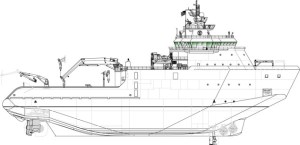
EdisonChouestOffshoreAHTSicebreaker

Drawing by North American Shipbuilding, click for larger

gCaptain reports that Edison-Chouest is building another icebreaker (Anchor Handling Tug Supply (AHTS) ship), with an option for a second. Another gCaptain post appears to indicate that they are in fact building two.

These vessels appear to be similar to the earlier M/V Aiviq.

If I read the report correctly, each ship will have Four 5060 KW generators. If so these ships will each have more horsepower (20,240 KW/27,131 SHP) than the diesel electric engines of the Polar class (18,000 HP), more than the Glacier (16,000 KW/21,000 SHP), and almost as much as the Healy (22,400 KW/30,027 SHP). They will be more than twice as powerful as the Wind class breakers (12,000 SHP), the National Science Foundation’s leased M/V Nathaniel B. Palmer (9,485 kW/12,720 HP), or USCGC Mackinaw (6,800 KW/9,119 SHP). They will also be more powerful than all but one of Canada’s icebreakers

They will be Polar Class 3. Polar class 3 means “Year-round operation in second-year ice which may include multiyear ice inclusions.” It appears we might be seeing the emergence of a whole class of privately owned American medium icebeakers.

Researching this, I found reference to two similar, if perhaps less capable, Class 4 icebreakers, both built in 1983 in Canada, as commercial AHTS vessels, one, CCGS Terry Fox, is now used by the Canadian Coast Guard, and her sister ship, Vladimir Ignatyuk, is now owned by Russia’s Murmansk Shipping Company and was chartered by the National Science Foundation to lead the break-in to McMurdo sound two seasons, during the Antarctic summers of 2011/12 and 2012/13.

The Russian icebreaker Vladimir Ignatyuk breaking a path in the annual sea ice to McMurdo Station, Antarctica on January 26, 2012. Credit: Steve Royce

The Russian icebreaker Vladimir Ignatyuk breaking a path in the annual sea ice to McMurdo Station, Antarctica on January 26, 2012.
Credit: Steve Royce

So far I have seen no indication of official Coast Guard interest in filling the stated requirement for three medium icebreakers. These ships do not have the redundancy we would like in a our ships. But that could be fixed. Plus lower cost might allow a different kind of redundancy, assigning two ships to the task rather than only one, allowing an organic Coast Guard self rescue capability that the Commandant has pointed out is missing with our current very limited icebreaker fleet. If the cost of these is similar to that of the M/V Aiviq ($200M, 16,240 KW/21,760 HP), even after upgrades to meet Coast Guard requirements, e.g. flight deck, hangar, communications, etc., and additional overhead that are included in Coast Guard procurement cost, we should be able to build a medium Icebreaker of similar capability for a third the $1B cost of a heavy icebreaker.

Is a medium icebreaker sufficient for our needs? We already have a documented requirement for three medium icebreakers in addition to three heavy icebreakers compared with the current fleet of one each. In a Defense News interview the Commandant pointed out, “First of all, it’s heavy ice breaking capability. Last year the Polar Star had to rescue a medium ice breaker from China. Just before they arrived, the wind shifted and they were able to get out on their own. Clearly, [that] is no place for a medium ice breaker. It does require heavy ice-breaking capability.” While I would never suggest that a Heavy icebreaker is not desirable, in fact the MV Xue Long (Snow Dragon) is more ice strengthened cargo ship than icebreaker with a large hull (21,025 tons) and relatively weak engines (13,200 KW/17,694 HP) and would be considered by the Coast Guard a light polar breaker (less than 20,000 HP). Historically the Operation Deepfreeze break-in has been done most frequently by ships we would now classify as medium or light icebreakers.

If you look at this chart, prepared by the Coast Guard, in 2013, of the 78 icebreakers of over 10,000 HP, operated by 17 countries, only eight of them were Heavy icebreakers (=>45,000 SHP). 34 were medium icebreakers of 20,000 to less than 45,000 HP, and 36  were smaller icebreakers of 10,000 to less than 20,000 HP. Interestingly, in addition to five heavy icebreakers, four medium, and two smaller icebreakers have managed to make it to the North Pole.

Even if funding can be found for a new heavy icebreaker, by the time it is built, we will again have only one heavy icebreaker (unless Polar Sea is reactivated), because the Polar Star will almost certainly be out of service by the time it enters service. We really need to consider alternatives to give us the numbers we need in the not too distant future. Apparently there is agreement we need at least two more medium icebreakers in addition to USCGC Healy. Getting them into the budget looks a lot more do able than a $1B heavy icebreaker, and far, far easier than two Heavies.

Tall Ships Coming to Philadelphia and Camden

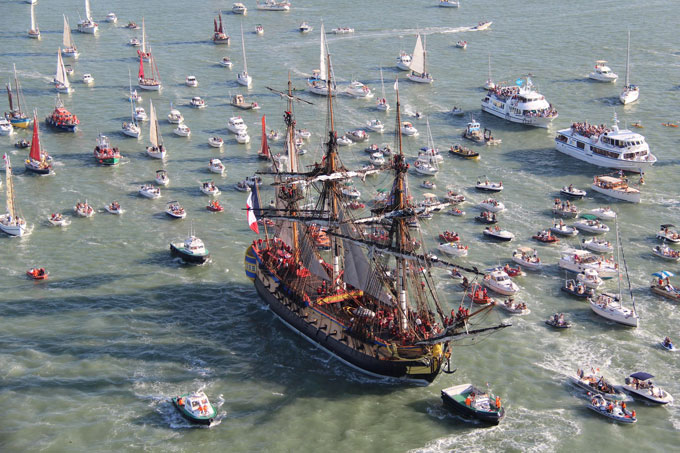
tall-ships-philadelphia-680uw

“Tall Ships this summer, the Tall Ships Challenge sailing festival will showcase dozens of boats large and small, including stunning replicas of historic ships like L’Hermione, shown here.” (Photo courtesy Tall Ships Philadelphia Camden 2015)

The Tall Ship Challenge is coming to Philadelphia and Camden June 25-28.

Not a lot of Coast Guard connection, other than that the Eagle will be there, and there will be a lot of work done by the Coast Guard, both regular and aux., to make it go smoothly, but it ought to be a great event.

UAE’s Ghannatha Program

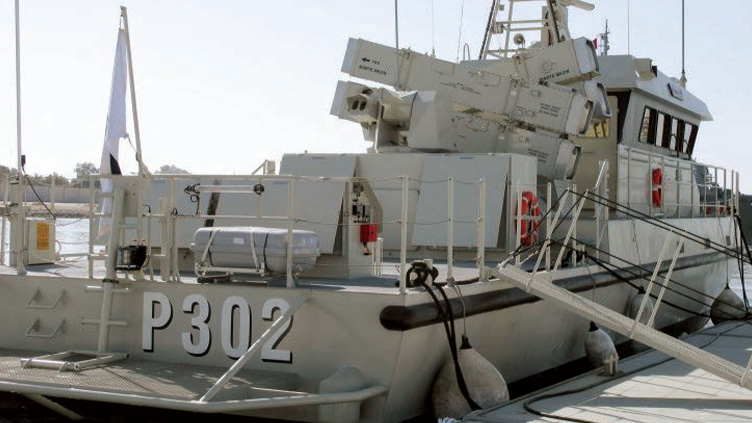
GhannathaPhaseII

I would like to talk about the United Arab Emirates’ 24 boat, Ghannatha program, because they seem to have departed from the usual form for patrol boats, both in their mission and their armament, apparently heavily influenced by the Swedish and Finnish Navies. They are neither typical lightly armed patrol boats nor heavily armed missile boats. In fact they come in three “flavors,”

  1. Six motor gunboats capable of carrying a platoon of 40 troops
  2. Six boats with automated breech loading 120mm (4.7″) mortars capable of both direct or indirect fire, and
  3. Twelve missile boats with missiles of an intermediate size (larger than Hellfire, but much smaller than Harpoon).

These boats are aluminum construction and actually only about half the displacement of the Coast Guard’s 87 footers, giving them shallow draft.

For comparison the dimensions on these of the boats relative to the Coast Guard’s 87 footers looks like this:

  • Ghannatha: 24×5.4×1.2 meters (first twelve)
  • WPBs: 26.52×5.92×1.74 meters

Figures from Combat Fleets of the World, 16th edition.

The gunboat/transports and the mortar boats were originally built to a common design, 24 or 25 meters in length (depending on source). While they appear to be patrol boats and have “P” for “patrol” hull numbers, they were built to land troops and supplies (explaining the shallow draft). The  gun and mortar boats are being modified as noted above. The 12 missile boats are slightly larger, the design lengthened to 26.5 meters (87 feet).

Lets talk about the weapons.

Rheinmetall MLG 27 27mm gun

This weapon arms the six transport/gunboats. They are most like a typical patrol boat. The weapon is not that different from the 25mm Mk38s that arm Webber class except that they have an almost insanely high rate fire, in that, at 1700 rounds/min, they can fire the 90 rounds on the mount in just over three seconds, probably about the time it will take for the first round to hit the target. There is also apparently only one type of round, so it may not have been the best choice.

Nemo 120mm Single Barrel Advanced Mortar System

This system, which will arm six of the earlier boats, has a range of up to 10KM (11,000 yards) and a maximum rate of fire of 10 rounds/min. There are Laser guided munitions available.

MBDA Marte Mk 2/N surface-to- surface guided missiles

This system will arm the twelve slightly larger new boats. The missile weighs 310 kg and is 3.85 metres long. The warhead weighs 70 kilogram (154 pound). The missile, has “an effective range in excess of 30 km, is a fire and forget, all weather sea skimming missile with inertial mid-course navigation through way points and active radar terminal homing. The Mk2/N system incorporates a mission planning function to optimize operation.”

These missiles give these boats a range almost double that of the 57mm or 76mm guns.

NAVDEX 2015–NavyRecognition

NavyRecognition reports on the Naval Defence Exhibition, held 22 – 26 February 2015 in Abu Dhabi, UAE. for me the most interesting reports were:

Light Weight 40mm Gun that required no deck penetration. It is not a competitor for the 57mm but compared to the Mk38 25mm, it probably does have enough additional range to allow it to engage beyond the 4,000 yard range that I believe is necessary to prevent extemporized armaments from targeting vital systems (like the gun) on our cutters. The Mk38 mod2 reportedly has an effective range of only 2,500 meters (about 2,750 yards).

New sonars suitable for small vessels, including a towed synthetic aperture sonar suitable for sub-surface-channel mapping and variations of ASW sonars currently in USN service that can be hull mounted and towed by vessels as small as the Webber class.

Defense News Interviews the Commandant

DefenseNews.Com just posted a three part video interview with the Commandant. Each segment is five to ten minutes in length.

Impact of Sequestration: http://www.defensenews.com/videos/defense-news/2015/03/01/24221471/

The Commandant notes, in the first two months of 2015 we have seized more drugs than we seized in all of 2013. He talks about establishing priorities and specifically mentions the Arctic and Western Hemisphere Drug enforcement.  He did not say what will drop out.

Capability vs Affordability http://www.defensenews.com/videos/defense-news/2015/03/01/24221423/

The Commandant has quite properly put emphasis on the OPC, and he has hit the point that spreading out procurement will cost more in the long run. He talked about icebreakers and discussed how we will need help funding them. He is pushing the results of the previous High Latitude study, saying the US needs three heavy and three medium icebreakers.

Coast Guard Modernization http://www.defensenews.com/videos/defense-news/2015/03/01/24221467/

Here he repeated themes from the State of the Coast Guard address. The importance of defending against Cyber attacks both within the Coast Guard and in the larger Maritime Transportation industry, the formation of an Arctic CG forum, and making the Coast Guard a hostile environment for those that might attempt sexual assault.

Observations

Seems the Commandant has recognized the need to sell the service and push for more funding, particularly for AC&I. It would not hurt to see the rest of the Coast Guard repeating the themes that he seems to have focused on, to make sure the message gets delivered.

The Commandant will continue to focus on the six major topics he highlighted in the State of the Coast Guard Address. Specifically I expect to see a lot more Coast Guard effort in the Eastern Pacific Transit Zone; we will continue to hear that the US needs three heavy and three medium icebreakers as the Commandant pushes for supplemental icebreaker funding; less obvious, but I think he is laying the ground work for an attempt to speed up the OPC construction schedule which would require at least another $500M annually in the AC&I account. There will be a lot more emphasis on cyber and tougher action on sexual assault. In terms of the objective of “maximizing return on investment,” I think we will see closer examination of fuel efficiency, manning, and other operating economies as a basis for where to invest modernization dollars.