

Click on the graphic to enlarge
The Acquisitions Directorate has a story on the commissioning of the 17th Webber class WPC, USCGC Donald Horsley (WPC-1117).
Included in the post was the graphic above, which gives us an indication of where future cutters will be homeported:
- Ketchikan, AK
- San Pedro, CA
- Pascagoula, MS
- Atlantic Beach, NC
- Cape May, NJ
One more WPC is expected to go to San Juan, so in about six months we should see a Webber class go to Ketchikan. Certainly its improved sea keeping compared to the 110s will be appreciated.
This is not, I’m sure, a complete list of future homeports, given that we expect 41 more of this class. I’m not privy to the home porting plan or how many will be in each port, but this looks like it will cover at least the next 18 months. It may cover a much longer period if more than one Webber class will be assigned to some of these ports, and that seems likely.
I would note that these homeports look good from a Ports, Waterways, and Coastal Security perspective. Ketchikan and the inland passage has a lot of cruise ship traffic. San Pedro is near the huge Los Angeles port complex and the strategic ports of Long Beach and Port Hueneme. Pascagoula based ships potentially protect the ports of the Eastern Gulf of Mexico including the eastern approaches to the Mississippi River port complex and the strategic port of Gulf Port, MS. Atlantic Beach, NC is close to Cape Lookout and Cape Hatteras, but it is also close to the strategic ports of Morehead City, Sunny Point, and Wilmington. WPCs in Cape May, NJ could provide protection for Delaware Bay, including the strategic port of Philadelphia.
If any of our readers has access to the homeporting plan, and it is public knowledge, I would appreciate the information.
 Chuck Hill's CG Blog
Bollinger delivers Webber #39, to be homeported in Guam. https://www.marinelog.com/shipyards/shipyard-news/bollinger-delivers-first-of-three-frcs-to-be-homeported-in-guam/
Webber Class #37 is commissioned
News Release
U.S. Coast Guard 8th District Public Affairs Detachment Texas
Contact: 8th District Public Affairs Detachment Texas
Office: (281) 464-4810
After Hours: (832) 293-1293
PA Detachment Texas online newsroom
Coast Guard commissions Cutter Edgar Culbertson in Galveston, Texas
HOUSTON — The Coast Guard held a commissioning ceremony for the Coast Guard Cutter Edgar Culbertson, the service’s 37th fast response cutter, at Sector Field Office Galveston, Texas, Friday.
Rear Adm. John Nadeau, Eighth Coast Guard District commander, presided over the ceremony, along with Lt. Katie Shveda, Coast Guard Cutter Edgar Culbertson commanding officer.
Edgar Culbertson, the cutter’s namesake, was a Coast Guard petty officer 1st class and Coast Guard Medal recipient who died April 30, 1967, while attempting the rescue of three brothers during a storm in Duluth, Minnesota.
Culbertson and two other Coast Guardsmen, Petty Officer 3rd Class Richard Callahan and Fireman Ronald Prei, volunteered to attempt the rescue. After arriving at the pier they tethered themselves together and searched the pier with lanterns in an attempt to locate the missing Halverson brothers. As the heroes searched for the boys, a large wave crashed over the wall, knocking Culberston over the side.
Culbertson was a 31-year-old native of Ferndale, Michigan, a veteran of the Korean War and had served in the Coast Guard since 1952.
The Coast Guard Cutter Edgar Culbertson’s patrol area will encompass 900 miles of coastline for the Coast Guard’s Eighth District, from Carrabelle, Florida, to Brownsville, Texas. Fast response cutters are named after Coast Guard enlisted heroes and will replace the service’s 110-foot patrol boats. These vessels feature advanced command, control, communications, computers, intelligence, surveillance, and reconnaissance equipment.
Photos here: https://content.govdelivery.com/accounts/USDHSCG/bulletins/2903f24
#38 commissioned.
News Release
U.S. Coast Guard 8th District Public Affairs Detachment Texas
Contact: 8th District Public Affairs Detachment Texas
Office: (281) 464-4810
After Hours: (832) 293-1293
PA Detachment Texas online newsroom
Coast Guard commissions Cutter Harold Miller in Galveston, Texas
HOUSTON — The Coast Guard held a commissioning ceremony for the Coast Guard Cutter Harold Miller, the service’s 38th fast response cutter, at Sector Field Office Galveston, Texas, Wednesday.
Rear Adm. John Nadeau, Eighth Coast Guard District commander, presided over the ceremony, along with Lt. Michael Salerno, Coast Guard Cutter Harold Miller’s commanding officer.
Harold Miller, the cutter’s namesake, was a Coast Guard boatswain’s mate 2nd class and a Silver Star recipient for his heroic actions that led to the victory at Tulagi Island during World War II.
On Aug. 7, 1942, while stationed aboard the U.S.S. McKean, Miller piloted the first wave of landing craft on Tulagi Island in the Pacific Theater against a Japanese force on Guadalcanal Island. Miller then made repeated trips in spite of heavy enemy fire to affect the landing of his embarked troops, equipment ammunition, and supplies.
The Coast Guard Cutter Harold Miller’s patrol area will encompass 900 miles of coastline for the Coast Guard’s Eighth District, from Carrabelle, Florida, to Brownsville, Texas. Fast response cutters are named after Coast Guard enlisted heroes and will replace the service’s 110-foot patrol boats. These vessels feature advanced command, control, communications, computers, intelligence, surveillance, and reconnaissance equipment.
This additional information was included in the CG-9 announcement.
“The Coast Guard has ordered 56 FRCs to date. Thirty-eight are in service: 12 in Florida; seven in Puerto Rico; four in California; three each in Hawaii, Texas and New Jersey; and two each in Alaska, Mississippi and North Carolina. Future FRC homeports include Santa Rita, Guam; Astoria, Oregon; and Kodiak, Seward and Sitka, Alaska.”
From CG-9, https://www.dcms.uscg.mil/Our-Organization/Assistant-Commandant-for-Acquisitions-CG-9/Newsroom/Latest-Acquisition-News/Article/2294845/coast-guard-accepts-40th-fast-response-cutter/
The Coast Guard accepted delivery of the 40th fast response cutter (FRC), Oliver Henry, in Key West, Florida, July 30.
It will be the second of three planned FRCs stationed in Santa Rita, Guam. Stationing FRCs in Guam supports Operation Aiga, an effort to strengthen the community of island nations in Oceania. “By placing an ocean-going Coast Guard buoy tender and FRCs, we will promote ‘rules-based order,’ build capacity and affirm the United States’ positive and enduring role in the region,” said Adm. Karl Schultz, Coast Guard commandant.
Chief Warrant Officer Oliver T. Henry, the cutter’s namesake, was one of the first Black petty officers and machinist mates in the Coast Guard, achieving the rank and rating well before the full integration of the Armed Forces. Henry’s rise started while serving aboard Coast Guard Cutter Northland during World War II, when he transitioned from the wardroom, where he served as a steward, to the engine room as a motor machinist mate. He was also one of the service’s first minority warrant officers and served over 15 years of his 26-year career as a warrant or chief warrant officer.
The Sentinel-class FRCs feature advanced command, control, communications, computers, intelligence, surveillance and reconnaissance equipment; over-the-horizon cutter boat deployment to reach vessels of interest; and improved habitability and seakeeping. The cutters are designed for multiple missions, including search and rescue; national defense; ports, waterways and coastal security; drug and migrant interdiction; and fisheries patrols.
The Coast Guard has ordered 56 FRCs to date. Thirty-eight are in service: 12 in Florida; seven in Puerto Rico; four in California; three each in Hawaii, Texas and New Jersey; and two each in Alaska, Mississippi and North Carolina. Future FRC homeports include Astoria, Oregon; and Kodiak, Seward and Sitka, Alaska.
Solicitation for precomm crew for four Webber class going to PATFORSWA in Bahrain, CGC GLENN HARRIS (WPC 1144), CGC EMLEN TUNNELL (WPC 1145), CGC JOHN SCHEUERMAN (WPC 1146), CGC CLARENCE SUTHPIN (WPC 1147). The first two going to PATFORSWA are CHARLES MOULTHROPE (WPC 1141) and ROBERT GOLDMAN (WPC 1142). #41 and 42 should be commissioned this year or early 2021. First two will probably will arrive in Bahrain summer 2021.
united states coast guard
30 JUL 20
ALCGENL 148/20
SUBJ: AY21 PATROL FORCES SOUTHWEST ASIA (PATFORSWA) 154′ WPC/FRC AFLOAT
SOLICITATION
A. ALCGENL 147-20 AY21 PATROL FORCES SOUTHWEST ASIA (PATFORSWA) 110′ WPB
AFLOAT SOLICITATION
B. Military Assignments and Authorized Absences, COMDTINST M1000.8A
C. Coast Guard Law Enforcement Competency Qualification Manual,
COMDTINST M16247.3F
D. Coast Guard Weight and Body Fat Standards Program Manual,
COMDTINST M1020.8H
E. Coast Guard Water Survival Training Program Manual,
COMDTINST M16240.4C
F. Screening for Overseas Duty, PSCINST 1300
1. This message solicits for 154′ WPC or Fast Response Cutter (FRC) afloat
assignments to commission four new 154′ WPCs at Patrol Forces Southwest Asia
(PATFORSWA). These assignments are normally for 12 months however PSC-EPM-2
is seeking applicants for 18, 21, or 24 month PCS deployments to begin in the
Spring of 2021. Personnel applying for this opportunity should understand
that there is a significant portion of the deployment that will be spent
inside the CONUS at pre-delivery training, post-delivery availability, and
cutter work ups prior to deployment to Bahrain. Those selected for this
opportunity will be required to attend pre-deployment training (PDT), which
lasts approximately 5 weeks in addition to any required pipeline training.
Additional training includes 6 weeks of pre-delivery training at the
Bollinger Shipyard in Lockport, LA followed by extensive post-delivery
availability workups and installations which last from 8 to 12 weeks.
Actual report dates to pre-commissioning cutters are set by the PATFORSWA
Admin Officer and LANT-39. The following 154′ WPC cutters are available:
CGC GLENN HARRIS (WPC 1144)
CGC EMLEN TUNNELL (WPC 1145)
CGC JOHN SCHEUERMAN (WPC 1146)
CGC CLARENCE SUTHPIN (WPC 1147)
Following the completion of post delivery availability and workups, the
cutters will transit to Bahrain. All members interested in this
assignment opportunity should apply under the GLENN HARRIS department
ID (048788). Successful completion of this assignment will result in an
assignment priority one. Members that request consideration for
this assignment will also be considered for 110′ WPB assignments
advertised in Reference A. Subsequent tours for all follow-on crews will
revert back to 12 months as described for PATFORSWA afloat assignments
in Reference A.
2. This is a dependent restricted, non-isolated PCS assignment. For
additional information and benefits see our websites listed in
paragraph 8.
3. Assignment criteria: Applicants must be:
a. 18 years of age at deployment date
b. Tour complete in AY21 or AY22
c. Suitable for overseas assignment per References B and F
d. A United States citizen
e. Maintain or be eligible for a Secret clearance
f. Must meet obligated service requirements of 21, 24, or 27 months from
report date
g. Must have completed and passed task 1-01, Physical Fitness Standards
(PT Test), of Reference C, within the last 6 months
h. Must meet Coast Guard weight standards per Reference D
i. E-resume includes command endorsement for all positions. Additional
command endorsements are required for independent duty afloat (DC, IT,
OS) per Reference B if applicable
j. Possess a driver’s license valid through the entire tour of duty
k. Able to pass Water Survival Training (Note 1)
l. Prior to arrival at PDT, members should possess a basic and/or
practical rifle qualification on the M16 or M4 rifle within the previous
5 years. Previous qualification with a personal defense weapon (PDW) is
also highly encouraged but not required. (Note 2)
Note 1: All members will be required to take part in 3 days of
intensive pool training as part of the Water Survival Training
Program (WSTP) at PDT. Students will be required to take and pass
the PT test in the first week of PDT in order to participate in
WSTP. Upon successful completion of the PT test, students will be
required to meet all tasks outlined in the WSTP Manual per Reference
D. Students should be comfortable in uniform treading water,
swimming, and jumping off an elevated platform. Members are
strongly encouraged to review WSTP requirements per Reference E
prior to attending PDT.
Note 2: Weapons qualifications are required for all shoreside and
afloat assignments. All E-7 and below assignments are designated as
anti-terrorism/force protection (AT/FP) watch standers.
4. Position information.
a. Boatswain’s Mate (BM): Members interested in applying for any
afloat assignments should apply to the following positions:
RATE/RANK POSN NUMBER NUMBER OF BILLETS
BMC 19381557 1
BM1 19381550 3
BM2 19381544 2
BM3 19381538 1
b. Culinary Specialist (CS): Members interested in applying for
afloat assignments should apply to the following position:
RATE/RANK POSN NUMBER
CS1 19381553
CS3 19381541
c. Damage Controlman (DC): Members interested in applying for
afloat assignments should apply to the following position:
RATE/RANK POSN NUMBER Notes
DC2 19381549 Independent Duty
d. Electrician’s Mate (EM): Members interested in afloat positions
should apply for the following position:
Rate/Rank POSN Number
EM1 19381554
EM3 19381539
d. Electronics Technician (ET): Members interested in applying for
afloat assignments should apply for the following position:
Rate/Rank POSN Number
ET2 19381546
ET3 19381537
e. Gunner’s Mate (GM): Members interested in applying for afloat
assignments should apply to the following position:
RATE/RANK POSN NUMBER
GM2 19381547
GM3 19381542
f. Information Specialist (IT): Members interested in applying for
afloat assignments should apply to the following position:
Rate/Rank POSN number Notes
IT2 19381543 Independent Duty
f. Machinery Technician (MK): Members interested in applying for
afloat assignments should apply to the following position:
Rate/Rank POSN Number
MKC 19381558
MK1 19381555
MK2 19381548
MK3 19381540
g. Operations Specialist (OS): Members interested in applying for
afloat assignments should apply to the following position:
Rate/Rank POSN number Notes
OS1 19381556 Independent Duty
5. Assignment Procedures: Members should complete Reference F
requirements for overseas assignment, complete a PT test and minimum
weapons qualification requirements, and submit a command endorsed e-resume
for PATFORSWA positions by 2 October 2020. Those who are tour complete in
AY21 or AY22 can apply and should list PATFORSWA positions only. If not
selected, members tour complete in AY21 should follow published AY21
shopping list deadline guidance or rating specific guidance for submitting
updated e-resumes. Members tour complete in AY21 will be given priority
for these assignments.
6. Applicants should be aware that documented rated experience and
qualifications may take precedence over assignment priority when making
these assignments. Those who meet PATFORSWA assignment criteria and are
not selected are encouraged to keep apprised of latest message traffic
for unexpected openings (follow-on ALCGENL). PSC-EPM-2 will notify
selected members or their commands on a case-by-case basis.
7. Command endorsement criteria: All PATFORSWA endorsements should
address the following:
a. Verify that member meets all assignment criteria in paragraph 3.
b. List member small arms qualifications and most recent certification
date. Again, verify that a passing basic and/or practical rifle
qualification on the M16 or M4 rifle has occurred within the previous
5 years along with passing of the physical fitness standards in the last
6 months. (Note 1)
c. Summarize previous law enforcement or AT/FP experience and
qualifications.
d. Backfill concerns: When addressing backfills for members not tour
complete in AY21, commands should keep in mind that receiving an
immediate backfill is not always possible. Backfill requests will factor
into the candidate selection process. Additional guidelines for command
endorsements can be found at our websites.
e. Due to current Restriction of Movement criteria, applicants should
understand they may be in country for 12 consecutive months. The member
comments shall include the following statement of acknowledgment:
“Member understands and acknowledges they may be in country for a
continuous 12 month period pending COVID travel restrictions.”
Note 1: For members whose weapons qualifications meet the minimum
criteria, but have lapsed, basic and practical qualification courses on
rifle (among other weapons) systems will be administered at PDT.
8. Training, Entitlements, FAQs: All personnel selected for this duty will
be required to complete PDT and applicable pipeline training. Details are
available on the EPM PATFORSWA and SMTC Portal Pages below. Members are
reminded that dependents can be relocated to a geographical area of choosing
for the duration of the tour and members that volunteer for 24 month tours
will be eligible for consecutive overseas tours benefits.
https://cg.portal.uscg.mil/units/psc/psc-epm/SitePages/PATFORSWA-MIPFTAG.aspx
https://cg.portal.uscg.mil/units/smtc/SitePages/Home.aspx
9. For assignment questions, please contact the following Assignment
Officers (AO’s) by Rate:
BM: CWO2 Richard Seymour, Richard.L.Seymour@uscg.mil, 202-795-6614
CS (E6): CWO2 William Wall, William.T.Wall@uscg.mil, 202-795-6570
CS (E4): CSCS Christopher Smith, Christopher.D.Smith@uscg.mil, 202-795-6595
DC: CWO4 Travis Lovvorn, Travis.V.Lovvorn@uscg.mil, 202-795-6592
EM: CWO2 Bruce Reid, Samuel.B.Reid@uscg.mil, 202-795-6586
ET (E4-E6): CWO4 Giovanni Wade, Giovanni.P.Wade@uscg.mil, 202-795-6581
GM: CWO4 Christopher Box, Christopher.L.Box@uscg.mil, 202-795-6613
IT: CWO2 Peter Deacon, Peter.G.Deacon@uscg.mil, 202-795-6604
MK: CWO2 Aaron Boyette, Grant.A.Boyette@uscg.mil, 202-795-6602
OS (E6): CWO3 Keith Moore, Keith.D.Moore@uscg.mil, 202-795-6583
10. Command representatives may contact LT Rachel Kent,
Rachel.R.Kent@uscg.mil (202-795-6616).
11. Questions regarding the operational nature of this assignment or
PDT should contact SMTC, YNCM Jessica Schroeder at
Jessica.K.Schroeder@uscg.mil, or 910-440-6002.
12. Released by: CDR R. Deisher.
13. Internet release authorized.
With three Webber class in Galveston, it looks like they have upgraded the supporting infrastructure. Below is a press release.
News Release
U.S. Coast Guard 8th District Public Affairs Detachment Texas
Contact: 8th District Public Affairs Detachment Texas
Office: 281-464-4810
After Hours: 832-293-1293
PA Detachment Texas online newsroom
HOUSTON — The Coast Guard held an establishment ceremony for Base Galveston in Galveston, Texas, Tuesday.
The ceremony was presided over by Rear Adm. Melvin W. Bouboulis, Director of Operational Logistics.
During the ceremony, Sector Field Office (SFO) Galveston was disestablished and Base Galveston was established.
Established on December 16, 2005, SFO Galveston, renamed Base Galveston, provides mission support services to Coast Guard and other military commands throughout the Sector Houston-Galveston area.
Base Galveston’s comptroller, galley, facilities engineering, naval engineering, and personnel support departments directly support ten tenant commands on the base: Coast Guard Cutters Harold Miller, Daniel Tarr, Edgar Culbertson, Beluga, Clamp, Harry Claiborne, Hatchet, and Seahorse as well as Station Galveston and Aids to Navigation Team (ANT) Galveston.
Base Galveston has over 100 active duty, reserve, and civilian employees providing support services to over 1,800 Coast Guard personnel throughout the region, including 10 cutters, five stations, and two ANT teams with 38 small boats. The base also hosts a Coast Guard Exchange, gym, armory with small arms firing range, a maintenance augmentation team, an industrial production facility, and ATON Buoy Yard Detachment. The Sector Education Services Officer, Worklife Staff, and Chaplain also provide support on the Base.
A live stream of the ceremony can be found at Sector Houston-Galveston’s Facebook page.
For more information follow us on Facebook and Twitter.
Since three Webber class are going to Guam (in addition to the buoy tender that is there, this may be of interest. Marines are opening a new base for 5000 Marines. https://www.stripes.com/news/pacific/marines-activate-camp-blaz-on-guam-the-corps-first-new-base-since-1952-1.647005?mc_cid=57567bf3d1&mc_eid=e51bf416d0&fbclid=IwAR2ww4749Q1oxI6wswHMpMnm2VRSvjkNjLW_tnOb078KoXfUNOd-60DxvYY#.X3XHgcDeokw.facebook
Pingback: “BOLLINGER SHIPYARDS DELIVERS 41st FAST RESPONSE CUTTER STRENGTHENING DEFENSE CAPABILITIES IN THE ARABIAN GULF” –Bollinger Press Release | Chuck Hill's CG Blog
A Bollinger news release on the delivery of FRC #42, bound for PATFORSWA. Notably despite pandemic and storms, she was delivered three weeks early.
————————————————————————————
BOLLINGER SHIPYARDS DELIVERS 42nd FAST RESPONSE CUTTER STRENGTHENING DEFENSE CAPABILITIES IN THE ARABIAN GULF
USCGC ROBERT GOLDMAN is second of six cutters destined for overseas operations in Manama, Bahrain
LOCKPORT, La., — December 21, 2020 – Bollinger Shipyards LLC (“Bollinger”) today delivered the USCGC ROBERT GOLDMAN to the U.S. Coast Guard in Key West, Florida. This is the 165th vessel Bollinger has delivered to the U.S. Coast Guard over a 35-year period and the 42nd Fast Response Cutter (“FRC”) delivered under the current program.
The USCGC ROBERT GOLDMAN is the second of six FRCs to be home-ported in Manama, Bahrain, which will replace the aging 110’ Island Class Patrol Boats, built by Bollinger Shipyards 30 years ago, supporting the Patrol Forces Southwest Asia (PATFORSWA), the U.S. Coast Guard’s largest overseas presence outside the United States.
“Bollinger is proud to continue enhancing and supporting the U.S. Coast Guard’s operational presence and ensuring it remains the preferred partner around the world,” said Bollinger President & C.E.O. Ben Bordelon. “It is our top priority to ensure that the brave men and women of the Coast Guard stationed in PATFORSWA have the most state-of-the-art, advanced vessels as they work to build and maintain the necessary regional alliances to ensure maritime security in the region. Building ships for the Coast Guard provides critical assets to bolster our national security and advance America’s interests, both at home and abroad.”
At a PATFORSWA change of command ceremony earlier in the summer, U.S. Coast Guard Atlantic Area Commander Vice Adm. Steven D. Poulin emphasized the importance of the unit, saying, “During these historical times it is important, now more than ever, that we maintain maritime security operations throughout the U.S. Central Command area of responsibility. [PATFORSWA is] pushing forward into the unknown to protect American interests in the region.”
PATFORSWA is composed of six cutters, shoreside support personnel, and the Maritime Engagement Team. The unit’s mission is to train, organize, equip, support and deploy combat-ready Coast Guard Forces in support of U.S. Central Command and national security objectives. PATFORSWA works with Naval Forces Central Command in furthering their goals to conduct persistent maritime operations to forward U.S. interests, deter and counter disruptive countries, defeat violent extremism and strengthen partner nations’ maritime capabilities in order to promote a secure maritime environment.
Earlier this month, Bordelon authored an opinion piece on how an expanded U.S. Coast Guard presence around the globe can “help further the regional partnerships and alliances necessary to curb the creeping influence of America’s strategic competitors and adversaries.” Bordelon argues that the Coast Guard has the opportunity to establish itself as the preferred regional partner through its work with PATFORSWA, Operation Aiga and elsewhere. Bordelon concludes that “white hull diplomacy should be looked to more and more as a complementary arrow in the whole-of-government quiver.”
The majority of the USCGC ROBERT GOLDMAN build occurred despite the COVID-19 global pandemic and six named storms impacting the Gulf region, all of which affected Louisiana and two of which made landfall in the state as hurricanes, including Hurricane Laura – a Category 4 storm and the strongest to hit the state since the Great Storm of 1856. Bollinger undertook precautions to ensure the health and safety of employees and not only maintained its schedule, but delivered the vessel 3 weeks early.
Each FRC is named for an enlisted Coast Guard hero who distinguished himself or herself in the line of duty. Robert Goldman enlisted in the Coast Guard in October 1942 as a pharmacist’s mate. In 1944 he reported for duty aboard the Coast Guard-manned, 328-foot Landing Ship, Tank-66, taking part in a campaign to re-take the Philippines from the Japanese. On November 12, 1944 a Japanese kamikaze plane flew straight for the men gathered on the starboard side of the LST’s stern. Goldman witnessed the enemy fighter impact the deck and explode. Goldman’s back was on fire from the aviation fuel, his right leg received shrapnel from the crashing fighter, and he suffered severe shock from the sudden crash and resulting carnage. Disregarding his own injuries, Goldman courageously treated the wounded and dying. For his heroic deeds, Goldman received the Purple Heart and Bronze Star medals.
FRC#41 commissioned.
News Release
U.S. Coast Guard Atlantic Area
Contact: Coast Guard Atlantic Area Public Affairs
Office: (757) 398-6521
After Hours: (757) 641-0763
Atlantic Area online newsroom
U.S. Coast Guard to commission 41st Fast Response Cutter
USCGC Moulthrope Seal
PORTSMOUTH, Va. — The U.S. Coast Guard will commission the USCGC Charles Moulthrope (WPC 1141), Patrol Forces Southwest Asia’s first Sentinel-class cutter, into service at Coast Guard Base Portsmouth, Thursday at 1 p.m. EST.
Due to COVID mitigation, in-person attendance is limited. Anyone interested in viewing the ceremony live may do so at http://bit.ly/WPC1411Com, clicking on the image at the top, or by clicking here.
Adm. Karl Schultz, commandant, U.S. Coast Guard, will preside over the 41st Sentinel-class cutter ceremony. Mrs. Dawn Schultz is the ship’s sponsor.
The Charles Moulthrope is the first of six FRCs planned for service in Manama, Bahrain. The cutter is named after Seaman Charles Moulthrope, remembered for heroic and selfless service as a member of the Revenue Cutter Service Cutter Commodore Perry, patrolling Alaska, when he rescued several of his shipmates who ended up in the sea.
The Coast Guard took delivery of Charles Moulthrope on Oct. 22, 2020, in Key West. They will transit to Bahrain later this year with their sister ship, the Robert Goldman (WPC 1142), delivered on Dec. 22, 2020, and due to be commissioned prior to departure.
From D14 Press release.
SANTA RITA, Guam —The Coast Guard accepted delivery of its newest Sentinel-class fast response cutter (FRC), the Coast Guard Cutter Frederick Hatch (WPC 1143), from Bollinger Shipyards in Key West, FL, Thursday.
Frederick Hatch is scheduled to be the third FRC stationed in Guam and will arrive in Santa Rita during the summer. The cutter was placed in commission, special status, and will remain in Florida while the crew completes pre-commissioning trials and maintenance.
The 45th FRC has been delivered.https://seapowermagazine.org/bollinger-shipyards-delivers-45th-fast-response-cutter-to-coast-guard/ This will be the forth vessel bound for PATFORSWA, so in a few months it, USCGC Emlen Tunnell (WPC-1145) and USCGC Glen Harris (WPC-1144) will be transiting to Bahrain, presumably in company with one of the Bertholf class NSCs.
I understand the third FRC has arrived in Guam.
Report of the arrival of third Webber class in Guam USCGC Frederick Hatch (WPC-1143) https://www.realcleardefense.com/2021/07/01/coast_guard_on_guam_now_at_full_strength_783789.html#!
The Acquisitions Directorate announcement of the delivery of the 45th FRC also included this information on homeports.
The Coast Guard has ordered 60 FRCs to date. Forty are in service: 12 in Florida; seven in Puerto Rico; four in California; three each in Hawaii, Texas and New Jersey; and two each in Alaska, Mississippi, North Carolina and Bahrain. Four additional FRCs have been delivered: three will be commissioned at their homeport of Guam later this month and one will be delivered to Bahrain along with Emlen Tunnell after their commissionings. Future FRC homeports include Astoria, Oregon; Boston; St. Petersburg, Florida; and Kodiak, Seward and Sitka, Alaska.
https://www.dcms.uscg.mil/Our-Organization/Assistant-Commandant-for-Acquisitions-CG-9/Newsroom/Latest-Acquisition-News/Article/2680472/coast-guard-accepts-45th-fast-response-cutter/
There will probably be some additional homeports, not yet identified, since that does account for homeports for all 64 currently funded.
any word of any north of boston?
So far no indication of FRCs North of Boston, but OPCs are going to New Port, RI.
I suspect we will see FRCs replace the WMECs in Kittery, ME.
From the Acquisitions Directorate. This seems to identify all the D17 homeports (there are two in Ketchikan already). Questions remains how many of the remaining 18 yet to be accepted FRCs will go where?
Coast Guard accepts 48th fast response cutter
March 22, 2022 —
The Coast Guard accepted delivery of the 48th fast response cutter (FRC), Pablo Valent, March 17 in Key West, Florida.
Pablo Valent is the first FRC that will be stationed in St. Petersburg, Florida.
Originally from Corpus Christi, Texas, the cutter’s namesake joined the United States Life-Saving Service in 1912. As a boatswain’s mate in September 1919, Valent helped rescue the crew of the hurricane-damaged schooner Cape Horn off the coast of Texas. For his heroic efforts, Valent received the Silver Lifesaving Medal and the prestigious Grand Cross of the American Cross of Honor Society. He was one of the first Hispanic Americans to receive these honors.
The Coast Guard has ordered 64 FRCs to date. Forty-five are in service: 12 in Florida; seven in Puerto Rico; four each in Bahrain and California; three each in Guam, Hawaii, Texas and New Jersey; and two each in Alaska, Mississippi and North Carolina. Two more will sail to Bahrain later this year. Future FRC homeports include Astoria, Oregon; Boston; and Kodiak, Seward and Sitka, Alaska.
News Release
U.S. Coast Guard 7th District PA Detachment Tampa Bay
Coast Guard to commission Cutter Pablo Valent
Coast Guard to commission Cutter Pablo Valent
Editor’s Note: Click on the images to download high resolution versions.
WHO: U.S. Coast Guard Cutter Pablo Valent and Sector St. Petersburg
WHAT: Commissioning of USCGC Pablo Valent (WPC 1148)
WHEN: 10 a.m. Wednesday, May 11, 2022
WHERE: Coast Guard Sector St. Petersburg, 8th Ave, St. Petersburg, FL 33701
Media interested in attending must RSVP no later than 4 p.m. Monday, May 9, with the Coast Guard Public Affairs Detachment Tampa office at padettampabay@gmail.com. Media should arrive no later than 9:15 a.m. for check-in.
ST. PETERSBURG, Fla. — The Coast Guard will commission the 48th Sentinel-class fast response cutter (FRC) Pablo Valent (WPC 1148), into service at Coast Guard Sector St. Petersburg, Wednesday.
Rear Adm. Brendan McPherson, commanding officer of the Coast Guard Seventh District, will preside over the ceremony. Ms. Cecilia Guillot, Valent’s great-niece, is the ship’s sponsor.
The cutter’s namesake Pablo Valent was originally from Corpus Christi, Texas, and joined the United States Life-Saving Service in 1912. In September 1919, Valent helped rescue the crew of the hurricane-damaged schooner Cape Horn off the coast of Texas. For his heroic efforts, Valent received the Silver Lifesaving Medal and the Grand Cross of the American Cross of Honor Society. Valent was one of the first Hispanic Americans to receive these honors.
The Cutter Valent is the 48th FRC and is the first to be homeported in St. Petersburg with missions including search and rescue, maritime law enforcement, coastal security, and living marine resources. There are 12 other FRCs in Florida, which operate throughout the Caribbean Sea.
Sector St. Petersburg is one of the Coast Guard’s largest commands, with an area of responsibility encompassing over 400 nautical miles of coastline along Florida’s west coast.
I believe this will be the third FRC in Ketchikan
From CG-9:
The Coast Guard accepted delivery of the 49th fast response cutter (FRC), Douglas Denman, May 26 in Key West, Florida.
Douglas Denman will be homeported in Ketchikan, Alaska.
Born in Tallapoosa, Georgia, the cutter’s namesake joined the Coast Guard in 1940 and was eventually assigned to the USS Colhoun as a coxswain. On Aug. 30, 1942, the Colhoun was positioned off the coast of Guadalcanal when it was attacked by adversarial aircraft. Denman was seriously wounded during the attack, but remained at his duty station. When the order was given to abandon ship, Denman and another crewmember helped evacuate the crew and get life jackets to those already in the water. Because of Denman’s selfless actions, 100 of the 150 officers and crew survived the attack and sinking of Colhoun. For his heroic efforts, Denman received the Silver Star and Purple Heart medals. He served for 20 years in the Coast Guard, retiring as a senior chief petty officer in 1961.
The Coast Guard has ordered 64 FRCs to date. Forty-eight are in service: 13 in Florida; seven in Puerto Rico; four each in California and Bahrain; three each in Guam, Hawaii, Texas and New Jersey; two each in Alaska, Mississippi and North Carolina; and Clarence Sutphin Jr and John Scheuerman, which will sail to Bahrain later this year. Future FRC homeports include Astoria, Oregon; Boston; and Kodiak, Seward and Sitka, Alaska.
Marine Log reports delivery of the 50th Webber Class Fast Response Cutter, the future USCGC William Chadwick (WPC-1150). This one is the first of the class to be homeported in Boston. We know the next in the class USCGC Warren Deyampert (WPC-1151) is also expected to be homeported in Boston and I suspect there will be a third.
https://www.marinelog.com/news/bollinger-delivers-50th-fast-response-cutter/
this is the CG announcement of acceptance of FRC#50 https://www.dcms.uscg.mil/Our-Organization/Assistant-Commandant-for-Acquisitions-CG-9/Newsroom/Latest-Acquisition-News/Article/3118574/coast-guard-accepts-50th-fast-response-cutter/
The Coast Guard accepted delivery of the 50th fast response cutter (FRC), William Chadwick, Aug. 4 in Key West, Florida.
William Chadwick will be homeported in Boston.
Born in Dover, New Jersey, the cutter’s namesake was a keeper of the Green Island Lifeboat Station in New Jersey and recipient of the Congressional Gold Lifesaving Medal for his rescue of the crew of the schooner George Taulane on Feb. 3, 1880. Chadwick remained keeper of Green Island Station until his retirement in August 1886.
The Coast Guard has ordered 64 FRCs to date. Forty-eight are in service: 13 in Florida; seven in Puerto Rico; four each in California and Bahrain; three each in Guam, Hawaii, Texas and New Jersey; two each in Alaska, Mississippi and North Carolina; and Clarence Sutphin Jr and John Scheuerman, which are currently underway to Bahrain. Future FRC homeports include Astoria, Oregon; and Kodiak, Seward and Sitka, Alaska.
For more information: Fast Response Cutter Program page
News Release
U.S. Coast Guard 17th District Alaska
Media Advisory: Coast Guard to commission Fast Response Cutter Douglas Denman in Ketchikan, Alaska
WHO: Commander, Coast Guard Pacific Area and Coast Guard 17th District
WHAT: Coast Guard Cutter Douglas Denman Commissioning Ceremony
WHERE: Coast Guard Base Ketchikan, 1300 Stedman Street, Ketchikan, AK 99901
WHEN: Wednesday, September 28, media arrive at 9 a.m. for security screening, 10 a.m. ceremony
KETCHIKAN, Alaska — Members of the media are invited to attend the commissioning ceremony for Coast Guard Cutter Douglas Denman (WPC 1149), the Coast Guard’s newest 154-foot Fast Response Cutter (FRC), in Ketchikan, Wednesday at 10 a.m., as it officially becomes operational.
Vice Adm. Andrew J. Tiongson, commander, Coast Guard Pacific Area and Rear Adm. Nathan A. Moore, commander, Coast Guard 17th District will preside over the ceremony, accepting the forty-ninth FRC and third of its class in Southeast Alaska into the military service’s fleet.
The cutter was named for Douglas Denman who was born in Tallapoosa, Georgia and joined the Coast Guard in 1940. He was eventually assigned to the USS Colhoun as a coxswain. On Aug. 30, 1942, the Colhoun was positioned off the coast of Guadalcanal when it was attacked by adversarial aircraft. Denman was seriously wounded during the attack, but remained at his duty station. When the order was given to abandon ship, Denman and another crewmember helped evacuate the crew and get life jackets to those already in the water. Because of Denman’s selfless actions, 100 of the 150 officers and crew survived the attack and sinking of Colhoun. For his heroic efforts, Denman received the Silver Star and Purple Heart medals. He served for 20 years in the Coast Guard, retiring as a Senior Chief Petty Officer in 1961.
Named after Coast Guard enlisted heroes, the FRCs are replacing the aging Island-class 110-foot patrol boats. The Sentinel-class cutters deliver vital capabilities to the Coast Guard, helping to meet the service’s need in the coastal zone and adjacent waters. Cutters like the Douglas Denman, facilitated hundreds of domestic fisheries boardings, apprehended 105 suspected drug smugglers, interdicted 18,877 kilograms of cocaine, depriving transnational criminal organizations of $787 million in profits and rescued or interdicted 1,805 irregular maritime migrants during fiscal year 2021.
The commissioning of a ship is an age-old tradition where the vessel is assigned to active service and the crew ceremoniously reports aboard to accept their positions that will be passed on like a torch until the ship’s life comes to an end in the service and it is decommissioned.
Members of the press are invited to attend the Coast Guard Cutter Douglas Denman’s commissioning ceremony. Please RSVP to Coast Guard 17th District Public Affairs at 907-654-4112 by 4 p.m., Tuesday. Media who do not RSVP will not have access to the event.
Coast Guard commissions 49th fast response cutter in Alaska
https://www.dcms.uscg.mil/Our-Organization/Assistant-Commandant-for-Acquisitions-CG-9/Newsroom/Latest-Acquisition-News/Article/3175866/coast-guard-commissions-49th-fast-response-cutter-in-alaska/
Sept. 30, 2022 —
CGC Douglas Denman
The Coast Guard commissioned the 49th fast response cutter (FRC), Douglas Denman, Sept. 28, 2022, in Ketchikan, Alaska. Douglas Denman is the third FRC stationed in Southeast Alaska. Vice Adm. Andrew Tiongson, commander of the Coast Guard Pacific Area, presided over the ceremony.
Born in Tallapoosa, Georgia, the cutter’s namesake joined the Coast Guard in 1940 and was eventually assigned to the USS Colhoun as a coxswain. On Aug. 30, 1942, the Colhoun was positioned off the coast of Guadalcanal when it was attacked by adversarial aircraft. Denman was seriously wounded during the attack, but remained at his duty station. When the order was given to abandon ship, Denman and another crewmember helped evacuate the crew and get life jackets to those already in the water. Because of Denman’s selfless actions, 100 of the 150 officers and crew survived the attack and sinking of Colhoun. For his heroic efforts, Denman received the Silver Star and Purple Heart medals. He served for 20 years in the Coast Guard, retiring as a senior chief petty officer in 1961.
The Sentinel-class FRCs feature advanced command, control, communications, computers, intelligence, surveillance and reconnaissance equipment; over-the-horizon cutter boat deployment to reach vessels of interest; and improved habitability and seakeeping. The cutters are designed for multiple missions including search and rescue; national defense; ports, waterways and coastal security; drug and migrant interdiction; and fisheries patrols.
The Coast Guard has ordered 65 FRCs to date. With this commissioning, 49 are in service: 13 in Florida; seven in Puerto Rico; six in Bahrain; four in California; three each in Alaska, Guam, Hawaii, Texas and New Jersey; and two each in Mississippi and North Carolina. Future FRC homeports include Astoria, Oregon; Boston; and Kodiak and Seward, Alaska.
I sounds like all the homeports have now been identified. 15 ships remain to be commissioned. 5 more will go to Boston. 3 more to Alaska, probably two to Kodiak and one to Seward. Probably three to Astoria. Probably one more to Pascagoula, Mississippi and Atlantic Beach, NC. The 15th will presumably go to one of the already established homeports.
It does seem there is a preference for groups of three.That makes sense in that it virtually guarantees one will be operational. Meanwhile a second is likely in some sort of stanby or workup and the third is in maintenance.
https://www.dcms.uscg.mil/Our-Organization/Assistant-Commandant-for-Acquisitions-CG-9/Newsroom/Latest-Acquisition-News/Article/3217390/coast-guard-commissions-first-new-england-based-fast-response-cutter/
“The Coast Guard commissioned the 50th fast response cutter (FRC), William Chadwick, Nov. 10, 2022, in Boston. William Chadwick is the first of six FRCs to be homeported in Boston….The Coast Guard has ordered 65 FRCs to date. With this commissioning, 50 are in service: 13 in Florida; seven in Puerto Rico; six in Bahrain; four in (San Pedro) California; three each in (Ketchikan) Alaska, Guam, Hawaii, (Galveston) Texas and (Cape May) New Jersey; two each in Mississippi and North Carolina; and one in Massachusetts. Future FRC homeports include Astoria, Oregon, and Kodiak and Seward, Alaska.”
From the Acquistions Directorate (CG-9) Website. https://www.dcms.uscg.mil/Our-Organization/Assistant-Commandant-for-Acquisitions-CG-9/Newsroom/Latest-Acquisition-News/Article/3251726/coast-guard-accepts-51st-fast-response-cutter/
Dec. 22, 2022 —
The Coast Guard accepted delivery of the 51st fast response cutter (FRC), Warren Deyampert, Dec. 22 in Key West, Florida. Warren Deyampert will be the second FRC to be homeported in Boston.
The cutter’s namesake was born in Alabama and enlisted with the Coast Guard at age 19. He was assigned in August 1941 to Coast Guard Cutter Escanaba. Deyampert was a Black American, so the prevailing attitudes of the era resulted in limited military career opportunities for him and other service members of color. Despite those obstacles, Deyampert excelled in his duties and trained as a rescue swimmer with his shipmates. In February 1943, Escanaba was part of a six-vessel convoy that included the U.S. Army transport ship SS Dorchester. In the early morning hours of Feb. 3, Dorchester was torpedoed by a German U-boat. Escanaba steamed to the rapidly sinking Dorchester and Deyampert and others plunged into the frigid North Atlantic waters to bring survivors to safety. He spent an estimated four hours in the frigid, oily water and contributed to the rescue of 145 survivors.
On June 13, 1943, Escanaba sank within minutes of an explosion that is believed to have been caused by the vessel hitting a naval mine. Deyampert was among those lost in the incident. He was posthumously awarded the Navy and Marine Corps Medal for gallant and voluntary action in the Dorchester rescues, as well as the Purple Heart Medal.
The Coast Guard has ordered 65 FRCs to date. Fifty are in service: 13 in Florida; seven in Puerto Rico; six in Bahrain; four in California; three each in Alaska, Guam, Hawaii, Texas and New Jersey; two each in Mississippi and North Carolina; and one in Massachusetts. Future FRC homeports include Astoria, Oregon, and Kodiak and Seward, Alaska.
We still have 14 contracted Webber class to be assigned. Four of those will go to Boston. Of the remaining ten it is unlikely all ten will go to Astoria, Kodiak, and Seward. It appears likely some will go to other homeports where they are already some of the class. I still have some expectation that we will see some based in America Samoa.
This is the second of six FRCs going to Boston.
Feb. 15, 2023, Media Advisory: Newest Fast Response Cutter to arrive in Boston
BOSTON — Coast Guard Cutter Warren Deyampert (WPC-1151) is scheduled to arrive Friday following a transit from Key West. The newly-built Warren Deyampert was accepted by the Coast Guard on Dec. 23, 2022, and will be one of six new Fast Response Cutters homeported in Boston.
The cutter’s arrival will include a water salute from the Boston Fire Department and air escort by an Air Station Cape Cod, Mass., MH-60 Jayhawk crew. Crew families, and Coast Guard personnel will be providing a pier side welcoming party for their arrival.
WHO: Chief Warrant Officer Lance DeFoggi, commanding officer of the Warren Deyampert, along with the ship’s crew
WHAT: Arrival of USCGC Warren Deyampert to Boston
WHEN: Friday, Feb. 17, at 10 a.m. Media are requested to arrive by 9:30 to clear security and be escorted to the pier
WHERE: Coast Guard Base Boston, 427 Commercial St., Boston, MA 02109
The Sentinel-class fast response cutter (FRC) is designed for multiple missions, including drug and migrant interdiction; ports, waterways and coastal security; fishery patrols; search and rescue; and national defense. The Coast Guard has ordered 65 FRCs to replace the 1980s-era Island-class 110-foot patrol boats. The FRCs feature advanced command, control, communications, computers, intelligence, surveillance and reconnaissance equipment; over the horizon cutter boat deployment to reach vessels of interest; and improved habitability and seakeeping.
The ship’s commissioning ceremony will be held March 30, at Base Boston.
Born in Alabama, the cutter’s namesake joined the Coast Guard, and served aboard the USCGC Escanaba, beginning in August, 1941. Although his time of enlistment was limited to serving in a food service rating, Deyampert also served as one of the cutter’s three rescue swimmers.
Following a torpedo attack on the U.S. Army transport ship Dorchester on Feb. 3, 1943, Deyampert swam in absolute darkness to rescue survivors in the freezing waters of the North Atlantic. His efforts directly affected the rescue of 100 crewmembers, many of whom were hypothermic and unable to swim.
On June 13, 1943, the Escanaba sank, following an explosion onboard that was believed to be from a torpedo attack. All but two crewmembers were killed in the explosion. Deyampert was posthumously awarded the Navy & Marine Corps Medal and Purple Heart Medal for his heroic rescue of the Dorchester crew.
Coast Guard accepts 52nd fast response cutter
March 3, 2023 —
The 52nd fast response cutter, Maurice Jester, was delivered to the Coast Guard March 2, 2023, in Key West, Florida. It will be homeported in Boston. U.S. Coast Guard photo.
The Coast Guard accepted delivery of the 52nd fast response cutter (FRC), Maurice Jester, March 2 in Key West, Florida. Maurice Jester will be the third FRC to be homeported in Boston.
The cutter’s namesake was born in Virginia in 1889 and enlisted with the Coast Guard in 1917 as a surfman. By 1936, he had achieved the rank of chief boatswain’s mate. After the U.S. entered World War II, Jester was commissioned as lieutenant and assigned command of Coast Guard Cutter Icarus. In 1942, Jester commanded the Icarus during the sinking of the German U-boat U-352 off the coast of North Carolina. Icarus deployed depth charges after detecting the U-boat on sonar, hitting the vessel and causing it to surface. U-352’s crew abandoned ship after reaching the surface and Icarus engaged the stricken vessel, sinking it completely. Icarus then rescued 33 U-boat crewmembers from the water, including the commanding officer, and delivered them to Charleston, South Carolina, as prisoners of war. Jester was awarded the Navy Cross and promoted to lieutenant commander following the incident. Jester was one of only six Coast Guardsmen to be awarded the Navy Cross during World War II.
The Coast Guard has ordered 65 FRCs to date. Fifty are in service: 13 in Florida; seven in Puerto Rico; six in Bahrain; four in California; three each in Alaska, Guam, Hawaii, Texas and New Jersey; two each in Mississippi and North Carolina; and one in Massachusetts. Future FRC homeports include Astoria, Oregon, and Kodiak and Seward, Alaska.
The 51st FRC and the second homeported in Boston has been commissioned.
https://www.news.uscg.mil/Press-Releases/Article/3347797/coast-guard-cutter-warren-deyampert-commissions-in-boston/
Coast Guard accepts 53rd fast response cutter
May 12, 2023 —
https://www.dcms.uscg.mil/Our-Organization/Assistant-Commandant-for-Acquisitions-CG-9/Newsroom/Latest-Acquisition-News/Article/3393870/coast-guard-accepts-53rd-fast-response-cutter/
The Coast Guard accepted delivery of the 53rd fast response cutter (FRC), John Patterson, May 11 in Key West, Florida. John Patterson will be the fourth FRC to be homeported in Boston.
The cutter’s namesake was born in New Jersey in 1834. In 1870, after serving in the U.S. Civil War, Patterson signed on as a surfman with the U.S. Life-Saving Service station in Sandy Hook, New Jersey. He transferred to Life-Saving Station Shark River, New Jersey, in 1883. In July 1885, the yacht Foam was anchored off the coast near Station Shark River, attempting to ride out severe weather, when it began taking on water. Receiving word of the situation, Patterson quickly assembled a surfboat crew and launched into the treacherous waters. After several attempts fighting the heavy winds and waves, the surfboat crew reached the stricken yacht, brought its crew safely aboard and successfully returned to shore. Thousands of spectators are reported to have gathered on the beach to watch the rescue unfold, and some of the witnesses petitioned the government to award the surfboat crew medals for bravery. Patterson and the surfboat crew were subsequently awarded the Gold Lifesaving Medal for their actions during the rescue. Patterson retired from the service in 1886 and passed away in 1918.
The Coast Guard has ordered 65 FRCs to date. Fifty-one are in service: 13 in Florida; seven in Puerto Rico; six in Bahrain; four in California; three each in Alaska, Guam, Hawaii, Texas and New Jersey; and two each in Mississippi, North Carolina and Massachusetts. Future FRC homeports include Astoria, Oregon, and Kodiak and Seward, Alaska.
From the Acquisitions Directorate, CG-9
https://www.dcms.uscg.mil/Our-Organization/Assistant-Commandant-for-Acquisitions-CG-9/Newsroom/Latest-Acquisition-News/Article/3466453/coast-guard-accepts-54th-fast-response-cutter/
Coast Guard accepts 54th fast response cutter
July 21, 2023 —
The Coast Guard accepted delivery of the 54th fast response cutter (FRC), William Sparling, July 20 in Key West, Florida. William Sparling will be the fifth FRC to be homeported in Boston.
William Sparling was one of the first Coast Guard enlisted members to be awarded the Silver Star Medal, one of the nation’s highest military awards for valor in combat. Sparling served as a landing craft coxswain during the Battle of Tulagi, a strategically important island in the Pacific theater, during World War II. The island was captured by enemy forces in May 1942, and Allied forces were concerned that the occupation of Tulagi would be used to threaten Allied units and supply routes in the region. Allied forces arrived at Tulagi on Aug. 7, 1942, to reestablish control of the island. The amphibious assault, supported by the landing craft piloted by Sparling and other coxswains, was the first U.S. offensive of World War II and was one of the first in a series of battles that defined the Guadalcanal campaign.
During the invasion, Sparling and other coxswains landed the first wave of U.S. Marines from USS McKean on the beaches of Tulagi. Over the next three days of fighting, Sparling and others made repeated trips between the Navy destroyer and Tulagi to deliver equipment, ammunition and other supplies to Marines as they engaged a determined occupying force of 800 troops. On Aug. 9, the remaining enemy forces surrendered, and the Allies successfully secured Tulagi.
The Coast Guard has ordered 65 FRCs to date. Fifty-two are in service: 13 in Florida; seven in Puerto Rico; six in Bahrain; four in California; three each in Alaska, Guam, Hawaii, Texas, New Jersey and Massachusetts; and two each in Mississippi and North Carolina. Future FRC homeports include Astoria, Oregon, and Kodiak and Seward, Alaska.
For more information: Fast Response Cutter Program page
Aug. 8, 2023
Fourth New England-based Fast Response Cutter to be commissioned in Portland
PORTLAND, Me. — The Coast Guard Cutter John Patterson (WPC-1153) is scheduled to be commissioned during a ceremony Thursday at 10 a.m.
The Coast Guard’s newest cutter was accepted by the Coast Guard on May 11, 2023 and will be the fourth of six Fast Response Cutters homeported in Boston.
The Sentinel-class fast response cutter (FRC) is designed for multiple missions, including drug and migrant interdiction; ports, waterways and coastal security; fishery patrols; search and rescue; and national defense. The Coast Guard has ordered a total of 65 FRCs to replace the 1980s-era Island-class 110-foot patrol boats. The FRCs feature advanced command, control, communications, computers, intelligence, surveillance and reconnaissance equipment; over-the-horizon cutter boat deployment to reach vessels of interest; and improved habitability and seakeeping.
John C. Patterson was born in 1834 to a local farm couple in Howell, New Jersey. Patterson volunteered as a private in New Jersey’s 14th Militia Regiment during the Civil War. He demonstrated superior leadership under pressure and quickly promoted into the officer grades where he rose to the rank of brevet brigadier general. After the war, in 1870, Patterson signed on as a surfman at the U.S. Life Saving Station in Sandy Hook, New Jersey. John Patterson served a total of 16 years in the Life-Saving Service, starting as junior-most surfman and rising to the rank of keeper. He was a keeper at two different stations and a member of the Life-Saving Service’s Advisory Board. Even after his 1886 retirement from the Service, Patterson continued to serve his community of Ocean Grove until his death.
From the Acquistions Directorate (CG-9) https://www.dcms.uscg.mil/Our-Organization/Assistant-Commandant-for-Acquisitions-CG-9/Newsroom/Latest-Acquisition-News/Article/3565392/fifth-new-england-based-fast-response-cutter-commissioned-in-new-castle-new-ham/
Fifth New England-based fast response cutter commissioned in New Castle, New Hampshire
Oct. 23, 2023 —
The Coast Guard commissioned its newest fast response cutter (FRC), Coast Guard Cutter William Sparling, Oct. 19, 2023, at Station Portsmouth Harbor in New Castle, New Hampshire. This is the fifth of six planned Sentinel-class FRCs to be homeported in Boston and the 54th to be commissioned.
The cutter’s namesake, William Allerton Sparling, was one of the first Coast Guard enlisted members to be awarded the Silver Star Medal, one of the nation’s highest military awards for valor in combat. Sparling served as a landing craft coxswain during the Battle of Tulagi, a strategically important island in the Pacific theater, during World War II.
Allied forces arrived at Tulagi on Aug. 7, 1942, to reestablish control of the island, which had been captured by enemy forces in May of that year and served as a potential threat to Allied unites and supply routes in the region. The amphibious assault, supported by the landing craft piloted by Sparling and other coxswains, was the first U.S. offensive of World War II and was one of the first in a series of battles that defined the Guadalcanal campaign. During the invasion, Sparling and other coxswains landed the first wave of U.S. Marines on the beaches of Tulagi. Over the next three days of fighting, Sparling and others made repeated trips to deliver equipment, ammunition and other supplies to Marines as they engaged a determined occupying force of 800 troops. On Aug. 9, the remaining enemy forces surrendered, and the Allies successfully secured Tulagi.
Sparling’s widow, Caroline Sparling, was in attendance and was the cutter’s sponsor. Ellen Burns Gemma, Sparling’s niece, attended and presented the long glass to the crew, officially setting the first watch aboard ship. “I feel a sense of tremendous pride and respect for each of you who will serve to carry out the U.S. Coast Guard’s strategic roles and missions of ensuring the safety, security and stewardship of our nation’s waters and far beyond,” Gemma said. “Please know the many Sparling family members and other relatives of Bill are deeply touched by this incredible honor.”
The FRC is designed for multiple missions, including drug and migrant interdiction; ports, waterways and coastal security; fishery patrols; search and rescue; and national defense. The FRCs feature advanced command, control, communications, computers, intelligence, surveillance and reconnaissance equipment; over-the-horizon cutter boat deployment to reach vessels of interest; and improved habitability and seakeeping.
The Coast Guard has ordered a total of 65 FRCs to replace the 1980s-era Island-class 110-foot patrol boats. Of the 54 now in service, 13 are in Florida; seven in Puerto Rico; six in Bahrain; five in Massachusetts; four in California; three each in Alaska, Guam, Hawaii, Texas and New Jersey; and two each in Mississippi and North Carolina. Future FRC homeports include Astoria, Oregon, and Kodiak and Seward, Alaska.
For more information: Fast Response Cutter Program page.
Three Sentinel Class cutters in my home state of New Jersey, all at Cape May (the southern tip of New Jersey), but why none in New York?
That’s very strange, considering USCG Sector New York’s website points out,
“Sector New York, is the largest Coast Guard (CG) operational field command on the East Coast… The Port of New York/New Jersey 3rd largest U.S. port.”
See https://www.atlanticarea.uscg.mil/Our-Organization/District-1/District-Units/Sector-New-York/
The FRCs are not being used in harbors, rivers, estuaries, etc. They are really being treated more like MECs. The “Fast Response Cutter” nomenclature is misleading in that these little ships don’t sit in port on short standby waiting for a distress call. Rather they patrol large areas off shore. Also these are district assets and Cape may is a central location in the 5th District with easy access to the sea. Boston is a central location in the 1st District.
frcs don’t do b-status?
@Eric, I don’t know for sure, and it could be different in different Districts. I was referring to short term standby like B-6 or B-2. B-12 would be logical in some cases. I think they might do short term standby in 17th District (Alaska) where they will be spread out, but in most places the fast response is provided by RB-S, RB-M, and WPBs. In most districts, most of the time, at least one will be underway all the time.
If anyone knows what kind of standby FRCs are pulling, please let us know.
Below is a CG News Release. The next two FRCs, #56 and 57, will go to Astoria and #58 will go to Kodiak. They have generally come out at about two to three month intervals.
https://www.dcms.uscg.mil/Our-Organization/Assistant-Commandant-for-Acquisitions-CG-9/Newsroom/Latest-Acquisition-News/Article/3592201/55th-fast-response-cutter-accepted-to-be-homeported-in-boston/
55th fast response cutter accepted, to be homeported in Boston
Nov. 17, 2023 —
Cutter Melvin Bell sails into Sector Key West for acceptance as the Coast Guard’s 55th fast response cutter. It will be homeported in Boston. U.S. Coast Guard photograph.
The Coast Guard accepted delivery of the 55th fast response cutter (FRC), Melvin Bell, Nov. 16, in Key West, Florida. Melvin Bell will be the sixth FRC to be homeported in Boston.
The FRC is designed for multiple missions, including drug and migrant interdiction; ports, waterways and coastal security; fishery patrols; search and rescue; and national defense. It features advanced command, control, communications, computers, intelligence, surveillance and reconnaissance equipment; over-the-horizon cutter boat deployment to reach vessels of interest; and improved habitability and seakeeping.
Melvin Kealoha Bell was born in Hilo, Hawaii, in 1920. Following his graduation from Hilo High School, Bell enlisted in the Coast Guard and was assigned as a mess steward aboard Coast Guard Cutter Taney. Bell later advanced to radioman third class and served assignments aboard Coast Guard Cutter Reliance and at the Coast Guard radio station at Diamond Head Lighthouse. Bell was on duty Dec. 7, 1941, during the attack at Pearl Harbor. That morning he transmitted the message from the 14th Naval District to commercial ships and stations in the area that Pearl Harbor was under attack.
During World War II, Bell served alongside Navy cryptological units in the Pacific region, intercepting and relaying coded adversarial messages to Navy code breakers. Toward the end of the war, Bell also served with intelligence units in Florida and New York.
After the war, Bell was serving as a chief radioman on Coast Guard Cutter Sagebrush when the Coast Guard created the electronics technician (ET) rating. Bell transferred to the new ET rating and reported to the Coast Guard Training Center in Groton, Connecticut, where he served as an instructor at the newly created ET school. Following his tour in Groton, Bell served at Coast Guard LORAN Station Panay Island in the Philippines and then aboard Coast Guard Cutter Casco, homeported in Boston.
In 1958, Bell was advanced to master chief electronics technician, the first person in the rating to achieve the rank. He is also the first Coast Guardsman of color to achieve the rank of master chief petty officer. Bell retired from the Coast Guard on Dec. 31, 1958, and spent the next 45 years in civil service positions with the Department of the Navy until his retirement in 2004, accumulating 66 years of combined federal service.
The Coast Guard has ordered 65 FRCs to date. Fifty-four are in service: 13 in Florida; seven in Puerto Rico; six in Bahrain; five in Massachusetts, four in California; three each in Alaska, Guam, Hawaii, Texas and New Jersey; and two each in Mississippi and North Carolina. Future FRC homeports include Astoria, Oregon, and Kodiak and Seward, Alaska.
For more information: Fast Response Cutter Program page.
Bollinger’s news release on delivery of FRC#55 here: https://www.marinelog.com/shipbuilding/shipyards/shipyard-news/bollinger-delivers-55th-frc-uscg-melvin-bell/
USCGC McCormick is homeported at Coast Guard Base Ketchikan, only 3.5 miles from the Ketchikan Shipyard that drydocked the cutter. https://www.marinelink.com/news/vigor-completes-works-uscgc-vessel-ahead-510355
Below is a news release from the Acquisitions Directorate (CG-9) Coast Guard accepts 56th fast response cutter, to be homeported in Astoria, Oregon > United States Coast Guard > Latest Acquisition News (uscg.mil)
The release does have a small error in that it identified the namesake’s first ship USCGC Kukui as a buoy tender. The current Kukui is a buoy tender, but his Kukui was a cargo ship USCGC Kukui (WAK-186) – Wikipedia
—-
Coast Guard accepts 56th fast response cutter, to be homeported in Astoria, Oregon
April 1, 2024 —
Coast Guard Cutter David Duren, the Coast Guard’s 56th fast response cutter, was accepted in Key West, Florida, March 14. After the cutter is commissioned into service, it will be homeported in Astoria, Oregon. U.S. Coast Guard photograph.
The Coast Guard accepted delivery of the 56th fast response cutter (FRC), David Duren, March 14 in Key West, Florida. David Duren will be the first of three FRCs homeported in Astoria, Oregon.
FRCs, named after Coast Guard enlisted heroes, are a key component of the Coast Guard’s surface fleet. Recapitalizing the capabilities of the 1980s-era Island class 110-foot patrol boats, each has a top speed of 28 knots and is equipped with artillery and interoperable command and control systems. These capabilities help our Coast Guard members successfully conduct missions such as ports, waterways and coastal security; fishery patrols; search and rescue; and national defense.
The FRC’s enhanced capabilities are on display in support of Combined Task Force (CTF 150) operations, resulting in several seizures over the past six months: an interdiction of illegal narcotics in the Gulf of Oman; a seizure of methamphetamines, heroin and hashish with a street value of $25 million in the Arabian Sea; and another disruption of illegal drugs with a street value of $9.5 million in the Arabian Sea. These operations, in conjunction with U.S. Navy and international partners that comprise CTF 150, are part of a combined removal of more $1 billion of illegal drugs from the region since 2021.
The namesake for this FRC, Master Chief Petty Officer David N. Duren, enlisted in the Coast Guard in 1965 and was first assigned to Kukui, a sea-going buoy tender out of Honolulu, Hawaii. From there, he transitioned into training for search and rescue boat operations specific to sea and weather conditions in the Pacific Northwest. In the following years, Duren would become a heavy weather coxswain and graduate from the Coast Guard’s National Motor Lifeboat School in 1969, becoming certified as Coast Guard surfman No. 100.
While serving as officer-in-charge at Coast Guard Station Depoe Bay, Oregon, Duren would perform a series of heroic rescues that would contribute to his rightfully earned nickname as “Big Wave Dave,” as well as respect as a forward-leaning and compassionate leader.
On Feb. 1, 1979, Duren and a fellow crewmember responded to a distress call from a small craft sinking in the surf off Oregon’s Siletz River Bar. Skillfully maneuvering through breaking 8-foot surf and floating debris from the sinking vessel, he located the two survivors, frightened but alive, in the water. Duren overcame a sporadically functioning motor, pounding surf and the presence of dangerous breakers to guide his craft back to shore where emergency vehicles waited.
In the following year, Duren organized a team of surface swimmers to rescue three boys stranded on an offshore rock surrounded by a quickly rising tide at Oregon’s Fogarty Creek State Park. Battling the surf, tide and the boys’ growing fatigue, Duren led his team in forming a rescue line to assist the boys to the beach and bring them to safety. When the last boy was knocked off the rock, separating him from his would-be rescuer, Duren, disregarding his lack of a wetsuit, swam to the boy’s aid and brought him safely to shore.
During his tenure at Station Depoe Bay, Duren received two Coast Guard Medals for exceptional heroism and the Douglas A. Munro Inspirational Leadership Award; deployed on search and rescue cases more than any other officer-in-charge; and participated in 250 cases in one year. Personnel under his command received a total of 24 medals and awards. After 28 years of service, Duren retired in 1993.
The Coast Guard has ordered 65 FRCs to date. Fifty-four are in service: 13 in Florida; seven in Puerto Rico; six in Bahrain; five in Massachusetts, four in California; three each in Alaska, Guam, Hawaii, Texas and New Jersey; and two each in Mississippi and North Carolina. In addition to Astoria, future FRC homeports include Kodiak and Seward, Alaska.
For more information: Fast Response Cutter Program page
April 25, 2024 —
Coast Guard Cutter Melvin Bell was commissioned on March 28, 2024, at the Coast Guard Academy in New London, Connecticut, and will be homeported in Boston. Photo by Petty Officer 3rd Class Matthew Thieme, Coast Guard Academy.
The Coast Guard commissioned the 55th fast response cutter (FRC), Coast Guard Cutter Melvin Bell, on March 28 at the Coast Guard Academy in New London, Connecticut. Melvin Bell, which was delivered to the Coast Guard in November 2023, is the sixth and final FRC to be homeported in Boston. Rear Adm. John W. Mauger, commander of the Coast Guard’s First District; Lt. Patrick Kelly, Melvin Bell commanding officer; and Rita Mayer, the cutter’s sponsor, were present at the ceremony, as well as additional Bell family members.
The cutter’s namesake, Melvin Kealoha Bell, was born in Hilo, Hawaii, in 1920 and first served as a mess steward in the Coast Guard before advancing to radioman third class before the outbreak of World War II. Bell was stationed at Pearl Harbor during the Dec. 7, 1941, attack and that morning transmitted the message from the 14th Naval District to commercial ships and stations in the area that Pearl Harbor was under attack. He served alongside Navy cryptological units in the Pacific region, intercepting and relaying enemy coded messages to Navy codebreakers. He later transferred to electronics technician and was the first person to achieve the rank of master chief electronics technician. Bell retired from the Coast Guard in 1958 and worked for another 45 years in civil service positions for the Department of the Navy before retiring again in 2004.
The Sentinel-class FRCs are replacing the 1980s Island-class 110-foot patrol boats. A total of 65 FRCs have been ordered to date to perform a multitude of missions that include drug and immigrant interdictions, joint international operations and national defense of ports, waterways and coastal areas. These cutters possess 21st century command, control, communications, computers, intelligence, surveillance and reconnaissance equipment, with improved habitability and seakeeping. Each FRC is named after an enlisted Coast Guard hero who performed extraordinary service in the line of duty.
Melvin Bell will join FRCs William Chadwick, Warren Deyampert, William Sparling, Maurice Jester and John Patterson in Boston.
For more information: Fast Response Cutter Program page.
Press Release.
June 28, 2024
Coast Guard commissions first Pacific Northwest-based Fast Response Cutter
ASTORIA, Ore. — The Coast Guard commissioned its 56th Fast Response Cutter and first one to be stationed in the Pacific Northwest during a ceremony held in Astoria, Ore., Thursday.
Coast Guard Cutter David Duren (WPC-1156) is the first of three planned Fast Response Cutter’s (FRC) to be homeported in Astoria.
The ceremony was presided by Vice Adm. Andrew Tiongson, Pacific Area Commander. Members from the Duren family were also on hand, including the cutter’s sponsor, Dawn Duren.
The namesake for the cutter, Master Chief Petty Officer David Duren, enlisted in the Coast Guard in 1965 and retired in 1993. During his career, Duren became a heavy weather coxswain and graduated from the Coast Guard’s National Motor Lifeboat School in 1969, qualifying as Coast Guard surfman No. 100.
During his tenure, Duren received two Coast Guard Medals for exceptional heroism and the Douglas Munro Inspirational Leadership Award. He deployed on search and rescue cases more than any other officer-in-charge at the time and during one year, he participated in 250 cases. Personnel under his command received a total of 24 medals and awards.
The crew of the David Duren will primarily serve in the Pacific Ocean, Puget Sound, Strait of Juan de Fuca, and the Columbia River. The Sentinel-class FRC is designed for multiple missions, including search and rescue; fishery patrols; ports, waterways, and coastal security; drug and migrant interdiction; and national defense.
The Coast Guard has ordered a total of 65 FRCs to replace the 1980s-era Island-class 110-foot patrol boats. The FRCs feature advanced command, control, communications, computers, intelligence, surveillance and reconnaissance equipment; over-the-horizon cutter boat deployment to reach vessels of interest; and improved habitability and seakeeping.
The commissioning ceremony is one of the most important traditional milestones in the life of a cutter, as it represents the readiness of the cutter to conduct Coast Guard operations and marks her entry into active service.
March 31, 2025MEDIA AVAILABILITY: Coast Guard to commission Coast Guard Cutter John Witherspoon (WPC 1158) in Kodiak, Alaska
KODIAK, Alaska — The Coast Guard is scheduled to hold a commissioning ceremony for Coast Guard Cutter John Witherspoon (WPC 1158), the service’s newest Fast Response Cutter (FRC), Thursday.
WHO: Rear Adm. Megan Dean, commander of the 17th Coast Guard District; Lt. Cmdr. Adam Young, commanding officer of Coast Guard Cutter John Witherspoon, Lt. j.g. Katelynn Lane, executive officer of Coast Guard Cutter John Witherspoon; cutter crew members.
WHAT: Commissioning ceremony for Coast Guard Cutter John Witherspoon, the service’s newest FRC and first of three FRC’s to be homeported at Coast Guard Base Kodiak
WHEN: Thursday, April 3rd, 2025, at 10:00 a.m.
WHERE: Coast Guard Air Station Kodiak aviation hangar
Members of the media are requested to RSVP to the Coast Guard District 17 Public Affairs office by emailing uscgalaska@uscg.mil or calling (907) 723-5367 no later than Wednesday, April at 2:00 p.m. to receive instructions for attendance and base access.
https://www.news.uscg.mil/Press-Releases/Article/4140214/media-availability-coast-guard-to-commission-coast-guard-cutter-john-witherspoo/
https://www.dcms.uscg.mil/Our-Organization/Assistant-Commandant-for-Acquisitions-CG-9/Newsroom/Latest-Acquisition-News/Article/4229159/coast-guard-accepts-delivery-of-60th-fast-response-cutter-frederick-mann/
Coast Guard accepts delivery of 60th fast response cutter, Frederick Mann
June 27, 2025 —
The Coast Guard’s 60th fast response cutter, Frederick Mann, at its mooring in Key West, Florida, on June 26, 2025. U.S. Coast Guard photo.
The Coast Guard accepted delivery of the 60th fast response cutter (FRC), Frederick Mann, on June 26 in Key West, Florida. Upon commissioning, Frederick Mann will be the third of three FRCs to be homeported in Kodiak, Alaska.
The Sentinel-class FRCs replaced the 1980s Island-class 110-foot patrol boats and possess 21st century command, control, communications, computers, intelligence, surveillance and reconnaissance equipment, with improved habitability and seakeeping. A total of 67 FRCs have been ordered to date to perform a multitude of missions that include drug and alien interdiction, joint international operations and national defense of ports, waterways and coastal areas.
Each FRC is named after an enlisted Coast Guard hero who performed extraordinary service in the line of duty. Frederick “Fred” Dean Mann was a decorated Coast Guard World War II hero who received the Presidential Unit Citation from Franklin D. Roosevelt, along with the Silver Star and Purple Heart.
As part of the Battle of Guadalcanal in 1942, Mann led efforts to extinguish a fire on USS George F. Elliott, a Navy vessel to which he was assigned. The vessel took a direct hit from a Japanese bomber that crashed on its deck, with its spilled fuel igniting a massive fire. Mann brought a fire hose to pump water into a nearby troop ammunition magazine compartment. Suffering from a lack of oxygen and smoke inhalation and faced with super-heated bulkheads, Mann returned to the compartment to ensure the hose continued to douse the fire and fill the compartment with water. His actions prevented catastrophic damage and loss of life that would have occurred if the ammunition had detonated. Mann’s efforts enabled the crew and troops to evacuate the vessel before it ultimately sank.
Mann returned stateside following the conclusion of the war and served at numerous shore duty stations during his 31-year career in the Coast Guard. He passed away in 2017 at the age of 98.
FRCs operate in a wide variety of areas, including critical maritime border zones, to support law enforcement and alien interdiction operations. Fifty-eight FRCs are in service: 13 in Florida; seven in Puerto Rico; six each in Bahrain and Massachusetts; four each in California and Alaska; three each in Guam, Hawaii, Texas and New Jersey; and two each in Mississippi, North Carolina and Oregon.
Frederick Mann, dockside in Key West, Florida. U.S. Coast Guard photo.
For more information: Fast Response Cutter Program page
Aug. 11, 2025If not us, who? A conversation with the CO of our newest Fast Response Cutter
By Christie St. Clair, MyCG Staff
Editor’s Note: With CGC Earl Cunningham getting commissioned on Monday, Aug. 11, we wondered what it feels like to be part of the ship’s first crew. So we called the ship, up in Kodiak, Alaska, to chat with commanding officer LT Frederick Scott. The conversation has been edited for length.
https://www.dvidshub.net/video/embed/973394
Can you tell us a bit about what’s led up to the commissioning?
LT Scott: Most of the crew and I got orders to Kodiak a year ago. We spent seven weeks down in Lockport, LA, receiving training from the shipbuilder. We then spent seven weeks in Key West, FL where we actually accepted the cutter and did training with the Coast Guard to get familiar with the ship, and get ready to sail it home. And then we spent seven weeks sailing home from Key West. So about 150 days to 200 days away from home port for most of the crew. So all that to say, yes, we’re very excited to officially bring it into the service on Monday, get to work and stand the watch.
That’s a long stretch of time away from home, considering the cutter hasn’t even been officially commissioned yet.
LT Scott: You definitely miss a lot of happy things at home. Some sad things. Between the entire crew, we lost family members while we were away. We had two members get engaged. Someone missed the first steps of their child. Some were lucky to have family come and visit.
But all the FRCs are named after Coast Guard enlisted heroes, like Earl Cunningham, who made the ultimate sacrifice to save someone else. And while we absolutely went through a lot, it doesn’t compare to what our ship’s namesake did. It’s something that constantly comes up among the crew.
Earl Cunningham passed away during a winter storm in Michigan and we keep seeing these little, you know, call it “connections from up above.” When we were in Louisiana, the state received its record blizzard of all time. They got about a foot of snow while we were down there. “We said, ‘Yep, that’s Earl Cunningham letting us know he’s watching.’” (READ: Here’s a great account of boatswain’s mate Earl Cunningham’s service to the country.)
https://www.dvidshub.net/video/embed/973404
It sounds like the entire crew feels a special connection to the cutter’s namesake.
LT Scott: Part of that is we’ve been able to get really close with Cunningham’s descendants. My first conversation with Earl’s granddaughter, Penney Helmer, took place as I was getting ready to PCS up to Alaska; she shared where Earl Cunningham was laid to rest. So I was able to stop at Earl Cunningham’s gravesite on our drive through Michigan. My wife and I were able to plant a flag at his gravesite and pay our respects on our way.
Really, everybody in the crew, they’ve gotten to know the family. They came down to the shipyard in Louisiana. They came and visited us in Key West, FL, when we accepted the vessel from the shipyard. Both his granddaughters will serve as the sponsor and the long glass presenter for the ship. [Editor’s note: In traditional commissioning ceremonies, a long glass presenter presents a “long glass” telescope to the crew, which signifies the officer of the deck’s authority on the ship and helps set up the vessel’s first watch while the ship’s sponsor gives the official order to “bring the ship to life”]
His great-great grandson was just born a few weeks ago, and will be here for the commissioning. We’ll actually be baptizing the baby on board the cutter! Per nautical tradition, his name will be inscribed in the ship’s bell and when the cutter gets decommissioned, that bell will be returned to the first child who was baptized from water drawn from the bell. So the bell will go back to the Cunningham family, which is pretty special.
The EARL CUNNINGHAM is taking over the watch from Alaska’s 110s, the Island Class patrol boats. Can you help us understand how the FRCs help advance America’s priorities?
LT Scott: There’s a lot changing with the Coast Guard right now, but that fundamental search and rescue mission is not going to change. It’s our bread and butter. Those 110s were also doing fisheries regulations and securing the borders and the maritime approaches to Alaska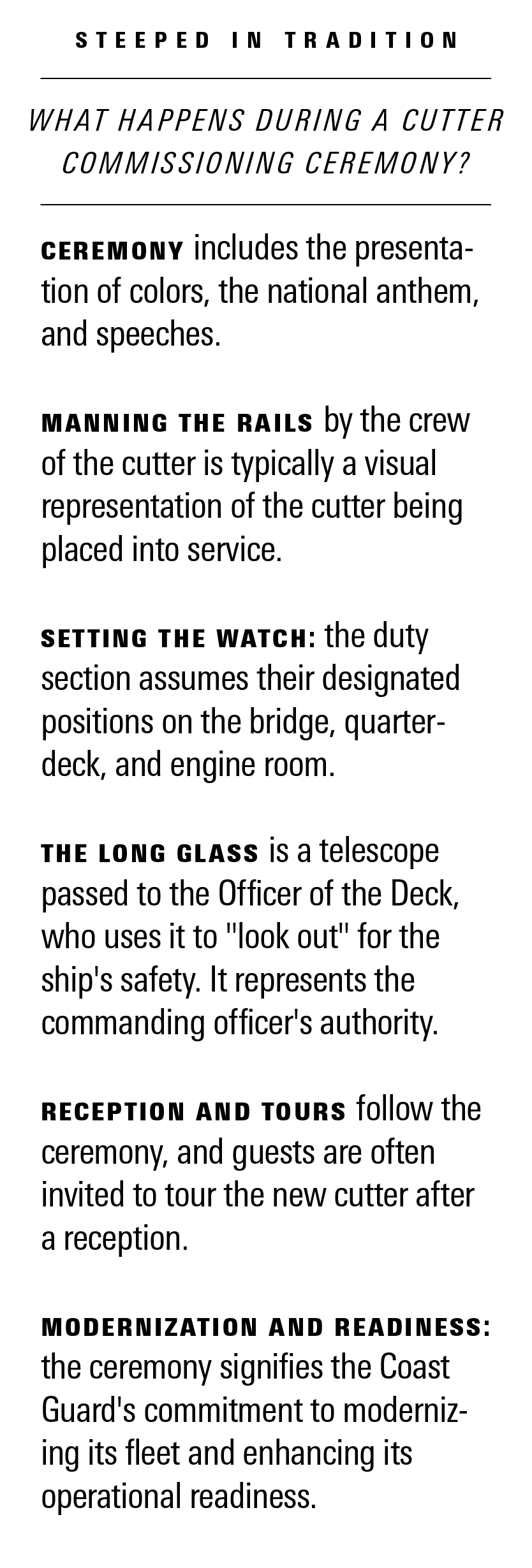 and the Pacific Northwest. These missions will now be conducted by fast response cutters. And I’d say we have a renewed focus, you know, as part of Force Design 2028, really honing in on our missions and what we owe the American public in doing so. Now we have the assets to do so.
We’re only 44 feet longer than the 110s, but we are incredibly more capable. We have an enhanced Intelligence, Surveillance and Reconnaissance suit, and a stern launch recovery system that lets us launch our over-the-horizon boat safely and quickly – whether it’s a law enforcement boarding or a search and rescue emergency.
Another thing that’s great about the FRC is the extended endurance that we have on board. We have a range of about 2500 nautical miles. We could probably go even a little further, depending on how we control our speed and our fuel consumption. So that gives us the ability to go far, to patrol long, and preserve our borders – to make sure that everybody’s secure no matter what they’re doing as they approach or depart from U.S. waters.
I think Earl Cunningham would approve of the FRC’s mission in Alaska.
LT Scott: We’re the 59th FRC and every single one is named for an enlisted hero. Earl Cunningham was a soldier first in the Army and then went on and served in the Coast Guard. So right away that kind of sentiment of endless service has been really important to us.
The motto that we chose as a crew is, “If not us, then who?” It kind of comes from Earl’s fateful night where he gave his life in pursuit of saving another. If it wasn’t for him, then a couple fishermen may not have made it home that day.
And that’s kind of the way that we look at our job, especially out here in the austere environment of Alaska. In the last frontier, if not us on board the Earl Cunningham and our other sister ships, then who? Among the crew, we’re really excited to continue to preserve his legacy.
https://www.news.uscg.mil/Press-Releases/Article/4382380/media-advisory-coast-guard-to-commission-coast-guard-cutter-olivia-hooker-wpc-1/
Jan. 19, 2026
MEDIA ADVISORY: Coast Guard to commission Coast Guard Cutter Olivia Hooker (WPC 1161) in Pascagoula, Miss.
U.S. Coast Guard Heartland District
PASCAGOULA, Miss. — The Coast Guard is scheduled to hold a commissioning ceremony for the Coast Guard Cutter Olivia Hooker (WPC 1161), the service’s newest Fast Response Cutter, followed by a tour of the cutter, Thursday.
WHO: Rear Adm. Will Watson, Commander of Coast Guard Heartland District; Lt. Colby Coco, commanding officer of the Coast Guard Cutter Olivia Hooker, L.t.j.g Finnegan Hall, executive officer of the Coast Guard Cutter Olivia Hooker.
WHAT: Commissioning ceremony for the Coast Guard Cutter Olivia Hooker and tour of the cutter guided by the executive officer.
WHEN: Jan. 22, 2026 at 10 a.m.
WHERE: 100 Singing River Island, Pascagoula, Miss.
Members of the media are requested to RSVP for attendance to the ceremony and the tour by contacting Coast Guard Heartland District Public Affairs at uscoastguardheartland@gmail.com or calling (618) 225-9008 no later than Wednesday at 1 p.m.
https://www.dcms.uscg.mil/Our-Organization/Assistant-Commandant-for-Acquisitions-CG-9/Newsroom/Latest-Acquisition-News/Article/4390497/coast-guard-commissions-61st-fast-response-cutter-olivia-hooker/
Coast Guard commissions 61st fast response cutter, Olivia Hooker
Jan. 27, 2026 —
Coast Guard Cutter Olivia Hooker, at its homeport of Pascagoula, Mississippi, during its commissioning on Jan. 22, 2026. U.S. Coast Guard photo.
The Coast Guard commissioned its 61st fast response cutter (FRC), Coast Guard Cutter Olivia Hooker, on Jan. 22 in Pascagoula, Mississippi. Olivia Hooker is the second FRC to be homeported at Coast Guard Station Pascagoula.
Presiding at the commissioning were Rear Adm. Will E. Watson, commander of the Coast Guard Heartland District, and Rear Adm. Zeita Merchant, assistant commandant of workforce management. Among the attendees were relatives of the vessel’s namesake, Dr. Olivia Hooker.
Hooker was a pioneering figure in the history of the Coast Guard as the first African American woman in the service. In February 1945, Hooker enlisted in the Coast Guard Women’s Reserve, also known as SPARs (an acronym derived from the Coast Guard’s motto, “Semper Paratus – Always Ready”). Hooker supported the service’s critical operations during a time of global conflict and was honorably discharged in 1946.
Following her military service, Hooker pursued higher education, earning a master’s degree from Teachers College, Columbia University and a doctorate in psychology from the University of Rochester. She went on to have a distinguished career as a psychologist and educator.
In 2015, at the age of 100, she was honored by the Coast Guard for her service and legacy. Hooker passed away on Nov. 21, 2018, at the age of 103.
The Sentinel-class FRCs replaced the 1980s Island-class 110-foot patrol boats and possess state-of-the-art command, control, communications, computers, intelligence, surveillance and reconnaissance equipment, with improved habitability and seakeeping. Each FRC is named after an enlisted Coast Guard hero who performed extraordinary service in the line of duty. Seventy-seven FRCs have been ordered to date to perform a multitude of missions that include drug and alien interdictions, joint international operations and national defense of ports, waterways and coastal areas.
For more information: Fast Response Cutter Program page
Feb. 7, 2026
Coast Guard Arctic District Public Affairs
KODIAK, Alaska — Media are invited to attend a commissioning ceremony Friday, Feb. 13, for Coast Guard Cutter Frederick Mann (WPC 1160) in Kodiak.
WHO:
· Rear Adm. Bob Little, commander of the Arctic District
· Lt. Jakob Daubert, commanding officer of Coast Guard Cutter Frederick Mann
· Lt. j.g. Cameron Kielty, executive officer of Coast Guard Cutter Frederick Mann
· USCGC Frederick Mann crew
WHAT: Commissioning ceremony for Coast Guard Cutter Frederick Mann, the third Fast Response Cutter (FRC) to be homeported at Coast Guard Base Kodiak.
WHEN: Friday, Feb. 13, at 11 a.m.
WHERE: Coast Guard Air Station Kodiak Aviation Hangar One.
Members of the media are requested to RSVP to the Coast Guard Arctic District Public Affairs office by emailing uscgalaska@uscg.mil no later than Tuesday, Feb. 10, at 4 p.m. to receive instructions for attendance and base access.
https://www.news.uscg.mil/Press-Releases/Article/4417085/us-coast-guard-accepts-delivery-of-62nd-fast-response-cutter-named-for-911-hero/
Feb. 26, 2026
U.S. Coast Guard accepts delivery of 62nd Fast Response Cutter named for 9/11 hero
U.S. Coast Guard Forces Micronesia
KEY WEST — The U.S. Coast Guard accepted delivery of the 62nd Fast Response Cutter, USCGC Vincent Danz (WPC 1162), on Thursday in Key West.
The Vincent Danz is the fourth FRC to be homeported to Guam.
“Accepting delivery of the Vincent Danz, Guam’s newest Fast Response Cutter, demonstrates the Coast Guard’s enduring commitment to the security of our Nation, the Pacific, and our partners throughout Oceania,” said Capt. Jessica Worst, commander, Coast Guard Forces Micronesia/Sector Guam. “Vincent Danz exemplified selfless service as a New York firefighter and Coast Guard reservist. This cutter will honor his legacy by protecting lives, combating illicit activity, and ensuring maritime security of our coasts, across Micronesia and beyond.”
The Sentinel-class FRCs replace the 1980s Island-class 110-foot patrol boats and possess 21st-century command, control, communications, computers, cyber, intelligence, surveillance, and reconnaissance equipment, with improved habitability and seakeeping.
The U.S. Coast Guard ordered a total of 77 FRCs to date to perform a range of missions, including countering illicit maritime activities, search and rescue, bilateral and multilateral international operations, and the national defense of ports, waterways, and coastal areas.
Each FRC is named after an enlisted U.S. Coast Guard hero who performed extraordinary service in the line of duty. Vincent Danz was a New York City police officer and U.S. Coast Guard reservist who made the ultimate sacrifice on Sept. 11, 2001, while responding to the attacks on the World Trade Center. Danz was a veteran of the United States Marine Corps and joined the New York City Police Department in 1987, while continuing to serve in the Coast Guard Reserve as a Port Security Specialist 2nd Class.
Danz was serving in the New York City Police Department, Emergency Services Unit, ESU Truck 3, when he responded to the World Trade Center as part of a massive emergency response and was killed when the World Trade Center collapsed. He was posthumously awarded the New York City Police Department’s Medal of Honor for his heroic deeds. His actions that day embodied the Coast Guard’s core values of honor, respect, and devotion to duty.
“It’s an honor, and we’re all incredibly proud to carry on the legacy of heroes like Vincent Danz,” said Petty Officer David Somera, the engineering petty officer and a proud son of Guam. “This third time I’ve been part of such a commissioning crew, and there’s a deeper appreciation for what it takes to bring a cutter to life. You start with this perfectly new ship, and it’s our job as the first crew to turn it from a steel vessel into a living, breathing part of the Coast Guard. It’s more than the mechanics; we’re building a team and a home that will serve and protect the people of Guam and the Pacific.”
The FRCs homeported in the U.S. territory of Guam extend the U.S. Coast Guard and Oceania District’s operational reach across the Pacific, conducting maritime security operations, combating illegal fishing, supporting search and rescue missions, and strengthening partnerships with Pacific Island nations and Allies. These cutter crews are essential to maintaining a safe, secure, and prosperous Pacific in one of the world’s most expansive maritime regions.
Vincent Danz will join the Myrtle Hazard (WPC 1139), Oliver Henry (WPC 1140), and Frederick Hatch (WPC 1143), commissioned in 2021 in Guam. Since their 2021 commissioning, Guam’s FRC crews distinguished themselves across the region.
USCGC Myrtle Hazard became the first to operationalize the bilateral maritime law enforcement agreement with Papua New Guinea, conducting joint patrols and boardings in 2023. USCGC Oliver Henry saved mariners in the Federated States of Micronesia, delivered humanitarian assistance during the Yap drought, and towed the 500-ton yacht Black Pearl to Palau, rescuing 11 people in 2024. USCGC Frederick Hatch became the first FRC to visit numerous Pacific ports, including Tacloban, Philippines, for the 80th anniversary of the Battle of Leyte Gulf, and operationalized the enhanced bilateral agreement with Palau in 2024. In the Marianas, the crews of all three cutters saved multiple lives, delivered critical supplies, and suppressed asymmetric migration.
Sixty-one FRCs are in service: 13 in Florida; seven in Puerto Rico; six each in Bahrain and Massachusetts; five in Alaska; four in California; three each in Hawaii, Guam, Texas, New Jersey, and Mississippi; and two each in North Carolina and Oregon.