Armed Drones: The Coast Guard’s Next New Frontier?–USNI Proceedings

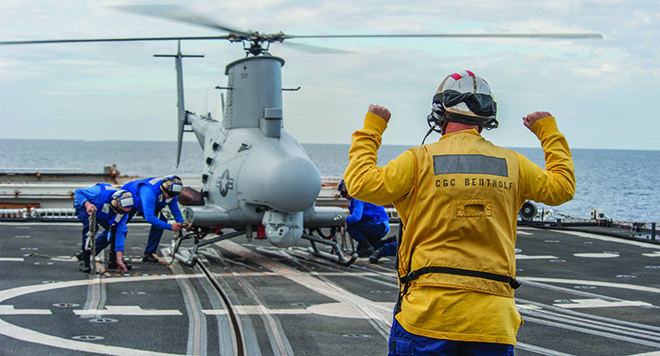
Coast Guard air crews unhook a Fire Scout UAS during a test on the Coast Guard Cutter Bertholf near Los Angeles, Dec. 5 2014. The Coast Guard Research and Development Center has been testing UAS platforms consistently for the last three years. (U.S. Coast Guard photo by Petty Officer 2nd Class Luke Clayton)

The Dec. 2017 issue of the US Naval Institute Proceedings magazine has an excellent article, by LCdr Craig Allen, Jr., USCG, considering the possibility of the Coast Guard employing armed drone, specifically to assume the airborne use of force (AUF) role.

He considers both the pros and cons of taking this step, and along the way makes a compelling case that it is not only feasible but probably also desirable.  Additionally he suggests that drones may allow the Webber class WPCs to employ AUF.

Surface Navy Association

The Coast Guard National Cuttermen Chapter is part of the Surface Navy Association (SNA). SNA is having their annual symposium in January. If you are interested in going, you might want to register ASAP. The following from SNA.

Where: Hyatt Regency Crystal City
When: January 9-11, 2018
Theme: Surface Forces & Cross-Domain Integration

If you have not registered for the Symposium and plan to attend, we encourage you to register 2 p.m. EST on Tuesday 12 December to qualify for the Tier 2 pricing.  Once registration is confirmed a payment link will be sent to you to complete the process.  This payment must be completed by 2 p.m. EST on Wednesday, 13 December to qualify for this pricing. Payment submitted after 2 p.m. EST on December 13 will be raised to the Tier 3 prices.
If you have already registered and have not paid you have until Noon on Wednesday 13 December to make a payment at the Tier 2 levels.  After that time you will be bumped up to the next pricing tier.

Where in the World are the WHECs?

The Former USCGC Morgenthau, now in Vvietnamese service

The Philippines has a continuing interest in the 378 foot WHECs, after all they already have three, and it appears they may want another. Certainly they and other operators (Nigeria, Bangladesh, and Vietnam) will want to cooperate in finding ways to keep them operational.

An online discussion group called “Defense of the Republic of the Philippines” has a page entitled “Where in the World are the WHECs?” devoted to the topic. It includes both the old and new names and hull numbers. It also looks at the future disposition of 378s still in US Coast Guard service (Sherman, Midgett, Mellon, and Douglas Munro). (Yes we currently have both a USCGC Douglas Munro (WHEC-724) and a USCGC Munro (WMSL-755).

Sherman is expected to be decommissioned in 2018, Midgett in 2019, Mellon in 2020. Douglas Munro’s decommissioning is not currently scheduled but will probably happen in 2021.

The decommissioning information is based on Annex J of a MARAD report, “OFFICE OF SHIP DISPOSAL PROGRAMS ANNUAL REPORT FOR FISCAL YEAR 2016.”


Mexican Navy’s New Helicopters

Mexican Navy AS365 MBe helicopter, by AIRBUS.

NavyRecognition reports that the Mexican Navy has taken delivery of ten new helicopters. They might look a bit familiar. These are the latest development of the AS365 family of aircraft.

As we have noted, the Mexican Navy parallels the USCG in many ways, including missions and equipment (here and here). They also are in the process of procuring a fleet of patrol craft that are smaller, 42 meters vice 47 meters over all, but closely related to the Coast Guard’s Webber Class cutters.


In the Arctic Ocean, at Least, Diplomacy Works–gCaptain

gCaptain reports on a ten nation accord to protect fisheries in the central Arctic Ocean.

For the next 16 years, commercial fishing will be prohibited in the central Arctic, a Mediterranean-sized patch of icy ocean more than 200 nautical miles from any nation’s coastline. This will give scientists time to study whether fishing might safely be allowed there. The goal is to avoid the overfishing that has depleted fish populations in other parts of the world — pollock in the Bering Strait, for instance, or krill in the Antarctic Ocean.”

Remembering, or Perhaps Losing the Memory, of Pearl Harbor

The video above is from last year. 

The Coast Guard Compass has a post in its Long Blue Line Series looking at the Coast Guard’s role in the events around Hawaii on December 7, 1941 and outlining Coast Guard activities leading up to and during World War II. The video above is from last year.

I looked back on previous posts on this topic, but unfortunately as a result of the Coast Guard’s migration of it’s on-line representation to new servers, it seems we have lost access to much of the historical material that was previously available, most notably the Coast Guard history Pearl Harbor index, as a result my previous posts which largely referred to this historical material now connect only to a singularly unhelpful page at Defense Media Activities.

For what it is worth, here are some previous commemorative post marking this day:

Hopefully I will address the Coast Guard’s Social media efforts relatively soon.

12/1/2017: Summary of keynote address at 11th Annual Arctic Shipping Summit–Coast Guard Maritime Commons

The Coast Guard Maritime commons provided this summary of the keynote address at the 11th annual Arctic Shipping Summit.

Director of Marine Transportation Systems Mr. Mike Emerson presented a Keynote Address on Arctic Waterways Management at the 11th Annual Arctic Shipping Summit in London, England on November 30, 2017.

The two day conference brought together experts and stakeholders to discuss some of the issues associated with Arctic operations, such as limited infrastructure and the harsh environment, and how regulations and technical advancements will impact commercial waterways management.

In his remarks, Emerson gave an overview of highlights from the U.S. Chairmanship of the Arctic Council from 2015-2017, and identified some emergent areas that warrant attention during chairmanships of the Scandinavian countries. He also discussed the Arctic Coast Guard Forum, which continues to demonstrate collaborative value, as evidenced by the success of the multi-national ARCTIC GUARDIAN Search and Rescue Exercise that was conducted off the coast of Iceland in September. Looking forward, Emerson said he anticipates increasing interest from countries outside the Arctic Circle to participate more fully in the Arctic Coast Guard Forum, as well as Arctic Council decision-making.

As Arctic ice recedes, a direct sea route from Europe to Asia is opening up along the coast of Russia, and Emerson said he expects the Northwest Passage across North America to follow suit.

“With more navigable waters, we can expect more shipping activities, and greater demands for waterways management,” Emerson said in his remarks. “The U.S. Coast Guard therefore, is engaging peer agencies across both borders in developing joint proposals for ship routes and areas-to-be-avoided in waterways that we share with Russia and Canada. These efforts, and a fresh focus on charting, polar codes, and acquisition of ice-capable assets are immediate priorities for ensuring marine safety and security.”

Emerson concluded his remarks by forecasting the need for government and industry leadership in infrastructure investments to support increased Arctic shipping, along with resource development, fisheries, and tourism. Finally, he emphasized the need to reconcile waterways management with indigenous communities – an area the Coast Guard is actively addressing.

Conference attendees also heard from representatives from the IMO, Canadian Coast Guard, Transport Canada, the Norwegian Ice Service, and many other private shipping and environmental organizations. Other topics covered included Arctic regulations, safe navigation and communications, effective infrastructure, and crew hiring and training.

 

Another Tug Rams Another Cutter in the Panama Canal

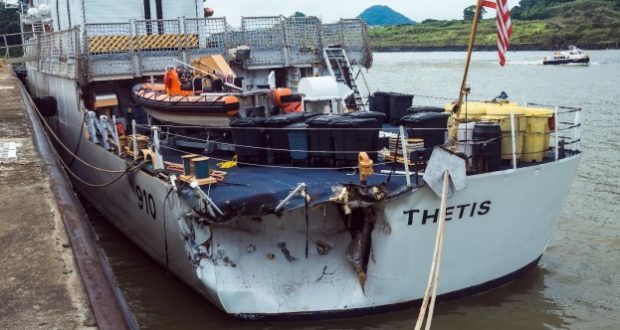
USCGC Thetis damage sustained in a collision in the Panama Canal 2 June 2016

USCGC Thetis was damaged when struck in the stern by a barge pushed by a tug in the Panama Canal on 2 June, 2016. Now there was a similar accident 18 April 2017. USCGC Tampa was struck in stern by a tug owned by the Panama Canal Authority. My first thought was that perhaps tug operators were being paid by the Drug cartels to disable cutters headed for the transit zone, but in fact Tampa had already finished her deployment to the Eastern Pacific.

Tampa was north bound in Miraflores Lake when the tug Cerro Santiago, south bound, having passed Tampa starboard to starboard, made an abrupt 180 and hit Tampa on the stern 29 minutes after midnight.

The tug master claimed he had fallen asleep. The NTSB  investigation found his claim of fatigue credible, working overtime, at the end of a seventh 8 hour workday, in a stressful environment.

Damage was relatively minor in both accidents, $170,018 in the case of Tampa‘s collision, but still there are lessons to be learned.

“Coast Guard Actions Postaccident:

“The Tampa added a written instruction on the vessel’s port entry checklist that requires the watchstander to verify that the AIS is operating in non-encrypted mode. (AIS was still encrypted when the collision occurred.–Chuck) In addition, for future transits of the canal, the Tampa’s aft lookout will be equipped with an air horn and handheld flares, which may be used when necessary to secure the attention of any vessel not operating in accordance with the rules of navigation. The position of shipping officer also was added back to the bridge watch composition. That position, which is charged with managing input from the CIC and the dedicated lookout, was staffed during the southbound transit; however, considering the staffing in the CIC, it was deemed a redundant capability and therefore removed for the northbound transit. As an organization-wide effort, the lessons learned from this accident have been added to the Coast Guard’s briefing program and will be discussed prior to future transits of the canal during briefings conducted on Coast Guard vessels.”

Thanks to Bryant’s Maritime Consulting for bringing this to my attention.