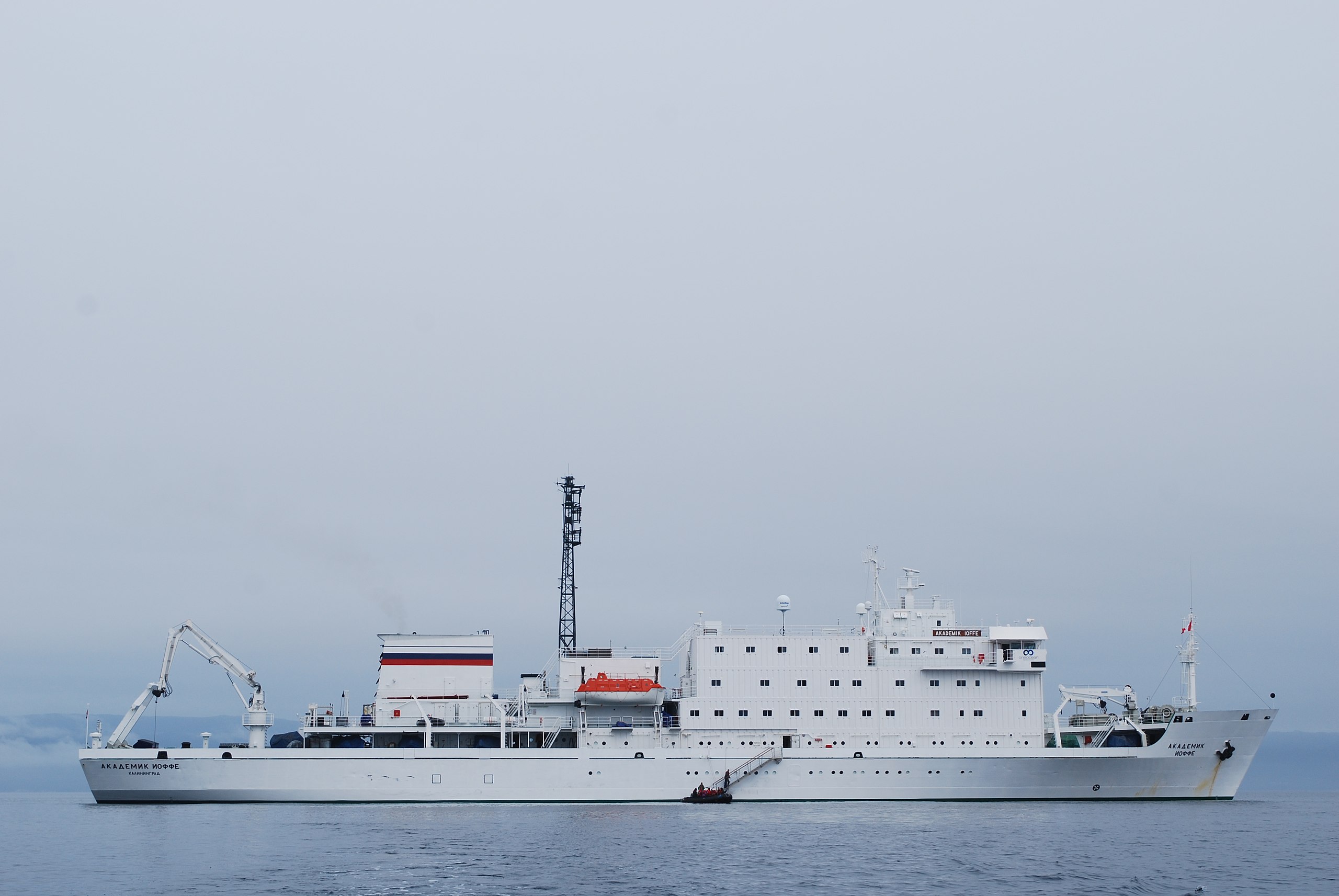
Profile view of the starboard side of the Russian research vessel Akademik Ioffe. The gangway is lowered with a Zodiac at its base. Photo: Ryan Sharpe, via Wikipedia
Maritime Executive reports on the results of an investigation into the 24 August 2018 grounding of a small Russian flag, research vessel turned passenger ship, AKADEMIK IOFFE in the Canadian Arctic.
The area is still not surveyed to the extent we have come to expect in the rest of the world. Not to mention it is a long way between SAR facilities. This could have been a lot worse.
To no one’s surprise, Bollinger is competing for the Phase II Offshore Patrol Cutter Contract. Below is a press release I received today from the Company.
The country is really going need more shipyards capable of building warships. It would not be a bad thing for these Coast Guard contracts provide “trainer wheels” to prepare first Eastern and now a perhaps a second shipyard for even more complex projects. The newly expanded Bollinger might be able to replace now defunct Avondale shipyard.
Bollinger Submits Proposal for U.S. Coast Guard Heritage-class Offshore Patrol Cutter
Bollinger Shipyards has the necessary management and production experience, engineering expertise, and facilities
Proven record of success executing USCG Detail Design and Construction contracts
Project would help sustain Bollinger’s seasoned workforce through 2031
LOCKPORT, La., — (June 11, 2021) – Bollinger Shipyards (“Bollinger”), a privately-held and leading designer and builder of steel military and commercial vessels, today submitted its proposal to the United States Coast Guard to build Stage 2 of the Heritage-class Offshore Patrol Cutter (OPC) program. If chosen, Bollinger would construct and deliver a total of 11 vessels to the U.S. Coast Guard over the next decade, helping to sustain the Bollinger workforce through 2031.
“Bollinger is the right shipyard at the right time to build the Offshore Patrol Cutter program for the U.S. Coast Guard.” said Ben Bordelon, Bollinger President and CEO. “Our long history building for the Coast Guard is unparalleled and has shown time and time again that Bollinger can successfully deliver the highest quality vessels on an aggressive production schedule.”
Bordelon continued, “Bollinger has the existing capability and capacity using our proven serial production build strategy and an experienced management team and workforce. Our production approach is based on our established and mature processes and tools, which integrate design development, production, and lifecycle considerations. Our unique experience results in a reliable production schedule and cost so that we can deliver high-quality vessels on time and on budget.”
Notably, in its current program for the U.S. Coast Guard, Bollinger has delivered Sentinel Class Fast Response Cutter hulls 1139 through 1144 a total of 127 days ahead of the contract schedule, despite the incredible challenges of the COVID-19 global pandemic and a historic hurricane season in the Gulf of Mexico impacting Louisiana’s coast.
Bollinger has a long history building for the U.S. Coast Guard, delivering 170 vessels in the last three decades alone. This includes the Island Class (49 delivered), the Marine Protector Class (77 delivered), and now the Sentinel Class (44 of 64 delivered to-date).
About the Offshore Patrol Cutter Program
Offshore Patrol Cutters (OPCs) will provide the majority of offshore presence for the Coast Guard’s cutter fleet, bridging the capabilities of the 418-foot national security cutters, which patrol the open ocean, and the Bollinger-built 154-foot fast response cutters, which serve closer to shore. The OPCs will conduct missions including law enforcement, drug and migrant interdiction, search and rescue, and other homeland security and defense operations. Each OPC will be capable of deploying independently or as part of task groups and serving as a mobile command and control platform for surge operations such as hurricane response, mass migration incidents and other events. The cutters will also support Arctic objectives by helping regulate and protect emerging commerce and energy exploration in Alaska.
About Bollinger Shipyards LLC
Bollinger Shipyards LLC (www.bollingershipyards.com) has a 75-year legacy as a leading designer and builder of high performance military patrol boats and salvage vessels, research vessels, ocean-going double hull barges, offshore oil field support vessels, tugboats, rigs, lift boats, inland waterways push boats, barges, and other steel and aluminum products from its new construction shipyards as part of the U. S. industrial base. Bollinger has 11 shipyards, all strategically located throughout Louisiana with direct access to the Gulf of Mexico, Mississippi River and the Intracoastal Waterway. Bollinger is the largest vessel repair company in the Gulf of Mexico region.
The Marine Corp is undertaking a study of fitness criteria. This is important to many in all branches of the military. Hopefully it will lead to standards that are more relevant and more fair.
“Coast Guard Cutter Forward and Coast Guard Cutter Bear, homeported in Portsmouth, Virginia, finish an at-sea transfer while underway on a two-month patrol. Coast Guard Cutter Forward returned to homeport on April 10, 2021.” (U.S. Coast Guard photo)
We all know, the Coast Guard will continue to use cutters long after there nominal life. Maybe we should act on that, by looking at using more durable material. Marine Link talks about how making hulls of titanium could provide significant savings in the long run.
The proposed rationale for maintaining the option of up-arming cutters is also interesting.
I will just quote their conclusion, but take a look at the whole rationale.
—
“The bigger the Navy (and USCG combination), the cooler it gets. It especially argues for building lots of USCG cutter hulls, but leaving them mostly unoutfitted for naval combat. One can build 20 titanium USCG cutters for the life cycle cost of 10 steel hulls, and make them ready for sea, but only install one ship with the best weapons package. The world will know that you can build something that can dominate the battle space, but there is no need to fit all 20 with the latest and the greatest (which saves enough money to build a couple of additional hulls) if there is no immediate threat of war. Meanwhile the “enemy” will know that when they start to rattle their sabers you will not have 10 (if built in steel) obsolescent hulls, but instead will have access to more than 19 hulls that can be fitted with the hottest weapons much more quickly. This is a much better result than having 10 old “fancy steel” units and actually will defer cost until it is needed. This thinking already works with steel hulls, but if the hulls do not waste away it becomes even more cost effective and further strengthens Dr. Daidola’s argument.
“So here we have three clever engineers who have developed two independent USCG procurement approaches, which each save incredible amounts of money, and, when combined, save even more money.”
CHARLOTTESVILLE, Va. – June 8, 2020 – Northrop Grumman Corporation (NYSE: NOC) has been awarded a newly expanded role as systems integrator for C5ISR and control systems on the U.S. Coast Guard Offshore Patrol Cutter (OPC), by Eastern Shipbuilding Group (ESG), the prime contractor for the OPC program.Artist’s rendition of USCGC ARGUS, the first vessel of the Heritage Class Fleet of Offshore Patrol Cutters. (Image courtesy Eastern Shipbuilding Group)
In a newly expanded role as C5ISR systems integrator, Northrop Grumman is responsible for integrating all cyber hardened C5ISR systems, including command and control, communications, navigation and the shipboard computer networking systems.
“With C5ISR and control system test and integration underway, the ESG-Northrop Grumman team hasn’t missed a beat,” said Todd Leavitt, vice president, maritime systems and integration, Northrop Grumman. “The effort and resiliency shown by our teammates at Eastern Shipbuilding Group has been outstanding.”
Northrop Grumman’s responsibilities for the OPC platform include the integrated bridge, navigation, command and control, computing network, data distribution, machinery control, and propulsion control systems, cyber/information assurance, testing and integration work.
Northrop Grumman solves the toughest problems in space, aeronautics, defense and cyberspace to meet the ever evolving needs of our customers worldwide. Our 90,000 employees define possible every day using science, technology and engineering to create and deliver advanced systems, products and services.
The June 2021 edition of the U. S. Naval Institute Proceedings has a short article by Captain Michael Cilenti, USCG, currently CO of USCGC Tampa, in the “Professional Notes” section, pp 78-79, about the service life extension program (SLEP) planned for six of the 270 foot WMECs. It is available on line if you are a USNI member.
Captain Cilenti, confirms what we have suspected, that the 76mm Mk75 gun and Mk92 firecontrol will be replaced by a 25mm Mk38, the same gun currently used on the Webber class WPCs.
The Captain is concerned primarily because the loss of the Mk92 means the loss of the ships’ most capable radar. The Mk92 is a multi-function radar. In addition to providing firecontrol, it is the ships’ only air search, and its most sensitive surface search. It is more effective in detecting the targets such as low profile semi-submersibles.
Capt Cilenti suggests that there is are alternatives already in or planned for Coast Guard use that could be installed to provide these capabilities. He suggest the AN/SPS-75 (TRS-3D), currently installed on the Bertholf class National Security Cutters and the Freedom class LCS, or the AN/SPS-77, planned for the Offshore Patrol Cutters and currently used on the Independence class LCS.
He notes that the addition of a multi-mode radar would allow the 270s to control emergency helicopter low visibility approaches by the embarked helicopter and facilitate UAS operations.
I hope someone is paying attention to the Captain’s plea. Adding a modern multi-mode radar and a UAS system such as V-BAT, could give us WMECs that are more capable than ever, of performing their law enforcement and SAR missions, while requiring few crew members and less extensive training. Deleting the Mk92 firecontrol system without replacement will leave these ships little more capable than the 210s and probably preclude installation of more capable Unmanned Air Systems.
The 270 SLEPs will begin in the near term. A decision to retain and enhance these ships sensor capability is urgent.
Late Addition:
I would suggest that the 25mm Mk38 be mounted up a deck, like the gun of the very similar Irish Naval Service Offshore Patrol Vessel LÉ Eithne pictured below. This would provide a greater degree of protection from green water coming over the bow. (Incidentally that gun is an earlier version of the 57mm being used on the National Security Cutters.)
LÉ ‘Eithne’ is a ship in the Irish Naval Service completed in 1984. Photo 16 August 2009 by Ross.
Dmitry Shulgin reports the successful test of a new rocket assisted, laser homing round, the “Guided Multipurpose Munition” (GMM), for the Carl Gustaf Recoilless Rifle (M3E1 in US service) and the AT4 single shot, recoilless, smooth bore, disposable, anti-tank weapon (designated M136 in US service).
The M3E1 is the US version of the M4. An updated M3 using titanium makes the weapon system six pounds lighter, 2.5 inches shorter and has an improved carrying handle, extra shoulder padding and an improved sighting system that can be adjusted for better comfort.
We talked about the possibility of Coast Guard use of the Carl Gustaf before. The M3E1 is now a common weapon that will arm every US Marine infantry squad. In the US Army there will be one for every platoon.
It may be that the laser guided round is only a Special Forces requirement, but after development it is almost certain to become more generally available.
This would not be a comprehensive answer to the Coast Guard need to be able to counter a terrorist attack by surface vessel, regardless of size. Even with the new round, it does not have the 4,000 yard range I believe desirable to minimize the probability of effective counter fire from improvised armament. It is unlikely to be effective against larger vessels, but, particularly with the new guided round, it could certainly be effective against small, fast, highly maneuverable threats.
There is always a concern for providing security for a highly portable weapon like this, but security requirements for these weapons and their ammunition should be comparable to that provided for machine guns.
As noted earlier, if things get hot for PATFORSWA, the cutters there could benefit from having a Marine detachment aboard that can employ the Carl Gustaf.
Other than the PATFORSWA, the first Coast Guard units that should receive armament upgrades are the force protection units that escort Fleet Ballistic Missile Subs during surface transit.
A picture taken on November 16, 2011 from a South Korean helicopter shows Chinese boats banded together with ropes, chased by a coastguard helicopter and rubber boats pacted with commandoes, after alleged illegal fishing in South Korean waters in the Yellow Sea.
Credit: Dong-A-Ilbo
“The United Nations declared June 5 an international day for the fight against illegal, unreported and unregulated (IUU) fishing in late 2017. Yet, on the fourth observance of the annual awareness campaign, the global challenges continue to grow.”
The IndoPacific Defense Forum, which is sponsored by the United State Indo-Pacific Command (USINDOPACOM) is apparently telling the nations of their area of responsibility that the Coast Guard is ready to assist them in combatting IUU fishing. Specifically that we can,
Got a response from a reader who linked a longer tale of the Coastie’s ship, LCI(L) 85: The Four- Leaf Clover. This is the story of a very small ship, about the same size as a Webber class WPC, one that did not even rate a name, in a very big war. Several crewmembers were discussed including what happened to them after D-Day and after the war. Its a great story.
I’ve added both stories to my heritage page. There are several other D-Day stories there as well.
Thanks to Tom Wade for bringing this to my attention.
Petty Officer 2nd Class Dale Veverka, a boatswains mate, Seaman George Degener, and Petty Officer 2nd Class Joshua Post, a machinery technician, conduct maneuvers on the Coast Guard Cutter Northland’s “over-the-horizon” small boat during transit to Rio De Janeiro, Brazil, April 9, 2008. UNITAS exercise, a multinational naval exercise the helps tests the interoperability of U.S. and foreign naval forces. U.S. Coast Guard photo by PA2 Nathan Henise.
The Coast Guard awarded contracts to four companies today, in a step toward acquiring the next generation of Coast Guard over the horizon cutter boats, the OTH V. The awardees are:
Blackfish Solutions LLC of Anchorage, Alaska
Gravois Aluminum Boats LLC of Jeanerette, Louisiana (doing business as Metal Shark Boats)
Inventech Marine Solutions LLC of Bremerton, Washington
MetalCraft Marine US, Inc. of Watertown, New York
Each awardee will produce a single boat that will be operated to demonstrate the actual capability of each design. Following the demonstration, a single contractor will be selected to produce the OTH V over the next 10 years. This production supports new cutter deliveries and recapitalization of OTH IVs. The total value of the indefinite-delivery indefinite-quantity OTH V contract – which includes manufacture, delivery and logistical support – is approximately $100 million.
The requirements for OTH V are similar to the prior iteration, but are intended to incorporate technology improvements. The requirements include a minimum top speed of 38 knots, powered by a diesel engine with waterjet propulsion and a minimum range of 150 nautical miles. The OTH V will carry up to 13 people, with dimensions limited to 26 feet long by 8.5 feet wide, and a performance weight of approximately 8,700 pounds. The updated cutter boat will capture technology improvements for its waterjet, as well as upgraded versions of the scalable integrated navigation and automatic identification systems. This will also be the first Coast Guard boat to include a shock monitoring system providing the crew with real-time information about wave impacts on the vessel.
The OTH V will be deployed across the Coast Guard fleet, including national security cutters, fast response cutters, offshore patrol cutters, polar security cutters and legacy medium endurance cutters. Outfitted with a robust onboard navigation and communications system, the OTH V will provide a high speed capability to extend the parent cutters’ capabilities when deployed in support of multiple Coast Guard missions.
OTH Vs will support mission accomplishment in almost all mission areas, with emphasis on search and rescue, drug and migrant interdiction operations, living marine resources, defense readiness and ports, waterways and coastal security.



 Artist’s rendition of USCGC ARGUS, the first vessel of the Heritage Class Fleet of Offshore Patrol Cutters. (Image courtesy Eastern Shipbuilding Group)





 Chuck Hill's CG Blog