“Coast Guard detects 16 unauthorized drones during Seafair Weekend Festival” –CG News

Coast Guard members, in collaboration with the FAA, the Seattle Police Department (SPD), and Mercer Island Police Department (MIPD), employ Counter-Unmanned Aircraft Systems (UAS) capabilities to enforce the FAA-issued Temporary Flight Restrictions on Lake Washington during the 2023 Seafair Weekend Festival in support of the Airshow August 3, 2023. This was the first year Coast Guard Counter-UAS has been employed at Seafair. (U.S. Coast Guard courtesy photo)

Below is a news release from Coast Guard News.

We have seen counter UAS equipment added to the Webber class cutters in Southwest Asia, but this is the first time I have seen public acknowledgement of domestic counter UAS operations by the Coast Guard.

As a drone operator myself, I was happy to see that the effort was primarily educational, but the Coast Guard does need a robust domestic counter UAS capability for contingencies.


Aug. 9, 2023

Coast Guard detects 16 unauthorized drones during Seafair Weekend Festival

SEATTLE — The Coast Guard employed Counter-Unmanned Aircraft Systems (UAS) capabilities in collaboration with the Federal Aviation Administration (FAA), Seattle Police Department (SPD), and Mercer Island Police Department (MIPD) to enforce the FAA-issued temporary flight restrictions on Lake Washington during the 2023 Seafair Weekend Festival in support of the airshow.

This is the first year Coast Guard counter-UAS has been employed at Seafair.

The Coast Guard detected 16 UAS operators violating airspace restrictions during the H1 Unlimited Hydroplane Races and Boeing Air Show. Officers from SPD and MIPD were able to contact eight UAS operators and provide education on airspace restrictions as well as safe UAS operations.

One operator was cited for reckless endangerment by the Seattle Police Department.

“Unauthorized UAS can be extremely dangerous to airshow pilots, as well as spectators,” said Cmdr. Scott McGrew, the Coast Guard incident commander for SeaFair. “Our robust partnership with the FAA, Seattle Police and Mercer Island Police Department is vital to ensure unauthorized UAS operators are intercepted and educated on safe operations and reminded of the FAA Temporary Flight Restrictions in place to support the airshow.”

UAS operators are reminded to check tfr.faa.gov or the b4ufly app to verify the airspace is authorized for UAS flight.

Guns for Ukrainian Island Class Patrol Boats.

Ukrainian Navy Island-class patrol boats, formerly of the U.S. Coast Guard, conduct maritime security operations in the Black Sea off the coast of Odesa, Ukraine.
UKRAINIAN NAVY

This was on the U.S. Department of Defense Daily Digest Bulletin for Aug. 7, 2023.

Safe Boats International LLC,* Bremerton, Washington, is awarded a $22,271,829 firm-fixed-price modification to previously-awarded contract N00024-21-C-2201 for the exercise of options for procurement and installation of six Gun Weapon Systems onto the Island Class patrol boats with spares. Work will be performed in Tacoma, Washington, and is expected to be completed by October 2024. Foreign Military Financing (Ukraine) funds in the amount of $22,271,829 will be obligated at time of award and will not expire at the end of the current fiscal year. The Naval Sea Systems Command, Washington, D.C., is the contracting activity. (Awarded Aug. 3, 2023)

Five Island class 110 foot patrol boats were transferred to Ukraine.  One of them has been sunk.

Previously vessels of this class were armed with crew served Soviet era 25 mm guns.

This is reported as modification of an existing contract, so I presume at least one vessel has already been rearmed. Thinking two guns per vessel, then six gun systems will go on three additional vessels. So, at least four ships with two guns each. Presumably, they would be 25 or 30 mm guns, hopefully the new 30mm Mk38 Mod4.

The announcement does say, “Work will be performed in Tacoma, Washington, and is expected to be completed by October 2024.” If this is true, these are additional boats. The Coast Guard still has many available for transfer. It is also possible there might be only one gun per vessel. All we know for sure is in the quote above.

In Dec. 2019 there was a suggestion that these vessels might be fitted with anti-ship cruise missiles, but there has been nothing further to indicate it has or will happened.

“Philippine Armed Forces Resupply Mission Hit with Chinese Coast Guard Water Canons” –Video

Thought it worthwhile to pass this video along.

First thing, the Chinese are devoting a lot of resources to isolating this particular outpost, an ancient, badly corroded, grounded, but still commissioned former US LST.  There are three large modern China Coast Guard cutters visible in the video, 5201, 5305, and 4203. All three are about 100 meters in length or larger, all equipped with 76mm guns. We have seen 5201 before.

CRASH AVERTED This photo taken on April 23, 2023 shows BRP Malapascua (right) maneuvering as a Chinese coast guard ship cuts its path at Second Thomas Shoal in the Spratly Islands. AFP PHOTO

Second, the Philippines would have known what they were up against. Couldn’t they have used something faster and more maneuverable that could have gotten around these large cutters to make this supply run. I hope I am wrong, and I may not understand what it takes to reach this grounded LST, but it is almost as if they are failing on purpose.

The US has warned the Chinese against targeting the Philippine Coast Guard.

“The Elephant in the Engine Room” –USNI

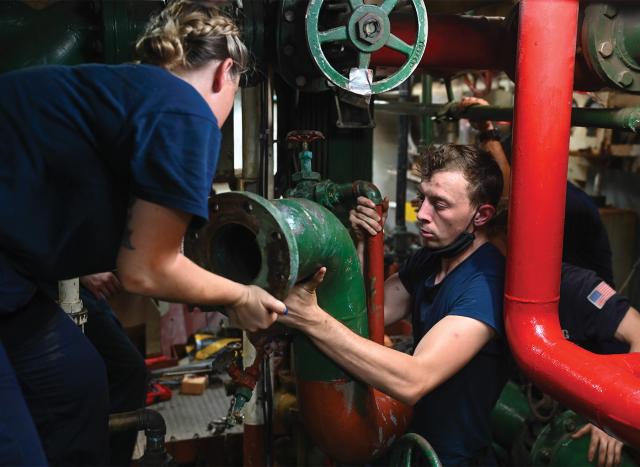
Engineers on board the USCGC Thetis (WMEC-910) work to replace a seawater pump to get the cutter fully mission capable. One way to increase skills and knowledge in the engine room would be platform specialization—having mechanics trained on specific engine models and continuing to work on those models in subsequent tours. U.S. Coast Guard (John Hightower)

The US Naval Institute Proceedings for August 2023 has what appears to be an important discussion of current problems with the way Coast Guard engineers are trained and treated. It was the first prize winner in this year’s Coast Guard essay contest.

The Coast Guard is aware that the surface asset classes coming online have roughly four times as many pieces of equipment installed as the classes they are replacing. The service is beginning to understand the effects of four times as many shipboard points of failure and orders-of-magnitude-more logistics support requirements. Senior leaders are hesitantly embracing the reality that the new ships also are more technically complex, with industrial IT systems connecting every pump, purifier, compressor, and propulsion component.

Some changes are proposed. I would only add that, maintainability and redundancy should be important considerations in ship design, and in regard to this,

 “Cutter crews avoid performing substantial planned maintenance on individual pieces of equipment while underway for fear of being anything less than fully mission capable when tasked with a new and urgent case.”

Most of our ships have redundancies. We need to keep maintenance current even if it means doing it underway and perhaps losing a few knots max speed. These limitations should of course be reported, but they should be expected. National security cutters for instance can take still make 22 to 24 knots even if their gas turbine is taken out of service. They are probably still capable of 26 knots if one of their diesels is down. The OPCs should still be capable of 18 knots if one of their diesels is down.

“Prototype work begins on the Coast Guard’s newest heavy polar icebreaker” –CG-9

A quarter and a dime are used to demonstrate the difference in the hull thickness of a PSC as compared to other Coast Guard cutters. U.S. Coast Guard Photo.

Below is a report from the Acquisitions Directorate (CG-9). Nice to see some movement now that Bollinger has taken over the project.


Bollinger Mississippi Shipbuilding began cutting steel July 24, 2023, on the first prototype module that will become the foundation of a new polar security cutter (PSC), the first heavy icebreaker to be built in the United States in 50 years. Up to eight modules will be constructed in Pascagoula, Mississippi, to prototype the shipbuilding processes and techniques that will be used when production of the first PSC begins in 2024.

“We’re relearning how to build this type of ship,” said PSC program manager Capt. Eric Drey, describing the construction approach being employed by Bollinger during the prototype phase.

The progressive crawl-walk-run approach consists of verifying the processes utilized during the build to ensure design completeness. This includes unit readiness reviews, ensuring engineering, computer aided design systems accurately transfer numerical control data to automated production machinery and slowing down early prototype module build times to maximize learning and enable improvements in the downstream production, engineering, and planning processes. Each module requires approximately four months of labor, during which time the shipyard will continue recruiting and training additional members of the workforce to manage the transition to production of the lead hull as the prototype modules are completed.

The hull of a heavy polar icebreaker is required to be much thicker than other Coast Guard cutters because of the pressure exerted on the ship by the surrounding ice. Deeper, more closely spaced structural stiffeners inside the hull ensure the ship doesn’t crumple when it encounters large ice floes, and the hull itself is constructed of 1 1/2-inch-thick steel alloy that remains flexible even in extremely low temperatures.

“It’s the first heavy icebreaker built by our nation in 50 years,” said Drey. “It’s not just a big day for the Coast Guard, but a big day for the nation.” The PSCs will be multi-mission cutters capable of supporting all Coast Guard statutory missions executed in the polar regions.

The Coast Guard’s operational polar icebreaking fleet currently consists of one heavy icebreaker, the 399-foot Coast Guard Cutter Polar Star that was commissioned in 1976, and one medium icebreaker, the 420-foot Coast Guard Cutter Healy that was commissioned in 1999.

Coast Guard mission demand in the polar regions is growing as environmental and economic activities continue to increase. The Coast Guard has identified a need for new polar icebreakers to assure year-round access to the polar regions and to provide self-rescue capabilities. PSCs enable the United States to maintain defense readiness in the Arctic and Antarctic regions; enforce treaties and other laws needed to safeguard both industry and the environment; provide ports, waterways and coastal security; and provide logistical support – including vessel escort – to facilitate the movement of goods and personnel necessary to support scientific research, commerce, national security activities, and maritime safety.

For more information: Polar Security Cutter Program page.

“CUTTER 37: THE LAST SHIP STANDING” –Coffee or Die

USCGC Taney, probably early 1944, equipped with four 5″/38s. She was in this configuration less than a year before being converted to an amphibious force flagship.

Coffee or Die has an article published on Coast Guard Day about the former USCGC Taney (WPG/WHEC-37), the last US warship to have survived Japan’s December 7, 1941 attack on Hawaii (there may still be a tug as well). It may not be the most accurate history (“USS Constellation…one of the original six frigates of the US Navy” –no that was a different ship, there are minor errors as well), but it is entertaining, including some first-person accounts that convey why ships of this class were so loved.

Since we are now seeing long delays in our ship building, it’s worth noting that she was built in the Philidelphia Navy Ship Yard. Four 327 foot cutters, Campbell (32), Duane (33), Ingham (35), and Taney (37), were laid down in a dry dock on 1 May 1935. All four were launched simultaneously 3 June 1936, 13 months later. All four were commissioned less than 18 months after the keels were laid, Taney taking the longest. Campbell was commissioned only 412 days after being laid down.

About a thousand years ago (1982-84) I was XO on the Duane. I loved that ship. Twelve years ago, I did a post on the class: 327s–Why Were They So Successful?

There is also this post about a sister ship: How Spencer Became the Coast Guard’s Top U-Boat Killer, Thank You Royal Navy

“Russia and China Sent Large Naval Patrol Near Alaska” –Wall Street Journal

The Wall Street Journal reports,

“Eleven Russian and Chinese ships steamed close to the Aleutian Islands, according to U.S. officials. The ships, which never entered U.S. territorial waters and have since left, were shadowed by four U.S. destroyers and P-8 Poseidon aircraft.”

The Russians and Chinese have been doing these joint deployments into the Bering Sea for at least a few years, and normally it has been the Coast Guard that followed them. This time the Navy sent a capable force, in addition to P-8 Maritime Patrol Aircraft they sent USS John S. McCain (DDG-56), the USS Benfold (DDG-65), the USS John Finn (DDG-113) and the USS Chung-Hoon (DDG-93).

Previous reports: 

Coast Guard Cutter Kimball encounters Russia and People’s Republic of China military naval presence in Bering Sea” –D17, Sept. 2022

“Chinese Warships Sailing Near Alaska’s Aleutian Islands Shadowed By U.S. Coast Guard” –Small Wars Journal, Sept. 2021

Chinese Navy Operating Off Alaska, Sept. 2015

http://www.state.gov/e/oes/ocns/opa/arc/uschair/258202.htm . This map of the Arctic was created by State Department geographers as part of the U.S. Chairmanship of the Arctic Council.

Why are they there?:

Russia is easy to understand. This is very close to their territory and their Pacific Fleet base in Petropavlovsk, but why the Chinese?

Russia is China’s top crude oil source, and much of that oil comes from Russia’s Arctic. In any conflict China’s energy sources are likely to be a target and the Bering Strait is the choke point on the most direct route from the Russian Arctic to Chia.

I would note that China’s excursions into the Bering Sea all seem to be toward the end of summer, which is about as nice as it gets in the Aleutians.

“Ukraine Situation Report: Photos Show Damage To Russian Tanker After Drone Boat Strike” –The Drive

The Drive has an excellent report on the sea drone attack on Russian Tanker Sig, including photos of the damage.

Looking at the video above, it is apparent that it starts with the unmanned surface vessel alongside ship or structure which might have been a point of reference. It makes a sharp high-speed turn until about time 0:19, when the target came clearly into view at a relatively short distance. This is a 37 second video, assuming 40 knots the UAS could go 4,000 yards in three minutes or only about 822 yards in the 37 seconds. The last 18 seconds when the UAS is pointed at the target would be a distance of about 400 yards.

The post also notes that Ukraine has declared six Russian Black Sea ports subject to “War-Risk.”

“Coast Guard Cutter Bertholf returns home after 120-day Bering Sea patrol” –Coast Guard News

Aerial view of Kotzebue, Alaska, U.S. U.S. Army Corps of Engineers, photographer not specified or unknown

Below is a US Coast Guard News report. This was a “Bering Sea Patrol” or what we used to call an Alaska Patrol or ALPAT, but it actually went further North than the Bering Sea.

Northwest Arctic Borough Alaska incorporated and unincorporated areas Kotzebue highlighted. From Wikipedia by Rcsprinter123

When we used to do ALPATs, we spent a lot of time around Dutch Harbor and out toward Adak. We might have gone as far North as the Bering Strait but didn’t spend much time there. Going North of the Berring Strait, which is on the Arctic Circle, was very rare, and we made no port calls at Nome (just south of the Strait) or at any location North of the Strait.
In this case, Bertholf made a port call at Kotzebue (population about 3,100) which is not really in the Bering Sea, it is in the Chuckchi Sea, North of the Bering. Note Bertholf had to anchor out in the Sound. There was no place for them to moor. You can see virtually all of the town in the photo above. It is above the Arctic Circle. It is a tiny town, but it has become important for the Coast Guard as the location for a seasonally deployed Helicopter detachment. (I have not seen any report of a detachment being deployed to Kotzebue this year.)
Despite a lot of talk about the increasing importance of the Arctic, so far, US Navy Pacific Fleet surface ships operating North of the Aleutians, are very rare. They may have operated in the vicinity of Dutch Harbor during an exercise, but I think it is fair to say we are more likely to see Russian and Chinese warships. We did in 2021 and 2022.

Aug. 3, 2023

Coast Guard Cutter Bertholf returns home after 120-day Bering Sea patrol

ALAMEDA, Calif. – The Coast Guard Cutter Bertholf (WMSL 750) and crew returned to homeport, Thursday, to Coast Guard Island after a 120-day Bering Sea patrol in support of United States national security, U.S. fishing fleet safety and prosperity, and the protection of U.S. living marine resources.

While patrolling the Bering Sea, Bertholf’s crew members conducted 15 boardings of commercial fishing vessels, ensuring compliance with federal fisheries laws, and preserving the highly valuable U.S. living marine resources. These boardings also ensure that the U.S. fishing fleet have sufficient safety equipment to survive in the event of an at-sea emergency.

In a demonstration of the strong trusted partnership between Japan and the United States, Bertholf conducted major at-sea and shore side engagements with the Japan Maritime Self Defense Force (JMSDF) training ships Kashima and Hatakaze. During the at-sea engagement, Bertholf, Kashima and Hatakaze executed multiple formations, and during a farewell pass, the JMSDF personnel displayed a highly impressive drumline performance on their flight deck.

Afterward, the three ships moored up together in Dutch Harbor, Alaska, and continued to build relationships and shape partnerships. These engagements included reciprocal ship tours, a baseball game, a fun run up local mountain Ballyhoo, and a Dutch Harbor beach bonfire.

The next day, the Japanese and U.S. crews came together with the Unalaska community and officials from the Qawalangin Tribe during the 81st anniversary of the World War II Battle of Dutch Harbor ceremony to commemorate the lives lost, the community impacts, and to recognize the healing and partnership that has been built in the decades that followed. Rear Adm. Konno, JMSDF Training Squadron Commander, Rear Adm. Moore, commander of U.S. Coast Guard Seventeenth District, and Mayor Tutiakoff presided over the ceremony and exchanged official gifts.

Additionally, Bertholf crew guarded the boundary line between the U.S. and Russian Exclusive Economic Zone (EEZ), ensuring that the fish in U.S. waters were protected from illegal, unreported and unregulated fishing from foreign nations.

Later in the patrol, Bertholf and crew anchored in Kotzebue Sound and engaged in several events with the community members of Kotzebue, Alaska, including a color run and a softball game. In addition, Bertholf’s law enforcement operators engaged with local fishermen and fish processors to establish positive relationships and ensure awareness of boater safety regulations and salmon skiff exemptions in the region.

“Our accomplishments during this patrol would not have been possible without the amazing crew that we have aboard,” said Capt. Billy Mees, Bertholf commanding officer. The entirety of the crew and their families have my utmost respect for the sacrifices they make for their country.”

The Bertholf returned home on the eve of the 15th anniversary of its commissioning date; August 4th, 2008, which also coincides with the Coast Guard’s 233rd birthday. Since then, Bertholf has truly lived up to the storied past of her namesake, Commodore Ellsworth P. Bertholf, the first Commandant of the U.S. Coast Guard, and its motto, Legends Begin Here.

Enlistment Bonuses and other Incentives: ALCOAST 281/23 – AUG 2023 UPDATE 5 – FY23 WORKFORCE PLANNING TEAM RESULTS – ENLISTED MONETARY INTERVENTIONS

Cutter from GI Joe (Hasbro)

I am just passing this along for any who might be interested or know someone who could be. I did do some reformatting to accommodate this platform. Hopefully I did not introduce any errors.

Subject: ALCOAST 281/23 – AUG 2023 UPDATE 5 – FY23 WORKFORCE PLANNING TEAM RESULTS – ENLISTED MONETARY INTERVENTIONS
Reply-To: uscoastguard@service.govdelivery.com

united states coast guard

R 032020Z AUG 23 MID120000346223U
FM COMDT COGARD WASHINGTON DC
TO ALCOAST
BT
UNCLAS
ALCOAST 281/23
SSIC 7220
SUBJ: UPDATE 5 – FY23 WORKFORCE PLANNING TEAM RESULTS – ENLISTED
MONETARY INTERVENTIONS

A. COMDT COGARD WASHINGTON DC 211940Z OCT 22/ALCOAST 403/22
B. Military Bonus and Incentive Programs, COMDTINST 7220.2A
C. 37 U.S.C. – Pay and Allowances of the Uniformed Services
D. Performance, Training and Education (PTEM) Manual, COMDTINST 1500.10D
E. Enlistments, Evaluations, and Advancements, COMDTINST M1000.2C
F. Coast Guard Medical Manual, COMDTINST M6000.1F

1. This ALCOAST announces an update to the results of the FY2023 Military Workforce Planning Team (MWPT). Specifically, this ALCOAST authorizes additional Enlistment Bonuses (EB) and Critical Skills Training Bonuses (CSTB) and increases authorized bonus amounts for specified rates.

2. These policy interventions are applicable to eligible candidates and enlisted active duty members. The bonus offerings in this ALCOAST are for FY2023, effective immediately. All authorized FY2023 interventions terminate on 30 Sep 2023. The EB and CSTB maximum amounts listed in paragraphs 3 and 4 of this ALCOAST supersede their respective maximum EB and CSTB amount listed in REF (A).

3. ENLISTMENT BONUS (EB). An EB is authorized for new recruits enlisting in the Coast Guard for the first time. Each EB is mutually exclusive and cannot be combined with any other EB.
a. Guaranteed A School Enlistment Bonus (GA-EB). A GA-EB is authorized for new recruits, for their first career enlistment, that sign an agreement to attend one of the following critical rating Class A-Schools immediately upon graduation from boot camp. Prior service applicants are not authorized a GA-EB. Applicants agree to enlist and satisfactorily complete a minimum of four years of Active Duty Service Commitment (ADSC) and abide by all requirements and eligibility qualifications of REF (B) and Section 331 of REF (C) to earn a GA-EB entitlement.
(1) Operations Specialist (OS). A $40,000 EB is authorized for OS applicants to enlist.
(2) Electricians Mate (EM). A $20,000 EB is authorized for EM applicants to enlist.
(3) Electronics Technician (ET). A $65,000 EB is authorized for ET applicants to enlist.
(4) Gunners Mate (GM). A $20,000 EB is authorized for GM applicants to enlist.
(5) Machinery Technician (MK). A $20,000 EB is authorized for MK applicants to enlist.
(6) Damage Controlman (DC). A $20,000 EB is authorized for DC applicants to enlist.
(7) Culinary Specialist (CS): A $65,000 is authorized for CS applicants without a degree or certificate to enlist.
(8) Culinary Specialist (CS): A $70,000 EB is authorized for CS applicants with a qualifying culinary certificate to enlist as an E-3.
i. A qualifying culinary certificate is defined as a culinary arts certification from an institution accredited by the American Culinary Federation.
ii. The culinary certificate must be verified by the CS RFMC.
iii. CS members who acquire a culinary certificate after completion of CS Class A-School and members in the Regular Coast Guard who acquire or hold a culinary certificate are ineligible.
(9) Culinary Specialist (CS): A $75,000 EB is authorized for CS applicants with a qualifying culinary degree to enlist as an E-3.
i. A qualifying culinary degree is defined as an Associate of Arts (AA) or Bachelor of Arts (BA) degree in culinary arts from an accredited academic or culinary institution.
ii. The culinary degree must be verified by the CS Rating Force Master Chief (RFMC).
iii. CS members who acquire a culinary degree after completion of CS Class A-School and members in the Regular Coast Guard who acquire or hold a culinary
degree are ineligible.

4. CRITICAL SKILLS TRAINING BONUS (CSTB). A CSTB is authorized for current active duty enlisted personnel who agree to attend and complete Class A-Schools below in subparagraphs (b) – (h), or in the BM Rating Apprenticeship Program (RAP), and agree to extend their enlistment upon graduation to meet obligated service IAW
REF (D).
a. General eligibility requirements:
(1) All CSTBs incur a four (4) year Active Duty Service Commitment (ADSC) from date of Class A-School graduation, advancement to pay grade E-4 through the BM RAP, or receipt of designator, whichever is later. Applicable contract extensions must be executed upon graduation of Class A-School, advancement to E-4 through BM-RAP, or receipt of designator to meet the minimum obligated service requirement;
(2) Members must abide by all requirements and eligibility qualifications IAW REF (B).
(3) Members may not receive a CSTB if they have signed a contract (annex) to receive a GA-EB for the same rate;
(4) Members who qualify for a CSTB, but received an EB, will receive the computed difference between the CSTB and EB;
(5) Members must continuously meet all performance and conduct
standards including additional reenlistment criteria as outlined in REF (E). Members who are eligible to extend are eligible to receive a CSTB; and
(6) Members must apply for the bonus by completing and submitting the Bonus Agreement listed in Paragraph 5.a. of this ALCOAST.
b. A $65,000 CSTB is authorized for CS Class A-School.
c. A $20,000 CSTB is authorized for DC Class A-School.
d. A $20,000 CSTB is authorized for MK Class A-School.
e. A $65,000 CSTB is authorized for ET Class A-School.
f. A $20,000 CSTB is authorized for GM Class A-School.
g. A $40,000 CSTB is authorized for OS Class A-School.
h. A $20,000 CSTB is authorized for EM Class A-School.
i. A $40,000 CSTB is authorized for BM RAP. To be eligible, a member must hold a current Boat Crew certification on any platform (except punts, skiffs, and ice rescue boats). Commands of new prospective applicants who meet the requirements must submit an A-school request form selecting BM RAP.

5. ADMINISTRATION.
The only approved Bonus Agreements to be used per this ALCOAST are as follows:
a. GA-EB: CG Form 7220A (revised Jun 2022 or later).
b. CSTB: CG Form 7220D (revised Aug 2022 or later), “Critical Skills Training Bonus.”
c. CSTB BM RAP: CG Form 5305G (revised Sep 2022 or later), “Enlistment Bonus: Boatswain Mate Rating Apprenticeship Program.”
d. All authorized forms are located at:
(Copy and Paste URL Below into Browser)

https://www.dcms.uscg.mil/ppc/pd/forms/

e. Members must maintain physical and medical standards for continuous retention IAW REF (F).
f. Members considering appointment to the warrant or officer corps may still enlist, re-enlist, or extend their contract in one of the above mentioned ratings without electing to receive a bonus.
g. The Pay & Personnel Center (PPC) receives a high volume of bonus questions and submissions. Unanswered questions must be routed through the member’s SPO before engaging PPC. Payments may take up to two (2) months from the date a member’s SPO has submitted a trouble ticket to PPC. Refrain from contacting PPC
about a bonus until two (2) months have elapsed from a trouble ticket’s submission date. If it is not known whether a ticket has been submitted, designated yeoman should contact PPC Customer Care for investigation. If no ticket is active, submit a trouble ticket with appropriate bonus documentation.
h. COs and OICs are reminded that all members who agree to obligate service and are within the FY of their end of enlistment, or within the FY of their six (6) and ten (10)
year active duty anniversary date will: (1) be counseled on their SRB eligibility; (2) have the opportunity to read REF (B) in its entirety; and (3) sign the appropriate Administrative Remarks, Form CG-3307, for their record.
i. Eligible members are reminded that they ultimately decide the length of contractual obligation and actual date of reenlistment. A reenlistment requires the member’s signature acknowledging they have read and understood the terms of the contract and have had all questions answered to their satisfaction.
j. Members who previously signed contracts IAW REF (D) are prohibited from canceling their existing contract to sign a new contract to meet the requirements of this ALCOAST.
k. Members who were counseled about their SRB eligibility and signed an Administrative Remarks, Form CG-3307, entry IAW REF (D), but have not signed a reenlistment contract, are eligible to receive a bonus in accordance with this message. Members must still meet the remaining requirements of this ALCOAST and REF (B).
l. For questions, members should contact their unit counselors (typically the Command YN/CMC/SCPO/MCPO) well in advance of their reenlistment or extension date. Additional sources of information include servicing personnel officers, work-life staff, and senior Yeoman. For questions that cannot be answered after exhausting all of the above resources, the designated administrative support representative for that specific unit may contact COMDT (CG-133) at: HQS-PolicyandStandards@uscg.mil.
m. Special Assignment Considerations: Members in critical ratings are encouraged to apply for special assignment opportunities; PSC-EPM will work within each rating to ensure a proper balance is achieved between special assignments and rating needs.

6. Questions regarding this ALCOAST may be directed to Office of Military Personnel Policy (CG-133) at: HQS-PolicyandStandards@uscg.mil.

7. This message will be cancelled on 01 OCT 2023.

8. RADM M. W. Raymond, Assistant Commandant for Military Personnel
(CG-1M), sends.

9. Internet release is authorized.