
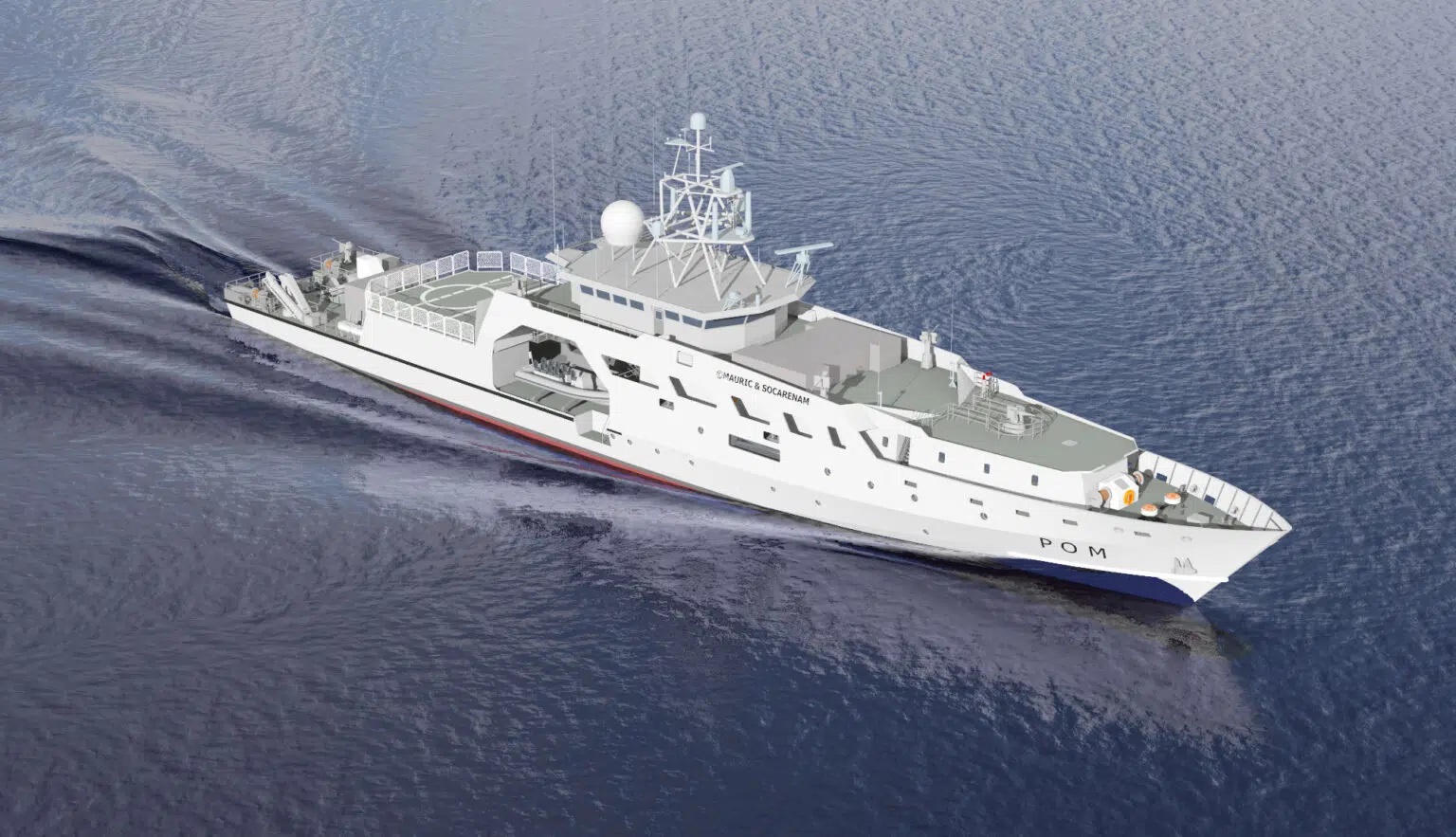
An artist’s rendering, Félix Éboué class or Patrouilleurs Outre-mer (POM)
The Offshore Patrol Cutter (OPC) is described as, “…a capability bridge between the national security cutter, which patrols the open ocean in the most demanding maritime environments, and the fast response cutter, which serves closer to shore.”
That may have been the intention, but that is not what we got.
While the National Security Cutter is better than the WHECs they replaced in almost every way, the OPCs are not only better than the WMECs they will replace, but they are also, in every way except maximum speed, better than the WHECs as well. Instead of a high/low mix of cutters, they all turned out high end. We should not be surprised the OPCs construction and operating costs approach those of the NSCs.
Construction costs are typically proportional to displacement. The OPCs’ displacement is 98% that of the NSC and 1232.8% (more than 12 times) that of the Fast Response Cutters.
This would not be a bad thing, if we had enough NSCs and OPCs to meet our large patrol cutter needs, but I don’t think we will ever get there.
We are expected to ultimately end up with only 36 large patrol cutters, fewer than we have had in decades and fewer than other Coast Guards with far smaller EEZs.
A new fleet mix study has been completed, but the results have not been made public (Why not? This is not transparency). I suspect it shows a need for substantially more than 36 large patrol cutters.
If we look at the previous “Fleet Mix Study,” now over a dozen years old, which minimized requirements because it did not consider “High Latitude regions of the ice shelf and Deployable Operations Group (DOG),” and assumed that NSCs would use the “Crew Rotation Concept” that was expected to allow them to operate 230 days per year, to meet all statutory requirements, the study indicated the Coast Guard needed 66 large cutters, 30 more than currently planned, and 91 FRCs.
If we want significantly more large patrol cutters than currently planned, perhaps we need a smaller, cheaper alternative to the OPCs that requires a smaller crew and are more economical to operate. In previous posts, I have referred to this alternative as (Cutter X).
Thinking Ahead:
Getting funding for more than two OPCs per year is probably unrealistic. The last OPC is not expected to be commissioned until 2038, 14 years from now. If we continue to build only two large patrol cutter a year, will not be able to grow the fleet until after 2038 and then it will grow slowly because the National Security Cutters will start aging out.
We might not be able to continue to build OPC sized patrol cutter after 2038. The Coast Guard will want to build Arctic Security Cutters (or perhaps Arctic Patrol Cutters). Both the Juniper class WLBs and Keeper class WLMs will need to be replaced.
(Where is our long-range shipbuilding plan?)
If we started in the next year of two, we could be producing true medium endurance cutters in significant numbers before the planned completion of the OPC program. On a 3 for 1 or even 2 for 1 exchange for the last few OPCs, if we tried, we could start to grow the fleet perhaps as early as 2032.
That is why the Félix Éboué class is worth a look. It is, what I believe may be, the absolute minimum fully capable Offshore Patrol Vessel. It covers all the bases. It is good enough for most operating areas. That is not to say, there are no good reasons for some add–ons, but I think it is a kind of benchmark. It is also a good representation of Cutter X. There are reasons we might want to go bigger, but before you increase the quality of the individual cutters, first we need to have enough.
The French Experience
France, like the US has a huge Exclusive Economic Zone (EEZ), the largest in the world, 11,691,000 km2 (4,514,000 sq mi). The US EEZ is 11,351,000 km2.
Unlike the US, the French don’t have a coast guard that operates ocean going ships to enforce laws and protect sovereignty. The French Navy does this, and uses a fleet of Offshore Patrol Vessels, some of which are referred to as frigates.
The Félix Éboué class is their newest class of OPVs. They are intended specifically to patrol the waters of French overseas territories in the Pacific and Indian Oceans. They will be based, two each, at Nouméa, Tahiti and La Réunion. They replace the P400 class, which are slightly larger than the Webber class WPC, which were found to be inadequate.
I have found some very good photos of the second ship of the class being fitted out, that show details I had not seen before, and would like to share them. I will also bring forward some of my earlier commentary with updates, so as to consolidate information on this interesting class.
Comparison with Webber class WPC (FRC):
Below is a comparison between the FRC and the Félix Éboué class (POM) that was included in an earlier post, updated with information about the propulsion system on the French ships.

French overseas patrol vessel (POMs) Auguste Bénébig. Photo: http://www.meretmarine.com
Like an FRC:
I always thought these looked like oversized Webber class, the proportions are similar, and the much larger POM is not much more complicated than the Webber class. The crew of the POM is 30, only six more than that of the FRC. Both have a bridge with a 360-degree view positioned well aft, minimizing vertical acceleration. Both have an 8 meter boat in a stern ramp. The armament is similar with four .50 cal. machine guns and a single medium caliber gun in the bow, a 20mm on the POM and a 25mm on the FRC. The POM uses slightly less powerful diesel engines, 2x ABC 16V DZC medium speed diesels 3.7MW each @ 1,000rpm, for a total of about 9924 HP compared to 11,600 for the FRC. (I am told the POM’s engines are also more economical and simpler to maintain.) But the French ships still manage to make 24 knots, a couple of knots more than claimed for the OPC. With similar crew and systems, they should not cost much more than the FRCs to operate.
Unlike an FRC:
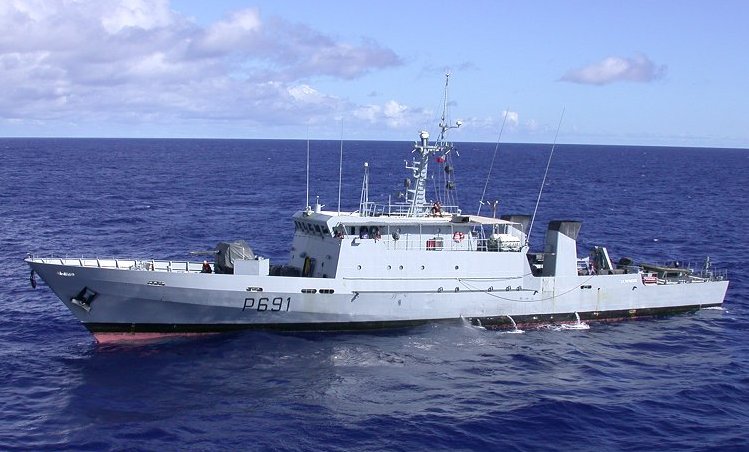
P400 patrol ship Tapageuse at sea near Tahiti (18 June 2003). Photographer: Jean-Michel Roche
While they would have been thinking of their existing 373 ton P400 class pictured above, it might appear to us that they wanted a ship to do the same sorts of missions the Webber class Fast Response cutters (FRC) are doing out of Guam, but they recognized that these ships would be far from any major naval base and that they would need to travel great distances and would be exposed to extreme weather conditions, so they needed to be larger (1300 tons vs 353 tons for the FRC) and have greater range (5500 miles vs 2500) and endurance (30 days vs 5 days).
Having chosen a larger hull, they took advantage of the greater volume and deck space to add a second RHIB, a multimode radar, space for 29 passengers (roughly a platoon of Marines), a sickbay, a dive locker, space for a 20 foot containerized mission module, a flight deck and hangar for a 700-kilogram-class rotor-blade drone (not yet deployed), and a holding area for up to six prisoners.
Some sources also indicate the French ships also have electric motors that would allow them to cruise on the ship’s service generators and secure the main propulsion engines, but I have seen no specifics.
The Photographs:

The second of the French Navy’s six new overseas patrol vessels (POM), the Teriieroo a Teriierooiterai, which will be based in French Polynesia and has been named in tribute to a Companion of the Liberation native of this Pacific territory, Photo: http://www.meretmarine.com

The Teriieroo at Teriierooiterai fitting out at the end of July, 2023 in Boulogne. Photo: http://www.meretmarine.com

Stern ramp for 8 meter RHIB. French Navy overseas patrol vessel (POM), Teriieroo a Teriierooiterai, fitting out 2023. Photo: http://www.meretmarine.com

Second 8 meter RHIB and davit (only) on starboard side. French Navy overseas patrol vessel (POM), Teriieroo a Teriierooiterai, fitting out 2023. Photo: http://www.meretmarine.com

Aliaca aerial drone on its launch catapult. French Navy overseas patrol vessel (POM), Teriieroo a Teriierooiterai, fitting out 2023. Photo: http://www.meretmarine.com

Recovery System for Unmanned Air System, French Navy overseas patrol vessel (POM), Teriieroo a Teriierooiterai, fitting out 2023. Photo: http://www.meretmarine.com
 Chuck Hill's CG Blog
Keep the Bollinger / Damen team together and work up a U.S. version of their 6711/6911 yacht support ships that are used for the Arialah class and smaller South African Warrior class. In that mix you are looking at crew sizes of 42-48 with total accommodation up to 77. The design can do a stern launch up to 7.5m and you could fit 2 sizable davits on deck, yet keep a flight deck potentially able to land an H-60. Sea Ax bow. 4 mains that can be divided into 2 engine rooms per their bid for the Australian OPCs. 1 main gun forward with 4 secondary stations. Able to handle the radars and probably could mount SEWIP lite and decoys.
These are the ships Andy is talking about:
Damen YS 6911 Yacht Support Vessel – Ship Technology (ship-technology.com)
Inside the Damen Yacht Support Vessel 6711 (boatinternational.com)
Re Damen yacht support ships.
While an Axe bow minimizes pitching, they can allow large waves to roll over the ship. I people have to go out on deck in heavy seas that can be a disadvantage.
I have never felt like these flight decks that incorporate an elevator down to a hangar were a good idea. It relies on a lot of heavy equipment and keeping sea water out looks like a challenge.
I also don’t like having the bridge and flight deck on the extreme ends of the ship, because that maximizes the vertical acceleration when the ship pitches.
I am sure the ships work fine in most weather conditions, but they have disadvantages when the weather is unpleasant.
Operating in bad weather is what we do.
Yeah I like how the bridge on Warrior is further aft and how the plan had been to move the flight deck forward a bit on their Australian proposal. When I am playing with the design the flight deck has some room to move forward when you aren’t dealing with tha RAM launcher the UAE added to theirs. Also helps with clearing room for the stern launch. If he ax bow is holding you back lets ditch it.
These ships could of course use the ScanEagle UAS that is currently used on the National Security Cutters but looks like DARPA expects to find something better. Beyond Blackjack: DARPA planning new X-plane to give ship COs local ISR assets – Breaking Defense
@Andy, It’s not like I really get any say in these things, but using an existing design could move the project forward a couple of years.
But I do think an OPV should be at least 80 meters long to improve seakeeping. How Long Should an OPV be? Is There a Minimum? | Chuck Hill’s CG Blog (chuckhillscgblog.net)
Agreed. part of my focus if on U.S. Yards down market that might have the ability and labor to take on the work. We have lots of potential to grow if we chose some imperfect solutions.
I noticed the French only put 20mm guns on. I wonder if the French have a very different outlook in the Pacific region than Australia does. Australia originally wanted to put 40mm guns on the OPV’s. Then this year they decided to cut the number of Arafura’s and wanted 11 light/general purpose frigates instead. So while Australia is upgunning it’s navy, the French are not. Admittedly the French mainland is in Europe, where the bulk of their proper navy is, but their OPV’s operate in South Pacific and they surely take into account the happenings there as well.
Just my 2 cents and thoughts.
It is difficult to make a ship this small lethal while keeping the crew small. Their 20mm does not have the range of different types of projectiles that the 25mm Mk38 has, but the rate of fire is much higher.
It has also been shown with small missiles attached to the remote weapons station. Another Gun/Missile Remote Weapon Station Suitable for Patrol Boats | Chuck Hill’s CG Blog (chuckhillscgblog.net)
The new French ships are much more capable than the ones they are replacing and much more capable of capacity building and preventing IUU, which is their peacetime mission.
Not a lot it could do in war time, except transport and insert special forces.
The French ship does have something of an ace in the hole in that it has space for a container you can see in the photos. There are a lot of things you can put in a container.
Meanwhile we send a 270 to the Pacific after replacing its 76mm with a 25mm. (of course the 270 could host a helicopter or put containers on the flight deck).