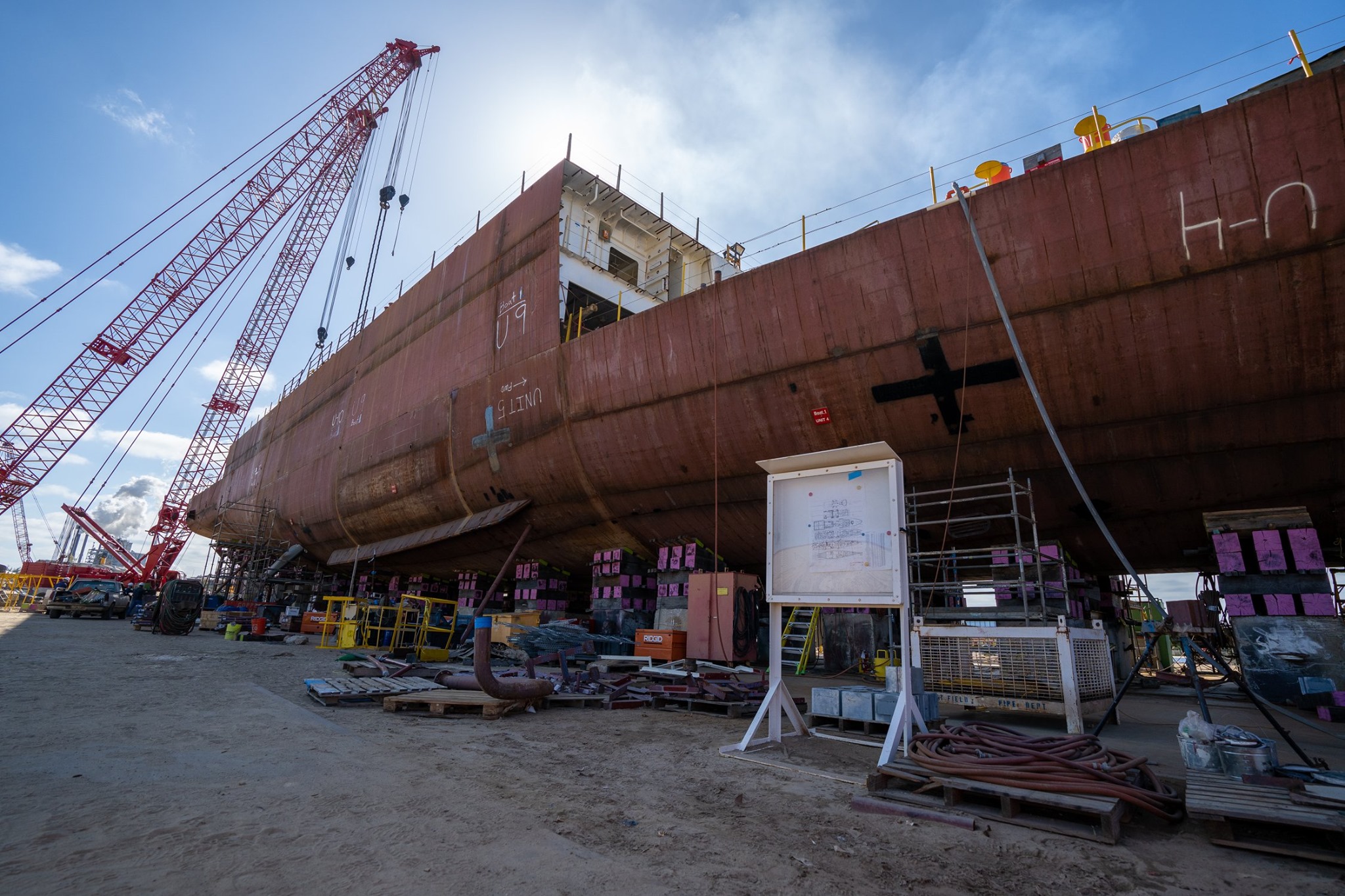
“Coast Guard releases request for information to support domestic icebreaker market research” –CG-9

USCGC Cleat (WYTL-65615)

The Acquisitions Directorate (CG-9) reports,

The Coast Guard today released a request for information (RFI) to inform the development of its acquisition strategy to recapitalize its light and medium domestic icebreaking capabilities.  Industry sources are invited to submit information on existing icebreaking-capable vessels or vessel designs that are ready for construction or already in production. The Coast Guard will use these responses to inform future program activities to recapitalize the domestic icebreaking capabilities provided by the 140-foot icebreaking tug and 65-foot small harbor tug.

You can access the RFI here.

There are a couple of things that may be surprising.

  • First the description of the two types of interest “DOMICE-M” domestic icebreaker, medium and “DOMICE-L,” domestic icebreaker, light. The 2,500 HP 140s are a long way from medium icebreakers by the Coast Guard’s usual medium icebreaker definition, 20,000 to 45,000 HP.
  • Second that that there seems to be an aversion to any increase in size. The “VESSEL PRELIMINARY CAPABILITY PARAMETERS” specifically requests  information only on vessels the same size or smaller than the exiting 140 foot WTGBs and 65 foot WYTLs, and the expected performance is essentially no better than the existing classes and could be worse.

Significantly the 65′ WYTLs are currently being treated more like station boats than commissioned ships. The intention is to continue that might be thought of as a reason to restrict length to 65 feet or less. Still that might be unnecessarily restrictive. It may require fewer people to run a particular 70 foot vessel than a particular 64 foot boat, but manning requirements are not included in the RFI. Reading between the lines it appears they actually want a smaller vessel than the 65 footers.

The constraint on length of the 140 replacement is even harder to understand. The range requirement clearly indicates these vessels will deploy for several days with presumably a mixed gender crew. Like the WTGBs they will probably have davits and a small ship’s boat. In District 9, on the Great Lakes, when not breaking ice, the WTGBs perform some of the functions Webber class WPCs perform in other districts. Speed and icebreaking are almost mutually exclusive, but a bit more waterline length does make a couple of extra knots easier.

“Coast Guard Cutter Liberty, final Island-Class cutter, decommissioned after over 35 years of service” / What Happens to the Decommissioned Cutters?

USCGC LIBERTY (WPB 1334), Credit to Gillfoto, 23 November 2012

Below is a news release from Coast Guard News.

It is the end of an era as the last of 49 Island class cutters leaves Coast Guard service. These boats continue to do useful work for other navies and coast guards as they are transferred under the Excess Defense Article (EDA) program.

The Surface Acquisitions Logistics Center at the Coast Guard Yard runs the EDA program doing necessary maintenance, sea trials, foreign crew training, and vessel transport and close-out.

110 foot Island class cutters have been transferred to Pakistan, the Republic of Georgia, Costa Rica, Ukraine, the Philippines, Tunisia, and Greece. Additional units are expected to go to Cameroon and Ecuador.

Decommissioned 87 foot WPBs and 210 foot WMECs

87 foot Marine Protector class WPBs have been transferred to Ghana, Lebanon, the Philippines, and Uruguay.


April 30, 2025

Coast Guard Cutter Liberty, final Island-Class cutter, decommissioned after over 35 years of service

ANCHORAGE, Alaska — The Coast Guard decommissioned Coast Guard Cutter Liberty (WPB 1334) during a ceremony in Valdez, Tuesday.

“This decommissioning marks the end of an era for the Coast Guard,” said Cmdr. Jordan Bogosian, a former Commanding Officer of Liberty and the ceremony’s presiding official. “I am proud of Coast Guard Cutter Liberty and her faithful service to our nation for more than three decades.”

Commissioned on December 19, 1989, Liberty was the 34th Island-Class cutter to join the fleet and the final Island-Class cutter to be decommissioned from Coast Guard service.

Liberty is a 110-foot, Island-Class patrol boat, a multi-mission platform that conducted operations to support search and rescue response, marine environmental protection, and national defense.

The Coast Guard is replacing the aging Island-Class patrol boats with Sentinel-Class Fast Response Cutters (FRCs) which feature enhanced capability to meet service needs. There are currently four FRC’s homeported in Alaska, with two more scheduled for delivery in the near future.

“It has been a profound honor to serve as the final commanding officer of USCGC Liberty,” said Lt. D. Toler Alexander, Commanding Officer of Liberty. “I am incredibly proud of this crew and all they have accomplished. LIBERTY leaves behind a legacy of over 35 years of exceptional service to the people of the United States and the great state of Alaska. I would like to extend my heartfelt gratitude to the communities of Valdez – and Auke Bay before it – for their unwavering support and for being such welcoming homeports to the cutter and her crew.”

“Reconciliation Bill Calls for $14.6B in Coast Guard Cutters, New Arctic Icebreakers”–USNI / Not Exactly

US Capital West Side, by Martin Falbisoner

U.S. Naval Institute News Service reports,

The Coast Guard could see $14.6 billion in new cutters as part of a massive supplemental that could almost double the service’s Fiscal Year 2025 budget, according to the text of the reconciliation bill reviewed by USNI News.

Included in the Republican-led funding proposal is money for almost 30 new cutters ranging in size from the 154-foot Sentinel-class Fast Response Cutter to the 460-foot Polar Security Cutter, according to a source familiar with the proposed buy.

Those include:

  • Three or more Arctic Security Cutters and an unspecified number of Great Lakes icebreakers for $5.03 billion.
  • Two Polar Security Cutters and advanced procurement for $4.3 billion.
  • Eight Heritage-class Offshore Patrol Cutters for $4.3 billion.
  • Up to 15 Sentinel-class Fast Response Cutters for $1 billion.

It also includes a lot more, but first, recognize that this is not a single fiscal year appropriation. In fact it is not an appropriation at all. You can read the actual text of the bill here.

“For the purpose of the acquisition, sustainment, improvement, and operation of United States Coast Guard assets, in addition to amounts otherwise made available, there is appropriated to the Commandant of the Coast Guard for fiscal year 2025, out of any money in the Treasury not otherwise appropriated, to remain available until September 30, 2029…”

That is a conditional statement.

If the money is available, you can spend it on these things. (I think the idea may have been that cancelling programs would save huge amounts of money in the FY2025 budget, that could be redirected. It now appears the initial estimates were wildly optimistic.)

The bill provides a long list of things money could be spent on, totaling $14.6B according to the USNI report. It does not directly fund them. It allows any FY2025 money not otherwise committed, to be moved into a pool the Coast Guard can draw on for the next four years.

The Coast Guard is not the only agency that can draw on “any money in the Treasury not otherwise appropriated,” This bill “appropriates” $15B for the FAA and about $257M to the Kennedy center under the same conditions. There is also nearly identical wording in the Defense Reconciliation bill but for much larger sums.

The bill is only 22 short double spaced pages. Only the first seven pages deal with Coast Guard acquisitions. (Nowhere in the bill is there a specific number of cutters as listed in the USNI article.)

Pages 8-11 deal with activation of CG Selected Reserve personnel.

On pages 11 and 12 there is imposition of vessel tonnage duties.

Pages 12-18 imposition of a Federal registration fee on motor vehicles.

Pages 18-20 would cancel some existing programs.

Pages 20-21 deals with the FAA.

This is more like an authorization than an appropriation.

While I doubt the Coast Guard will ever see $14.6B in redirected FY2025 funds, perhaps this will influence the budget process in future years. The priorities expressed here may allow the Coast Guard the option of redirecting money to new programs if we continue to have continuing resolutions rather than actual budgets.

This Day in Coast Guard History, May 1

Based on the Coast Guard Historian’s timeline, https://www.history.uscg.mil/research/chronology/
With inspiration from Mike Kelso

May 1

1876: A New Lifesaving Station Opens on Lake Erie – 89 People Are Rescued in the Next 20 Years. A Marblehead resident named Lucien M. Clemons was appointed the station’s first keeper, and his tenure began with the official opening of the facility in 1876. Clemons had demonstrated his courage and lifesaving skills on May 1 of the previous year when he and his brothers Hubbard and A.J. – rowing out into stormy weather on Lake Erie on that day in a 12-foot (3.7-meter) skiff (a flat-bottomed boat) — rescued the two surviving members of the seven-person crew of the shipwrecked 102-foot (31.1-meter) schooner Consuelo. As a result of their heroic efforts in that rescue, the Clemons brothers became the first recipients of life-saving medals first class (the present-day Gold Lifesaving Medals).

1875  Captain Lucien M. Clemens and his brothers Al and Hubbard “displayed the most signal gallantry in saving two men from the wreck of the schooner Consuelo” in an open rowboat.  Five others on board the schooner perished when the schooner capsized in the heavy seas “with the wind blowing a gale from the northeast” before the brothers arrived on scene.  Their daring rescue resulted in the award of the Gold Life-Saving Medals to each, the first time the medals were ever awarded.

Revenue Cutter USCGC McCulloch

1898  USRC McCulloch fought as part of the fleet under the overall command of Commodore George Dewey, USN, at the Battle of Manila Bay during the Spanish-American War.   President John McKinley later recommended that her commanding officer, Revenue Captain Daniel B. Hodgson, be retired at full pay as reward of merit for “efficient and meritorious services.”  A joint resolution of Congress was so approved on May 3, 1900.

1900  The Lighthouse Board took charge of all lighthouses in Puerto Rico.

The United States Lightship LV-87/WAL-512 (Ambrose) is a riveted steel lightship built in 1907 and served at the Ambrose Channel lightship station from December 1, 1908, until 1932. This photo was taken by participant/team Tony as part of the Commons:Wikipedia Takes Manhattan project on April 4, 2008.

1921  The first radio fog signals in the United States were placed in commission on Ambrose Lightship, Fire Island Lightship, and Sea Girt Light Station, New Jersey.

Lightship LV-101/WAL-524. Acquired 2 September 1916, Decommissioned 23 March 1964. Light Vessel 101 was assigned to the stations:
Charles, Cape Charles, Virginia (1916–1924); Relief, Relief 5th District (1925–1926);
Overfalls, Overfalls, Delaware (1926–1951); Stonehorse, Stonehorse Shoal, Massachusetts (1951–1963); CrossRip, Cross Rip Shoal, Massachusetts (1963–1964), now a museum ship in Portsmouth, VA. Photo by William J. Grimes

1935  By Department of Commerce authority, a readjustment of the boundary between the 3rd and 4th Lighthouse Districts was made, by which certain aids to navigation in the approaches to Delaware Bay, including Overfalls Lightship, were placed under the jurisdiction of the 4th Lighthouse District.

1936  Congress passed the Whaling Treaty Act, which made it unlawful to take right whales or calves of any whale.  The act was enforced by the Coast Guard.

1942  Two Coast Guard planes located a lifeboat with 13 survivors and landed in open seas and took injured men ashore as others were rescued by lifeboat.

1973  The Coast Guard’s Merchant Marine Detachment-Saigon, Republic of Vietnam, was disestablished.

1992  CGC Venturous served as the patrol commander’s on-scene command platform for most of the International America’s Cup Class World Championship sailing races that took place off San Diego from May 1-11, 1992.  The CGC Sherman took over that duty for May 10-11.  Coast Guard active duty, reserve, and auxiliary personnel also assisted in perimeter patrols along the race course.

The Miss Majestic. When the DUKW was converted for commercial passenger
service, a steel frame was installed around and over the passenger compartment. The
Miss Majestic had a vinyl canopy over the frame to protect passengers from the weather.

1999  A amphibious tourist boat (DUKW) sank in Lake Hamilton, near Hot Springs, Arkansas, killing 13 persons.  The Coast Guard investigated the accident.

A Coast Guard Air Station Kodiak MH-60 Jayhawk aircrew, deployed to forward operating location Kotzebue, Alaska, conducts a pre-flight brief before flying a mission to Point Lay, July 13, 2017. FOL Kotzebue houses two Air Station Kodiak MH-60 Jayhawk helicopters and crews in support of Operation Arctic Shield. U.S. Coast Guard photo by Lt. Brian Dykens.

2013  CGAS Kodiak deployed a MH-60 Jayhawk helicopter crew and support personnel to a forward operating location in Cordova, to safeguard mariners in Prince William Sound and south central Alaska.  The FOL in Cordova was one of four seasonal Coast Guard FOLs in Alaska and was scheduled to remain in operation until September 30, 2013.  The forward deployed crews received logistical support from Air Station Kodiak based HC-130 Hercules airplane crews throughout their deployment.  The previous year, FOL Cordova aircrews saved nine lives and assisted 12 others during the 2012 summer season.

2020  On 1 May 2020 the U.S. Coast Guard announced that RADM Melissa Bert had been vested as the Judge Advocate General & Chief Counsel of the Coast Guard.  RADM Bert is the first woman to hold that office.

This Day in Coast Guard History, April 30

Based on the Coast Guard Historian’s timeline, https://www.history.uscg.mil/research/chronology/
With inspiration from Mike Kelso

April 30

Oil painting of George Washington’s inauguration as the first President of the United States which took place on April 30, 1789. circa 1899

1789  President George Washington was inaugurated in New York City as the nation’s first President.  His inauguration marked the beginning of U.S. Constitutional government.

1798  Congress established the Department of the Navy on this date.  Nevertheless, the United States Navy traces its origins to the Continental Navy, which the Continental Congress established on October 13, 1775 by authorizing the procurement, fitting out, manning, and dispatch of two armed vessels to cruise in search of munitions ships supplying the British Army in America.  In 1972, Chief of Naval Operations Admiral Elmo R. Zumwalt authorized the recognition of 13 October 13, 1775 as the Navy’s official birthday.

1818  Congress authorized use of “land and naval forces of the United States to compel any foreign ship to depart United States in all cases in which, by the laws of nations or the treaties of the United States, they ought not to remain within the United States.”  This was the basis of neutrality enforcement.

1832  All commissions of naval officers serving in the Revenue Cutter Service were revoked.  All vacancies were then filled by promotion from within the Service for the first time.

BM1 Edgar Culbertson in the yard at the Coast Guard Lifeboat Station in Duluth, Minnesota, circa 1967

1967  BM1 Edgar A. Culbertson gave his life attempting to rescue three boys in Duluth, Minnesota.  BM1 Culbertson, along with two other members of Station Duluth, volunteered to venture out on the North Pier at Duluth to rescue three boys who had been reported to be out on the pier during a severe storm.  Witnesses had seen a wave wash one of the boys away but two were apparently trapped near the lighthouse at the end of the pier.  Culbertson’s Coast Guard Medal citation noted: “Lashing themselves together, the three men proceeded, with hand lanterns as the only illumination, to the end of the breakwater.  Despite the high waves, winds gusting to 40 knots, driving rain and 36 degree water, the rescue party diligently searched the breakwater and light but found no trace of the boys.  While returning to the beach a 20-foot wave swept Petty Officer CULBERTSON off his feet and hurled him up to and over the breakwater parapet into the sea.  Despite the strenuous efforts of his teammates, Petty Officer CULBERTSON perished in this gallant rescue attempt.”  He was posthumously awarded the Coast Guard Medal.  The other two Coast Guardsmen, BM2 Richard R. Callahan and FN Ronald C. Prei, were also awarded the Coast Guard Medal for their heroism.

The Coast Guard Cutter Edgar Culbertson sails into port in Galveston, Texas, March 23, 2020. The Edgar Culbertson is the service’s 37th fast response cutter. (U.S. Coast Guard photo by Petty Officer 3rd Class Paige Hause)

2020  The crew of the Coast Guard Cutter Midgett concluded a successful 37-day patrol in support of counter-Illegal, Unregulated and Unreported (IUU) fishing and regional security operations in Oceania, April 30, 2020. Patrolling over 7,118 square nautical miles (8,191 statute miles), Midgett’s law enforcement team boarded seven commercial foreign-flagged fishing vessels. The boardings verified compliance with WCPFC conservation management measures and specifications for the marking and identification of fishing vessels. They conducted 15 additional sightings and vessel queries. Those reports were provided to the FFA Regional Fisheries Surveillance Center in Honiara, Solomon Islands, demonstrating the Coast Guard’s interoperability with its key regional partners. The crew conducted joint operations with crews aboard an HC-130 Hercules long-range surveillance aircraft from U.S. Coast Guard Air Station Barbers Point, who flew several reconnaissance flights to improve maritime domain awareness. Midgett’s crew of 120 departed their homeport of Honolulu in late March, 2020, but returned shortly after to address concerns over possible COVID-19 exposure among the crew. One crew member who did not sail with the cutter for other reasons tested positive for the virus on April 1. Although no one else showed COVID-19 symptoms, the command, in concert with military and state health officials, took immediate and decisive action to quarantine and test those at risk of exposure. No one aboard tested positive, and the ill member ashore made a full recovery. Midgett resumed the patrol on April, 8, 2020.

The crews of the Coast Guard Cutters Midgett (WMSL 757) and Kimball (WMSL 756) transit past Koko Head on Oahu, Hawaii, Aug. 16, 2019. The Kimball and Midgett are both homeported in Honolulu and two of the newest Coast Guard cutters to join the fleet. (U.S. Coast Guard photo by Petty Officer 3rd Class Matthew West/Released)

“Coast Guard Cutter Calhoun seizes over $74 million in cocaine interdicted in Atlantic Ocean” –Damn that is a long way from home!

A Coast Guard Cutter Calhoun (WMSL 759) small boat approaches a vessel suspected of drug smuggling in the Atlantic Ocean, April 12, 2025. Calhoun crew members boarded the fishing vessel approximately 1,265 miles west of Las Palmas, Canary Islands and seized approximately 10,000 pounds of cocaine, worth an estimated $74 million. (U.S. Coast Guard photo)

Below is a news release from Coast Guard News.

Another photo of the intercepted vessel. (U.S. Coast Guard photo)

Sometimes things in a news release just jump out at you as unusual. First there were the photos of the smuggling vessel. It is a Dhow. Looks like something you might see in the Red Sea.

Then there is the location of the intercept, “1,265 miles west of Las Palmas, Canary Islands.” The Canary Islands are off the Coast of Morocco, North Africa.

Assuming the report is in nautical miles and the intercept was due West of Las Palmas, then that put the intercept about 2200 nautical miles due East of Orlando, Florida.

It is most likely the drugs were ultimately bound for Europe. This has to have been an intelligence based intercept.


April 28, 2025

Coast Guard Cutter Calhoun seizes over $74 million in cocaine interdicted in Atlantic Ocean

ATLANTIC OCEAN — The crew of U.S. Coast Guard Cutter Calhoun (WMSL 759) seized approximately 10,000 pounds of cocaine, worth an estimated $74 million in the Atlantic Ocean, April 12-13, 2025.

The seized contraband was the result of an interdiction in international waters in the Atlantic Ocean, and five suspected smugglers remain in U.S. custody pending prosecutorial disposition.

On April 12, the Calhoun, under tactical control of Coast Guard Atlantic Area, detected a suspicious fishing vessel in international waters exhibiting behavior consistent with narcotic trafficking approximately 1,265 miles west of Las Palmas, Canary Islands. Calhoun’s crew launched a cutter small boat and interdicted the suspicious vessel, apprehending five suspected smugglers and seizing approximately 10,000 pounds of cocaine.

“This interdiction demonstrates the Coast Guard’s unwavering commitment to combating transnational criminal organizations (TCOs),” said Vice Adm. Nathan Moore, commander, Coast Guard Atlantic Area. “Our dedicated crews, in close coordination with interagency and international partners, continue to disrupt the flow of illicit narcotics, which serves as a critical strategic action that disrupts the financial networks of TCOs, undermining their ability to fund further illicit activities that threaten our communities.”

The Coast Guard is the United States’ lead federal maritime law enforcement agency with authority to enforce national and international laws on the high seas and waters within U.S. jurisdiction. The Coast Guard continues increased operations to interdict, seize and disrupt transshipments of cocaine and other bulk illicit drugs by sea. These drugs fuel and enable cartels and TCOs to produce and traffic illegal fentanyl, threatening the United States.

Calhoun, which commissioned in 2024, is the newest of four, 418-foot, Legend-class national security cutters homeported in North Charleston, South Carolina. The cutter’s primary missions are counter-drug operations and defense readiness.

Calhoun falls under the command of U.S. Coast Guard Atlantic Area, which is based in Portsmouth, Virginia. U.S. Coast Guard Atlantic Area oversees all Coast Guard operations east of the Rocky Mountains to the Arabian Gulf. In addition to surge operations, they also allocate ships to deploy to the Caribbean and Eastern Pacific to combat transnational organized crime and illicit maritime activity.

For breaking news, follow us on X (formerly Twitter). For additional information, find us on Facebook and follow us on Instagram.

Make a difference on land, at sea or in the air with the Coast Guard. Visit GoCoastGuard.com to learn more about active duty and reserve, officer and enlisted opportunities. Information on how to apply to the U.S. Coast Guard Academy can be found here.


This Day in Coast Guard History, April 29

Based on the Coast Guard Historian’s timeline, https://www.history.uscg.mil/research/chronology/
With inspiration from Mike Kelso

April 29

The 82-foot patrol boats of Squadron One (RONONE) deploying from Subic Bay in the Philippines to the theater of operations in Vietnam. (U.S. Coast Guard)

1965  President Lyndon Johnson approved the commitment of Coast Guard forces to service in Vietnam under the Navy Department’s operational control.  The formation for service in Vietnam of Coast Guard Squadron One (RONONE) was announced.

1975  Coast Guard discontinued operations at Con Son Island LORAN Station.

USCGC STORIS moored alongside LAMUT. The 3″/50 was located in the gun tub on the O-1 deck just aft of the stack. During WWII the 180 foot buoy tenders has a similar installation. 

1992  CGC Storis‘ 3-inch/.50 caliber main battery was removed from the cutter.  It was the last 3-inch/.50 caliber gun in service aboard any U.S. warship.  The 3-inch/.50 was a dual-purpose weapon (surface and anti-aircraft) that had been in U.S. service since the 1930s.  It was shipped to Curtis Bay where is was made inoperable and then loaned to a VFW club.

2014  The Boston-based CGC Escanaba returned to its homeport after a 36-day patrol in the North Atlantic.  While out on patrol, the medium-endurance cutter focused on fisheries missions in support of Operation Atlantic Venture.  Escanaba’s crew conducted 26 law enforcement boardings during the patrol.  Crew members measured fishing gear, inspected daily catch limits and ensured that vessels’ safety gear was in good, working order.  The cutter crew also conducted 46 training evolutions with the crew of an MH-60 Jayhawk helicopter crew from Coast Guard Air Station Cape Cod.

The crew of U.S. Coast Guard Cutter Escanaba (WMEC 907) conducts small boat personnel transfers with the U.S. Coast Guard Cutter Isaac Mayo (WPC 1112), in the South Florida Straits, Feb. 26, 2024. Escanaba’s crew contributed to the interdiction and repatriation of over 100 migrants from Haiti and Cuba while patrolling the Coast Guard Seventh District’s area of responsibility. (U.S. Coast Guard photo by Seaman Laura Holguin-Rojas)

“Charting a Course” –Indo-Pacific Defense Forum / Coast Guard in the Western Pacific

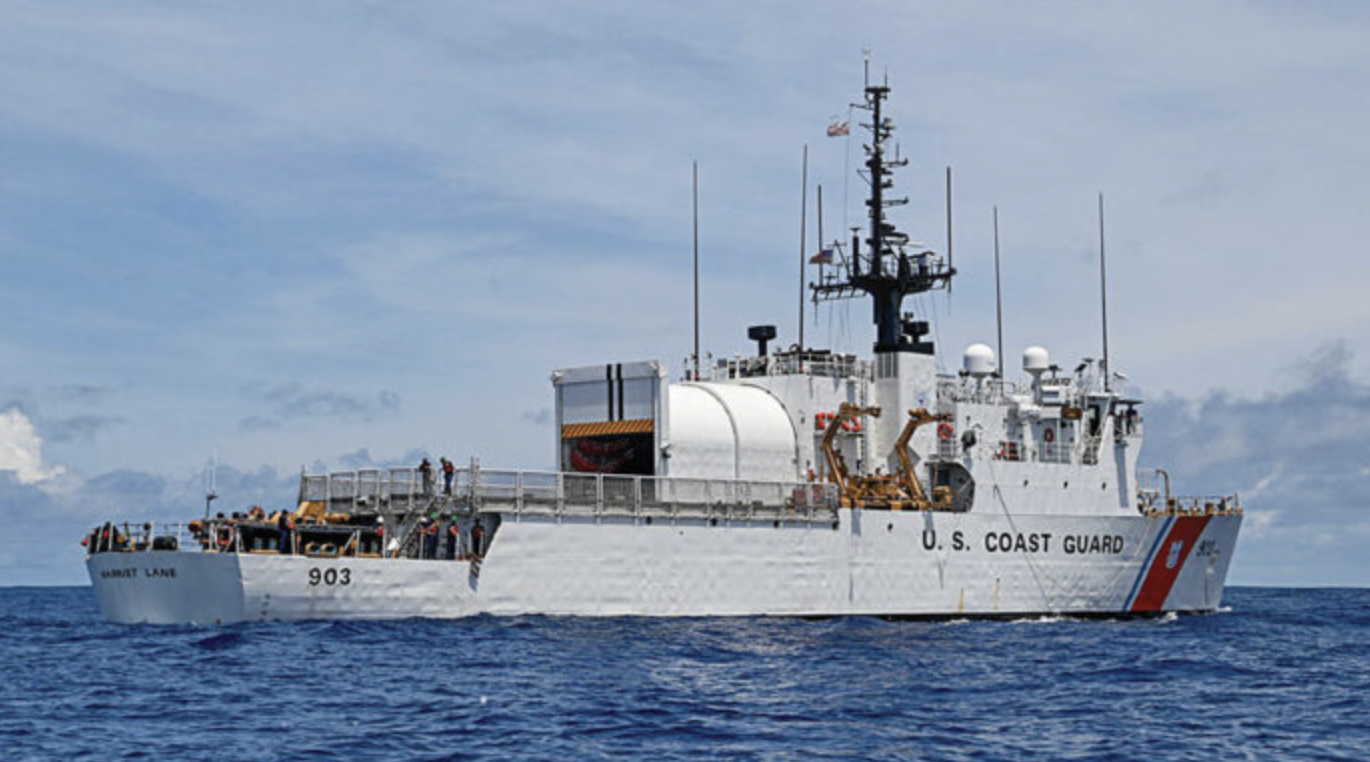
The U.S. Coast Guard cutter Harriet Lane conducts a February 2024 patrol for Operation Blue Pacific, which included combating illegal fishing with local partners. SENIOR CHIEF PETTY OFFICER CHARLY TAUTFEST/U.S. COAST GUARD

The Indo-Pacific Defense Forum reports,

The United States Coast Guard has increased its international engagements throughout the Pacific in recent years. Through initiatives such as the Pacific Area Campaign Plan, the Coast Guard plays a pivotal role in advancing the White House’s Indo-Pacific Strategy and the National Maritime Domain Awareness Plan. Such efforts align with the 2050 Strategy for the Blue Pacific Continent, the long-term vision for the region developed by the 18-member Pacific Islands Forum.

Harnessing regional expertise and understanding the advantages of coordinated responses to environmental threats and illegal fishing, the Coast Guard established two key centers of expertise in Honolulu, Hawaii, in October 2023. The Indo-Pacific Marine Environmental Response Regional Activities Center (MER-RAC) and the Illegal, Unreported and Unregulated Fisheries Center of Expertise (IUUF COE) bring together Coast Guard specialists and international partners to share best practices, facilitate expert exchanges and develop collaborative strategies for addressing transnational issues.

This Day in Coast Guard History, April 28

Based on the Coast Guard Historian’s timeline, https://www.history.uscg.mil/research/chronology/
With inspiration from Mike Kelso

April 28

1908  The Revenue Cutter Service became the primary federal agency in charge of patrolling regattas.

USRC Seneca, 1908

1918  CGC Seneca saved 81 survivors from the torpedoed British naval sloop Cowslip while on convoy route to Gibraltar.  Cowslip had been attacked by three German U-boats.

Harry Gabriel Hamlet, USCG, Commandant of the Coast Guard (1932), commanded USS Marietta ,October 1918 – 12 July 1919

1919  While in command of USS Marietta in the Bay of Biscay, Captain Harry G. Hamlet rescued a crew of 47 persons from USS James which was sinking at sea, April 23, 1919.  For his actions that day he was awarded a Gold Lifesaving Medal.  His award citation noted: “This rescue was made extremely difficult and hazardous owing to high seas, which threatened to send the two vessels crashing together. In effecting the rescue, Captain Hamlet displayed admirable seamanship.”  Captain Hamlet would later serve as Commandant of the Coast Guard from 1932-1936. (If this story sounds familiar, it is because the same incident was erroneously reported in the “This Day in Coast Guard History, April 22 / 23.”)

Marietta (PG-15) In European waters. Photo courtesy of Paul H. Silverstone from U.S. Small Combatants: An Illustrated Design History by Norman Friedman

The U.S. Navy amphibious transport dock ship USS Cleveland (LPD-7) underway off the coast of Port Hueneme, California (USA), on 3 February 2000, in support of search and recovery operations for Alaska Airlines Flight 261.

1993  Coast Guard PACAREA LEDETs, operating from the USS Valley Forge and USS Cleveland, boarded the St. Vincent-flagged 225-foot freighter Sea Chariot about 300 miles southwest of Panama.  The boarding team discovered bales of cocaine in some of the containers on board and then seized the vessel.  The vessel was escorted through the Panama Canal to Station Miami Beach where a search of the vessel’s containers turned up 11,233 pounds of cocaine.

2001  A LEDET assigned to USS Rodney M. Davis, with later assistance from CGC Active made the largest cocaine seizure in maritime history to date when they boarded and seized the Belizean F/V Svesda Maru 1,500 miles south of San Diego.  The fishing vessel was carrying 26,931 pounds of cocaine.

Spike NLOS Missile System Photos and Video

A FaceBook friend alerted me to photos and the video above of an exercise launch of Spike NLOS missiles from a Philippine Acero class Fast Attack Craft (FAC), a version of the Israeli Shaldag V.

I see a need for something similar in the Coast Guard.

There was a discussion of Spike NLOS in earlier post. That post showed two smaller four round launchers fitted to an 11.9 meter craft.

The missile never leaves its shipping container until it is launched.

“Spike NLOS is delivered as a ‘wooden roound’ enabling long shelf life, low maintenance, and low life-cycle cost.”

TYPHOON MLS NLOS has an eight cell Spike NLOS missile launcher and integrated Toplite stabilized observation and target acquisition system (same as on the Mk38 mod2 and mod3). Photo: RAFAEL via defense-update.com

Below is one of the Philippine Acero class launching a Spike NLOS. In the US, Spike NLOS is currently used by the US Army and it is marketed through Lockheed Martin.

Philippine Navy Acero class patrol boat launches Rafael Spike NLOS. The vessel features a Rafael Typhoon MLS-NLOS missile launcher capable of carrying 8 Spike-NLOS surface-to-surface missiles (limited to 4 ships only). Additionally, it is armed with one Mk.44 Bushmaster II autocannon mounted on a Rafael Typhoon Mk 30-C remote-controlled weapon station, two M2HB Browning 12.7 mm/50-cal. heavy machine guns mounted on Rafael Mini Typhoon remote-controlled weapon stations, and two M60 7.62 mm/30-cal. GP machine guns.