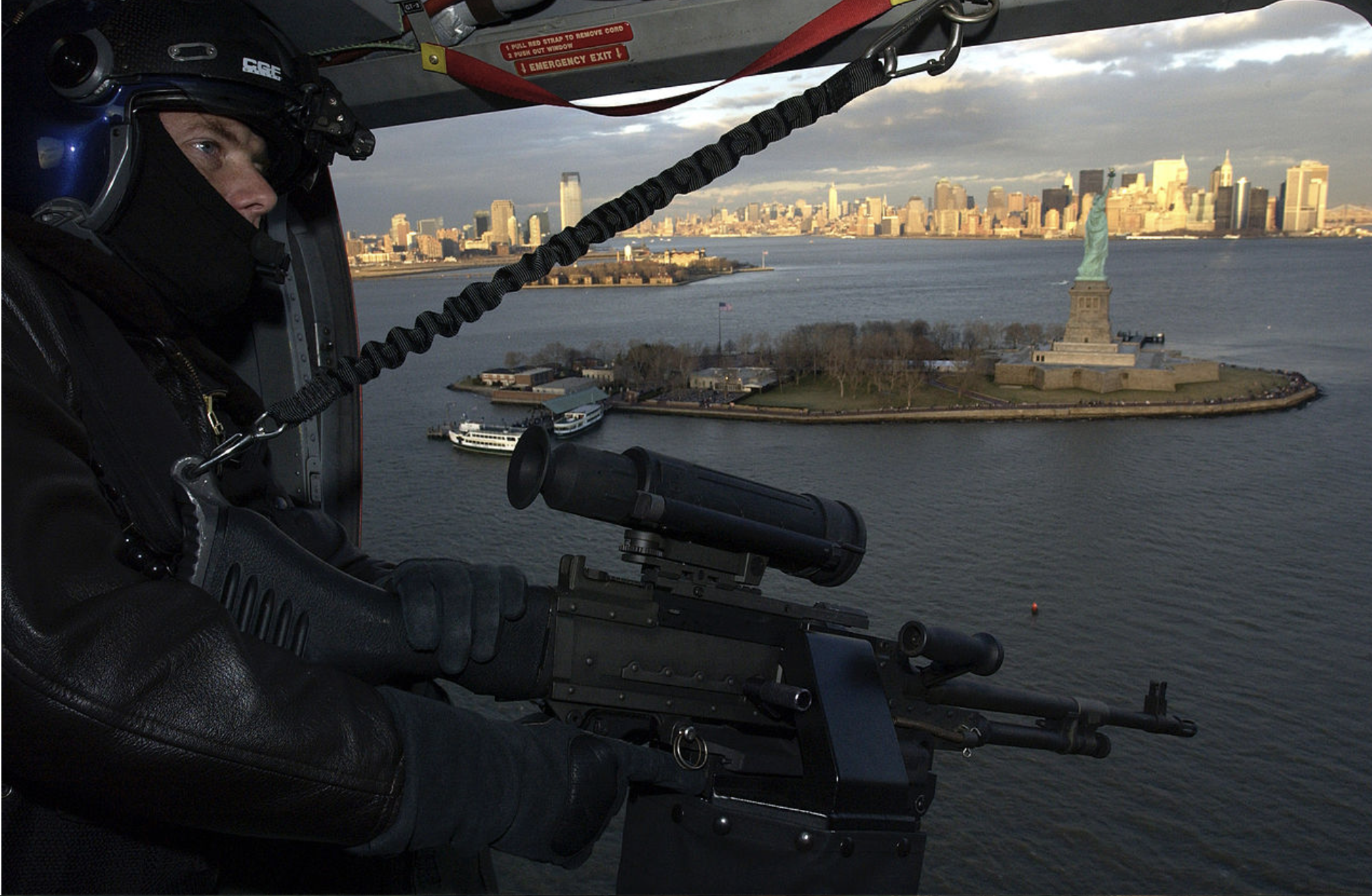
“Epirus Introduces Leonidas H2O, High-Power Microwave System for Maritime Interdiction and UAV Protection” –Naval News

Naval News reports,

April 8, 2025—Epirus announced today the introduction of Leonidas H2O, a, high-energy, high-power microwave (HPM) system developed to counter boat motors, unmanned surface vessels (USV) and unmanned aerial vehicles (UAV). The system is built using the scalable Leonidas energy-based, high-power microwave technology platform.

Leonidas H2O demonstrated effectivity against vessel motors at record ranges during the U.S. Navy’s Advanced Naval Technology Exercise Coastal Trident (ANTX-CT) program, during which the system was tested against four commercially available vessel motors ranging from 40 to 90 horsepower at a multitude of ranges.

The Company website is here.

Watch the video. Looks like something the Coast Guard might be interested in.

“Coast Guard Force Design 2028” –News Release

The U.S. Coast Guard’s headquarters campus in Washington, D.C.

Below is a Coast Guard News Release.

It is too early to say where these changes will take the Coast Guard, but both the acting Commandant and the Senior Advisor to the Secretary for the Coast Guard (SASCG) Mr. Sean Plankey, are Coast Guard Academy graduates (class of 1987 and 2003). Both seem to be firmly grounded in the military nature of the Coast Guard. Both have spent a lot of time in close contact with DOD.

“Force Design 2028 is the way we will become a more agile, capable, and responsive fighting force (emphasis applied–Chuck) to best serve the American people,” ADM Lunday said.

Some of the steps outlined in Force Design 2028 appear specifically intended to move the Coast Guard closer to DOD.

–Align with the DoD’s “Rapid Force-Wide Review of Military Standards” for physical fitness, body composition, and grooming standards. We’ll follow DoD standards to the maximum extent possible and build processes that are necessary to ensure total force readiness.

–Increase Coast Guard engagement with the Defense Innovation Unit (DIU) to accelerate technology and capability acquisition and adoption by leveraging leading edge disruptive technology development in the private sector. This includes increasing our footprint at DIU and maximizing the number of training allowance billets available at the DIU Immersive Commercial Acquisition Program.

I certainly see a need for more attention to the Coast Guard’s Defense Readiness Mission and to Ports, Waterways, and Coastal Security.

My impression is that the Coast Guard will be increasingly focused on protecting the Maritime Transportation System, particularly in cyberspace.


April 3, 2025

Coast Guard Force Design 2028

By MyCG Staff

Acting Commandant Kevin E. Lunday recently announced Force Design 2028 (FD 2028). Directed by Department of Homeland Security Secretary Kristi Noem and led by the Senior Advisor to the Secretary for the Coast Guard (SASCG) Mr. Sean Plankey, FD 2028 is creating a blueprint to ensure the Service is ready for the future and the Nation’s demands.

“Force Design 2028 is the way we will become a more agile, capable, and responsive fighting force to best serve the American people,” ADM Lunday said.

FD 2028 is focused on four campaigns:

  • People
  • Organization
  • Acquisition and Contracting
  • Technology

Here are some details about each campaign, including some of the first steps already underway. Additional details can be found in ALCOAST 155/25.

People
We are building the Coast Guard’s future force, starting today. Increased national demand for our Coast Guard requires a larger, more capable military workforce. This campaign will improve training systems, boost access to medical care, and modernize both the Coast Guard Reserve and the civilian management system.

Early actions:

  • Align with the DoD’s “Rapid Force-Wide Review of Military Standards” for physical fitness, body composition, and grooming standards. We’ll follow DoD standards to the maximum extent possible and build processes that are necessary to ensure total force readiness.
  • Starting in Promotion Year 2026, best qualified selection boards will be required to employ in-zone reordering to the maximum authorized by law to reorder those officers of particular merit for promotion.
  • Remove administrative burdens on our members by reducing reporting and other requirements that are redundant and of little value. (See ALCOAST 145/25 for details.)
  • Restore maximum Commander and Officer-in-Charge discretion and flexibility in their use of non-judicial punishment (NJP) under Article 15 of the Uniform Code of Military Justice (UCMJ).  This change is consistent with the ultimate responsibility entrusted to commanders to maintain good order and discipline at their units.

Organization
As global security threats, technological advancements, and operational demands continue to evolve, the Coast Guard must adapt its organizational construct and internal decision making and governance processes to remain relevant, effective, and responsive.

Early actions:

  • Delegate operational authorities to the appropriate level of command to increase mission effectiveness and reduce risk to Coast Guard personnel. The recent delegation of non-compliant vessel use of force authorities to pursuit coxswains and cutter commanding officers is one example that empowers those at the tactical edge with the authorities, capabilities, and effective command and control needed to deliver operational results.
  • Establish a USCG HQ Director of Staff, reporting to the Vice Commandant, who is responsible for streamlining executive decision-making, enhancing agility and integration, aligning strategic messaging, and optimizing HQ processes.
  • Restructure the Deputy for Personnel Readiness (DPR) enterprise to optimize support for our most valuable resource-our people. This transformation establishes a comprehensive, people-centric approach across four business lines: accessions and training, total workforce management, workforce and family services, and healthcare delivery. We will separate policy/program management from service delivery to best meet the needs of our people.
  • Restructure the Deputy for Materiel Readiness (DMR) enterprise to focus on a systems approach to assets, ensuring the Coast Guard has the right capabilities, in the right place, at the right time. This transformation includes creating new business lines to oversee the total lifecycle management of our surface, air, C5I, and shore infrastructure, and integrating acquisition and sustainment functions for greater efficiency and effectiveness.
  • Establish the Assistant Commandant for Operational Integration and Response Policy (CG-3/5R) to align operational integration and planning at the Service level to increase decision-making speed and resource allocation to our operational commanders and advance national level planning and preparedness while increasing situational awareness for the Secretary, Department, Joint Staff, and Interagency partners.

Acquisitions and Contracting
Develop a high velocity acquisition and contracting system to rapidly deliver the assets the Service needs to fulfill its commitment to the American people.

Early actions:

  • Eliminate or minimize bureaucratic delays to delivering the assets the Service needs. An example is the recent elevation the Simplified Acquisition Procedures and micro- purchase limits to the maximum extent allowed by law and regulation, ensuring rapid distribution of goods and services to the field units charged with carrying out our front-line missions.
  • Increase Coast Guard engagement with the Defense Innovation Unit (DIU) to accelerate technology and capability acquisition and adoption by leveraging leading edge disruptive technology development in the private sector. This includes increasing our footprint at DIU and maximizing the number of training allowance billets available at the DIU Immersive Commercial Acquisition Program.
  • Improve the speed of contracting and procurement by empowering our contracting professionals in the field, reducing redundant and sequential approval and review process that add unwarranted mission risk.
  • Provide improved transparency and accountability in the contracting process through development of a quick-to-field contract tracking system and establish clear metrics and targets that consider mission impact.

Technology
The Coast Guard will accelerate the adoption of secure, state-of-the-market technologies to enhance data sharing, situational awareness, and operational effectiveness.

Early actions:

  • Leverage efficient industry solutions to dramatically accelerate the Authority To Operate (ATO) process for Information Technology systems and achieve the goal of ATOs in 30 days. This will begin with the Software Factory and minimize bureaucratic delays to deliver essential capabilities required for Coast Guard mission success.
  • Establish data teams in each mission domain to make sure we’re fully leveraging data to improve operations.
  • Establish a Rapid Response Rapid Prototype Team to transform how we deliver mission-critical technology solutions. This effort will span operations, engineering, acquisitions, finance, information technology, logistics, data science, and change management/integration – delivering proven innovation where it matters most.

How we will stay on course

An FD 2028 implementation team comprised of permanently assigned military and civilian personnel is being established and will report to the new Director of Staff.  The team will coordinate a Coast Guard wide effort to implement the Secretary’s intent on FD28 as well as continue the actions already started.

“We are executing transformational change to renew the Coast Guard,” said ADM Lunday.  “Force Design 2028 will ensure the Coast Guard remains Semper Paratus, Always Ready, to serve the American people.”

This Day in Coast Guard History, April 9

Based on the Coast Guard Historian’s timeline, https://www.history.uscg.mil/research/chronology/
With inspiration from Mike Kelso

April 9

Mark Twain, age 31, 30 September 1867

1859  Samuel Clemens, who later gained fame as a writer under the pseudonym Mark Twain, was issued a steamboat pilot’s certificate.

REVENUE CUTTER LINCOLN

1867  The Senate ratified a treaty to purchase Alaska from Russia.  The cutter Lincoln was dispatched with LT George W. Moore, USRM, as the first U.S. agent in the territory.

USCGC Northland, 1944

1941  The United States and Denmark signed an “agreement relating to the defense of Greenland.”  The Coast Guard, in part because of its experience in the Arctic environment, was the principal service used to carry out the agreement.  The first action seen by U.S. forces in World War II was the seizure of a weather station and a pro-German vessel in Greenland waters by CGC Northland just before the U.S. officially entered the war.

USCGC Cleat (WYTL-65615)

1974  The oil tanker Elias docked at the Atlantic Richfield Terminal in Fort Mifflin, Pennsylvania, caught fire.  CG-40412 responded and was first on scene and began SAR for any crew who jumped overboard.  CG-40412 crewman Kim Lee remembered: “The response for our crew on 40412 was looking for personnel off the ship Elias that might be in the water.  We were first on scene and I called back to base giving the update.  The request by us was to shut the Delaware River down to all traffic due to crude oil on fire extending completely across the Delaware River.  Captain of the Port (Capt. Goodwin) shut the river down which stopped all vessels traffic in the area.  A while had passed and we then received a distress call from the Coast Guard Cutter Cleat and we quickly responded toward the Cleat.  The crewmen from the Cleat were in the water and the Cleat was on fire and drifting into the Elias which was totally involved in fire.  My crew (Petty officer Joe Friel and Allen Mowbray) began pulling the crew out of the river.  We then attached a tow line on the burning Cleat and began towing it toward the middle of the channel.  At one point while towing the Cleat our engines on the 40412 stopped because of the ships (Elias) mooring lines in our props.  My crew quickly pulled up the mooring lines and cut them apart with a hand ax.  Freeing one engine we were able to pull the Cleat to safety and put out the fires on the Cleat.  All members of the Cleat crew were accounted for but one engine men who we found still down in the engine room trying to start the Cleat’s main.”

“Rolling Airframe Missiles To Arm Arleigh Burke Destroyer Fleet” –The War Zone / Will NSCs get the Upgrade? OPCs?

SeaRAM

The War Zone Reports,

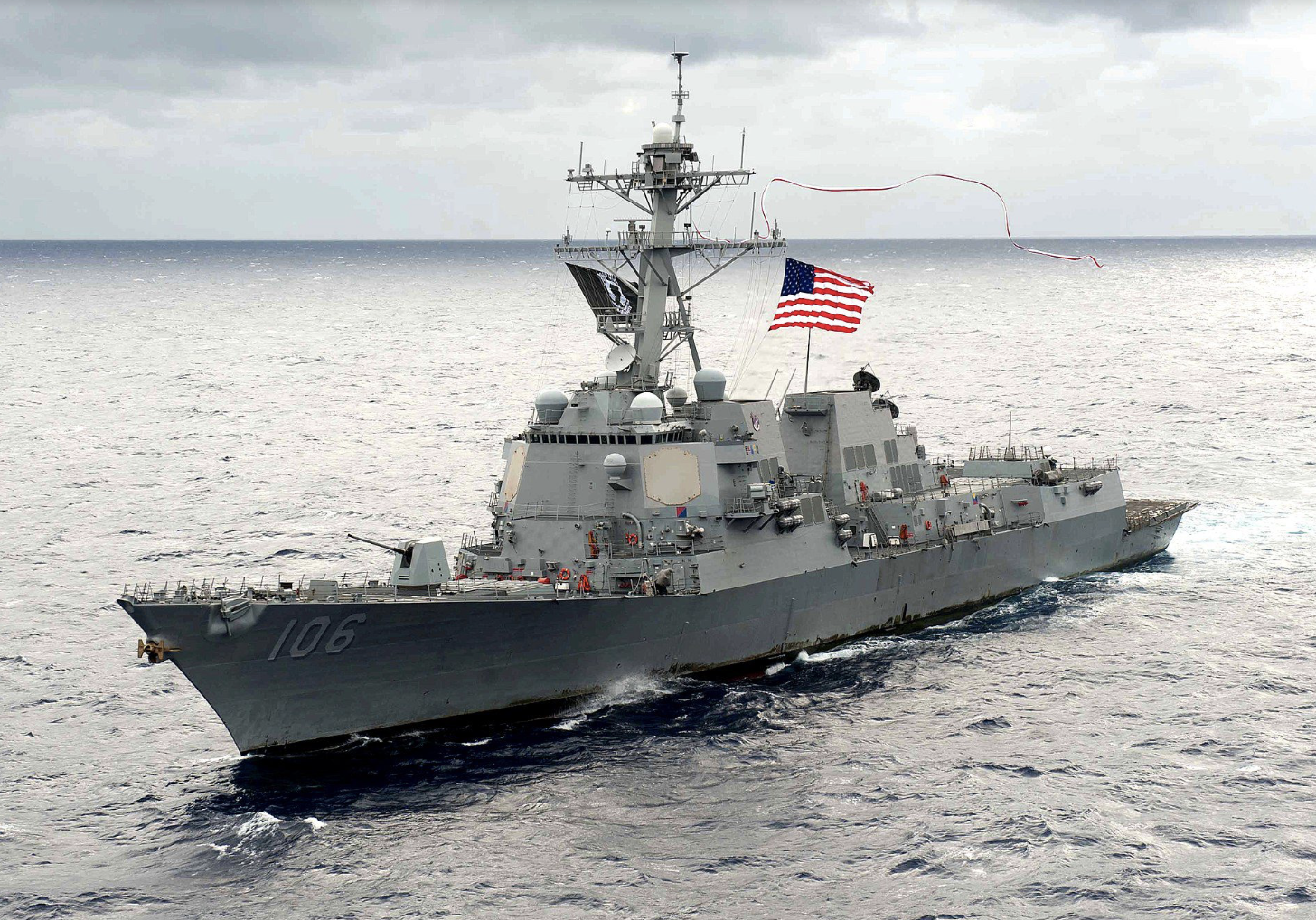
The U.S. Navy plans to add RIM-116 Rolling Airframe Missiles(RAM) to the arsenals of its Arleigh Burke class destroyers to boost their defenses against incoming cruise missiles, drones, and other air and surface threats. RAM launchers will take the place of existing 20mm Vulcan cannon-armed Mk 15 Phalanx Close-in Weapon Systems (CIWS), but the exact final configuration will differ depending on the sub-class of ship.

Replacing the Phalanx with SeaRAM on National Security Cutters would be a major improvement in their ability to survive an air attack. It has much greater range and greater ability to deal with multiple targets, as well as much better anti-surface capabilities, than the Phalanx which has an absolute max range of about three miles and an effective range of about one mile.

It is an easy swap.

The SeaRAM combines the radar and electro-optical system of the Phalanx CIWS Mk-15 Block 1B (CRDC) with an 11-cell RAM launcher to produce an autonomous system—one which does not need any external information to engage threats. Like the Phalanx, SeaRAM can be fitted to any class of ship. Due to the common mounting, SeaRAM inherits the relatively easy installation characteristics of its gun-based sibling, with Raytheon stating that SeaRAM “fits the exact shipboard installation footprint of the Phalanx, uses the same power and requires minimal shipboard modification”. In 2008, the first SeaRAM system was delivered to be installed on USS Independence.

The Missile: 

RAM or Rolling Airframe Missile, RIM-116, is a relatively small, relatively cheap, quite  mature weapon system having its Initial Operational Capability in 1992. Fitting SeaRAM would bring the NSC’s weapons fit more in line with that of the LCSs which are also fitted with the 57mm Mk110 and RAM. RAM is currently fitted on virtually every US Navy surface combatants other than cruisers which will soon be decommissioned and the destroyers that will be getting the system.

Anti-Surface Capability:

RAM would also provide an enhanced anti-surface capability. SeaRAM would be an excellent complement to the 57mm Mk 110. The 57mm has a greater maximum range than the RAM, but effective ranges are similar, at five to six miles. SeaRAM has only eleven rounds immediately available, but it’s combination of high hit probability, Mach 2+ speed, 164 pound mass, and a 1.3 kg (24 lb 15 oz) warhead means it can inflict significant damage quickly.

(Eleven rounds times 164 pounds equals 1804 pounds. That mass is equal to 340 rounds of 57mm HE and the RAM probably has a higher hit probability.)

Why isn’t the Navy Converting all Phalanx?

The fact that the Navy is not replacing all Phalanx systems with SeaRAM might suggest they don’t believe RAM is necessary for all classes, but, actually, every US Navy combatant that has a Phalanx, also has a longer ranged missile system. If they don’t have the longer ranged Standard or ESSM missile systems, then they have RAM, many have more than one.

Hopefully all Coast Guard NSC Phalanx systems will be replaced by SeaRAM.

The Offshore Patrol Cutter:

For many potential naval missions, OPCs are interchangeable with the NSCs. They probably should be similarly equipped. If the NSCs need SeaRAM, the OPCs need it more.


This Day in Coast Guard History, April 8

Based on the Coast Guard Historian’s timeline, https://www.history.uscg.mil/research/chronology/
With inspiration from Mike Kelso

April 8

U.S.R.C. Onondaga, America’s Cup races, 1901. Library of Congress.

1902  President Theodore Roosevelt, Jr., and his party of 40 guests boarded USRC Onondaga in Charleston Harbor.  The cutter, which had been dressed in “rainbow fashion,” extended to the President “all honors as prescribed by the Regulations, Revenue Cutter Service.”  The cutter and its crew of transported them to Fort Sumter and back. The cutter expended “42 6 pdr saluting charges” by firing two separate 21-gun salutes.

1909  Race Point, Massachusetts: The sloop Keewaydin IV’s mast was carried away and the sloop anchored 2 miles SW of station, but dragged ashore.  Station crew was on the beach when she struck and the keeper rowed out surf and threw a heaving line on board.  One of the two men was rescued by this means.  The other jumped overboard and was pulled ashore by the keeper.  The sloop drifted up on the beach and became a total wreck.

USRC Seneca, 1908

1913 USRC Seneca, designed from the keel up as the nation’s first “derelict destroyer,” inaugurated the service’s participation in the International Ice Patrol.

SAULT SAINT MARIE, Mich. (Sept. 15)–The Coast Guard Cutter Katmai Bay (WTGB 101) is tied to the pier at Group Sault Saint Marie, Michigan. USCG photo by PA1 Harry C. Craft III

1978 CGC Katmai Bay was launched at Tacoma Boatbuilding Company, Inc., in Tacoma, Washington.  Katmai Bay was the first cutter in the Coast Guard’s new class of icebreaking harbor tugs.  The cutter was sponsored by Ms. Jeanmarie Griffin.

Coast Guard Cutter Polar Star (WAGB 10) visited Palmer Station, a United States research station on the Antarctic peninsula, March 3, 2023, after completing a successful deployment in support of Operation Deep Freeze 2023. This was the Coast Guard Cutter Polar Star’s first visit to Palmer Station in 35 years. Operation Deep Freeze is one of many operations in the Indo-Pacific in which the U.S. military promotes security and stability across the region. (U.S. Coast Guard photo by Petty Officer 3rd Class Aidan Cooney)

2023 CGC Polar Star returned to Seattle 8 April 2023 following a 144-day deployment to Antarctica. The deployment marks the ship’s 26th journey to Antarctica as part of Operation Deep Freeze, an annual joint military service mission to resupply the United States Antarctic stations. Polar Star departed Seattle on 14 November 2022, traveling more than 25,000 miles through the North Pacific, South Pacific, Indian, Southern, and South Atlantic Oceans. While en route, the crew made two stops in Australia. After arriving in Antarctica, the cutter broke a 15.3-mile channel through fast ice to create a route for cargo vessels to reach McMurdo Station. The cutter then departed the Antarctic region on March 2. On the return journey, the ship crossed the Drake Passage, rounded Cape Horn, and stopped in Chile. At the stop in Valparaiso, Chile the Polar Star’s crew conducted exchanges with the Chilean Navy and First Naval Zone members. “The completion of this mission is a testament to our crew’s hard work, sacrifice, and dedication,” said CAPT Keith Ropella, Polar Star’s commanding officer.

This Day in Coast Guard History, April 7

Based on the Coast Guard Historian’s timeline, https://www.history.uscg.mil/research/chronology/
With inspiration from Mike Kelso

April 7

Photograph of Ellsworth P. Bertholf, Commandant of the U.S. Revenue Cutter Service from 1911 to 1915 and Commandant of the U.S. Coast Guard from 1915 to 1919. Coast Guard photo.

1866  The first Commandant of the U.S. Coast Guard, Ellsworth P. Bertholf, was born in New York City.  He entered the Revenue Cutter Service as a cadet on September 14, 1885 and graduated from the Revenue Cutter School of Instruction with the Class of 1887.

1938  Congress passed HR 8982, an amendment to the Alien Fishing Act (50 Stat. 639).  The amendment clarified the earlier laws on salmon fishing in Alaskan waters by limiting commercial salmon fishing in the vicinity of Bristol Bay, Alaska, to U.S. citizens only.  The act was enforced by the Coast Guard.

HMT Bedfordshire one of over 20 Royal Navy trawlers dispatched to the US to escort coastal convoys, sunk by the German submarine U-558 on 11 May 1942 off the coast of Ocracoke Island in the Outer Banks of North Carolina, with the loss of all hands.

1942  A Coast Guard aircraft directed a Royal Navy trawler to a life boat with 24 survivors off the coast of North Carolina.

1952  The breakup of ice in the Missouri River and its tributaries at Bismarck, North Dakota, and above, and on the Big Sioux, created the worst flooding conditions in that area in thirty years.  U.S. Coast Guard personnel rendered assistance, utilizing small boats, mobile radio stations, automotive equipment, helicopters, and fixed wing aircraft.  The Coast Guard evacuated stranded persons, transported critical relief supplies, evacuated livestock from low ground, transported personnel engaged in levee construction, and generally assisted the Red Cross, local, state, civil, and military authorities.

“Taking Stock of China’s Polar Fleet” –The Diplomat

Aerial view of China’s icebreaker Xue Long 2 berthing at the pier of Qingdao Olympic Sailing Center on July 3 in Qingdao, Shandong Province of China.
This icebreaker, delivered in 2019 and with a displacement of about 14,000 tons, is said to be the first icebreaking vessel capable of breaking polar ice with both its bow and stern in the world.

The Diplomat provides an unusually balanced assessment of China’s current icebreaker competence. It also projects their growing technical development.

It looks at the relationship between China and Russia in the Arctic, opportunism but with some degree of distrust.

Xue Long 2. Snow Dragon 2 China icebreaker

China’s largest and most capable icebreaking research vessel, Xue Long 2. Snow Dragon 2, sails in Antarctica’s Prydz Bay in this aerial photo taken on Nov. 19, 2019

It talks about the Chinese military’s interest in polar regions, not just the Arctic, they see the Antarctic as an area of possible future conflict.

Aerial view of China’s icebreaker Ji Di berthing at the pier of Qingdao Olympic Sailing Center on July 3 in Qingdao, Shandong Province of China.
© Sun Qimeng/VCG via AP

Also of interest is the growing number of ships of various types that are not icebreakers, in the usual sense of a ship that breaks ice to allow other ships to pass, but are ships of various types that are simply designed to operate independently in ice covered waters.

China’s first icebreaker, Ukrainian built, Xue Long 1. Snow Dragon 1

This Day in Coast Guard History, April 6

Based on the Coast Guard Historian’s timeline, https://www.history.uscg.mil/research/chronology/
With inspiration from Mike Kelso

April 6

Men killing fur seals on St Paul Island, Alaska, 1890s.

1894  The President authorized the Revenue Cutter Service to enforce the Paris Award, which was concerned with the preservation of fur seals in Alaska.

Miami-class cutter USCGC Tampa photographed in harbour, prior to the First World War. Completed in 1912 as the U.S. Revenue Cutter Miami, this ship was renamed Tampa in February 1916. On 26 September 1918, while operating in the English Channel, she was torpedoed and sunk by the German Submarine UB-91. All 131 persons on board Tampa were lost with her, the largest loss of life on any U.S. combat vessel during the First World War. Official U.S. Navy photo NH 1226 from the U.S. Navy Naval History and Heritage Command

1917  The United States declared war on Germany and joined the Allied Powers in World War I.  The Coast Guard, which at that time consisted of 15 cruising cutters, 200 commissioned officers, and 5,000 warrant officers and enlisted men, became part of the U. S. Navy by Executive Order.  The cutters immediately reported to their assigned naval districts for duty.  Cutters provided armed parties to seize German ships that had been interned in U.S. ports.  Coast Guard aviators were assigned to naval air stations in this country and abroad.  One Coast Guardsman, First Lieutenant (Eng.) Charles E. Sugden, USCG, commanded the Naval Air Station at Ile Tudy, France, and was later awarded the French Chevalier of the Legion of Honor.  Another officer, Second Lieutenant (Eng.) Philip B. Eaton, USCG, commanded Chatham Naval Air Station and he piloted one of two HS-1 seaplanes that attempted to bomb and machine gun a surfaced U-boat off the coast of New England after the U-boat had shelled a tug and barges four miles off Cape Cod.  Eaton’s bombs failed to explode, however, and the U-boat escaped.  One cutter, CGC Tampa, was lost in action with all hands while on convoy duty in British waters.

“HOIST PICK-UP DEMONSTRATION: A Coast Guard HO3S helicopter from the Coast Guard Air Station Elizabeth City, N.C., demonstrates the use of hydraulic hoist to pick up a man from the ground during the American Helicopter Society Show at Anacostia Naval Air Station, Washington, D.C., April 28-29, 1951. The helicopter equipment has proved invaluable in effecting rescues in areas inaccessible by any other means.”; no photo number; April 1951; photographer unknown.
Note the rescue litter basket slung beneath the HO3S’s fuselage.

1949  A U.S. Coast Guard H03S-1 helicopter completed the longest unescorted helicopter ferry flight on record.  The trip from Elizabeth City, North Carolina to Port Angeles, Washington via San Diego, a distance of 3,750 miles, took 10-1/2 days to complete and involved a total flight time of 57.6 hours.

“Sen. Rick Scott Announces Bill to Establish a Secretary for the U.S. Coast Guard”

The U.S. Coast Guard’s headquarters campus in Washington, D.C.

Senator Rick Scott (R-FL) has announced introduction of a bill to establish a Secretary of the Coast Guard, who would in turn report to the Secretary of Homeland Security. This would parallel the Secretary of the Navy’s relationship with the Secretary of Defense, but then the DOD budget is five times that of DHS, and, in fact, the Navy Department budget is 50% larger than the entire DHS  budget.

The Maritime-Executive has a report on this, written by K. Denise Rucker Krepp that attributes this move to the Fouled Anchor controversy which investigated alledged coverup of mishandling of allegations of racism, hazing, discrimination, sexual harassment, sexual assault, and rape.

My own feeling has always been that when within a local jurisdictions, violations of local laws, particularly sexual assault and rape, should be handled by local law enforcement.

The caption on the photo above, as it appears in the Maritime-Executive report states, “Unlike the other armed forces, the service has no civilian leader.” This is not really true. The Coast Guard is under the Secretary of Homeland Security. Similarly there is no “Secretary of the Marine Corps,” a much larger military service than the Coast Guard, with a budget almost four times as large, but they do fall under the Secretary of the Navy and do in fact have civilian leadership.

Creating a Secretary of the Coast Guard would not just add one civilian political appointee, he would need a civilian staff. This would be a whole new level of bureaucracy between DHS and the Coast Guard, and we know how well “Gossip Games” go. Meanwhile there is nothing that stops the Secretary DHS from having part of his staff specialize in oversight of the Coast Guard. 

I will take this opportunity to state, I think the Coast Guard should be an independent agency, like NASA or the EPA. The Federal Government has lots of them. The Coast Guard has no shortage of oversight from Congress and the Coast Guard’s eleven missions don’t really fit neatly in any existing department. It would cut out an entire level of bureaucracy.

It might be assumed that a Secretary of the Coast Guard would support the service, but could they really do a better job of representing the service or perhaps they would have a different agenda. This might even lead to civilianizing or politicizing the service.

This Day in Coast Guard History, April 5

Based on the Coast Guard Historian’s timeline, https://www.history.uscg.mil/research/chronology/
With inspiration from Mike Kelso

April 5

USCGC Itasca as HMS Gorlsston

1941  President Franklin Roosevelt signed the official order to transfer all 10 Coast Guard Lake-Class cutters of the Coast Guard to the Royal Navy under Lend-Lease.

HMS WALNEY, formerly USS SEBAGO, after refit. Underway in coastal waters. Tomlin, H W (Lt), Royal Navy official photographer – This photograph A 5322 comes from the collections of the Imperial War Museums (collection no. 4700-01)

1950  The Coast Guard announced that former enlisted women of the Coast Guard Reserve could apply for enlistment in the “Women’s Volunteer Reserve.”  Enlistments were to be for a three-year period with written agreement to serve on active duty in time of war or national emergency.

1967  The commander of all Soviet fishing vessels in the Far East, Evgeniy Gromov, invited representatives from the Coast Guard and the Bureau of Commercial Fisheries to meet aboard the Soviet vessel Olivtorka off Kodiak, Alaska.  The purpose of the meeting was to improve understanding in the implementation of the recent U.S.-Soviet 12-mile fisheries agreement that went into effect on March 15, 1967.