“Infrastructure protection, resource competition among Arctic warming concerns, says State’s Papp”

FierceHomelandSecurity is reporting testimony by former Commandant, Admiral Papp in his new role as U.S. Special Representative for the Arctic at the State Department.

The melting of the permafrost that Adm. Papp mentions, is one reason the Coast Guard will not be establishing much in the way of permanent, shore-based infrastructure in the Arctic.

UAS for the Webber Class?

Coast Guard Compass is reporting that the R&D Center has conducted tests of an unmanned aerial surveillance system from the Webber class WPC Richard Etheridge.

The experiment is being done on the cheap, using surplus Marine Corp WASP III UAS.

This particular aircraft is very small (less than a pound), with a maximum speed of about 40 knots, an endurance of about 45 minutes, and a nominal range of 5 km, so it is not going to get very far from the launch platform. Sensors are limited to color and IR video, so it is still like “looking through a staw” in terms of its ability to search, but it might be useful for taking a closer look at targets, without the necessity of moving the CG vessel to intercept, particularly at night; for documenting a drug bust; or for keeping an eye on the disengaged side of a potentially hostile target during a boarding. The recovery method used was to land in the water, but we could certainly do better.

I can’t say I am particularly impressed with what I have seen of the system so far, since I can pick up something similar at the local hobby shop (google “First Person Video”). I have a friend who flies one, including the ability to use GPS to fly way-points and automatically return to the launch point and land, all for less than $1,000, but it is a start and at least it is a recognition of a need and an opportunity.

Still think we could fly Scan Eagle from the WPCs.

Navy Chooses Existing LCS Designs as Basis for Small Surface Combatant

LockheedSSC
Photo: A modified Littoral Combat Ship design based on the Lockheed Martin Freedom-class. US Navy Image. Click on the image to enlarge. Note the USNI post also includes an image of a modified Independence class LCS

USNI is reporting that the existing Littoral Combat Ship designs will be modified to become the new Small Surface Combatant. It is not clear if they mean they will continue to build two designs in parallel, or if they mean they will select only one of the two. Perhaps there will be a competitive bid.

In spite of apparently incorporating all the elements of both the anti-submarine and anti-surface modules plus over-the-horizon Anti-Ship Cruise Missiles, it is reported they will have a lighter displacement than the existing LCSs. Surprisingly they apparently will not include VLS, but will include a multi-function towed array sonar, over the horizon ASCMs, upgraded radars, EW, and Cruise Missile decoy systems, torpedo countermeasures, a Mk38 Mod2 25 mm, and additional armor, in addition to the Mk110 57mm, two Mk46 30mm, Hellfire, MQ-8 UAVs and HM-60 helicopters. Both designs will use SeaRAM.

The question for the Coast Guard now is, how much commonality with this new class can be incorporated into the Offshore Patrol Cutter either as equipment actually installed or as equipment fitted for but not with? The more commonality that can be achieved, the more supportable the ships will be over the long haul.

The world seems to be becoming a more dangerous place, where the US may need every warship it can muster. We cannot afford the luxury of building the OPCs without wartime potential.

Special Operations Command, Combatant Craft, Medium

Combatant_Craft_Medium_Mark_1_CCM-Mk1_USSOCOM_2

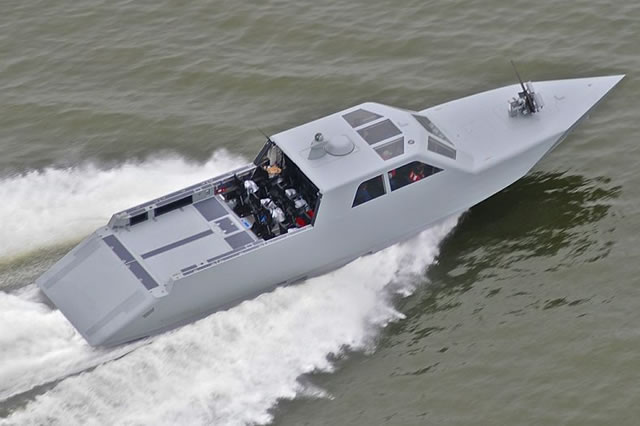
Navy Recognition has a story on the Navy’s planned 60 foot “Combatant Craft, Medium” or CCM.

Characteristics as follows:
CCM Mk1 main characteristics (as provided by USSOCOM):
Length: approximately 60’
Speed: 40
Range: 400 nautical miles
Crew: 4
Payload: 7750 lbs.
Passengers: up to 19
Engine: Twin forced induction diesel engines driving props
Hull: Double step hull made of aluminum

See the story linked above for more photos and details.

Monster Offshore Facility

The New York Times calls it, “The Biggest Ship in the World (Though It Isn’t Exactly a Ship)”

“It’s called Prelude, and it’s bigger than big. More than 530 yards long and 80 yards wide, it was constructed with 260,000 metric tons of steel, more than was used in the entire original World Trade Center complex, and it’s expected to displace 600,000 metric tons of water, or as much as six aircraft carriers.”

This one is to be anchored in North West of Australia, but if one comes to the US EEZ, it is going to be an incredible Marine Inspection task.

Coast Guard In a “Death Spiral?”

Dec. 4, the US Naval Institute had a seminar, “Defense Forum Washington 2014, What Does the Nation Need from its Sea Services?” VAdm Charles D. Michel, Deputy Commandant for Operations, was the Coast Guard representative on the panel discussion labeled “Sea Service Briefing.” He did a credible job of representing the Coast Guard. He also made some headlines when he said that the LCS was an excellent asset for drug enforcement, and eloquently presented a case for maritime drug interdiction.

But I would like to particularly recommend a portion of the presentation by Ron O’Rourke, who is the Congressional Research Service. He devoted the last few minutes of his presentation to the Coast Guard, beginning about minute 24:30. He does a better job of explaining the crisis in Coast Guard budgeting than I have ever seen done by any Coast Guard representative.

Looking at some of the other speakers, I learned that they have taken the program to replace the Ballistic Missile Submarine Force out of the regular navy shipbuilding budget. I think this is significant, because the effect of the SSBN replacement on the Navy ship building budget, is very similar to the effect of the heavy icebreaker procurement on the Coast Guard budget. Perhaps this might be used as a precedence for a special, separate appropriation for the icebreaker.

Fire Scout Operates from Bertholf

FIRESCOUTmq-8B

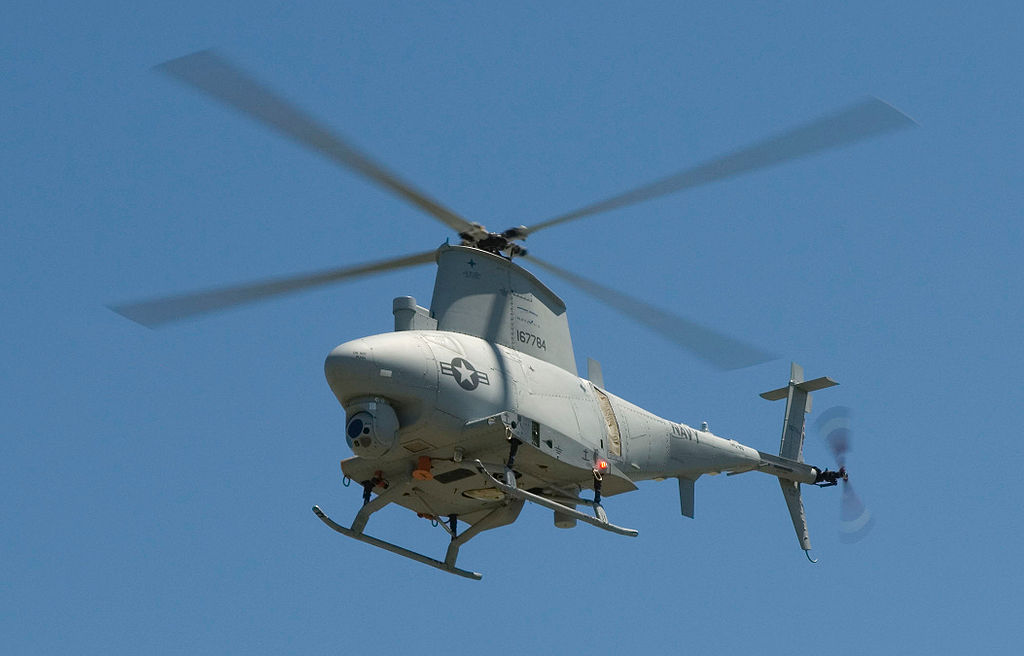
Photo credit: Jrfreeland , MQ-8B Fire Scout Vertical Unmanned Air System (VUAS) flies with the BRITE Star II electro-optical/infrared payload using a Tactical Common Data Link (TCDL) at Webster Field, Naval Air Station Patuxent River, Md.

DefenseNews is reporting Fire Scout is currently deployed on four ships including the Bertholf.

“On Dec. 2, the California-based Coast Guard cutter Bertholf got underway off Southern California carrying two Fire Scouts, the first time Coasties have operated the drone aboard a national security cutter.

“Not all the embarks are aimed directly at operational needs. The Coast Guard concept demonstration, Dodge said, “will show what they can do with a large-sized aircraft.” Fire Scout, he said, “is probably on the large side of potential solutions for their cutters. I think they’re still trying to sort out what their need is.”

“The Bertholf demonstration is using two 8Bs — one an instrumented test aircraft, the other fitted with a search radar, one of five Bravo models being upgraded with a small Telephonics ZPY-4 radar fitted in the nose.

“A full Fire Scout operating system wasn’t installed on the Bertholf for the tests, scheduled to run about two weeks. “Instead of fully integrating the mission control station into the ship, we put it in a conex box,” Dodge said.”

The Post talks about other on-going activity, production plans, and losses amoung the Fire Scout fleet.

Late addition, video of the Firescout MQ-8B operating from Bertholf:

Ice Capable Research Vessel “Sikuliac” Delivered NSF

SikuliaqOnAcceptanceTrials
Photo: Sikuliaq on Acceptance Trials

The Marine Log is reporting the delivery of a new ice capable research vessel to the National Science Foundation.

The 261-foot double-hulled vessel will be stationed at Seward Marine Center, its homeport in Seward, Alaska, where it will be tasked with year-round operation. The Sikuliaq is the first vessel in the U.S. academic research fleet capable of breaking ice up to 2.5 feet thick, making it uniquely equipped for polar and sub-polar research.

The Marine Log post focuses on the ship’s engineering plant which includes four MTU 4000 series diesels (the same series used in the Webber class) in a fully integrated diesel electric plant providing both ship’s service power and propulsion.

Earlier we talked about this ship, and the possibility of adapting the design as an Artic Patrol Cutter. My 2011 post includes a bit more detail about the ship. You can read it here.