The War Zone reports that Ukraine has equipped some of their unmanned surface vessels (USV) with machineguns to allow them to respond to Russian countermeasures including helicopters and jet fighters. The video above is from the perspective of the USV.
It is interesting but what if the Coast Guard was in the position of the defenders? The attacker could be any type of small, fast, highly maneuverable, surface craft, manned or unmanned.
Take a look at the video linked here and included in the “War Zone” post. A Russian Border Security Force Kamov Ka-29 helicopter is attempting to stop a USV using both a door gunner and a forward firing gun. What I see:
It is daylight–advantage helo
The helicopter is at relatively close range–advantage helo
The USV is not shooting back–advantage helo
It appears the helicopter is getting at least a few hits
What I am not seeing:
Any effect on the surface craft’s speed or maneuverability
Use of guided weapons that would quickly disable the surface craft at longer range
In this case the helicopter, which is taking no return fire, might be able to stay on top of the surface craft and complete the destruction of the USV, but if that had been the case, you would have thought the video would have included it. For some reason the mission appears to have been unsuccessful. The helicopter may have run out of ammunition or been low on fuel.
If there had been more than one attacking USV and/or their objective was nearby, the time taken to achieve a kill might be critical. If the surface craft has been firing back, the helicopter might have been lost in the attempt.
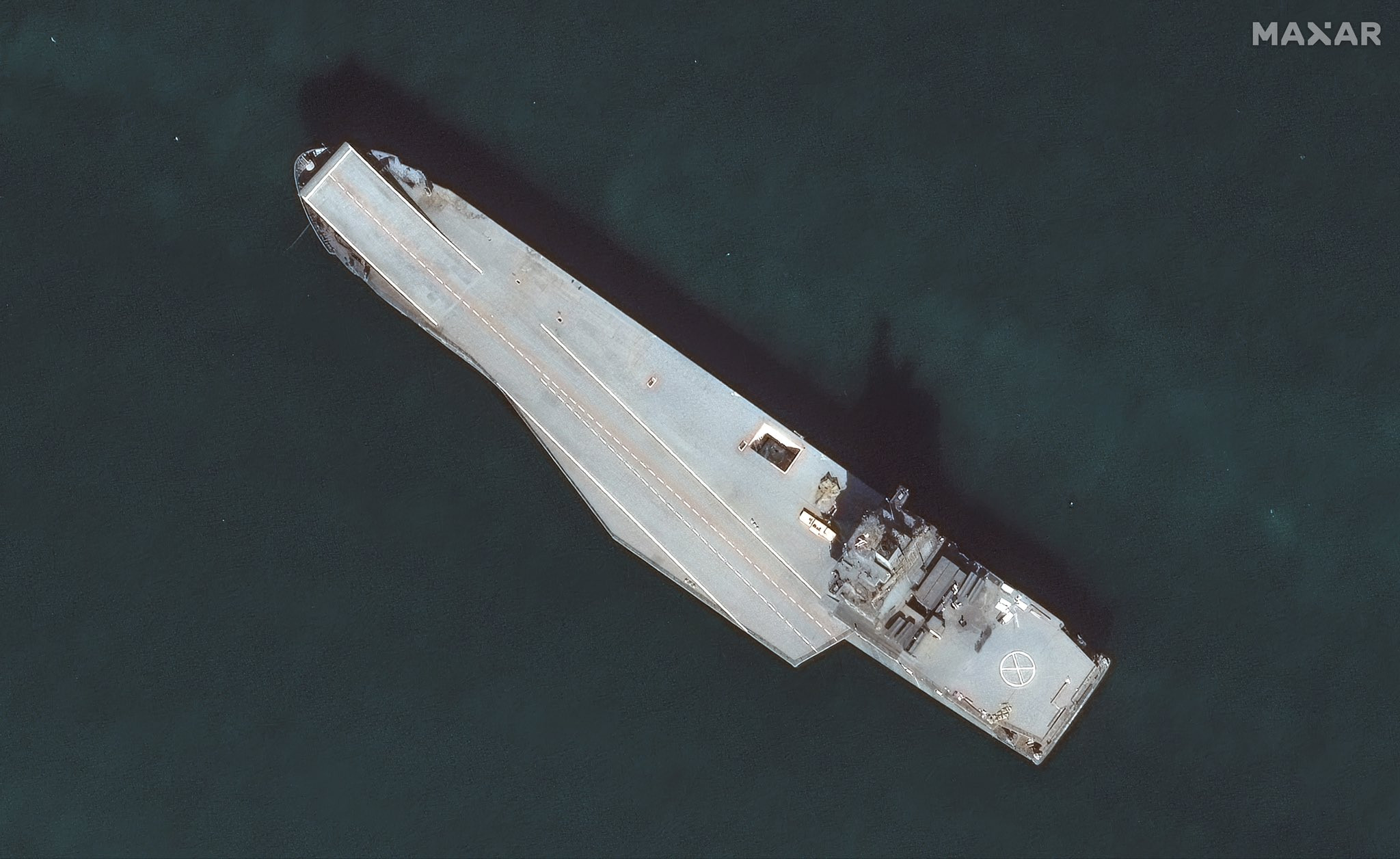
Satellite image of the drone carrier I.R.I.S. Shahid Bagheri (C-110-4) by Maxar Technologies. Note the open aircraft lift and boxed anti-ship missiles behind the superstructure. There appears to be a UAV under netting ahead of the superstructure. This may be a Gaza or similar type
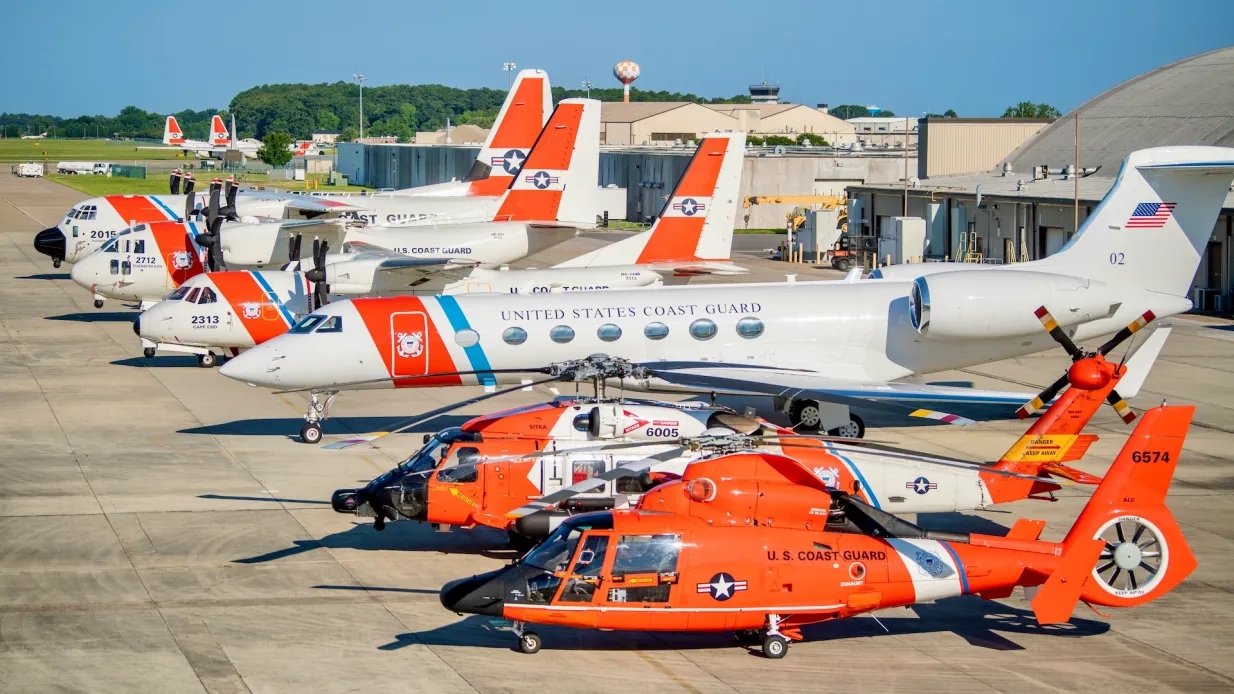
Every Coast Guard Aircraft Type Pictured Together In Rare ‘Family Photo’. Pictured: HC-130J, C-27J, HC-144, C-37B, MH-60T, MH-65E.
I have always been under the impression that the Coast Guard aviation fleet was better maintained than the cutter fleet. That, because of the more immediate and potentially fatal results of unreliability, the aviation part of the Coast Guard was immune from the insidious desire to “do more with less” that effects the cutter fleet. I may have been wrong.
The Coast Guard needs to move fast. The crisis in the Coast Guard’s rotary wing community not going away. As of early December, almost 18 percent of the Coast Guard’s 45-strong MH-60T “Jayhawk” medium range recovery fleet is out of service. Eight helicopters with over 19,000 flight hours are, as of now, permanently grounded….If the flight restrictions remain, the Coast Guard aviation—led by the hard-used Jayhawks—will run into serious peril. By late 2023, over 90 percent of the Coast Guard’s MH-60T helicopters were operating with more 16,000 flight hours, so, without a rollback to the Coast Guard’s original 20,000 flight hour target, several more Coast Guard Jayhawks are set to bump up against the new 19,000 flight hour limitation…Coast Guard leadership is finally showing signs of throwing in the towel and recognizing reality. A new aviation strategy is under development. In a December 10th email, a Coast Guard spokesperson wrote, “We are developing a comprehensive strategy for the future of Coast Guard Aviation,” that “will outline aircraft transitions across our rotary and fixed-wing fleets, as well as the potential development of an uncrewed fleet.”
–
Hopefully this is just the CG aviation community making a timely correction.
–
The current Coast Guard MH-60T program as outlined by the Acquisitions Directorate is here and I have reproduced the text below.
–
When I first heard about the grounding of H-60s due to the reduction in pre-SLEP operational life from 20,000 to 19,000 hours, it appeared to me that the Coast Guard should be able to continue to maintain at least the capabilities it had previously enjoyed as SLEPs had been completed on all MH-65s and newly SLEPed and additional remanufactured HMH-60Ts joined the fleet. In fact, a new H-60 air station has been opened, but perhaps the rebuilds are taking longer than expected, H-65s are proving difficult to maintain, and the effects of reduced operational life are cascading.
–
I have a lot of respect for the author, Craig Hooper. He has been very supportive of the Coast Guard.
… it is going to take a long time. H-65s will be with us until the early 2040s. The Coast Guard intends to increase its H-60 fleet to at least 127, up from 45. Currently the Coast Guard has 98 H-65s or a total 143 rotary wing aircraft. We may be looking at 16 fewer total aircraft, but that is in the distant future and not really a reason for concern. Somehow, I doubt the plan will remain unchanged for 20 years, nor should it.
Thanks to David V. for bringing this to my attention.
Consolidation of the Coast Guard’s rotary wing fleet to a single MH-60T airframe is necessary to mitigate sustainability challenges with the MH-65 short range recovery helicopter and maintain the service’s rotary wing capability until recapitalization in line with the Department of Defense’s Future Vertical Lift program.
How will the Coast Guard increase and sustain the fleet?
The Coast Guard established a service life extension program (SLEP) in 2017 to extend the service life of the 45 MH-60T aircraft currently in the fleet. These helicopters have been in service since 1990; without the SLEP, 90% of the MH-60T fleet would reach the end of its service life by 2028.
As part of the SLEP, the Coast Guard is replacing the hulls of the legacy airframes with hulls from two sources: retired U.S. Navy H-60 aircraft and newly manufactured hulls procured from the original equipment manufacturer, Lockheed Martin/Sikorsky.
The Navy hulls are being converted to the MH-60T configuration at the Coast Guard Aviation Logistics Center (ALC) in Elizabeth City, North Carolina.
The program awarded an indefinite-delivery, indefinite-quantity contact in January 2021 for the production of new hulls – consisting of three fuselage structure sections: the nose, mid (cabin) and transition – that will be engineered, manufactured and delivered in the MH-60T configuration. Use of new hulls provides an airframe service life of 20,000 flight hours, compared to an average service life of approximately 12,000 flight hours for the previously used Navy hulls.
The remaining production activities – including installation of new dynamic components such as rotors and electrical rewiring – for all hulls will also be completed at ALC.
In October 2023, the Coast Guard received approval from the DHS to proceed with acquisition program activities that expand on the original SLEP to include a component for fleet growth.
The MH-60T Acquisition/Sustainment Program is authorized to:
Move to full rate production of newly manufactured hulls as part of the SLEP for the existing MH-60T fleet.
Conduct Obtain Phase activities and execute low-rate initial production of 12 new aircraft that will transition three Coast Guard air stations currently operating with the MH-65 to the MH-60T.
Begin Obtain Phase activities for aircraft that will transition the remaining Coast Guard air stations to the MH-60T from the MH-65.
The SLEP is now known as Increment 1 of the program. To date, three aircraft have completed SLEP activities. Forty-five new hulls are currently under contract.
The first fleet growth phase, known as Increment 2 of the program, will organically produce 36 aircraft to convert eight air stations from MH-65 to MH-60T operations. The program has been authorized to produce the first 12 aircraft for this increment and will seek authorization from DHS to produce the remaining aircraft at a later date. Transition of the first air station under Increment 2 started in summer 2024.
The air stations not transitioned to MH-60Ts under Increment 2 will be converted as part of Increment 3 of the program. The final air station transition is anticipated to occur in the early 2040s.
The MH-60T Acquisition/Sustainment Program was initially chartered in 2017 to evaluate and implement technical and mechanical solutions for extending MH-60T use through the 2030s. On Oct. 31, 2023, the Department of Homeland Security gave approval to add acquisition program activities to the existing SLEP.
The sustainment effort is being implemented through form, fit and function replacements of the structural hull components, dynamic components such as the rotor, and electrical rewiring. Replacement of the structural hulls will be accomplished either through conversions of retired Navy SH-60F/HH-60H hulls into the MH-60T specification or through the procurement of newly manufactured hulls from the original equipment manufacturer that will be engineered, manufactured and delivered to the Coast Guard in the MH-60T specification.
The acquisition effort will start with the conversion of eight air stations from MH-65 to MH-60T operations through the organic production of 36 aircraft. The program has been authorized to produce the first 12 aircraft for this increment and will seek further authorization from DHS to produce the remaining aircraft.
The existing MH-60T avionics components and software will continue to be used and maintained on the replacement hulls through decommissioning and disposal.
Characteristics
Length: 64 feet 10 inches
Rotor Diameter: 53 feet 8 inches
Height: 17 feet
Maximum Weight: 21,884 pounds
Cruise Speed: 170 knots
Range: 700 nautical miles
Service Ceiling: 13,000 feet
Endurance: 6.5 hours
Crew: four
Features
Common avionics architecture system of digital glass cockpit instruments similar to those installed on the Coast Guard’s fixed-wing aircraft
Surface search radar and electro-optical/infrared sensors
Engines standard with the Department of Defense’s H-60 fleet
Five multifunction display screens
Sensor and hoist cameras
Integrated traffic collision avoidance system
7.62 mm machine gun for firing warning shots and a 7.62 mm shoulder-fired weapon for precise targeting, such as disabling engines on noncompliant go-fast vessels, can be installed
Standardized mission system components complementing capabilities and equipment installed on the Coast Guard’s upgraded MH-65 short range recovery helicopter
The Mobile Point Lighthouses prior to the American Civil War. They were destroyed during the Battle of Mobile Bay.
1835 The superintendent of the lighthouse system wrote to Winslow Lewis, “I perceive by a Mobile paper which I received this morning that the Mobile Point light has been fitted by you as a revolving light” similar to the nearby Pensacola lighthouse. “I am very sorry that you have done so.” Lewis was a contractor who – almost by himself a virtually controlled the administration of the lighthouse system. The incident helped cause a Congressional investigation that ultimately created a modern lighthouse system in this country.
1839 Near Gloucester, Massachusetts, a storm from the southeast caught and dragged ashore or drove to sea over fifty vessels. An eyewitness wrote: “From one of the beach to the other, nothing could be seen but pieces of broken wrecks; planks and spars…ropes and sails…flour, fish, lumber…soaked and broken…” The local fishermen manned two boats, the Custom House boat and the newly launched Revenue Cutter Van Buren (commissioned December 2, 1839) and “fearlessly risked their lives for the safety of their fellow creatures” and brought many safely to shore.
15 December 1943, New Britain. Landing craft approach the inhospitable shores near Arawe, where American troops forced a landing at dawn in one of the most daring amphibious assaults yet undertaken in this area. Completely overwhelming the Japanese defenders they seized the entire Arawe Peninsula within three hours. Note the number identifying the landing craft had been whited out by the censor. Photo credit: Harold George Dick
1976 The Liberian-flagged 644-foot tanker Argo Merchant, with 7.5 million gallons of oil on board, grounded on a shoal 28 miles southeast of Nantucket. Coast Guard helicopters from AIRSTA Cape Cod rescued her 38-man crew. CGCs Sherman and Vigilant responded, along with other vessels, but heavy weather prevented the containment of the spill. The tanker broke in two on December 21.
December 16
USRC Gallatin; “U.S. Coast Guard survey schooner GALLATIN photographed in 1855 Gallatin was a 73-foot topsail schooner that displaced 112 tons. She was built by the New York Navy Yard and entered Revenue service in 1830. She was ordered to Charleston, SC, on 16 November 1832 to enforce federal tariff law and suppress the “nullification proceedings” adopted by the State of South Carolina. She was transferred to the Coast Survey in 1840 and returned to Revenue service between 1848 to 1849 and then returned to the Coast Survey. She was captured by Confederate forces early in the Civil War and served the South as a privateer. This is the earliest known photo of a Revenue cutter although by the time this photo was taken she had already transferred permanently to the Coast Survey.
1831 Secretary of the Treasury John McLane ordered Revenue cutters to conduct “winter cruises.” The USRC Gallatin became the first cutter “directly authorized by the government to assist mariners in distress.”
The crash site of the United Airlines DC-8, United 826, in Park Slope, Brooklyn
1960 A United Airlines DC-8 with 84 passengers on board collided with a TWA Super Constellation carrying 44 in mid-air over the New York City area. There were 134 fatalities including all aboard the two aircraft and six on the ground. Coast Guard helicopters, working with the aircraft of the Army, Navy and New York Police Department, transported the injured to a nearby hospital. Coast Guard vessels also searched the New York harbor area. The debris they picked up was used by the Civil Aeronautics Board in its determination of the cause of the mishap.
The crash site of the TWA Super Constellation, TWA 266, in Miller Field, Staten Island.
Drones are hot sellers. There are a lot of them, and there will be many more after Christmas. With the reports of use of drones in the war between Ukraine and Russia, activities involving drones are starting to receive a lot of public attention, and it is not surprising that many see them as potentially dangerous or at least a threat to privacy. Drones flown at night have probably also resulted in a number of UFO sighting reports. Plus, a lot of drone operators are not aware or ignore FAA regulations that apply to them.
Opinions about the size and speed of drones seen at night are extremely unreliable, but there are ways to identify drones that are operating legally. I will try to provide some basic information and point toward the current regulations.
Why are they hard to track? Large drones are not hard to track if they are operated at altitude. On the other hand, small drones operated at low altitudes are very hard to pick up on radar. They are down in the clutter. Virtually all of these sightings are probably small drones of less than 55 pounds, the vast majority less than five pounds.
Air search radars frequently exploit doppler effect to pick moving targets out of the clutter, but most drones are slower than the speeds necessary to trigger a detection by doppler–they are close to the ground and move at speeds similar to that of millions of cars.
In addition to being small, most drones are made of non-radar reflective materials like foam and plastic. There is very little that would return a radar signal other than the motors and wires.
Why don’t the operators show up electronically? Most radios used to control drones now are frequency agile and relatively short range so they may be difficult to recognize. They have to be frequency agile because they use the same radio frequencies common in household electronics, so short bursts on a 2.4 GHZ frequency are indistinguishable from thousands of others. Also, drones may fly a preprogrammed route with no additional radio frequency required. Drones can also be programmed to follow a person or presumably any moving object.
Are they doing anything illegal? FAA Regulations Part 107 applies to both recreational and commercial use of small, civil, unmanned aircraft systems–small meaning 55 pounds (25 kg) or less. As the operator of remote-control model airplanes that are, like multi-rotors, considered drones, I am somewhat familiar with the issues.
Some things are specifically illegal without a specific waiver or exemption. Waivers may be relatively easy to obtain. I regularly get one where I fly.
Flying a UAS beyond the line of sight of the person or team controlling the drone
Flying more than 400 feet above ground level.
A single pilot operating more than one aircraft simultaneously
Flying at night or during twilight without required lighting.
Operating in restricted air space. (Restricted areas may be temporary like over sporting events or effectively permanent like around airports and over Washington DC.)
Flying or hovering over your house at less than 400 feet is probably not illegal, but flying over people exposed on the ground may be. Harrasing people on the ground with a drone is definitely illegal.
How can they be detected and identified? Perhaps most relevant is the requirement to have a remote ID module if flown outside of a “Federally Recognized Identification Area (FRIA)” (typically a defined area around a remote-controlled model airfield registered and approved by the FAA).
So that solves the problem, right? No! The ID modules are short range, I have heard 2 miles or less. Operated low or where terrain blocks the signal, it is going to be less, so to even detect the signal you have to be relatively close. There are applications for smart phones that allow anyone to access the ID module signal, but generally law enforcement has received no training and in fact has no knowledge that these are available.
So, what should we do? We are in a transition period. Going from a time when drone sightings were rare, to a time when they will be routine. Amazon is planning on using drones to drop packages. Drones are useful. They are not going away. Seeing lights in the night sky that move irregularly and that you cannot identify is probably not a reason for concern. We really don’t want people shooting at lights in the sky.
Irresponsible drone operation may require enforcement. FAA’s stated enforcement strategy is first to try to educate before moving on to fines. There no specific acts identified as felonies under part 107 but negligent operation causing significant damage or violation of restricted airspace would certainly be covered by other laws including laws applied to operation of larger aircraft.
Perhaps Coast Guard units need to be trained in the use of drone ID applications.
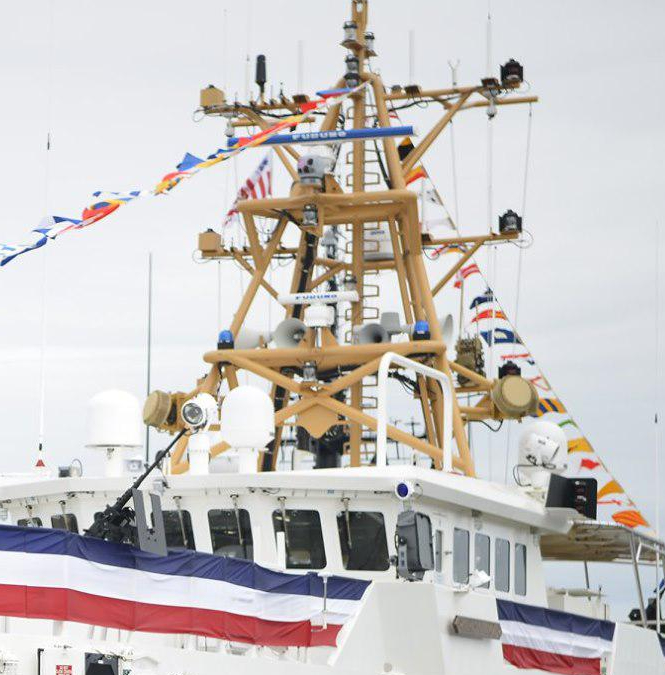
Use of Force: As we know, drones can be used as weapons and as they become more common place, there is more likelihood the Coast Guard will need to take them down for force protection, defense readiness, and Ports, Waterways, and Coastal Security. The cutters of Patrol Forces Southwest Asia (PATFORSWA) have been fitted with short range, high resolution, drone detection radars and what appear to be electronic countermeasures, so are getting some experience with drone detection, passive countermeasures, and possibly hard kill countermeasures as well.
The Coast Guard’s missions may require use of force. In some cases, electronic warfare may be sufficient. Directed energy weapons seem to hold promise, but 30mm guns with air burst ammunition and APKWS 70mm guided rockets have proven capability and provide additional capability against other threats.
USCGC Charles Moulthrope (WPC-1141) prior to departure for PATFORSWA. Small drone detection radars are visible low on the mast.
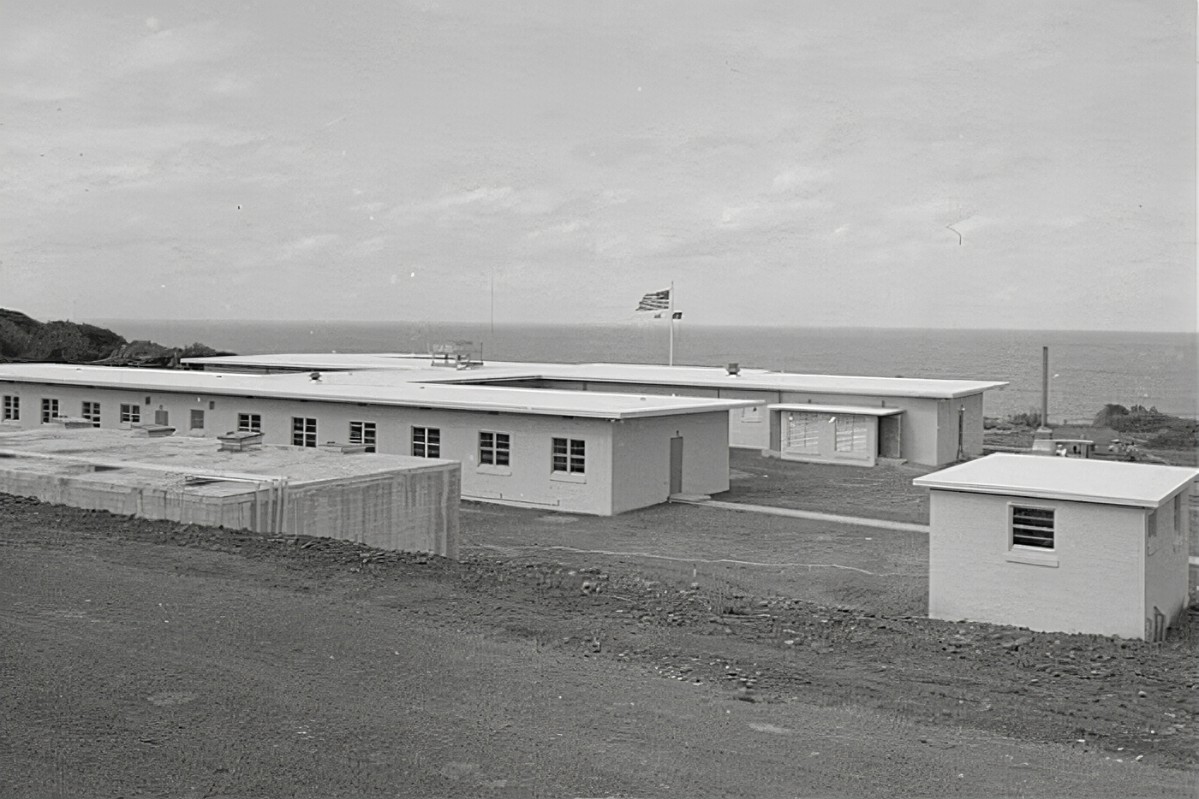
1965 The Treasury Department received “official word” to commence a project to build a number of LORAN stations throughout Southeast Asia in support of the escalating U.S. efforts in the Vietnam War. The LORAN project was code-named “Tight Reign.”
South Korean Navy P-3CK
2014 Coast Guard search and rescue crews were relieved by Republic of Korea assets in their search for 26 crewmembers from the fishing vessel 501 Oryong that capsized November 30, 2014, near Chukotka, Russia, in the Bering Sea. The Coast Guard completed more than 24 searches covering more than 4,576 square miles utilizing two cutters, two helicopters, and multiple airplanes. Coast Guard crews will continue to partner with the Republic of Korea to provide search and rescue planning support. Two Republic of Korea Navy P-3 Orion aircraft joined the search for survivors on December 6, 2014. The Republic of Korea vessel Sam-Bong arrived at the 501 Oryong’s last known position and began their investigation. The Coast Guard offered to assist the Kamchatka Border Guard Directorate and the Republic of Korea with their search for survivors and deployed the following assets: CGCs Munro, Alex Haley, HC-130s from Air Station Kodiak, and two SAR planners from Juneau deployed to Anchorage to work with South Korean Navy P-3 aircrews. The Republic of Korea reported the 501 Oryong, with 60 crewmembers, was hauling in its catch when a wave hit and flooded the vessel’s storage chambers with seawater. Good Samaritans rescued eight crewmembers, but one died of complications, 26 bodies were recovered, and 26 crewmembers were reported missing.
December 14
1846 Revenue Captain Alexander Fraser protested in a report to Congress against “unjust imputations” made against the Service for its involvement in the failure of the first steam cutters. He also requested the authority to employ medical aid on cutters and to provide pensions for personnel disabled in service.
1854 Congress authorized the appointment of the first lifeboat station keepers at $200 per year each and superintendents for Long Island and New Jersey serving under Secretary of Treasury who “may also establish such stations at such lighthouses, as, in his judgment, he shall deem best.”
Sea otters. Photo taken under U.S. FWS permit #MA-043219. (Ryan Wolt)
1911 President William Howard Taft proclaimed the Convention entered into between the United States, Great Britain, Japan, and Russia for the preservation of the fur seal and the sea otter. As this treaty prohibited entirely the killing of seals, and sea otters, on the part of the four nations concerned, in the North Pacific Ocean and Bering Sea, it was necessary that the movements of the Revenue Cutter fleet that enforced the agreement “correspond generally” to the progress of the seal herd in its annual northern migration. During the 1912 season the following cutters were assigned: Rush, Manning, McCulloch and Tahoma. This was the first regular patrol in enforcement of the regulations issued pursuant to the International Convention proclaimed on December 14, 1911. Prior to that date Revenue Cutter vessels enforced the regulations of the Paris Tribunal of arbitration decreed August 15, 1893 for the preservation of the fur seal. The patrol of the North Pacific Ocean and Bering Sea was first inaugurated in 1895 for the enforcement of the provisions of the Act of Congress approved April 6, 1894. The cutters Rush, Bear, Corwin, Grant, and Perry were the first cutters assigned to carry out this patrol which commenced in 1895.
1996 The 735-foot M/V Bright Field collided with the New Orleans Riverwalk, causing substantial damage and injuring over 100 people. Coast Guard forces responded.
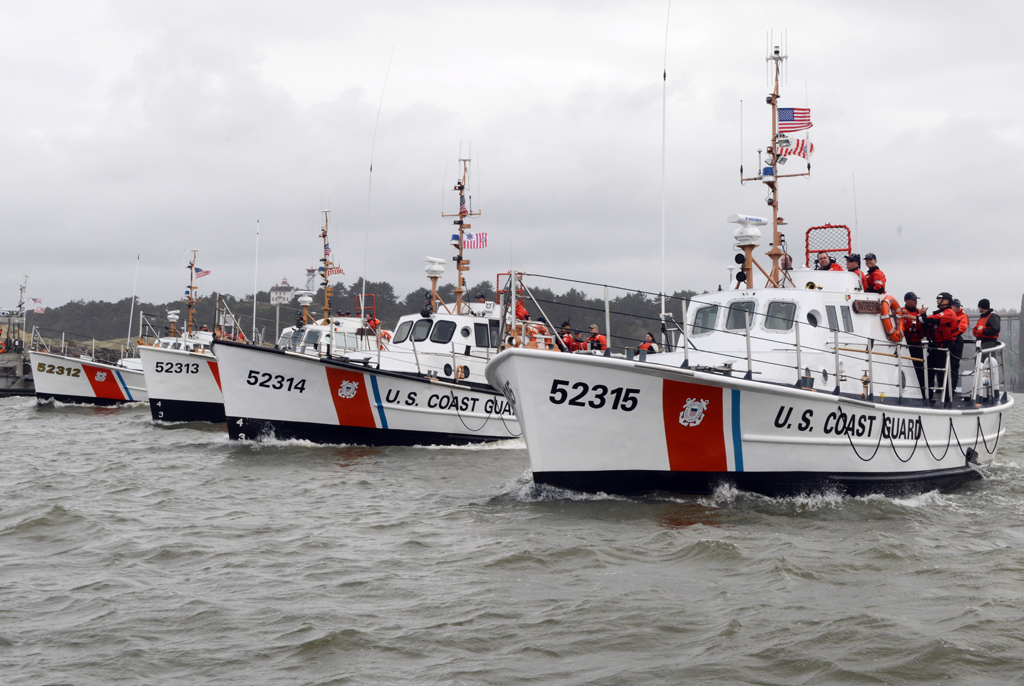
Being Replaced: Coast Guard crew members aboard four 52-foot Motor Life Boats and one 47-foot Motor Life Boat transit in formation outbound of Yaquina Bay, Ore., April 9, 2019. The four 52-foot MLBs are the only active vessels of their kind and the crews are assigned to different units across the Pacific Northwest, which is why having all four together for the roundup was a rare occurrence. (U.S. Coast Guard photo by Petty Officer 3rd Class Trevor Lilburn)
The proposal should give the Coast Guard some very capable craft. I did not read the entire 196 pages front to back, but I did manage to find out some of the capabilities included in the specifications.
First some limits:
Length 64 feet or less
Beam 22 feet or less
Draft 7 feet or less
Other characteristics:
Speed: at least 20 knots
Cruise Speed: 16 knots
Minimum Speed: 5 knots or less
Range: 500 nautical miles
Crew: Minimum 4
Missions:
SAR is number one, but also
Marine Safety
Law Enforcement
Ports Waterways and Coastal Security
Marine Environmental Protection
plus, anything else they might use it for.
Capabilities:
They are expected to operate in 35′ seas, 60 knot winds, and 25′ surf.
The boats will support a relief crew of four for missions that last more than 10 hours in calm waters or more than six hours in more demanding conditions. There is also seating for five survivors for a total of 13 seats. Berthing is limited to four.
The boats will have both open and enclosed bridges. It will be equipped with a bow thruster, recovery wells on either side and a powered towline reel.
Communications include satellite phone, and if I understand correctly, encrypted voice and data.
In addition to radar, sensors will include Electro Optics and Infra-Red (EO/IR).
Maybe We Need More than Six:
As I have noted before, such vessels could replace 87 foot WPBs that are approaching the end useful life in at least some ports and do it with a smaller crew and probably better seakeeping. They might not encounter 25 foot surf as frequently as the those in the Pacific Northwest, but the capability to deal with heavy weather will be there when needed. They don’t have the endurance of WPBs but when cases extend beyond their endurance, FRCs should take over. I do hope they are a bit faster than 20 knots, after all the 47 footers can do 25 knots.
These provide a window into how the future Coast Guard might look and are perhaps the only real way the Coast Guard will actually be able to continue to do more with less.
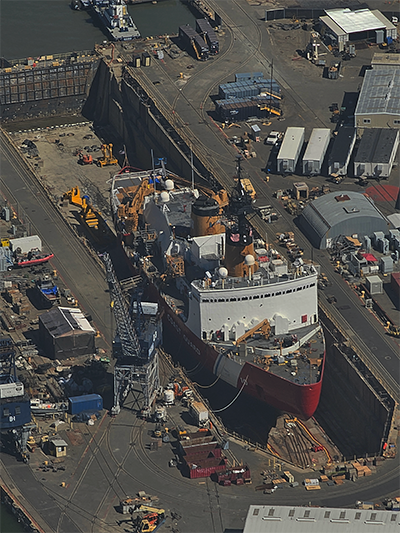
Polar Star at Mare Island Dry Dock LLC undergoing the fourth phase of its five-year Service Life Extension Project. U.S. Coast Guard photo by Cmdr. Jeremy Courtade.
“A multi-billion shortfall in operation and maintenance coffers is hampering US Coast Guard operations with a steep cliff looming on the horizon, according to Commandant Adm. Linda Fagan…The four-star admiral estimated that her service funding really needs to grow from $13 billion up towards the $20 billion range, and that right now it could “ingest” $3 billion for operation and maintenance accounts to keep helicopters in the air and vessels mission ready. That additional $3 billion, Fagan added, could be used to shore up infrastructure, buy additional parts, maintenance, and for command, control, communication, computer, cyber and intelligence (C5I) initiatives.”
The Commandant says dry dockings are being deferred and parts and equipment has to be passed from cutter to cutter to allow them to deploy with full capability.
Swapping equipment puts an additional load on the crews. Being Semper Paratus cost money.
Good to see the Commandant being forthright about the problems, rather than trying to pretend the Coast Guard does not need additional funding to meet the ever-increasing demands.
Being a credible, essential part of the defense establishment by having clearly defined roles in a potential future conflict with China and/or Russia would help to justify additional cost and heightened readiness.
1881 Six men landed from a boat on Race Point, Cape Cod, and were soon after found, wet, chilled, and much exhausted, by the patrolman from Station No. 6, Second District. He learned that they were the captain and crew of the Canadian schooner J .A. Hatfield that had been sunk in a collision with an unknown bark the previous night. The patrolman conducted them to the light keeper’s dwelling nearby.
United States Coast Guard Cutter Mellon (WHEC-717) makes way through the Bering Sea while acting as search and rescue standby cutter for the Bering Sea Opilio Crab fishery. U.S. Coast Guard photograph 010209-C-6130A-500, PA1 Keith Alholm
2014 CGC Mellon returned to Seattle following a seven-week deployment in the Eastern Pacific Ocean after interdicting nearly 700 pounds of cocaine seized from seagoing drug smugglers. The drugs, recovered during a single bust off the coast of Central America, were worth an estimated street value of $18.6 million. Three suspects were detained during the operation. The more than 150-person crew of Mellon left Seattle on October 25 to conduct anti-narcotics and search and rescue missions along the coast of Mexico and Central America. Their efforts resulted in six law enforcement boardings and the disruption of an additional 1,900 pounds of cocaine shipments headed for the U.S. Just as Mellon began its journey homeward on November 24, 2014, the cutter was diverted to lead search and rescue operations in the case of a missing U.S. sailor. The sailing vessel Seven Sisters was found capsized off the coast of Mexico with no crew present after the vessel was reported as overdue to the port of Acapulco. Over the course of nearly a week, Mellon launched its attached MH-65 Dolphin helicopter and crew up to four times a day and covered more than 26,000 square miles of ocean while searching for the lost sailor. Extra lookout watches were set aboard the cutter in hopes of finding him, but the case was suspended after the search efforts proved unsuccessful. Another search and rescue operation involved a few unlikely survivors. About 300 miles off the coast of Guatemala, Mellon’s crew spotted four sea turtles and a dolphin entangled in more than 100 feet of abandoned fishing line. A small crew launched one of the small boats to rescue the animals and remove the debris from the water. After nearly an hour of cutting the animals free, they were released and appeared to be uninjured.
December 12
1876 The first ever examination for Revenue Cutter cadets was held in Washington, D.C.
The 82-foot patrol boats of Squadron One (RONONE) deploying from Subic Bay in the Philippines to the theater of operations in Vietnam. (U.S. Coast Guard)
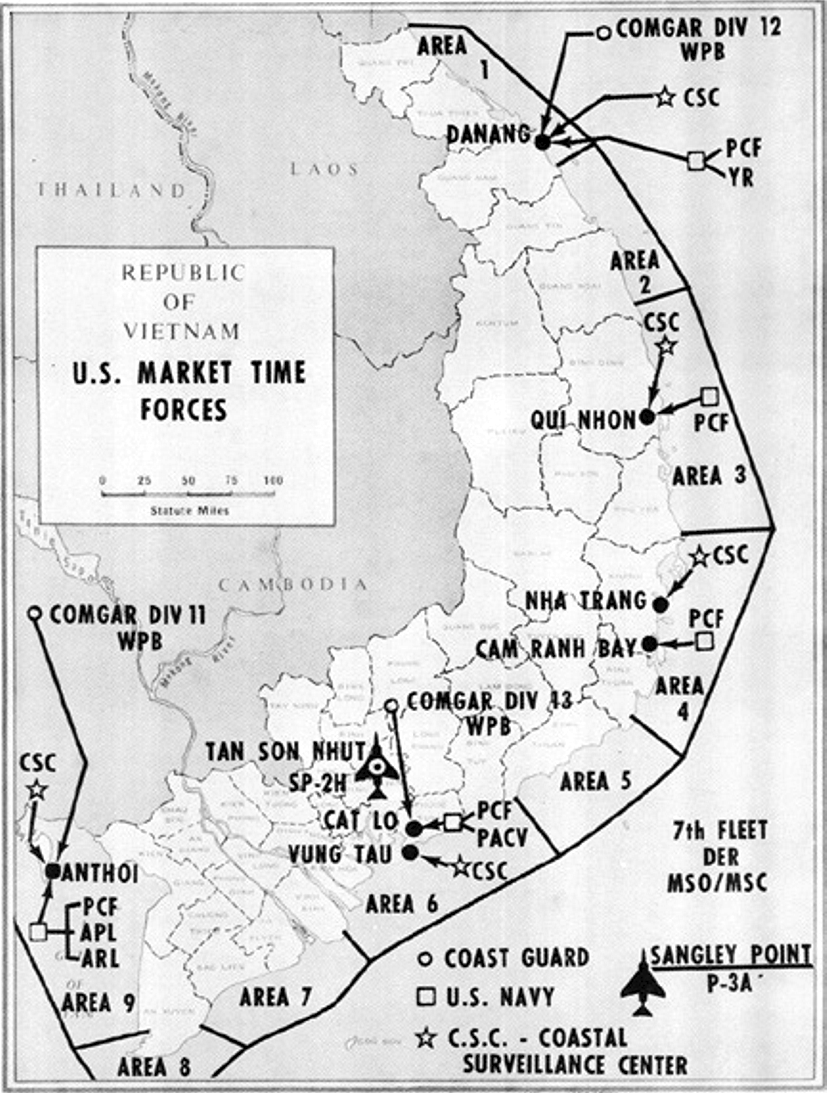
1965 Division 13, Coast Guard Squadron One (RONONE) was established for service in Vietnam. This third division of 9 WPBs, which would be based at Cat Lo, brought the squadron up to 26 WPBs with Division 11, 9 WPBs based at An Thoi Naval Base, Phu Quoc Island, and Division 12 based at Da Nang.
1994 CGC Munro responded to a mayday from the Greek-registered 798-foot container ship Hyundai Seattle approximately 550 nautical miles south of Adak, Alaska. The freighter reported an engine room fire that left the ship dead in the water. An HH-65 attached to the cutter hoisted 27 crewmen to safety. The freighter was later towed safely into Seattle.







 Chuck Hill's CG Blog