Chuck Hill's CG Blog

Chuck Hill's CG Blog

“Unified Response: Joint Naval Drills in South China Sea” –MSN

Vessels from Australia, the USA, the Philippines, and Japan navigate in formation. (AFP Photo)

MSN reports,

The United States, Japan, Australia, and the Philippines … have announced preparations to perform cooperative naval exercises to preserve freedom of navigation and the rule of law as a display of unity…The combined forces of the participating nations will conduct a series of exercises aimed at improving interoperability and cooperation on April 7 as part of the joint naval and air drills.

Notably, there don’t seem to be any coast guard assets from any nation involved in this exercise.

There has been a lot of speculation about the timing of this exercise being so close to that of the trilateral summit which begins April 11, but the exercise is actually pretty small, with only one ship each from the US, Australia, and Japan. The exercise involves no aircraft carriers, submarines, or amphibious assault ships.

The largest ship participating is the Japanese Destroyer Akebono (DD-108) which is not an Aegis ship, and it is one of their smaller destroyers at 6200 tons full load. The US representative is a Littoral Combat Ship, USS Mobile (LCS-26) at 3,104 tons full load.

“Austal leaves door ajar in takeover bid from Hanwha Ocean” –Defense News

Austal’s planned new assembly building and ship lift. Ships featured in the illustration

Defense News reports,

“Despite an initial rejection from Austal, South Korean firm Hanwha Ocean’s bid to buy out the Australian shipbuilder has some analysts pondering the benefits of such deal.”

This have anything to do with the US Coast Guard?

The prize of Austal USA, a supplier of U.S. Navy vessels, presumably enters Hanwha’s calculus, even if this subsidiary has relative autonomy from Austal Australia.

Austal won the recompete for the OPC with a contract including options for OPCs #5-15. South Korean shipbuilders are very competitive, so their experience might be beneficial, but so far, no real indication this is going to happen.

Still, it suggests they want an in on US military ship construction. If not Austal, perhaps some other yard.

“Media Advisory: U.S. Coast Guard Cutter Harriet Lane is scheduled to return to home port following inaugural Operation Blue Pacific Patrol in Oceania” –CG News

Australian Royal Navy personnel stand in formation on a pier as the U.S. Coast Guard Cutter Harriet Lane (WMEC-903) and crew prepare to moor at HMAS Cairns, Queensland, Australia, March 7, 2024. The Harriet Lane and crew had a five-day port call in Cairns during its inaugural 2024 Operation Blue Pacific patrol in Oceania. (U.S. Coast Guard photo by Petty Officer 2nd Class Ty Robertson)

Below is a Coast Guard News release. The release has some videos including interaction with children in Port Vila, Vanuatu (very cute).

One thing that caught my eye was the use of the plural in this statement, “The Coast Guard plans to use medium endurance cutters (emphasis applied–Chuck) for responsibilities in Hawaiian waters, as well as an increase Coast Guard presence throughout the Indo-Pacific and Oceania.”

Was this just a misstatement by the PAO or does this mean we will see more WMECs in 14th District?

I would also note that Harriet Lane apparently made this patrol without a helicopter. Barbers Point does fly H-65s, but last I heard, they only have three. Did the cutter at least have a Scan Eagle?


April 4, 2024

Media Advisory: U.S. Coast Guard Cutter Harriet Lane is scheduled to return to home port following inaugural Operation Blue Pacific Patrol in Oceania

Editor’s Note:  Media should RSVP by Monday, April 8 by 4 p.m. to Petty Officer 2nd Class Ryan Fisher at ryan.m.fisher@uscg.mil
Imagery of Harriet Lane’s patrol can be found here: Operation Blue Pacific 

Who: U.S. Coast Guard Rear Adm. Michael Day, commander U.S. Coast Guard Fourteenth District, and Cmdr. Nicole Tesoniero, commanding officer U.S. Coast Guard Cutter Harriet Lane (WMEC 903).

What: U.S. Coast Guard Cutter Harriet Lane and crew are expected to return to home port after their inaugural Operation Blue Pacific patrol in Oceania. Media are invited to watch Harriet Lane and crew moor at Pearl Harbor and families be reunited after being away for more than 70 days. Media will be able to hear remarks from Day and Tesoniero regarding Operation Blue Pacific and the increased Coast Guard presence in Oceania.

Where: Joint Base Pearl Harbor-Hickam, 1000 North Rd, Honolulu, Hawaii, 96860

When: Tuesday, April 9 at 10 a.m.  

Harriet Lane and crew partnered alongside allies and several Pacific Island countries from January to April 2024. Among those countries were Samoa, Fiji, Vanuatu, Australia, Papua New Guinea, Nauru and Marshall Islands. The focus was on advising and sharing best practices, along with bolstering our partners’ capabilities to promote and model good maritime governance in the region.

Harriet Lane and crew expanded U.S. Coast Guard presence in Oceania alongside Pacific Island countries exercising bilateral maritime law enforcement agreements with shiprider provisions to strengthen maritime domain awareness and support efforts to combat illegal fishing activities with partners with whom we have existing relationships.

The Harriet Lane is U.S. Coast Guard Pacific Area’s newest Indo-Pacific support cutter and spent more than 15 months in a Service Life Extension Program (SLEP) in Baltimore, Maryland, to prepare for the transition in missions and operations.

The Coast Guard plans to use medium endurance cutters for responsibilities in Hawaiian waters, as well as an increase Coast Guard presence throughout the Indo-Pacific and Oceania. The ship is especially suited for longer-range six-to-eight week joint operational and training patrols in the Pacific, taking pressure off shorter range Hawaii-based cutters more suited to service closer to home port.

Commissioned in 1984, Harriet Lane is a 270-foot medium endurance cutter homeported in Pearl Harbor, Hawaii, to support Coast Guard missions in the Pacific region. The service’s medium endurance cutter fleet supports a variety of Coast Guard missions including search and rescue, law enforcement, maritime defense, and protection of the marine environment.

U.S. Coast Guard Heavy Icebreaker Returns to the U.S. (but Not to Homeport) Following Completion of Antarctic Mission

The U.S. Coast Guard Cutter Polar Star (WAGB 10) sails under San Francisco’s Golden Gate Bridge after its 138-day deployment to Antarctica for Operation Deep Freeze 2024, March 31, 2024. The cutter will soon enter a Northern California drydock for phase four of its five-year service life extension program to prepare the cutter for the following year’s Operation Deep Freeze, which is the annual logistical support mission provided by the Department of Defense to the National Science Foundation, managed by the U.S. Antarctic Program. (U.S. Coast Guard photo by Seaman Autumn Riewestahl)

Below is a Coast Guard News release. Note that while Polar Star has returned to the US, she did not return to Seattle, her homeport. Once again Polar Star will spend much of her inport time, probably the majority, away from homeport. Last year, in 2023, it was 19 weeks. The year before that, 2022, it was at least 146 days. I couldn’t find the figure for 2021, but I am sure it was similar. The decision not to change the ship’s homeport to the Bay Area, when they knew how much time the ship would spend away from homeport seems to me, cruel and unusual. I hope we never do this again.


April 4, 2024

U.S. Coast Guard heavy icebreaker returns to the U.S. following completion of Antarctic mission

SAN FRANCISCO – The Coast Guard Cutter Polar Star (WAGB 10) and crew returned to the United States Sunday, following a 138-day deployment to Antarctica to support Operation Deep Freeze 2024.

This deployment marks the Polar Star’s 27th journey to Antarctica in support of Operation Deep Freeze, an annual joint military service mission to resupply the United States Antarctic stations, in support of the National Science Foundation (NSF) – the lead agency for the United States Antarctic Program (USAP). This year also marks the 64th iteration of the annual operation.

The Polar Star crew departed Seattle bound for Antarctica on Nov. 15, 2023, traveling more than 27,500 miles through the North Pacific, South Pacific, Indian, and Southern Oceans, as well as the Bering Sea and Gulf of Alaska, which included stops on four continents.

While en route to Antarctica, the Polar Star made three logistical stops in Pearl Harbor, Hawaii, Sydney, and Hobart, Australia. In Hobart, the cutter and crew hosted the U.S. Ambassador for Australia, Caroline Kennedy, Australian members of parliament, Australian and Tasmanian government representatives, and local industry partners.

After arriving in Antarctica, the cutter broke a 38-mile channel through fast ice up to 12 feet thick, creating a navigable route for cargo vessels to reach McMurdo Station. The Polar Star and crew executed three close-quarters ice escorts for cargo vessels through difficult ice conditions to guarantee the delivery of nine million gallons of fuel and 80 million pounds of cargo to advance scientific endeavors in the most remote region of the world. The cutter departed the Antarctic region on Feb. 14 after 51 days of operations in support of Operation Deep Freeze 2024.

On the return journey, the Polar Star evaded a severe bomb cyclone in the Southern Ocean and had stops in Auckland, New Zealand, Yokosuka, Japan, and Dutch Harbor, Alaska. The Polar Star’s stop in Yokosuka consisted of a media visit and formal reception hosted aboard the cutter, where the crew conducted professional exchanges with senior maritime representatives from the United States, Japan, Australia, and New Zealand, underscoring the importance of collaboration within the Indo-Pacific to promote security and stability across the region.

“The successful completion of this mission stands as a testament to the relentless commitment and selflessness exhibited by our crew,” said Capt. Keith Ropella, Polar Star’s commanding officer. “Despite adverse weather, difficult ice, and formidable mechanical challenges, the crew of Polar Star not only achieved their mission but did so with remarkable expertise and teamwork, proof of their devotion to duty and dedication to their shipmates.”

Operation Deep Freeze is the annual logistical support mission the Department of Defense provides to the NSF, which the USAP manages. This includes strategic and tactical inter-theater airlift and airdrop coordination, aeromedical evacuation support, search and rescue response, sealift, seaport access, bulk fuel supply, port cargo handling, and transportation requirements supporting the NSF. This unique mission demonstrates U.S. commitment to the Antarctic Treaty and scientific research programs. The Polar Star and crew contribute to this yearly effort by breaking the solid ice channel to clear the way for supply vessels.

The Polar Star is now in Vallejo, California, for phase four of its five-year Service Life Extension Project (SLEP). SLEP was awarded to Mare Island Dry Dock, LLC to recapitalize targeted systems, including the propulsion, communication, and machinery control systems, and conduct significant maintenance to extend the cutter’s service life. The Coast Guard will mitigate the risk of lost operational days due to unplanned maintenance or system failures by replacing obsolete, unsupportable, or maintenance-intensive equipment. Each phase is coordinated so that operational commitments, like Operation Deep Freeze missions in Antarctica, will still be met.

The Seattle-based Polar Star is the United States’ only asset capable of providing access to both Polar Regions. The cutter is a 399-foot heavy polar icebreaker commissioned in 1976. It weighs 13,500 tons, is 84 feet wide, and has a 34-foot draft. The six diesel and three gas turbine engines produce up to 75,000 horsepower.

“U.S. and Independent State of Samoa sign addendum to existing maritime law enforcement agreement in the Pacific” –CG News

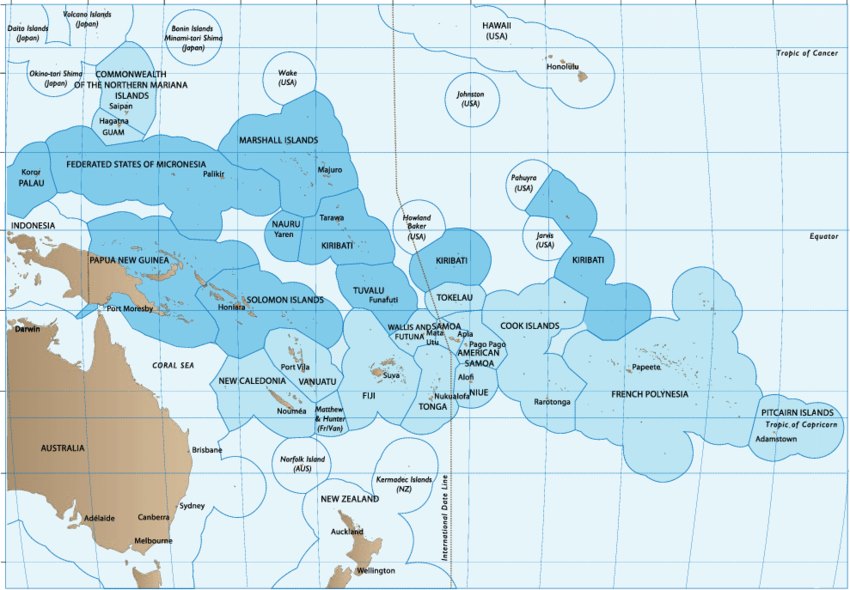
Estimated exclusive economic zones (EEZs) of Pacific Island countries and territories (PICTs). The EEZs of countries that are the Parties to the Nauru Agreement are shown in darker blue. Note that not all EEZs of PICTs have been officially delineated under the United Nations Convention on the Law of the Sea. Source: Patrick Lehodey

Below is a CG news release (includes photos of the signing). The State of Samoa, like Papua New Guinea, is not one of the three nations included in the Compacts of Free Association that include the Federated States of Micronesia and the Republic of Palau that have similar agreements. Of the three Compact of Free Association nations, only the Republic of Marshall Islands does not have the enhanced agreement that permits the US Coast Guard to act in their behalf without a national law enforcement officer on board.

All these island nations have a huge combined EEZ. We are offering help, but our assets in the Western Pacific are thin compared to the assets we have in Atlantic Area policing a much smaller EEZ.

If the illegal fishermen know where the few cutters are, they may just fish illegally in a different area and wait until the cutter leaves. The long-term solution is to help these nations control their own waters and provide enough assets to effectively police the US EEZ in the 14th District. Over and above ships, we need a multinational domain awareness system that can track the illegal fishing and provide intelligence driven enforcement. It looks like we are working on that in the form of the Indo-Pacific Partnership for Domain Awareness (IPDMA) program.


PRESS RELEASE | April 5, 2024

U.S. and Independent State of Samoa sign addendum to existing maritime law enforcement agreement in the Pacific

HONOLULU — The United States and the Independent State of Samoa had the honor to share and sign an addendum to the existing 2012 Bilateral Agreement, at U.S. Embassy Apia in Samoa, to continue and expand operational cooperation to suppress illicit transnational maritime activity, on April 5, 2024.

“In partnership with Samoa, the United States stands committed to safeguarding and ensuring security of Samoa’s economic exclusive zone, by preserving its marine resources, environment, promoting sustainable development for future generations” said U.S. Embassy Apia, Samoa’s Charge d’Affaires, Noriko Horiuchi.

The U.S. Coast Guard and Independent State of Samoa signed the addendum to the existing Bilateral Agreement allowing enhanced maritime law enforcement operations, maritime domain awareness and assists with implementation of integrated operations between the U.S. and Samoa by extending U.S. Coast Guard operability to deter predatory and illegal fishing activities in Samoa’s Exclusive Economic Zone (EEZ).

The enhanced maritime law enforcement agreement represents another tool for Samoa to use to help combat transnational illicit maritime activity and illegal fishing activities within its EEZ. This enhanced agreement enables Samoa to request the U.S. Coast Guard to inspect vessels and enforce their coastal state regulations without a Samoan officer present. This agreement does not replace the joint work conducted with Samoan shipriders; rather, it augments the capability and plays a crucial role in protecting marine ecosystems and the sustainable livelihoods they support.

These enhanced agreements demonstrate the United States’ commitment to a stable, secure and prosperous Pacific region. The strengthened partnerships in the Pacific have been invaluable in increasing the number of boardings within partners’ EEZs, which in turn has led to the deterrence, observation and reporting of vessel crew activities and fishing operations for partner nation’s enforcement agencies.

This advancement follows the similar agreements signed by the Federated States of Micronesia in October 2022, the bilateral defense agreement signed with Papua New Guinea in May 2023, and the enhanced maritime bilateral agreement with the Republic of Palau in August 2023.

“We’re honored to sign this enhanced maritime bilateral agreement with our valued partner, the Independent State of Samoa. This agreement strengthens our collaborative efforts within the region,” said Capt. Tom D’Arcy, chief of response for U.S. Coast Guard District Fourteen in Honolulu. “This agreement serves as a testament to the importance of maritime security in maintaining national sovereignty and regional stability, and we look forward to working even closer with Samoa to effectively address common maritime challenges in the Pacific.”

Through bilateral law enforcement agreements, community engagements and senior leader visits, like the recent U.S. Coast Guard Commandant visit, and subject matter exchanges between maritime agencies, we continue to demonstrate how these partnerships significantly enhance our collective capacity to safeguard shared resources and build a prosperous Oceania that is inclusive and secure for all law-abiding nations.

“US, Philippines, Japan to tackle South China Sea incidents in trilateral summit, says Manila official” –Reuters

Philippine Coast Guard vessels join Japanese and U.S. Coast Guard ships during joint exercises off the coast of Bataan, Philippines, in June 2023. IMAGE CREDIT: Philippine Coast Guard

Reuters reports,

A trilateral summit between the United States, Japan, and the Philippines will include a discussion of recent incidents in the South China Sea, Manila’s foreign ministry said on Friday.

The summit begins April 11.

Can’t help but think this may result in some additional tasking for the Coast Guard.

“Stateless Cargo Ship De Yi Detained: South Korea’s Bold Move Against North Korea” –Regtechtimes via MSN

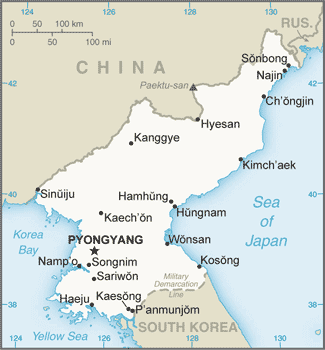
North Korea

MSN reports,

“A cargo ship called De Yi was recently detained by South Korea as it was traveling between Korea and Japan and was berthed close to the port of Yeosu. The ship’s detention is a component of South Korea’s stepped-up unilateral measures against North Korea, which also include sanctioning ships that trade arms with Russia and stepping up monitoring for sanctions violations… The South Korean Coast Guard acted quickly after the vessel’s crew—13 people total—refused to cooperate with orders to stop, including a Chinese captain and crew members from China and Indonesia. For further investigation, the ship was escorted to the port of Busan… Authorities from South Korea and the United States (emphasis applied–Chuck) are closely examining the ship to make sure it is not carrying any illegal goods.”

“Coast Guard Commandant challenges workforce to move the service forward” –MyCG

Just passing this along from MyCG (looks like access to the townhall video is limited). This seems to be a promising sign that the leadership does not expect all solutions to come from the top down.


Coast Guard Commandant challenges workforce to move the service forward

By Kathy Murray, MyCG Senior Writer

The U.S. Coast Guard Commandant Adm. Linda Fagan encouraged members to help her improve the service during a Workforce Town Hall on Wednesday.  Here’s the link: workforcetownhall.mov (sharepoint-mil.us)

“We’re all in different places in the team, but each and every one of us contributes to the well-being and organizational success of the Coast Guard,” Fagan said. “It’s OUR Coast Guard. It’s not mine, it’s not somebody else’s. There is no they or them. It’s us, ours, collectively. And so together we – WE – make the changes. Together we create the opportunity and together we create the culture that we aspire to.”

Adm. Fagan described her vision of a modern service, with a thriving, efficient, effective workforce.

According to Fagan, too many talented people with the Coast Guard are stuck trying to create success around inefficient processes. She challenged members to think in new and creative ways.  “Like if somebody comes to you and says, ‘We’ve always done it this way,’ that is a red flag, right? It may have served Joshua James well, but it doesn’t serve us well now. And so do not be burdened or encumbered by a legacy view when that [view is no longer] right.”

“The status quo is the risk position,” Fagan said.

Fagan took questions with Master Chief Petty Officer of the Coast Guard, Master Chief Heath Jones, during the hour-long event which was live-streamed from a packed auditorium at Coast Guard Headquarters. The pair answered questions submitted online in advance and from in-person attendees.

Sexual harassment remained a top concern. Two attendees shared their personal experiences with sexual assault, and concerns about access to resources for both military members and civilians.

Fagan thanked them and reiterated the steps the service has taken to address sexual assault, by creating a world-class Sexual Assault Prevention, Response and Recovery program available to both military members and civilians. But there’s more to do. “I want an environment where everyone always experiences a workplace that is free from harm,” she said, and noted the Service was engaged in a long-term effort to strengthen service culture.

“We have the devotion part down,” Fagan said, noting that more than 200 servicemembers are currently supporting the Baltimore bridge collapse. “When the Coast Guard is at its best,” she added, “we work together. We hold each other accountable. We hold each other up.”

Additional highlights:

  • On managing workforce shortages and decommissioning of vessels:   Although Jones noted improvements in recruiting, Fagan said she expects workforce shortages to persist and that more ships could be tied up in upcoming assignment years. “I see it as an opportunity to challenge some operating assumptions,” she said, mentioning ways we are working differently to conduct missions and avoid putting members at risk, but she reiterated that the Service, “cannot do the same with less.”
  • On the impact of budget-related stress on less senior employees:  Jones said he thinks members across every level of the workforce are impacted by the Coast Guard’s budget, as well as federal shutdowns and continuing resolutions. He said he is encouraged by a bill that currently seems to have bipartisan support that would continue to pay all military members in the event of a shutdown. Fagan added that since the 2019 shutdown, the Coast Guard has learned ways to mitigate some of the pay issues, if necessary.
  • On reducing civilian hiring delays: Fagan agreed that the process was not nimble enough. She said leaders are working to find ways to make it more efficient and advocating for budget increases to hire more human resources staff. But she asked for help in finding efficiencies and different ways to speed the process while generating, “the most robust talent pool we can find.”
  • What encouragement would MCPOCG offer to E-6 and below: “Don’t ever close the door to any opportunity in your career,” Jones said. He confessed that late in his career he almost missed a great opportunity that way.

Over 100 members of the workforce submitted questions before the Town Hall, and the Commandant and MCPOCG plan to respond to the remaining questions directly or on their social media platforms in the coming weeks.

“Maritime Nation S3 E3: The USCG: At the Intersection of Diplomacy, Law, and Security” –Navy League Video

Above is a great video interview of the Commandant conducted as part of a Navy League Series of video podcasts entitled Maritime Nation. I was frankly surprised by the depth of the interview, and impressed by the Commandant’s willingness to think outside the box.

Thanks to Lee for bringing this to my attention.

South Korea Seizes Chinese Fishing Vessels –Newsweek

A picture taken on November 16, 2011 from a South Korean helicopter shows Chinese fishermen wielding sticks to stop an attack by South Korean coastguard commandoes armed with clubs aboard rubber boats during a crackdown on alleged illegal fishing in South Korean waters in the Yellow Sea off the southwestern coast county of Buan. South Korea’s coastguard mobilized 12 ships, four helicopters and commandoes for a special three-day crackdown on illegal fishing by Chinese boats this week. REPUBLIC OF KOREA OUT AFP PHOTO / DONG-A ILBO (Photo credit should read DONG-A ILBO/AFP/Getty Images)

Newsweek reports,

“South Korea’s Coast Guard seized five Chinese vessels for allegedly fishing illegally in the country’s waters late last month, confiscating boats and deporting several crew members…The joint patrol’s 30 participating vessels and three aircraft waters were operating in the vicinity of Jeju Island from March 25-31, Korea JoongAng Daily reported.

“The country’s coast guard said that, on average, 300 Chinese vessels fish illegally in the country’s exclusive waters each day, with that figure dropping to an estimated 140 during periods of intensified crackdowns.”

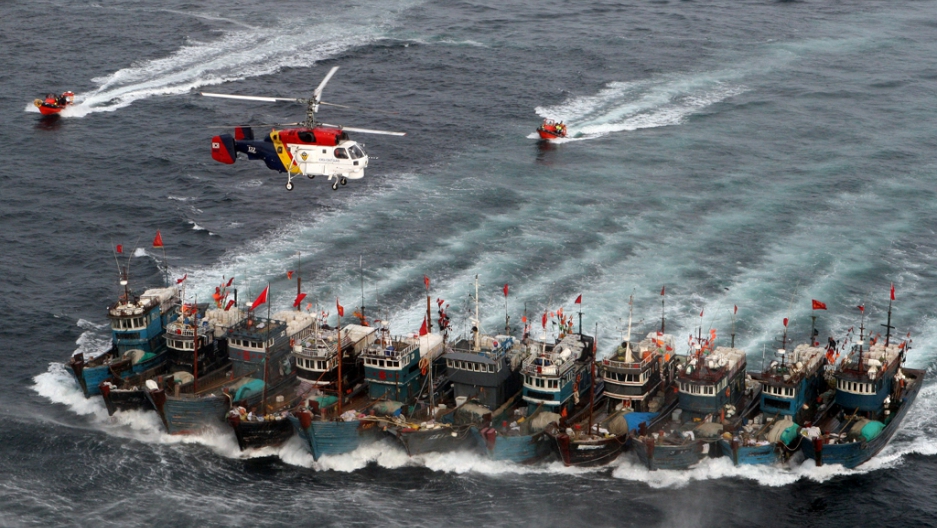
As you can see from the photo above and below. This is not a new problem.

A picture taken on November 16, 2011 from a South Korean helicopter shows Chinese boats banded together with ropes, chased by a coastguard helicopter and rubber boats pacted with commandoes, after alleged illegal fishing in South Korean waters in the Yellow Sea.
Credit: Dong-A-Ilbo

In many cases these encounters have become violent. The South Koreans have not been afraid to seized Chinese fishing vessels, but on the other hand they have not been successful in stopping large scale illegal fishing.