
The Coast Guard Deputy Commandant for Operations has issued “United States Coast Guard Force Posture 2024.” Dated October 2024, it is reportedly the first of its kind and a new edition will be published annually. I have appended the Coast Guard News Release regarding the publication below.
“This posture statement informs all audiences about the U.S. Coast Guard’s operational priorities, initiatives, requirements and future challenges across its missions and geographic regions. It conveys how we are “Advancing Mission Excellence” in accordance with the 2022 Coast Guard Strategy and the Department of Homeland Security (DHS) Strategic Plan. This posture statement serves as a window into the breadth and depth of the Coast Guard’s commitments and how it is posturing our workforce, capabilities, and assets to deliver operational services that best serve the American people.
It is organized under four major topics rather than by the eleven statutory missions.
- Operating Environment (p.3)
- Guiding Principles (p.3/4)
- Operating Posture (p.4-7)
- Geographic Operating Areas (p.7-11)
I love it, but it does lack a clear summary of what we will do differently. I will try to interpret some of that. Below I provide a readers’ digest version with a few comments, looking first at the eleven Coast Guard missions as listed in 6 U.S. Code § 468, at select Geographic Operating Areas, and finally I will speculate on the long term implications. Given the increased use of the Coast Guard as a tool of foreign policy, I also suggest changes to the Area Commanders’ areas of responsibility (AOR) to make them fit more easily into the national command structure.
MISSIONS
Some of the missions are specifically addressed in the “Operating Posture” section, others are not. The Eleven missions are:
Non-homeland security missions:
- Marine safety
- Search and rescue
- Aids to navigation
- Living marine resources (fisheries law enforcement)
- Marine environmental protection
- Ice operations.
- Ports, waterways and coastal security
- Drug interdiction
- Migrant interdiction
- Defense readiness
- Other law enforcement.
I will just address them in alphabetical order:
Aids to Navigation:
Aids to Navigation is not called out under a separate heading.
- “Our comprehensive approach (to the Marine Transportation System (MTS)) encompasses…Maintaining aids to navigation…” (p.4)
- The Coast Guard is reinforcing actions to be “brilliant at the basics” that strengthen…aids to navigation.
- The Coast Guard is in the early phase of recapitalizing an aging fleet of inland aids to navigation tenders with new Waterways Commerce Cutters, crucial to maritime commerce in our inland river system. These investments are central to maintaining service delivery in an increasingly complex MTS (Maritime Transportation System–Chuck).
Sounds like minimal changes in the near term but expect improving technology may reduce manpower requirements. Elsewhere there is indications buoy tenders may increasingly be used for non-AtoN missions. This suggests that the number of sea-going buoy tenders (WLBs) is unlikely to be significantly reduced, but their character may change–more on this below.
Defense Readiness
We are increasing attention on the Coast Guard’s defense readiness mission given the increasing threat posed by nation-state competitors. Through integration with Department of Defense efforts, refreshing defense-related plans, and preparedness exercises, we are sharpening readiness to support homeland defense requirements and force deployment commitments for major overseas contingencies. We continue to meet our commitments to North American Aerospace Defense Command (NORAD) for National Capital Region and deployable Rotary Wing Air Intercept and we are adjusting the structure of our Port Security Units (PSU) to address Reserve workforce shortages. We are also integrating PSU elements with DoD expeditionary units to increase their deployment readiness.
This is a welcome recognition of an increasingly hostile world and the emergence of non-state actors who, acting independently or as a proxy for hostile states, can impact national security.
Hopefully it also means we are considering adaptations to our cutter and air fleet to make them more useful early in a near peer conflict (i.e. with China).
Drug Interdiction:
Drug Interdiction is not called out as a separate topic. The only indication of a change is this statement under the section “Western Hemisphere,”
“We will maximize employment opportunities by conducting a mix of missions such as counter drug and combating illegal, unreported and unregulated fishing when appropriate.” (p.9)
Ice Operations:
Ice operations is not called out as a separate mission, but it is addressed in the “Polar Regions” section (p.8/9) of the Geographic Operating Areas section.
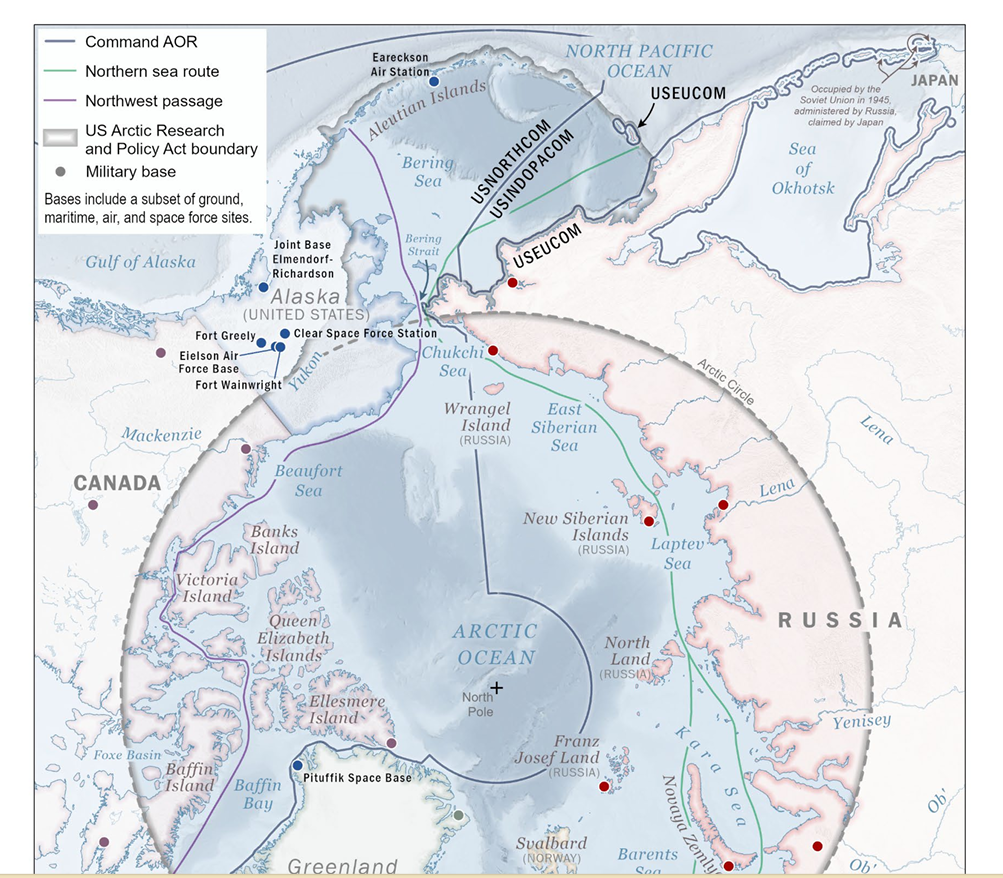
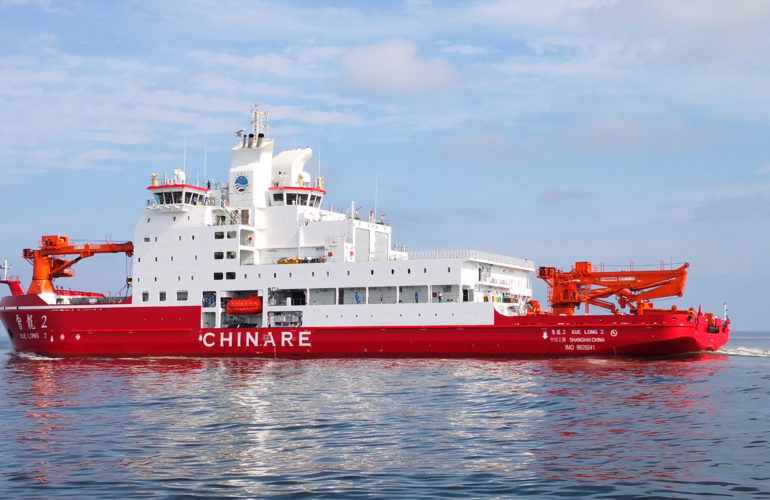
Arctic and Antarctic Ice operation will get a big boost as we go from 2 polar icebreakers to eight. In the Arctic there will be a continuing need for non-icebreaking large cutters and we can expect increased exploitation of fixed wing aircraft and particularly satellite for communications and information.
Living Marine Resources
“We will increasingly favor shore-based law enforcement teams and our patrol boat fleet, supported by maritime domain awareness sensors, to ensure we best match this mission.”
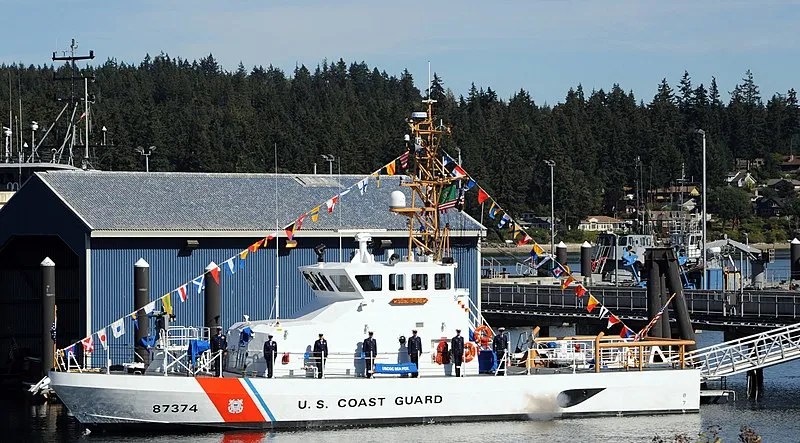
Webber class WPCs have proven capable of assuming much of the fisheries protection mission. They can go anywhere fishing vessels can go and stand up to any weather they might be fishing in. So FRCs are stepping up to missions WMECs have traditionally done. Not mentioned, but on the other hand, in Alaska and the distant Pacific there is still a role for larger ships.
Marine Environmental Protection:
There was no section devoted to Marine Environmental Protection as a specific mission. MEP was referred to briefly in the Mission execution section (p.5) Arctic (p.8)
But there was this under “Incident Management and Crisis Response” (p.6)
Management of large, complex incidents is a central Coast Guard competency. Employment of this capability enables success for the most consequential crises and events, builds trust, and supports DHS. However, the Coast Guard does not have a large contingency capacity “in garrison” for emergencies. We will continue to strengthen Coast Guard incident management capacity and proficiency to meet increasing demand, including in the Reserve workforce. The Coast Guard continues to respond to stakeholder requests for assistance for incident management while we prioritize incidents with a Coast Guard nexus and prevent overextending Coast Guard resources.
Marine Safety
There is a lot of activity here,
“The Coast Guard is reinforcing actions to be “brilliant at the basics” that strengthen marine inspection, investigation, Vessel Traffic Services, waterways management, and aids to navigation.”
Changes in the environment include autonomous vessels, offshore renewable energy installations, an emerging space launch and recovery industry, and alternative vessel fuels. All of which require determination of standards.
Migrant Interdiction
“The Coast Guard will deploy cutters and aircraft, and adaptive force packages where practical, sufficient to interdict migrant ventures, save lives, and deter maritime migration. We continue to prepare with partners to respond to a mass migration to mitigate a national crisis. We are also integrating new technology to better anticipate, detect, deter, and interdict migrant ventures.
No significant reprioritization here. This is an area where the Webber class WPCs (20 in D7 alone) have supplemented or replaced WMECs. It is an area where shore based Unmanned Air Systems and Unmanned surface vessels like saildrone could provide persistent initial detection and perhaps reduce demand for fixed wing search aircraft.
Other Law Enforcement
Not surprisingly there is no mention of this “mission” because the Coast Guard does it on an ad hoc incidental basis. The Coast Guard’s specific law enforcement missions, drug and migrant interdiction, marine environmental protection, and fisheries are addressed separately. It is a catchall for any illegal activities. So, no change.
Port, Waterways, and Coastal Security
The Coast Guard’s force posture for this mission was configured for the post 9/11 security environment and the Coast Guard is examining approaches to optimize our capabilities to meet emerging threats. For example, the proliferation of drones poses a growing risk to the MTS and we will continue to employ our counter-UxS technology in conjunction with DHS and other partners to prepare for this threat. We are also taking steps to ensure that our deployable specialized forces are configured for their role as threats and operational needs evolve.
Recognizing and preparing to counter the UxS threat is significant. I’ve already made several suggestions. I hope if we get a hard kill system, it will also improve effectiveness against other potential threats.
This was included under Defense Readiness,
“…we are adjusting the structure of our Port Security Units (PSU) to address Reserve workforce shortages. We are also integrating PSU elements with DoD expeditionary units to increase their deployment readiness.”
To me Ports, Waterways, and Coastal Security is a subset of Defense Readiness once you understand that Defense Readiness is a full time, 24/7 job that does not wait until war is declared or the Coast Guard is transferred to the Navy Department. Attacks like 9/11 or Pearl Harbor, will likely come as a surprise, there may be no time to mobilize before an attack, and our Maritime Transportation System is a likely target.
Search and Rescue:
“Search and Rescue is an enduring, no-fail mission that is deeply ingrained in the Coast Guard’s identity. As it remains a top priority, technical advances now allow us to perform the mission more effectively and with fewer resources.“
SAR success standards are not being lowered, but technology is increasingly taking the search out of search and rescue. Individual units have greater capability so fewer dedicated units may be required. Expect fewer personnel to be assigned to less demanding SAR missions that are also covered by local government first responders.
GEOGRAPHIC OPERATING AREAS
The Operational Posture goes on to discuss specific operating areas. Some of this has been addressed in the mission summaries above, so I will say no more about the Arctic, Western Hemisphere, Middle East and Europe, Caribbean, and Atlantic basin that are discussed individually in the Operational Posture, but I will talk about the Indo-Pacific, Eastern Pacific, and Antarctica.
Indo-Pacific
The Indo-Pacific is a top regional priority given its geostrategic importance, criticality to global trade, and the threat contesting a free, open, and rules-based maritime commons.
Yes, we are paying more attention to the Pacific, the Indian Ocean not so much. We expect to have six Webber class WPCs in Guam. Harriet Lane (WMEC-903) has been moved from Atlantic Area to Hawaii and it looks like a second WMEC may also be moved. Two OPCs each are expected to go to Long Beach and Kodiak. Assuming Alex Healy stays in Kodiak and the last Pacific Area 210 is decommissioned or transferred to Atlantic Area, that will give Pacific Area 13 large patrol cutters–still fewer than the 16 that were in PacArea in 2000 and only 39.4% of the 33 large cutter total I think we have now and will have for the foreseeable future.
Given the great distances involved, the fact that 84% of the US EEZ is in Pacific Area, and because we have an obligation to the Compact of Free Associated States–Federated States of Micronesia, the Republic of the Marshall Islands, and the Republic of Palau–that together have additional EEZ equal to about 50% of the entire US EEZ, it makes no sense for 60% of the large cutters to be in Atlantic Area. More than half of all large patrol cutters should be in Pacific Area.
Eastern Pacific:
“…with declining major cutter and maritime patrol aircraft availability, we will increasingly employ fast response cutters, ocean-going buoy tenders, and adaptive force packages supported by expeditionary logistics.” I am not surprised; this is something that was begun when Admiral Fagan was Pacific Area Commander.
“…we remain committed to supporting the Mexican Navy as they expand their Captain of the Port authorities through increased information sharing, joint training and exercises, and capacity building engagements. This expanded partnership will enhance maritime governance in the Western Hemisphere and contribute to the fight against illicit trafficking of fentanyl and precursor chemicals through Mexican ports into the U.S.”
—-Let’s talk about Areas of Responsibility–An Aside
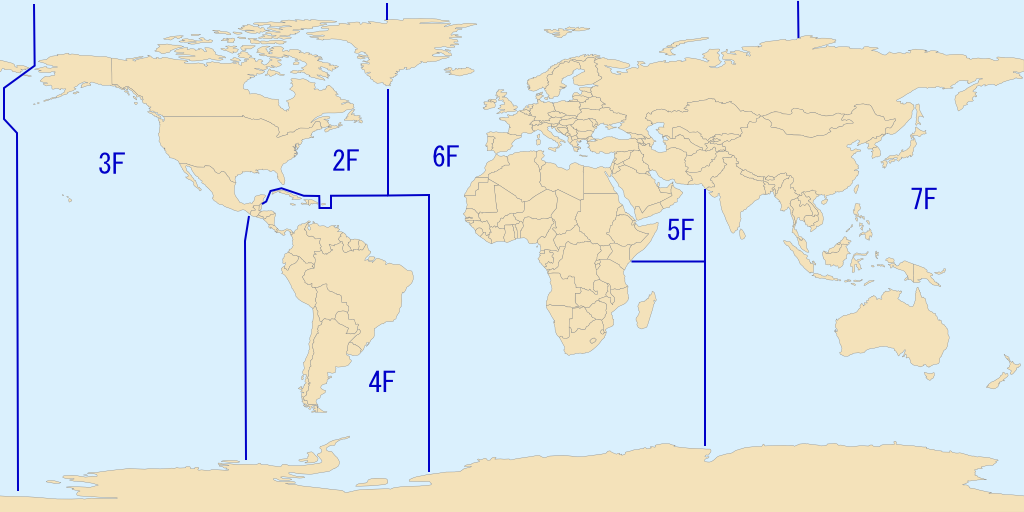
US navy fleets areas of responsibility. Source Wikipedia.
The only mitigating rationale I see for not transferring most of the large cutters to Pacific Area is that the Eastern Pacific drug transit zone is actually closer to Atlantic Area ports than to Pacific Area ports. This is why all of South America is under 4th Fleet, which is an Atlantic Fleet command. Probably an argument should be made for realigning the Coast Guard Area geographic descriptions to match those of the Atlantic and Pacific Fleets. A change of name to Eastern and Western Area might be appropriate and in fact a more accurate description.
Atlantic area includes not only the Atlantic coast but also the great lakes, inland areas, the Gulf of Mexico, Caribbean, and parts of the Arctic and Southern Oceans. Pacific Area also includes inland areas, the Indian Ocean (part of which is under Atlantic Fleet), and parts of the Arctic and Southern Oceans.
A realignment along Fleet dividing lines would also mean the dividing lines would more closely correspond to COCOM areas of responsibility and limit the number of cases where COCOMs would need to deal with both Coast Guard Areas to NORTHCOM. Currently there is also overlap in SOUTHCOM, AFRICOM, and CENTCOM. All three of those COCOMs would only need to deal with the Eastern (Atlantic) Area. That seems to be what is happening with AFRICOM and CENTCOM now anyway. PATFORSWA WPCs, Atlantic Area assets, operate routinely in the Indian Ocean, part of the PACAREA AOR. 
Unified Combatant Commander’s Areas of Responsibility.
As Pacific Area assumes more responsibility in the Western Pacific and potentially the Indian Ocean passing off responsibility for all Coast Guard operations in 4th Fleet’s Area of Operations to Atlantic Area might make sense.
Antarctic:
The U.S. priority for Antarctica remains maintaining “a continent reserved for peace and science in accordance with the provisions of the Antarctic Treaty of 1959.”
No real change expected other than more and better icebreakers, but not everyone thinks like the US.
We should have the agility to react to a change from the present “continent reserved for peace and science.” We really have no reason for confidence that Antarctica will not become a zone of Conflict. Fortunately, actions to increase capabilities in the Arctic may also serve us well in Antarctica.
Implications for the Future
Cutter Design:
Patrol Cutters: Moving from “Patrol and Interdict” to “Target and Interdict” suggests that cruise speed endurance may become less important, and that higher max speed and an economical loiter speed may become more important. Greater emphasis on Defense Readiness would also suggest the desirability of greater speed. This suggest that we may want to build fewer than the currently planned 25 OPCs and shift investment to a new design based on a different set of priorities that we can build in greater number; ships with greater speed and increased modularity to accommodate an uncertain future.
Buoy Tenders: Improved aids to navigation may mean tenders will spend less time on routine AtoN maintenance. Still, they will need to be geographically distributed to respond to critical outages. It seems these ships will become more multi-mission by design. They should continue to be able to operate in ice. Their increased use for non-AtoN missions suggest that they may need overflow berthing and more fuel and stores capacity when supporting WPC deployments and to make them more effective in law enforcement roles–more speed, a flight deck and hangar for UAS and a deck gun such as the Mk38 Mod4.
Deployable Teams
Sounds like we will be getting more deployable Law Enforcement Detachments given the proliferation of capacity building objectives. Increased specialization and a desire for continuity in this area may someday result in a new rating.
Thanks to Paul for bringing the video to my attention.
Coast Guard unveils first Operational Posture Statement
By Zach Shapiro, MyCG Writer
The Coast Guard just released its first Operational Posture Statement, which outlines the service’s operational priorities, including its plans to adapt to personnel and resource challenges. Vice Adm. Peter W. Gautier, Deputy Commandant for Operations (DCO), unveiled the document Friday during an event at the Center for Strategic and International Studies (CSIS) in Washington, D.C.
Think of the new annual Operational Posture Statement as a tactical annual document that supports the long-term Coast Guard Strategy by providing more specificity.
To improve operational efficiency and effectiveness, for example, the Coast Guard will increasingly use intelligence and data to shift its approach from “patrol and interdict” to “target and interdict.”
And to improve readiness, the Coast Guard will focus on three key elements: the workforce, capabilities, and assets. The Operational Posture recognizes the need to meet increasing demand while addressing workforce and resource shortages. The service will also continue to recapitalize cutters, boats, aircraft, and infrastructure.
The Operational Posture “is our effort to communicate with our stakeholders and be transparent with the American people on how we will confront all of these challenges, this increasing mission demand, and provide the kind of services that Americans deserve,” Gautier said.
Six guiding principles underpin the Operational Posture Statement:
- Balance current operations with future readiness
- Strengthen maritime governance
- Counter strategic competitors while fulfilling our primary responsibility to secure and defend the homeland
- Adjust force structure and posture to maximize operational effectiveness while maintaining a high level of support for our people, platforms, and infrastructure
- Employ resources holistically to meet growing demands
- Leverage intelligence, information, and improved maritime domain awareness to shift from a “patrol and interdict” to “target and interdict” model
These priorities reflect the increasing national and global demands for Coast Guard services. As 90 percent of global trade moves by sea, maritime security is the bedrock of national security and economic prosperity. In the face of rising global maritime tensions, the Coast Guard has a unique and critical role as a law enforcement entity and military agency.
Amidst this evolving environment, Gautier emphasized, the Coast Guard remains committed to its Search and Rescue (SAR) mission. That mission is “a sacred trust with the American people and a no-fail mission. It is our primary lifesaving mission. It defines us as a humanitarian service,” he said.
Moving forward, the Coast Guard intends to release a new Operational Posture Statement annually to outline the ways in which the service is adapting to new challenges and missions to best serve the American people.
- To read the Operational Posture Statement in full, please click here.
- To view Vice Adm. Gautier’s remarks, click here.
Resources:




 Current Coast Guard Icebreakers: CCGS Henry Larsen (medium icebreaker, top photo), CCGS Terry Fox (heavy icebreaker, bottom photo)
