“U.S. Marine Corps And The New Long-Range Attack Munition” –Naval News

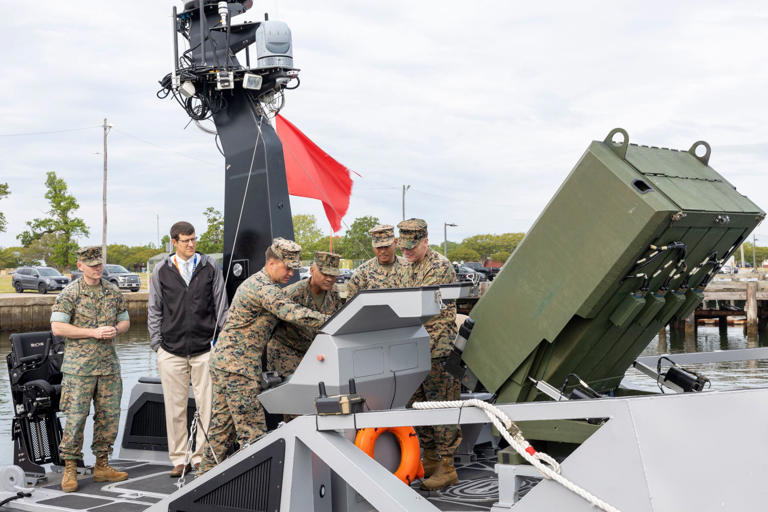
Not exactly the same, but you get the idea:   U.S. Marine Corps Lt. Gen. Brian W. Cavanaugh, the commanding general of Fleet Marine Force, Atlantic, Marine Forces Command, Marine Forces Northern Command, and Marines with 3d Marine Littoral Regiment, 3rd Marine Division, examine the manual controls to the Long Range Unmanned Surface Vessel, Joint Expeditionary Base Little Creek-Fort Story, Virginia, April 27, 2023. A LRUSV is an optionally manned vessel capable of extended travel and transporting loitering munitions that accurately track and destroy targets on sea or land. Metal Shark is designing, building, testing and implementing the LRUSV system under an other transaction authority aggrement with Marine Corps Systems Command to primarily serve as an intelligence, surveillance, and reconnaissance platform.
© Provided by The Drive

Naval News reports the Marines hope to develop a new long range loitering munition. It would take off vertically, be relatively inexpensive, be usable against both moving and fixed targets, on land or at sea, with a “minimum total payload weight capacity of 25 pounds (lbs) to include weapon seeker and warhead (but excludes fuel weight)” and have a range of about 150 nautical miles.

This might be something the Coast Guard could use. Single rounds should be effective against small, fast, highly maneuverable threats, while multiple hits might be effective against larger threats.  The relatively long range would mean it would not have to be widely distributed. A few, held as group assets, might be sufficient to deal with a terrorist threat.

“NPS Research on Coast Guard Icebreaker to Enhance Arctic Readiness” –Marine Link

During a seven-week Arctic transit aboard the U.S. Coast Guard icebreaker USCGC Healy (WAGB 20), Dr. Nita Shattuck from the Naval Postgraduate School (NPS) will study the impact of the extreme environment on crew performance and potential mitigations. Additional research includes assessment of an Amos01 3D printer installed by David Dausen from NPS’ Consortium for Advanced Manufacturing Research and Education (CAMRE), and specially instrumented to measure the impact of adverse Arctic sea conditions.

Marine Link reports the Naval Post Graduate School is doing some interesting studies on the working environment experienced by USCGC Healy’s crew.

To study the effects of these conditions on a ship’s crew at sea, Shattuck and her team will collect physiological data from the Healy’s crew members. Using innovative wearable technology, they will continuously monitor physiological processes such as sleep, heart rate, heart rate variability, respiration, oxygen saturation, and skin temperature. Study participants indicate that the rings are an improvement over wrist-worn wearables. The team will also use other sensors to monitor ambient light, noise levels, motion, and vibration aboard the ship.

The report also mentions that Healy will be going to Tromsø, Norway. How they get there will be interesting. Will they go the Northwest Passage through the Canadian EEZ or the Northern Sea Route through Russia’s EEZ?

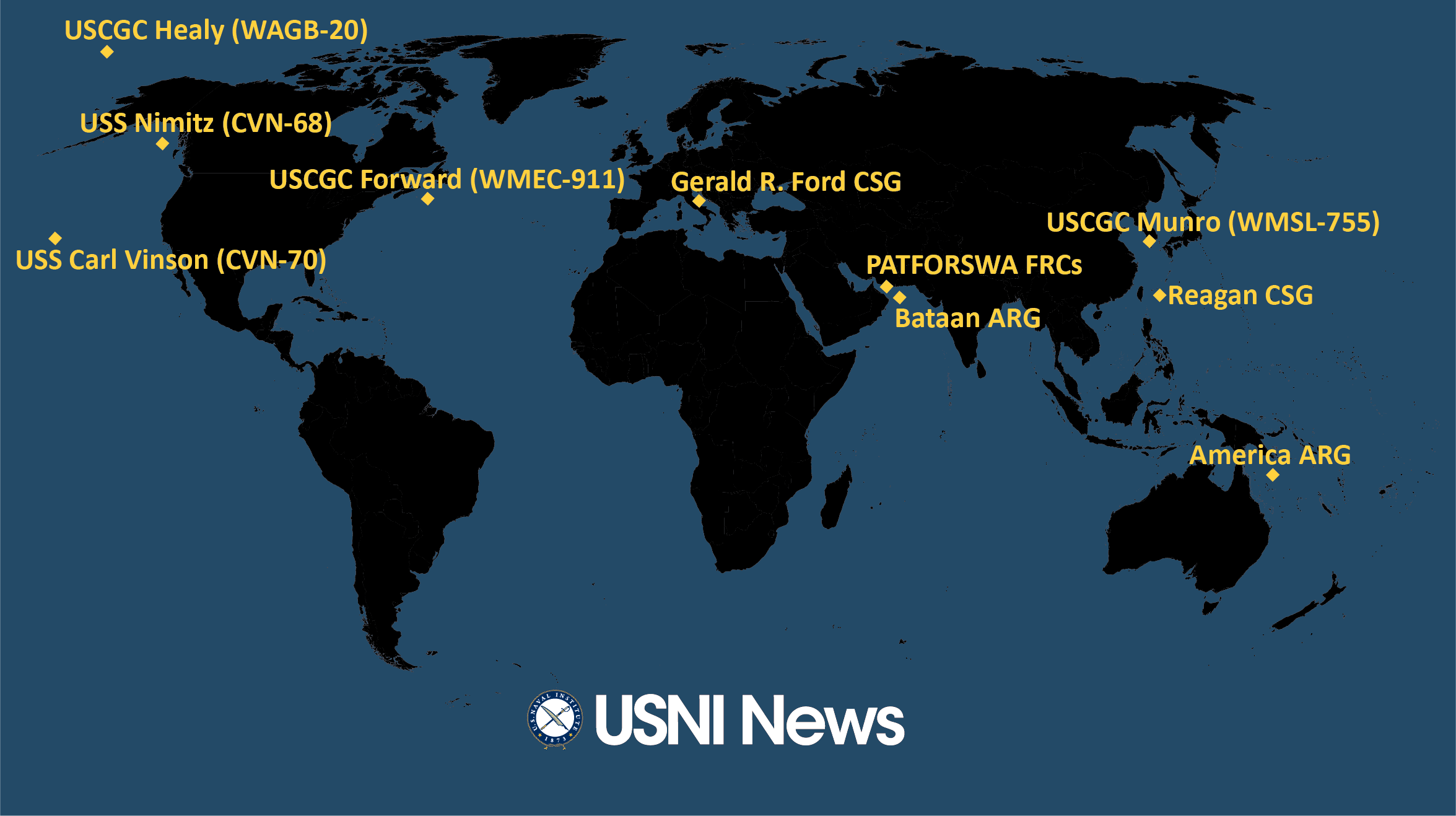
“USNI News Fleet and Marine Tracker: Aug. 14, 2023” –USNI

The US Naval Institute News Service “Fleet Marine Tracker” continues to report atypical Coast Guard activities. It continued to report on USCGC Healy’s Arctic deployment and mentioned PATFORSWA as they have since they have since they began including Coast Guard units in May.

This week, they included some activity I have not seen reported elsewhere.

“Legend-class National Security Cutter USCGC Munro (WMSL-755) departed Fleet Activities Yokosuka (CFAY) and is now in South Korea.”

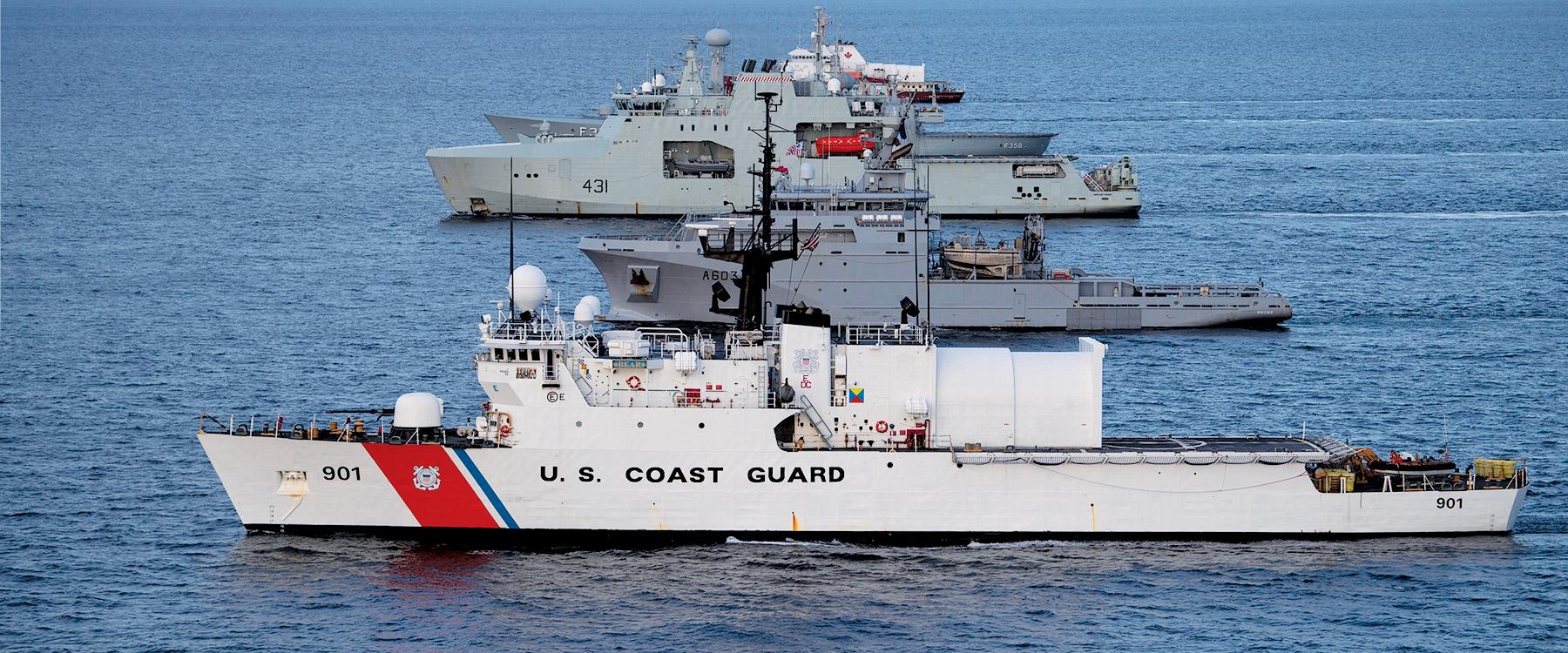
“Coast Guard Cutter Forward (WMEC-911) is currently supporting Operation Nanook. Operation Nanook is an annual Canadian-led exercise that fosters international cooperation and shared responsibility in the Arctic and the northern Atlantic Regions.”

The USCGC Bear (WMEC-901) and allied ships from Canada, Norway, France, and Denmark steam in formation in the North Atlantic Ocean during last year’s Operation Nanook in August 2022. 

“INSIDE LOOK aboard HMCS Harry DeWolf” –Video

Just a short video, made at least a couple of years ago, but particularly wanted to feature the “cable deck,” time 1:27 to 1:45, where you see mooring and anchoring gear conspicuously missing from the foc’sle. Keeping this gear inside the ship is critical to keeping it operational in the Arctic environment.

A total of eight ships of the class are planned, six for the Canadian Navy and two for their Coast Guard. Navy or Coast Guard, these “Arctic Offshore Patrol Ships” (AOPS) essentially perform what we view as Coast Guard missions. They are 6,615 ton ships, 340 feet (103.6 meters) in length. Four diesel generators provide power to two electric motors that provide 12,000 HP for a 17 knot max speed. Range is 6,800 nautical miles at 14 knots. The crew is 65 with accommodations for 87. The gun seen in the video is a weatherized version of the 25mm Mk38. They are Polar Class 5.

China Coast Guard in the Russian Arctic?

Chinese Coast Guard officials observed the April 25 anti-terror exercise conducted by FSB Coast Guard in the Kola Bay north of Murmansk. Photo: Murmanski Vestnik

The Barents Observer has an interesting article, “Russia’s Coast Guard cooperation with China is a big step, Arctic security expert says,” that seems to portend a China Coast Guard presence in the Arctic, perhaps shepherding their fishing vessels.

“The Russia-China memorandum signed in Murmansk opens for joint efforts to combat terrorism, illegal migration, fighting smuggling of drugs and weapons, as well as stopping illegal fishing. The deal was signed by top leaders with FSB Border Guards and the Chinese Coast Guard.”

It may be noteworthy that this meeting was not in Asia, in one of Russia’s Pacific ports. It was in Europe, in Murmansk, on the Kola Peninsula, home of the Russian Arctic Fleet.

This agreement may turn out to be a first step toward joint China and Russia exploitation of Russia’s, as yet unrecognized, extensive continental shelf claims in the Arctic extending all the way to the North Pole and beyond into areas also claimed by Canada and Denmark (from Greenland).