Japan to Build Five Large Cutters for Philippine Coast Guard

Japanese built Philippine Coast Guard cutter BRP Melchora Aquino

The EurAsian Times reports that Japan and the Philippines have finalized their largest security agreement to date.

“The US $507 million project is funded by an Official Development Aid loan from the Japan International Cooperation Agency. Around $425 million will be utilized in constructing five 97-meter-long multi-mission response vessels (MRRV) and a five-year integrated logistics support package…The patrol vessels are expected to be delivered between 2027 and 2028.”

The Philippine CG already has two ships of this type. We talked about this class earlier. Final specs, if there are no changes, from NavyRecognition,

“The MRRV has a length of 96.6 meters (317 feet–Chuck), a maximum speed of not less than 24 knots, and has a complement of 67 crew members. She has a two 6600 kW (6.6MW) diesel engines.”

That is about 17,700 HP. By comparison, the OPCs, which are longer and twice as heavy. will have 19,520 HP.

It appears the Philippine Coast Guard still has not armed their cutters with anything larger than .50 caliber machine guns. This class does have water cannon. Their Japanese counterparts are armed with either 20mm Gatling guns or Bushmaster II 30mm chain guns in Remote Weapon Stations.

Meanwhile the Philippine Navy is also buying Offshore Patrol Vessels, six from S. Korea. They will be much more heavily armed.

“U.S., Japan, Korea Coast Guards sign trilateral agreement to increase maritime cooperation” –News Release

U.S., Japan, Korea coast guards sign trilateral agreement to increase maritime cooperation
Mr. Kishimori Hajime, deputy Consul General of Japan (left), Japan coast guard Vice Adm. Watanabe Yasunori, Japan coast guard vice commandant for operations, U.S. Coast Guard Vice Adm. Andrew Tiongson, commander, U.S. Coast Guard Pacific Area, and Hyunchul Kang, deputy Consul General of the Republic of Korea, pose with a signed trilateral agreement at Coast Guard Island, Alameda, Calif., May 9, 2024. Japan, Republic of Korea and U.S. coast guards gathered to finalize a trilateral letter of intent, which will drive the three nations to work together to advance maritime safety, security and prosperity in the Indo-Pacific. (U.S. Coast Guard photo by Master Chief Petty Officer Charly Tautfest)

Below is a PACAREA news release.

Like the US Coast Guard, Japan and South Korea have been attempting to help SE Asian nations strengthen their maritime security and law enforcement organizations so that they can deal with what is essentially state supported, state sponsored, and state coordinated theft of their resources.

This should at least allow better coordination and avoid unnecessary duplication. The Philippines and Vietnam are likely to be primary beneficiaries.

We probably have things to learn too. The Japanese and S. Korean Coast Guards are both large and have a lot of experience countering violent resistance.

A picture taken on November 16, 2011 from a South Korean helicopter shows Chinese fishermen wielding sticks to stop an attack by South Korean coastguard commandoes armed with clubs aboard rubber boats during a crackdown on alleged illegal fishing in South Korean waters in the Yellow Sea off the southwestern coast county of Buan. South Korea’s coastguard mobilised 12 ships, four helicopters and commandoes for a special three-day crackdown on illegal fishing by Chinese boats this week. REPUBLIC OF KOREA OUT AFP PHOTO / DONG-A ILBO (Photo credit should read DONG-A ILBO/AFP/Getty Images)

Thanks to Paul for bringing this to my attention. 


May 12, 2024

U.S., Japan, Korea Coast Guards sign trilateral agreement to increase maritime cooperation

ALAMEDA, Calif – U.S. Coast Guard, Japan Coast Guard and Korea Coast Guard representatives displayed continued commitment to enhance maritime expertise and promote regional cooperation by signing a trilateral letter of intent, Thursday.

This agreement aligns trilateral cooperation between Japan, the Republic of Korea and the United States to include capacity-building efforts to Association of Southeast Asian Nations and Pacific Island countries. The letter of intent advances a joint statement between the three nations’ leaders, which was held at Camp David in August 2023.

U.S. Coast Guard Vice Adm. Andrew Tiongson, Commander, U.S. Coast Guard Pacific Area, met Japan Coast Guard Vice Adm. Watanabe Yasunori, Japan Coast Guard Vice Commandant for Operations, to finalize a trilateral letter of intent, which was previously signed by Korea Coast Guard Oh Sang Kwon, Deputy Commissioner of the Korea Coast Guard. Oh signed the letter of intent in April with the understanding that the agreement would be finalized upon Watanabe’s May visit to U.S. Coast Guard Pacific Area command.

Mr. Hyunchul Kang, Deputy Consul General of the Republic of Korea, attended the trilateral signing on behalf of the Korea coast guard, and Mr. Kishimori Hajime, Deputy Consul General of Japan, presented brief remarks as well.

“This trilateral agreement between U.S., Japan and Korea Coast Guards is the lynchpin that will drive our coast guards to work together to advance maritime safety, security, and prosperity in the Indo-Pacific,” said Tiongson. “It will enhance our multilateral operations with each other, as well as other trusted partners in the region.”

The agreement specifically recognizes the important of efforts to conserve maritime resources, combat illegal, unreported and unregulated fishing and search and rescue response efforts.

“Korea Coast Guard to transfer 3,000-ton ship to Ecuadorian Navy” –The Korea Time

Korea Coast Guard’s decommissioned KCG3001 vessel that will be transferred to the Ecuadorian Navy / Courtesy of Korea Coast Guard © Provided by The Korea Times

The Korea Times, via MSN reports,

“The Korea Coast Guard’s (KCG) first 3,000-ton vessel, which was deployed in 1994, will be transferred to Ecuador after completing 30-years of service in Korea.

The KCG signed a memorandum of understanding with the visiting Ecuadorian Defense Minister Giancarlo Loffredo on Thursday for the transfer of the decommissioned KCG3001 vessel at its headquarters in Incheon.

The Korean Navy has transferred a total of eight Pohang class corvettes and 13 Chamsuri class patrol boats to nine different navies/coast guards. This is the first incident I have seen where a Korean CG vessel has been transferred.

The South Korean Coast Guard reportedly has about the same number of large CG cutters as the USCG, despite having an EEZ only about 2.7% that of the US. The donated vessel is 30 years old. Currently the oldest S. Korean CG cutter is reportedly 36 years old. None of the others are over 28 years old.

The cutter being donated is identified as 3,000 tons, but that is only a rough category and reflects light displacement not full load.

Ecuador can certainly use the reinforcement. 


Coast Guard In Indo-Pacific Exercises

Photo from an earlier exercise: Philippine Coast Guard vessels join Japanese and U.S. Coast Guard ships during joint exercises off the coast of Bataan, Philippines, in June 2023. IMAGE CREDIT: Philippine Coast Guard

The US Coast Guard seems to be everywhere lately. Two recent exercises:

Balikatan 2024 builds Philippine-U.S. interoperability, multilateral partnerships

“France deployed a naval vessel to the exercise for the first time, the frigate FS Vendémiaire, while the Philippine and U.S. coast guards deployed vessels for the joint naval exercises for the first time.”

U.S., Pakistan Forces Complete Exercise Inspired Union 2024

“A U.S. Coast Guard maritime engagement team, a U.S. Marine Corps fleet anti-terrorism security team, a civil affairs team, and an expeditionary mine countermeasures and diving team, took part in Inspired Union.”

“Coast Guard MH-65 Dolphin helicopters retired after 36 years of service in Alaska” –News Release


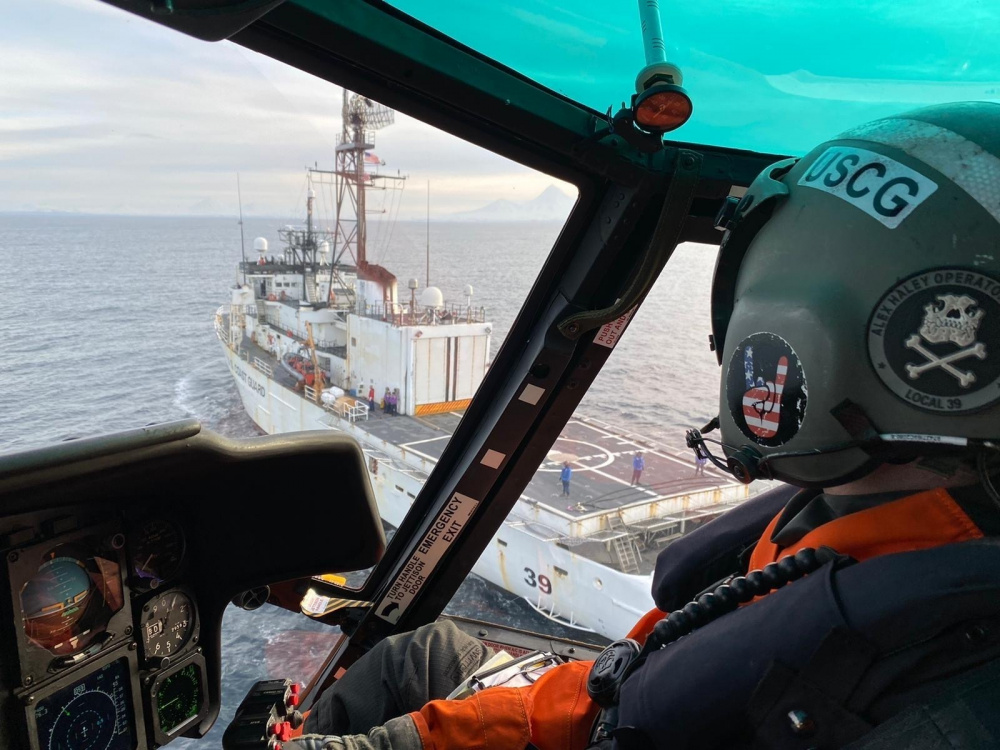
An MH-65 Dolphin helicopter crew based out of Air Station Kodiak and
deployed aboard Cutter Alex Haley, prepares for a helicopter in-flight refueling at sea evolution with the cutter crew during a search and rescue case near Dutch Harbor, Alaska, Wednesday, Dec. 30, 2020. The crew hoisted an injured fisherman from the vessel Magnus Martens and placed him in the care of awaiting Guardian Flight Alaska personnel for further transport to Anchorage. (U.S. Coast Guard photo by Lt. Benjamin DeGroot)

Below is a District 17 news release. This marks an important step in the move to an all H-60 rotary wing fleet and it also means that ships on ALPAT will be moving to operating MH-60s rather than H-65s.

I have to wonder, since recently upgraded MH-65Es will be with us for a very long time, if perhaps we might be able to open a new Coast Guard air station in Guam or the Northern Marianas (probably Tinian where the USAF is refurbishing an air base) and perhaps in American Samoa using H-65s. (I notice, when USCGC Harriet Lane recently deployed to the Western Pacific, she apparently did so without a helicopter, which would have made the ship more effective.) Certainly, the people of these American territories would welcome the additional SAR resources. That additional Western Pacific air stations might also, at least temporarily, operate Coast Guard fixed wing aircraft would also help to counter Illegal, Unreported, Unregulated (IUU) fishing.


 April 24, 2024

KODIAK, Alaska – The Coast Guard retired the Air Station Kodiak MH-65 Dolphin helicopter fleet during a ceremony, Tuesday.

Capt. Timothy Williams, commanding officer of Air Station Kodiak, presided over the ceremony honoring the 36 years of service the MH-65 Dolphin airframe and its crews provided to the Arctic region.

Air Station Kodiak currently has a rotary-wing fleet of six MH-60 Jayhawk helicopters. The unit will shift to a rotary-wing ship-and-shore based fleet of nine MH-60 Jayhawks in 2025.

Air Station Kodiak will be the fourth Coast Guard Air Station to transition to a single rotary wing fleet of MH-60 Jayhawk helicopters. Air Stations Borinquen, Traverse City, and New Orleans all recently completed similar transitions.

“For decades, the cutter and helicopter team were the core of the ALPAT mission,” said Cmdr. James Kenshalo, MH-65 Dolphin pilot. “Together they projected force and protection to the most extreme remote regions of our nation’s territories, operating beyond where help could reach. Countless lives have been saved because of these dedicated crews.”

Commissioned in January of 1988, the Alaksa Patrol (ALPAT) mission executed solely by MH-65 Dolphin aircrews provided Coast Guard Cutters with a reliable airborne asset during Alaska Patrols.

To read more about the Coast Guard MH-65 Dolphin and MH-60 Jayhawk helicopters click the following links:

SRR – MH-65 (uscg.mil)

MH-60T Service Life Extension Program (uscg.mil)

RIMPAC Preparation

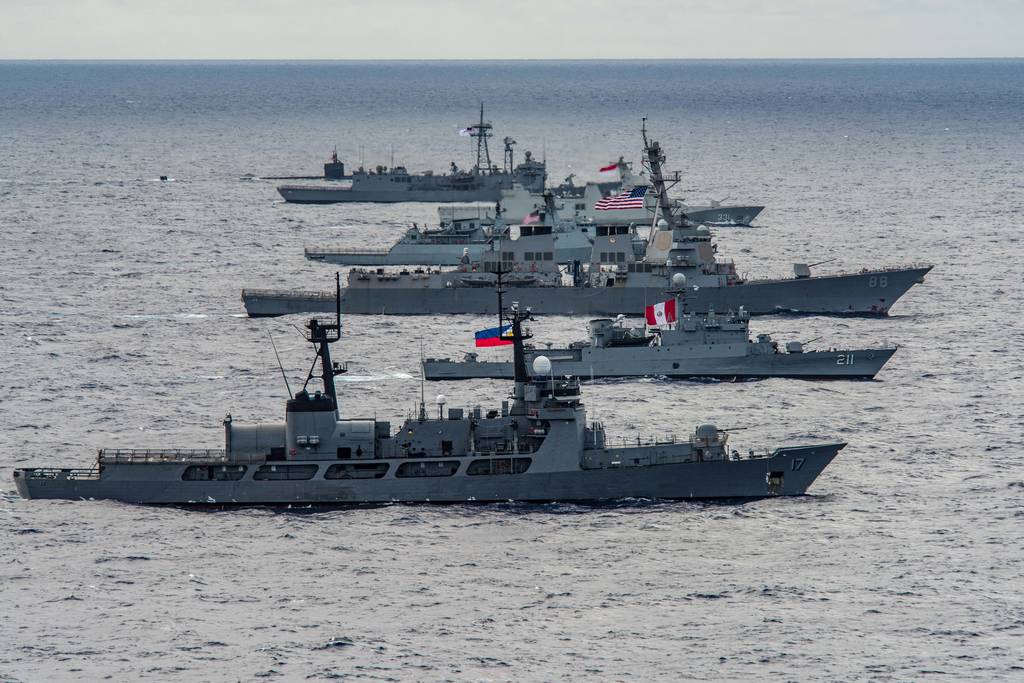
Navy ships assemble to form a multinational fleet for a photo exercise off the coast of Hawaii during the Rim of Pacific (RIMPAC) exercise on July 26, 2018. Twenty-six nations, more than 45 ships and submarines, about 200 aircraft and 25,000 personnel are participating in RIMPAC. (MC3 Dylan Kinee/U.S. Navy)

The biannual RIMPAC exercise is regularly the largest naval exercise in the world, and the Coast Guard is a regular participant. During the last two RIMPACs National Security Cutters did some interesting stuff, including commanding a task force and hosting Navy MH-60R and MH-60S Helicopters.

In addition, the Coast Guard will have a role in securing the safety of participating units.

It is almost certain we will see some former US Coast Guard cutters participating since they are now in the navies or coast guards of Colombia, Sri Lanka, Nigeria, the Philippines, Vietnam, and Bangladesh.

I hold out hope that Coast Guard units may be able to participate in a SINK-EX. even if the target is a former Coast Guard patrol boat, but it’s not likely.

Using the comments section, I will use this post to pass along information on preparation for the exercise. Below are posts that give us some previews of what to expect.

Japan Coast Guard H225 Helicopters

Japan CG Airbus H225 Helicopter

Below is an AirBus news release. The H225 is about the same size as the MH-60J despite the claims in the news release, Wikipedia reports that while the H225 has more power, the MH-60J has a higher speed and greater range.

Japan Coast Guard adds three H225s

Tokyo, 11 April 2024 – Japan Coast Guard (JCG) has placed an additional order for three H225 helicopters, taking its total H225 fleet up to 18. The largest Super Puma operator in Japan received three H225s in December 2023 and one in February 2024 for its growing fleet. The new helicopters will support territorial coastal activities, maritime law enforcement, as well as disaster relief missions in the country.

“The Japan Coast Guard has been an active operator of the Super Puma family helicopters for three decades. This follow-on order demonstrates the customer’s confidence in our products and the dedicated support to their fleet,” said Jean-Luc Alfonsi, Managing Director of Airbus Helicopters in Japan. “We believe the H225 is the perfect choice for JCG’s critical missions for law enforcement, as well as coastal and island protection, given its versatility in all weather conditions. We are committed to fully supporting its existing fleet, as well as its upcoming deliveries, ensuring high availability for its operations.”

JCG’s H225 fleet is covered by Airbus’ highly adaptive HCare Smart full-by-the-hour material support. This customised fleet availability programme allows the national coast guard agency to focus on its flight operations whilst Airbus manages its assets.

As the latest addition to the Super Puma family, the H225 is recognised for its high performance in challenging conditions as well as its outstanding range and payload capacity. The H225 has benefited from Airbus Helicopters’ continuous improvement policy. It is now equipped with new avionics including the largest screens available on the market and an innovative interface that, combined with its renowned autopilot, reduces pilot workload and enables them to focus on the mission at hand.

Offering the industry’s best range, speed, payload and reliability in the 11-ton-category twin-engine rotorcraft, the H225 offers outstanding endurance and fast cruise speed, and can be fitted with various equipment to suit a variety of roles.

24 H225s are currently flown in Japan by Japan’s Ministry of Defence or parapublic operators for various search and rescue missions, VIP, fire-fighting, as well as passenger and goods transportation.

“How Fast Response Cutters Have Transformed Coast Guard Operations In Guam” –Naval News / What About Air Assets?

The crew of USCGC Oliver Henry (WPC 1140) arrives in Pohnpei, Federated States of Micronesia, on Feb. 1, 2024, to download supplies for delivery to the outer islands of the FSM to combat the effects of a current drought. The supplies included 2,000 lbs of rice, three medical kits, 70 gallons of bottled water, and boxes of paper products. (Photo courtesy of U.S. Embassy Kolonia)

Naval News has an excellent article reviewing the additional capabilities Webber class FRCs have provided. It also highlights the vast operating area and associated challenges including necessary maintenance.

U.S Coast Guard Forces Micronesia Sector Guam’s AOR is based on Guam Search and Rescue Region. (U.S Coast Guard Navigation Center) Around 3 million square kilometers or 1.9 million square miles and includes the entirety of Palau, the Federated States of Micronesia, and Republic of the Marshall Islands.

For scale, the distance from the bottom of the area above to the top is 1020 nautical miles. According to the post, “It’s [an area] two thirds the size of the continental United States that we patrol with three ships and 300 people,” (I suspect that was in reference to the Contiguous 48, but it’s a huge area.)

ASSETS:

Something that should not be missed is that the only normally available rotary wing assets in the area are a squadron of Navy MH-60S, and there are no fixed wing SAR or law enforcement assets in the region. If an extensive search is required for any reason, it usually means flying a C-130J over 3,400 nautical miles down from Coast Guard Air Station Barbers Point, Hawaii just to get to Guam.

Major Cutters do occasionally cruise these waters, but it is rare. There is also a 225 foot buoy tender homeported in Guam.

Hopefully these waters will see USCGC Harriet Lane frequently, but on her first Western Pacific patrol, it did not appear she deployed with a helicopter (I believe Barbers Point has only three). Being one of the first four 270s that were built by Tacoma Boat, her flight deck is not strong enough to support the Navy MH-60S so they could not even us her flight deck to extend their range, much less operate from the ship.

Most of the time, there will only be one Coast Guard surface vessel underway in this vast area. Assets are still too few to provide any degree of persistence as a deterrent to Illegal, Unreported, or Unregulated (IUU) fishing. Any vessels involved in IUU fishing would likely have a good idea where our cutters are operating and with no fixed wing search aircraft, our ability to search for IUU perpetrators is extremely limited.

In addition to more cutters, we really need good maritime domain awareness, probably meaning some kind of long-range search aircraft, manned or unmanned, operating routinely in this area. We might consider basing C-27Js in Guam. It is a long way from USCG support, but the Australian Air Force also flies C-27Js, so there might be some synergy there.

“Unified Response: Joint Naval Drills in South China Sea” –MSN

Vessels from Australia, the USA, the Philippines, and Japan navigate in formation. (AFP Photo)

MSN reports,

The United States, Japan, Australia, and the Philippines … have announced preparations to perform cooperative naval exercises to preserve freedom of navigation and the rule of law as a display of unity…The combined forces of the participating nations will conduct a series of exercises aimed at improving interoperability and cooperation on April 7 as part of the joint naval and air drills.

Notably, there don’t seem to be any coast guard assets from any nation involved in this exercise.

There has been a lot of speculation about the timing of this exercise being so close to that of the trilateral summit which begins April 11, but the exercise is actually pretty small, with only one ship each from the US, Australia, and Japan. The exercise involves no aircraft carriers, submarines, or amphibious assault ships.

The largest ship participating is the Japanese Destroyer Akebono (DD-108) which is not an Aegis ship, and it is one of their smaller destroyers at 6200 tons full load. The US representative is a Littoral Combat Ship, USS Mobile (LCS-26) at 3,104 tons full load.

“Media Advisory: U.S. Coast Guard Cutter Harriet Lane is scheduled to return to home port following inaugural Operation Blue Pacific Patrol in Oceania” –CG News

Australian Royal Navy personnel stand in formation on a pier as the U.S. Coast Guard Cutter Harriet Lane (WMEC-903) and crew prepare to moor at HMAS Cairns, Queensland, Australia, March 7, 2024. The Harriet Lane and crew had a five-day port call in Cairns during its inaugural 2024 Operation Blue Pacific patrol in Oceania. (U.S. Coast Guard photo by Petty Officer 2nd Class Ty Robertson)

Below is a Coast Guard News release. The release has some videos including interaction with children in Port Vila, Vanuatu (very cute).

One thing that caught my eye was the use of the plural in this statement, “The Coast Guard plans to use medium endurance cutters (emphasis applied–Chuck) for responsibilities in Hawaiian waters, as well as an increase Coast Guard presence throughout the Indo-Pacific and Oceania.”

Was this just a misstatement by the PAO or does this mean we will see more WMECs in 14th District?

I would also note that Harriet Lane apparently made this patrol without a helicopter. Barbers Point does fly H-65s, but last I heard, they only have three. Did the cutter at least have a Scan Eagle?


April 4, 2024

Media Advisory: U.S. Coast Guard Cutter Harriet Lane is scheduled to return to home port following inaugural Operation Blue Pacific Patrol in Oceania

Editor’s Note:  Media should RSVP by Monday, April 8 by 4 p.m. to Petty Officer 2nd Class Ryan Fisher at ryan.m.fisher@uscg.mil
Imagery of Harriet Lane’s patrol can be found here: Operation Blue Pacific 

Who: U.S. Coast Guard Rear Adm. Michael Day, commander U.S. Coast Guard Fourteenth District, and Cmdr. Nicole Tesoniero, commanding officer U.S. Coast Guard Cutter Harriet Lane (WMEC 903).

What: U.S. Coast Guard Cutter Harriet Lane and crew are expected to return to home port after their inaugural Operation Blue Pacific patrol in Oceania. Media are invited to watch Harriet Lane and crew moor at Pearl Harbor and families be reunited after being away for more than 70 days. Media will be able to hear remarks from Day and Tesoniero regarding Operation Blue Pacific and the increased Coast Guard presence in Oceania.

Where: Joint Base Pearl Harbor-Hickam, 1000 North Rd, Honolulu, Hawaii, 96860

When: Tuesday, April 9 at 10 a.m.  

Harriet Lane and crew partnered alongside allies and several Pacific Island countries from January to April 2024. Among those countries were Samoa, Fiji, Vanuatu, Australia, Papua New Guinea, Nauru and Marshall Islands. The focus was on advising and sharing best practices, along with bolstering our partners’ capabilities to promote and model good maritime governance in the region.

Harriet Lane and crew expanded U.S. Coast Guard presence in Oceania alongside Pacific Island countries exercising bilateral maritime law enforcement agreements with shiprider provisions to strengthen maritime domain awareness and support efforts to combat illegal fishing activities with partners with whom we have existing relationships.

The Harriet Lane is U.S. Coast Guard Pacific Area’s newest Indo-Pacific support cutter and spent more than 15 months in a Service Life Extension Program (SLEP) in Baltimore, Maryland, to prepare for the transition in missions and operations.

The Coast Guard plans to use medium endurance cutters for responsibilities in Hawaiian waters, as well as an increase Coast Guard presence throughout the Indo-Pacific and Oceania. The ship is especially suited for longer-range six-to-eight week joint operational and training patrols in the Pacific, taking pressure off shorter range Hawaii-based cutters more suited to service closer to home port.

Commissioned in 1984, Harriet Lane is a 270-foot medium endurance cutter homeported in Pearl Harbor, Hawaii, to support Coast Guard missions in the Pacific region. The service’s medium endurance cutter fleet supports a variety of Coast Guard missions including search and rescue, law enforcement, maritime defense, and protection of the marine environment.