“U.S. Coast Guard Cutter Munro holds a change of command ceremony” –News Release

Royal Navy vessel HMS Spey (P234) (foreground) conducts coordinated ship maneuvers with U.S. Coast Guard Cutter Munro (WMSL 755) Sept. 17, 2023, in the South China Sea. Munro is deployed to the Indo-Pacific to advance relationships with ally and partner nations to build a more stable, free, open and resilient region with unrestricted, lawful access to the maritime commons. (U.S. Navy photo by Chief Petty Officer Brett Cote)

Below is a news release. Routine change of command, but the Munro’s recent activities are interesting for their variety, three very different activities in widely dispersed areas, Eastern Pacific, Western Pacific, and far Northern Pacific. More info in these earlier news releases:


 May 31, 2024

U.S. Coast Guard Cutter Munro holds a change of command ceremony

SAN DIEGO — The U.S. Coast Guard Cutter Munro (WMSL 755) held a change of command ceremony Thursday in San Diego.

Vice Adm. Andrew J. Tiongson, Commander, U.S. Coast Guard Pacific Area, presided over the ceremony in which Capt. James O’Mara IV relieved Capt. Rula Deisher as Munro’s commanding officer.

Deisher served as Munro’s commanding officer from May 2022 to May 2024, sailing over 73,000 nautical miles to 17 ports, including eight foreign countries during patrols in the Bering Sea, Western Pacific, and Eastern Pacific.

Most recently, Munro and the crew were responsible for the interdiction and seizure of illegal narcotics worth an estimated $460 million in wholesale value and over $2 billion in street value while patrolling the Eastern Pacific Ocean in support of the Joint Interagency Task Force-South. Munro’s crew also supported Operation Southern Shield during their recent patrol by conducting 16 fisheries boardings in the Southern Pacific Regional Fisheries Management Organization convention area, upholding the maritime rules-based order.

During Munro’s Western Pacific patrol, the cutter and crew hosted multiple engagements with foreign partners, including a discussion about the SAPPHIRE agreement with Japanese Coast Guard officers, a subject matter expert exchange, an at-sea engagement with the Korea Coast Guard, and participated in CARAT Brunei, where Munro worked alongside the Royal Brunei Navy in professional subject matter expert exchanges, leadership conferences, and an at-sea engagement.

While patrolling the Bering Sea, Munro conducted 24 fisheries boardings and two search-and-rescue cases, including the medical evacuation of a critical patient from Dutch Harbor, Alaska, to Anchorage, Alaska.

“To the crew of Munro, thank you,” said Deisher. “I am so proud of your endless dedication and care toward each other and our mission. This crew is phenomenal, and it has been an honor and privilege to sail with them and learn from them.”

Deisher’s next assignment is to serve as the Seventeenth District’s Response Division chief.

O’Mara, the incoming commanding officer, brings a wealth of experience to Munro.

Reporting from the Coast Guard’s Eleventh District as the Enforcement Branch chief, O’Mara oversaw assets across 1,000 miles of shoreline from the California-Oregon state line to the Mexico border and 73 federal waterways. He also worked closely with the Department of Defense Joint Interagency Task Forces and the Department of Homeland Security Joint Task Force West to conduct effective drug and law enforcement interdiction efforts across the Eastern Pacific.

Munro will be O’Mara’s seventh ship and fourth command, following previous commands aboard the Coast Guard Cutters Active (WMEC 618), Farallon (WPB 1301), Monomoy (WPB 1326), and Narwhal (WPB 87335).

The change of command ceremony, a time-honored tradition, is a significant event conducted before the assembled company of a command. It confirms to the unit’s men and women that the authority of command is maintained. The ceremony symbolizes a transfer of total responsibility, authority, and accountability from one individual to another, marking a new chapter in the command’s history.

Commissioned in 2017, Munro is one of four Coast Guard Legend-class national security cutters homeported in Alameda. National security cutters, measuring 418 feet long and 54 feet wide, boast a top speed of over 28 knots, a range of 12,000 nautical miles, endurance of up to 90 days, and can hold a crew of up to 170. The advanced technologies of the national security cutter class ships support the national objective of maintaining the security of America’s maritime boundaries and providing long-range search and rescue capabilities.

“U.S., Japan, Korea Coast Guards sign trilateral agreement to increase maritime cooperation” –News Release

U.S., Japan, Korea coast guards sign trilateral agreement to increase maritime cooperation
Mr. Kishimori Hajime, deputy Consul General of Japan (left), Japan coast guard Vice Adm. Watanabe Yasunori, Japan coast guard vice commandant for operations, U.S. Coast Guard Vice Adm. Andrew Tiongson, commander, U.S. Coast Guard Pacific Area, and Hyunchul Kang, deputy Consul General of the Republic of Korea, pose with a signed trilateral agreement at Coast Guard Island, Alameda, Calif., May 9, 2024. Japan, Republic of Korea and U.S. coast guards gathered to finalize a trilateral letter of intent, which will drive the three nations to work together to advance maritime safety, security and prosperity in the Indo-Pacific. (U.S. Coast Guard photo by Master Chief Petty Officer Charly Tautfest)

Below is a PACAREA news release.

Like the US Coast Guard, Japan and South Korea have been attempting to help SE Asian nations strengthen their maritime security and law enforcement organizations so that they can deal with what is essentially state supported, state sponsored, and state coordinated theft of their resources.

This should at least allow better coordination and avoid unnecessary duplication. The Philippines and Vietnam are likely to be primary beneficiaries.

We probably have things to learn too. The Japanese and S. Korean Coast Guards are both large and have a lot of experience countering violent resistance.

A picture taken on November 16, 2011 from a South Korean helicopter shows Chinese fishermen wielding sticks to stop an attack by South Korean coastguard commandoes armed with clubs aboard rubber boats during a crackdown on alleged illegal fishing in South Korean waters in the Yellow Sea off the southwestern coast county of Buan. South Korea’s coastguard mobilised 12 ships, four helicopters and commandoes for a special three-day crackdown on illegal fishing by Chinese boats this week. REPUBLIC OF KOREA OUT AFP PHOTO / DONG-A ILBO (Photo credit should read DONG-A ILBO/AFP/Getty Images)

Thanks to Paul for bringing this to my attention. 


May 12, 2024

U.S., Japan, Korea Coast Guards sign trilateral agreement to increase maritime cooperation

ALAMEDA, Calif – U.S. Coast Guard, Japan Coast Guard and Korea Coast Guard representatives displayed continued commitment to enhance maritime expertise and promote regional cooperation by signing a trilateral letter of intent, Thursday.

This agreement aligns trilateral cooperation between Japan, the Republic of Korea and the United States to include capacity-building efforts to Association of Southeast Asian Nations and Pacific Island countries. The letter of intent advances a joint statement between the three nations’ leaders, which was held at Camp David in August 2023.

U.S. Coast Guard Vice Adm. Andrew Tiongson, Commander, U.S. Coast Guard Pacific Area, met Japan Coast Guard Vice Adm. Watanabe Yasunori, Japan Coast Guard Vice Commandant for Operations, to finalize a trilateral letter of intent, which was previously signed by Korea Coast Guard Oh Sang Kwon, Deputy Commissioner of the Korea Coast Guard. Oh signed the letter of intent in April with the understanding that the agreement would be finalized upon Watanabe’s May visit to U.S. Coast Guard Pacific Area command.

Mr. Hyunchul Kang, Deputy Consul General of the Republic of Korea, attended the trilateral signing on behalf of the Korea coast guard, and Mr. Kishimori Hajime, Deputy Consul General of Japan, presented brief remarks as well.

“This trilateral agreement between U.S., Japan and Korea Coast Guards is the lynchpin that will drive our coast guards to work together to advance maritime safety, security, and prosperity in the Indo-Pacific,” said Tiongson. “It will enhance our multilateral operations with each other, as well as other trusted partners in the region.”

The agreement specifically recognizes the important of efforts to conserve maritime resources, combat illegal, unreported and unregulated fishing and search and rescue response efforts.

“Coast Guard Cutter Bertholf arrives in Singapore”

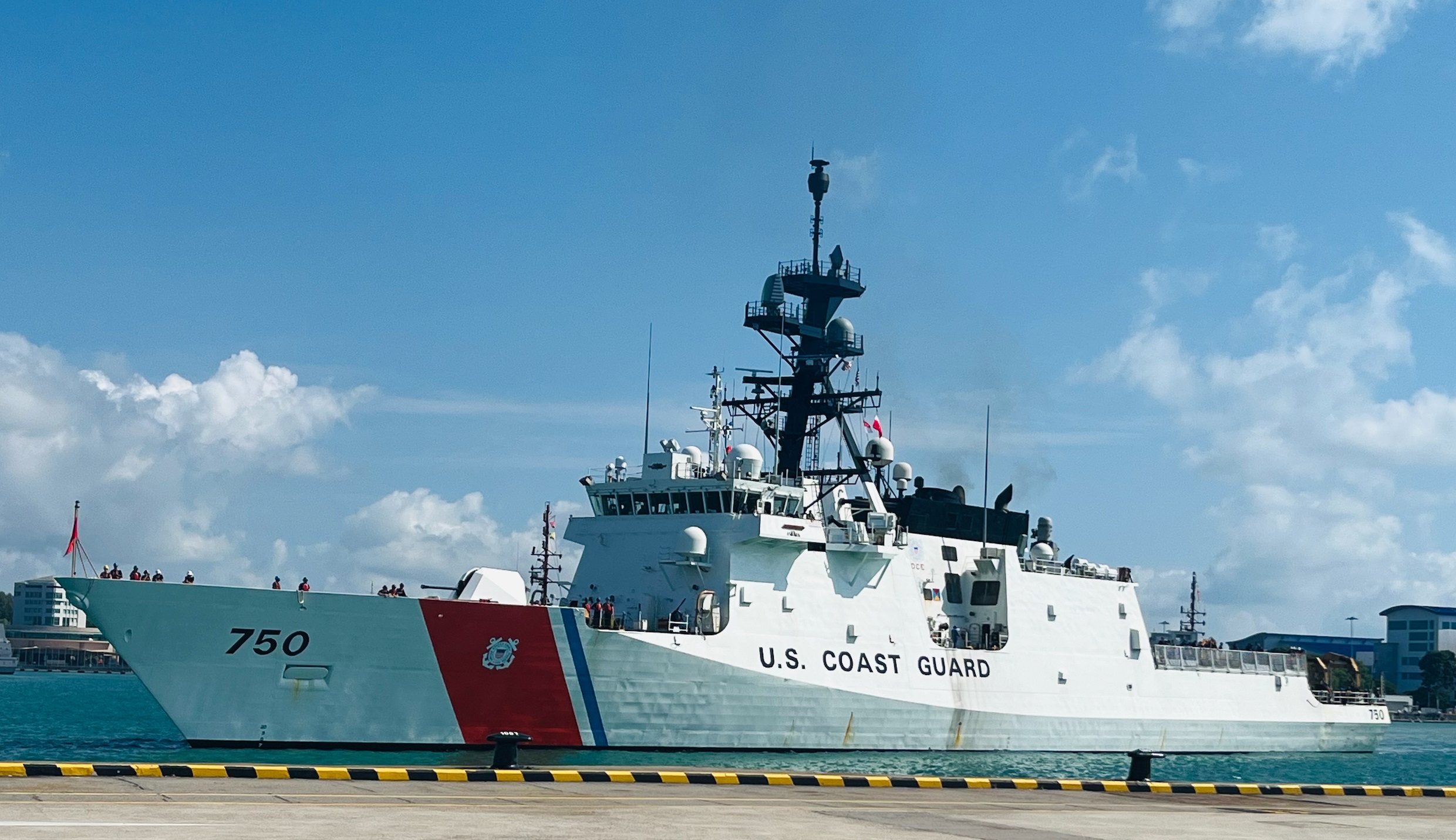
U.S. Coast Guard Cutter Bertholf (WMSL 750) arrives at Changi Naval Base in Singapore, Feb. 25, 2024. The Bertholf moored next to USS Gabrielle Giffords (LCS 10), a U.S. Navy Littoral Combat Ship, also in the region to support an open Indo-Pacific region. (U.S. Coast Guard photo by Cmdr. Trevor Parra)

Below is a US Coast Guard news release. You can find more photos at the link. 


March 5, 2024

Coast Guard Cutter Bertholf arrives in Singapore

SINGAPORE – U.S. Coast Guard Cutter Bertholf (WMSL 750) and crew arrived in Singapore, Feb. 25, after transiting more than 8,000 nautical miles over 30 days from San Diego, Calif.

During the visit to the Republic of Singapore, the crew of the cutter is scheduled to participate in several professional engagements and at-sea exercises.

The two-day professional meetings will allow for collaboration, exchanges of best practices, and operational planning for the scheduled two-day exercises at-sea with the Republic of Singapore Navy vessel, Guardian. In addition to the Republic of Singapore Navy, the crew of the Bertholf intend to work with the Singapore Police Coast Guard and Malaysia Maritime Enforcement Agency.

“The crew of the Bertholf is excited to be in Singapore and looking forward to the many events with the crew of the Republic of Singapore Navy, Police Coast Guard, and Malaysia Maritime Enforcement Agency,” said U.S. Coast Guard Capt. Billy Mees, commanding officer of the Bertholf. “The Indo-Pacific region is a dynamic environment and fostering partnerships with our allied nations helps ensure we improve maritime governance in these crucial economic waterways.”

Bertholf is one of four National Security Cutters homeported in Alameda. The U.S. Coast Guard currently maintains 10 National Security Cutters. Bertholf is operating as part of Commander, Task Force (CTF) 71, U.S. 7th Fleet’s principal surface force, promoting a free and open Indo-Pacific, strengthening partner networks, and enhancing maritime safety and security.

Bertholf is the first legend-class national security cutter and has a range of 12,000 nautical miles, endurance of up to 90 days and can hold a crew of up to 170. Coast Guard Cutter Bertholf is homeported in Alameda, Calif.

“ASEAN kicks off its first-ever joint military drills in Indonesia” –Reuters

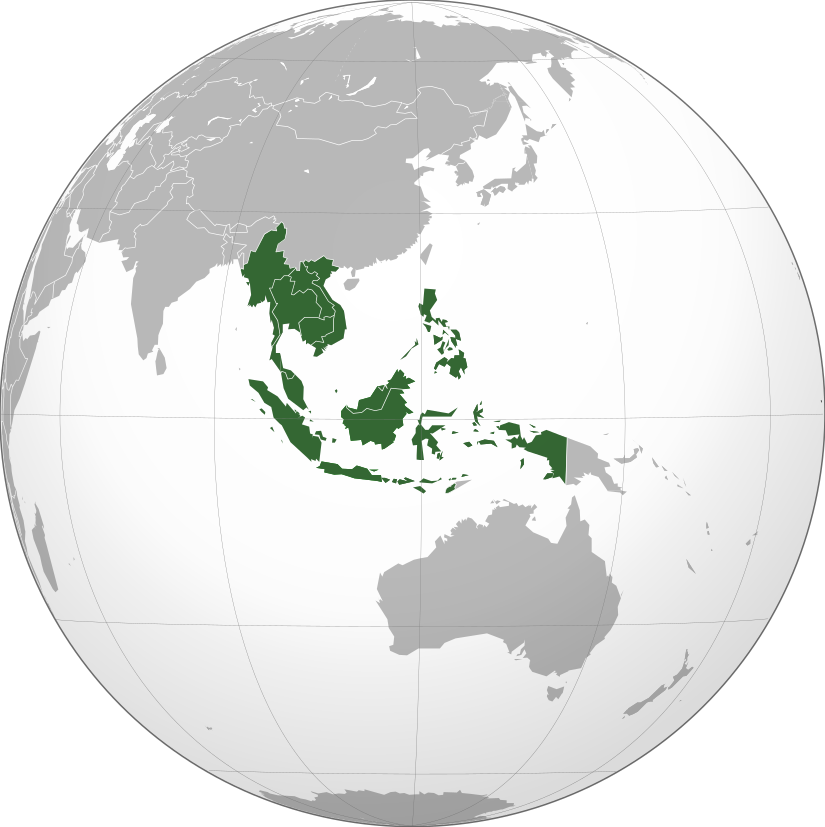
Association of Southeast Asian Nations in orthographic projection. Credit: Addicted04

Reuters reports,

“Units from the countries of ASEAN began their first ever joint military drills in Indonesia’s South Natuna Sea amid rising geopolitical tensions between major powers and protests against China’s activities in the South China Sea…The five-day non-combat operation is aimed at developing military skills, including maritime security and patrols, and the distribution of humanitarian assistance and disaster relief, the Indonesian military said in a statement.”

This is a step toward establishment of recognized norms and cooperative law enforcement by ASEAN members in the South China Sea.

Significantly Indonesia is taking a leadership role. Indonesia seems to be the most aggressive nation in ASEAN with regard to protecting their EEZ assets.

“Indo-Pacific coast guards try to head off a troubling storm” –Asia Times

The Philippine Coast Guard conducted its first-ever trilateral maritime exercise with the United States Coast Guard (USCG) and the Japan Coast Guard (JCG) in waters off Mariveles, Bataan, from June 1-7, 2023. Photo: Philippine Coast Guard

The Asia Times reports, “Indo-Pacific coast guards and maritime law enforcement agencies are taking additional steps to improve their cooperation.”

We have frequently talked about US Coast Guard actions in the Western Pacific, but this gives us a better understanding of the leadership roles being taken by the Coast Guards of Japan, India, Indonesia, and the Philippines, working in cooperation with Vietnam, Malaysia, Singapore, Bangladesh, Cambodia, South Korea, Sri Lanka and the Maldives.

Perhaps someday we will see something like my proposed Combined Maritime Security Task Force Pacific.

The CENTCOM sponsored Combined Maritime Forces provides a good model.

“ASEAN Coast Guard Forum strengthens cooperation to combat maritime threats” –Indo-Pacific Defense Forum

Coast guard leaders and personnel from member states of the Association of Southeast Asian Nations participate in the June 2023 ASEAN Coast Guard Forum in Jakarta, Indonesia. IMAGE CREDIT: Indonesian Maritime Security Agency

Indo-Pacific Defense Forum reports on the second annual ASEAN Coast Guard Forum.

“Representatives of the coast guards of Brunei, Indonesia, Malaysia, the Philippines, Singapore and Thailand attended the meeting…The inaugural ACF was held in Bali, Indonesia, in November 2022. The next ACF will be held in the Philippines in 2024, with Thailand serving as host in 2025.”

Good to see growing regional international cooperation between coast guard agencies. Similar organizations include the North Pacific Coast Guard Agencies Forum initiated by the Japan Coast Guard in 2000 and the Arctic Coast Guard Forum established in 2015.

“U.S. Coast Guard Cutter Stratton visits Singapore during Indo-Pacific deployment”

Passing along this news release. (More photos available through the link.)


May 31, 2023

U.S. Coast Guard Cutter Stratton visits Singapore during Indo-Pacific deployment

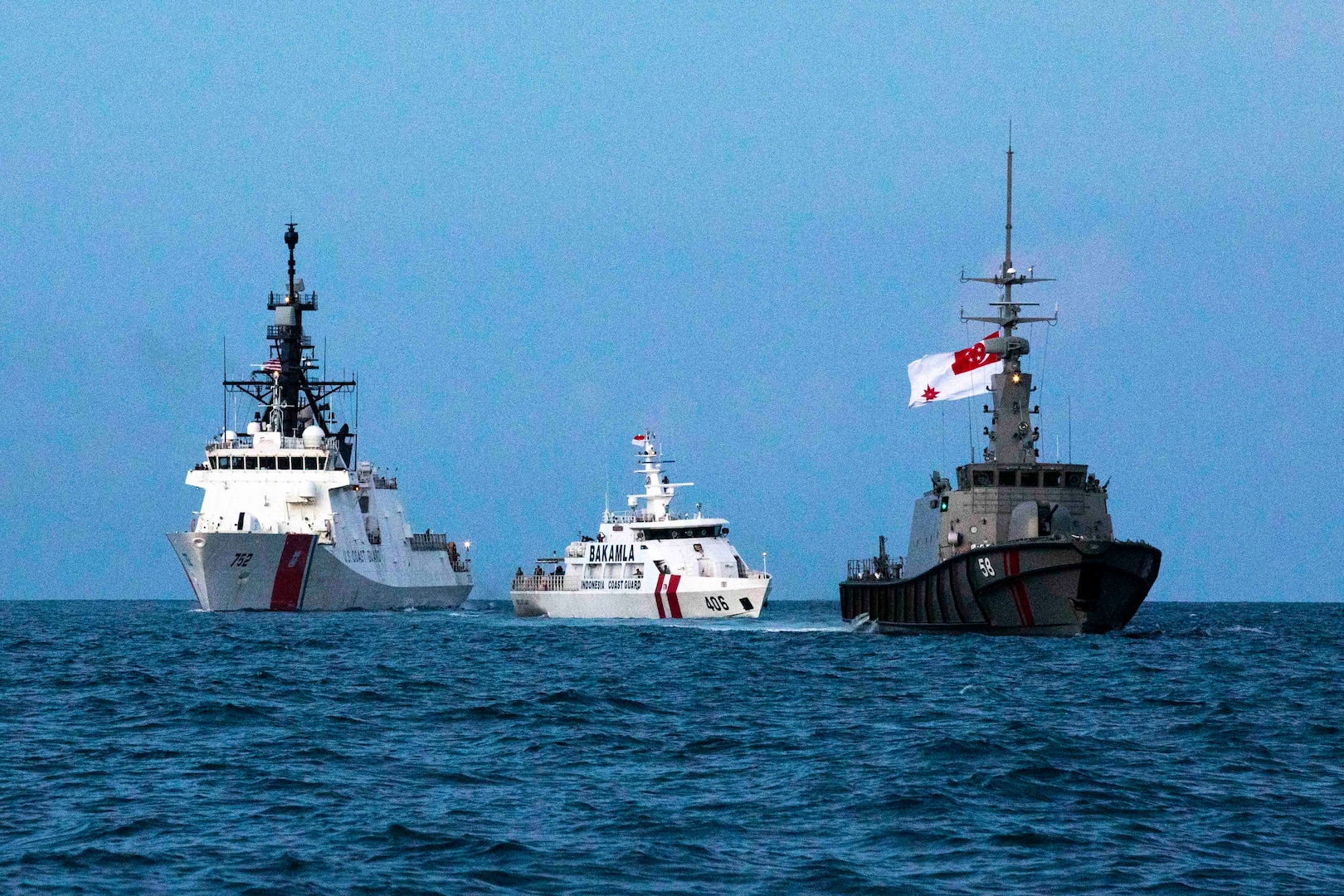
SINGAPORE – U.S. Coast Guard Cutter Stratton (WMSL 752) departed Singapore, May 22, following a scheduled port visit while deployed to the Indo-Pacific.

While in Singapore, Stratton’s commanding officer and crew strengthened trusted partnerships with local leaders, maritime safety and security stakeholders, and the community.

“The United States Coast Guard is committed to upholding a rules-based order in the Indo-Pacific. Stratton is here to support our allies and partners in making sure the Indo-Pacific region remains free and open to all,” said Capt. Brian Krautler, Stratton’s commanding officer. “The crew is looking forward to operating with our partners in the region. The crew of Stratton is ‘always ready’ to operate alongside like-minded nations as a trusted partner.”

While in port, the U.S. Ambassador to Singapore, the Honorable Jonathan Kaplan, toured the Stratton discussing interoperability in the region. The cutter’s crew volunteered with the Genesis school, a school for special needs children, and served at a food bank that feeds up to 7,000 people.  Additionally, the Stratton’s crew played friendly matches of ultimate Frisbee against the Republic of Singapore Navy sailors.

Stratton is deployed in the Indo-Pacific to engage with ally and partner nations and promote a free and open Indo-Pacific. The Stratton crew is conducting operations to share best practices and expertise in search-and-rescue, law enforcement and maritime governance. U.S. Coast Guard and U.S. Navy forward-deployed forces remain ready to respond to crises as a combined maritime force. Singapore is Stratton’s fourth port visit since departing her homeport of Alameda, California.

Stratton is operating as part of Commander, Task Force (CTF) 71, U.S. 7th Fleet’s principal surface force. CTF-71 is responsible for the readiness, tactical and administrative responsibilities for forward-deployed assets andsurface units conducting operations in the region.

Stratton is a 418-foot national security cutter capable of extended, global deployment in support of humanitarian missions, and defense missions. National security cutters routinely conduct operations throughout the Pacific, where the range, speed and ability to operate in extreme weather provides the mission flexibility necessary for the U.S. Coast Guard to serve as a unique strategic contributor in the region.

The namesake of U.S. Coast Guard Cutter Stratton is Capt. Dorothy Stratton, who led the service’s all-female reserve force during World War II. Capt. Stratton was the first female commissioned officer in the Coast Guard and commanded more than 10,000 personnel. The ship’s motto is “We can’t afford not to.”

U.S. 7th Fleet is the U.S. Navy’s largest forward-deployed numbered fleet, and routinely interacts and operates with allies and partners in preserving a free and open Indo-Pacific region.

U.S. Coast Guard Pacific Area is responsible for U. S. Coast Guard operations spanning across six of the seven continents, 71 countries and more than 74 million square miles of ocean. It reaches from the shores of the West Coast of the United States to the Indo-Pacific, Eastern Pacific, Arctic and Antarctic. Pacific Area strives to integrate capabilities with partners to ensure collaboration and unity of effort throughout the Pacific.

“US, PH, Japan coast guards hold maritime law enforcement training” –The Manila Times

More than 30 participants from the Philippines, Malaysia, Thailand and Vietnam joined the Multinational Vessel Boarding Officer Course funded by the US Department of State’s Bureau of International Narcotics and Law Enforcement Affairs in Puerto Princesa City, Palawan on May 15-26, 2023. CONTRIBUTED PHOTO

The Manila Times reports on a US sponsored, Philippines hosted, boarding officer course that was also extended to officers from other ASEAN partners.

“Through this course, 33 participants from the PCG, Philippine National Police Maritime Group, Malaysia’s Maritime Enforcement Agency, Thailand’s Maritime Enforcement Command Center, and Vietnam’s Department of Fisheries enhanced their knowledge of the law of the sea and policy on the use of force.”

Thanks to Paul for bring this to my attention. 

“How a new Vietnam-Indonesia deal will affect South China Sea disputes” –Defense News

Defense News reports that Vietnam and Indonesia have agreed on demarcation of their respective EEZs where they had previously been in dispute.

Peaceful settlement of conflicting SE Asian nation claims would go a long way toward presenting a united front against China’s expansive 9 Dash Line claims and clarify IUU fisheries enforcement.

“Practically, the successful Indonesia-Vietnam EEZ [exclusive economic zone] demarcation will help both countries to resolve illegal, unreported, and unregulated (IUU) fishing, which has been a serious bilateral irritant and a broader issue involving third-party countries, including China and Thailand,” according to Bich Tran, a visiting fellow writing in the Fulcrum, a publication of the ISEAS—Yusof Ishak Institute in Singapore.

Upgrades to the Philippine WHECs

BRP Ramon Alcaraz (former USCGC Dallas) equipped with new Sea Giraffe multi-mode radar in Cebu.

NavyRecognition reports, “China Coast Guard try to intercept Philippine Navy’s BRP Andres Bonifacio.” We talked about this incident earlier, but this report also includes information about the upgrades to the former US Coast Guard cutter. We did talk about upgrades earlier, but this has more specifics, particularly in regard to the sonar. All three of the Philippines’ former cutters are being upgraded.

The OPV is equipped with various sensors and processing systems, including the Naval Shield Baseline 2 Integrated Combat Management System, a Saab AB AN/SPS-77 Sea Giraffe AMB 3D air/surface search radar, a Furuno FAR3220BB 25KW X-band navigational radar, a Sperry Mk 92 Mod 1 Fire Control System, and an ELAC Hunter 2.0 hull-mounted sonar.

BRP Andres Bonifacio is armed with a Mk 75 Oto Melara 76mm Compact gun, two Mk 38 25mm autocannons, six M2HB Browning .50 caliber guns, and two USN-Mark 36 SRBOC (Super Rapid Blooming Offboard Countermeasures) mortar-type launching systems.

The combat management system, AN/SPS-77, sonar, and 25mm Mk38 Mod2/3s are all upgrades since the hand-over. I also found some additional information, that also mentioned Radar Electronic Support Measure (R-ESM), a new Identification Friend or Foe (IFF), and the SeaFLIR 230 electro-optical/infra-red (EO/IR) system.

The AN/SPS-77 is also used on Independence class LCS and will equip the US Coast Guard Offshore Patrol Cutter.

The sonar is by a German company and offers mine avoidance and torpedo detection as well as passive and active submarine and UUV detection capabilities. We don’t know which of the various sized transducers associated with this system was chosen. Transducers of 4 kHz to 30 kHz are available that span the range from low frequency long range systems to relatively short ranged high frequency systems. A medium frequency seems most likely.

Some of these upgrades, particularly the multimode radar, support helicopter operations. The Philippine Navy currently has two AW159 Wildcat helicopters with significant ASW and anti-surface capability. So far these are the only Philippine aircraft with an ASW capability and they may be based on other Philippine Navy warships.

The upgrades were done in South Korea. The Philippine military seems to have developed a relationship with South Korea. The Philippine Navy has purchased two 2600 ton light frigates from S. Korea and has contracts out for two 3200 ton corvettes and six 2400 ton 94.4 meter Offshore Patrol Vessels.

The three Philippine ships are probably now the best equipped of the 12 former US Coast Guard 378s currently serving in five different navies and coast guards, but there are still some desirable possible additions, including anti-ship cruise missiles (ASCM), close in weapon systems (CIWS), light weight ASW torpedoes, and towed array sonars.