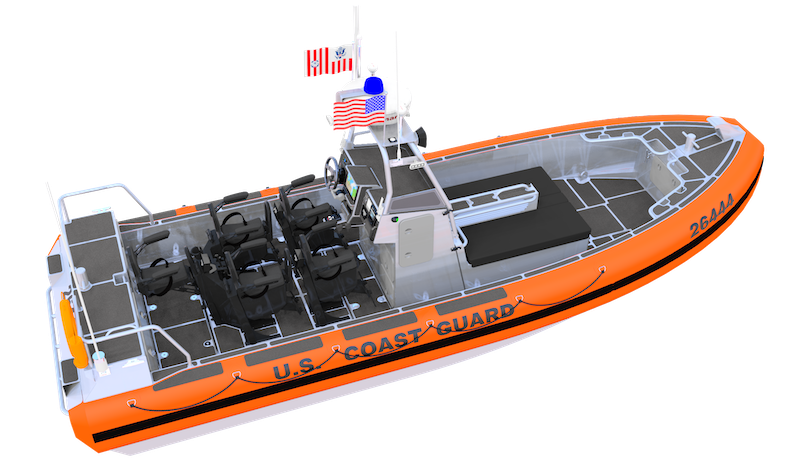
Special Purpose Craft – Heavy Weather 2nd Generation (SPC-HWX II)

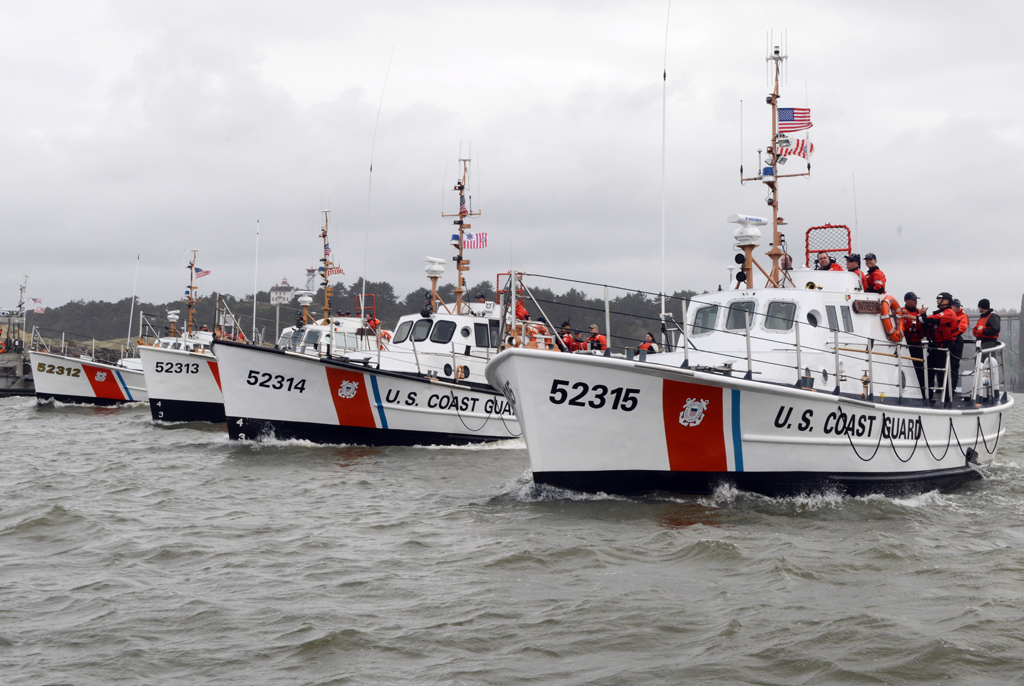
Being Replaced: Coast Guard crew members aboard four 52-foot Motor Life Boats and one 47-foot Motor Life Boat transit in formation outbound of Yaquina Bay, Ore., April 9, 2019. The four 52-foot MLBs are the only active vessels of their kind and the crews are assigned to different units across the Pacific Northwest, which is why having all four together for the roundup was a rare occurrence. (U.S. Coast Guard photo by Petty Officer 3rd Class Trevor Lilburn)

The Acquisitions Directorate has announced the release of a request for proposal for six boats to replace the 52 foot MLBs which were taken out of service more than three years ago. You can find the RFP here.

The proposal should give the Coast Guard some very capable craft. I did not read the entire 196 pages front to back, but I did manage to find out some of the capabilities included in the specifications.

First some limits:

  • Length 64 feet or less
  • Beam 22 feet or less
  • Draft 7 feet or less

Other characteristics:

  • Speed: at least 20 knots
  • Cruise Speed: 16 knots
  • Minimum Speed: 5 knots or less
  • Range: 500 nautical miles
  • Crew: Minimum 4

Missions:

  • SAR is number one, but also
  • Marine Safety
  • Law Enforcement
  • Ports Waterways and Coastal Security
  • Marine Environmental Protection
  • plus, anything else they might use it for.

Capabilities:

They are expected to operate in 35′ seas, 60 knot winds, and 25′ surf.

The boats will support a relief crew of four for missions that last more than 10 hours in calm waters or more than six hours in more demanding conditions. There is also seating for five survivors for a total of 13 seats. Berthing is limited to four.

The boats will have both open and enclosed bridges. It will be equipped with a bow thruster, recovery wells on either side and a powered towline reel.

Communications include satellite phone, and if I understand correctly, encrypted voice and data.

In addition to radar, sensors will include Electro Optics and Infra-Red (EO/IR).

Maybe We Need More than Six:

As I have noted before, such vessels could replace 87 foot WPBs that are approaching the end useful life in at least some ports and do it with a smaller crew and probably better seakeeping. They might not encounter 25 foot surf as frequently as the those in the Pacific Northwest, but the capability to deal with heavy weather will be there when needed. They don’t have the endurance of WPBs but when cases extend beyond their endurance, FRCs should take over. I do hope they are a bit faster than 20 knots, after all the 47 footers can do 25 knots.


“Today’s patrol boats now tackle different missions across locations” –Workboat

Today’s Force Protection boats purposely have less horsepower than their predecessors. MetalCraft photo.

WorkBoat reports on four different patrol boats from three different manufacturers, being made for the Navy, Santa Barbara (CA) Harbor Patrol, and the Palm Beach (FL) County Sheriff’s Department.

They are very different boats, but each has interesting characteristics.

Thanks to Eaglespeak for bringing this to my attention.

“Boats of the United States Coast Guard” –CG-9

Response Boat, Medium (RB-M). Photo from Vigor

A friend (thanks Lee) brought this little book to my attention.

“Boats of the United States Coast Guard”

Don’t know how I missed this, but seems very comprehensive, 30 pages and 44 different types of craft.

“Test driving the Coast Guard’s new over-the-horizon cutter boat” –WorkBoat

Over the Horizon Boat V. Arnie Hammerman photo.

WorkBoat tests one of four pre-production Over the Horizon Cutter Boat Vs. It is extremely well done and extremely complementary.

A report of the contract award is here. There is a report of delivery of the first boat here.

Given the selection process, and the fact that this is the fifth iteration of the Over the Horizon Cutter Boat, we should expect that it should be a good boat, but this additional feature shows that the Coast Guard has recognized a hazard and is concerned about the health of the crews.

“This is the first Coast Guard boat to include a shock-monitoring system that provides the crew with real-time information about wave impacts on the vessel.”

Thanks to MikeB for bringing this to my attention.

“Naval Special Warfare (NSW) Surface Support Craft (SSC) and U.S. Coast Guard Special Purpose Craft, Law Enforcement II (SPC-LE2) Vessels – Contract Update” –Seapower

The Navy League on-line magazine, Seapower, reports the Navy and Coast Guard are buying Ambar Series boats from SilverShips.

The $8.2 million delivery order is a Firm-Fixed-Price Indefinite Delivery, Indefinite Quantity (IDIQ) single award contract (N00024-21-D-2205) by the Naval Sea Systems Command for the construction and delivery of up to 110 Naval Special Warfare (NSW) Surface Support Craft (SSC) and U.S. Coast Guard Special Purpose Craft, Law Enforcement II (SPC-LE) vessels, in addition to other accessories, parts and training. The contract includes options that, if exercised, would bring the cumulative value of the contract to $51.6 million and production work would continue through 2026-2027.

11 meter SPC-LE

There is more information in this earlier post about the original contract. Coast Guard boats will be Open Center Console (Open) variant with three Mercury 5.7L V10 350 and 400hp Verado outboards.

Silver Ships also has a contract to make remote controlled surface targets for the Navy. The Coast Guard might end up shooting at some of them.

Thanks to Lee for bringing this to my attention. 

“Coast Guard awards contract for long range interceptor III cutter boats” –CG-9

Preliminary general arrangement drawing of the third generation of long range interceptor cutter boats to be made for the Coast Guard. Courtesy of MetalCraft Marine U.S. Inc.

Below is a May 30, 2023 Acquisitions Directorate (CG-9) news release. 


The Coast Guard awarded an indefinite-delivery, indefinite-quantity contract to MetalCraft Marine U.S. Inc. of Watertown, New York, May 23 for construction, testing, delivery and logistical support for the third generation of long range interceptor (LRI III) cutter boats. The contract has a total potential value of $31.3 million. The Coast Guard plans to acquire up to 17 LRI IIIs.

At just under 35 feet in length, the LRI is the larger of two types of cutter boats that are deployed from national security cutters (NSCs). The LRI III is a twin-engine, twin-waterjet driven boat, capable of speeds of 40 knots. The boats will be equipped with a robust navigation and communication system that allows each LRI III to deploy over the horizon, beyond the line of sight of the cutter. The LRI III has a semi-enclosed cabin for protection from weather with interior shock-mitigating seating for five and six additional shock-mitigating seats outside the cabin on the aft deck. The LRI III will replace the current fleet of LRI IIs as those boats approach the end of their service life.

The LRI cutter boat platform is designed to augment Coast Guard NSC mission effectiveness by projecting the parent cutter’s over-the-horizon capability in search and rescue, drug and migrant interdiction, living marine resources, defense readiness, and ports, waterway and coastal security missions.

For more information: Boat Acquisition Program page

“US First OTH V cutter boat delivered to Coast Guard for operational test and evaluation” –CG-9

A Coast Guard crew tests a newly delivered over the horizon V cutter boat near Cape May, New Jersey. U.S. Coast Guard photo.

The Acquisitions Directorate (CG-9) reports


The Coast Guard on April 18 accepted delivery of its first fifth generation over the horizon (OTH V) cutter boat, which will support fast response cutter Angela McShan, based in Cape May, New Jersey. This is the first of four OTH Vs ordered for operational test and evaluation under a 10-year contract awarded to Inventech Marine Solutions of Bremerton, Washington, in August 2022. The contract supports delivery of up to 194 boats and has a total value of almost $100 million.

The OTH V will be deployed across the Coast Guard fleet of national security cutters, fast response cutters, offshore patrol cutters, polar security cutters and legacy medium endurance cutters. Outfitted with an onboard navigation and communications system, the OTH V will provide a high-speed capability to extend parent cutter capabilities when deployed in support of multiple Coast Guard missions.

OTH Vs will support mission accomplishment in almost all mission areas, with emphasis on search and rescue, drug and migrant interdiction, living marine resources, defense readiness, and ports, waterways and coastal security operations.

For more information: Boat Acquisition Program page

“South Korea Unveils High-Speed Interceptor Craft – HSIC” –Naval News

Naval News reports,

South Korea’s Defense Acquisition Program Administration (DAPA) developed a “high speed interceptor craft” (HSIC) dubbed “Phantom” capable of reaching a top speed of 60 knots.

Specifications include:

  • Displacement: 20 tons
  • Length: 20 meters (65.6′)
  • Beam: 4 meters (13.1′)
  • Range: 300 nautical miles
  • Crew of up to 12 plus 2 ton payload

Apparently, the  high performance is made possible by carbon fiber composite construction. The US Coast Guard really doesn’t have anything of comparable length  that I can compare it to, but we have had much smaller 35 foot “Long Range Interceptor” alluminum hull cutter boats that displaced 12 tons and 45 foot “Response Boat, Medium” boats that displaced 18.4 tons (light). (I don’t have current specs. This information from my nine year old Combat Fleets of the World.)

Bet the Vampire APKWS guided rocket system would fit on the cabin roof in place of the remote weapon station with 12.7 to 30mm gun.

“Coast Guard awards $103 million contract to Inventech Marine for up to 200 over the horizon boats” –WorkBoat

New Over the Horizon boat design. Inventech Marine Solutions rendering

WorkBoat reports on the award of a contract for construction of up to 200 “Over The Horizon Cutter Boats” (CB-OTH V) to Inventech Marine Solutions (IMS) of Bremerton, WA.

We had a Coast Guard news release on this contract award earlier, that talked about the selection process and where the boats will go, but the Workboat article gives much more detail about the tech that went into the boat and why it was chosen. Perhaps most significantly,

The performance of the boat during the in-water demonstration event was noteworthy in that it averaged 30 knots in SS3, the highest of any of the boats, while eliciting comments from the operators that it was the most comfortable and capable.

Thanks to Paul for bringing this to my attention. 

“RIBCRAFT Delivering On $80 Million Navy Contract” –Marine Link

Marine Link reports,

RIBCRAFT will build up to 278 of the 7-Meter rigid inflatable boats worth approximately $80 million. This is purported to be the largest single contract based on number of boats ever awarded by the U.S. Navy.


Each vessel is powered by a single Steyr SE266E40 diesel engine with Bravo Two X Mercruiser outdrive and equipped with a Briartek man overboard indicator system (MOBI), and forward M60/M240 weapon foundation. With a full load of 18 sailors, the 7-meter RIB will have a sprint speed of 25 knots.

These boats will be built alongside the U.S. Navy Expeditionary 11-Meter RIB that RIBCRAFT is currently building at its Massachusetts facilities. Together these contracts have a total value of over $120 million, making the company New England’s most significant boat manufacturer.

These appear a bit less capable than the water jet powered Coast Guard 8 meter “Over the Horizon” cutter boat, more like the Cutter Boat, Large, employed on WMEC210s and 225 foot buoy tenders.