“The Fleet we Have, Want, and Need – with Jerry Hendrix,” Midrats

Sunday there will be a streaming live interview that some of you might find interesting. It is on a podcast called Midrats. There is an opportunity to contribute to the discussion both by phone and using an online discussion tool. It would not hurt to have a little Coast Guard representation there as well to clarify how he sees the role of the Coast Guard in the National Fleet. If you miss it on Sunday, it is archived on line or you can pick it up on itunes. You can also find the connection through the USNI blog or through the Eaglespeak blog.

Below is a quote in full of the program description. I don’t think they will mind my passing it along.

Please join us at 5pm EST on 9 Nov 14 for for Midrats Episode 253: “The Fleet we Have, Want, and Need – with Jerry Hendrix”

What is the proper fleet structure for the USN as we design our Navy that will serve its nation in mid-Century?

Join us for a broad ranging discussion on this topic and more with returning guest, Henry J. Hendrix, Jr, CAPT USN (Ret.), PhD.

Fresh off his recent retirement from active duty, Jerry is a Senior Fellow and the Director of the Defense Strategies and Assessments Program at the Center for a New American Security (CNAS).

A Naval Flight Officer by training, his staff assignments include tours with the Chief of Naval Operation’s Executive Panel (N00K), the Office of the Undersecretary of Defense for Policy (Force Development) and the OSD Office of Net Assessment.

His final position in uniform was the Director of Naval History.

Hendrix also served as the Navy Fellow to the Weatherhead Center for International Affairs at Harvard University. He has a Bachelor Degree in Political Science from Purdue University, Masters Degrees from the Naval Postgraduate School (National Security Affairs) and Harvard University (History) and received his doctorate from King’s College, London (War Studies).

He has twice been named the Samuel Eliot Morison Scholar by the Navy Historical Center in Washington, DC, and was also the Center’s 2005 Rear Admiral John D. Hays Fellow. He also held the Marine Corps’ General Lemuel C. Shepherd, Jr. Fellowship. He authored the book Theodore Roosevelt’s Naval Diplomacy and received a number of awards, including the United States Naval Institute’s Author of the Year and the Navy League’s Alfred T. Mahan Award for Literary Achievement.Listen in here (or use that link to pick the show up later) or visit us on iTunes.

New Mission off Somalia?

gCaptain is reporting, “The United Nations Security Council authorized naval inspections of ships off Somalia’s coast and beyond suspected of carrying illegal weapons and charcoal, a commodity that generates millions of dollars a month in revenue for militants linked to al-Qaeda.”

Possibly there will be some Coast Guard involvement in the form of detachments on US Navy ships and conceivably with the 110 foot WPBs operating out of Bahrain.

Unfortunately, it appears, that if inspections are done, it will be in a haphazard fashion. The expectation is that the ships already in the Indian Ocean doing counter piracy will also do this. But really, the places the ships need to be to do these inspections is different from where they need to be to respond to piracy attacks, because innocent ships avoid the Somali coast. The place to intercept smugglers is close to the Somali coast.

This is the kind of operation the Coast Guard specializes in. It is essentially no different from drug or migrant interdiction. It is what the Coast Guard did in Vietnam as part of Markettime.

If the Coast Guard had some built in excess capacity to respond to contingencies, they could take on this sort of operation.

The entire US Navy is excess capacity to respond to contingencies. It is not built for routine peacetime operations. It would not be a bad thing for those that decide the budgets to see building a capable Coast Guard as the same sort of insurance.

“Cutter X” Revisited

L'AdroitStarbBow
Photo: French Patrol Vessel, L’Adroit, DCNS photo

Almost two years ago I made a proposal for an alternative fleet mix. Since then the cutter recapitalization program has moved along. Funding of the eighth and final National Security Cutter is expected in FY2015. 30 Webber class WPCs have been funded and the contract with Bollinger has run its course. The Administration has asked for funding of two more in FY2015. If the Congress does what they have done in the past the Coast Guard may get funding for as many as six.

Like the original post, the purpose here is to offer another possible cutter fleet mix that might be procured at the same cost as the “Program of Record” (POR) that would include approximately the same number of units but provide more large “cruising cutters”, eg, over 1000 tons (49 vs 33), while hopefully replacing the existing WMEC fleet earlier, avoiding the worst of the disastrous drop in the number of major cutters that appears likely in the 2020s, and providing more cutter days while requiring fewer or at least no more personnel than either the legacy fleet or the POR.

The original post was largely in response to a Department of Homeland Security study modeling the effectiveness of alternative fleet mixes, “Options for the Future USCG Cutter Fleet Performance Trade-Offs with Fixed Acquisition Cost,” by Alarik Fritz • Raymond Gelhaus • Kent Nordstromr (.pdf). My hope was to offer a better alternative that might be evaluated by a follow-on study.

What comes through loud and clear, from that study is that:
◾The Coast Guard need some ships with the capability to do boat and helicopter ops in State Five Seas particularly for operations in the Northeast and Alaska.
◾In the Southeast and West, where the primary missions are Drug Enforcement and Migrant Interdiction, we are a long way from a point of diminishing returns, that is, mission performance is directly linked to the number of cutters, effectiveness increasing in almost direct proportion to the number of cutters available.
◾The cutters’ ability to launch boats and helicopters in State Five conditions are much less important in the West and Southeast where most of the cutters are normally deployed.

Meanwhile the Coast Guard’s responsibilities continue to grow.

The concept of Cutter X was basically to take the equipment and crew of the Webber class and put them in a larger, higher endurance, more seaworthy hull and augment the crew only as necessary to deal with the additional endurance, the availability of two boats and helicopter and/or UAV operations. The original post provided several examples of similar ships, and since then I have posted another example. Basically the result is a relatively simple vessel, only a bit more sophisticated than a 210 but grown about 50% larger with the possibility of a hangar in addition to the flight deck. My presumption would be that these ships would rely more on shore based aircraft rather than an organic air search capability, meaning the tempo of air operations would be lower than for larger cutters. They might operate more frequently with UAVs rather than helicopters. In other words, a ship of about 1,500 tons, about half the size of the OPC, closer in size to a 270 than a 210 (but perhaps longer than the 270, L’Adroit at 1,450 tons full load is over 285 feet long), and about four times bigger than a Webber class WPC. Other characteristics I would expect are a speed of approximately 24 knots, a range of 5,000 miles or more, and an endurance of at least three weeks. Weapons would initially be limited to a single Mk38 mod2 25mm and crew served .50 cal.

L'AdroitHangar
Photo: L’Adroit, looking forward from the flight deck toward the superstructure and the hangar.

Basically my assumption was and is that the tradeoffs between ship typed would work something like this:

1 NSC = 2 OPCs = 4 “X” class = 12 FRCs

This equates to approx. prices of: $700M/NSC, $350/OPC, $175M/Cutter X, and $60M/FRC.

It is no longer possible to trade-off NSCs for X class cutters, so the new alternative mix would look like this:

8 NSCs, 15 OPCs, 26 “X” class, and 42 FRCs

This gives us as many vessels as the program of record (91), more “cruising cutters” capable of sustained distant operation (49 vs 33) including 23 ships (8 NSCs and 15 OPCs) that are capable operating boats and aircraft in sea state 5 for Alaska and the Northeast, and 15 OPCs with ice strengthened hulls for operation in the Arctic and potentially the Antarctic.

Like the previous post I’ll compare this possible fleet mix to the Coast Guard Fleet as it existed in 2000/2001 (which was larger than the existing fleet) and the fleet in the Program of Record (POR), on the basis of cutter days available and crewing requirements using both conventional and augmented crewing.

Crewing:

For the analysis below I have used the following as the personnel allowances for the new classes:
◾NSC 122
◾OPC 90 (still to be firmed up)
◾FRC 24 (includes two extra junior officers assigned to gain experience)

While some of the vessels cited in my previous post as comparable to Cutter X are crewed by as few as 30, which I will use as a lower limit, I believe the Coast Guard would use more, if only as an opportunity to provide more at sea experience. At most, the personnel allowance should not be more than that of the 210s. My figures may be out of date, but at least at one point that was a crew of 62. I’ll use this as the upper limit.

Cutter Days AFHP and Crew Requirements:

The 2000/2001 fleet: Theoretically the 2000/2001 fleet could have provided 8,140 cruising cutter days away from homeport (AFHP) (44 cruising cutters x 185 days) and would have required a total personnel allowance of 5,477 (1.49 cutter days/crew member).

The Program of Record: Without augmentation, the program of record would theoretically provide 6,105 cruising cutter days AFHP (33 cruising cutters x 185 days) and require a total personnel allowance of 4,618(1.32 cutter days/crew member).

With Augmentation (increasing their personnel allowance by a third and running the cruising cutters 230 days/year) the program of record would theoretically provide 7,590 cruising cutter days and require a total personnel allowance of 5,693 (1.33 cutter days/crew member).

Proposed Mix: Without augmentation, the proposed mix would theoretically provide 9,065 cruising cutter days AFHP (49 cruising cutters x 185 days) and require a total personnel allowance of between 4,114 (assuming a crew of only 30 for Cutter X, 2.2 cutter days/crew member) and 4,946 (assuming a crew of 62 for Cutter X, 1.83 cutter days/crew member).

With Augmentation (increasing the personnel allowance of the cruising cutters by a third and running them 230 days/year) the proposed mix would theoretically provide 11270 cruising cutter days AFHP (49 cruising cutters x 230 days) and require a total personnel allowance of between 5,150 (assuming a crew of only 30 for Cutter X, 2.19 cutter days/crew member) and 6,259 (assuming a crew of 62 for Cutter X, 1.80 cutter days/crew member).

What about the loss of FRCs? The proposal would trim 16 FRC from the POR. They are projected to operate up to 2500 hours per day. If we assumed that all 2500 hours were devoted to offshore cruising for the 16 additional units, that would add 1667 days AFHP to the POR for a total of 7,772 days AFHP for the un-augmented fleet (1.68 cutter days/crew member) and 9,257 days AFHP for the augmented POR (1.63 cutter days/crew member)(disregarding the 42 additional FRC that are included in both the POR and my proposed fleet mix).

In summary Cutter Days Available:
◾————————————–————–Un-Augmented———Augmented by 1/3
◾2000/20001 (cruising cutters only)—————–8,140———————N/A
◾POR (cruising cutters only)—————————6,105——————-7,590
◾POR (w/1,667 additional FRC day AFHP)——-7,772——————–9,257
◾Proposed Mix w/Cutter X (cruising cutters only)9,065—————–11,270

It looks like this alternative provides an improvement of at least 16.6% over the program of record, possibly as much as 48.5% depending on how you view the FRCs as a patrol asset. It appears that the un-augmented version gives virtually the same number of ship days away from homeport (within 2% assuming both we count the additional WPCs as cruising cutters and that the augmented ships provide 230 days AFHP. If they provide only 225 days AFHP even this small advantage goes away) as that of the augmented version of the program of record while requiring 13 to 28% fewer crewmembers (several hundred to over 1,000). And without the possibly problematic requirement for augmentation.

Is it doable? What is the timing? How would it effect with other programs?

The eight NSC should be essentially fully funded by the end of FY 2015. Thirty FRC are already funded. Funding twelve more to bring the total to the proposed 42 by the end of FY2017 would only require funding four per year, and might be done in only two years if Congress continues funding six a year, meaning funding for construction of X class cutters could begin in FY2018.

I think the funding could look something like this

————-OPC—X class
FY 2017—–1
FY 2018—–1——–1
FY 2019—–1——–1
FY 2020—–1——–1
FY 2022—–1——–2
FY 2023—–1——–3
FY 2024—–1——–3
FY 2025—–1——–3
FY 2026—–1——–3
FY 2027—–1——–3
FY 2028—–1——–3
FY 2029—–1——–3
FY 2030—–2——–0
FY 2031—–1——–0

The proposed mix funds 33 new generation large cutters by FY 2026, four years before the POM. The cutter X program would be fully funded in FY2029. Through FY2030, when the Program of Record is expected to be completed, it will have funded 48 new generation large cutters compared to the 33 new cutters of the Program of Record. In FY 2031 the proposal will add a 49th cutter. Since the X class cutters are nearer the size of existing cutters, they might also reduce the expense of modifying the shore establishment to support a larger number of OPCs. Additionally eliminating the requirement for augmentation will minimize new construction ashore to support the augmentation crews.

Other Considerations:

The proposed fleet mix has a pyramidal structure that may work well as a training ground for COs, e.g., assuming O-3s command the 42 Webber class (I know currently we have been using O-4s), O-4s command the 26 X class, O-5s command the 15 OPCs, and O-6s command the 8 NSCs.

Politically it is probably better for the Coast Guard to have two concurrent shipbuilding programs (OPC & X class) rather than just one, since that will normally lead to budgetary support from two Congressional delegations.

Huge New Marine Reserve, Pacific Remote Islands Marine National Monument

Pacifci Marine Reserve
Photo Credit: Marine Conservatory Institute, Click to enlarge.

We knew this was coming. gCaptain reports implementation and gives more detail.

“The proclamation expands the existing Pacific Remote Islands Marine National Monument to six times its current size, resulting in 490,000 square miles (about 390,000 square nautical miles) of protected environment around tropical islands and atolls in the south-central Pacific Ocean. At that size, it is now the largest protected area on the planet, land or sea. The protected area encompasses the seven islands and reefs of Wake, Johnston, Baker, Howland, Kingman, Jarvis and Palmyra, as well as the ocean around them.”

If I read this right, the area encompassed in larger than the entire US Atlantic Coast EEZ (considering Gulf of Mexico separate) and the difficulty policing it is exacerbated by the fact that it is in several pieces separated by hundreds of miles. As I noted earlier, this sure looks like justification for at least one more cutter in Hawaii, and possibly other additional ships and air assets there or in Guam. A ninth NSC added to the FY2016 budget appears well justified.

Singapore Builds “Cutter X”

SingaporeLittoralMissionVesselPortBow

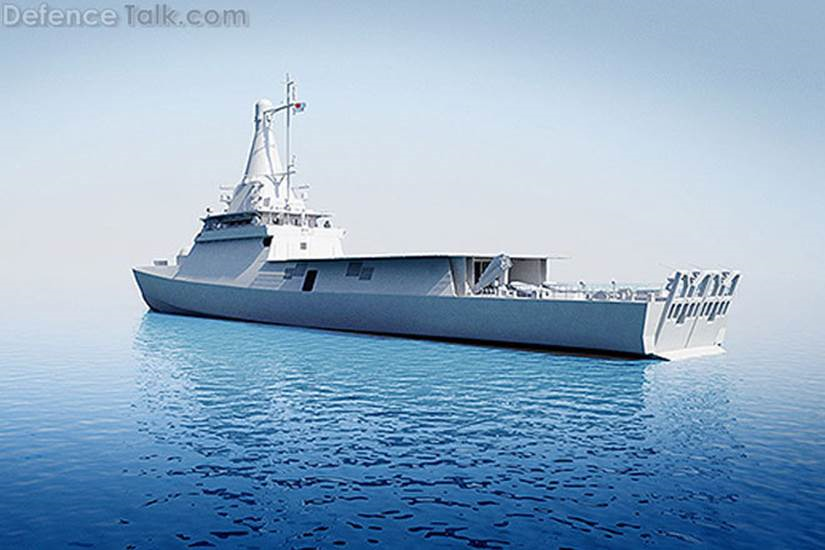
Singapore is building a new class of patrol vessels that look very much like my proposal for “Cutter X”, trading some Webber class and some larger ships for an intermediate design, costing about half what an OPC would cost, basically putting the equipment and crew (with some augmentation) of a Webber Class into a larger more seaworthy hull, to allow them to be used for extended operation in environments that do not require the ice strengthened hull and ability to launch and recover helicopters and boats in sea state five provided by the OPC.

Singapore is building eight of the ships under the project name “Littoral Missions Vessel” to replace eleven smaller, 500 ton, Fearless class patrol vessels that are approaching 20 years old. These ships are reportedly 80 meters in length (262.5 feet), displace 1200 tons (probably a light displacement), have a beam of 12 meters (39.4 feet), a range of 5,000 nautical miles at 15 knots, and a speed of 27 knots, all with a crew of only 30, though they do include additional accommodations for 30 more. (more here)

SingaporeLittoralMissionVesselPortQuarter

It appears these ships will use the same engines as the Webber Class. It is not clear how many of these engines they are using. Two would give them almost 12,000 HP which would almost certainly be good for at least 24 knots, but it might require three or four engines to make 27 knots.  (reports now indicate the class has two engines totallin about 12,000 HP)

In some respects these ships are more capable than the proposed cutter, in that they will have a 76mm gun and firecontrol system, in addition to smaller remotely operated weapons. It also appears to have space reserved for a small AAW missile system. On the other hand, while the flight deck can handle an H-60, the ship, unlike the French L’Adroit which was my model for “cutter X”, has no helicopter hangar, although it might be possible to add one using the same solution employed on L’Adroit (putting it under the bridge).

Soon, I expect to do an update of the “Cutter X” proposal, based on where we are now in the cutter recapitalization program.

Underway Time–Navy

Navy Times reports that eight types of surface ships including aircraft carriers, amphibs, command ships, cruisers, destroyers, frigates, and LCSs averaged 33.1% of the time underway during the years 2011 to 2013.

Wonder how figures for the Coast Guard compare? The Navy figure is almost certainly different from “Days Away From Homeport” although the article seems to equate it when they say, “Sailors…have seen more of the sea than they have of their families in the past three years.” How are they counting yard periods away from homeport (probably a rare event for them), or in port time way from homeport? Is a day underway for only a few hours counted the same as a 24 hour day?

No matter how these are counted, my impression is that the Coast Guard’s average would be higher in spite of the numerous mechanical breakdowns we are hearing about. If so, shouldn’t more people know it?

CG issues Draft RFP for Second Phase of FRC Procurement

page1-640px-USCG_Sentinel_class_cutter_poster_pdf

The Acquisition Directorate is reporting that they have issued a draft Request for Proposal (RFP) for a new contract to build Webber class WPCs.

It will provide for options of either four or six cutters per year for seven years. If all options were exercised the maximum number of cutters that could be built would total 42, but this probably will not be the case.

In February 2012, the Coast Guard exercised a $27.2M option to purchase the “Procurement and Data License Package” for the Webber class Fast Response Cutters, so the Coast Guard can allow other shipyards to bid to build follow-on ships of the same class.

25 September 2013, the Coast Guard exercised an option for six more cutters. This resulted in a total 24 Webber class built or under contract. I believe this was FY2013 money and we will see another contract to exercise the final option on the existing contract bringing the total to 30, which leads to a question. There is a statement in the RFP that I find difficult to understand, B.2.(b) “The total number of cutters obtained under this contract will be limited to twenty-six (26).” All along the program of record has been 58 of these vessels. The maximum number of vessels that can be funded under the phase one contract is 30 cutters so why limit this second contract to 26 when we have a stated requirement for 28 more? Does the Coast Guard plan on making a sole source buy of two ships in FY2015 and award this contract in FY2016?

Why preemptively limit the buy to less than the total of the options anyway. There might be a change of plans that would increase the Coast Guard requirement. The Navy might want to buy some using our existing contract, or the Coast Guard might want to make a Foreign Military Sale purchase on behalf of a friendly foreign government.

Despite being probably the best candidate we will ever see (a mature program with a proven product, approved by the Department for full rate production, that will continue for at least another five years), I saw no indication that a multi-year procurement was considered. I would hope that savvy ship builders would offer this as an additional option. It is still not too late for the Coast Guard to obtain Congressional permission to award a Multi-year Procurement for these ships. Or for Congress to direct this money saving procurement method.

Drug Enforcement Return on Investment

FierceHomelandSecurity is reporting on testimony of both the Commandant and the Commander of SouthCom, Marine Corps Gen. John Kelly, before a joint hearing of the House Transportation and Infrastructure and Foreign Affairs subcommittees.

“Joint Interagency Task Force South, which is part of Southcom and includes the Coast Guard, (other–Chuck) military services and other agencies, seizes the majority of the cocaine bound for the United States, said Marine Corps Gen. John Kelly, the Southcom commander. Yet it receives only 1.5 percent of the federal government’s total counternarcotics budget, he said.”

Commandant Adm. Robert Papp, who appeared alongside Kelly, said that in the past five years, the Coast Guard seized more than twice the amount of cocaine as all domestic law enforcement agencies – federal, state and local – combined.

Over the last five years, Coast Guard ships and law enforcement detachments operating in the offshore regions have removed more than a million pounds of cocaine with a wholesale value of nearly $17 billion. This is more than two times the amount of cocaine seized by all other U.S. federal, state and local law enforcement agencies combined.

While I have my own reservations about the effectiveness of efforts to restrict supply, if you are going to attempt to cut supply, it sure looks like funding Coast Guard efforts should be the first place to put your money.

Aviation News

DefenseNews reports on Admiral Papp’s comments regarding Coast Guard aviation. Two basic messages, The Coast Guard may be able to ride the coat tails the Air Force’s procurement of replacement H-60s, and The C-27s will be put to work very quickly.

Replacement of existing MH-60s is still a long way away. There is also the Army’s procurement of new rotary wing aircraft that might produce a more capable replacement.