“Wash the Sky Clean of Drones” –USNI

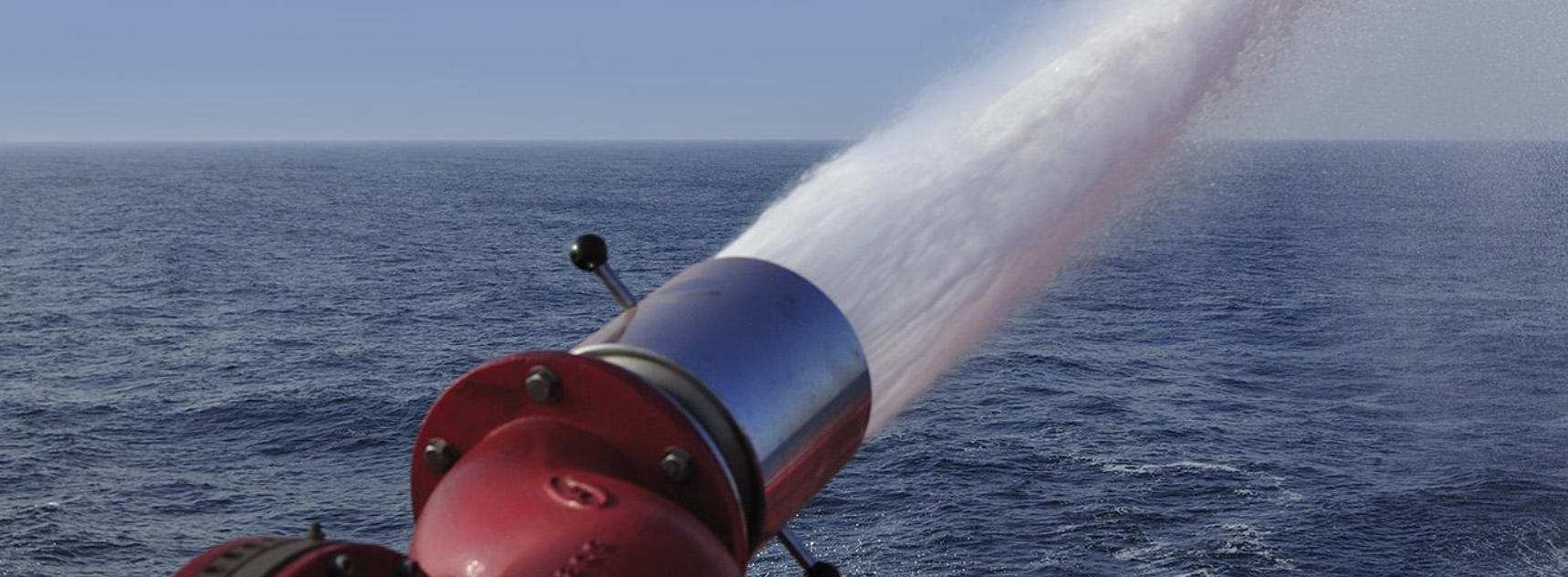
Powerful shipboard firefighting monitors can operate with flow rates in the vicinity of 16,000 gallons per minute, generating nozzle pressures and forces capable of knocking down or destroying drones with seawater. SHUTTERSTOCK

Captain Karl Flynn, U.S. Marine Corps, offers a novel counter to small drones,

It is well established that unmanned aerial systems (UASs) and vehicles (UAVs) are cheap, ubiquitous, and deadly against ground forces. While U.S. Navy ships and aircraft have proven themselves effective at shooting them down in the Red Sea, unmanned aircraft could soon become more dangerous in multiple environments: busy ports, canals, straits, the littorals, and other choke points. The Navy should explore using high-powered water cannons—also known as firefighting monitors—as ship-based counter-UAS (cUAS) weapons.

Now, I don’t think this would work against anything, but the small First Person Video drones that are now extremely common, but that is what the Coast Guard is most likely to encounter. At close range, water under high pressure can be damaging, but it’s not likely to cause collateral damage, like firearms could.

There are, of course, other reasons we might want to have powerful fire monitors.
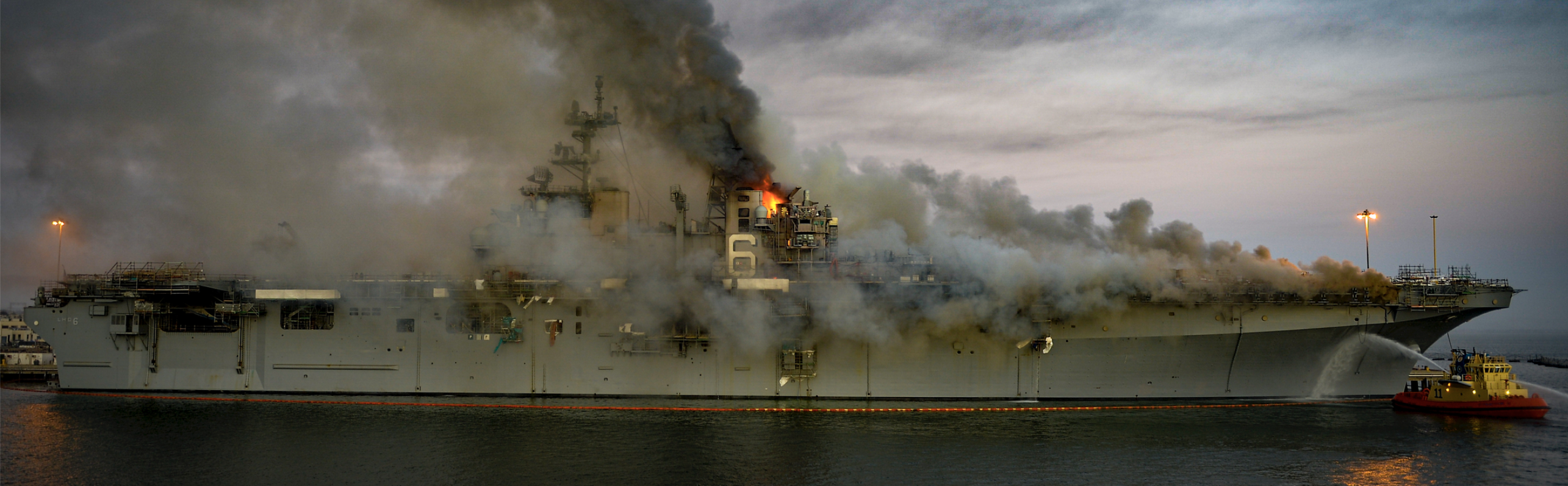
SAN DIEGO (July 12, 2020) The U.S. Navy amphibious assault ship USS Bonhomme Richard (LHD-6) on fire at Naval Base San Diego, California (USA), on 12 July 2020. On the morning of 12 July, a fire was called away aboard the ship while it was moored pier side at Naval Base San Diego. Base and shipboard firefighters responded to the fire. Bonhomme Richard was going through a maintenance availability, which began in 2018. The fire was extinguished on 16 July.

They can also be used in less than lethal confrontations.
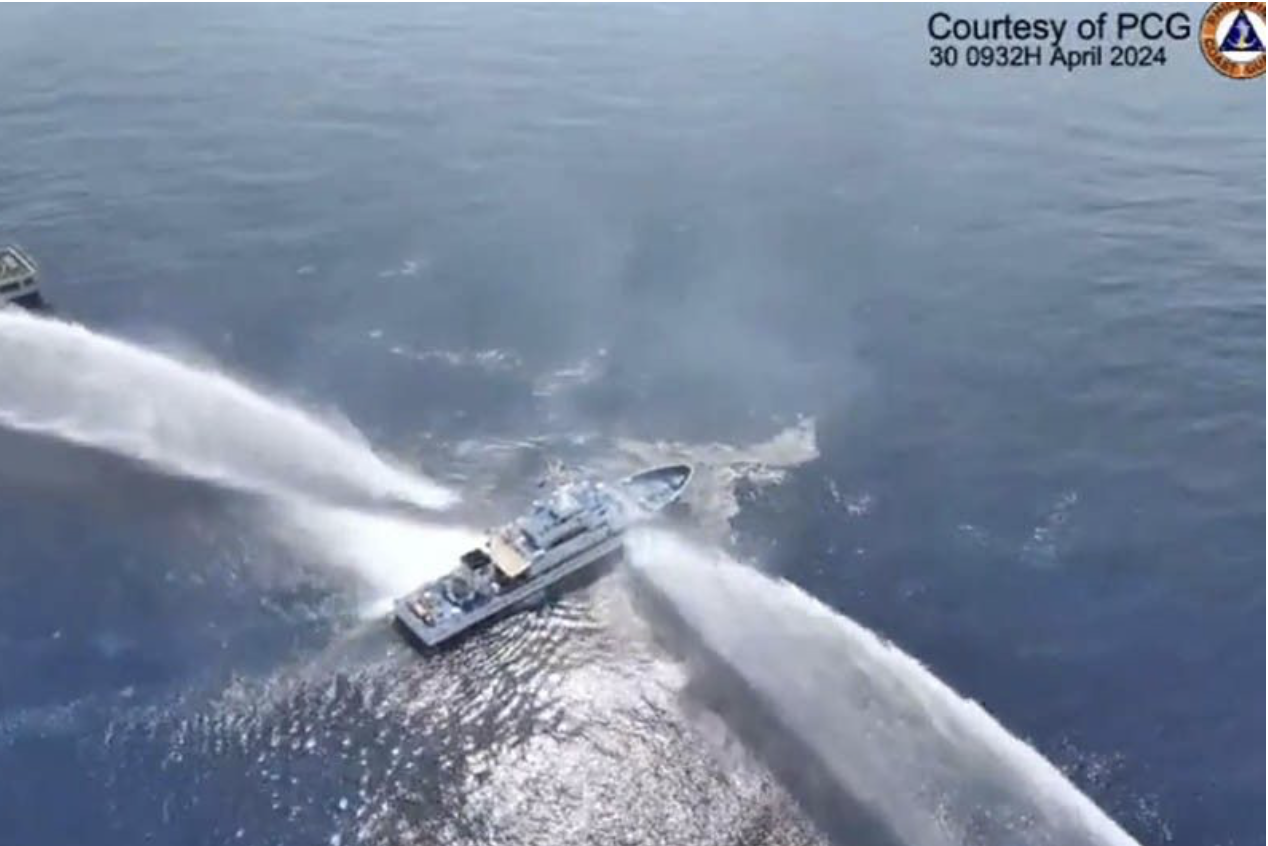
Screengrab from Philippine Coast Guard shows a Philippine vessel being water cannoned by the China Coast Guard on April 30, 2024.

They have become a regular feature of Gray Zone activities in the Western Pacific.
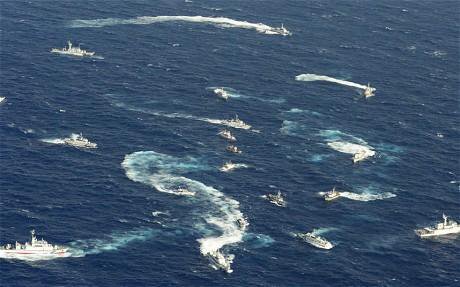
A water cannon battle between Taiwanese and Japanese Coast Guard vessels.

Frankly, what we have now looks kind of wimpy by comparison.
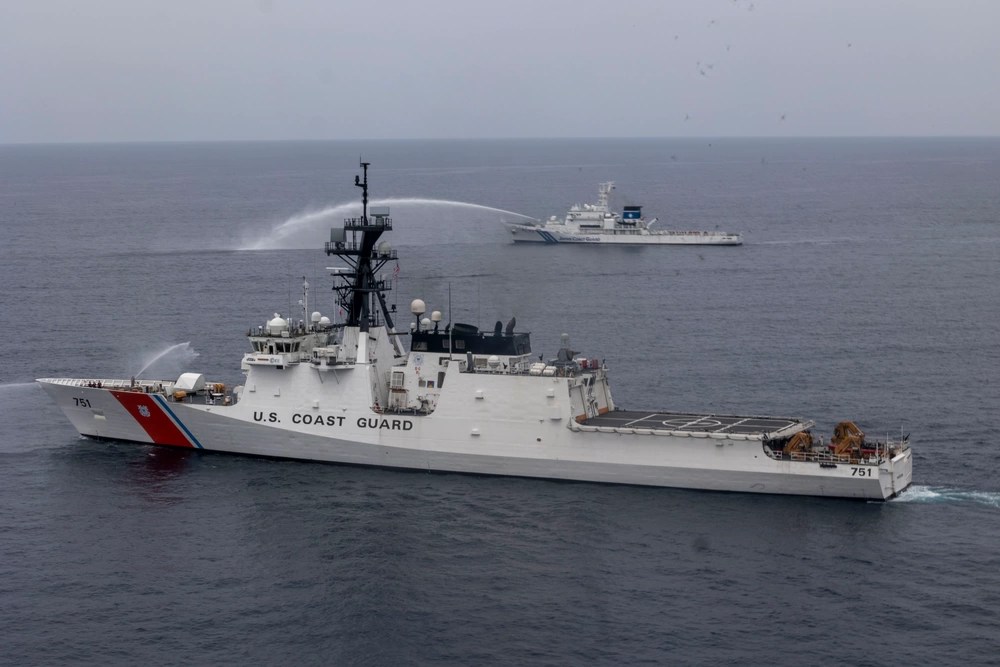
U.S. Coast Guard Cutter Waesche and Japan Coast Guard vessel JCGC Wakasa (PL-93) test their water cannons during a trilateral search and rescue exercise in the East Sea, June 6, 2024. Coast Guardsmen from Japan, Republic of Korea and the United States used the trilateral training as an opportunity to rehearse cohesion between the nations when operating together. The U.S. Coast Guard has operated in the Indo-Pacific for more than 150 years, and the service is increasing efforts through targeted patrols with our National Security Cutters, Fast Response Cutters and other activities in support of Coast Guard missions to enhance our partnership. (U.S. Marine Corps photo by Cpl. Elijah Murphy)

“Colombia Joins Combined Maritime Forces in Middle East as 41st Member” –CMF / Another Small Step Toward International Law

MANAMA, Bahrain – Graphic illustration of the flag of Colombia and the Combined Maritime Forces logo. CMF welcomed Colombia, Jan. 21th, as the 41th member of the world’s largest maritime security partnership. 240127-N-NO146-1001.JPG, Photo By: NAVCENT Public Affairs

Below is a news release from Combined Maritime Forces / US 5th Fleet.

I would not normally make a separate post about this, but recently I saw someone remark that International Law has no enforcement mechanism.

Combined Maritime Forces (CMF) is an international law enforcement mechanism.

It is, after all, not a military alliance, it is a law enforcement alliance, and while its police powers are limited, they are nevertheless real. Its power extends beyond national territorial seas and is derived from the concurrence of its members that certain behaviors are unacceptable.

It is not yet effective against nation states, but it does operate against the gray zone agents of nation states.

This is a remarkable development and overtime, hopefully, it will be extended to other geographic areas and broadened in scope.


Colombia Joins Combined Maritime Forces in Middle East as 41st Member

By Combined Maritime Forces Public Affairs | January 27, 2024

MANAMA, Bahrain —Combined Maritime Forces welcomed Colombia as the 41st member of the world’s largest maritime security partnership, Jan 21.

“It is a privilege to have Colombia as an official part of CMF,” said Vice Adm. Brad Cooper, CMF commander. “We welcome the Colombians in the largest international naval coalition, dedicated to maritime security and stability in the Middle East, and protecting some of the world’s most important waterways. I look forward to sharing our experiences and being ‘Ready Together’ with our new partners.”

CMF is comprised of a headquarters staff and five combined task forces focusing on defeating terrorism, preventing piracy, encouraging regional cooperation, and promoting a safe maritime environment. The naval partnership upholds the international rules-based order by supporting security and stability across 3.2 million square miles of water encompassing some of the world’s most important shipping lanes.

“CHINA’S MARITIME GRAY ZONE TACTICS AND SEALIGHT WITH RAY POWELL AND GAUTE FRIIS” –CIMSEC Podcast

CRASH AVERTED This photo taken on April 23, 2023 shows BRP Malapascua (right) maneuvering as a Chinese coast guard ship cuts its path at Second Thomas Shoal in the Spratly Islands. AFP PHOTO.

CIMSEC has a podcast discussing China’s “gray zone” tactics.

Perhaps more importantly they provide links to a series of short posts on specific gray zone tactics with examples.

There is also another post, “Gray Zone Tactics Playbook: Going Dark.” by Miao Shou, SeaLight, August 16, 2023.

Those bulbous bows probably make pretty good rams. 

BRIDGING THE GAP: HOW THE UNITED STATES CAN IMMEDIATELY ADDRESS ITS ARCTIC CAPABILITY LIMITATIONS –Modern War

The Modern War Institute at West Point published an article that suggests that NOAA ships can help provide presence in the Arctic and that this will contribute to the defense of the Homeland.

Looks like NOAA has about 16 active ships. None are very large and I don’t think any of them are ice rated.

Certainly, NOAA has business in the Arctic, understanding the oceans is an essential part of readiness for conflict, but I don’t see them as any sort of deterrant. On the other hand I don’t see Russia’s large number of icebreakers as adding significant additional threat to US or Canadian security. They simply need a lot of icebreakers to support their economic operations in the Arctic.

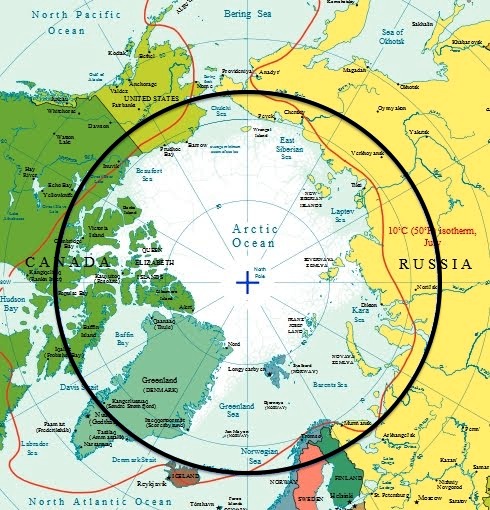
Which Arctic are we talking about?

For most of the world, the Arctic is the region North of the Arctic Circle. For some reason the US defines the Arctic as including the Bering Sea and the Aleutians. That does include some pretty cold territory but really, it is not the Arctic, and there is no reason the US Navy should not be operating surface ships there, but they don’t.

I am talking about the Arctic North of the Arctic circle.

What are the military threats to North America that might come across the Arctic Ocean?

While the Russian Arctic build-up threatens Norway, maybe Iceland, and perhaps Greenland, let’s consider only North America.

Much of the Russian build up in the Arctic is defensive, and this is understandable. They have a lot of assets in the Arctic. Much of their national income comes from the Russian Arctic.

There is absolutely no chance the Russians are going to attempt to land an army in the North American Arctic as an overland invasion. It would be too difficult to move and virtually impossibe to resupply. They would be under constant attack by US and Canadian Aircraft. As a Canadian Officer once noted, if Russia landed troops in the Canadian Arctic they would need to be rescued. The most we are likely to see from the Russian Army is Special Forces assaults on sensor and associated communication  systems in the Arctic.

The largest portion of the Russian Naval fleet (30-35%) is based in the Arctic, but not because it is intended to operate exclusively in the Arctic. Much of it is based there because they don’t have better choices. The Northern Fleet has their only relatively unrestricted access to the Atlantic. Even Northern Fleet units have to transit the Greenland-Iceland-UK (GIUK) Gap (or the English Channel) to make it into the Atlantic Sea Lanes, The Baltic Fleet is surrounded by potential adversaries and would have to exit through the Danish Straits. The Black Sea Fleet is bottled up behind the Turkish straits and even after exit would have to cross the Mediterranean and through the Straits of Gibralter.

Russian Submarines do operate under the ice and may launch missiles or conduct commando raids in the Arctic.

The serious threats that could come across the Arctic Ocean will be in the air or in space–aircraft and ballistic and cruise missiles including the new hypersonics.

Coast Guard icebreakers could have a role in facilitating deployment and continuing support of sensor systems in the Arctic.

Gray Zone threats to Sovereignty

The more probable near term threats to the US come in the form of Gray Zone Ops that are intended to reshape the World’s view of normal. We have seen this with China’s Nine Dash Line and their attempts to recast rights associated with the Exclusive Economic Zone.

It appears Russia is trying to do the same. We have seen it in the Black Sea, and we are likely to see it in the Arctic.

The extent of Russia’s continental shelf is as yet undecided, but their claims are expansive.

Looks like China intends to do some resource extraction and fishing in the Arctic and they have not been particularly respectful of the rights of others.

The US Coast Guard will need to do fisheries protection inside the US Arctic EEZ and the Canadian CG inside theirs. There are probably going to be opportunities for cooperation and synergy between the two coast guards in the high North.

With the increase in traffic as ice melts, NOAA probably needs to do a lot of oceanographic research and survey work in the Arctic, but they are probably going to need to either build their own icebreakers or ride Coast Guard icebreakers to do it.

“Chinese Assessment of New U.S. Naval Strategy” –USNI

The US Naval Institute news service provides a translation of a Chinese review of the Tri-Service Naval Strategy, “Advantage at Sea.”

It is, in my view, a surprisingly even handed evaluation. Not that it does not reflect the Chinese position, but it is at least fairly accurate.

One particular paragraph references the US Coast Guard.

Third, the U.S. will also introduce a new style of struggle, namely, it will bolster competition in the “gray zone.” That is, the U.S. will take greater action in the domains of social media; supply chains, especially defense industry chains; and space and cyber. A fairly obvious early indicator of this was that the USCG—which traditionally operates in the vicinity of the U.S. coast to defend the security of U.S. territory—has recently moved forward into the South China Sea region. It is preparing to conduct military operations in the South China Sea, with the aim of striking China’s maritime forces as well as bolstering joint law enforcement with regional states in the South China Sea, in order to respond to China’s South China Sea rights protection operations.

The idea of the USCG moving into the South China Sea “with the aim of striking China’s maritime forces” is a bit far fetched, but the rest is reasonably accurate and reflects the Strategy’s recognition of the Coast Guard as uniquely qualified to counter aggression in the “Gray Zone.”

“Stuck in the middle with you: Resourcing the Coast Guard for global competition” –Brookings

Brookings contends that the Coast Guard, not the Navy, is the proper instrument to counter Chinese maritime “gray zone” operations. But it needs more money, something in the range of $200-500M more per year, a 1.7-4.2% budget increase.

Simply put, for a relatively meager influx of operations and maintenance funds, at least in DoD terms (where the unit cost of a single Fordclass aircraft carrier is more than the Coast Guard’s entire annual budget), the Coast Guard could provide substantially more services in the Pacific. Enhanced funding in the range of $200-$500 million would translate to improved readiness and availability of its National Security Cutter (NSC) fleet and other Coast Guard assets capable of operating deep into the Pacific theater. Importantly, this funding might actually save money for DoD. Using the Coast Guard to conduct joint military exercises and patrols, capacity building, and international training is far cheaper than using a higher-end Navy ship to perform the same missions. (emphasis applied–Chuck)

It goes on to suggest that the PATFORSWA model be replicated in the Western Pacific and suggests,

As a corollary, as the Coast Guard plans for its Offshore Patrol Cutter acquisition, it should consider whether it could optimize a sub-class of these vessels for these types of defense-flavored operations in the Pacific.

There is also a suggestion of overseas basing,

Finally, it may also be time for the Coast Guard to consider independent foreign basing options for the first time in recent memory, perhaps with America’s close ally and “Five Eyes” partner, Australia. A Coast Guard detachment in Australia would not only provide for an additional Pacific-centric staging area, besides existing Coast Guard locations in Hawaii and Guam, but would also assist with Coast Guard strategic icebreaking operations directed towards Antarctica, which is itself becoming more and more relevant in the era of great power competition.

Once we have our fleet of icebreakers, we might want to base one in Australia or New Zealand, but Guam still looks like a good place for our patrol ships, even if we might include OPCs in addition to the three Webber class FRCs currently planned. Patrolling our Western Pacific EEZ and that of friendly Micronesian states, we might want to replenish at Manus Island, Papua New Guinea, where Australia is developing a joint use base. At least for short term deployments, our ships and aircraft might also exploit the newly improved base at Wake Island 1,501 miles (2,416 kilometers) east of Guam, 2,298 miles (3,698 kilometers) west of Honolulu.