“Enhancing the Maritime Patrol Operational Picture” –Seapower

A screen grab of the Labyrinth, a Minotaur cloud-platform, software. Labyrinth adds robust scalability in handling and correlating large volumes of data while providing external stakeholders access via a secure web-based interface.

The Navy League’s on-line magazine, Seapower, gives us a look at the growing power of the Minotaur Family of Systems (MFoS), that is being incorporated into all Coast Guard fixed wing patrol aircraft.

Looks like a major piece of the Maritime Domain Awareness puzzle.

“Coast Guard completes final delivery of MH-65E helicopter” –CG-9

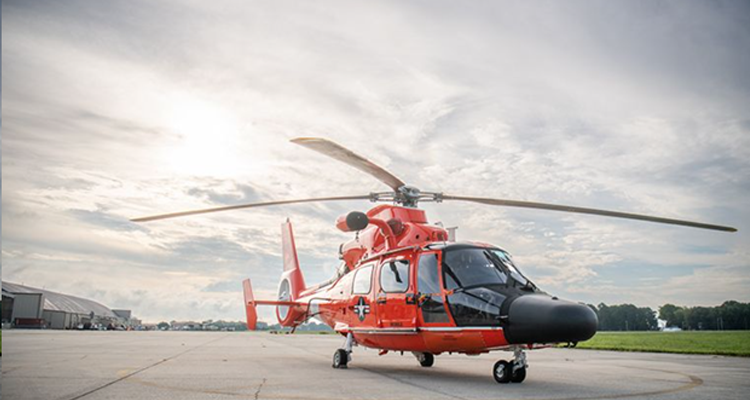
CGNR 6577 is readied for departure from the Aviation Logistics Center on Aug. 19. Its delivery to the Aviation Training Center in Mobile, Alabama, marks the 90th and final MH-65 helicopter to complete the service life extension program and upgrades resulting in the Echo configuration. U.S. Coast Guard photo

Below is a story from the Acquisitions Directorate (CG-9). This comes only days after they also reported that they had completed upgrades to the Fleet of 18 HC-144s.

Despite completion of these two programs, Aviation Logistics Center, Elizabeth City still has plenty of work to do. There is an on-going program to upgrade the C-27J fleet and newly acquired C-130Js with Minotaur Mission Systems and a Service Life Extension Program and additional procurement/remanufacture of MH-60Ts to ultimately allow conversion of eight air stations from MH-65 to MH-60T.


The H-65 Conversion/Sustainment Program reached an important milestone Aug. 19, sending off the 90th and final MH-65E to its operational unit at Aviation Training Center (ATC) in Mobile, Alabama. The transition from the MH-65D to the MH-65E (commonly referred to as the “Delta” and “Echo” configurations, respectively) has been in development for over a decade.

The Short Range Recovery (SRR) production line at the Aviation Logistics Center has been executing the Echo conversion since 2018 when the very first Echo was delivered to ATC Mobile to prepare for pilot training and course development in the new model. By happenstance, the final Echo was also delivered to ATC, an altogether fitting accomplishment as the program came full circle and achieved full operating capability.

A highlight of the program was SRR’s consistency and adherence to the delivery schedule as they produced an Echo aircraft every 22 days and achieved an 80% on-time delivery rate, a testament to the product line after factoring in the pace of early production activities and the negative impacts of COVID-19.

The avionics upgrade to the MH-65E configuration provides enhanced search and rescue capabilities including modern “glass cockpit” technology that increases pilot and aircrew situational awareness and provides commonality with the service’s MH-60T Jayhawk fleet. The upgrades also include reliability and capability improvements for the automatic flight control system, enhanced digital weather and surface radar, and multifunctional displays with more accurate fuel calculations.

The upgrades bring the fleet into compliance with the Federal Aviation Administration’s Next Generation Airspace Transportation System requirements and extend the aircraft service life through the Coast Guard’s transition to an all-MH-60T rotary wing fleet.

Since the first Echo delivery, the aircraft has surpassed 100,000 flight hours and has been involved in more than 8,000 search and rescue cases. The model is responsible for saving and assisting more than 1,200 lives, making a substantial contribution to the 26,000 lives rescued throughout the 40 years the Coast Guard has flown different variants of the H-65.

The MH-65E is a multi-mission helicopter, responsible for over 100 ship deployments across the world and participated in more than 15 hurricane response efforts. Air Station Atlantic City commenced its transition in October 2022 and has executed over 100 land-based deployments conducting rotary wing air intercept missions as part of national defense. The Helicopter Interdiction Squadron in Jacksonville, Florida, which commenced its transition to the MH-65E in July 2021, has conducted 62 deployments in the MH-65E, with 133 interdictions and seizing nearly 300,000 pounds of cocaine and over 60,000 pounds of marijuana totaling nearly $4 billion in illegal narcotics.

“Coast Guard completes upgrade of its HC-144 fleet” –CG-9

Below is news from the Acquisitions Directorate, (CG-9)


Coast Guard completes upgrade of its HC-144 fleet

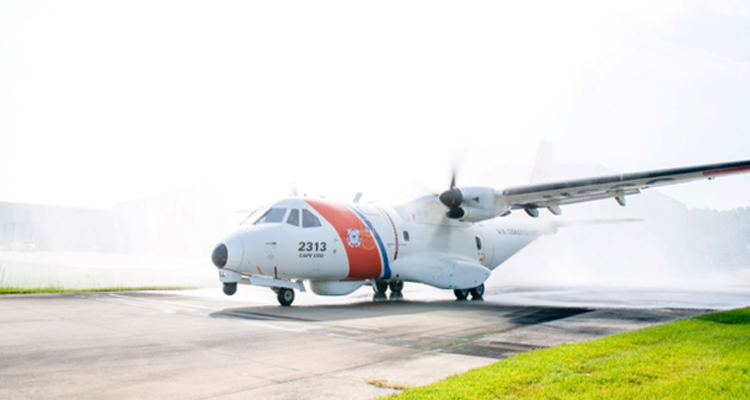
The crew of CGNR 2313 prepares the aircraft for takeoff from the Coast Guard Aviation Logistics Center (ALC) in Elizabeth City, North Carolina, and delivery to Coast Guard Air Station Miami. This is the 18th and final HC-144 to be outfitted with the Ocean Sentry Refresh and Minotaur mission system architecture. U.S. Coast Guard photo by the Aviation Logistics Center.


The Coast Guard completed the upgrade of its HC-144 Ocean Sentry medium range surveillance aircraft fleet with the delivery of the 18th and final plane to undergo the Ocean Sentry Refresh (OSR) and integration of Minotaur mission system architecture.  On Aug. 6, a crew flew CGNR 2313 from the Aviation Logistics Center (ALC), the site of the upgrade work, to Air Station Miami, where the plane is now based.

The delivery marks the end of the decade-long modification effort, restoring full fleet complement and providing advance situational awareness and mission system capabilities necessary to carry out missions around the clock.

CGNR 2313 receives the traditional “water salute” as it prepares to depart ALC for delivery to Air Station Miami. U.S. Coast Guard photo.


Upon completion of the upgrade, the aircraft have been redesignated as HC-144Bs. The Bravo iteration merged two significant upgrade projects, OSR and Minotaur missionization.

OSR upgrades the aircraft with a new flight management system, which serves as the primary avionics computer for communication control, navigation and equipment monitoring.

Minotaur missionization integrates installed sensors and radar and provides dramatically improved data fusion as well as information processing capabilities.

The modifications to the HC-144B have made missions faster and more effective, according to Pesebra Cartwright, program manager for the Medium Range Surveillance Aircraft Program. “It enables crews to fly with lower cloud ceilings, allowing on-scene coverage.”

Cartwright added, “Feedback from the fleet on the HC-144B aircraft is overwhelmingly positive.”

He quoted a pilot as saying, “I’d rather fly an HC-144B with one operational Minotaur mission system workstation than to fly an HC-144A with a full function legacy mission system pallet.”

On search and rescue missions, the operator can locate vessels matching the search profile faster using the improved radar software. The high-definition forward-looking infrared (FLIR) sensor provides better pictures to quickly identify vessel type, name and people onboard. Also, the improved direction-finding equipment provides location information based on the signal from a 406 MHz Emergency Position Indicating Radio Beacon, allowing crews to fly directly to position, a significant advancement over the Alpha configuration’s limits of following a line of bearing. “This undoubtedly leads to more lives assisted and/or saved,” Cartwright said.

Faster and more effective applies to law enforcement missions as well. The improved radar allows for quicker location of vessels suspected of transporting illegal drugs or undocumented migrants or fishing in prohibited areas. The high-definition FLIR then provides better pictures to properly document the vessel while providing a compass location to a Coast Guard intercept vessel. With this upgrade, HC-144B mission system operators are now able to share Minotaur data with other Minotaur-equipped aircraft, ultimately improving mission effectiveness.

For more information: Medium Range Surveillance Program page and Minotaur Program page

“MQ-9B SeaGuardian Showcased at RIMPAC 2024” –News Release

An MQ-9 Sea Guardian unmanned maritime surveillance aircraft system flies over the Pacific Ocean during U.S. Pacific Fleet’s Unmanned Systems Integrated Battle Problem (UxS IBP) 21, April 21. UxS IBP 21 integrates manned and unmanned capabilities into challenging operational scenarios to generate warfighting advantages. US Navy Photo

The Coast Guard has an unfilled requirement for a shore based Uncrewed Air System (UAS) to provide Maritime Domain Awareness.

Below is a news release from General Atomics Aeronautical Systems, Inc.

Reading the news release, I see the system incorporated an “integrated Minotaur Mission System.” Minotaur is a system currently being installed on all Coast Guard fixed wing search aircraft as well as US Navy and Marine Corps platforms. It went on to say “For RIMPAC, the MQ-9B effectively passed ISR&T (Intelligence, surveillance, reconnaissance, and targeting–Chuck) information to various surface and air units, such as the Nimitz-class carrier USS Carl Vinson, Guided Missile Destroyers (DDGs), Littoral Combat Ships (LCS), frigates, patrol boats, P-8s, P-3s, and numerous other U.S. and foreign units that took part in the exercise.” Could that have included Midgett and her task force? The use of the MQ-9B to drop sonobuoys for the task force and their embarked ASW helicopters would have been an interesting experiment.


GA-ASI’s MQ-9B SeaGuardian® Showcased at RIMPAC 2024

Sonobuoy Dispensing System and LRASM Among the New Capabilities Featured

SAN DIEGO – 14 August 2024 – With the completion of the U.S. Navy’s Rim of the Pacific (RIMPAC) flight operations on July 28, 2024, the MQ-9B SeaGuardian® Unmanned Aircraft System (UAS) supplied by General Atomics Aeronautical Systems, Inc., self-deployed back to its home base in El Mirage, Calif., but only after introducing an array of new capabilities. The flight home followed close to 100 flight hours supporting RIMPAC 2024 over the four-week exercise in and around the Hawaiian Islands.

RIMPAC is the world’s largest international maritime exercise. RIMPAC 2024 featured 29 nations, 40 surface ships, three submarines, 14 national land forces, more than 150 aircraft, and 25,000 personnel.

SeaGuardian provided real-time Intelligence, Surveillance, and Reconnaissance (ISR) data feeds to the U.S. Pacific Fleet Command Center using Signals Intelligence (SIGINT) parametrics and full-motion video to the watch floor and intelligence centers for real-time dynamic tasking — just as it did for the RIMPAC 2022 exercise. This year, SeaGuardian delivered some new features and capabilities, including Long Range Anti-Ship Missile (LRASM) targeting and a new Sonobuoy Dispensing System (SDS) to support its Anti-Submarine Warfare capability. SeaGuardian was configured with a prototype SDS pod capable of deploying 10 A-size sonobuoys per pod (SeaGuardian can carry up to four SDS pods or up to 40 sonobuoys) and the SeaVue Multi-role radar from Raytheon, an RTX business. Upon dispensing, the sonobuoys were successfully monitored and controlled by the SeaGuardian’s onboard Sonobuoy Monitoring and Control System (SMCS).

SeaGuardian is a maritime derivative of the MQ-9B SkyGuardian® and remains the first UAS that offers multi-domain Intelligence, Surveillance, Reconnaissance, and Targeting (ISR&T) as an internal payload that can search the ocean’s surface and depths in support of Fleet Operations. At RIMPAC 2024, SeaGuardian showcased all operational payloads, which includes the SeaVue, SNC’s Electronic Support Measures (ESM) solution, an Automatic Identification System (AIS), and a self-contained Anti-Submarine Warfare (ASW) system.

SeaGuardian’s multi-domain capabilities allow it to flex from mission to mission and pass real-time sensor data directly to the Fleet. For RIMPAC 2024, SeaGuardian added Link 16 Joint Range Extension Application Protocol (JREAP) “C” (internet protocol) and an integrated Minotaur Mission System to provide real-time sensor data for the various Maritime Operations Centers, ships, and aircraft with Minotaur nodes.

“For RIMPAC, the MQ-9B effectively passed ISR&T information to various surface and air units, such as the Nimitz-class carrier USS Carl Vinson, Guided Missile Destroyers (DDGs), Littoral Combat Ships (LCS), frigates, patrol boats, P-8s, P-3s, and numerous other U.S. and foreign units that took part in the exercise,” said GA-ASI President David R. Alexander.

On July 31, 2024, SeaGuardian self-deployed back to GA-ASI’s Desert Horizon Flight Operations Facility in El Mirage, Calif.

About GA-ASI

General Atomics Aeronautical Systems, Inc. (GA-ASI), an affiliate of General Atomics, is a leading designer and manufacturer of proven, reliable RPA systems, radars, and electro-optic and related mission systems, including the Predator® RPA series and the Lynx® Multi-mode Radar. With more than eight million flight hours, GA-ASI provides long-endurance, mission-capable aircraft with integrated sensor and data link systems required to deliver persistent situational awareness. The company also produces a variety of sensor control/image analysis software, offers pilot training and support services, and develops meta-material antennas.

For more information, visit www.ga-asi.com     

Avenger, Lynx, Predator, SeaGuardian, and SkyGuardian are registered trademarks of General Atomics Aeronautical Systems, Inc.


 

Why the “J-model” C-130s Make Such a Difference

LIMA, PERU, 10.06.2023, Courtesy Photo, USCG District 11
The aircrew of the Coast Guard 2007, an HC-130 based out of U.S. Coast Guard
Air Station Barbers Point, Hawaii, poses for a picture with observers from the Peruvian Navy and Air Force, in Lima Peru, October 2023. During the course of two weeks, Peruvian observers accompanied the USCG aircrew as they conducted overflights of the fishing fleet on the high seas during Operation Southern Shield 2023. (U.S. Coast Guard photo by pilot-in-charge, Lt. Zachary Hunter.) Note the six bladed props that identify the C-130J. 

Below is a news release, “Coast Guard accepts 16th missionized HC-130J into fleet,” from the Acquisitions Directorate (CG-9). There is more here than the announcement of a newly missionized aircraft. The post goes on to talk about the advantages the C-130Js bring to the service, particularly in the Pacific.

The C-130Js provide a 20 percent increase in speed and a 40 percent increase in range over the HC-130H, as well as much improved avionics. The Coast Guard is moving to a fleet of 22 HC-130Js and retiring all their C-130Hs.

The Coast Guard also has 14 HC-27Js and 18 HC-144s all being equipped with Minotaur.

HC-130J Characteristics

  • Length: 97 feet 9 inches
  • Wingspan: 132 feet 7 inches
  • Height: 38 feet 11 inches
  • Maximum Weight: 175,000 pounds
  • Cruise Speed: 320 knots true airspeed
  • Range: 4,900 nautical miles
  • Endurance: 20+ hours

HC-130J Features

  • Standardized Minotaur mission system across all Coast Guard fixed-wing aircraft
  • Real-time tracking and Rescue 21 integration to enhance common operating picture and maritime domain awareness
  • Advanced radar and electro-optical/infrared sensors for search and rescue, law enforcement and intelligence gathering missions; the Coast Guard’s Super Hercules is the first HC-130 aircraft in the world with a 360-degree, belly-mounted, multimode surface search radar
  • Commonality of command, control, communication, computers, cyber, intelligence, surveillance and reconnaissance components and capabilities with those on the Coast Guard’s medium range surveillance aircraft

Minotaur Features

  • Commonality of command, control, communications, computers, cyber, intelligence, surveillance and reconnaissance components and capabilities across all Coast Guard fixed-wing surveillance aircraft
  • Interoperability with multiple Defense and Homeland Security department platforms
  • Real-time tracking and Rescue 21 integration to enhance common operating picture and maritime domain awareness
  • Automatic Dependent Surveillance – Broadcast technology to receive traffic and weather broadcasts and information about other aircraft, including identification, position and altitude
  • Tactical screen replay to review a target’s entire flight in seconds and track the target via its trajectory, even if the target stops broadcasting information or otherwise evades the sensors

The Coast Guard has nine air stations operating fixed wing search aircraft. There are six in the Atlantic Area, which includes the Gulf of Mexico.

  • Cape Cod, MA (C-144)
  • Elizabeth City, NC (C-130, C-27, C-144)
  • Miami, FL (C-144)
  • Clearwater, FL (C-130)
  • Mobile, AL (C-144)
  • Corpus Christi, TX (C-144)

There are only three Coast Guard air stations operating fixed wing search aircraft in the Pacific Area.

  • Sacramento (C-27)
  • Barbers Point, HI (C-130)
  • Kodiak, AK (C-130)

Kodiak and Barbers Point certainly needed the additional range and on-station time that the C-130Js provide.

Barbers Point is the only Coast Guard air station in the 14th District, despite the fact that the 14th District includes 48% of the entire US’s Exclusive Economic Zone (EEZ), and has additional responsibilities to assist the Federated States of Micronesia (FSM), the Republic of the Marshall Islands (RMI), and the Republic of Palau under the Compact of Free Association which together have an EEZ total equal to more than 49% that of the US.


Coast Guard accepts 16th missionized HC-130J into fleet

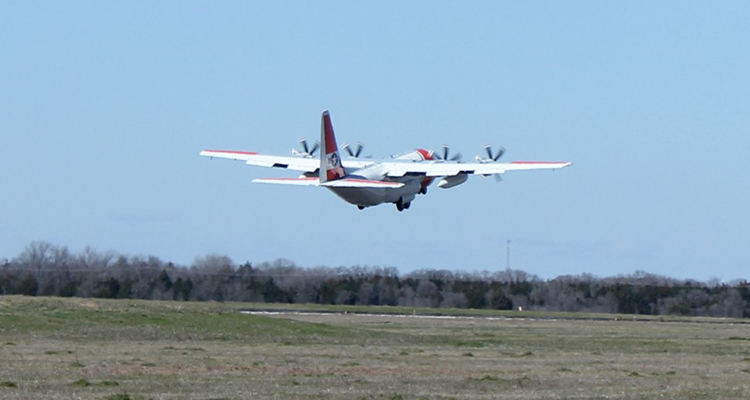
The Coast Guard’s 16th fully missionized HC-130J takes off for its first test flight following the year-long missionization and Block Upgrade 8.1 modification at L3Harris in Waco, Texas. U.S. Coast Guard photo.


The Coast Guard accepted delivery of its 16th fully missionized HC-130J long range surveillance aircraft, CGNR 2016, Feb. 19 following completion of Minotaur mission system integration and Block Upgrade 8.1 installation at L3Harris in Waco, Texas.

The aircraft was delivered to Air Station Elizabeth City in Elizabeth City, North Carolina, returning that air station to its full complement of five HC-130J aircraft. The air station was temporarily operating with four aircraft while an Elizabeth City HC-130J was assigned to Air Station Barbers Point, Hawaii, to complete the transition of that facility to HC-130J operations.

The more advanced engines, six-blade propellors and Minotaur-integrated sensors of the HC-130J enable the Coast Guard to better respond to mariners in peril by improving response times, extending time on scene for search and rescue and law enforcement patrols, and increasing effectiveness and versatility. Regarding the latest air station transition, the improvements are ideally suited for Barbers Point’s vast jurisdiction – 12.2 million square miles of open ocean, atolls and island chains, which make up the Coast Guard’s Fourteenth District.

Three recent natural disasters in Air Station Barbers Point’s area of responsibility have highlighted the value of the improved aircraft, especially the 26% increase in patrol range over the legacy HC-130H.

  • A Barbers Point HC-130J flew 2,300 miles to be the first aircraft on scene after Typhoon Mawar struck Saipan in May 2023, performing overflight assessments and delivering critically needed relief supplies. Over a week, the aircraft flew over 97 flight hours and dispatched 400,000 pounds of cargo and 169 passengers.
  • Barbers Point aircrews responded when wildfires burned thousands of acres in Maui, Hawaii, in August 2023, providing search and rescue and damage assessment along with moving passengers and cargo for disaster relief.
  • Barbers Point HC-130J aircrews answered the call when Tropical Cyclone Lola slammed the island nation of Vanuatu in October 2023, assessing the damage to ports, airports and critical infrastructure. Aircrews also delivered over 80,000 pounds of relief supplies.

The HC-130J and its Minotaur system also play a vital role in identifying and monitoring illegal fishing by providing surveillance and gathering intelligence on suspicious fishing activities. That information is shared with local and national authorities and aids in determining what vessels need to be boarded for inspection.

The service’s Super Hercules aircraft carry out many Coast Guard missions, including search and rescue, drug and migrant interdiction, cargo and personnel transport, and maritime stewardship, as well as providing critical support to Department of Homeland Security partners. The aircraft also can serve as a command and control or surveillance platform capable of identifying and classifying objects and sharing that information with operational forces.

For more information: HC-130J Long Range Surveillance Aircraft Program page and Minotaur Mission System page

“HII AWARDED $244 MILLION CONTRACT TO INTEGRATE MINOTAUR SOFTWARE PRODUCTS INTO MARITIME PLATFORMS” –HII News Release

New Minotaur operator workstations are being installed on all HC-144Bs. Minotaur provides dramatically improved data fusion and integrates installed sensors and radar. U.S. Coast Guard photo by Aviation Engineering Warrant Officer 3 Randy Jopp.

Below is a news release from HII (Huntington Ingalls). Minotaur is being installed on all USCG fixed wing search aircraft (C-130J, C-27J, and C-144). This seems to say cutters, as well as Navy floating units and Marine units, are also being fitted with elements of the system. 


HII AWARDED $244 MILLION CONTRACT TO INTEGRATE MINOTAUR SOFTWARE PRODUCTS INTO MARITIME PLATFORMS

Contract Extends HII’s ISR Mission Support Across Domains

MCLEAN, Va., (Oct. 17, 2023) — HII (NYSE: HII) announced today that its Mission Technologies division was awarded a $244 million task order to integrate Minotaur software products into maritime platforms for the U.S. Navy, U.S. Marine Corps and U.S. Coast Guard.

HII was awarded this contract under the Department of Defense (DoD) Information Analysis Center’s (IAC) multiple-award contract (MAC) vehicle.  IAC MAC task orders are awarded by the U.S. Air Force’s 774th Enterprise Sourcing Squadron to develop and create new knowledge for the enhancement of the Defense Technical Information Center repository and the research and development and science and technology community.

Under the Naval Air Systems Command task order, HII will perform research, development, test and evaluation to facilitate the integration of Minotaur Family of Services products into the services’ maritime platforms to meet intelligence, surveillance and reconnaissance warfighting requirements.

Minotaur products support the warfighter by enhancing sensor performance and presenting data from multiple types of sensors, including radar and C5ISR equipment, into a single common operating picture and transmitting that data to other platforms and units during operations.

HII has been the first and only industry prime developer of Minotaur since the program was first awarded to industry in 2020.

The contract has a five-year period of performance, with work conducted at contractor facilities in various U.S. locations.

“HII has been at the forefront of Minotaur software development for nearly a decade,” said Andy Green, executive vice president of HII and president of Mission Technologies. “It’s a privilege to continue this mission-critical work and to concurrently deliver the advantage to three branches of the Armed Forces.”

“We are pleased that the Navy has selected this proven technology to meet the combined requirements of next-generation Navy, Marine Corps and Coast Guard ISR platforms,” said Todd Gentry, president of Mission Technologies’ C5ISR business group. “We have assembled an outstanding team and look forward to expanding our longstanding partnership with the Navy and supporting the tri-service maritime strategy.”

C5ISR
Find more information about HII’s C5ISR capabilities.

NOTE

The DoD IAC, sponsored by the Defense Technical Information Center, provides technical data management and research support for DoD and federal government users. Established in 1946, the IAC program serves the DoD science and technology and acquisition communities to drive innovation and technological developments by enhancing collaboration through integrated scientific and technical information development and dissemination for the DoD and broader science and technology community.

This material is based upon work supported by the DoD Information Analysis Center Program (DoD IAC), sponsored by the DTIC under Contract No. FA807523F0049.

Approved for Public Release, Distribution Unlimited. Any opinions, findings and conclusions or recommendations expressed in this material are those of the author(s) and do not necessarily reflect the views of the DoD.

About HII

HII is a global, all-domain defense provider. HII’s mission is to deliver the world’s most powerful ships and all-domain solutions in service of the nation, creating the advantage for our customers to protect peace and freedom around the world.

As the nation’s largest military shipbuilder, and with a more than 135-year history of advancing U.S. national security, HII delivers critical capabilities extending from ships to unmanned systems, cyber, ISR, AI/ML and synthetic training. Headquartered in Virginia, HII’s workforce is 44,000 strong. For more information, visit:

C-27J Gets Minotaur

A Coast Guard C-27J Spartan crew, assigned to Coast Guard Air Station Sacramento, flies over San Francisco, California, during area of responsibility familiarization training, Monday, Feb. 6, 2018. Coast Guard photo by Lt. Scott Handlin

Below is a news release from the Acquisitions Directorate (CG-9):

Looking at the Coast Guard’s fixed wing fleet, this is the first of the 14 C-27Js to be equipped with Minotaur, but 14 of the 18 HC-144s are so equipped as are 15 C-130Js. A contract has been awarded for conversion of C-130J numbers 17 and 18 with options for conversion of numbers 19 to 22.


The Coast Guard successfully performed the first flight of the newly missionized HC-27J prototype aircraft, CGNR 2712, today at Naval Air Station (NAS) Patuxent River, Maryland. The milestone flight is part of the Coast Guard’s effort to enhance its fixed-wing surveillance aircraft fleet with improved capabilities to gather, process and transmit information during maritime patrol aircraft joint operations.

The flight was a culmination of efforts by the Coast Guard’s Aviation Projects Acquisition Center and Medium Range Surveillance Aircraft program office along with Naval Air Systems Command’s Naval Air Warfare Center Aircraft Division AIRWorks Team and the original equipment manufacturer, Leonardo Aircraft Division (LAD). The first flight of the HC-27J was a modified functional check flight and was tailored to exercise the program’s Safety of Flight and Safety of Test systems prior to fully proceeding into the flight test phase. The initial flight tests will be performed by the Naval Air Systems Command Test and Evaluation Squadron (VX-20) HC-27J test team with support from the Coast Guard and LAD at NAS Patuxent River.

The Coast Guard is in the process of missionizing 14 C-27J aircraft that were transferred from the U.S. Air Force under the National Defense Authorization Act of 2014. As originally delivered, the C-27Js were outfitted with weather radar and communications equipment. Missionization refers to the process of integrating specialized equipment, such as radar, sensors and processors, that enhance the aircraft’s effectiveness in carrying out Coast Guard missions. The Coast Guard is using Minotaur mission system architecture developed by the Navy across its fixed wing fleet to integrate the specialized components such as surface search radar and electro-optical/infrared sensors because it offers significant increases in speed and memory capability.

For more information: Medium Range Surveillance Program page and Minotaur Program page

“Coast Guard delivers 14th Minotaur-missionized HC-144 to fleet” –CG-9

New Minotaur operator workstations are being installed on all HC-144Bs. Minotaur provides dramatically improved data fusion and integrates installed sensors and radar. U.S. Coast Guard photo by Aviation Engineering Warrant Officer 3 Randy Jopp.

Below is a story from the Acquisitions Directorate (CG-9). 14 of 18 HC-144s have been missionized with Minotaur. The statement, “The aircraft will be based at Air Station Cape Cod, Massachusetts, the first of three to be stationed there” refers only to the “B” model with Minotaur. Three HC-144As were already there and are being replaced by the upgraded aircraft.


The Coast Guard completed work on its 14th HC-144B Ocean Sentry medium range surveillance aircraft outfitted with both the Ocean Sentry Refresh (OSR) modifications and the Minotaur mission system Jan. 17. Modifications to CGNR 2318 were completed at the Aviation Logistics Center in Elizabeth City, North Carolina. The aircraft will be based at Air Station Cape Cod, Massachusetts, the first of three to be stationed there.

The OSR project upgrades the aircraft with a new flight management system, which manages communication control, navigation and equipment monitoring. After the OSR upgrade is completed, each aircraft is redesignated as an HC-144B.

Minotaur integrates installed sensors and radar and provides dramatically improved data fusion as well as information processing and sharing capabilities.

Completion of missionization and upgrade of a 15th HC-144 is scheduled for later this year. Air Station Miami completed transition to the upgraded aircraft in 2022 and Air Station Corpus Christi, Texas, transitioned in 2019. The service plans to upgrade each of the service’s 18 HC-144s by the end of 2024, with transition of Air Station Cape Cod and Aviation Training Center Mobile, Alabama.

For more information: Medium Range Surveillance Program page and Minotaur Program page

“Coast Guard delivers ninth Minotaur-missionized HC-144 to fleet” –CG-9

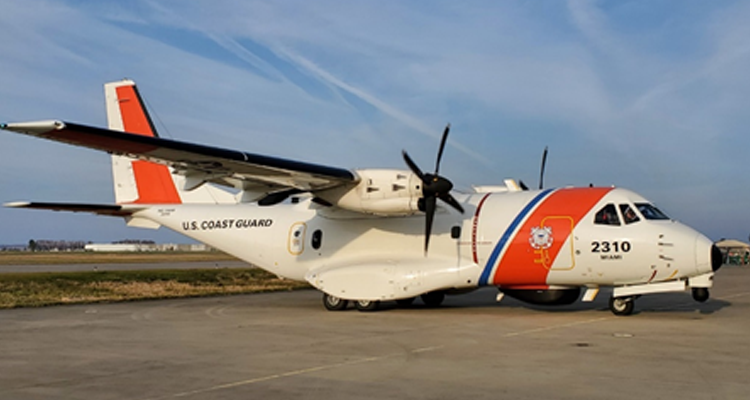
CGNR 2310 departs for its second test flight after completing Minotaur missionization. It is the Coast Guard’s ninth HC-144B Ocean Sentry outfitted with both Ocean Sentry Refresh modifications and the Minotaur mission system. U.S. Coast Guard photo by Aviation Engineering Warrant Officer 3 Randy Jopp.

The Acquisitions Directorate, CG-9 reports,


The Coast Guard accepted delivery of its ninth HC-144B Ocean Sentry medium range surveillance aircraft outfitted with both the Ocean Sentry Refresh (OSR) modifications and the Minotaur mission system Dec. 16, 2020. Modifications to CGNR 2310 were completed at the Aviation Logistics Center in Elizabeth City, North Carolina. The aircraft will be based at Coast Guard Air Station Miami.

The OSR project upgrades the aircraft with a new flight management system, which manages communication control, navigation and equipment monitoring. After the OSR upgrade is completed, each aircraft is redesignated as an HC-144B.

Minotaur integrates installed sensors and radar and provides dramatically improved data fusion as well as information processing and sharing capabilities.

Completion of missionization and upgrade of a 10th HC-144 is scheduled for June 2021. The service plans to upgrade each of the service’s 18 HC-144s by 2024.

For more information: HC-144 program page and Minotaur program page

New Minotaur operator workstations are being installed on all HC-144Bs. Minotaur provides dramatically improved data fusion and integrates installed sensors and radar. U.S. Coast Guard photo by Aviation Engineering Warrant Officer 3 Randy Jopp.