Shell Oil on the way to the Arctic

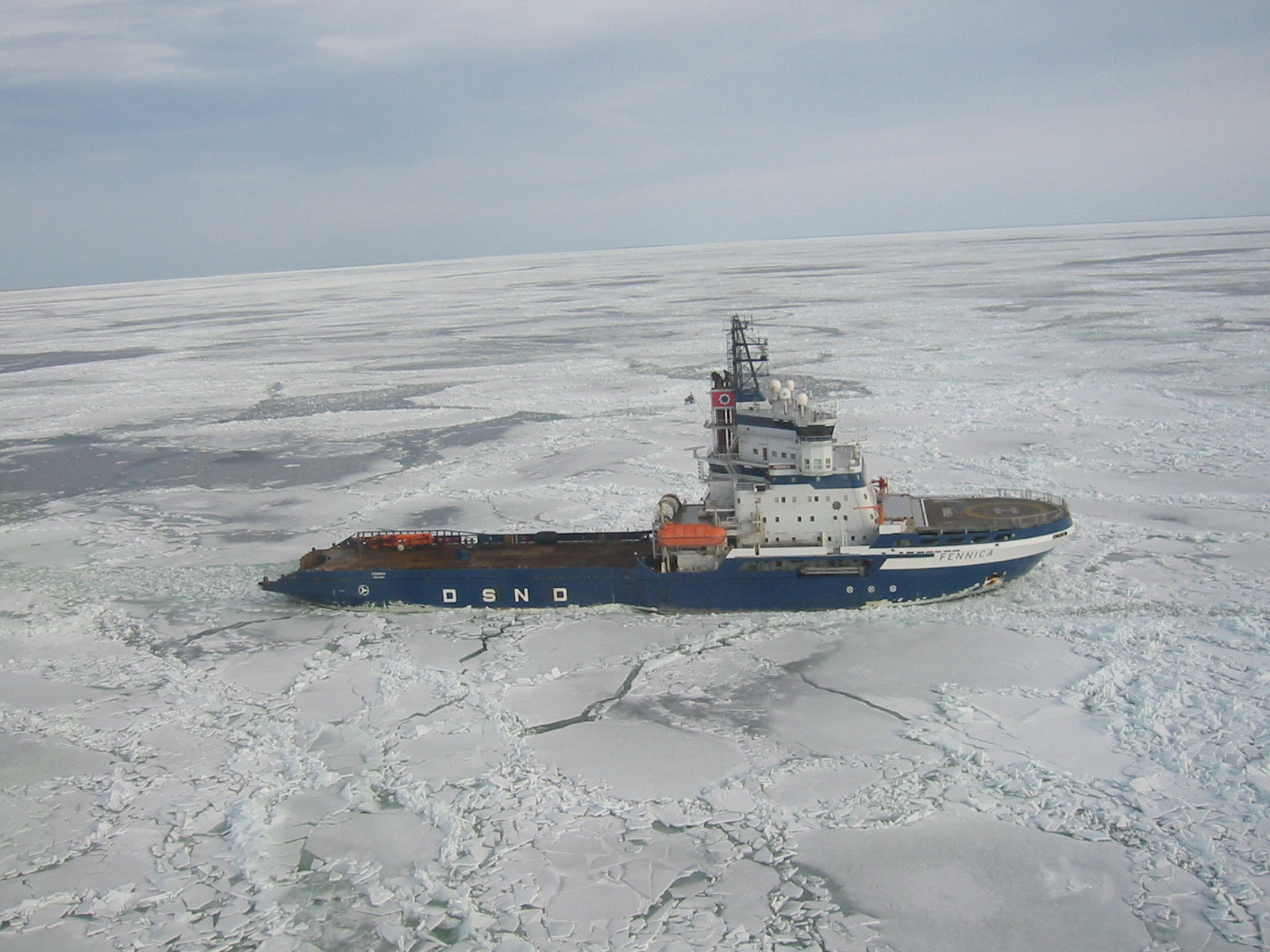
File:Icebreaker Fennica.jpg

Photo Credit: Marcusroos via Wikipedia “Finnish icebreaker Fennica in the Bay of Botnia”

Shell Oil has a fleet of roughly two dozen ships on the way to the Arctic where they are expected to drill exploratory wells in the Beaufort and Chukchi seas. The drill ships have recently left Seattle and are on the way to Dutch Harbor, where they will wait for the ice to clear. At least four of these ships are ice-class ships, as big or bigger than some of the Coast Guards earlier icebreakers, including Chouest’s M/V Nanuq (301 ft) and Aiviq (361 ft) and the Finish multipurpose icebreakers Nordica and Fennica (381 ft). Fuelfix.com provides additional detail and shows some of the preparation for the possibility of a spill.

(Thanks to Tim Colton’s Maritime Memos, he’s got lots of other good stuff including developments in the ship building industry–problems at Austal, a comment on Canada’s ship building paralysis, and advice for the Navy and Coast Guard on how to make “should-cost estimating” work.)

International Maritime Partnerships

Thought some of you might be interested in this short explanation of the standing Combined Maritime Forces (CMF) Task Forces 150, 151 and 152, that include Coast Guard members in addition to naval forces of 26 nations. These task force are intended to counter terrorism (150) and piracy (151) and to provide security in the Persian (Arabian) Gulf (152).


OPC, Design for Wartime, Build for Peacetime

As noted in the post “GAO Responds to Fleet Mix Studies, Part 1, The Report,” the Department of Homeland Security “Cutter Study” raised the possibility of an austerely equipped Offshore Patrol Cutter (OPC) possibly deleting some equipment or capabilities of the ship as currently planned including:

  • Sensitive Compartmentalized Information Facility (now referred to as the Ship’s Signals Exploitation Space or SSES)
  • Air Search and Fire Control Radars
  • Electronic Warfare Support Measures
  • Berthing space (114 instead of 122)
  • Weapons suite (e.g., 25mm gun instead of 57mm)

This got me to thinking. What do these ships really need, both for their peacetime functions and for possible wartime roles? I hope the Department’s suggestion presages a return to CNA (Center for Naval Analysis) to do a more formal evaluation of the effects of these changes. Until then, I’ll venture some comments on these proposed deletions, then go on to talk about how the ships might be equipped first for war, then for peace.

Continue reading

New Swedish WPB

Maritime propulsion is reporting the Swedish Coast Guard is getting a new class of five patrol boats, being built by Baltic Workboats AS, Estonia.

“The 52 t vessels have an LOA of 90 ft (26.5 m), beam of 20 ft (6.2 m) and draft of 5 ft (1.5 m). Unusual for its size, there is a triple pod propulsion system comprising three Volvo Penta IPS 1050 steerable pod drives with D13-800 diesels each rated at 800 hp at 2,000 rpm (Rating 4 – light commercial application).”

Lower emissions and up to 30% fuel savings are also reported.Top speed is 32 knots and range exceeds 600 nmi.

Photo: Baltic Workboats

Summer 2012 “Delivering the Goods” Available

The new addition of the Acquisition Directorate’s news letter, “Delivering the Goods” (pdf), is available here.

It is an informative issue. There are stories about

  • Developing the infrastructure to accept the first 18 Webber Class Cutters–6 to Miami, 6 to Key West, and finally 6 to San Juan
  • The 35 foot “Long Range Interceptor” LRI II boat for the National Security Cutters
  • Rescue 21 maintenance contract
  • Expected completion of the 110 Mission Effectiveness project. (Only 17 of the 49 (now really only 41) will get this treatment.)
  • There is a note about installation of the “Watchkeeper” software for inter-agency operations centers
  • A profile of the C-130 project manager
  • And, Master Chief Ayers talks about Coast Guard interest in small Unmanned Air Systems, particularly Scan Eagle.

InformationDissemination 5th year Celebration/Tactics and Strategy–Consider how the CG might fit

Perhaps my favorite naval blog, Informationdissemination, is celebrating their fifth anniversary. They have invited a number of prominent individuals to write for the blog and the turn0ut has been impressive. Below, I have listed some of the topic and authors.

Most recently they have published a post by the author of perhaps the most influential book on naval tactic of the last 50 year, Fleet Tactics and Coastal Combat, Wayne P. Hughes, Jr., Captain USN (Retired), an operations research professor at the Naval Postgraduate School, Monterey, CA. I think its worth a look. (We had an earlier two part discussion of Coast Guard roles “What Might Coast Guard Cutters Do in Wartime, Part 1, Navy Shortfalls” and “…part-2, Coast Guard Roles”.)

————————————-

How can the concepts articulated in writing by transformers/innovators get translated to action? Admiral James G. Stavridis, Supreme Allied Commander, Europe and Commander, United States European Command

What is Air-Sea Battle? Admiral Jonathan Greenert, Chief of Naval Operations.

What fundamental skills do today’s midshipmen need to learn in order to lead the Navy three decades from now? Vice Admiral Michael H. Miller, the 61st Superintendent of the U.S. Naval Academy

US MARSEC Capability Development Programs in West Africa: Current Status and Future Prospects, N.R. Jenzen-Jones &  LT Chad R. Hutchins, USN.

With so few U.S.-Flagged ships and carriers, is America still a maritime power? Stephen Carmel, Sr. Vice President Maritime Services at Maersk Line, Limited.

How would you describe the evolution of social media in the Navy? Rear Adm. Dennis J. Moynihan, U.S. Navy Chief of Information

Is China the real Mahanian maritime power of the 21st century? Robert C. Rubel, Dean, Center for Naval Warfare Studies at the Naval War College.

How long would it take the shipbuilding industry to grow capacity and throughput if the nation faced a naval crisis or conflict? Mike Petters, President and Chief Executive Officer of Huntington Ingalls Industries.

What is the Littoral Combat Ship in your words, and what should LCS be looking to the future? Christopher Cavas, Journalist at Defense News and Navy Times

To what extent is the Navy setting forth a strategic vision that agrees with your understanding of America’s global role? Secretary John Lehman, Special Adviser to Gov. Mitt Romney and Co-Chair of Romney Campaign’s Defense Working Group

and the same question to a representative of the Obama campaign

To what extent is the Navy setting forth a strategic vision that agrees with your understanding of America’s global role? Secretary Richard Danzig, former Secretary of the Navy under President Bill Clinton and an advisor to President Barack Obama’s re-election campaign on national security issues.

Commandant Interviewed–Link to Video

The Commandant was recently interviewed on a video blog, “This Week in Defense News.” You can watch it here.

Not surprisingly the topic is the budget including sequestration, National Security Cutters, icebreakers, and Off Shore Patrol Cutters.

The interview is in three parts and total time is a bit over 20 minutes. Not sure how long this will be available.

Approaching a Merchant Ship May be Hazardous–Sydney vs Kormoran

File:Bundesarchiv Bild 146-1969-117-48, Hilfskreuzer Kormoran.jpg

Photo: German Auxiliary Cruiser Kormoran

The Mystery:

On 19 November, 1941 the Australian light cruiser Sydney disappeared. Because of wartime radio silence procedures, she wasn’t missed  for several days. Searches began on 24 November and continued though the 29th.
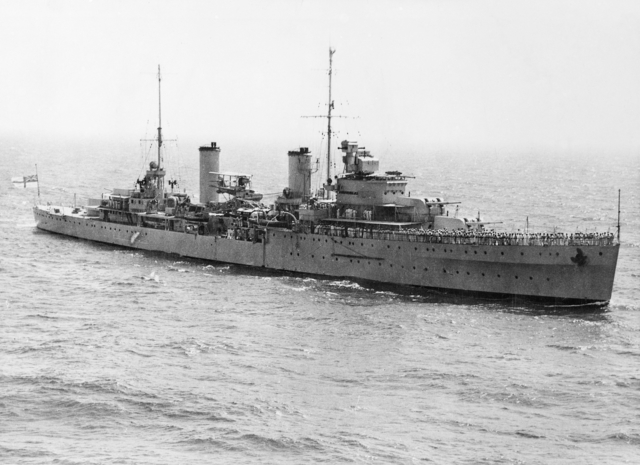
File:HMAS Sydney (AWM 301473).jpg

Photo: HMAS Sydney, 1940

HMAS Sydney was a substantial warship. Commissioned only six years before, she had recently returned to Australia from the Mediterranean where she had been very active. She had shelled the Italian coast, participated in a major fleet action, and taken part in the sinking of an Italian destroyer, a light cruiser, and at least three merchant ships. At 562 feet long, 8,940 tons, armored, and armed with eight 6″ guns in four turrets, she was approximately the size of modern Burke class DDG and about twice the size of a National Security Cutter.

The Adversary:

The searchers found no survivors from the Sydney, but surprisingly found German Navy personnel. Gradually the story came out.

The German sailors were from the Kormoran. Kormoran had been built as a merchant ship. She was large for the period at 8,736 tons and 515 feet long, but would be dwarfed by most modern merchant ships. She had been converted to a clandestine commerce raider. She was armed with six 5.9″ (150mm) guns dating from the first world war (only four of which could bear on a side), five 20mm machineguns, and two 37 mm anti-tank guns.  In addition she was armed with six torpedo tubes, four in pairs on either side and two underwater tubes. She carried scout planes and a large number of mines. She could also alter her appearance to resemble several different allied or neutral merchant ships.

Kormoran had been away from Germany for more than eleven months and had sunk ten merchant ships and captured an eleventh. Kormoran was disguised as a Dutch freighter when Sydney stumbled upon her.

The Fatal Error:

Sydney made the mistake of approaching Kormoran too closely. After sighting a vessel that was not expected to be in the area, and exchanges of signals, Sydney continued to close until they were within 1500 yard, off the Kormoran’s starboard beam. When it became clear that she would not be able to fool the Australian cruiser, Kormoran broke her battle ensign and both ships opened fire almost simultaneously. Sydney’s eight round salvo was high. Kormoran launched two torpedoes. Her first salvo did inconsequential damage, but her second destroyed Sydney’s firecontrol tower, while her 20 and 37 mm guns kept the crews away from Sydney’s open secondary mounts. Sydney’s two forward 6″ turrets were destroyed before they were able to fire their second salvo. Kormoran then turned her attention to the engineroom for three salvos. Sydney’s two aft turrets began firing independently in local control.

As the Kormoran fired her eighth and ninth salvo, one of the two torpedoes she had fired hit the Sydney forward, causing the bow to break downward. This forced her to veer left and pass behind the Kormoran. These events had taken only minutes. Since the torpedo would have covered the 1500 yards between them in little over a minute and 6″ guns fire at up to ten rounds per minute, it may have taken less than two minutes to severely maul an experienced first line warship.

The Second Phase:

The ships now separated. Sydney limped away south, while Kormoran held her course and speed. Sydney’s forward turrets were shattered, and her after turrets jammed. She had fires in the engineering spaces and around the seaplane catapult. About fifteen minutes after the engagement had begun, she belatedly launched torpedoes at the stern of the Kormoran.

Kormoran turned to port to unmask her batteries with the intention of destroying Sydney. The unguided torpedoes missed at the now extended range, the shot made totally impossible by Kormoran’s turn. At this point Kormoran’s engines failed and she went dead in the water. Still she continued firing the four 5.9″ guns that would bear at near their maximum rate, reportedly expending up to 450 of the 100 pound shells while Sydney moved slowly away. The last rounds were expended as the range opened to 6,000 meters (6,600 yards). This would have taken at least eleven minutes, and at that still relatively short range, against a slow moving target, at least one in ten shells should have hit.

Damage Control Fails:

Both ships lost their attempts to control damage and both sank during the night. Of Kormoran’s crew of 399, 317 survived. Many of those that were lost, died when a rubber raft suddenly sank. Why there were no survivors from Sydney’s crew of 645, is a question that has prompted controversy and accusations of war crimes. When the wrecks were discovered in 2008, Sydney’s bow had broken off, but it appeared the main body of the ship had sunk upright. Investigation of the wreck also appeared to confirm German accounts of the engagement.

Lessons Learned:

Sydney was lost, but she did succeed in destroying the raider because, although several vital systems were destroyed early on, she had sufficient redundancy to continue to inflict damage that proved fatal.

The delay in launching torpedoes was difficult to understand. She should have been able to fire the four port tubes when the action commenced. The four starboard tubes should have been able to bear as the Sydney passed astern of Kormoran. They may not have been fully readied and Kormoran’s suppressive fire on the secondary mounts may have also killed the crews of the near-by torpedo tubes or otherwise disabled them.

Coast Guard ships may find themselves placed in a situation not unlike the Sydney’s while providing “ports, waterways, and coastal security” or enforcing a blockade. The CO will have to decide where to place the ship. After years of fisheries and law enforcement boardings, it is natural for Coast Guard ships to make a close approach. It has real advantages, allowing better view of the vessel of interest and their activities and shortening the time in transit for boarding parties, but in a situation where the ship might prove hostile, it may be hazardous.

A more extensive treatment of the battle on which this post is based is here. The section “Why Burnett approached so close” is particularly relevant.

Sydney had approached closely enough that Kormoran was able to selectively target vital systems. Kormoran would have known the location of all of Sydney’s weapons, while the Kormoran’s were far less obvious. Exploiting surprise, Kormoran used her inferior weapons to quickly shift the odds in her favor.

In a similar situation, close in, it might be possible to place a cutter at a severe firepower disadvantage with only a couple of shots destroying the more potent weapons. Extending the range quickly makes this unlikely.

A hostile vessel’s extemporized armament might include machine guns and anti-tank guided missiles, but there are also thousands of surplus anti-tank and anti-aircraft guns in circulation, manufactured during the cold war, ranging in size up to 130 mm (5.1″) that could be mounted on a ship and would prove effective in an anti-surface mode at short range.

What all these systems have in common is their accuracy drops off rapidly with increasing range. It may not be practical to stay beyond their maximum range, but it is probably possible to keep enough distance, to make it highly unlikely critical systems can be destroyed before the cutter can react.