Philippines and China in Standoff–former USCGC Center Stage

https://i0.wp.com/upload.wikimedia.org/wikipedia/commons/0/03/Scarborough_Shoal_Landsat.jpg

Photo credit, NASA Landsat 7 image of Scarborough Shoal in the South China Sea

The former USCGC Hamilton, now BRP Gregorio del Pilar, is at the center of a standoff with the Chinese over a remote atoll shaped group of rocks and shallows called variously Scarborough (or Panatag) Reef or Shoal.

Both the Chinese and the Philippines claim sovereignty.

A Philippine patrol plane located eight Chinese fishing vessels inside the atoll. With the Gregorio del Pilar now on scene, two Chinese Maritime Surveillance vessels are blocking Philippine fisheries enforcement action against the fishing vessels and the Chinese are demanding the Philippine Navy depart their waters; while the Philippines is asserting it will enforce its sovereignty. Diplomacy is given lip service, but the standoff is ongoing. The US has a treaty obligation to the Philippines (subject to interpretation of course) and there are calls for US assistance.

A long discussion from the Philippine point of view here.

Photo: Philippine flag planted on Scarborough Shoal, Photographed by Adel Rosario, 05:11, 2 May 2010 (UTC)

File:Panatag Shoal.jpg

Black Eye for NATO and European SAR Organizations

NATO and European SAR organizations are being blamed for the death of 63 refugees from the fighting in Libya. The voyage started with 72 refugees, 50 men, 20 women, and two babies. Fifteen days later, when the craft drifted back to Libya, only ten remained alive and one of those subsequently died.

The media (CNN story here, MailOnline (UK) here) seems to have concentrated on this case as emblematic of failure, but it does not begin to tell the story. According to Aljazeera, “The UN Refugee Agency (UNHCR) estimates that roughly 50,000 people attempted to cross the Mediterranean by boat in 2011 and close to 2,000 drowned.”

To the outside observer there seem to have been many opportunities to rescue the refugees. Not having done so is seen as racist. NATO and European Coast Guards are being blamed, but might simply have been overwhelmed.

Clearly rescue organizations are being held to a very high standards. It is not enough that they rescue the vast majority of those in distress, they must rescue everyone without fail. It is not unlikely that once, perhaps several times, these organizations responded to reports of the boat adrift, located a boat in the area and assumed the mission was accomplished.

Its not unlikely our Coast Guard will find itself in a similar situation again.


What Does It Take to Sink a Ship, Illustrated

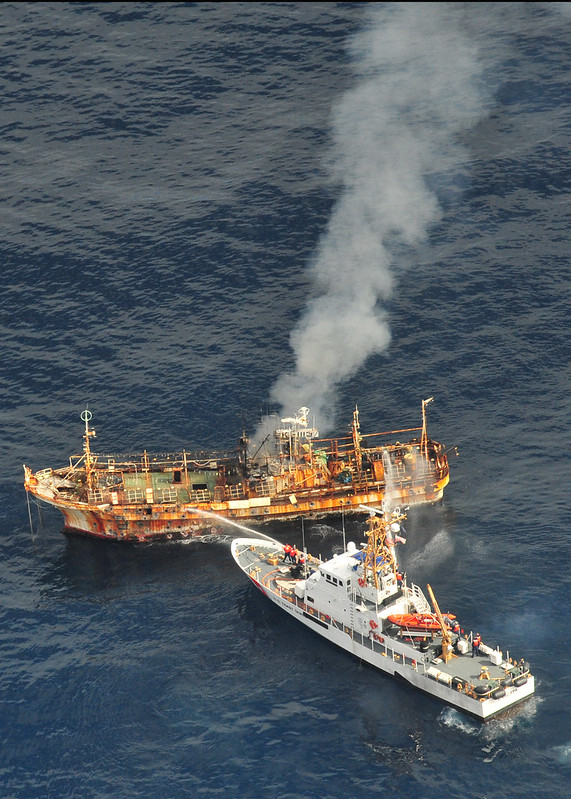
A little over a year ago, I published a post entitled “What Does It Take to Sink a Ship.” It has proven perhaps my most widely read post. The recent sinking of the Japanese fishing vessel Ryou-Un Maru beautifully illustrates the point that ships can be very hard to sink by gun fire.

120405-G-ZZ999-The sinking of the Japanese fishing vessel Ryou-un Maru

  • Title: GULF OF ALASKA – The Japanese fishing vessel, Ryou-Un Maru
  • Summary: GULF OF ALASKA – The Japanese fishing vessel, Ryou-Un Maru, shows significant signs of damage after the Coast Guard Cutter Anancapa fired explosive ammunition into it 180 miles west of the Southeast Alaskan coast April 5, 2012.

Reportedly the USCGC Anacapa began the operation at 13:00 and the Ryou-Un Maru sank at 18:15. It appears that the F/V may have been hit 100 times by explosive 25mm projectiles. With no crew aboard to do damage control and probably with no real measures taken to ensure water tight doors were closed, it stayed afloat for over five hours and ultimately the Anacapa resorted to pumping water into the vessel to sink it.

120405-G-RS249-005-USCG responds to Japanese vessel in Gulf of Alaska

  • Title: 120405-G-RS249-005-USCG responds to Japanese vessel in Gulf of Alaska
  • Summary: GULF OF ALASKA – The Coast Guard Cutter Anacapa crew douses the adrift Japanese vessel with water after a gunnery exercise 180 miles west of the Southeast Alaskan coast April 5, 2012. The crew was successful and sank the vessel at 6:15 p.m. in 6,000 feet

This was a very small ship, probably less than 500 tons, the implications for our ability to stop a medium to large vessel with a determined crew on board, bent on using the vessel for a terrorist act in an American port should be obvious. With even crude and unsophisticated measures to protect vital machinery and control functions, a ship can resist a great deal of gunfire and continue to its objective.

Late Addition–Video of the sinking added 25 Dec. 2012

Another New icebreaker, No Not Coast Guard

gCaptain reports, Shell oil recently took delivery of a 360 foot icebreaker anchor handling vessel. This is the fourth icebreaker built by Edison Chouest Offshore in the last two decades. Two of them (Laurence M. Gould and Nathaniel B. Palmer) were chartered by the National Science Foundation to support their high latitude work.

Reportedly this is part of a continuing trend toward larger vessels to support oil drilling as it moves further off shore.

While it is certainly no Polar Class, it appears to be larger than either the Wind Class or the Glacier. Its good to know that if we wanted to quickly build an arctic patrol vessel that would not break the bank (reported cost $200M), there is at least one American shipyard up to the task.


Unconventional Chinese Rescue Cutter

The Chinese have built an interesting little ship with a trimaran hull, that appears to designed for one of their several coast guard type organizations. It is designated “North Rescue 143.”

It looks a little like a cross between a 110 and an Independence Class Littoral Combat Ship.

Of course this is not the first time the Chinese have shown an interest in non-conventional hull forms. There had been some indication they intended to use the basic form of their catamaran Type 022 (Houbei Class) missile boats as a patrol boat.


DOD Support for CG Arctic Presence

Navy Times is reporting Coast Guard efforts establish a presence in the Arctic are getting some support from USNORTHCOM.

“The Defense Department will help bolster the Coast Guard’s presence in the Arctic, the commander of U.S. Northern Command told the Senate Armed Services Committee.

“Army Gen. Charles Jacoby and Coast Guard Commandant Adm. Bob Papp signed a white paper March 13 that addresses capability gaps in infrastructure, communications, domain awareness and presence in the Arctic.”

Good to see a Combatant Commander (COCOM) supporting Coast Guard programs that serve his Area of Responsibility (AOR). This is in contrast to USSOUTHCOM’s silence regarding Coast Guard needs when it came to providing ships for drug interdiction.

The Navy Times article focuses on the proposed new ice breaker, but there appears to be more to it than that. Certainly there is a need for defense infrastructure in the Arctic and the Coast Guard may be seen as caretakers for facilities that could be augmented in times of crisis. Perhaps putting words into action, DARPA is working on systems that might facilitate “Domain Awareness” in the Arctic.

(It had looked like the Canadians were ahead of us in Arctic operations, but apparently they do not see it that way.)

The world is divided into six COCOM Areas of Responsibility. Coast Guard personnel serve in all of them. Coast Guard units are either permanently or frequently assigned to at least five of them. Hopefully Coast Guard participation is sufficiently valued that they will occasionally speak on behalf of the Coast Guard.