Fall 2011 CG-9 Newsletter Available

The Acquisition Directorate has issued its Fall 2011 Newsletter, “Delivering the Goods.” It is available as a pdf here.

The news letter includes:

  • Information on the third National Security Cutter, Stratton, and her trip up the East Coast where she was toured by the Chairman of the Joint Chiefs and Department of Homeland Security Secretary Janet Napolitano
  • The appearance of the MH-60T, a prototype upgrade to the H-60, at the Innovation Expo in Tampa, Fla. The CG is piggy backing the development on an Army program
  • An award to the Interagency Alternative Technology Assessment Program that grew out of the Deepwater Horizon oil spill.
  • There is a profile of Giao Phan as the Deputy Program Executive Officer (PEO) and Deputy Director of Acquisition Programs who came to the US as a refugee from South Vietnam.
  • And Master Chief Ayers answers a question about changes to the stern ramp system from its original form on Bertholf to its new form on Stratton and relates it to con figuration management.

Piracy Update, 20 November, 2011

Somalia/Gulf of Aden/Indian Ocean:

NATO Reports show at least three attacks and at least three incidents of vessels being approached in a suspicious manner by skiffs that appeared to be pirates, but there were no successful attacks reported.

https://i0.wp.com/upload.wikimedia.org/wikipedia/commons/thumb/3/33/INS_Suvarna.jpg/1024px-INS_Suvarna.jpgINS Suvarna, sister ship of INS Sukanya. Photo: INS SuvarnaM. Mazumdar/ Bharat-Rakshak. Original uploader was Mittal.fdk at en.wikipedia. Permission: CC-BY-SA-3.0.

India continues to deal aggressively with pirates. “The Hindu” reports the actions of the INS Sukanya (1,890 tons full load, 331′ loa) when five skiffs approached vessels in the five ship convoy she was escorting,

“While two of them managed to escape, INS Sukanya successfully intercepted the remaining three boats and…nabbed 26 Somali pirates with six AK 47 rifles, 12 magazines and about 300 rounds of ammunition.

“This is the fifth successful anti-piracy operation conducted by INS Sukanya in the course of her ongoing patrol mission in the Gulf of Aden that commenced in September, the Navy said.”

The uncertainty introduced by the Kenyan invasion of Southern Somalia is having an effect on the ransom pirates are demanding for the ships and crews they currently hold. Ransom demands have been cut as the pirates hope to “close the deal.

There are reports that Ethiopia has also moved troops into Somalia to support the Kenyan invasion.

While Kenya and Ethiopia move against Al Shabaab rebels in the South, there is a report the locals in Puntland are moving against pirates enclaves in the Northeast.

Nigeria/Gulf of Guinea

gCaptain reports three people were kidnapped after eight armed men boarded an offshore supply vessel, the MV C-Endeavour, belonging to Edison Chouest Offshore, off the coast of Nigeria. The report came by email from Kurt Glaubitz, a spokesman for Chevron.

Mekong River:

The attack that left 13 Chinese dead, reported in the last update, has resulted in China dispatching up to 1,000 armed police to work in the territory of Burma, Thailand, and Laos, to protect its trade on the Mekong.

Armed Security Guards:

The Marine Log reports H.R. 2838, the Coast Guard and Maritime Transportation Act of 2011, that recently passed the U.S. House of Representatives, “…strengthens existing authorities against piracy, as well as improves an existing training program to instruct mariners on acceptable use of force against pirates.  It authorizes armed security on vessels carrying government impelled cargo through high risk waters, and includes a report on ways to improve U.S. efforts to track ransom payments and the movement of money through Somali piracy networks.

“‘Somali pirates have vastly expanded the range of their attacks on merchant vessels.  But even more alarming, the pirates have dramatically increased the number and viciousness of their attacks in recent months,’ said LoBiondo (Coast Guard Subcommittee Chairman Frank A. LoBiondo (R-NJ). ‘To protect American seafarers, this legislation will strengthen an existing training program on use of force against pirates.  Additionally, it will provide authority for government agencies to reimburse shippers for armed security aboard vessels carrying U.S. aid to the region.‘”

The Maritime Executive reports there is a growing consensus in the US, that failure to provide armed security may open up ship owners to legal liability for failure to provide seaman with a safe working environment and a seaworthy vessel.

Elsewhere authorities remain unconvinced. The Netherlands is telling its ship owners that, if they use private armed security guards, they could be subject to criminal prosecution.

“Jumbo Shipping from Rotterdam and Vroon Shipping based in Breskens have both said they will carry armed guards while sailing under the Dutch flag.

“The ministry of defence has set up special teams to help combat the threat of piracy but the shipping firms say this is not a solution. ‘You have to order them six weeks in advance and we cannot work like that,’ the Jumbo spokesman said.

“Denmark, Spain, Norway and Britain do allow shipping firms to use private security guards while travelling close to the Somali coast.”

Strat Comm Cultural Diversity Commentary

Armed Forces Journal brings us this bit of new speak from the program for the Coast Guard’s October 2011 Innovation Expo:

“Strategic Innovation is value creation hard wired to organizational strategic direction,” reads the introduction to one of the keynote speeches. “Strategic Innovation is achieved by looking to the horizon[,] seeing the shifts, and bringing diversity of though [sic] and objective non-traditional perspective to traditional service delivery as the organization examines the effectiveness of its culture, processes and structures.”

Or as we used to say, “If you can’t dazzle ’em with brilliance, baffle with bull s**t.”

OPV (OPC) for the Philippines

NavSea has issued an RFI for something that looks a lot like an Offshore Patrol Cutter (OPC), to be procured under the Foreign Military Sales (FMS) program.

“This Request for Information (RFI) N00024-11-R-2217 is being issued in anticipation of a potential future procurement program for the Republic of the Philippines. The Naval Sea Systems Command is conducting market research to determine the existence of a general purpose Offshore Patrol Vessel (OPV) …”

This is a bit old, having been issued on May 6, 2011 (only four days after the issuance of the draft OPC specifications) with a June 3, 1011 response deadline, but I only just stumbled across it here. The Philippines would like to have the ship assembled in country, but that is a question to be addressed by the contractors. If the program follows the pattern I have seen in other countries, the lead ship would be built here and the follow-ons in the Philippines. A multi-ship buy is expected, but the number is not specified and subject to change.

Considering that there is the possibility of extensive similarities to the Offshore Patrol Cutter program, you might assume this was discussed with the Coast Guard, but I have my doubts. After all, the Philippines might want to participate in the OPC program since a large order quantity is likely to drive down cost.

The specifications require “The vessel must be new construction, but derived from a proven hull design previously built by the contractor.” (That sounds like the ship yard would not be allowed to use a design previously built by a different contractor.) (revision: this was changed to: “The vessel must be new construction, but derived from a proven hull design.”)

The specifications are also remarkably specific, not only in performance, but also in dimensions.

  • a. Overall Length: At least 80 meters (NTE 10%)
  • b. Beam: At least 10.5 meters (NTE 10%)
  • c. Displacement (full load): At least 1,000 tons (NTE 10%)

If, as I suspect, the “(NTE 10%)” means “Not To Exceed” then it is also setting maximums, so:

  • length: 80 to 88 meters (262.4 to 288.64′)
  • beam: 10.5 to 11.55 (34.45 to 37.9′)
  • full load displacement: 1,000 to 1,100 tons

I have done an extensive literature search, and I cannot find an OPV 80 meters or longer, with a full load displacement <= 1,100 tons. The closest I got in terms of tonnage was the Israeli SA’AR 5 corvettes, not really an OPV, but the hull might be used:

  • 85.64 meters long
  • 11.88 meter beam (10.3 at the waterline)
  • 1,227 tons full load

By way of comparison the dimensions for the 270 and 210 are:

  • WMEC 270
  • 82.3 m long
  • 11.58 m beam
  • 1,780 tons

and

  • WMEC 210
  • 60.96 m
  • 10.36 m
  • 1,000 tons

Specifications include:

  • helo deck for a seven ton helicopter (but a hanger was not specified).
  • speed => 20 knots
  • Endurance of 3,500 miles at a cruise speed of at least 14 knots and storage for 30 days supplies.
  • Mixed crew accommodations for 75 including a flag officer, 14 other officers and three civilians.
  • “The ship will be equipped with two 11 meter Rigid Hull Inflatable Boats (RIBs) capable of being quickly launched from a stern ramp.” This sounds a lot like L’Adroit  (87 m x 11 m, 1,450 tons), and seems to be driven by a desire to use the ships for small scale amphibious operations–landing perhaps a platoon.
  • “Propulsion System shall be two main diesel engines with fixed pitch propellers.” This degree of specificity is hard to understand, considering the many alternatives available, particularly the advantages of variable pitch props.

The Combat Systems requirement are quite extensive for an OPV of this size including:

  • 76 mm gun
  • 25 mm gun.
  • “Surveillance and acquisition radar capable of 3D surveillance and acquisition radar that meet OPV requirements for combat surface and air defense search
  • “IFF ability to differentiate and friendly units from unknowns
  • “Radar fire control system to provide data to 76mm gun and 25mm gun systems trained at the same target
  • “Electro Optical Fire Control System for the 76mm and 25mm gun systems
  • “Electronic Support measures for the passive listening capability for selected radar laser and infrared warning devices and communications signals from land, air and sea with the OPV battle space
  • “Ship should have space available for the future growth for SAM (Surface to Air Missile), SSM (Surface to Surface Missile) and ECM (Electronic Counter Measures) as well as towed array sonar equipment”

The list of  “Interested Vendors”  includes:

Sure looks like they have something very specific in mind, particularly since they gave less than a month to make a response.

Offshore Patrol Vessel Power Point

There is an interesting power point presentation, “The Changing Face of OPV Design and Cost Drivers,” available here (pdf). Apparently it was presented at the OPV Asia Conference in Singapore, April 5-7, 2011, by the President of STX Canada Marine Inc./STX US Marine Inc. These are divisions of STX Offshore and Shipbuilding headquartered in South Korea with 18 shipyards in eight different countries.

There is a series of charts discussing the effects of increased size, increased speed, and increasing levels of combat and surveillance capabilities have on cost.

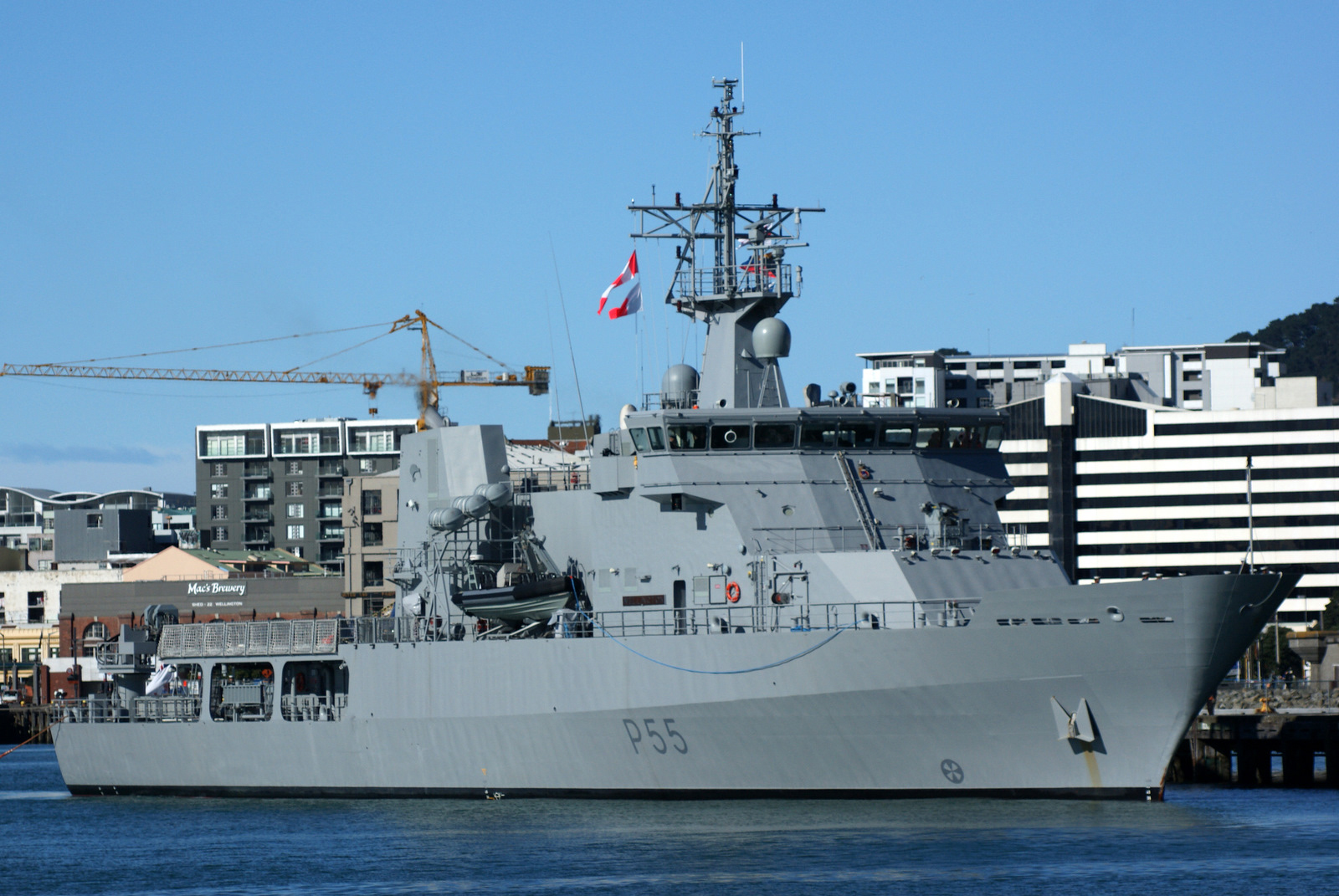
STX is the maker of the Royal New Zealand Navy’s ice strengthened OPVs “Otago“ and “Wellington.”

File:HMNZS Wellington.JPG

Mexico takes delivery of MPA–Their Version of HC-144

The Mexican Navy has taken delivery of the first of four Airbus Military CN235 aircraft equipped as Maritime Patrol Aircraft (MPA) paralleling the Coast Guard’s own planned procurement of 36 CN235s as HC-144A.

The delivery was made through EADS North America under the Mérida Initiative, a joint program between the US Government and the Government of Mexico.

Sweating the Small S**t

You may have heard that the Navy’s newest aircraft carrier, George H. W. Bush (CVN-77), has been in the news because of its toilets. Informationdissemination has more information, including the Captain’s side of the story, and an interesting discussion.

Great object lesson on the importance of the mundane, and how being too upfront with you mom can cause a lot of trouble.