Maritime Executive has a article regarding the necessity of an integrated Coast Guard. Don’t know that there is anything we haven’t talked about before, but always night to get another perspective.
Why a Coast Guard?–Maritime Executive
Reply

Maritime Executive has a article regarding the necessity of an integrated Coast Guard. Don’t know that there is anything we haven’t talked about before, but always night to get another perspective.
The US Naval Institute News service has a short story about the evacuation of more than half a million people from Southern Manhattan following the attack on 9-11 as told by former Commandant James Loy. Apparently this is part of much larger oral history project.
Based on 15 interviews conducted by Paul Stillwell from August 2002 to August 2006. The volume contains 621 pages of interview transcript plus appendices and a comprehensive index. The transcript is copyright 2014 by the U.S. Naval Institute; the interviewee placed no restrictions on its use.
I’ve posted the video above before, but it is an excellent tribute to the spirit of those that responded so unselfishly to this attack.
Not commentary, but something that has been predicted, and two you might like to see.
As we have been told might happen, gCaptain tells us a cruise ship is planning to transit the North West Passage through the Arctic.
Then, just for fun, there are some great photos of the USS Constitution, and a video of some time spent on the mainmast of the Charles W. Morgan.
Lockheed Martin animation of Hellfire employment from an LCS
It looks like the Navy is beginning to field some weapons that are appropriate for the Coast Guard’s mission of preventing maritime terrorist attacks while addressing concerns that using weapons in US ports may cause collateral damage.
We talked about this concern recently.
I have always felt this mission had to devolve onto the smaller vessels, because the larger cutters don’t spend much underway time around US ports and when they are in port they usually cannot be gotten underway quickly. For this reason the WPCs need to be able to perform the mission.
Navy Recognition has news of progress on two of these systems, Dual Mode Hellfire and Dual Mode Brimstone.
The Longbow Hellfire is already present in the US inventory in large numbers and is being adopted for the LCS anti-surface module. The Brimstone is very similar in size, warhead, and range (about 8,000 yards), but has the advantage of a datalink that allows a “man-in-the-loop” which I think is desirable. Unfortunately, so far the USN is only looking at Brimstone as an air-launched weapon.
Test of Brimstone against two 40 foot maneuvering targets, discriminating between the targets and similar sized craft
Test of the Griffin. (Note limited damage)
A third system, SeaGriffin has a smaller footprint and warhead and has had a shorter range (only 43″ long, weighing 33 pounds, with a 13 pound warhead, surface to surface range of 5,500 meters), but it appears that the latest version may have a longer range, than either Hellfire or Brimstone, perhaps up to 18,000 yards (assuming they have, as reported, triple the previous range). The latest version of SeaGriffin does have a man-in-the-loop capability. Griffin is already being deployed on US Navy Cyclone class PCs. There are lots of photos showing the relatively small size of this system here.
I have never expected that extreme range was an important consideration for Coast Guard weapons, but for the anti-terrorism mission (or enforcing a blockade in wartime), we probably need the ability to engage from outside 4,000 yards (beyond the effective range of the 25mm Mk 38), because inside that range, there are a number of systems that might be added to a ship that could have a good probability of quickly disabling our vessels.
I still believe none of these weapons is capable of quickly and reliably stopping a medium sized ship or anything larger. For that I think we still need at least a light weight torpedo, but these weapons would significantly improve the chances against vessels of any size and particularly against small high speed maneuvering targets. Equipped with these, a Webber class cutter could be better able to fulfill this mission than a National Security Cutter with its 57mm guns.
The State Department has issued a document regarding US policy for the suppression of Piracy of the Horn of Africa (HOA) and in the Gulf of Guinea (GOG). It is a brief four page intro and two annexes, eight pages addressing the HOA and ten addressing the GOG.
The link on the State Dept. website is here.
The Coast Guard is mentioned:
“Provide persistent interdiction-capable presence at sea off the HOA. Consistent with other U.S. mission requirements, U.S. Navy and/or U.S. Coast Guard forces operating in the region provide persistent interdiction through presence, conduct maritime counter-piracy operations, and coordinate counter-piracy activities with other forces operating in the region to the extent practicable. When in range, these forces will prevent suspected pirate vessels from operating, respond to reports of pirate attacks with the objective of disrupting such attacks, and, in appropriate circumstances, terminate the act of piracy and any resultant hostage situation with intent to deliver any surviving pirates ashore for prosecution. These forces will also coordinate efforts among all multilateral coalitions such as Combined Maritime forces, NATO’s OPERATION OCEAN SHIELD, the European Union’s OPERATION ATALANTA, and independent naval forces.”
As we know, Customs and Border Protection effectively duplicates the Coast Guard role in drug enforcement and Alien Interdiction in many areas. The Witchita Eagle reports they are currently in the process of buying up to 40 new “multi-role aircraft” in the form of sensor equipped Beech KingAir 350s, or C-12s to use the military designation. (Note Witchita is home of Beech Aircraft)
“According to the agency’s documents, the request calls for a plane whose sensors are able to detect a plane the size of a Cessna 172 from 17 miles away, a 30-foot boat from 29 miles away and a person from seven miles away. It must be able to “classify the target” at a distance of 2 miles, the request said.”
Significantly, the first of these have been assigned to San Diego and Jacksonville, FL, suggesting they will be used for maritime interdiction.
We have talked about this aircraft before as a possible alternative to long ranged, high endurance UAVs and possibly the HC-144.
These appear to be extremely capable aircraft, perhaps equal in effectiveness to HC-144 as search aircraft, and cheaper to operate. If we are not careful the CBP may make the CG appear inefficient by comparison.
These might also be more appropriate for the interception mission CG helicopters currently perform over Washington DC.
Even after the C-27J acquisition, it appears the Coast Guard will still be short of its planned total required number of fixed wing search aircraft. Is a common airframe for both CBP and the CG out of the question?
Nationalgeographic.com is reporting that the US will extend the Pacific Remote Islands Marine National Monument to 200 nautical miles off shore, from almost 87,000 square miles (225,000 square kilometers) to nearly 782,000 square miles (2 million square kilometers). This includes the waters off Howland Island, Baker Island, Jarvis Island, Palmyra Atoll, and Kingman Reef, Wake and Johnston Atolls. These are waters that don’t see a cutter very often, and it is almost one seventh of the entire US EEZ.
In addition the White House announced a commitment to combat Illegal, Unreported and Unregulated fishing.
Doesn’t this look like justification for more Cutters?
Declaring a reserve without enforcement is useless. To me this sounds like ample justification for another cutter to be based in Hawaii. The OPCs are not ready so that means a Bertholf Class. The Coast Guard has been saying they really need nine NSCs Since the workload is increasing, increasing assets is only logical. Long lead items for the eighth and final NSC were included in the FY2014 budget and full funding is expected in FY2015. I’m am sure Huntington Ingalls and their Congressional delegation would be happy to see the series extended by another unit.

DefenseTech is reporting that the Coast Guard is looking for means of making its general purpose machine guns into precision weapons, so that if they have to use the weapons, the possibility of collateral damage can be minimized.
“The Coast Guard wants to make its deck-mounted machine guns accurate enough for crowded American harbors.
“To do that, Coast Guard gunners need a weapon mount that’s stable enough to turn an M240 machine gun – a weapon designed to kill area targets on the battlefield – into a precision tool capable of putting every round on target.”
Gratifying to see that the Coast Guard is thinking though how situations might develop where they will need to use deadly force in situations where there is a danger of collateral damage. Its easy to understand that using a machinegun on an unstabilized mount on a boat that is bouncing around might endanger the local population as well as the intended target.
The Navy may have already selected a stabilized machine gun mount: http://www.kongsberg.com/en/kps/news/2013/september/the-sea-protector-mk50-supporting-the-us-navy/
More here: http://en.wikipedia.org/wiki/Protector_(RWS)
But even that may be too large for some of our smaller boats.
There are smaller alternatives. Thanks to RStoner for bringing this option to my attention:
Looks like this might have trouble accurately firing bursts, but apparently it could accurately fire single shots and give boats some of the disabling fire accuracy of the airborne use of force units without the extensive training.
Still I hope the Coast Guard will look beyond simply making a more accurate machine gun. Any gun is likely to have a percentage of its rounds go astray, possibly endangering the innocent.
Perhaps the Coast Guard should continue this train of thought, applying the same concern on a larger scale. After all, we may need to stop much larger vessels inside US internal waters. Shooting 25mm or even 57mm inside Puget Sound or Chesapeake Bay is a poor option, but given the way cutters are currently equipped, it may be the only option available and ultimately they may be ineffective even for small targets.
Looking at true precision weapons, there are a whole range of options:
Griffin can be used for relatively small targets, here and here.
For larger targets Longbow Hellfire is already in the US Navy inventory or perhaps the largely American made BAE Brimstone/Sea Spear which appears to offer even more target selectivity.
Once the target gets larger than about 1000 tons it is going to be very difficult to stop. As noted earlier I think the answer to this problem is a light weight torpedo that can target a ship’s propellers.
Frankly I doubt we will have a major cutter (WMSL/WHEC/WMSM/WMEC) in the area if the Coast Guard ever suddenly finds itself needing to stop a maritime terrorist threat. They do not hang around US ports when they are underway, and when they are in port, they take too long to go from cold iron to underway. If this ever happens the largest Coast Guard vessel likely to respond is a Webber Class WPC. They are large enough to mount weapons capable of stopping even the largest ship. They really need to be properly equipped for the possibility.
Related:
Navy Times reports that eight types of surface ships including aircraft carriers, amphibs, command ships, cruisers, destroyers, frigates, and LCSs averaged 33.1% of the time underway during the years 2011 to 2013.
Wonder how figures for the Coast Guard compare? The Navy figure is almost certainly different from “Days Away From Homeport” although the article seems to equate it when they say, “Sailors…have seen more of the sea than they have of their families in the past three years.” How are they counting yard periods away from homeport (probably a rare event for them), or in port time way from homeport? Is a day underway for only a few hours counted the same as a 24 hour day?
No matter how these are counted, my impression is that the Coast Guard’s average would be higher in spite of the numerous mechanical breakdowns we are hearing about. If so, shouldn’t more people know it?
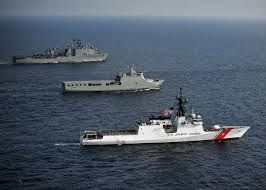
NationalDefenseMagazine.org has a piece that reports the Seventh Fleet advocating for the Coast Guard.
There is an apparent error in that Capt. David Adams is identified as “Commander of the Navy’s 7th Fleet.” I assume they mean he is a spokesman for ComSeventhFleet. Nevertheless, the good news is that someone in 7th Fleet is advocating for the Coast Guard. The bad news is that the Coast Guard may not be, being recognized for what it is already doing.
The implied desire in the article that the Coast Guard send ships to the South China Sea to confront the Chinese Coast Guard,
“We have no white hulls in the Pacific, hardly,” Adams said. “We are going to have to fund the Coast Guard, not to do their conventional missions, but to come and help with the white-hull problem out in the Pacific.”
is probably a non-starter, both because of a shortage of Coast Guard assets and because the Coast Guard has no authority in the waters in question, but that may not have been what the Captain was really saying, although taking Philippine and Vietnamese fisheries enforcement officers aboard a National Security Cutter and using it for fisheries enforcement under their authority in the South China Sea could be interesting.
Dean Cheng, senior research fellow at the Heritage Foundation’s Asian studies center suggested,
“‘The Coast Guard is a civilian entity, and there is little reason to my mind that [it] should not exercise in conjunction with the coast guards and civilian law enforcement entities of American allies’ in the Asia-Pacific region, he said”
Mr. Cheng, must have missed USCGC Waesche’s participation in CARAT 2012, the transfer of two 378s to the Philippines and boats to Vietnam and really for the 1000th time, the Coast Guard is a military service.
(Actually very few of the China Coast Guard ships are repainted navy ships and most of their cutters are not as well armed as their USCG counterparts.)
What more can the Coast Guard do? We could certainly sell (or the State Department could give) cutters, boats, and aircraft to SE Asian countries and help train their coast guards. Foreign Military Sales of Offshore Patrol Cutters, Webber class WPCs, and HC-144s with subsequent training might be an instrument of foreign policy. There used to be a something called “seconding” whereby officers of one country filled billets in the armed services of another, but the USCG is not going to be enforcing their laws.
If the nations of Southeast Asia do as Bob Marley sang and “Stand-up, stand-up for your right,” and the Chinese gray hulls “over the horizon” are indeed tempted to intercede, I hope some haze gray 7th Fleet ships are near by to dissuade them from doing anything foolish. Coast Guard cutters will not.
Note, I changed this post after realizing I had misread parts of the referenced post.
 Chuck Hill's CG Blog