Guided Rounds for the 57mm Mk110, ALaMO and MAD-FIRES, an Update

Comments on the recent post, “Defense Primer: U. S. Precision-Guided Munitions,” had enough new information to justify an update on the two smart rounds being developed for the 57mm Mk110, ALaMO and MAD-FIRES. We last discussed ALaMO on April 2, 2019 and MAD-FIRES, May 28, 2019.

This 24 July, 2019 report on MAD-FIRES confirms that, “If ordered, MAD-FIRES won’t be the first smart, guided ammunition for the LCS and FFG(X). The ALaMO round is preceding it. Designed by L3, ALaMO (Advanced Low-cost Munitions Ordnance) HE-4G is a low-cost 57mm guided smart munition being developed for the U.S. Navy’s Littoral Combat Ship, new Fast Frigate, and the U.S. Coast Guard’s National Security and Offshore Patrol Cutters. (emphasis applied–Chuck)

A 2017 report that suggests MAD-FIRES might be applied to the Mk38 mount and discusses earlier development of guided bullets as small as .50 cal. under the EXACTO program.

This 2018 contract tells us that development of the MAD-FIRES should be completed in May 2020. No indication that the Coast Guard will get MAD-FIRES, but it is probably premature to expect that. 

This 27 Sept. 2019 contract, indicates this is still a DARPA program, meaning it is still in development.

The Raytheon Co., Raytheon Missile Systems, Tucson, Arizona, has been awarded an $11,133,688 cost-plus-fixed-fee contract modification (P00017) for a within-scope change to previously awarded contract (HR0011-15-C-0081) to develop long-lead, high-risk items in preparation for the MAD-FIRES Phase III program. Fiscal 2019 research and development funds in the amount of $11,133,688 are being obligated at the time of award. Work will be performed in Tucson, Arizona (61%); McKinney, Texas (22%); and Karlskoga, Sweden (17%), with an estimated completion date of January 2021. The Defense Advanced Research Projects Agency, Arlington, Virginia, is the contracting activity.

Some speculation: 

MAD-FIRES

The video above seems to show a couple of things about the MAD-FIRES round. First that is expected to “hit to kill” rather than being a proximity fused round. Second that It is a subcaliber round, you can see the discarding sabot parts fall away as the round leaves the muzzle. The discarding sabot suggest it will be a higher velocity round than the current unguided 3P round and that it may have a longer range.

The use of  a different discarding sabot or perhaps none, may mean the same projectile could be fired from either larger or smaller caliber weapons.

The MAD-FIRES program often seems to be linked to an earlier program called EXACTO that created a guided .50 caliber round. That program used a form of laser guidance, which may be the case with MAD-FIRES.

There are reports that the British Type 31e frigate will use the MAD-FIRES round. This is logical in that this will be the first ship in the Royal Navy to use the 57mm gun, but there is also something unusual about this design. In addition to the 57mm, the ship is armed with 40mm guns, one forward and one aft on top of the hangar, in lieu of Phalanx or another CIWS. The 40mm gun, like the 57mm is a Bofors design, marketed by BAE. It may be that the 40mm guns will also be equipped with MAD-FIRES. A 40mm so equipped could start engaging incoming anti-ship cruise missiles at much longer range than Phalanx could. This could be the CIWS of the future.

ALaMO

ALaMO is apparently intended primarily to target smarms of small boats. To at least some extent it can be used against air targets, but the developer has not been making any claims regarding countering anti-ship cruise missiles which may be telling. It may be that ALaMO is not as fast, as maneuverable, or long ranged as MAD-FIRES. It is almost certainly cheaper.

“Coast Guard releases inland buoy tender top-level requirements” –CG-9

The Coast Guard Cutter Bluebell sits moored on the Willamette River waterfront in Portland, Ore., June 4, 2015. (U.S. Coast Guard photo by Chief Petty Officer David Mosley.)

The following is from the Acquisitions Directorate (CG-9). Note this refers only to the river buoy tender (WLR/WLI). Earlier, CG-9 indicated that the Inland Construction Tender (WLIC) is expected to share a common afterbody with the buoy tender, so I presume there will be many similarities.

—-

The Coast Guard released top-level requirements for the inland buoy tender waterways commerce cutter (WCC) variant in a special notice Nov. 6.

The WCC program plans to exhibit and present updates at the International WorkBoat Show in New Orleans Dec. 4-6, 2019. The program will have a booth (No. 347) and provide information about its mission needs, status, and desired fielding schedule during a presentation on Wednesday, Dec. 4 from 11 a.m. to 12 p.m. CST. A team of program members will be available to meet one-on-one on Dec. 4 with any shipbuilder that has built a ship that satisfies the inland buoy tender requirements or that could meet the requirements with minor modifications to the ship. The deadline to request a meeting regarding prospective inland buoy tenders is Nov. 18, 2019.

For more information: Waterways Commerce Cutter program page

“ALCGOFF 156/19 – OFFICER PERSONNEL MANAGEMENT VIRTUAL ROAD SHOWS”

I am posting this because, first I think it is important, and two, it extends over such a long period the information might get lost. So it will be here if you need to reference it.

s
united states coast guard

R 30 OCT 19

ALCGOFF 156/19
SUBJ: OFFICER PERSONNEL MANAGEMENT VIRTUAL ROAD SHOWS
1. The Boards, Promotions, and Separations Branch (OPM-1), Assignments Branch 
(OPM-2), Officer Evaluations Branch (OPM-3), and Career Management Branch 
(OPM-4) have scheduled several virtual road shows beginning 13 November 2019. 
Each virtual road show will be led by the Officer Career Management Branch 
and have a guest presenter to offer tailored advice to a specific audience 
and/or topic.
2. The virtual road show schedule and guest presenter is as follows:
  a. 12 November 2019, 1400ET: OPM-3 OSMS 2.0
  b. 11 December 2019, 1400ET: OPM-4 Career Management/CMD Screening Panels 
  c. 15 January 2020, 1400ET:  OPM-1 Promotion Boards 
  d. 12 February 2020, 1400ET: Post Graduate School Counseling Session 1
  e. 11 March 2020, 1400ET: Post Graduate School Counseling Session 2
  f. 15 April 2020, 1400ET: OPM-2 Afloat Assignment Officer
  g: 13 May 2020, 1400ET: OPM-2 Intel/DCMS Assignment Officer
  h. 27 May 2020, 1400ET: OPM-2 Prevention Assignment Officer
  i: 10 June 2020, 1400ET: OPM-2 Support/Special Assignments Assignment Officer
  j: 24 June 2020, 1400ET: OPM-2 Aviation Assignment Officer
  k: 15 July 2020, 1400ET: OPM-2 Chief Warrant Officer Assignment Officer
  l: 05 August 2020, 1400ET: OPM-2 Response Assignment Officer
3. The information we provide is meant to generate a discussion between OPM and 
the officer corps and assist officers in the field with becoming more aware of 
the most current trends and policies affecting their assignments, promotions, 
and evaluations.
4. In an effort to meet the volume of officers requesting Post Graduate counseling 
(mandatory for Junior Officers within their first two tours), OPM-4 will offer 
two virtual road shows as well as post a podcast recording of the presentation 
on the OPM-4 Portal Page in the spring of 2020. Mandatory counseling can be 
accomplished in one of three ways: attend the virtual roadshow, listen to the 
podcast, or thru completion of individual member counseling requests scheduled 
thru HQS-SMB-CGPSC-OPM-4@uscg.mil. Commanding Officers shall note the method by 
which mandatory counseling was attained in the Command endorsement section of 
the Post Graduate Panel Submission in Direct Access. Aviators within their first 
two tours applying to Aeronautical Engineer Officer Training and/or Flight Safety 
Officer are not required to complete counseling with OPM-4, but are still welcome 
to request counseling if desired.
5. To sign up for a virtual road show please email the OPM-4 inbox at 
HQS-SMB-CGPSC-OPM-4@uscg.mil with the subject “VIRTUAL ROAD SHOW” and the 
requested presentation date. We recommend commands encourage their 
officers attending virtual roadshows to do so from one consolidated location. 
This should generate robust wardroom conversation and maximize call in 
opportunities for others. 
6. Call in instructions and additional information will be posted prior to 
each virtual road show on the Career Management Branch (OPM-4) 
portal page: https://cg.portal.uscg.mil/units/psc/psc-opm/opm-4/SitePages/Home.aspx.
7. CAPT M. T. Brown, Chief, PSC-OPM, sends.
8. Internet release is authorized.

“Reorienting the Coast Guard: A Case for Patrol Forces Indo-Pacific” –War on the Rocks

An Air Station Barbers Point HC-130 Hercules aircrew flies over the Coast Guard Cutters Midgett (WMSL 757) and Kimball (WMSL 756) off Oahu, Hawaii, Aug. 16, 2019. The Midgett joined the Kimball as the second national security cutter homeported in Hawaii. (U.S. Coast Guard photo by Petty Officer 3rd Class Matthew West/Released)

War on the Rocks has a post suggesting that the Coast Guard, with Navy support, should establish a patrol squadron to support United States Indo-Pacific Command (USINDOPACOM), even if it means closing down the existing PATFORSWA.

The Coast Guard’s role as lead agency in multiple Indo-Pacific maritime security institutions, particularly the Southeast Asia Maritime Law Enforcement Initiative, provides opportunities to demonstrate America’s role as a key component of the Indo-Pacific security architecture. A larger, operational Coast Guard role in the region would reinforce this message, and contribute to regional security and sovereignty, in sharp contrast to the Chinese Communist Party’s degradation of both. With appropriate funding and manning, an operational U.S. Coast Guard unit in the Indo-Pacific would add credibility to U.S. institutional commitments at a time when American security guarantees are being challenged across the region.

He suggests that this new command needs to be larger than PATFORSWA.

The Coast Guard recently committed to basing three of these cutters in Guam within two to three years, indicating that U.S. Coast Guard leadership is already looking for ways to maintain forces forward in the near term. However, when considering the size and scope of the Indo-Pacific theater, and the fact that current requirements in the Arabian Gulf call for six boats, three cutters is only a good first step, not a complete solution. A robust force consisting of a mix of six fast response cutters, the Coast Guard’s new Heritage-class offshore patrol cutters, and perhaps a rotationally deployed national security cutter would be appropriately sized and ideally positioned to assume responsibility for security cooperation with Indo-Pacific coast guards and navies seeking increased “white hull” interaction with the United States.

He also sees a role for a Coast Guard Intelligence detachment.

In addition to supporting the proposed Patrol Forces Indo-Pacific, a Coast Guard intelligence unit could fulfill the 2020 National Defense Authorization Act requirement for a U.S. intelligence fusion center in the Indo-Pacific without creating an unnecessary parallel structure alongside those already in existence.

Surface Navy Association Symposium Jan. 14-16, 2020, Hyatt Regency, Crystal City

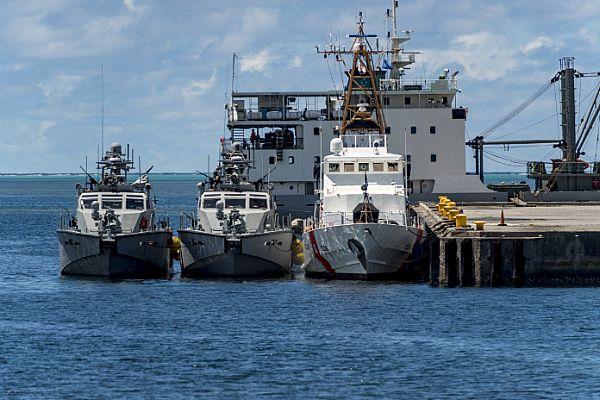
COLONIA, Yap (July 4, 2019) The U.S. Coast Guard Island-class patrol boat USCGC Kiska and Mark VI patrol boats assigned to Coastal Riverine Squadron (CRS) 2, Coastal Riverine Group 1, Detachment Guam, moored in the Micronesia port of Yap. CRG 1, Det. Guam’s visit to Yap, and engagement with the People of Federated States of Micronesia underscores the U.S. Navy’s commitment to partners in the region. The Mark VI patrol boat is an integral part of the expeditionary forces support to 7th Fleet, capability of supporting myriad of missions throughout the Indo-Pacific. (U.S. Navy photo by Mass Communication Specialist 2nd Class Jasen Moreno-Garcia/Released)

The Surface Navy Association (SNA) Symposium is scheduled for January 14-16, 2020 at the Hyatt Regency, Crystal City.

There is, of course, a National Cuttermen Chapter of the SNA so this may be of interest. There will be a Cuttermen’s call. No charge for Active Duty, Reservist in Uniform, and  Gov’t Civilians.

Details here.

“Coast Guard Focused On Being Sea-Based In Arctic As Merits Of Deep-Water Port Debated” –USNI

Normally I would have just added this as a comment to our earlier discussion of an Arctic deep water port, but there was one statement that caught my eye.

For the Coast Guard, a proposed fleet of six heavy icebreakers (emphasis applied–Chuck) will provide the service with the resources needed to fulfill its Arctic missions, Adm. Karl Schultz, the commandant of the Coast Guard, told USNI News after an speaking at an event co-hosted by the Center for Strategic and International Studies and the U.S. Naval Institute.

This might be a misquote or a slip of the tongue, but this would be a departure from the previous plan of three heavy icebreakers and three medium icebreaker.

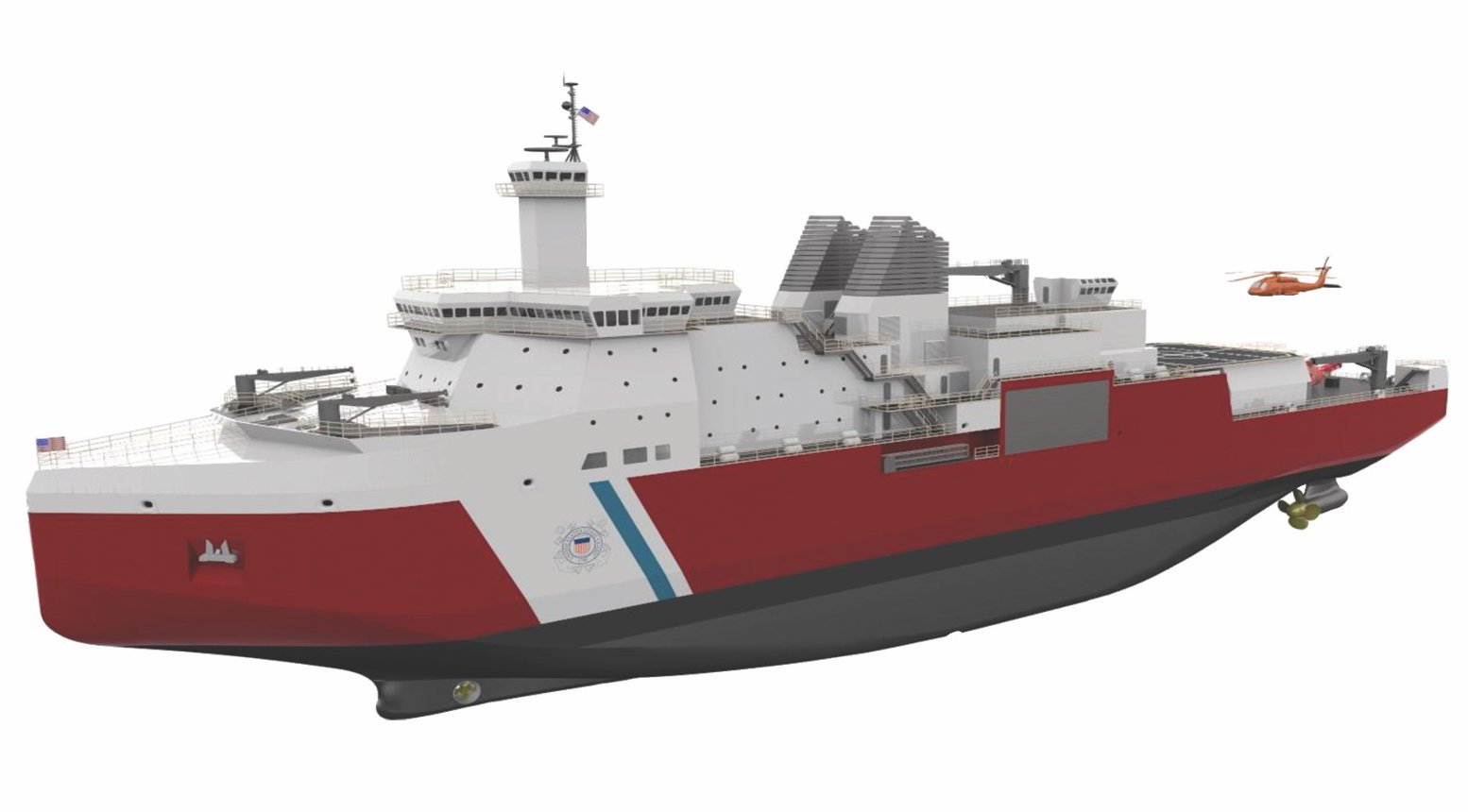
Since the heavy icebreaker cost less than originally expected and price should decrease for subsequent ships a single class might make sense.

The Commandant went on to make it clear that while there may be good reasons to develop a deep water port near the Arctic (neither of the ports being considered is actually above the Arctic circle) the Coast Guard’s primary concern is getting icebreakers built.

So far, while the Navy has started talking about operating surface ships in the Arctic, the Pacific Fleet has not been doing it. Their last “Arctic” exercise was actually in the Gulf of Alaska close to Kodiak. Until they start operating regularly North of the Aleutians, they don’t need a base an “Arctic Base.” The logical first step, if they want to return to the Bering Sea (still not really the Arctic), would be to re-activate NAS Adak.

Will Guest on Midrats Podcast Sunday

Axolotl. A type of Salamander that may retain gills
Photo credit: LoKiLeCh

I am scheduled to be the guest on the “Midrats” podcast this Sunday. This is where you will find the Podcast.

https://www.blogtalkradio.com/midrats/2019/10/06/episode-509-larger-navy-how-about-better-uscg-instead

For those of you unfamiliar with the blog, here is the description:

Navy Milbloggers Sal from “CDR Salamander” and EagleOne from “EagleSpeak” discuss leading issues and developments for the Navy, Marine Corps, Coast Guard and related national security issues.

Sal, also has this tongue in cheek description of his blog, so you have a hint what he is like.

Proactively “From the Sea”; an agent of change leveraging the littoral best practices for a paradigm breaking six-sigma best business case to synergize a consistent design in the global commons, rightsizing the core values supporting our mission statement via the 5-vector model through cultural diversity.

Let’s just say, he finds buzzwords less than useful.

It will be broadcast live from 5 to 6 PM Eastern, 2 to 3 Pacific, Sunday, Oct. 6. If you sign in, you can make comments that the host can choose to respond to. It will also be available in recorded form on iTunes.

This will be a Coast Guard centric episode. “Cdr. Salamander” saw the “Navy, this is Coast Guard, we need to talk” post and mentioned it on his blog.

We will probably start with that, but discussion will not be limited to that.


Navy, this is Coast Guard, we need to talk

Look, I know you are in trouble. As much as we might kid each other, when it is time to fight, I’m your best friend, and I want to help. But you seem in denial, or maybe you are just up to your ass in alligators, and too preoccupied to think about how I might help. 

Numbers of ships is way down. You don’t even have enough escorts to protect the highest priority merchant shipping. You have had trouble bringing new classes on line. You are having trouble keeping the ships you have properly maintained, and you are having trouble manning the ships you have. Our shipbuilding industry has lost the ability to surge production of complex vessels. We don’t have enough trained mariners to man the shipping needed for a prolonged conflict. 

It hasn’t mattered much since there has not been much competition, but that is changing. 

The Chinese Navy is adding ships faster than you are. Their ships are starting to look very impressive. They have a robust ship building industry, and huge merchant marine and fishing fleets to backstop their Navy. They even have more Coast Guard ships than we do. 

It that were not enough, the Russian Navy is rebuilding, although they are a long way from as capable as the old Soviet Navy, but, worst case, we might have to fight them both, along with some minor hangers-on who have their own scores to settle. 

Meanwhile most of our allies, who may or may not help, have been coasting, letting their capabilities decline.

I know you are trying to fix this, but maybe I can help at least a little bit, if you will tell me what we can do.  

——

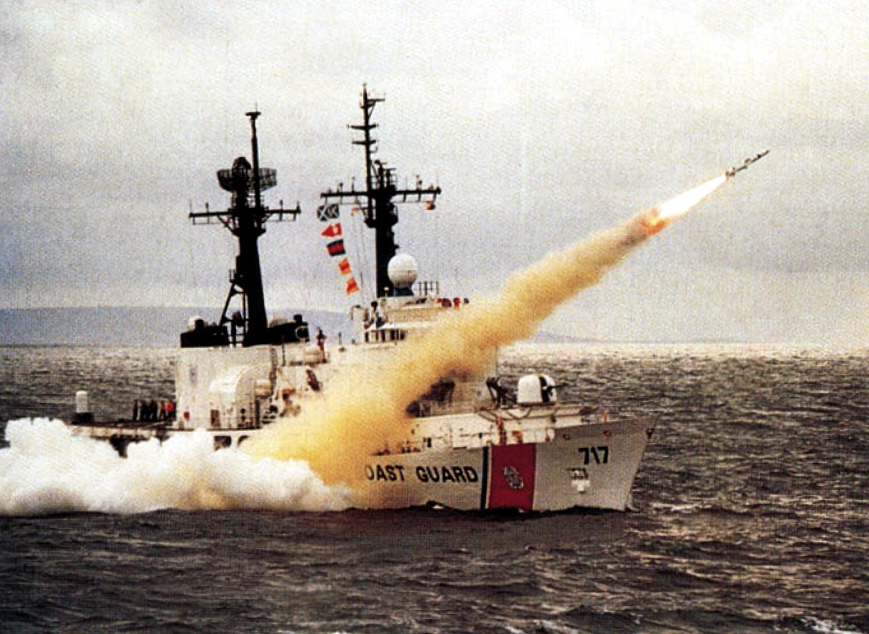
USCGC Mellon seen here launching a Harpoon anti-ship cruise missile in 1990.

The Coast Guard used to be an armed naval force prepared for war. We came out of World War II with an ASW mission, and while our assets got older, the mission continued. In the late 80s we cut the number of ASW assets, but modernized the best of our ships, upgrading their ASW equipment and adding anti-ship cruise missiles.

Then, we all got a break. The Soviet Union collapsed and the need for ASW escorts pretty much disappeared. The Navy downsized and the Coast Guard removed all ASW equipment and the anti-ship missile.

We had almost 30 years without a major naval threat, but it looks like that is changing.

The US Coast Guard is the US Navy’s closest ally, but it seems there is little coordination between the two in defining Coast Guard roles in a major conflict. We certainly don’t see any evidence in the way the cutters are currently being equipped.

In terms of personnel, the Coast Guard is larger than the UK’s Royal Navy or the French Navy. The new cutters are comparable in many respects to frigates or corvettes. Looks like we are going to have 64 Webber class patrol craft similar in capabilities to the Navy’s Cyclone class. Plus we have over 200 aircraft.

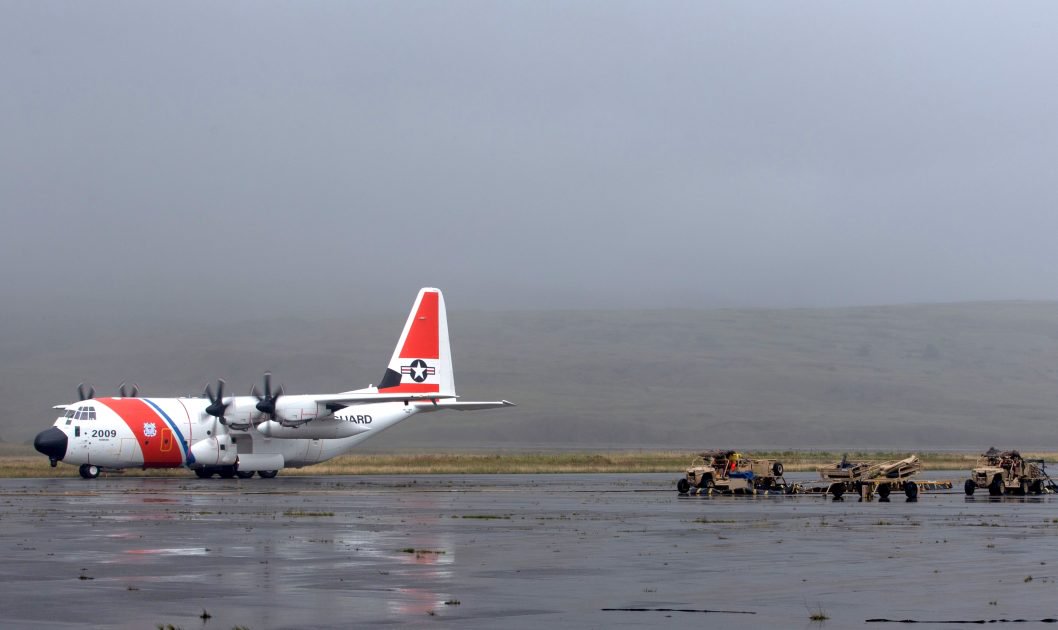
A U.S. Coast Guard C-130 participates in forward arming and refueling point (FARP) operations during Arctic Expeditionary Capabilities Exercise (AECE) in Adak, Alaska on Sept. 18, 2019. US Marine Corps Photo

Being combat ready is one of the Coast Guard’s eleven missions, but obviously we are not.

Though there has been some thought regarding the use of Coast Guard assets for limited wars in the tradition of their use in Vietnam and the Gulf Wars, consideration of the possibility of a larger conflict is nowhere evident in the way these assets are currently equipped. They may not even be adequately armed to deal with the full range of terrorist threats.

Upgrading the Bertholf class NSCs and the Offshore Patrol Cutters could add up to 36 light frigates to the national fleet. The Navy would need to provide some additional equipment, but that cost would be far less than the cost of adding similar ships to the Navy, and the difference in operating costs between ships with or without the upgrades is very small.

The Bertholf class National Security Cutters and the Offshore Patrol Cutters share systems with the Littoral Combat ships and the planned FFG(X). Exploitation of some of the additional systems developed for the LCS should be possible. Huntington Ingalls has already done basic design work on upgrades to the National Security Cutter class as part of a marketing effort.

There are opportunities for synergy between the Coast Guard and the Navy reserve such as flying Navy ASW helicopters from Coast Guard ships.

The first of the Offshore Patrol Cutters has yet to be completed. Significant upgrades should be possible. The program is just getting started with the first of a projected 25 expected to be delivered in 2021. It may be possible to develop a more capable, better armed “B”class.

OPC “Placemat”

Potential Missions: 

  • Upgraded NSCs and OPCs could escort priority shipping from the US coasts to the theater of operations. They may not be ideal, but they are ships we will have.
  • They and the Webber class supported by Coast Guard aviation assets could sweep the seas of hostile merchant shipping and fishing vessels that might be used to provide intelligence, land agents, or lay mines.
  • Those same assets could help enforce a blockade.
  • We can do Combat SAR and provide rescue services for when vital supply ships are inevitably lost. We can’t afford to loose trained mariners.
  • We can protect bases from unconventional attacks.
  • Buoy tenders can place sensors on the sea floor to detect enemy activity or lay something like captor mines.
  • Some of our ships can support unmanned systems for mine countermeasures.

If we go to war, “If it floats, it fights” will apply to Coast Guard vessels as well as Navy. They need to be ready. We need to be equipped and trained for whatever the Navy wants us to do.