“Lighthouse Act – 7 August 1789” –BRYMAR

A little late, but I am passing this little tidbit of Coast Guard history along from BRYMAR consulting.

Lighthouse Act – 7 August 1789

C:\Users\User\Pictures\01Blog pix\USLHS-a.jpg
The Lighthouse Act was the ninth statute adopted by the First Congress of the United States. It provided for the voluntary cession by the various states of all lighthouses, beacons, buoys, and public piers to the federal government and tasked the Secretary of the Treasury with building and maintaining the aids to maritime navigation. The Lighthouse Establishment (later named the United States Light House Service) is the oldest of the various components of the present-day United States Coast Guard, joining in 1939.

“sUAS Extend Coast Guard Capabilities in the Inland Rivers” –USNI

160919-N-AT101-177 GULF OF MEXICO (Sept. 19, 2016) Cadet 1st Class Hanson Oxford, a student at the U.S. Air Force Academy, operates an unmanned aerial system aboard a rigid hull inflatable boat during exercise Black Dart, Sept. 19. Black Dart is the largest Department of Defense (DoD) live-fly, live-fire, counter Unmanned Aerial Systems (UAS) technology demonstration. (U.S. Navy photo by Mass Communication Specialist 1st Class Maddelin Angebrand/Released)

A thought provoking article from the US Naval Institute looking at ways small unmanned air systems (sUAS) have been used, or might be used, in support of Coast Guard missions in inland areas.

The Coast Guard apparently includes systems as large as ScanEagle in the sUAS category. The USNI post notes,

“Individual Coast Guard units are currently prohibited from procuring and operating their own sUAS until the Coast Guard can establish a program to provide the appropriate systems and training to operators.”

The discussion here is not about systems as large as ScanEagle, but rather small, off the shelf systems, costing less than $5,000. The costs of these systems is so low, and the potential impact so great, perhaps the Coast Guard should have a program to procure a small number of these systems for units that can make a case for them, as prototypes for future deployment. Ground rules might specify a one year trial period and periodic feedback.

Marines are already starting to deploy these at the squad level. Presumably there must be a contract for them. Maybe they are already on GSA schedule.

Drugs Smuggling By Container

File photo shows the MSC Gayane. Photo: MarineTraffic.com

Three recent incidents of drugs being smuggled by containers aboard ship.

In the US:

June 18 (Reuters) – Federal authorities seized 16.5 tons of cocaine worth more than $1 billion from a ship in Philadelphia in one of the largest drug seizures in U.S. history, the U.S. Justice Department said on Tuesday.

Federal, state and local law enforcement agents on Monday boarded the MSC Gayane, a cargo ship docked in Philadelphia’s Packer Marine Terminal, and found cocaine in seven shipping containers, according to a criminal complaint filed in Philadelphia federal court.

Since then, four additional arrests have been made. The Customs and Border Protection news release is here. Crew members facilitated the loading of the drugs.

August 1, a vessel docked in Felixstowe, UK where the vessel was boarded and authorities found approximately 398 kilograms of heroin hidden among towels and bathrobes.

Germany seized 4.5 tonnes of cocaine from a container at the port of Hamburg, marking that nation’s biggest drugs haul to date. The shipping container in that case was loaded in Montevideo, Uruguay and bound for Antwerp.

“Coast Guard Awards Contract for 47-Foot Motor Lifeboat Service Life Extension Program” –CG-9

47-Foot Motor Life Boat (MLB) 47231 from Station Morrow Bay, 4 Dec 2007. Photo by Mike Baird

The Acquisitions Directorate (CG-9) reports award of a contract for service life extension work on its 47 foot motor lifeboats. 

—–

The Coast Guard on Aug. 5 awarded a firm fixed price indefinite delivery, indefinite quantity contract to Birdon America Inc. of Denver, Colorado, to perform work supporting the service’s 47-foot Motor Lifeboat (MLB) service life extension program (SLEP). The initial award to complete the detail design and service life extension work on the first vessel is valued near $6.5 million, with a total projected contract value of close to $190 million to complete the MLB SLEP over the 10-year contract period. The initial work for detail design and the first vessel will be performed at a subcontractor facility on the West Coast, Fred Wahl Marine Construction along the Umpqua River in Reedsport, Oregon. Once in full production, a second subcontracted work facility is planned to be opened on the East Coast.

The 47-foot MLB is the Coast Guard’s primary search-and-rescue platform operating in surf and heavy weather conditions. It has self-righting capability and the ability to operate in winds up to 50 knots, seas up to 30 feet, and surf up to 20 feet. The service’s fleet of more than 100 MLBs has been in service for 15 to 21 years and is approaching the end of its planned 25-year service life. The operational need for these unique capabilities in search-and-rescue, maritime law enforcement, and contingency response remains high.

The SLEP will extend the useful life of the MLB by 20 years; SLEP work will be performed on a minimum of 107 MLBs and a maximum of 117 MLBs. The main work will be on systems experiencing technical obsolescence: the main propulsion, electrical, steering, towing and navigation systems, as well as replacement of areas of the hull and structure that have demonstrated high failure rates. Additionally, efforts to enhance human system integration will be made where practical to do so. The original operational capabilities and characteristics of the 47-foot MLB will not change.

CG Exercises Option for Webber Class WPCs #51-56

The Coast Guard Cutter Lawrence Lawson crew mans the rail during sea trials off the coast of Miami, Florida, on Dec. 12, 2016. The ship will be the second fast response cutter stationed in Cape May, New Jersey, and is scheduled for commissioning in early 2017. (U.S. Coast Guard photo by Eric D. Woodall)

The Acquisitions Directorate (CG-9) reports the exercise of a contract with Bollinger for construction of six more Webber class WPCs (Fast Response Cutters or FRCs).

The Coast Guard exercised a contract option for production of six more Sentinel-class FRCs and associated deliverables worth just over $297.4 million with Bollinger Shipyards of Lockport, Louisiana, July 31.

This option brings the total number of FRCs under contract with Bollinger to 56 and the total value of the contract to approximately $1.23 billion. The contract has a potential value of $1.42 billion if options to procure all 58 cutters are exercised. The FRCs built under this option will be delivered beginning late 2022 into late 2023. To date, there are 33 FRCs in operational service.

Things to note.

  • The $1.23B referred to did not pay for all 56 vessels, only those purchased under the most recent contract.
  • Buying in quantity lowers the price. Since this is a long running contract and we have ordered the maximum number Bollinger can build in a year, increasing efficiencies have lowered the per ship price from over $60M to less than $50M.
  • While this program will likely continue to deliver vessels through at least 2024, we are nearing the end of this program, at least in terms of contracting. FY2020 may be the last year that will include money for WPC new construction, if it includes funding for six more vessels and 64 is final number constructed. This would include 58 in the program of record and six to replace the six WPBs in PATFORSWA (four of which have already been funded).

Happy Coast Guard Day

It is Coast Guard Day. It is time for picnics and telling your shipmates how you appreciate them. Of course many are still on the job.

For 22 years I had the privilege of being part of the organization. Most of the time it was fun, although there were times when it definitely was not. Don’t expect perfection. Like the nation itself, the Coast Guard is a work in progress. It can be better. Your efforts may not always be appreciated. Be true to the ideals that motivate you, and you and the organization will be better in the end.

An Offshore Patrol Vessel With Teeth

Royal Thai Navy’s second offshore patrol vessel based on the River class, HTMS Prachuap Khiri Khan (OPV 552) constructed by Bangkok Dock Ltd and poised for induction into service. Note RGM-84 Harpoon anti-ship cruise missiles fitted. Photo: http://thaidefense-news.blogspot.com/2019/07/blog-post_31.html

Naval News reports that the Thailand has recently launched a second Krabi class Offshore Patrol Vessel (OPV). (It appears the ship has completed fitting out.) These are a version of the Royal Navy’s BAE designed River class OPVs. The Royal Navy is still building “Batch II” of this class. Three of the class are also in service with the Brazilian Navy and they may build more.

The Thai vessels are clearly the most heavily armed. While the British Royal Navy ships have at most one 30mm gun and the Brazilian ships have one 30mm and two 25mm guns, the first Thai ship emerged with an Oto Melara 76mm and two 30mm. This second OPV has added Harpoon anti-ship missiles. Four missile cannisters are visible in the photo above and they could probably carry as many as eight missiles.

At 90.5 meters (297′) in length and about 2,000 tons full load, they are a little larger than a WMEC 270, and about half the size of an Offshore Patrol Cutter.

Note: Thailand does have a small coast guard squadron, but these ships are not part of it. Naval history buffs might find this naval battle between Thailand and France in 1941 interesting. 

Coast Guard Day ALCOAST, “COAST GUARD’s 229TH BIRTHDAY”

Revenue Cutter Thomas Jefferson captures three Royal Navy barges and personnel in Hampton Roads. US Coast Guard Collection.

Below you will find the text of the Commandant’s ALCOAST regarding the upcoming Aug. 4, “Coast Guard Day.”

I find it curious that it only talks about the Law Enforcement Mission, and almost exclusively drug enforcement, with only a mention of fisheries and no mention of alien migrant interdiction, environmental protection, or marine safety regulation. No mention of SAR, AtoN, Military Readiness (other than “maintaining our national security”), or recreational boating safety. Notably no mention of icebreaking either domestic or polar when we are seeking funding for icebreakers. No mention at all of the other organizations that were folded in to make the modern Coast Guard.

It is almost as if this is written for a specific audience. Makes me curious as to why it was written the way it was. 

(Incidentally Bill Wells is sure to point out that Alexander Hamilton did not create the Revenue Marine as a Service, and certainly not as a “military service.”)

ALCOAST 253/19
COMDTNOTE 5700
SUBJ:  COAST GUARD’s 229TH BIRTHDAY
1. Sunday, 4 August 2019, marks the Coast Guard’s 229th birthday.
2. The U.S. Coast Guard’s law enforcement mission is its oldest, and sets us
apart from other military services. After the American Revolution, Secretary
of the Treasury Alexander Hamilton was keenly aware of the need to protect
the Nation’s customs revenue, maintain coastal waters, and combat illegal
trade and piracy. On 4 August 1790, Congress, at the urging of Hamilton,
created the Revenue Marine, a military service designed to patrol coastal
waters and regulate the collection of tariffs. The Coast Guard proudly traces
its roots to that date, and for the past 229 years, the Coast Guard has served
the Nation with excellence.
3. The first recorded narcotics seizure by a cutter occurred on 31 August 1890.
A detail of four officers and eighteen men of the Revenue Cutter WOLCOTT boarded
and discovered a quantity of opium on the steamer GEORGE E. STARR. The vessel
and its illegal cargo were seized for violations of U.S. customs law.
4. On 16 January 1920, Prohibition became the law of the land. Given the mission
of preventing liquor smuggling into the United States, the Coast Guard saw a
rapid expansion of both facilities and personnel. By 1924, the “Rum War”
escalated. Smuggling from the sea, particularly along the East Coast, grew into
an immense, highly-coordinated criminal activity. That criminal behavior was met
with intensive and aggressive action by the Coast Guard. When Prohibition ended
on 5 December 1933, Coast Guard Headquarters reported: “The continued pressure
of Coast Guard preventative measures was a potent factor in reducing the volume
of the smugglers’ business and in bringing about a change of smuggling technique.”
5. By the 1970s, the Coast Guard faced an escalation of drug smuggling on the high
seas. This rapid growth of the maritime illegal narcotics trade drove the need for
highly-trained boarding teams and Law Enforcement Detachments (LEDETs), to specialize
in drug interdiction. On 1 November 1984, CGC CLOVER seized 13 tons of marijuana.
Three days later, CGC NORTHWIND became the first icebreaker to make a narcotics
seizure, capturing 20 tons of marijuana. On 8 May 1987, Coast Guard units seized 1.9
tons of cocaine. In 1989, the National Defense Act named the Coast Guard as the lead
agency for maritime drug interdiction.
6. Over the next several years, Coast Guard units continued to interdict drug
traffickers, seizing tons of marijuana and cocaine. CGC DAUNTLESS became the first
cutter in history to seize one million pounds of marijuana. In 2004, Coast Guard teams
intercepted and seized two ships near the Galapagos Islands, resulting in the capture
of more than 56,000 pounds of cocaine. In March 2007, CGCs HAMILTON and SHERMAN seized
42,845 pounds of cocaine aboard a Panamanian-flagged vessel.
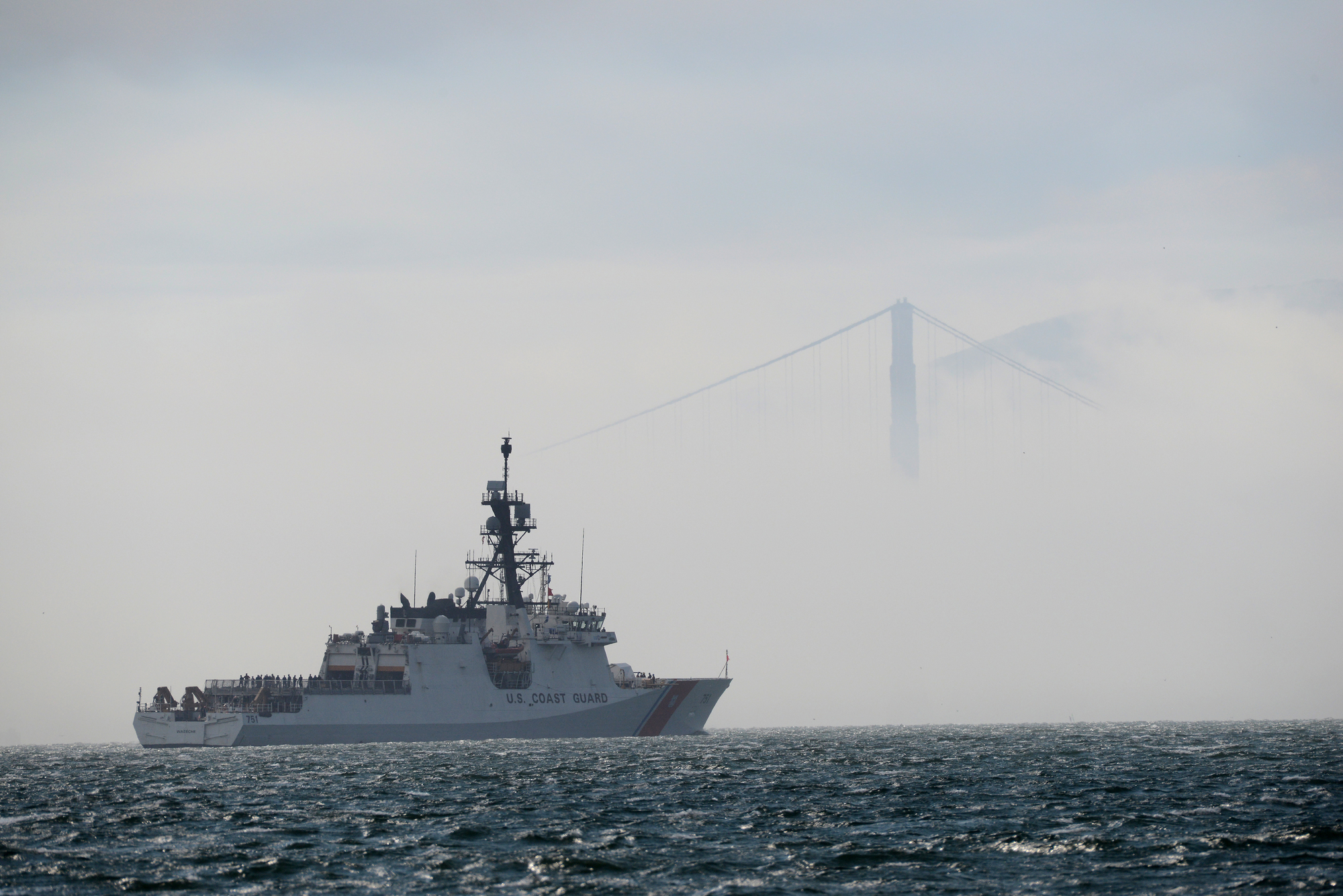
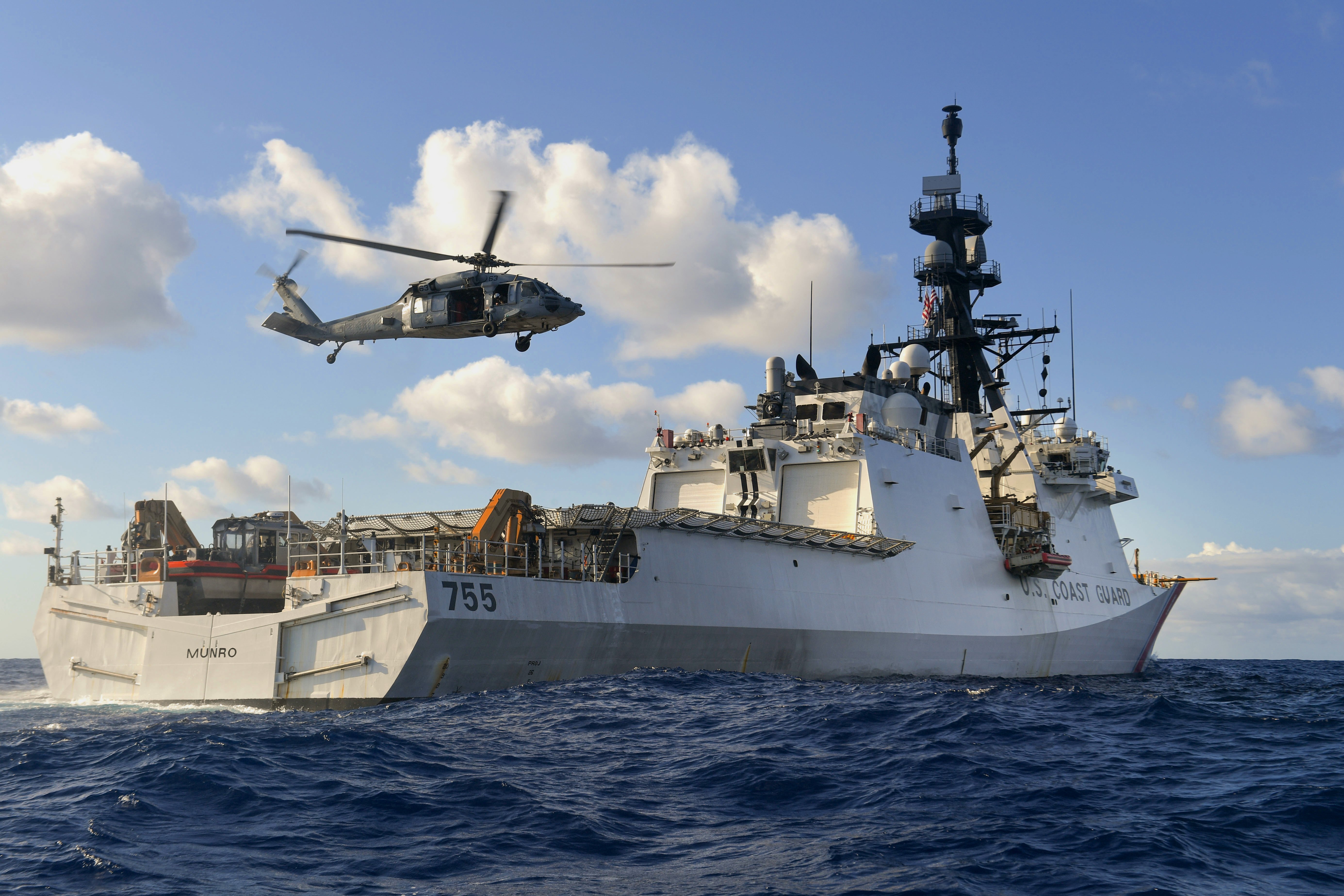
7. Today, the mission continues. In July, CGC MUNRO, our newest operational National
Security Cutter, completed its first-ever counter-drug patrol in the Eastern Pacific.
The interdiction of a self-propelled semi-submersible (SPSS) on 18 June resulted in
17,000 pounds of cocaine, the largest single seizure since 2015. Nine total interdictions
resulted in nearly 40,000 pounds of illicit narcotics with a wholesale value of $569
million dollars. During the patrol, MUNRO’s crew worked closely with the Coast Guard’s
Helicopter Interdiction Tactical Squadron (HITRON), which celebrates its 20th anniversary
this year with over $21 billion in seized narcotics from airborne use-of-force interdictions.
8. As we celebrate the 229th birthday of the Coast Guard, it is evident that our first
mission remains one of our most important today. Coast Guard air and surface assets, as
well as our brave men and women, are tasked with enforcing fisheries laws, ensuring secure
ports and waterways, keeping illegal narcotics off our streets, and maintaining our national
security. We remain “Semper Paratus – Always Ready.”
9. ADM Karl Schultz, Commandant, sends.
10. Internet release authorized.

“Joint Bomber Patrol Over the Pacific: The Russo-Chinese Military Alliance in Action” –Eurasian Daily Monitor

CSR Report RL33153 China Naval Modernization: Implications for U.S. Navy Capabilities—Background and Issues for Congress by Ronald O’Rourke dated February 28, 2014. Page 8 – Figure 1. Jin (Type 094) Class Ballistic Missile Submarine Source: Photograph provided to CRS by Navy Office of Legislative Affairs, December 2010.

The Jamestown Foundation’s Eurasian Daily Monitor reports on the implications of growing alliance between Russia and China reflected in their recent joint bomber patrols intercepted off S. Korea and Japan.

There is an interesting aspect to this growing alliance that might suggest more reason for US military construction and activity in the Arctic, which, in turn, may require more icebreaker support.

“Russian military expert Alexander Shirokorad…Building on earlier Russo-Chinese missile- and air-defense cooperation that necessarily involved the transmission of highly classified information between them…openly advocates for joint Russo-Chinese air- and missile-defense infrastructure in the Arctic. Unexpectedly, however, he also advances an entirely new concept of allowing Chinese nuclear-armed submarines to gain critical support from Russian Arctic ports. It is difficult to gauge to what degree Shirokorad’s article was meant to have been a justificatory trial balloon. But the piece clearly takes on additional significance when looked at in the context of the Pentagon’s annual report on China, which explicitly warns that Beijing may eventually start deploying nuclear submarines in the Arctic.”


“Cutter Bertholf’s Indo-Pac Deployment Highlighted Coast Guard’s National Security Role” –USNI

The U.S. Coast Guard Cutter Bertholf (left) moves in formation with Philippine coast guard vessels Batangas (center) and Kalanggaman during an exercise on May 14. U.S. Coast Guard/Chief Petty Officer John Masson

This piece from Naval Institute News Service is worth a read. It is an illustration of what the Commandant was talking about here.