ALCOAST 110/18 – MAR 2018 CAMPAIGN TO HONOR VIETNAM VETERANS IN 2018-2019

Just passing this along for the benefit of those who would not have had an opportunity to see the ALCOAST. Thanks to Vince Patton for posting on his Facebook page.

R 280741 MAR 18
FM COMDT COGARD WASHINGTON DC//CG-092//
TO ALCOAST
UNCLAS//N05700//
ALCOAST 110/18
COMDTNOTE 5700
SUBJ:  CAMPAIGN TO HONOR VIETNAM VETERANS IN 2018-2019
1. Thursday, March 29th, is the second annual National Vietnam War Veterans Day.
This day marks the commencement of the U.S. Coast Guard’s campaign to honor
Vietnam Veterans over the next year. All Coast Guard active, reserve, and
auxiliary members are encouraged to participate in the U.S. Coast Guard’s
12 x 12 Campaign: 12 units, 12 months, honoring at least 1,200 Veterans this year.
2. The President signed the National Vietnam War Veterans Day Act on March 29, 2017,
calling on the nation to observe every March 29th as National Vietnam War Veterans
Day, in honor of those who served and sacrificed during the longest conflict in
United States history. According to the Department of Veterans Affairs the United
States loses an estimated 500 Vietnam veterans every day, many passing away before
they receive the thank you and homecoming they so rightly deserve. Coast Guard
units can collaborate with their communities, colleagues, families and veterans
groups to plan and host dignified events to present the lapel pins to as many
Vietnam veterans as possible, and recognize the selfless service of this
remarkable generation of patriots.
3. The Coast Guard has partnered with the Vietnam War Commemoration Program
to observe the 50th anniversary of the Vietnam War, and to thank and honor
veterans of the conflict for their service and sacrifice. The Vietnam War
Commemoration Program was established to recognize all veterans who served
November 1955 to May 1975, regardless of location. All veterans from that
twenty year era are eligible and should be recognized; service in the country
of Vietnam is not a requirement.
4. To host an event contact LT Emily Brockway at: Emily.H.Brockway@uscg.mil
or (202) 372-4641. View the Coast Guard Vietnam Commemoration web page at: 
http://www.history.uscg.mil/Commemorations/Vietnam/.
5. The 12 x 12 Campaign poster is available at https://go.usa.gov/xQc3d.
6. RADM Peter Gautier, Director of Governmental and Public Affairs, sends.
7. Internet release authorized. 

New Side Arm

Compact XM18, above left, and the full-size XM17, lower right. (Army Photo)

We now have an indication that the Coast Guard may be following the Army and Marine Corps in replacing the M9, 9mm, made by Beretta USA. with the Sig Sauer Modular Handgun System.

“The U.S. Marine Corps, U.S. Air Force, U.S. Navy, and U.S. Coast Guard all have orders that will be fielded starting later this year and early next year.”

Unit cost is $180. We do not yet really know if this is a move to replace all the Coast Guard’s hand guns or only those for select units, but there may be reason to believe it will be a wholesale replacement. .

The Army’s 10-year MHS agreement calls for Sig Sauer to supply the service with full-size XM17 and compact XM18 versions of its 9mm pistol. The striker-fired pistols can be outfitted with suppressors and accommodate standard and extended-capacity magazines. There is also an accessory rail for mounting accessories such as weapon lights.


Alert Returns Home After a Disappointing Series of Casualties

USCGC Alert (WMEC-630), newest of the remaining 14 ships of its class.

The USCGC ALERT (WMEC-630), one of 14 remaining 210 foot cutters had what must have been a very frustrating cruise. The Navy League’s on-line magazine reports,

“The crew departed Astoria Feb. 5 to conduct a counter-narcotics patrol in the Eastern Pacific when the ship suffered more than 35 equipment casualties within the first 19 days of their patrol, including malfunctions in the ship’s radar, propulsion and fuel systems.

“The ship’s main diesel engine also suffered a crankcase explosion, resulting from a seized bearing on an oil pump, which caused a week-long delay in Panama while the crew inspected the engine. Following the inspection, a decision was made to end the patrol.”

The ship has returned to its homeport, March 16. 39 days away from homeport and nothing to show for it.

As disappointing as this may have been, I applaud the fact that the Coast Guard is making public the difficulties of operating units well past their “best if used by” date. Otherwise everyone just assumes everything is alright. Everything is not alright.


Chinese Crack Down on IUU

HMNZS Wellington intercepts suspected toothfish poachers

An interesting report that seems to indicate the Chinese are doing something to curb Illegal, Unreported, Unregulated (IUU) Fishing.

I would note that cutting subsidies does not seem to be a severe penalty, while subsidized fisheries in any form appear to be an unfair trade practice.

We also have this report on the effect of IUU fishing in the Caribbean.

Coast Guard, Navy collaborate on preparing for mines, security threats in Southeast Alaska–JuneauEmpire.com

Coast Guard Cutter John F. McCormick (WPC 1121)

JuneauEmpire.com has news of something a bit unusual happening in Juneau, a Navy/Coast Guard mine countermeasures exercise.

Doing mine countermeasures in Alaska is not easy for the US Navy because basically, the only navy in Alaska is the US Coast Guard.

There are basically three kinds of mine countermeasures done by USN,

  • airborne with a helicopter pulling a sled,
  • ship based, increasingly done by surface and subsurface unmanned systems as a way to keep sailors out the minefields,
  • and by divers.

Formerly the mine countermeasures ships were highly specialized, but they are now moving to using LCSs which are based in either Mayport, FL or San Diego, CA. In either case it would take a long time for them to get to Alaska.

The Helicopters, divers, and unmanned systems can be flown there, but they will need support including work space, communications, and ground and water transportation. The divers and unmanned systems will require supporting craft unless the mining is done very close to shore. The less they have to bring the better. That is apparently where the Coast Guard comes in.

It sounds like this is all preliminary to a more complex exercise in 2020.

“…Juneau could be a location of drills in 2020. Along with Anchorage, Kodiak and Seward, Juneau is an option for having an exercise in the water where Coast Guard and Navy personnel have to go in and figure out how to remove mines…”

One of the activities was touring the Webber class John F. McCormick (WPC-1121). Presumably the WPC was brought up from its homeport, Ketchikan, specifically for this purpose. Perhaps they are already familiar with Coast Guard’s buoy tenders, but they could also be very useful in supporting diver and unmanned systems operations.

As for where the 2020 exercise should be done–Cook Inlet–since Anchorage is the only strategic port in Alaska. Exercise results would also probably be more universally applicable if it is done away from the facilities of the District headquarters in Juneau, which are not available elsewhere in Alaska..


“Arctic nations develop coast guard co-operation”–the Independent Barents Observer

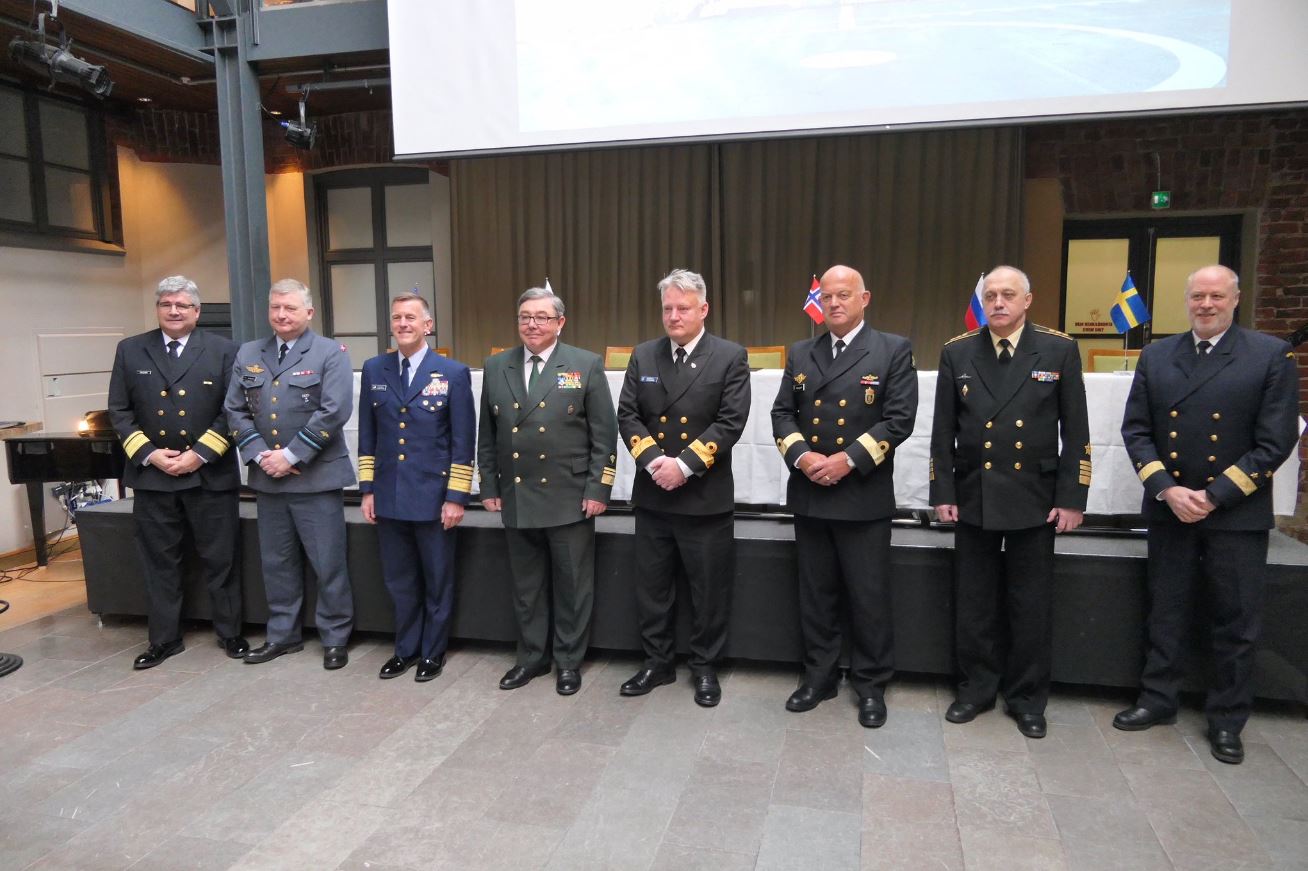
Representatives of the coast guards of Canada, Denmark, Finland, Iceland, Norway, Sweden, the Russian Federation and the United States, gathered in Oulu, Finland last week for a series of meetings of the Arctic Coast Guard Forum (ACGF) Experts and Principals. Photo: Finnish Border Guards/Twitter

A short story about the Arctic Council and Arctic Coast Guard Forum.

“It’s grown up, it’s no longer a new forum, it’s now entering fourth year and it’s got a live exercise under its belt, it’s got a couple of tabletop exercises, the delegations are now familiar with each other, there are strong relationships being built and I think that’s a sign of the forum maturing.”

Information for Coast Guard Veterans and Retirees Filing for Veterans Affairs Disability Compensation Due to Asbestos- and Lead-Related Health Effects—Office of Health Services

An instruction aimed primarily at active duty personnel who might have been exposed to asbestos and/or lead on cutters built prior to 1991 was discussed in an earlier post. Now we get some guidance for those who have left the service. Thanks to Vince Patton who posted this on his Facebook page. Retirees might want to follow him if you have Facebook.

If you were assigned to Coast Guard cutters that were constructed prior to 1991, you may have been exposed to very low levels of asbestos and lead. Recorded levels of exposure were well below the Occupational Safety and Health Administration (OSHA) levels that require medical surveillance examinations.

Routine exposure for asbestos and lead would include working on and berthing in a Coast Guard cutter where there may be small exposed areas of asbestos-containing thermal insulation, a number of torn asbestos-containing floor tiles, and lead dust from lead ballast ingots and lead-containing paint.

Exceptional exposures may have occurred during certain maintenance procedures (e.g. tearing up entire floor surfaces of asbestos-containing floor tiles and torching or sanding surfaces painted with lead-containing paint) without the use of personal protective equipment.

Asbestos- and Lead Related Health Effects
It is very difficult to link lead-related health effects to low level exposures on Coast Guard cutters. Routine exposures to asbestos on Coast Guard cutters could possibly be linked to the following medical conditions:

  • Mesothelioma
  • Asbestos-related cancers (lung, larynx, and ovary). (Note – the linkage for very low levels of exposure for these cancers is not clear.)

VA Disability Compensation Process
The VA has a mechanism for veterans to apply for compensation due to a disability that is the result of an injury, disease or an event in military service. If you experience a health effect believed to be due to exposure to asbestos or lead during military service and you desire to apply for VA disability compensation, you will need to provide evidence that supports the following:

  • There was an event in service that caused the injury or disease;
  • You have a current physical or mental disability; and
  • There is a relationship between your current disability and an event in service.

Additional assistance may be obtained through a VA employee at a VA National Facility or a Veteran Service Organization (VSO).

You should also look at https://www.benefits.va.gov/compensation/apply.asp.

Documentation of Exposure
Veterans and Retirees may document their exposure due to a permanent duty assignment on a Coast Guard cutter constructed prior to 1991 by providing the VA with the following information:

  • Orders for a permanent duty assignment on a Coast Guard cutter.

OR

A Career Summary list of all of permanent duty assignments (if you printed this out from Direct Access prior to separation).

OR

Documentation in your Coast Guard Service Treatment Records (medical records) which states that you had a permanent duty assignment on a specific Coast Guard cutter (if this was recorded).

OR

Military Service Records from the National Archives in St. Louis, Missouri (if you have separated from the Coast Guard prior to 10/1/2006). See https://www.archives.gov/veterans/military-service-records for additional information. Under Information and/or Documents Requested, you should request your entire Official Military Personnel File. The DD-214 will not include information on your permanent duty assignments.

OR

Military Service Records from the Coast Guard Military Records Section/ Personnel Service Center (if you have separated from the Coast Guard on or after 10/1/2006). See http://www.dcms.uscg.mil/PSC/BOPS/PSC-BOPS-C/PSC-BOPS-C-MR/PSC-BOPS-C-MR_PDR/ for additional information. In Section II “Information and/or Documents Requested” of the SF-180 you should request your entire Official Military Personnel File. The DD-214 will not include information on your permanent duty assignments.

Japan Coast Guard expands Liquid-Robotics’ Wave Glider Fleet–NavyRecognition

We have discussed the Liquid Robotics Wave Glider before, as a way to improve Maritime Domain Awareness, noting it is being used by the Brits for fisheries monitoring and by Boeing in support of the US Navy.

Now NavyRecognition brings us a report that the Japanese are using it to monitor the environment providing real time information

Certainly better information about surface currents could help us in search planning.