gCaptain has an editorial that is worth the read. While I still see the possibility of a physical attack, the cyber threat is very real.

gCaptain has an editorial that is worth the read. While I still see the possibility of a physical attack, the cyber threat is very real.

US Capital West Side, by Martin Falbisoner
The Congressional Research Service updated its “Coast Guard Cutter Procurement: Background and Issues for Congress” on 24 April, 2019.
You can read it here. I have quoted the summary below.
The Coast Guard’s program of record (POR) calls for procuring 8 National Security Cutters (NSCs), 25 Offshore Patrol Cutters (OPCs), and 58 Fast Response Cutters (FRCs) as replacements for 90 aging Coast Guard high-endurance cutters, medium-endurance cutters, and patrol craft. The Coast Guard’s proposed FY2020 budget requests a total of $657 million in procurement funding for the NSC, OPC, and FRC programs.
NSCs are the Coast Guard’s largest and most capable general-purpose cutters; they are intended to replace the Coast Guard’s 12 aged Hamilton-class high-endurance cutters. NSCs have an estimated average procurement cost of about $670 million per ship. Although the Coast Guard’s POR calls for procuring a total of 8 NSCs to replace the 12 Hamilton-class cutters, Congress through FY2019 has funded 11 NSCs, including the 10th and 11th in FY2018. Six NSCs are now in service. The seventh was delivered to the Coast Guard in September 2018. The eighth through 11th are under construction. The Coast Guard’s proposed FY2020 budget requests $60 million in procurement funding for the NSC program; this request does not include funding for a 12th NSC.
OPCs are to be smaller, less expensive, and in some respects less capable than NSCs; they are intended to replace the Coast Guard’s 29 aged medium-endurance cutters. Coast Guard officials describe the OPC program as the service’s top acquisition priority. OPCs have an estimated average procurement cost of about $421 million per ship. On September 15, 2016, the Coast Guard awarded a contract with options for building up to nine OPCs to Eastern Shipbuilding Group of Panama City, FL. The first OPC was funded in FY2018 and is to be delivered in 2021. The second OPC and long leadtime materials (LLTM) for the third were funded in FY2019. The Coast Guard’s proposed FY2020 budget requests $457 million in procurement funding for the third OPC, LLTM for the fourth and fifth, and other program costs.
FRCs are considerably smaller and less expensive than OPCs; they are intended to replace the Coast Guard’s 49 aging Island-class patrol boats. FRCs have an estimated average procurement cost of about $58 million per boat. A total of 56 have been funded through FY2019, including six in FY2019. Four of the 56 are to be used by the Coast Guard in the Persian Gulf and are not counted against the Coast Guard’s 58-ship POR for the program, which relates to domestic operations. Excluding these four OPCs, a total of 52 FRCs for domestic operations have been funded through FY2019. The 31st FRC was commissioned into service on March 22, 2019. The Coast Guard’s proposed FY2020 budget requests $140 million in acquisition funding for the procurement of two more FRCs for domestic operations.
The NSC, OPC, and FRC programs pose several issues for Congress, including the following:

USS Sterett (DDG-104), front, participates in a photo exercise with Chilean Frigate Almirante Lynch (FF-07), second, Royal Canadian Navy Halifax-class frigate HMCS Ottawa (FFH-341), third, French Navy Floreal-class frigate FS Prairial (F-731), fourth, United States Coast Guard Cutter USCHC Bertholf (WMSL-750), fifth, the dry cargo and ammunition ship USNS Charles Drew (T-AKE 10), sixth, and Royal Canadian Navy commercial container ship Asterix. US Navy Photo
The Center for International Maritime Security (CIMSEC) is an organization I strongly support and they are asking for volunteers to help. I am providing a copy of their request below.
By Michael Madrid
Want to get more involved with CIMSEC? We are welcoming volunteers to help out in areas from membership, social media, article editing, website technical support, podcast production, and more. Our organization is understanding enough to be flexible with geographic disparity and busy day jobs. So if you want to join as a volunteer and help grow this community, please email us at membership@CIMSEC.org by May 8.
Michael Madrid is CIMSEC’s Director of Membership. Contact him at Membership@cimsec.org.
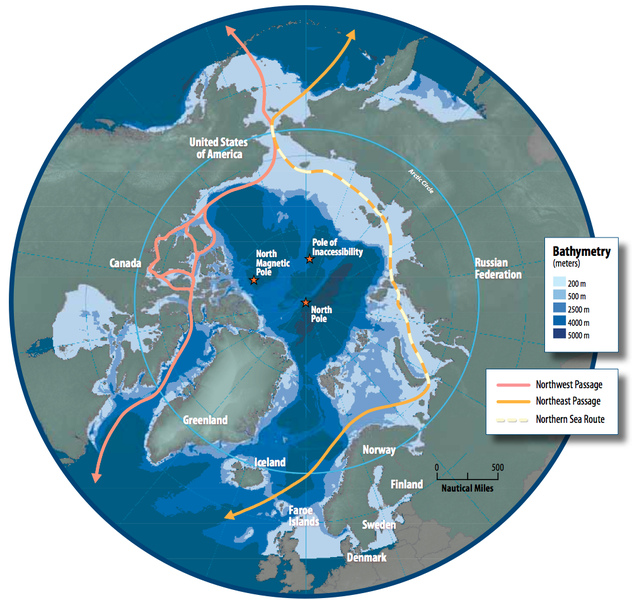
Map of the Arctic region showing shipping routes Northeast Passage, Northern Sea Route, and Northwest Passage, and bathymetry, Arctic Council, by Susie Harder
The National Interest looks at why the Chinese have decided to build nuclear powered icebreakers. There is an interesting quote from the People’s Liberation Army Navy magazine, “With respect to Arctic resources, whoever gets there first, will enjoy the most wealth.”
A couple of items I found interesting were:

An illustration of HawkEye 360’s first satellite constellation, called Pathfinder, orbiting Earth. HawkEye 360/UTIAS Space Flight Laboratory
Back in November, SpaceX fired off a Falcon 9 Rocket with 64 satellites aboard. Among the 64, along with two for the Coast Guard to improve Arctic communications, were a cluster of three called Pathfinder, intended to look for emissions from vessels that would rather not have their location known, including pirates, smugglers, and particularly vessels engaged in Illegal, Unreported, and Unregulated fishing. According to Business Insider,
“The trio of spacecraft belong to a startup called HawkEye 360, and they’re designed to “see” radio signals from space. The company’s software will take unique radio signals coming from ships to “fingerprint” vessels, track them over time, and even forecast future movements.”
Reportedly the satellites can detect and locate radio frequency signals of at least one watt, including satellite phones, push-to-talk radios, and marine radars.
“In addition to fingerprinting such vessels, HawkEye 360’s machine-learning algorithms will also be able to determine typical activity patterns for a ship and flag any unusual deviation. ”
“In the future, they aim to launch five more three-satellite clusters, which will create a constellation that can map Earth’s radio signals once every 30 to 40 minutes.”
There is more background in a gCaptain report here.
Supposedly, the results will be available commercially. Since the same software will also find military vessels I have to wonder if that data will be scrubbed before release?
Meanwhile MarineLink reports the US Coast Guard is teaming up with Global Fishing Watch to track illegal, Unregulated, and Unreported (IUU) fishing.
There is getting to be a lot of intelligence available, but are there platforms enough to exploit it all?
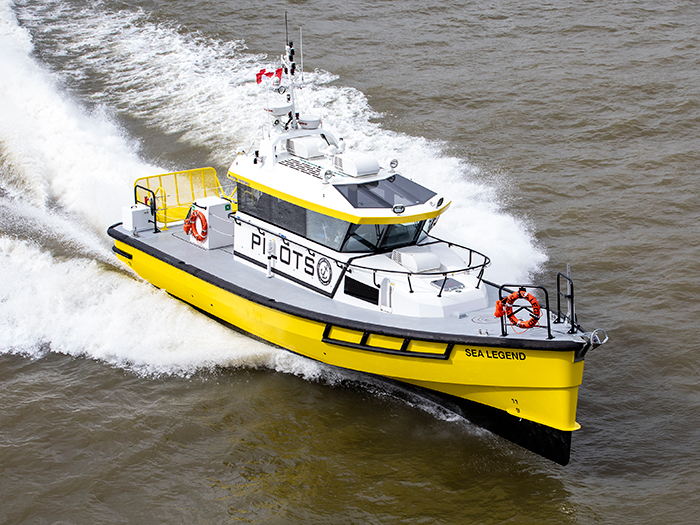
Canada’s Sea Legend Pilotage’s Damen composite FRP hulled Stan Pilot 1605
Another interesting, relatively fast heavy weather boat with an added feature, a man-overboard scoop, built for a Canadian pilot organization.
Plus it is built of composites.
After being built at Damen’s specialist in composite construction, Damen Shipyards Antalya, Turkey, the Stan Pilot 1605 FRP was outfitted at Damen Shipyards Gorinchem, the Netherlands, where Transport Canada was able to inspect the vessel.
According to Damen’s naming convention, the boat has a length of approximately 16 meters (52.5′) and a beam of approximately five meters (16.5′).
The man-overboard recovery system has got to be of interest to a SAR organization.
The scoop is a sophisticated piece of kit that retrieves people from the water and can be used even when the person has lost consciousness. The control for this function is located at the stern, from where the vessel can also be controlled during an emergency.
This reminded me of an earlier post that featured a man in the water recovery system.

An announcement from the Bay Area Chapter of Surface Navy Association:

Camarc designed 56′ Pilot Boat being built by Vigor for LA Pilots. Source: Vigor
Below you will find a press release from Vigor regarding construction of new Pilot Boats for Los Angeles. I am passing it along because pilot boats like Coast Guard motor surf boats have to deal with nasty weather, so they tend to be similar in many ways. They do provide a pretty good description of these boats.

Kirstjen Nielsen, 6th United States Secretary of Homeland Security, official photo. Photo by Matthew T. Harmon/United States Department of Homeland Security
Reuters reports that Homeland Security Secretary Kirstjen Nielsen will be stepping down.
“Her departure was first reported by CBS News, which said it was unclear whether Nielsen’s departure would be voluntary.”
Reportedly, Kevin McAleenan, the current U.S. Customs and Border Protection commissioner, will be acting DHS secretary.
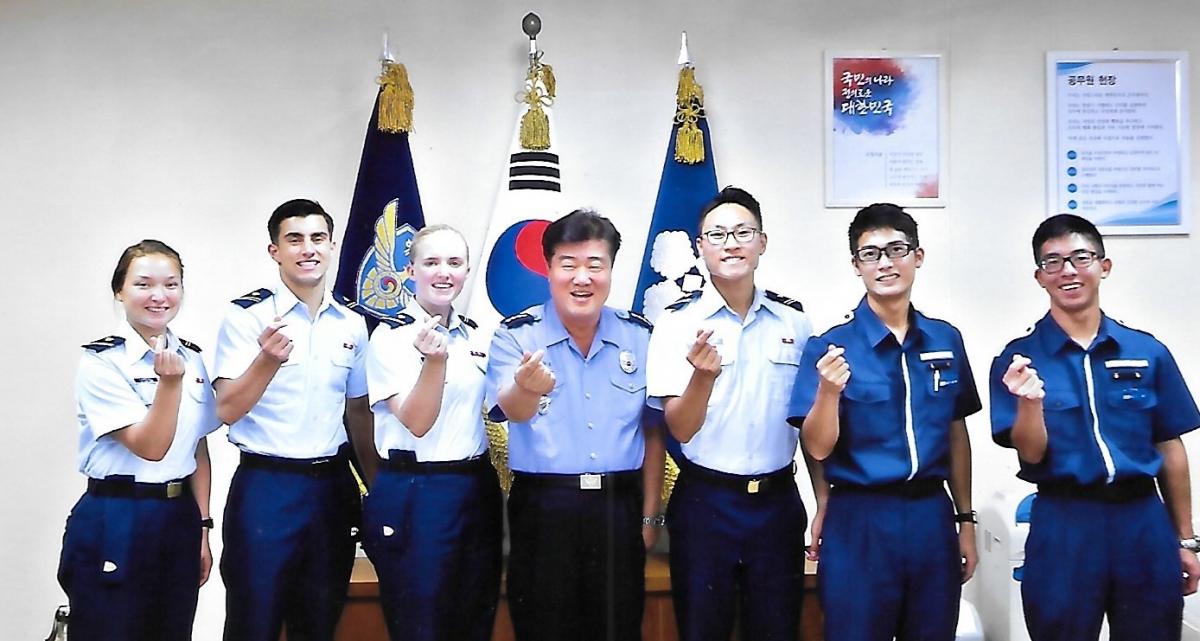
U.S. Coast Guard Academy cadets with their hosts at the Korean Coast Guard Academy in 2018.
The US Naval Institute has an article by a Coast Guard Academy cadet, Drew Cheneler, who, along with three others, had an eight day exchange tour with the South Korean Coast Guard. He relates his experience and came away with a suggestion.
“The Coast Guard should consider establishing a Pacific office in South Korea, to improve joint training in maritime inspections and investigations and support efforts to combat China’s illegal and gray-zone maritime activities. The IMTB has working relationships with other Pacific partners, including the coast guards of Bangladesh, Indonesia, and the Singapore Police. Bangladesh, Sri Lanka, and the Philippines have received transfer of former U.S. Coast Guard high-endurance cutters, as well.
“Making these arrangements less ad hoc through the opening of such offices only makes sense, as they would not be a direct, offensive threat to China or anyone else. A regional Pacific IMTB office would train foreign partners in maritime safety, natural resource protection, and maritime mobility. It would improve prevention of and response to fatal maritime accidents.”

S. Korean CG traing ship Badaro

