Another Very Different Candidate for “Cutter X”

mrv-80-image-04
Click on photo to enlarge

The Australian Navy has had problems with their Armidale class patrol boats. These little ships, similar to the Coast Guard’s Webber Class WPCs (Fast Response Cutters), have been sent great distances to enforce Alien Migrant Interdiction Operations. They are really are not up to the task, so Australia has been planning a larger class. In addition to the fourteen Armidale patrol vessels, they hope to use the same class to also replace six Huon-class minehunter, two Leeuwin-class survey vessel, and four Paluma-class survey motor launch.

This projected class of 20 larger ships is referred to as the Offshore Combatant Vessel.

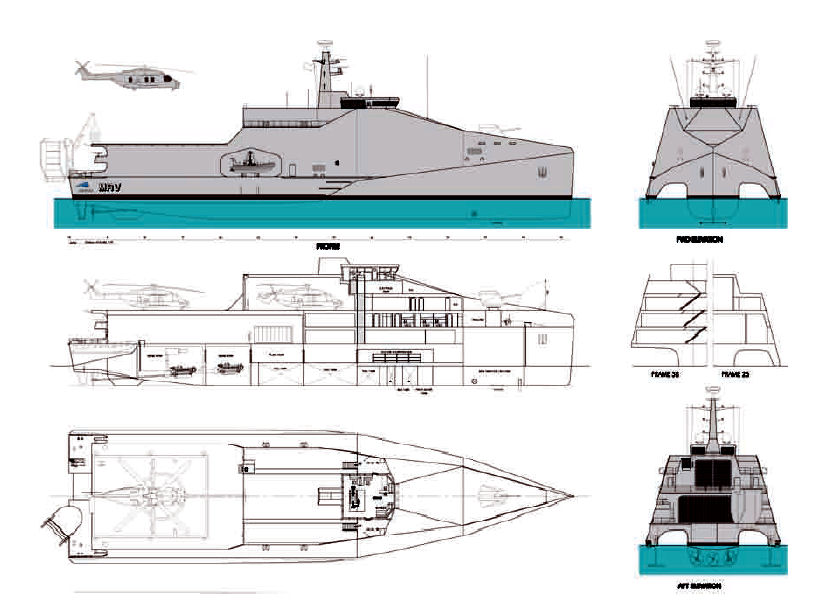
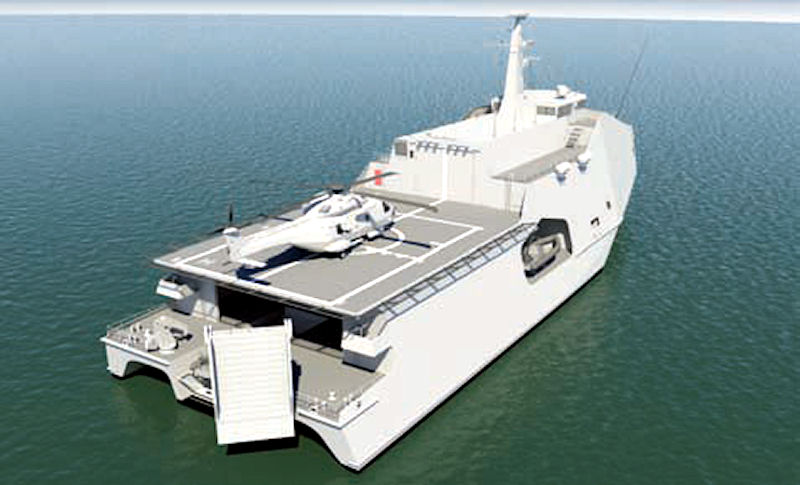
No design has been chosen yet as far as I can tell, but Austal is a local firm (with a shipyard in the US as well) that probably has an inside track. Their design referred to as a “Multi-Purpose Vessel,” is a bit unusual, but it might be appropriate to use as a USCG cutter to fill the space between the Offshore Patrol Cutter (OPC) and the Webber class WPCs, that I have been referring to as “Cutter X.”

It looks a bit like a scaled down Independence class LCS, not surprising since the Independence class are also made by Austal. It, like the Independence design, is a trimaran hull with lots of clear helicopter operating area and a hangar, as well as a large open area under the flight deck for modular systems, or perhaps in our case transporting migrants. Looks like they could also be very useful for Humanitarian Assistance Disaster Response (HADR) Mission.

Austal 80 meter Multi-Role Vessel

Austal 80 meter Multi-Role Vessel


Click on photo to enlarge

Length overall 80 meters (262.5 feet)
Length (waterline) 78.8 meters
Beam (moulded) 21.1 meters (69.2 feet)
Depth (moulded) 6.7 meters
Hull draft 3.2 meters (10.5 feet)
Mission deck 500m2 (5382 sq.ft.)
Flight Deck area 290m2 (3122 sq.ft.)
Hangar 1 x NH-90 (a 23,370 lb gross weight helicopter) or similar
Complement 35
Crew accommodation 87 berth
Endurance 28 days
Range 4,500nm @ 12 knots
Speed (max) 26 knots
Main engines 3 x MTU 20V 4000 @ 4,300kW at 2,170 rpm Diesel engines
(Same engines used in the Webber class)
Propulsion 3 x fixed pitch propellers
Weapons and Sensors •Standard 25mm stabilized naval gun
(the artist concept actually shows a 57mm)
•4 x .50 cal general purpose machine gun mounts

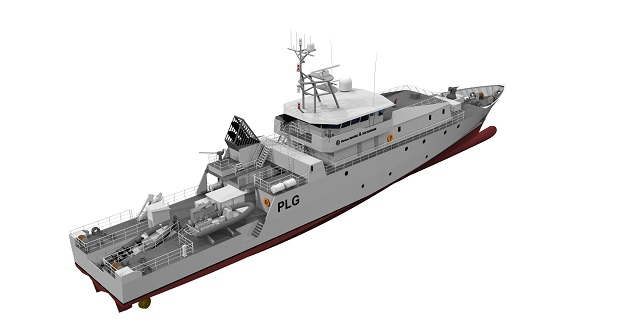
Austal 80 meter Multi-Purpose Vessel

Austal 80 meter Multi-Purpose Vessel

Click on photo to enlarge

Thanks to JamesWF for reminding me of this design.

100th Anniversary of the Formation of the Coast Guard

The Coast Guard Compass notes the 100th anniversary of the consolidation of the Revenue Cutter Service (USRCS) and the Life Saving Service (USLS) to form the Coast Guard, noting the roles of Bertholf and his Lifesaving Service compatriot Sumner Kimball. Bertholf, of course, already has a cutter named for him and USCGC Kimball (WMSL-756) will be the seventh in the Bertholf class.

Small Warship Survivability

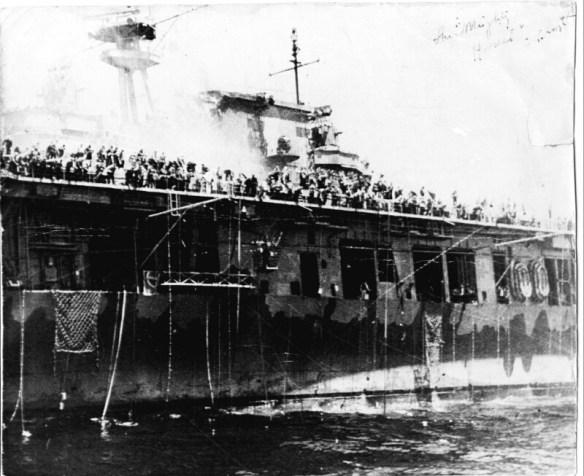
USS Hornet (CV-8) abandon ship

(USS Hornet (CV-8) as the crew abandons ship

There has been a lot of discussion lately about the survivability of the LCS and smaller combatants in general. A recent US Naval Institute News opinion piece contends,

“Small warships are historically unsurvivable in combat. They have a shorter floodable length, reduced reserve buoyancy and more likely to be affected by fire and smoke damage than larger combatants. In both World Wars, losses in ships below 3000 tons in displacement far exceeded those of larger vessels.

“In World War II, for example, the U.S. lost a total of 71 destroyers and 11 destroyer escorts — all under 3400 tons displacement and less than 400 feet in length.

“By comparison, only 23 larger ships were lost. Part of that figure is undoubtedly due to their operational employment, but in simple terms of engineering and physics, larger ships are inherently more survivable than their smaller counterparts.”

In the Coast Guard we once had a saying, “In our obscurity is our security.” I think that should be kept in mind when we consider the survivability of small surface combatants. No, they cannot take as much damage as major surface combatants, but the enemy gets a vote, and he will be less “excited” by the presence of smaller vessels, while he will normally choose to put more effort into destroying larger, more threatening ships. As in land warfare, tanks are more survivable than infantrymen, but they don’t necessarily last longer.

To look at how this factor might influence survivability, I looked at how many of the ships that were in commission at the beginning of World War II were sunk as a result of enemy action. My source is the “Summary of War Damage to U.S. Battleships, Carriers, Cruisers, Destroyers, and Destroyer Escorts” which is accessible here. The figures there do not correspond to those quoted above, rather they report 58 destroyers and 9 destroyer escorts sunk, along with 26 larger surface combatants, all listed by name. (The USNI post may have included constructive losses that were not actually sunk or losses to other than enemy action, and does not include the three battleships salvaged although they were out of action most of the war.)

If we look only at the US fleet at the beginning of the war, it included 233 major surface combatants of which 46 or 19.7% were sunk by enemy action during the course of the war. If we break it down by class it looks like this:

Type: Number in Commission, Dec. 7, 1941/Number sunk/% lost to enemy action
Aircraft Carriers (CV): 7/4/57.1%
Escort Carrier (CVE): 1/0/0%
Battleships (BB): 17/5/29.4% (of the 5 sunk, all were at Pearl Harbor, 3 were salvaged)
Heavy Cruisers (CA): 18/7/38.9%
Light Cruisers (CL): 19/1/5.3%
Destroyers (DD): 171/29/17%

(There were no Destroyer Escorts in commission at the beginning of the war.)

If we lump  all the cruisers together, 8 of 37 were lost or 21.6%

If we lump the lone escort carrier together with the fleet carriers then four of eight were sunk or 50%

Additionally three destroyers were lost to weather in a hurricane. They were not ballasted properly, because of the exigencies of impending combat operations.

Clearly, at least looking at the World War II experience, the US Navy did not loose a higher percentage of smaller ships. If anything it appears the opposite is true. A smaller percentage of smaller ships were lost (17% vs 27.4%). More small ships were lost simply because there were many more of them. Undoubtedly some of the DDs and DEs that were sunk, would have survived the damage they received, if they had been bigger, but presumably there would also have been fewer of them. If the decision criteria were an equal chance of being sunk, then probably taking greater risk with smaller ships is both reasonable and unavoidable.

I will note that the probability of personnel loss on small ships is probably higher because they are more likely to sink quickly and catastrophically, while larger ships are more likely to sink slowly.
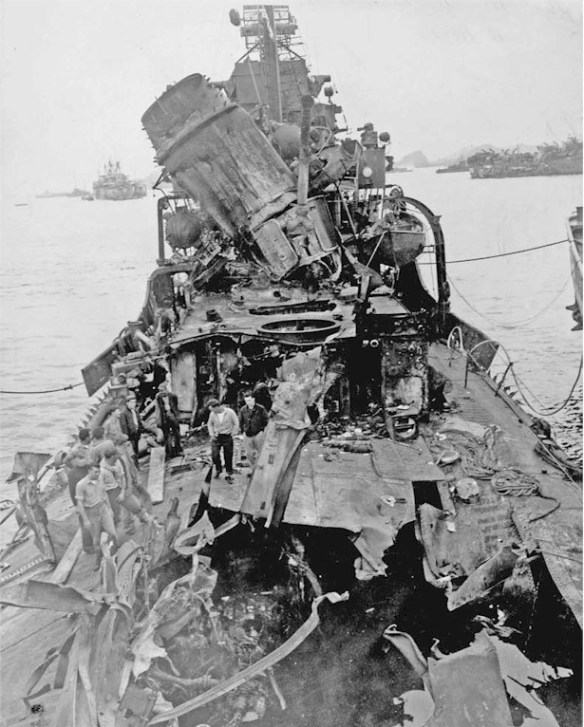
USS_Newcomb_Damage_1945

Photo: USS Newcomb DD 586 was hit by as many as five kamikaze on 6 April 1945 as she was screening for the cruiser USS St. Louis off Okinawa. She survived but was not repaired.

I will add a bit of anecdotal evidence. As part of Operation Overlord, the Normandy Invasion, 60 US Coast Guard 83 foot patrol boats were assigned to rescue those unlucky enough to find themselves in the water or sinking. 30 went to the American beachheads and 30 went to the British and Canadian beachheads. Being wooden hulled and gasoline powered, they certainly would not have been considered “survivable.” Apparently they were in the thick of it, because they rescued 1438 men from the water and sinking craft. In spite of all the fire from shore, not a single boat was sunk and not a single crewmen was killed. Apparently the German gunners were too busy with the landing craft hitting the beach and the warships that were shelling them. They simply were not a priority target.

ResFlot1_CG21

USCG 83 ft patrol boat, probably June 1944. Photographer unknown.

Pacific Fisheries Standoff

HMNZS Wellington intercepts suspected toothfish poachers

HMNZS Wellington intercepts suspected toothfish poachers

We don’t often talk about fisheries, because normally the operations are routine, but something interesting is happening in the western Pacific.

BBC reports the New Zealand Navy OPV Wellington (which looks a lot like Eastern’s design for the OPC) has intercepted three Equatorial Guinea flagged (but believed to be Spanish owned) fishing vessels apparently fishing illegally for Patagonian Toothfish, commonly called Chilean Sea Bass, a highly valued and overfished resource. Despite being given permission to board by the flag state, the fishing vessels are resisting efforts to board.

Australian advocates are pointing to this incident as evidence Australia’s apparent inability to do what New Zealand is doing. There is more here.

This does appear to be symptomatic of inadequate enforcement.

Generally, it appears, that our own efforts in the Western Pacific may also be inadequate. It is probably not common knowledge that the US EEZ around islands West and South of Hawaii is larger than our EEZ around Alaska, the West Coast, or the East and Gulf Coast, and many of the fish taken in these waters are extremely valuable. In spite of new tasking in the area, we don’t seem to be giving this area much attention. There is also the question of who polices what would be the Antarctic EEZ if any country had sovereignty their.

Funding an Icebreaker

In thinking about how to fund a new icebreaker, it is apparent, (1) Congress, the administration, and the department have the (unrealistic) idea that ship building budgets need to be consistent from year to year (they never have been). (2) Cost of a single icebreaker is so high, funding it from the Coast Guard’s customary shipbuilding budget would disrupt ongoing programs and result in higher costs in out years to restart these disrupted programs.

The Navy is facing a similar, though as a percentage, less severe problem with the Ohio SSBN replacement program. The proposed solution is to fund the new submarines outside the Navy’s shipbuilding budget. This way the additional money does not establish a precedence for a higher Navy shipbuilding budget, and Congress has the illusion of holding the line on spending.

The advantage the Navy has here, is being part of the Defense Department. Nuclear Deterrence is obviously a DOD mission. On the other hand it is hard to make the case that icebreaking is a Homeland Security mission, so we are unlikely to be able to kick the funding requirement upstairs to the DHS.

Still it might be possible for some interested Congressional delegation to sponsor a separate special appropriation, outside the Coast Guard’s normal (inadequate) shipbuilding budget to cover the cost of a new icebreaker. After all, $1B is only .033% of an annual three trillion dollar budget. Maybe no one will notice.

New French OPV for the Western Hemisphere

FrenchLightPatrolGuiana

NavyRecognition is reporting that two 60 meter (197 foot) 21 knot French Navy patrol vessels are being built for operation in French waters in the Western Hemisphere including the French West Indies and Guiana on the North Atlantic Coast of South America.

They are expected to have a crew of 24, support two RHIBs, and have an endurance of 12 days.

Among their duties will be policing waters in the vicinity of the Guiana Space Centre, now the European Space Agency’s primary launch site near the equator.

The Coast Guard may have an opportunity to work with these vessels.

End of an Era, Last Frigate Cruise for USN & LEDET

800px-USS_Kauffman_FFG-59

Photo: USS Kauffman (FFG-59) Defense Visual Information Gallery photo ID DN-SC-90-04968

The Navy Times is reporting that USS Kauffmann (FFG-59) is departing for what is expected to be the last deployment for a US Navy Oliver Hazard Perry class frigate, and it will be a “Counter Transnational Organized Crime/Counter Illicit Trafficking mission” meaning it will almost certainly have a Coast Guard team aboard.

The 51 ships of this class have frequently supported USCG Coast Guard Law Detachments and operated under Coast Guard authority. Ultimately Littoral Combat Ships (LCS) and Joint High Speed Vessels (JHSV) will replace them in these missions, but right now, the decommissionings seem to be coming much faster than the replacements. Meanwhile far fewer assets are available than required to move on actionable intelligence despite of the fact that this is the most efficient method of interdicting drug traffic.