Puddle Pirates in SW Asia

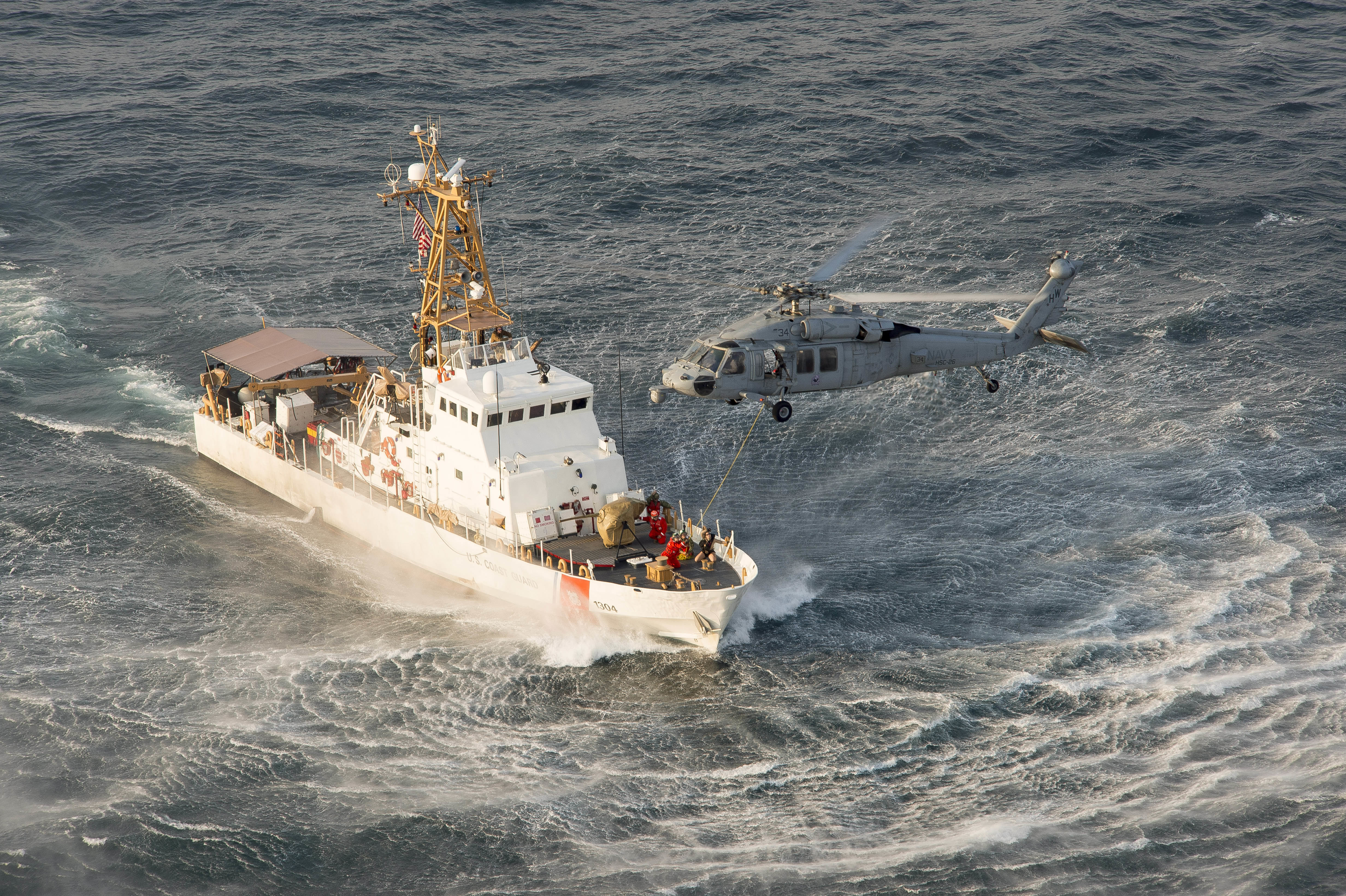
141219-N-DX365-258   BAHRAIN (Dec. 19, 2014) Helicopter Sea Combat Squadron (HSC) 26, Det. 1, conducts a vertical onboard delivery with the U.S. Coast Guard Cutter Maui (WPB 1304). HSC-26 is a forward deployed naval force asset attached to Commander, Task Force 53 to provide combat logistics and search and rescue capability throughout the U.S. 5th Fleet area of responsibility. (U.S. Navy photo by Mass Communication Specialist 1st Class Joan E. Jennings/Released)

141219-N-DX365-258
BAHRAIN (Dec. 19, 2014) Helicopter Sea Combat Squadron (HSC) 26, Det. 1, conducts a vertical onboard delivery with the U.S. Coast Guard Cutter Maui (WPB 1304). HSC-26 is a forward deployed naval force asset attached to Commander, Task Force 53 to provide combat logistics and search and rescue capability throughout the U.S. 5th Fleet area of responsibility. (U.S. Navy photo by Mass Communication Specialist 1st Class Joan E. Jennings/Released)

Just an unusual photo–and a reminder of where some of our people are.

Fisheries Enforcement Taken Seriously

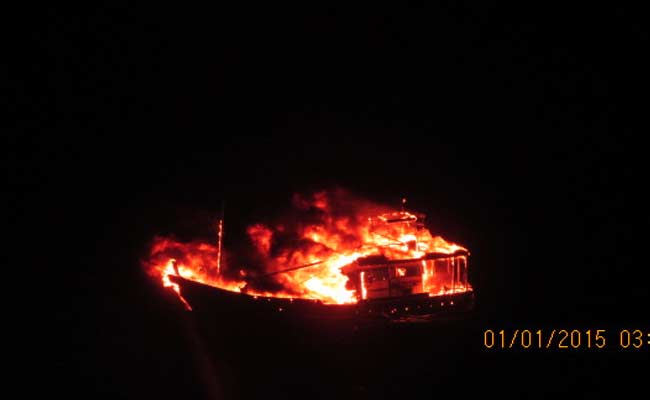
Indian Government Photo: Pakistani F/V self-destructs after intercept by Indian Coast Guard

Indian Government Photo: Pakistani F/V self-destructs after intercept by Indian Coast Guard

gCaptain has a report of an odd incident during which an Indian Coast Guard cutter, the RajRatan (similar in concept to the Webber class WPCs), acting on intelligence, approached a Pakistani fishing vessel and after attempting to stop it, including an hour long chase and warning shots, the crew of the F/V set it afire resulting in an explosion and apparently the deaths of all aboard. Other reports suggest this may in some way have been connected to the expected visit of President Obama to India on Jan. 26.

Thanks for a Successful 2014

Just as I did last year, I would like to thank the readership for another successful year.

We had 202,688 views in 2014, up from 155,432 last year. The daily average has gone from 322 in 2012 and 426 in 2013, to 555 in 2014. I don’t have a readout on this, but that is a daily average of about 220 individual visitors.

There were 208 new posts this year, some of the most viewed were published in previous years.The most viewed posts in 2014 were:

  1. OPV to OPC (2012)
  2. The Navy’s New Patrol Boat (2012)
  3.  What Does It Take to Sink a Ship? (2011)
  4.  Preliminary and Contract Design Contract Winners for OPC Announced (2014)
  5.  Offshore Patrol Cutter Concepts (2013)

I am told we had visitors from 169 countries. Some of these could have been spammers, but 35 Countries had more than 200 views. Top five following the US were the UK, Philippines, Canada, Netherlands, and Australia.

The busiest day of the year was November 4th with 2,037 views. The most popular post that day was Philippine CG to Get an “MEC” and Four “PBs” from France.

Frequently the site will get a bump from a mention on another blog or source. I would like to give a tip of the hat to these. Top sources for referrals were:

  1. http://www.timawa.net/
  2.  http://www.thinkdefence.co.uk/
  3. Facebook, which might be from my own page, https://www.facebook.com/chuckhhill, or from either Warships of the World or Historic Ship Geek where I probably spend too much time.
  4. http://cimsec.org/
  5. http://www.eaglespeak.us/

We had over 8,300 comments. Top Commenters (other than myself) were Bill Smith, James WF, x, Bill Wells, and Nicky.

I would also like to thank Lee for his many leads and suggestions. Unfortunately Tim Colton has terminated his blog, his commentary will be missed.

Again, thanks for the interest, contributions, and comments.

Shouldn’t Airliners Have Hydrostatically Released EPIRBs?

We have had two airlines disappear this year, Malaysia Airlines Flight 370 in March and another this month. Both hit the water and sank. The most recent incident at least left debris on the surface that marked the crash site, but even so it took a substantial search to locate the wreckage. MH370 resulted in a huge search effort that was to my knowledge fruitless.

Our friend, Ken White had a very reasonable question, Why don’t airliners have hydrostatically released EPIRBs? Good question. Having two would not be unreasonable. The devices might also be activated by sudden high g-forces.

CG History from Bill Wells

Friend and frequent contributor, retired Master Chief Bill Wells has a historical piece about living conditions aboard 19th century revenue cutters in “Prologue,” a magazine published quarterly by the National Archives and Records Administration.

It is the cover article of the Fall 2014 issue and is entitled “Wet, Cold, and Thoroughly Miserable.” You can access it as a pdf at the magazine’s web site here.

Marine Inspection Failure in Adriatic Ferry Fire?

You have probably heard about the fire on the Ferry Norman Atlantic in the Adriatic between Greece and Italy, but there were a couple of particularly interesting notes in this CNN report that suggest a failure of marine inspection authorities.

In the first three hours of the fire, around 150 people were able to escape via the vessel’s lifeboats. But when the ferry lost power, the electronic arms were unable to function, leaving the rest of the boats dangling uselessly by its side.

It’s not known how the fire started, but it’s believed to have originated in the parking bay. A truck driver told the Greek news media that trucks filled with oil were “packed like sardines,” their cargo scraping the ceiling, which could have set off sparks in rough seas to start a fire, he surmised.

Poland Builds an OPV

NavyRecognition is reporting that Poland has floated out an OPV. This ship like the Israeli OPVs discussed in my previous post is a MEKO A-100 design. The NavyRecognition post includes a photo of the vessel in its current state and an artist’s concept of the finished product.

This project has had a long gestation period. The ship was laid down in 2001. It began as a project to build seven corvettes referred to as the Gowron class, but funding was not forthcoming, and the project was cancelled, leaving the first ship of the class on the ways, largely complete structurally but without its expensive weapons systems. Ultimately they made a decision to complete the ship as an OPV without the planned anti-ship and anti-aircraft missiles and anti-submarine systems.

There is more information and photos here.

“Standard displacement mass of the vessel is to be as much as 1800 tonnes, total length – 95.2 m (312.3 ft), width – 13.5 m (44.3 ft), height to the level of the board – 9.35 m, displacement – 3.6 m. The ship is to be able to operate autonomously for a period of 30 days.

“Mixed propulsion system consists of 2 main engines (power output: 2 x 3240 kW) and a turbine, maximum power of which is to be as much as 25 000 Kw. All that is to allow the ship to reach speeds of up to 30 knots. Range of the vessel – 2000 NM at at 18 knots and  4500 NM at 14 knots. Ship’s power plant is equipped with 4 generators, 600 kW each. Additional equipment includes bow azimuth thruster, which improves manoeuvrability, and active stabilizers, which improve comfort for the crew.”

The ship’s weapons will be:
» 1x Oto Melara 76mm main gun
» 2x Oto Melara Marlin WS 30mm remote weapon stations
» 4x GROM Short range surface to air missile launchers
» 4x 12.7 mm machine guns

This is typical OPV weaponry with the exception of the GROM missile systems which are relatively simple MANPADS (man portable air defense systems).

Happy Holidays

It has been my pleasure to have a long association with people who have chosen a life of service to humanity and their country. This time of year helps to bring it all into focus. Hope you all have a wonderful holiday season and a Happy New Year!