UAS for the Webber Class?

Coast Guard Compass is reporting that the R&D Center has conducted tests of an unmanned aerial surveillance system from the Webber class WPC Richard Etheridge.

The experiment is being done on the cheap, using surplus Marine Corp WASP III UAS.

This particular aircraft is very small (less than a pound), with a maximum speed of about 40 knots, an endurance of about 45 minutes, and a nominal range of 5 km, so it is not going to get very far from the launch platform. Sensors are limited to color and IR video, so it is still like “looking through a staw” in terms of its ability to search, but it might be useful for taking a closer look at targets, without the necessity of moving the CG vessel to intercept, particularly at night; for documenting a drug bust; or for keeping an eye on the disengaged side of a potentially hostile target during a boarding. The recovery method used was to land in the water, but we could certainly do better.

I can’t say I am particularly impressed with what I have seen of the system so far, since I can pick up something similar at the local hobby shop (google “First Person Video”). I have a friend who flies one, including the ability to use GPS to fly way-points and automatically return to the launch point and land, all for less than $1,000, but it is a start and at least it is a recognition of a need and an opportunity.

Still think we could fly Scan Eagle from the WPCs.

Navy Chooses Existing LCS Designs as Basis for Small Surface Combatant

LockheedSSC
Photo: A modified Littoral Combat Ship design based on the Lockheed Martin Freedom-class. US Navy Image. Click on the image to enlarge. Note the USNI post also includes an image of a modified Independence class LCS

USNI is reporting that the existing Littoral Combat Ship designs will be modified to become the new Small Surface Combatant. It is not clear if they mean they will continue to build two designs in parallel, or if they mean they will select only one of the two. Perhaps there will be a competitive bid.

In spite of apparently incorporating all the elements of both the anti-submarine and anti-surface modules plus over-the-horizon Anti-Ship Cruise Missiles, it is reported they will have a lighter displacement than the existing LCSs. Surprisingly they apparently will not include VLS, but will include a multi-function towed array sonar, over the horizon ASCMs, upgraded radars, EW, and Cruise Missile decoy systems, torpedo countermeasures, a Mk38 Mod2 25 mm, and additional armor, in addition to the Mk110 57mm, two Mk46 30mm, Hellfire, MQ-8 UAVs and HM-60 helicopters. Both designs will use SeaRAM.

The question for the Coast Guard now is, how much commonality with this new class can be incorporated into the Offshore Patrol Cutter either as equipment actually installed or as equipment fitted for but not with? The more commonality that can be achieved, the more supportable the ships will be over the long haul.

The world seems to be becoming a more dangerous place, where the US may need every warship it can muster. We cannot afford the luxury of building the OPCs without wartime potential.

Coast Guard In a “Death Spiral?”

Dec. 4, the US Naval Institute had a seminar, “Defense Forum Washington 2014, What Does the Nation Need from its Sea Services?” VAdm Charles D. Michel, Deputy Commandant for Operations, was the Coast Guard representative on the panel discussion labeled “Sea Service Briefing.” He did a credible job of representing the Coast Guard. He also made some headlines when he said that the LCS was an excellent asset for drug enforcement, and eloquently presented a case for maritime drug interdiction.

But I would like to particularly recommend a portion of the presentation by Ron O’Rourke, who is the Congressional Research Service. He devoted the last few minutes of his presentation to the Coast Guard, beginning about minute 24:30. He does a better job of explaining the crisis in Coast Guard budgeting than I have ever seen done by any Coast Guard representative.

Looking at some of the other speakers, I learned that they have taken the program to replace the Ballistic Missile Submarine Force out of the regular navy shipbuilding budget. I think this is significant, because the effect of the SSBN replacement on the Navy ship building budget, is very similar to the effect of the heavy icebreaker procurement on the Coast Guard budget. Perhaps this might be used as a precedence for a special, separate appropriation for the icebreaker.

Fire Scout Operates from Bertholf

FIRESCOUTmq-8B

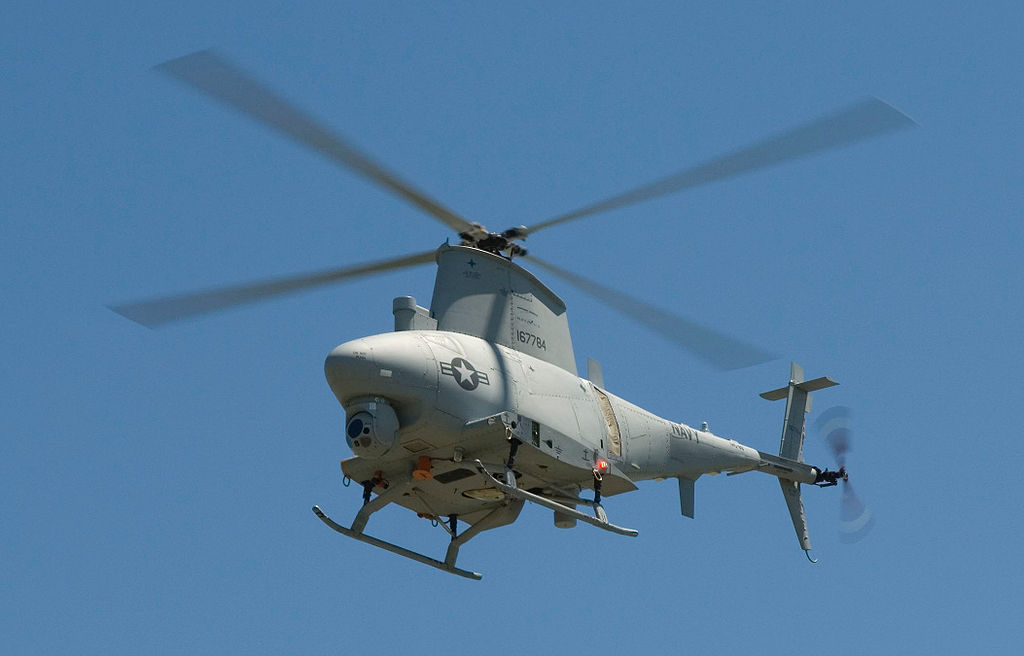
Photo credit: Jrfreeland , MQ-8B Fire Scout Vertical Unmanned Air System (VUAS) flies with the BRITE Star II electro-optical/infrared payload using a Tactical Common Data Link (TCDL) at Webster Field, Naval Air Station Patuxent River, Md.

DefenseNews is reporting Fire Scout is currently deployed on four ships including the Bertholf.

“On Dec. 2, the California-based Coast Guard cutter Bertholf got underway off Southern California carrying two Fire Scouts, the first time Coasties have operated the drone aboard a national security cutter.

“Not all the embarks are aimed directly at operational needs. The Coast Guard concept demonstration, Dodge said, “will show what they can do with a large-sized aircraft.” Fire Scout, he said, “is probably on the large side of potential solutions for their cutters. I think they’re still trying to sort out what their need is.”

“The Bertholf demonstration is using two 8Bs — one an instrumented test aircraft, the other fitted with a search radar, one of five Bravo models being upgraded with a small Telephonics ZPY-4 radar fitted in the nose.

“A full Fire Scout operating system wasn’t installed on the Bertholf for the tests, scheduled to run about two weeks. “Instead of fully integrating the mission control station into the ship, we put it in a conex box,” Dodge said.”

The Post talks about other on-going activity, production plans, and losses amoung the Fire Scout fleet.

Late addition, video of the Firescout MQ-8B operating from Bertholf:

Ice Capable Research Vessel “Sikuliac” Delivered NSF

SikuliaqOnAcceptanceTrials
Photo: Sikuliaq on Acceptance Trials

The Marine Log is reporting the delivery of a new ice capable research vessel to the National Science Foundation.

The 261-foot double-hulled vessel will be stationed at Seward Marine Center, its homeport in Seward, Alaska, where it will be tasked with year-round operation. The Sikuliaq is the first vessel in the U.S. academic research fleet capable of breaking ice up to 2.5 feet thick, making it uniquely equipped for polar and sub-polar research.

The Marine Log post focuses on the ship’s engineering plant which includes four MTU 4000 series diesels (the same series used in the Webber class) in a fully integrated diesel electric plant providing both ship’s service power and propulsion.

Earlier we talked about this ship, and the possibility of adapting the design as an Artic Patrol Cutter. My 2011 post includes a bit more detail about the ship. You can read it here.

Document Alert–Howard Coble Coast Guard and Maritime Transportation Act of 2014 (H.R. 5769)

The MarineLog is reporting that the Coast Guard authorization bill is out of committee. Labeled the “Howard Coble Coast Guard and Maritime Transportation Act of 2014 (H.R. 5769),” it is certainly not the final word on the Coast Guard budget, but it is a start, and it contains some interesting provisions. The MarineLog story includes a link to the bill, by all means check it out, but I will briefly discuss some salient sections.

Improves acquisition activities: In order to save time and money, the legislation requires the Coast Guard to develop plans and use current authorities to reduce the cost and accelerate the delivery of new assets under its $25 billion major systems acquisition program.

I don’t see a lot that will accelerate delivery of new assets except that Sec. 220 “extends through fiscal year 2017 the authority of the Commandant of the Coast Guard to hire experienced acquisition personnel on an expedited basis,” and Sec. 223 again provides authority for multiyear procurement of the Offshore Patrol Cutter (OPC). It may be that they anticipate funding more than the two Webber Class the administration has requested–as has been done in previous years. Buying six rather than only two would add very roughly $240M.

Sec. 101. Authorization of Appropriations
This section authorizes $8.7 billion in discretionary funds for the Coast Guard for fiscal year 2015. This funding will support military pay raises for Coast Guard servicemembers at a level consistent with servicemembers of the other armed forces.

That is a 6.95% ($565M) increase if it in facts makes it through budget process.

Sec. 215. Mission Need Statement
This section directs the Coast Guard to submit to the Committee a single, new Mission Need Statement (MNS) covering all of its major acquisition programs with the submission of the budget request to Congress for fiscal years 2016 and 2019 and every four years thereafter. It further requires the Coast Guard to base the MNS on the funding provided in the Capital Investment Plan submitted for the fiscal year in which an MNS is required to be submitted. Finally, the Coast Guard is required to describe which missions it will not be able to achieve for any year in which the MNS identifies a gap between the mission hour targets and projected mission hours from new and legacy assets.

I found this a bit confusing, but it sounds like the report would only be required every four years. This would be an opportunity to highlight shortfalls in equipment.

Sec. 219. Active Duty for Emergency Augmentation of Regular Forces
Under current law, the Secretary of Homeland Security may call Coast Guard reservists to active duty to prepare for and respond to a natural or manmade disaster. The Secretary’s authority is limited to a call up of not more than 60 days in any four-month period and not more than 120 days in any two-year period. This limitation hampers the ability of the Coast Guard to respond to large-scale or multiple disasters. There is no similar limitation on other reserve components called up by the Secretary of Defense. This section would eliminate the “not more than 60 days in any four-month period” limitation on the call up of Coast Guard reservists

More movement toward making it easier to call on Reservists–for better or worse. Makes it easier to cut out any resiliency in the active forces.

Sec. 224. Maintaining Medium Endurance Cutter Mission Capability
This section requires the Secretary of Homeland Security to provide the Committee with a plan for decommissioning the 210-foot Medium Endurance Cutters (MEC), extending the life of the 270-foot MECs to ensure the Coast Guard can maintain mission capability through the OPC acquisition, identifying the number of OPCs necessary to maintain historical sea state five capability, and acquiring OPCs that maintain historical sea state five capability, as well as OPCs that do not maintain such capability.

I think they may be asking if all MECs really need to be replaced by OPCs (sea state five capability) or if some of them could not be replaced by something less capable and less expensive (like cutter X?). It also seems to say they do not believe they need a fleet more capable than the current (historical) one. If 210s and 270s do not in fact have sufficient life remaining to wait for the currently planned gradual replacement through 2034 (as I doubt they do), it might argue for accelerated procurement.

Sec. 226. Gaps in Writings on Coast Guard History
This section requires a report to Congress on any gaps that exist in writings on the history of the Coast Guard.

This ought to make Bill Wells heart glad, but I doubt he will be pleased with the official response.

Sec. 229. e-LORAN This section ensures certain navigation infrastructure is not dismantled until the Secretary of Homeland Security determines whether it is needed and authorizes the Coast Guard to enter into agreements with public and private entities to develop a GPS back-up system.

There is recognition of the potential vulnerability of GPS and a desire to keep options open for reestablishing loran as an alternative.

Sec. 230. Analysis of Resource Deficiencies with Respect to Maritime Border Security
This section requires a report to Congress on any deficiencies that exist in Coast Guard resources relating to maritime border security

Not sure why this is needed separately if you are going to have a Mission Need Statement (Sec. 215) but a lot of people seem to be very concerned about border security. For most this seems to be alien interdiction. I would point out how poorly prepared we are to actually stop a terrorist attack in progress once detected. The Coast Guard needs specific capabilities to deal with these threats that must be both highly effective and precise enough to avoid collateral damage including missiles for small fast targets and possibly light weight torpedoes for stopping large vessels. Machine guns or even 57mm guns do not answer the need.

Sec. 505. Icebreakers
This section requires the Coast Guard to provide Congress with a strategy to maintain icebreaking capabilities in the Polar Regions that includes an analysis of the cost effectiveness of acquiring or leasing new icebreaker assets. The section also prohibits the Coast Guard from spending any of its funds to pay for the capabilities of a new Polar Class icebreaker that are requested by other federal agencies. The Coast Guard is authorized to use funds transferred from other agencies pursuant to an agreement to address such requests. Finally, the section authorizes the Coast Guard to conduct a service life extension of the POLAR SEA after it provides a previously mandated report to Congress concerning the icebreaker.

It appears they are telling the Coast Guard not to do missions for other agencies without getting paid for it. So does the Coast Guard have an missions of its own that require Polar Icebreakers? There is SAR, fisheries, and MEP to be done in the Arctic, but do they require a heavy icebreaker? The authorization to do a life extension for the Polar Sea seems to be recognition that it seems to be the only option affordable in the near term. Hopefully they will think beyond restoring the problematic systems they have plagued this class.

Sec. 506. Icebreaking in Polar Regions
This section ensures that Coast Guard statutory missions are included as priorities when the administration budgets for activities in the Polar Regions.

Here I think the Committee is reminding the administration that the Coast Guard does in fact need to do missions like SAR, fisheries, and MEP in the Arctic and that necessary resources need to be provided.

Reorganization for Border Enforcement

DefenseDaily has a report of a pending reorganization of the Department of Homeland Security’s oversight of the border interdiction problem based on a 20 November memo from DHS Secretary Johnson. I was a bit surprised I did not see this reported anywhere else.

Johnson on Thursday directed the Coast Guard, Customs and Border Protection (CBP), Immigration and Customs Enforcement (ICE) and Citizenship and Immigration Services to stand up within 90 days Joint Task Force East, Joint Task Force West, and Joint Task Force Investigations, DHS said on Friday afternoon. In the memo Johnson said at the end of the 90 days each task force should have a headquarters and relevant personnel should be “realigned.”

There will be two geographically defined operational task forces and a supporting investigative task force headed by Immigration Customs Enforcement (ICE). It appears that the geographic divide roughly equates (but not exactly) to the split between the Atlantic and Pacific Areas. The Eastern Task Force (JTF-East) will be headed by the Coast Guard (presumably COMLANTAREA) and the Western Task Force (JTF-West) which apparently includes all the land border with Mexico, as well as he Pacific coast, will be headed by Customs and Border Protection (I presume COMPACAREA will be the Deputy).

Would be nice if all the Homeland Security agencies had common territorial divisions so that coordination could be simplified.

Thanks to Lee for the heads-up.

African Fisheries–Only Bad Choices

Offiziere.ch has an excellent post on the problems of managing fisheries off Africa. While they talk about illegal, unreported and unregulated (IUU) fishing, that is only the beginning.

Among other problems, there are so many countries in Africa (54 countries, at least 32 with coast lines) that their individual EEZs are too small to manage fishing stocks. If one country attempts to rebuild stocks by reducing fishing, a neighboring country may take advantage of their sacrifice and undo their efforts.