Some nice graphics showing the decline of piracy in the Indian Ocean and nearby waters, showing a dramatic decline.
(You might click on the charts and enlarge in order to read them clearly.)

Some nice graphics showing the decline of piracy in the Indian Ocean and nearby waters, showing a dramatic decline.
(You might click on the charts and enlarge in order to read them clearly.)
KTOO public radio, Gavel, Alaska has published a two part interview with Lt. Leone, done by Ed Ronco, KCAW Texas Public Radio in San Antonio. You can read them or hear them at the links below.
http://www.ktoo.org/2012/11/20/leone-cg-6017-hit-something-we-never-saw/
http://www.ktoo.org/2012/11/21/leone-a-rapid-liquid-stop/
Thanks to Ryan Erickson for bringing this to my attention.
Currently the largest Coast Guard cutters are being equipped with the Mk 110 (BAE/Bofors 57 mm Mk3) gun mount. By all reports it is a good defensive weapon, effective against air threats and small fast surface vessels. But is this weapon also the most appropriate for the most likely scenarios?
The Choices: Given that we can only consider weapons supported by the US Navy, there are really only two choices, The Mk 45 5″ and the Mk110 57mm; three if you consider the Mk75 76 mm which seems to be going away.
Mk75 76 mm guns, are mounted on the once large, but now rapidly dwindling FFG-7 class in addition to 378s and 270s. There are currently roughly 50 systems installed, but that can be expected to rapidly decrease with no new installations planned. Still, this is based on perhaps the most successful post-WWII naval gun, the Oto-Melara (now Otobreda) 76mm, one that is still being installed on some of the most sophisticated new construction foreign made vessels. There has been some talk from USN sources that they may choose to install the Mk 75 on future LCS, but unless there is a change, it looks likely the 270s will be the last operational US vessels to use the Mk75.
The Mk110 57 mm, is found on the National Security Cutter (NSC) and the Littoral Combat Ship. It is also planned for the Offshore Patrol Cutter, and will be used as a secondary mount on the Zumwalt Class DDG. It is based on the Bofors 57mm Mk3, a competitor to the more successful Oto Melara 76mm. There are currently only about six units operational on US ships now, but if all four classes are completed as planned there will be 94 systems afloat.
The 5″ Mk 45, in its three mods, is the most numerous medium caliber gun in the USN inventory, and until the 155mm Advanced Gun System (AGS) becomes operational on the Zumwalt Class DDGs it is also the largest US naval gun. (Only 6 AGS on three ships are currently planned). There are currently about 106 USN mounts afloat. Numbers have declined somewhat particularly with the decommissioning of the Spruance Class. They are still being installed on new construction and planned Burke Class destroyers, but as DDGs with one mount replace cruisers with two, the number is likely to decrease further to between 80 and 90 mounts. It is also in service with ten foreign navies. It is the most successful mount of its class in the world.
The Advanced Gun System planned for the Zumwalt Class DDGs is simply too large to consider for use on cutters.
Why do we have guns on our ships at all?
Self defense isn’t a requirement until it becomes necessary to accomplish one of these tasks.
Signalling or intimidating the typical drug smuggler doesn’t require even a 57mm. A .50 cal is usually adequate, and if not a 25 mm certainly is.
Derelict destruction is now rare, but it apparently was a common requirement at least into the ’30s. While rare, as the Anacapa found out, when it was tasked to sink an abandoned Japanese fishing vessel, it may be more difficult that might be expected. Even so, it is rare, and there are other ways to do this mission, so its not really a consideration in the choice of weapons.
The need for a larger weapon only surfaces for the last two purposes, protection of Ports, Waterways, and Coastal Security (PWCS) and wartime tasking.
Forcibly compelling compliance.
Both PWCS and war time roles are likely to require cutters to be able to board and inspect merchant vessels and the ability to forcibly stop or sink them if they do not comply with instructions, regardless of their size. This requirement is likely to surface across the entire range of possible military conflicts from helping an ally in a counter-insurgency to a wide spread multinational conflict including operations against a great power.
If there is a major conflict, we are going to have to quickly neutralize the adversaries merchant fleet, which might otherwise engage in mining, providing intelligence, dropping off agents, supporting submarines, or even have aboard cruise missiles: http://elpdefensenews.blogspot…
The Coast Guard, and the Revenue Cutter service before it, have always needed a capability to compel compliance. Has our ability kept pace with the increased size of merchant ships?
From the 1920s through the the mid ’80s, when the 378s were FRAMed, the weapon of choice for the larger cutters was a 5″, first the 5″/51 and beginning in World War II the 5″/38. The 5″/51 was developed as secondary armament for battleships and also armed light cruisers, and a small number of destroyers. It was larger than the 4″ guns typically found on destroyers before the 1930s, when the 5/38 was introduced. (Destroyers, of course, did also carry torpedoes as their main armament.) Both the four 240 ft Tampa class (completed 1921-22) and the seven 327 ft Secretary Class (completed 1936-37) were built with two 5″/51s and two 57mm six pounders. The ten 250 ft Lake Class (1928-32) Cutters were built with a 5″/51, a 3″/50, and two 57mm.

240 foot Tampa Class cutter, original armament, 2×5″/51, 2x6pdr
From the reports of submarine successes during WWII, based on numbers of ships and total tonnage sunk, I infer that the average merchant vessels of the period, was about 5,000 tons. 20,000 tons was considered a big ship.
I don’t know what the average size is now, but they have gotten a lot bigger. Anything less than 20,000 tons is considered small and they go up to over 20 times that.
Give that size is a primary factor in ship survivability, today’s merchant ships are likely to be much harder to stop than the ships of the 60 to 90 years ago. Are our ships correspondingly better armed?
The boarding scenario minimizes the relative importance of gun range and sophisticated fire control. If the vessel refuses, combat is likely to commence at short ranges. Modern systems are capable of much greater accuracy at a distance, but even in the ’20s, when ranges were even less than now, because boardings parties were transported by pulling boats, virtually every round would have been a hit. There are at least two ways we can compare hitting power, first we can compare the weight of rounds the systems could have put on target and we can also compare the destructive potential of the individual rounds in terms of muzzle energy.
For reference there are the characteristics I used for calculations.
System Projectile Weight Muzzle velocity Rate of fire
– (lbs/KG) (ft/sec and M/sec) rounds/minute
5″/51 50/23 3150/960 8.5
5″/38 55/25 2500/760 20
76mm Mk 75 14/6.3 3030/925 80
57mm Mk110 5.3/2.4 3400/1035 220
5″/62 Mk45 mod4 70/31.75 2650/807.7 20
In terms of potential for putting weight of projectiles on target, there is remarkably little difference if we compare the two 5″/51s that equipped the cutters of the ’20s and ’30s with a single mount of any of the modern systems. (Projectile weight x rate of fire)
I’m not sure this is the best metric for the task of disabling or sinking a ship. The projectiles need to reach the vitals of the ship. As ship have gotten bigger, the vitals become more difficult to reach and more damage resistant, which would favor the more powerful weapons.
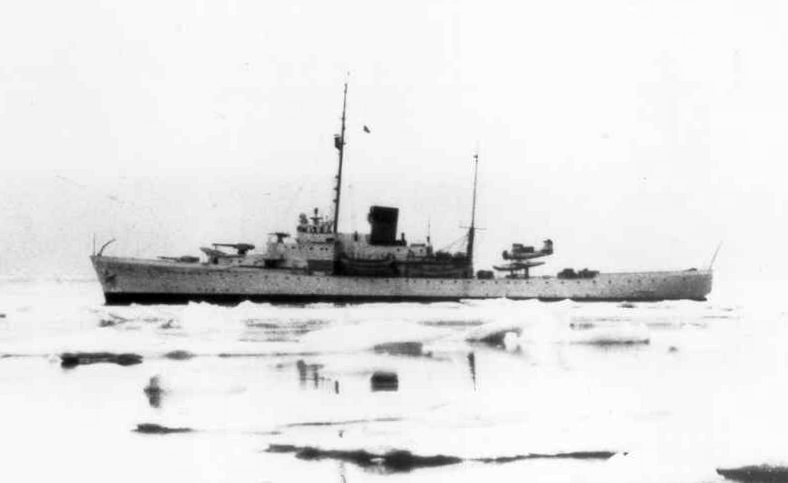
US Coast Guard Photo: The U.S. Coast Guard cutter USCGC Duane (WPG-33) in Greenland waters, circa 1940
The potential of the individual projectiles to penetrate and cause damage is reflected in the muzzle energy.
System Projectile Weight Muzzle velocity Muzzle energy
– (lbs and KG) (ft/sec and M/sec) MegaJoules
5″/51 50/23 3150/960 21.2
5″/38 55/25 2500/760 14.4
76mm Mk 75 14/6.3 3030/925 5.4
57mm Mk110 5.3/2.4 3400/1035 2.6
5″/62 Mk45mod4 70/31.75 2650/807.7 20.7
Here the oldest system is remarkable in that of all the systems considered, the 5″/51 had the highest muzzle energy. Only the 5″/62 Mk45 mod 4 is close.

USCGC Campbell (WPG-32) at the New York Navy Yard, in May 1940. USCG photo
Other Wartime Roles:
I have not been privy to war plans in a very long time, and as they say, plans seldom survive first contact with the enemy, but we have the experience of the past to draw on.
In the 67 years since the end of World War II, I do not believe any cutter has fired at an air target in anger. In fact, I know of no occasion when US Navy surface ships have engaged air targets with medium caliber guns. There have been some occasions when Navy vessels and even cutters have engaged surface targets with guns, but by far the most common use has been Naval Gun Fire Support (NGFS), now referred to by the more generic term Naval Surface Fire Support (NSFS). Cutters did it frequently in Vietnam, firing over 77,000 5″ rounds. The US Navy did it in the Korean War, Vietnam, Operation Praying Mantis (1988), and the First Gulf War. It was done during the Second Gulf War by British and Australian ships. The USN was apparently doing NGFS as recently 2007 in Somalia.
Naval Surface Fire Support (NSFS)
The US Navy has an acknowledged shortfall in NSFS capability. The number of ships capable of performing NSFS has dropped precipitously. For those that remain NSFS is a secondary mission to Ballistic Missile Defense (ABMD), AAW, or ASW. If there is a major conflict, they are likely going to be called upon for other missions that will leave them out of position to do NSFS.
The Zumwalt class destroyer with its 155mm advanced gun system was to have been the primary NSFS platform and there were to have been 32 of them, but the program has been cut back to only three.
If the Offshore Patrol Cutters were equipped with a Mk45 5″ they could provide a increase in US naval NSFS capability out of all proportion to the small marginal increase in cost.
More about the Mk45 5″
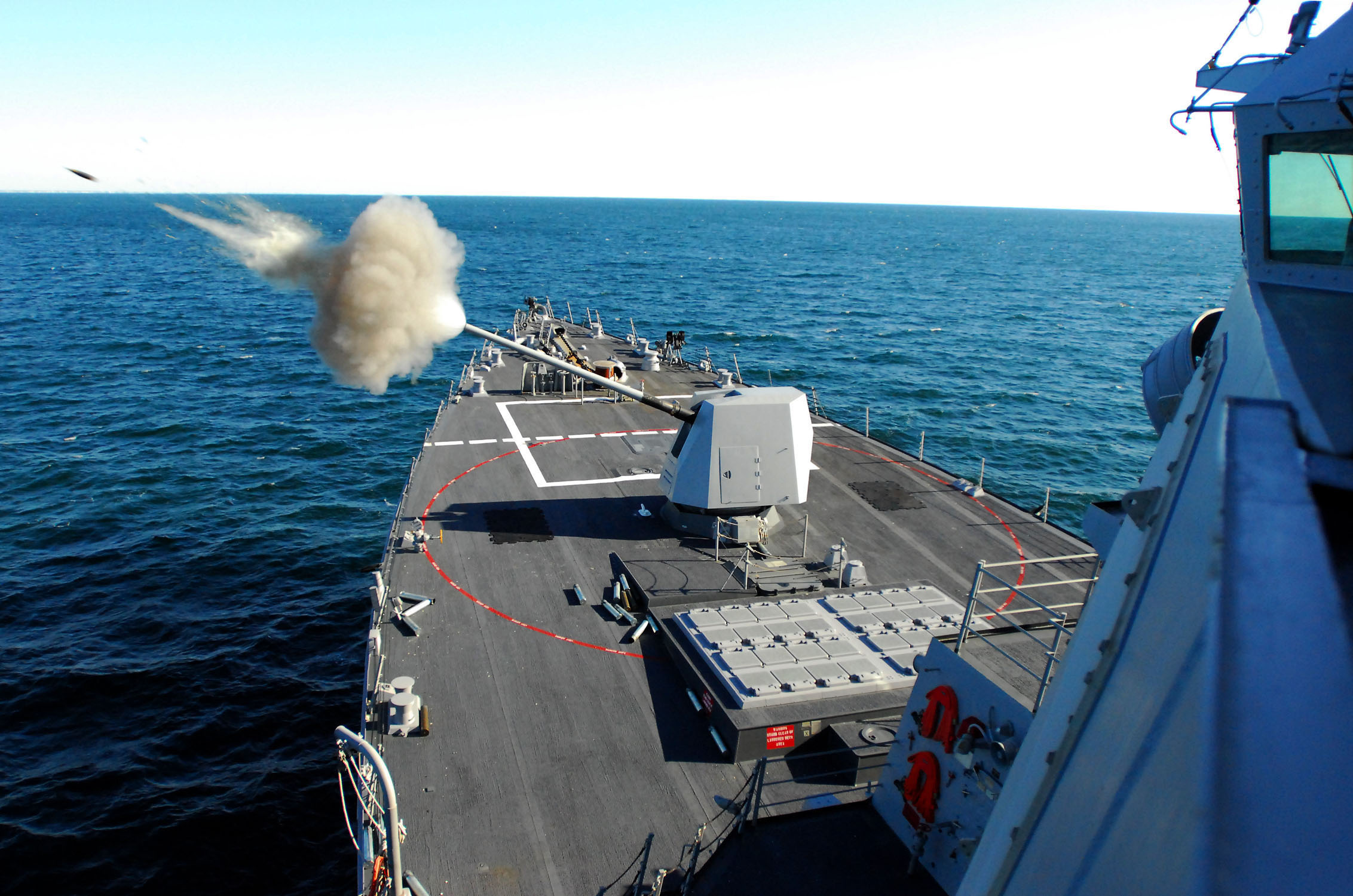
Photo: US Navy photo by Joshua Adam Nuzzo. USS Forrest Sherman (DDG 98) fires its five-inch gun.
The Mk 45 was originally designed as a direct replacement for the 5″/38 single mount. Destroyers the size of the OPC carried five 5′/38 mounts in addition to torpedoes and numerous 40 and 20 mm guns. Even in its latest version, the Mod 4, its 33 ton weight is not unreasonable for a ship the size of the OPC.
As the most numerous US naval gun a large variety of projectiles are available and there remains great potential for further development. The 5″ is effective against air targets, and special projectiles have been developed for dealing with small high speed surface targets. Add on GPS guidance can make them precision strike weapons in the NGFS role.
Conclusion:
In choosing the Mk110 57mm because it was seen as a better AAW weapon, a better anti-swarm weapon, as lighter, cheaper, easier to maintain or man, for whatever reason, the Coast Guard will have a weapon that is at best only marginally more capable, perhaps even less capable, of performing the most likely missions–stopping/sinking a surface target or performing NSFS–than the weapons of 60 to 90 years ago.
While the size, toughness, and survivability of merchant ships has increased dramatically, the Coast Guard has not provided its ships with a significantly improved capability to stop or sink a ship since the introduction of the 5″/51 in 1921. I still think the Coast Guard should add a light weight anti-surface vessel torpedo to its inventory as the cheapest way to have a truly effective ship stopper that can be made widely available. But until such a weapon becomes available, the Mk45 5″ is the best alternative available.
The 5″ Mk45 is a versatile weapon. Equipping the OPCs with this weapon make the ships more capable of performing both the PWCS and probable wartime mission and significantly enhances the NSFS capability of US Naval forces in a major conflict.

USCGC Cook Inlet (WHEC-384), USCG photo

USCGC Duane (WHEC-33) steaming home after completing her tour of duty in Vietnam, 1968. USCG photo


5″/38 fired from a Coast Guard 311 ft WHEC
The Army has issued a document, US Army Weapon Systems Handbook 2013, (a 388 page pdf) outlining their various programs (not all of which are actually weapons). Apparently it is intended to support their budget requests, in that contractors and states where work will be done, are highlighted. I’ve added it to the reference page.
It is potentially interesting for two reasons. It shows how the Army is attempting to sell their programs, and it also provide some food for thought in terms of where the Coast Guard might ride the coat tails of Army procurement programs (programs like small arms training systems, UAVs, ISR systems, and aircraft).
Interestingly, their new Light utility helicopter, the UH-72A Lakota, “to be deployed only to non-combat, non-hostile enronments” includes “USCG communications” and “UHF/VHF communications” as “major dependencies.” They are well on their way to procuring over 300 of them. 100 helicopters, assigned to National Guard units, will be fielded across the continental US, Puerto Rico, and Hawaii, to provided Homeland Security patrols and drug enforcement support. These aircraft are a bit smaller than the H-65s, they use twin engines from the same family, are a bit slower, but have more useful load, and what appears to be a larger cabin. Sounds like they ought to be able to land on cutters if you could convince the pilots.
(p. 210)
For those interested, there is a brief outline of Army organization on page 345.
Blomberg is running a story about “non-profits” and the focus is on the American Bureau of Shipping, but it also suggest a too cozy relationship with the Coast Guard.
“Since 1998, ABS has hired four former Coast Guard admirals as executives. They include retired Admiral Robert Kramek, who led the Coast Guard as commandant from 1994 to 1998. It was Kramek who signed an agreement with ABS in 1995 that expanded the nonprofit’s powers to inspect independently owned ships on the Coast Guard’s behalf.”
Evidence of lax standards is suggested, based on the sinking of a tanker and the subsequent environmental damage, after it had been cleared for operation by the ABS in spite of an unfavorable report by one of their own agents.
“Rare details of ABS’s operations emerged following a disaster on the high seas. On Nov. 19, 2002, an oil tanker that had passed a recent ABS inspection split in half during a storm in the Atlantic Ocean and sank. The nonprofit company had approved the 26-year-old single-hulled Prestige, registered in the Bahamas, in May 2002.
“The wreck of the Prestige, 130 miles (225 kilometers) off the coast of Spain, spread more than 50,000 tons of fuel oil along hundreds of miles of Spanish and French beaches and disrupted fishing and tourism, causing damage estimated at more than $1 billion by the Spanish government.
“The Kingdom of Spain sued ABS in U.S. District Court in New York in 2003, claiming the company had behaved recklessly. In a sworn statement in that case, former Prestige Captain Efstratios Kostazos said he informed the tanker owner and ABS that he was leaving the ship two months before it sank.
“During my almost 40 years of going to sea, I have never seen a vessel in this poor condition that was still in actual service,” he wrote.
“Former ABS surveyor John Lee said in a sworn statement that he had inspected the Prestige on Dec. 13, 2000, and had refused to certify it.
““I was shocked and horrified by the general level of deterioration and condition of the vessel,” he wrote. Lee wrote that ABS allowed the ship to go to sea, despite his objections.”
Its an interesting tale, read the whole thing.
Credit Tim Cloton’s Maritime Memos for bringing this to my attention.
It is the 70th anniversary of the first of a pair of pivotal naval battles in Guadalcanal Campaign that ended Japanese night time dominance of the disputed waters around the Solomons Islands chain. This not a Coast Guard story, but it is a story that was important to me. Growing up in Atlanta, I saw the beautiful builder’s model of the USS Atlanta, and read about the desperate battle in which she was lost. It fueled my interest in ships.
In 2009 I was fortunate enough to participate in a project on the US Naval Institute Blog, organized by the “Steeljaw Scribe” to commemorate the Solomons Island Campaign and wrote the sections on the two naval battles fought 12 to 15 November.
The Solomons Campaign: The Battle of Guadalcanal, Part 1
The Solomons Campaign: The Battle of Guadalcanal, Part 2
These may not have been Coast Guard stories, but I’m sure it was the men of NOB Cactus, including many Coasties, who were pulling the survivors out of the water and helping to fight fires when the fighting ended.
In Flanders fields the poppies blow
Between the crosses, row on row,
That mark our place; and in the sky
The larks, still bravely singing, fly
Scarce heard amid the guns below.
We are the Dead. Short days ago
We lived, felt dawn, saw sunset glow,
Loved and were loved, and now we lie,
In Flanders fields.
Take up our quarrel with the foe:
To you from failing hands we throw
The torch; be yours to hold it high.
If ye break faith with us who die
We shall not sleep, though poppies grow
In Flanders fields.
Time to recognize and celebrate the creation of another great military service and American institution, the US Marine Corps, whose members trace their origin to this day in 1775. Even before the Declaration of Independence, the Marine Corps had made their first landing on a hostile shore.
Defense Industry Daily reported:
The Center for American Progress and the Institute for Policy Studies, two left-wing American think tanks, are advocating the implementation of a unified security budget, and defense budget cuts at the scale, but not in the shape, of the sequester. PDF report.
The basic aim seems to be to consider “all the tools” of national security and make tradeoffs between them. The authors appears to assume that this would move funds from DOD to Dept of State, to bring “better balance.”
A possible advantage of such a scheme, from a Coast Guard prospective, might be an expectation that some funding might be shifted from the Navy to the Coast Guard, but there is no assurance, given the Navy’s powerful influence, that it would not actually go the opposite direction. An H-65 is pictured on the cover, but the Coast Guard is mentioned only twice in the 119 page document, and in neither case is it in the context of considering the impact of this proposal on the CG budget.
Certainly the budget process in Congress appears broken. Coast Guard leaders must testify before a confusing plethora of committees and sub-committees, apparently so frequently, it adversely impacts their ability to do their jobs.
There is some indication that viewing all aspects of security as a whole is gaining some traction:
The Budget Control Act divided its mandated spending cuts in FY 2012 into two categories: “security,” which included the Departments of Defense, International Affairs, Homeland Security, and Veterans Affairs accounts, and “non-security,” which included all other discretionary account categories. (p. 7)
But this distinction was subsequently replaced by wording that distinguished only DOD and other.
Does this proposal have a ghost of a chance? Will it help? I waited to see if President Obama would be reelected before posting this, because a Republican win would have made it even more unlikely. Efforts to trade off among DOD, DHS, and State could just be another layer of bureaucracy heaped on top of the existing dysfunctional morass, but perhaps as part of a comprehensive restructuring, it might be useful, but it seems unlikely we will see a significant change.
The name I recognized in the group that made this proposal, and one of the two principle authors, was Lawrence J. Korb, Senior Fellow, Center for American Progress.
“Lawrence J. Korb is a Senior Fellow at the Center for American Progress, a nonpartisan progressive think tank based in Washington, D.C. Prior to joining the Center, he was director of national security studies at the Council on Foreign Relations. Previously, Korb also served as director of the Center for Public Policy Education and senior fellow in the Foreign Policy Studies Program at the Brookings Institution. Korb served as Assistant Secretary of Defense (Manpower, Reserve Affairs, Installations, and Logistics) from 1981 through 1985. In that position, he administered about 70 percent of the defense budget. Korb served on active duty for four years as a naval flight officer, and retired from the Naval Reserve with the rank of Captain. He has written 20 books and more than 100 articles on national security issues.
He’s not quite at the top level, but he is respected and not without influence.
Fiercehomelandsecurity is reporting the results of a study points out the effects of an up to five meter rise in sea level on buildings in DC.
I don’t think anyone expects that in the near future, but seeing how much storm surge we had in New York as a result of Sandy (14 feet/4.3 meters), I don’t think we can assume we will never see a surge close to five meters.
Even though 5 meters exceeds the likely amount of sea-level rise for the next 100 years, the study (.pdf) says that level could be reached during storms. Affected buildings would include the FBI, the Internal Revenue Service, the Justice Department, the Federal Trade Commission and the Education Department.
No federal buildings would be in the flooded area if sea levels were to rise 2.5-meters, the next lowest amount the study considered. Current predictions of the city’s sea-level rise, a result of climate change, range from 0.2 meters to more than 2 meters in the next 100 years, says the University of Maryland team behind the study.
Looking at my Google maps, it appears the land around Buzzard’s Point is two to three meters. Perhaps it is fortunate that the Coast Guard Headquarters is being moved to higher ground.
Relocation is expected to begin August, 2013. You can see more information about the new headquarters here.
 Chuck Hill's CG Blog