U.S. Coast Guard participates in Exercise Argus 2023

The USCGC Sycamore (WLB 209) crew participates in a navigation exercise with HDMS Knud Rasmussen (P570), a Royal Danish Navy Knud Rasmussen-class patrol vessel and the FNS Fulmar (P740), a French Navy patrol vessel, off the coast of Southern Greenland, June 13, 2023. Deployed forces demonstrated U.S. Coast Guard capabilities to build partner capacity and expertise in search and rescue, navigation, and damage control. These efforts solidify key strategic relationships while achieving mutual Danish, Greenlandic, and U.S. goals in the North American Atlantic Arctic and Northwest Atlantic Ocean. (U.S. Coast Guard photo by Lt. Cmdr. Katherine Blue)

Just passing along this very nice photo and caption from the Defense Visual Information Distribution Service (DVIDS). I have added links to describe the vessels involved.

“US Coast Guard Ready to Move New Anti-SASH Policy” (SASH=Sexual Assault Sexual Harassment) –Marine Link

Marine Link reports,

In May, the U.S. Coast Guard will start a strengthened and pointedly direct anti-SASH campaign that will extend across the maritime industry. SASH is an acronym for sexual assault/sexual harassment, and this new effort adds muscle to Marine Safety Information Bulletin (MSIB Number: 1-23) “Reporting Sexual Misconduct on U.S. Vessels” released in February. The new bulletin supersedes a previous one from late 2021.

I don’t normally report on Marine Safety topics. Never really had any experience in that area, but this could affect every boarding officer.

“Support Pay Parity for our Coast Guard servicemembers!” –Navy League

USCGC Northland (WMEC 904) approaches the pier, March 30, 2023 in Portsmouth, Virginia. Northland conducted a 62-day maritime safety and security deployment in the Florida Straits and Windward Passage while patrolling in support of Homeland Security Task Force – Southeast and Operation Vigilant Sentry. (U.S. Coast Guard video by Senior Chief Petty Officer Melissa Leake)

Just passing this along. Remember what happened last time we had a delay in approval of an increase in the debt ceiling?


Hello everyone,

Please take a moment to join our Rapid Response email campaign in support of Congresswoman Scholten’s “Pay Our Coast Guard Parity Act of 2023”.

The Coast Guard is vital to America’s national and economic security, yet they are not covered by the same paycheck protections as other members of the armed forces. With the very real possibility of a government shutdown in the near future, it is imperative that we provide the men and women of the Coast Guard with the financial security that they and their families have earned!

Please use the link below to learn more about this issue and to send a letter directly to your Members of Congress by just clicking send! Let’s get to work!

Thank you,

Luke Lorenz, Senior Director, Legislative Affairs, Navy League of the United States

“U.S. to Increase International Coordination, Presence in Strait of Hormuz” –NAVCENT

A U.S. Navy L3 Harris Arabian Fox MAST-13 drone boat and the U.S. Coast Guard cutters USCGC John Scheuerman and USCGC Charles Moulthrope transit the Strait of Hormuz on Wednesday, April 19, 2023. (Information Systems Technician 1st Class Vincent Aguirre/U.S. Coast Guard)

Below the break, I have reproduced a U.S. Naval Forces Central Command (NAVCENT) news release

Meanwhile, Defense One reports the remarks of a Pentagon spokesman on the subject,

In the meantime, Ryder said, the U.S. military will be increasing the “rotation of in-theater assets patrolling the Strait of Hormuz with the intent of bolstering our vigilance and our presence at this location.” Those assets include “manned and unmanned aerial platforms, as well as surface naval vessels from the Navy, [and] the Coast Guard, to help enhance our maritime surveillance.”

Would love to know the rules of engage for both NAVCENT and Islamic Revolutionary Guard Corps Navy. Move, counter-move, counter-counter-move.

PATFORSWA is sure to be front and center.


NEWS | May 12, 2023

U.S. to Increase International Coordination, Presence in Strait of Hormuz

By U.S. Naval Forces Central Command Public Affairs

U.S. 5th Fleet is working with regional allies and partners to increase the rotation of ships and aircraft patrolling in and around the Strait of Hormuz following Iran’s recent unlawful merchant vessel seizures.

The increased force presence supports multinational efforts to deter threats to commercial shipping and reassure regional mariners. In addition to heightened patrols, U.S. 5th Fleet is bolstering international maritime security collaboration among the International Maritime Security Construct and European Maritime Awareness in the Strait of Hormuz.

“Iran’s unwarranted, irresponsible and unlawful seizure and harassment of merchant vessels must stop,” said Vice Adm. Brad Cooper, commander of U.S. Naval Forces Central Command, U.S. 5th Fleet and Combined Maritime Forces. “U.S. 5th Fleet and our partners are committed to protecting navigational rights in these critical waters.”

Iran has harassed, attacked or interfered with the navigational rights of 15 internationally flagged merchant vessels over the past two years. This pattern of destabilizing behavior is contrary to international law and disruptive to regional security.

“IMDEX Asia 2023” –Naval News

Below are four videos produced by Naval News, reporting aspects of the IMDEX Asia 2023 Trade Show, some of which included paid sponsorship. 

I have also reproduced the commentary that accompanied each video where it was posted on YouTube.

Day 1 at IMDEX Asia 2023. In this video, we focused on the MRCV (multi-role combat vessel) program of the Republic of Singapore Navy (RSN).

We interviewed Saab, the prime contractor for the basic design phase, ST Engineering, prime contractor for the detailed design, and Thales who will provide multi-function radars for the these vessels. The RSN shared an animated video with us which we comment.

The design of the MRCVs incorporates the ’mothership’ concept, where a manned vessel is able to operate multiple unmanned systems to expand its surveillance and influence over a large area. The MRCVs will support the operations of unmanned drones and vessels, which will be key force multipliers for the RSN’s operations. It will be configurable to be fitted with modular mission modules so that it can conduct a wide range of missions from peace to war. In addition, we will incorporate automation and data analytics into our combat and platform systems to enhance situational awareness, accelerate decision-making, and improve efficiencies in logistics and engineering support.

The ’mothership’ concept is a natural progression from the RSN’s unmanned journey since the early-2000s. We incorporated the lessons learnt from past shipbuilding projects, including the locally designed littoral mission vessels. We also leveraged technology, such as 3D modelling and detailed model testing, to test and evaluate the design. At the same time, our RSN operators and engineers work closely with the Defence Science and Technology Agency (DSTA) engineers during the design stage to ensure that operational, logistics and maintenance requirements are properly incorporated.

Day 2 at IMDEX Asia 2023 in Singapore. In this video, we discuss the Mine Counter Measure (MCM) vessel built by German shipyard Abeking & Rasmussen for the Indonesian Navy (TNI AL). We also meet with Kraken of Canada to find out more about their KATFISH High-Speed Towed Synthetic Aperture Sonar system. Last but not least, we learn all the details about the MU90 lightweight torpedo (and a key future feature: hard kill counter-torpedo) with Eurotorp.

  • 00:36 – Abeking & Rasmussen MCM Vessel and USVs
  • 03:21 – Kraken’s KATFISH High-Speed Towed Synthetic Aperture Sonar system
  • 05:43 – Eurotorp’s MU90 LWT torpedo
  • 01:03 – BARAK MX Integrated Air & Missile Defense System
  • 01:40 – Gunnery solution / weapon control computer
  • 02:02 – MF-STAR digital AESA radar
  • 02:53 – LAHAT advanced lightweight laser homing missile
  • 03:10 – LORA Long Range Artillery Precision Strike Tactical Missile
  • 03:41 – Mini HARPY Multi-Purpose Tactical Loitering Munition
  • 04:57 – VTOL UAV
  • 05:18 – Containerized solution

At IMDEX Asia 2023, Rafael Advanced Defense Systems highlighted for the first time the IRON BEAM’s naval application and unveiled the new C-DOME Mission Module. =====================

Rafael’s NAVAL IRON BEAM is designed to quickly and effectively engage and neutralize a variety of threats, including short-range ballistic rockets, drones and UAVs of various sizes. Like its land-based variant, the naval application can be integrated into an existing air defense system such as the IRON DOME, thus constituting a complementary, cost-effective defense solution, in addition to the kinetic air defense capability. The company also showcased its newest configuration of the naval application of IRON DOME, known as the C-DOME Mission Module. With C-DOME already tested and operational in the Israeli Navy, RAFAEL has developed the C-DOME Mission Module concept for local defense applications, providing advanced solutions for OPVs, auxiliary ships, and other naval support ships and assets, enabling them with advanced air defense capabilities, without the need for deck penetration, vessel hull retrofit or complex platform integration.


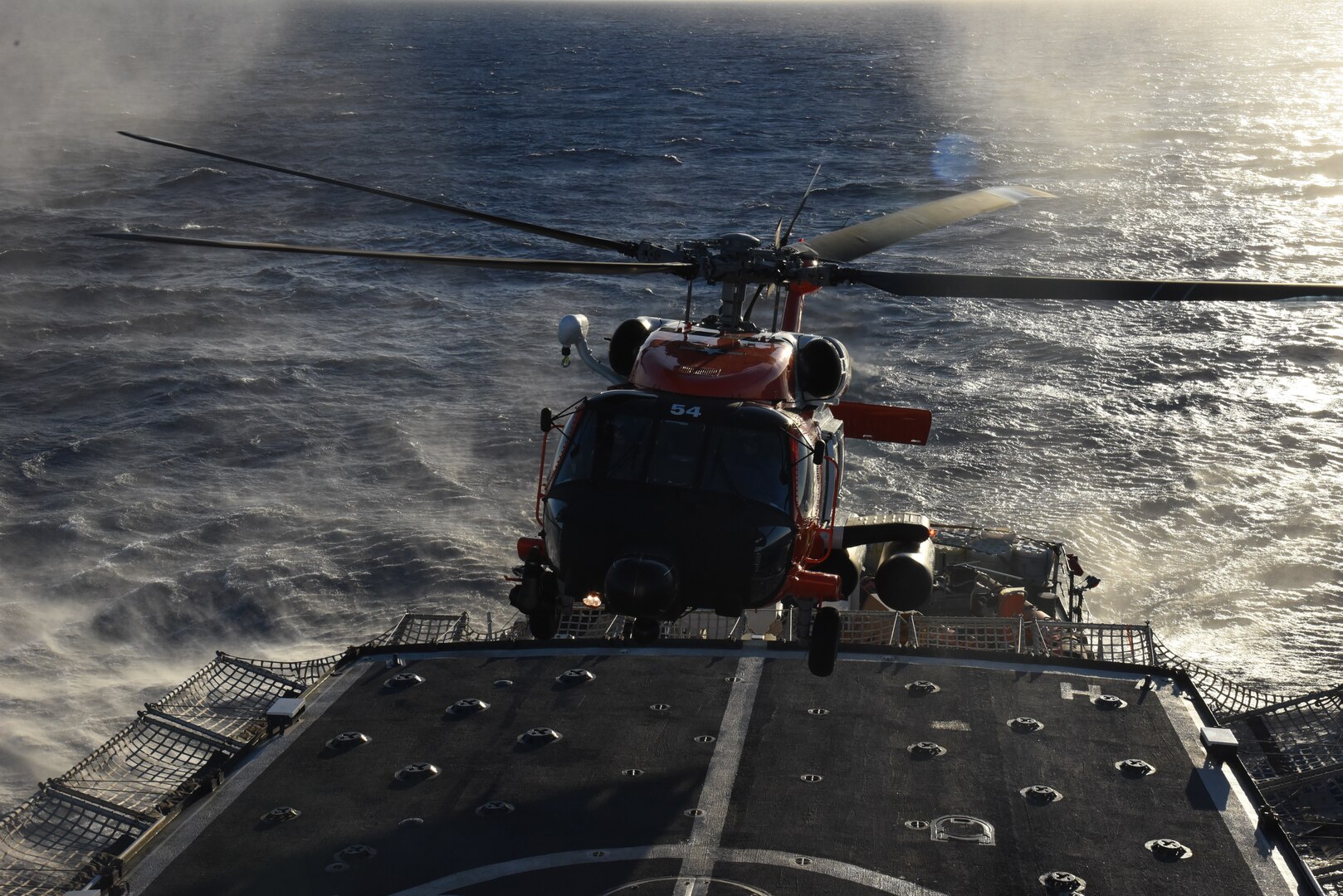
MH-60 on WMECs?

The photo above accompanied the press release reproduced below. There is no caption or credit attached to the photo (I hate that). There is no mention of flight ops in the news release. The helicopter may not actually be landing, but that’s what it looks like. This may have just been a training flight with no aviation detachment embarked. The 270s were designed to operate H-60 size helicopters, but it has been very rare. As the service moves to a homogeneous rotary wing fleet of all MH-60s, it should become common.

Doesn’t look like the 210s could operate H-60s at all. That is a mighty small flight deck. My understanding is that the first four 270s had a design flaw that meant that while an H-60 could land on the ships, they could not traverse the deck and be hangared. That means only ten of the 27 currently commissioned WMECs (Haley, 13 x 270s, 13 x 210s) will be able to operate MH-60s. (I assume Haley has the capability.)

The other 17 ships are not going to be replaced anytime soon. Unless they are decommissioned without replacement, it looks like the last 210 will not go out of service until 2031 (at least 62 years old at that point); the four earliest 270s not before 2033 (at least 49 years old); and the last WMEC not until 2038 (Really looks like 2039 to me).

If the Coast Guard wants to continue operating helicopters from these less capable ships, they may have to keep at least a few H-65s for another ten years. The CG has put a lot of money and effort into upgrading these aircraft, reportedly increasing their service life by 10,000 hours. That is a lot of hours. The conversions to MH-65E are not even completed yet. As of 27 April, 2023, 63 of 98 have been completed. It looks like enough MH-65s could be maintained to support the WMECs that cannot support the MH-60 until they are decommissioned, but the service may choose not to do so.

We are seeing a lot of 210s and even 270s operated without an embarked helicopter, particularly while operating in the Caribbean where fixed wing support is readily available and where the flight decks are often used as a holding area for migrants.

There is also the possibility that the ships would be better served by replacing the helicopter with an Unmanned Air System. At least in terms of search capability, a UAS is probably a better choice, but we haven’t seen a UAS capable of HITRON’s airborne use of force/armed overwatch function so essential for the drug interdiction mission.


May 11, 2023

USCGC Thetis returns home following 66-day multi-mission Caribbean Sea patrol

KEY WEST, Fla. – The crew of the USCGC Thetis (WMEC 910) returned to their home port in Key West, Thursday, following a 66-day patrol in the Florida Straits and Caribbean Sea.  

Thetis’ crew contributed to the interdiction, care and repatriation of 125 migrants from Haiti and Cuba while patrolling the Seventh Coast Guard District’s area of responsibility in support of Operation Vigilant Sentry and Homeland Security Taskforce — Southeast.

During the patrol, Thetis’ crew rescued 31 Cuban migrants from an overcrowded, adrift and homemade vessel in the South Florida Straits. The boarding team safely embarked the migrants aboard Thetis, where Petty Officer 1st Class William Ice, a health services technician assigned to Thetis, provided a lifesaving emergency procedure for one of the migrants. During another case, Thetis watch standers spotted a Haitian sailboat in distress and provided rescue assistance to the 13 Haitians.

Additionally, working with Bahamian Customs Department, Thetis safely returned 54 Haitian migrants to their point of departure in the Bahamas after their overcrowded and unseaworthy vessel was intercepted in transit to West Palm Beach, Florida.

“I am so proud of the crew’s hard work and professionalism this patrol,” said Cmdr. Gavin Garcia, commanding officer of Thetis. “It takes a great deal of teamwork within the ship as well as coordination with other organizations to meet the demands of two of the Coast Guard’s main missions in the South Florida Straits: search and rescue and maritime law enforcement.”

Thetis is a 270-foot Famous-class medium endurance cutter. The cutter’s primary missions are counter-narcotics operations, migrant interdiction, living marine resources protection, and search and rescue in support of U.S. Coast Guard operations throughout the Western Hemisphere.

“Part-Time Service Could Be the Future of the Coast Guard, Commandant Says” –Military.com

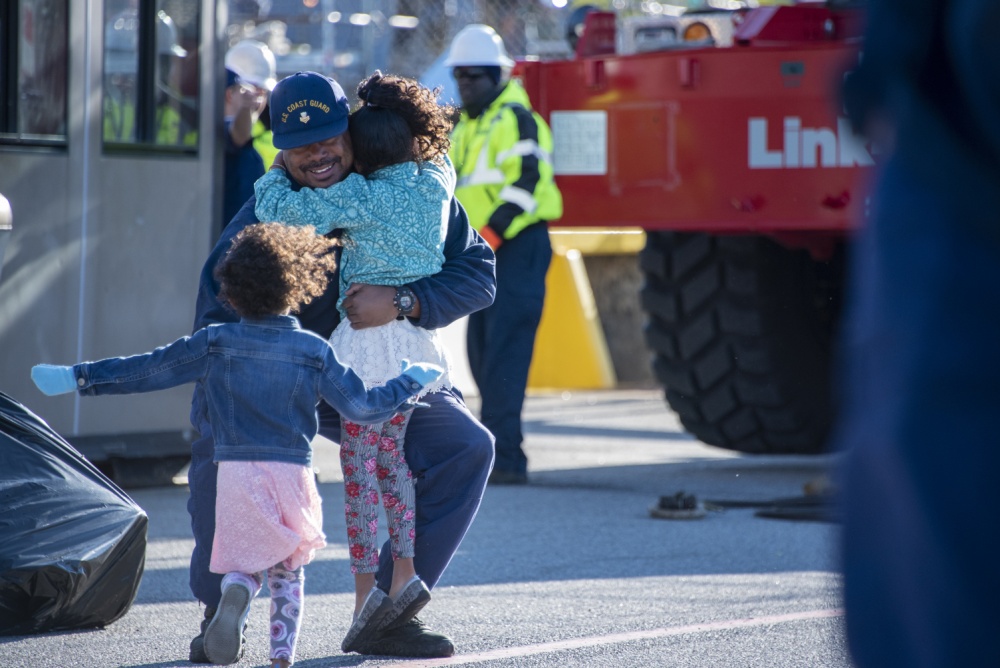
A Coast Guard Cutter Valiant crew member embraces his family Feb. 27, 2020, as he returns home to Naval Station Mayport, Florida. The Valiant crew returned home after completing a nine-week patrol in the Caribbean Sea supporting Joint Interagency Task Force South. (U.S. Coast Guard photo by Petty Officer 2nd Class Ryan Dickinson)

Military.com reports,

Commandant Adm. Linda Fagan has instructed her workforce management team to consider creative options such as a part-time active-duty employment track, or lateral entry and revolving door policies, to draw new personnel.

The Commandant seems to be willing to reimagine the personnel system. Does seem likely that shorter periods of commitment and guaranteed geographic stability in a station of choice could bring more people in.

Sounds like we might be headed for a kind of military reserve/civilian hybrid.

Something we might think about is a professional mariner that can sign on for a voyage and is off entirely when it is completed. It works for Military Sealift Command, but rather than civilians, they might be Reservists. Probably would require a lot higher sea pay.

Thanks to Blake for bringing this to my attention. Blake tells me, “Turns out she already has the authority to do this using the Temporary Reserve program that has laid dormant in federal law since ww2.”

“U.S. Coast Guard Cutter Stratton visits Yokosuka” –News Release

An earlier Western Pacific Deployment. U.S. Coast Guard Cutter Stratton (WMSL 752) participates in a exercise with the Australian maritime surveillance aircraft in the South Pacific Ocean, Feb. 23, 2022. The Stratton is currently underway conducting exercises and operations with partner nations in the South Pacific region. (U.S. Coast Guard photo by U.S. Marine Corps Sgt. Sarah Stegall)

Passing along this news release. You might want to check out the original. They have more photos. The officer seen in two of the photos in fatigues is Air Force three star Lt. General Ricky Rupp, Commander of United States Forces Japan and Fifth Air Force.

May 10, 2023

U.S. Coast Guard Cutter Stratton visits Yokosuka

Editor’s Note: To view more U.S. Coast Guard Indo-Pacific imagery, click here.

YOKOSUKA, Japan – U.S. Coast Guard Cutter Stratton (WMSL 752) departed Yokosuka, May 3, following a scheduled port visit while deployed to the Indo-Pacific.

Stratton is deployed in the Indo-Pacific to engage with ally and partner nations and to promote a free and open Indo-Pacific.

“Deploying U.S. Coast Guard assets to the Indo-Pacific promotes security, safety, sovereignty, and economic prosperity in the region while strengthening relationships between the U.S. and partner nations,” said Capt. Brian Krautler, Stratton’s commanding officer. “The crew was excited to experience the wonderful culture and hospitality of Japan.”

Yokosuka is Stratton’s third port visit since departing its homeport of Alameda, California.

The Stratton crew is conducting exercises in the region to share best practices and expertise in search-and-rescue and law enforcement. U.S. Coast Guard and U.S. Navy forward-deployed forces remain ready to respond to crises globally as a combined maritime force.

Stratton is a 418-foot national security cutter capable of extended, worldwide deployment in support of homeland security and defense missions. National security cutters routinely conduct operations throughout the Pacific, where their unmatched combination of range, speed, and ability to operate in extreme weather provides the mission flexibility necessary for the greater U.S. Coast Guard to serve as a unique strategic contributor in the region.

The namesake of the Stratton is Capt. Dorothy Stratton, who led the service’s all-female reserve force during World War II. She was the first female commissioned officer in the Coast Guard and commanded more than 10,000 personnel. The ship’s motto is “We can’t afford not to.”

Stratton is operating as part of Commander, Task Force (CTF) 71, U.S. 7th Fleet’s principal surface force. CTF 71 is responsible for the readiness, tactical and administrative responsibilities for forward-deployed Arleigh Burke-class guided-missile destroyers as well as any surface unit conducting independent operations in the region.

U.S. 7th Fleet is the U.S. Navy’s largest forward-deployed numbered fleet, and routinely interacts and operates with allies and partners in preserving a free and open Indo-Pacific region.

U.S. Coast Guard Pacific Area is responsible for U. S. Coast Guard operations spanning across six of the seven continents, 71 countries and more than 74 million square miles of ocean. It reaches from the shores of the West Coast of the United States to the Indo-Pacific, Eastern Pacific, Arctic and Antarctic. Pacific Area strives to integrate capabilities with partners to ensure collaboration and unity of effort throughout the Pacific.

“New Danish 64m Patrol Vessel Nordsøen optimised, built and delivered with Hull Vane®” –News Release

Below is a news release from the makers of Hull Vane. I, of course, have no direct knowledge of how well this works or what unmentioned disadvantages there may be, but it does look like this is no longer theory. There have been years of experience with these by sophisticated end users. I have been tracking this for a while (see below) and have hoped the US Coast Guard would investigate its application. The cost saving appears substantial. If it has been looked into, and found disadvantageous, please let me know.


Danish 64m Patrol Vessel Nordsøen optimised, built and delivered with Hull Vane®

May 9, 2023 

Quiet, efficient, comfortable

Last summer was a hectic time at Hvide Sande Shipyard, based on Denmark’s West Coast. July and August were filled with sea trials, finishing touches and commissioning of systems of the newbuild Nordsøen. Hvide Sande Shipyard won the public tender to build the vessel in late 2020. On August 24, 2022, the ship was named and handed over to her owner. It is the first Offshore Patrol Vessel which combines azimuthing propulsion pods with a Hull Vane® behind the transom.
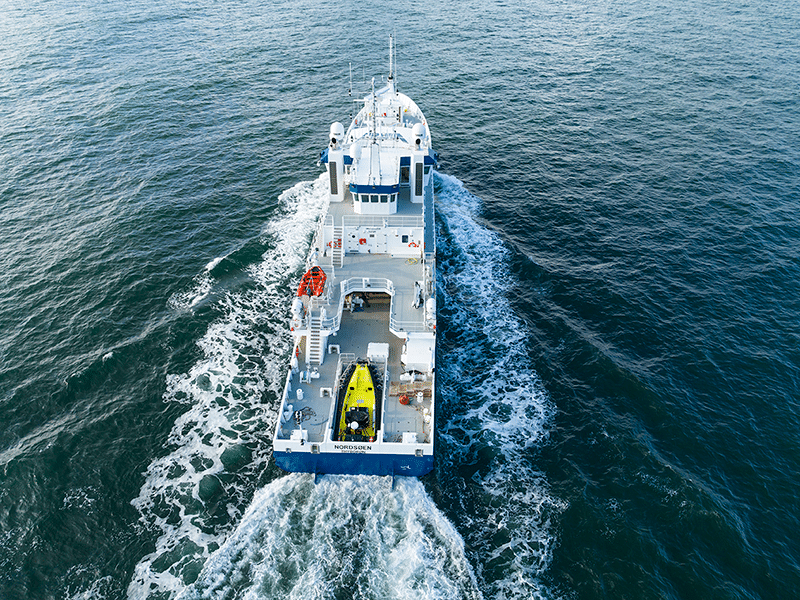
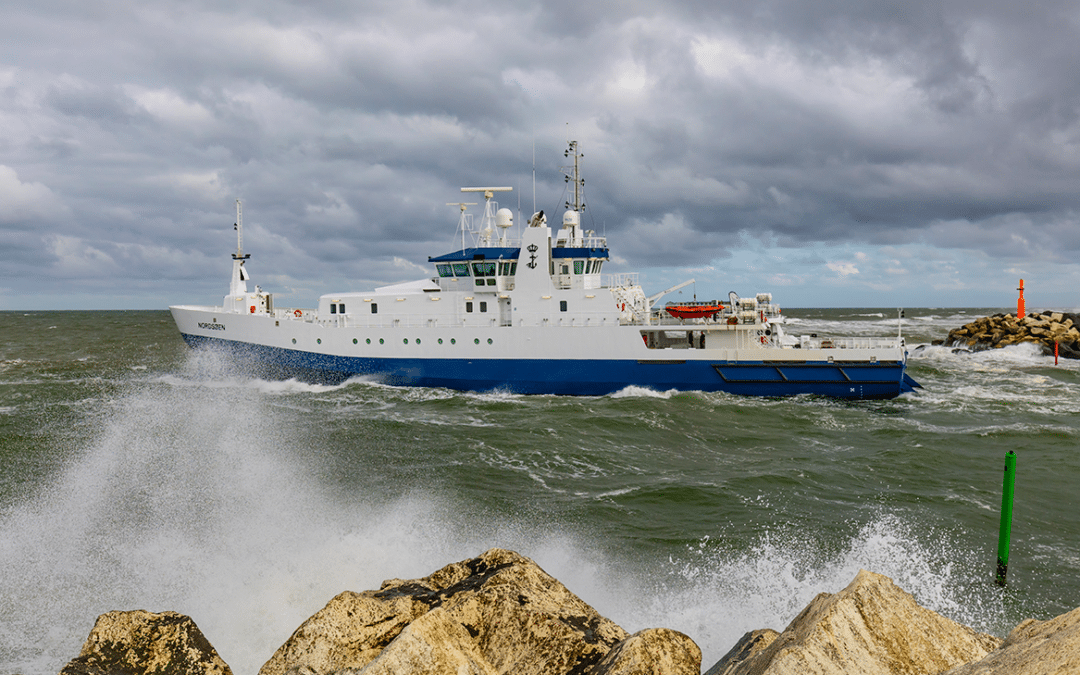
Regardless of the speed, Nordsøen sails almost wakeless, thanks to the Hull Vane®  (Photo credit: Thorbjørn Sund)

12 to 17% less CO2 emissions
Given that the public tender awarded a lot of points on low lifecycle costs and energy efficiency, Hvide Sande Shipyards contacted Hull Vane BV during the concept design stage. Due to her length, displacement and speed range (10-18 knots), it was quickly determined that Hull Vane® would provide great benefits, which was later confirmed with CFD computations with and without Hull Vane®. The resistance reduction from the Hull Vane® amounts to 12% at 10 knots, 17% at 14 knots and 14% at 18 knots.
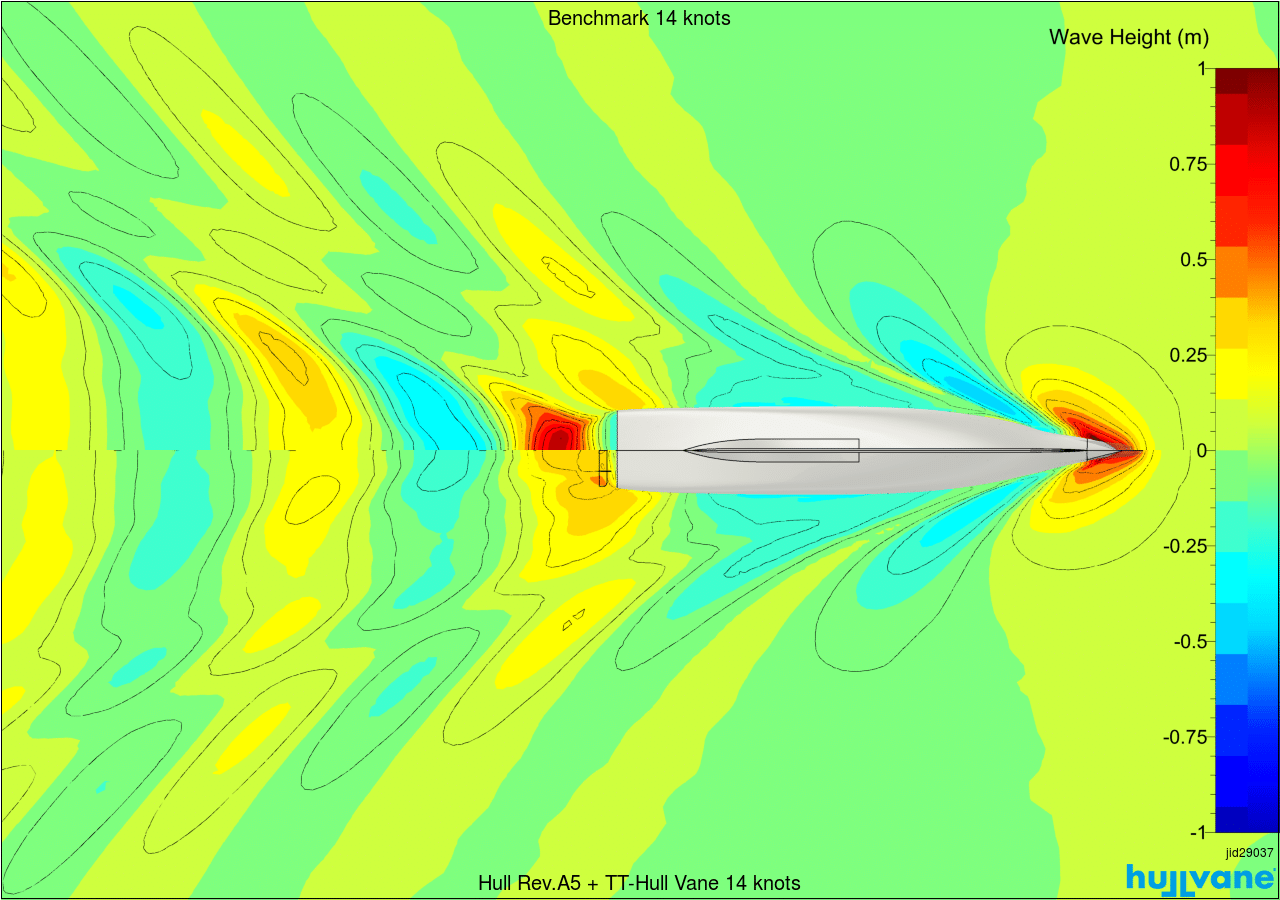
Wave profile without (top halve) and with Hull Vane® (bottom halve) at 14 knots.

Diesel Electric pod drives
Bruno Bouckaert, sales director of Hull Vane BV: “The project was atypical, in the sense that from the first conversation about Hull Vane® up to its installation, everything was done through online meetings, as we were in full Covid lockdown-times. That said, the project couldn’t have run smoother. There are some interesting firsts for Hull Vane®: Nordsøen is the first ship where Hull Vane® is installed on a ship with azimuthing propulsion drives. The combination works perfectly, and in fact, because of the Hull Vane®, the pods have to do less steering corrections in bow- or stern-quartering seas, which also improves their efficiency and reduces the noise level.
Another first is the stern ramp system. On Nordsøen, the stern ramp is equipped with a slide-out system. All we had to do is make sure that the Hull Vane® was out of the path of this system. We see a benefit of such systems as it allows patrol vessels and naval ships with a stern ramp to be designed with an optimal hull shape, without a lot of transom immersion. Offshore Patrol Vessels sail a lot of time at moderate speeds (5-15 knots), and then it’s really beneficial to have not too much transom immersed”.

Quietly efficient
So what’s the verdict after the sea trials and several months of usage? All expectations have been met, and the vessel is said to be exceptionally quiet and efficient. The ship has never sailed without Hull Vane®, but it’s obvious that Nordsøen makes very few waves, a clear sign of her efficiency.

According to the operational profile published in the tender documents, the Hull Vane® on Nordsøen saves 317.000 liter of marine diesel fuel per year. That’s enough to drive all the way around the earth every other day with a normal diesel car. The CO2 emissions are reduced by 1.090 tons per year, at an off-the-charts low CO2 abatement cost of – 212 €/ton CO2 abated. The reduced resistance from the Hull Vane® allowed the shipyard to purchase smaller azimuthing pods and diesel-generator plant, a cost saving which exceeded the Hull Vane® cost and therefore reduced the total build cost. It may sound against the laws of quantum mechanics, but the Hull Vane® on Nordsøen actually has a negative payback period. The investment in the Hull Vane® was recovered before the ship even sailed her first nautical mile.
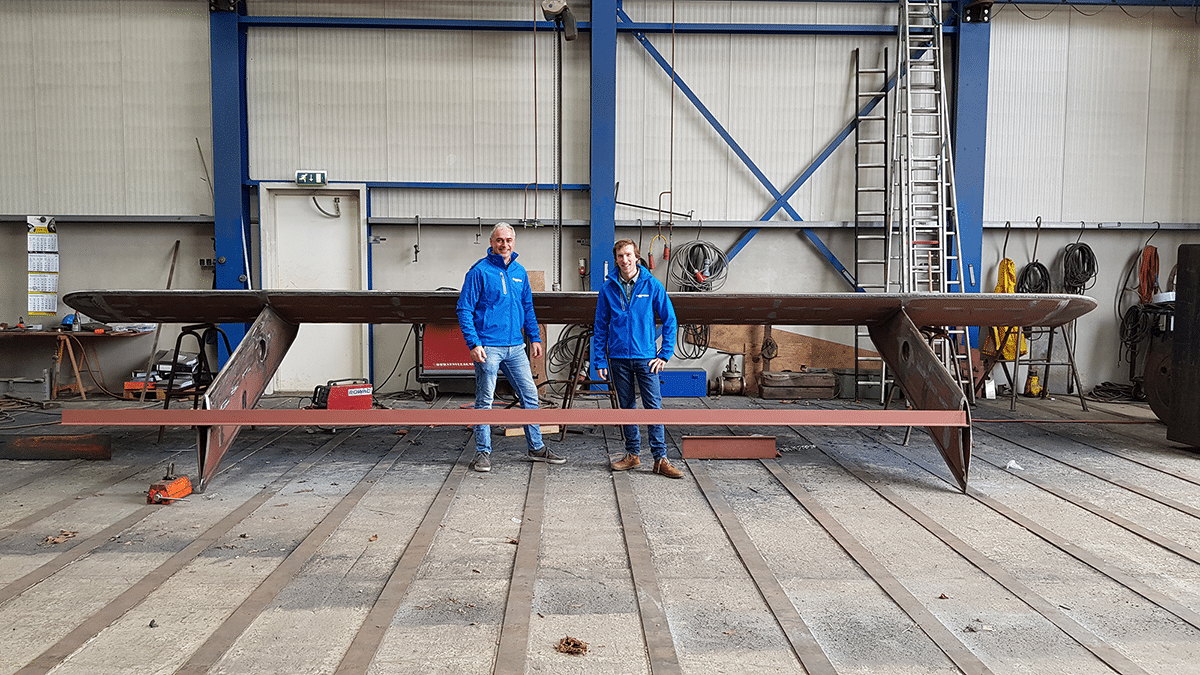
Hull Vane team on site visit during construction

Hull Vanes have now been installed on many patrol vessels operating in the Netherlands, France, Belgium, Denmark and Nigeria. On all these vessels, the reduction in fuel consumption from the Hull Vane® exceeds 10%. It’s a proven and very cost-effective solution for governments wishing to reduce the use of energy and CO2 emissions of their fleet, at a negative cost due to the energy savings. Whatever the fuel of the future will be, Hull Vane® makes the future energy transition easier and more affordable.
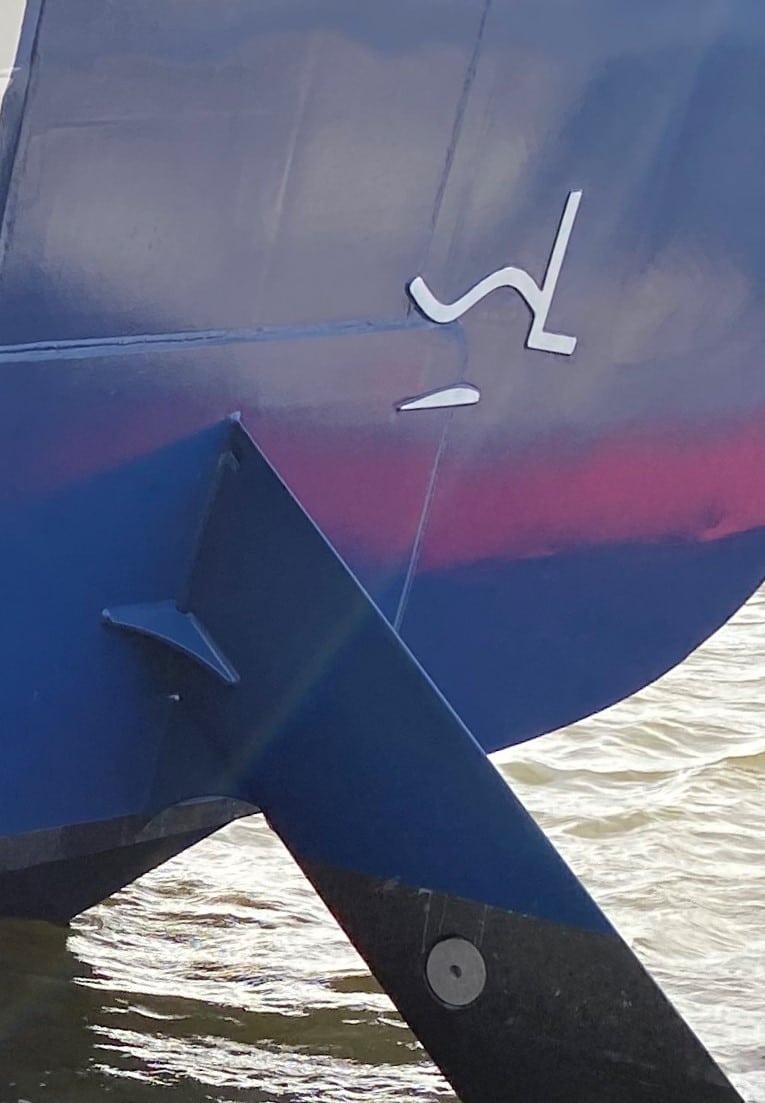
Hull Vane® marking on the transom